




Abstract
Over the past few decades, regions and regional institutions have gained increased attention in both scholarly literature and policy debates. A fundamental weakness in both debates, however, is the simplified focus on state actors and the official goals and policies of regional international organizations and inter-state frameworks. This article addresses this extant weakness by opening up for a more diverse empirical reality. By drawing on the new regionalism approach and two illustrative, comparative case studies from West Africa and East Africa, we offer new insights about how state and non-state actors interact in both formal and informal domains in order to produce variegated logics of regionalism that are poorly described by other theoretical perspectives. The article concludes by assessing the implications for theory and future research on regionalism in Africa and in other regions.
Keywords
Over the past few decades, regions and regional institutions have gained increased scholarly attention as important units of analysis and global “governors” with policy-relevant influence, respectively. This has generated a welcome body of literature under the broad banner of regionalism and, more recently, comparative regionalism. This article takes as its point of departure the observation that too much focus in this literature has been placed on issues of aspects of sovereignty transfer, political unification, and policymaking within inter-state frameworks and regional international organizations (RIOs). 1 The state-centric methodological bias in large parts of existing scholarship is strongly correlated with the tendency to focus on and explain variations from the case of Europe, especially formalistic and EU-style institutionalization—a phenomenon Amitav Acharya refers to as EU-centrism. 2 State-centrism and EU-centrism travel well together and often reinforce one another.
Nowhere is the problem of state-centrism and EU-centrism more profound than in the policy debate and scholarly literature on regionalism in Africa. Clearly, regionalism in Africa is often conceived too narrowly and through state-centric and EU-centric analytical lenses. As a result, policy prescriptions tend to be based on wishful thinking and on the official goals of RIOs instead of “really existing” regionalism whereby state and non-state actors interact in both formal and informal domains. More specifically, extant research focuses extensively on the African Union (AU), such as the Economic Community of West African States (ECOWAS), the Intergovernmental Authority on Development (IGAD), and the Southern African Development Community (SADC). An integral part of this view is that these and similar state-led RIOs are perceived as “weak” and “underdeveloped” because they often fail to deliver according to their official mandates. The dominant policy prescription is therefore to strengthen state capacity or the institutional capacities of these RIOs in order to improve their performance. These state-centric and RIO-centric policy prescriptions are usually oversimplified and out of context. Frequently they are even counterproductive, since they often misunderstand the underlying social logic—in particular, the relationships between state and non-state actors and the nature of formality and informality in the African context.
The case of Africa underlines the need to reconcile formal and state-centric (de jure, state-led, policy-driven, top-down) approaches with informal and non-state-centric (de facto, spontaneous, poly-centric, bottom-up) approaches to regionalism. Hence, formal and informal regionalism are tightly linked and shape each other, and by bringing them together within one single framework we get new insights to the dynamics of regionalism in Africa. In order to capture the interplay between the formal and informal, we draw on what has become established as the new regionalism approach (NRA). Whereas most other frameworks in the field (e.g., the African integration school, as well as realist, intergovernmental, and liberal-functionalist approaches) focus primarily on state actors and the official mandates and policies of RIOs, the NRA provides a different type of analysis regarding formality and informality and the often intense and symbiotic relationships between state and non-state actors.
After presenting the main tenets of the NRA and our perspective on how to overcome state-centrism, we provide two illustrative, comparative case studies on West Africa and East Africa, respectively. The two case studies will highlight the linkages between state/non-state actors and formal/informal dimensions of regionalism with regard to two crucial policy fields: economic development and the provision of security. After discussing our findings in the comparative context, we conclude the article by offering reflections on theory and future research on regionalism in Africa and other regions.
The new regionalism approach and the rethinking of state-centrism
Since around the late 1990s, the development of the NRA has spurred a fruitful debate about the various ways in which state, market, and civil society actors interact and come together in different “formal” and “informal” coalitions, networks, and modes of regional and multilevel governance. Viewed from the perspective of the NRA, analyses of regionalism become a rather different exercise compared to how regionalism is usually studied through most other state-centric and EU-centric approaches within the field of comparative regionalism. 3
Situating ourselves within the NRA, we contend that conventional state-centric ontological and epistemological solitudes need to be transcended. It is not sufficient to simply subsume “non-state actors” within a state-centric analysis. The contours of the agency of state and non-state actors need to be examined within one integrated framework. As correctly pointed out by Richard Gibb, the fundamental problem with state-centrism “has not been the focus on the state but the uncritical way the state has been contextualised and analysed.” 4 It is therefore necessary to transcend conventional conceptions of the unitary Westphalian state and “the territorial trap” of the nation-state inherent in much of conventional theory. The point is not to reject the nation-state or state actors, but rather to transcend the problem of methodological nationalism and state-centrism. Methodological nationalism takes the Westphalian nation-state as a given, and as the main unit of political allegiance in international relations, which has resulted in many superficial representations of spatial horizons and practices—not least in the Global South.
We posit that simply taking non-state actors into consideration remains problematic as long as the underlying analysis is state-centric and based on methodological nationalism. As the case studies in this article will illuminate, non-state actors have a significant influence on the contours of state-led and policy-led regionalism (e.g., entrepreneur networks on formal economic institutions and armed group networks on formal security institutions). Concomitantly, state actors insert themselves into regionalization driven by non-state actors (e.g., government agents participating in informal networks supporting illicit trade). These dynamics are of particular salience for agential constructivism (a new branch of social constructivism), for the NRA recognizes the agency of state and non-state actors alike—yet does not privilege one over the other. Agential constructivism seeks to operationalize the ideational, normative, and symbolic motivations of state and non-state actors while being careful to not overlook the material interests and structural constraints considered by such actors. 5
The underlying conceptual component of regionalism is the “region.” A region is a spatial identifier that may be drawn or conceptualized according to topographical features or geographical lines—or more arbitrarily with little heed to either. For the NRA and constructivists, a region can also exist as a reflection of a socially constructed conception of a demarcated area—with either blurred or relatively sharp spatial dimensions—based on shared social, performative, practical, or cognitive understandings. Hence, constructivists and new regionalists, in particular, view regions as socially constructed, imagined, and heterogeneous with unclear territorial margins. This approach is particularly relevant for the study of regionalism in the Global South, because it helps to transcend EU-centric conceptions of fixed regional boundaries as well as the exaggerated focus on the official mandates and policies of RIOs that still prevail in most other theories and perspectives of the field.
Before we turn to the empirical case studies that illustrate the interplay of state-centric and non-state-centric regionalism in West Africa and East Africa, it is pertinent to elaborate on the contextual rationale for these cases. Africa is complex, multi-dimensional, and home to several formal regionalist projects as well as myriad informal regionalization processes at various institutional levels (macro, meso, and micro). Though sharing some common facets, African regionalism differs in important respects from the European variant. The latter is not only held by many observers as the most advanced form of regionalism—in the liberal political and economic senses—but it is also a type of regionalism that is predominantly formal, policy-led, and legalistic, and at the same time believed to be less affected by the “dark sides” of regionalism associated with illicit networks as well as the divisive potential of identity politics. 6 Although the EU is home to a wide range of illicit networks and “Brexit” is only one of several examples of identity politics that counter the state-led regional projects, the overall (mis)perception of Europe as the epitome of regionalism persists.
While the notion of the Westphalian state assumes that it has total sovereignty and de jure control over its territory, in reality, African politics is strongly informalized, which deeply affects the logic of regionalism on the continent. Informal politics and neo-patrimonial networks are by no means unique to Africa but are perhaps a tad more pronounced there. In turn, the state-society nexus in Africa is more informalized compared to many other regions, allowing both state and non-state actors to engage in a wide variety of ways which are usually ignored by the state-centric approaches to regionalism.
The close interaction between formal and informal takes its particular form due to the sheer size of the informal sector and economy in Africa. In proportional terms, the size of Africa’s informal economy is the highest in the world, with some estimates suggesting it employs more than 66 percent of the continent’s urban workforce. 7 Large income disparities and an active dual economy have helped informal cross-border trade (both licit and illicit) contribute more to African economies than official intra-regional trade—despite commonly held views that free-trade areas and common external tariffs associated with formal, state-centric regionalism will transform Africa. 8 The result is that non-state actors operating in the informal sector—whether conscious of it or not, are crucial players in African regionalisms. Non-state actors, ranging from entrepreneurs to civil society organizations to armed groups, to name just a few, can influence state-centric regionalism “from below.” 9 Concomitantly, state actors are by no means shut out of non-state and informal regionalization processes, which other theoretical approaches limited to formal and state-centric dimensions of regionalism usually fail to account for.
Regionalism in West Africa
One of the overarching premises of state-centric approaches is that member-states are believed to benefit economically from formal policy coordination, for instance by reducing official barriers to trade. This type of formal and policy-driven trade integration is also believed to promote regional security based on the liberal assumption that states that are integrated trade partners are less likely to go to war with one another. Although these premises and assumptions underpin many RIOs in Africa, they have not necessarily produced tangible results. On the contrary, state-led and formal regional institutions created to facilitate regional integration have frequently contributed to political, economic, and security instability, which has raised doubts about institutional sustainability as well as the actual motivations of the leaders of member-states. Using the analytical prism of the NRA, the case study of West Africa illustrates the agency of both state and non-state actors as well as the overlaps and linkages between formal and informal regionalisms from economic and security perspectives.
Economic regionalism in West Africa
Despite recent offshore oil discoveries and relative mineral abundance, West African states continue to face economic difficulties. Though the region is home to several multi-purpose RIOs (e.g., l’Union Économique Monétaire Ouest-Africaine) as well as to a range of sub-regional and micro-regional entities and identities, ECOWAS is the most robust example of a formal state-centric economic integration project. Although ECOWAS purports to promote the free movement of goods and citizens from its member-states and to eventually establish a common currency, little progress on these fronts has been achieved in practice. ECOWAS as a formal economic regionalist project has also not delivered on the developmental promises of economic transformation envisioned by its advocates. In practice, informal regionalisms—led by non-state actors—have spurred economic activities with developmental impacts on the ground. While difficult to measure with precision, informal trade and economic growth accrue via cross-border flows of persons and goods across the region—which count the Atlantic Ocean and Central Africa as inflow conduits, and exploit Sahara Desert trade routes and interfaces—a dynamic that predates the colonial era. 10 Most of these flows have been constituted by agrarian traders, families, ethnic commercial networks, migrant labourers, and refugees. Although the size of these informal flows and their contribution to the West African economy is not included in official data, they are more valuable to the region’s actual economy than formal intra-regional trade. 11 These flows are based on networks that form conduits for primary commodities, food, labour, and local and imported consumer goods. 12 Agential factors that contribute to comparatively more informal trade include efforts by participants to bypass slow bureaucratic processes and relatively expensive permits and paperwork, and high transaction costs associated with customs and duties for inter-regional trade (e.g., bordering states from different regional economic organizations) as well as delays caused by poor infrastructure (e.g., dubious quality of roads, seaports, and some airports).
The desire to avoid the above-mentioned transaction costs strengthens the demand for the informality of “grey” and “black” markets. Some scholars have argued that the agency exerted by actors via informal networks undermines formal/official intra-African trade and supports “shadow regionalism” by encouraging rent-seeking activities and policy distortions by state officials. 13 For example, for decades, a significant portion of Sierra Leone’s diamond production has been smuggled out of the country through the Parrot’s Beak, an informal micro-region comprising the borders of Guinea, Sierra Leone, and Liberia. 14 Similarly, illegal imports of Nigerian petrol across the Nigeria-Bénin border account for an estimated 70–85 percent of Bénin’s national petrol consumption. 15 Rough diamonds and oil are among the more notable natural resources that have had a notorious legacy of not only supporting illicit economies but also providing the financial means for non-state armed groups (NSAGs) such as rebels (e.g., in Sierra Leone, Liberia, and Côte d’Ivoire) and anti-government militias (Nigeria) to jeopardize human security in West Africa, respectively.
Security regionalism in West Africa
In comparison to outcomes from state-driven regional economic integration, there has been somewhat greater success in state-led regional security efforts in West Africa. With the end of the Cold War and the subsequent failures of US peacekeeping efforts in Somalia and US diplomatic efforts in Angola in the early to mid 1990s, calls for “African solutions to African problems” finally gained traction in the context of regional peacekeeping. The ECOWAS Cease-Fire Monitoring Group (ECOMOG) intervention force was the first credible attempt at regional security in West Africa, albeit with its own share of controversies. ECOMOG’s intervention in the Liberian civil wars (e.g., 1990–1998) marked the first full-scale conflict resolution attempt by a sub-regional group in Africa. The start dates of other interventions led by ECOMOG include Sierra Leone (1997) and Guinea Bissau (1999). Although Nigeria has often been accused of leading these interventions as a means of improving its reputation internationally and distracting from a poor governance record domestically, these efforts did improve regional security and bolster the human security of civilians residing in these countries. Nevertheless, these three ECOMOG interventions were not conducted without valid critiques. In Liberia, ECOMOG troops were accused on pilfering various goods, including mining equipment, which led observers to informally refer to the acronym of the mission as “Every Car or Movable Object Gone.” In Sierra Leone, some ECOMOG troops were accused of “sobel” activities—soldiers by day; rebels by night—which included colluding with Revolutionary United Front (RUF) rebels in order to mutually benefit from the illicit extraction and trade of rough diamonds. In the Liberian and Sierra Leonean ECOMOG missions, state-centric regional efforts provided security while simultaneously enabling non-state-centric regional illicit economies to thrive.
In recent years, ECOMOG’s track record continues to be mixed. A recent ECOWAS-led military intervention is the ECOWAS Mission in The Gambia (ECOMIG), which began in January 2017 as a means of forcing president Yahya Jammeh to respect the results of the December 2016 elections and step down from office. Some 7,000 ECOMIG troops participated in the military intervention, which allowed Adama Barrow to take office following the country’s first democratic presidential election in twenty-two years. 16 Although it did not occur under the ECOMOG auspices of Section 21 or 22 of the ECOWAS Protocol Relating to the Mechanism for Conflict Prevention, Management, Resolution, Peacekeeping and Security (1999), ECOMIG was consistent with Section 25, which seeks to prevent “serious and massive violation of human rights and the rule of law.” Jammeh’s behaviour not only represented an example of an unconstitutional change of government (i.e., refusing to vacate the office of the presidency), but there were fears of violent reprisals against Barrow supporters by pro-Jammeh contingents of the government security forces—many of whom benefitted from the illicit networks that were protected by the Jammeh regime for roughly two decades. Important parts of the state apparatus—military, intelligence services, police, and the judiciary—thrived under Jammeh so long as they contributed to protecting the regime (rather than promoting the human security of Gambians). Although Barrow was re-elected after receiving roughly 53 percent of votes in the December 2021 presidential elections, there is pressure to prosecute members of the state apparatus who committed human rights abuses during the Jammeh regime. Widely considered a successful intervention, ECOMIG employed formal military means that paused—but did not remove—informal illicit networks (smuggling narcotics and other goods) in The Gambia. To put the formal-informal interface differently, since the illicit networks have merely become dormant rather than having disappeared—and with Jammeh residing in Equatorial Guinea and many of the aforementioned state officials residing across West Africa—there is the constant threat of a coup that would re-install Jammeh’s illiberal regime.
Since the intervention in The Gambia, ECOWAS has switched from military involvement to placing sanctions and suspensions in response to a spate of military coups spreading in the region. 17 From May 2021 to the time of writing, there have been four successful coups—one in Burkina Faso, one in Guinea, and two in Mali; as well as an additional failed attempt in Guinea Bissau. Fostered largely by growing public anger at government handling of longstanding violence by NSAGs, the coups have garnered public support, further illustrating the interplay between state and non-state actors in the region.
Traditionally, West African regional security has been state-centric and spearheaded by states. However, regional security dynamics involving the role of non-state actors such as domestic and foreign private military and security companies, and NSAGs, have gained increased attention. 18 Non-governmental and civil society organizations also play important roles in the provision of post-conflict humanitarian services. Arguably, NSAGs pose a greater threat to West African regional security than state actors. Militant attacks in northern Mali and Burkina Faso, claimed by al-Qaeda in the Islamic Maghreb (AQIM), have been associated with poor regional border security and the influx of small arms and light weapons after the fall of the Gaddafi regime in Libya. 19 West Africa’s borders are exploited by transnational terrorist groups as they control illicit trade networks to support and expand the scope of their operations, including the recruitment of youths in the region. The Boko Haram insurgency is an evocative example of how non-state-centric regional security concerns are particularly compelling in West Africa, as it began in Nigeria but has since engulfed three other countries around the Lake Chad Basin—Niger, Cameroon, and Chad. The Lake Chad Basin is a non-state-centric region with common identities and political economies that is also home to one of the largest humanitarian crises in Africa. State-centric regional security responses based on the mobilization of government military forces from countries in the Lake Chad Basin have created a counterterrorism security regime against Boko Haram through the Multinational Joint Task Force (MNJTF), authorized by the AU in 2015. Even with Boko Haram reportedly on its “back foot,” as claimed by the Nigerian government, the non-state armed group remains an asymmetrical regional threat. 20 Lack of centralized coordination and military professionalism, corruption that feeds illicit networks, and poor civilian relations have resulted in a mixed track-record for the MNJTF.
In short, state-centric regional security responses have their drawbacks—characteristics that are often glossed over by conventional accounts that implicitly cast the state as “legitimate” and non-state actors as “illegitimate.” For agential constructivists, this is problematic because it assumes that state actors have liberal ideational and material objectives and non-state actors have illiberal ideational and material objectives—which is often not the case in practice. Such binaries are also problematic as they assume that a discrete set of spots on a continuum and a snapshot in time can be applied to state and non-state actors for an indefinite period, thereby restricting the agency of these actors and perverting responses by the international community to address human security needs on the ground. To be sure, evidence from West Africa reinforces the observation that state and non-state actors are often intertwined, but they can also be in direct conflict as arbiters of order within and across national borders. Focusing on state-centric regional security responses alone not only leads to faulty assumptions, but also misses the nuances that explain why civilians might look to private security firms, NSAGs, and NGOs for the provision of personal security. This also helps to explain why state-centric regional security responses in West Africa are often checked by non-state-centric economic, political, and military networks across and within the region—phenomena that are also present in East Africa.
Regionalism in East Africa
The formal and informal aspects of regionalism are manifested in East Africa as well. In accordance with the previous section, our analysis focuses on the formal-informal intersections in two main issue areas of IGAD: economic development and security. The first part of the analysis finds that formal regionalization initiatives, by way of non-participatory, policy-led economic integration efforts, have been sidelined by the informal, cross-border movements of goods, peoples, and services. The second part of the analysis contends that the security functions of IGAD—while serving as a highly formalized, institutionalized, and state-centred set of processes—have had some success in responding to the regional insecurity fomented by NSAGs. Analyses of both these themes provide a salient understanding of the agency of regionalism in East Africa, one that emphatically stresses the role, function, and capacity of state actors as well as non-state actors.
Economic regionalism in East Africa
Like other parts of the continent, formal regionalization efforts in East Africa are exemplified in the form of regional economic integration projects. Although the seven-member East African Community (EAC) makes reference to a common customs union and a common market, recent gains in economic growth among the EAC’s member-states have accrued from individual state efforts at discovering and exploiting natural resource reserves and boosting tourism sectors rather than intra-EAC trade. The EAC is moving ahead with the proposed East African Federation—a unification of EAC member-states into a single political union that, if successful, will be the largest change to post-colonial borders and represent the largest customs union and common market in Africa. 21 IGAD has similar economic integration objectives, but less success. IGAD has sought to formalize regional economic integration between its member-states through its Regional Economic Cooperation and Integration (RECI), a framework that works to “create an open, unified, regional economic space for the [East African] business community—a single market open to competitive entry and well-integrated into the continental and global economies.” 22 IGAD also works with member-states in pursuit of economic integration and cooperation in the region. Despite the holding of numerous meetings and summits, and efforts of each organization’s government officials and “Africrat” 23 counterparts, formal attempts by the EAC and IGAD at state-centric regionalization in East Africa have been undermined by a host of issues ranging from poor governance and limited capacity to informal cross-border trade and flows of people and illicit goods.
The salience of informal cross-border trade has not necessarily meant the complete negation of state-centric regionalization efforts in East Africa. Rather, such economic flows have led to calls for a reconceptualization of its development implications and the agency of its participants in both policy-oriented and academic circles. These calls have been heeded, as policymakers and scholars have started to work on ways to promote greater unification of formalized, state-centric initiatives with informal non-state-centric mechanisms, actors, and processes in East Africa. This can be seen in the development of new intergovernmental initiatives that seek to empower—rather than co-opt or deter—informal trade. These initiatives that recognize the important interconnections between the formal and the informal are being facilitated under the auspices of IGAD. IGAD has sought to support informal cross-border trade through trade facilitation at border crossing points, promotion of participation of borderland communities in regional trade, and assisting member-states with more efficient border security and customs procedures. 24 Some gains have been made on this front—for instance, in 2021, IGAD member-states adopted the Protocol on Free Movement of Persons as an important step towards harnessing the region’s informal migration and trade flows. Ultimately, state-centric regional initiatives like these represent a growing acceptance and acknowledgement by state officials of the salience of informal regional economic practices, customs, and processes—as well as the importance of non-state actors such as female entrepreneurs—in promoting economic development in East Africa. Moreover, informal trade and illicit networks not only impact economic dimensions, but also affect regional security dynamics. Thus, it is important to consider the interaction between formal and informal, as well as economy and security. 25
Security regionalism in East Africa
The scholarly literature on state-centric security has long sought to conceptualize the role of RIOs in conflict management and security governance. The African Union Mission in Somalia (AMISOM) peacekeeping force is a hybrid example—directed by a macro-level RIO (the AU) working in conjunction with the UN in order to thwart the non-state armed group Al-Shabaab and bolster the state capacity of the government of Somalia. IGAD has supported AMISOM, which we elaborate upon later in this section. Furthermore, our focus on meso-regional organizations such as IGAD aligns with this literature, which suggests that RIOs are important actors in preventing or managing conflict. RIOs have a comparative advantage in managing conflict due to their ability to foster cultural similarities between the member-states mutually involved in, or threatened by, conflict. Additionally, as Fredrik Söderbaum and Rodrigo Tavares note, it is important to analyze non-state actors in regional security dynamics as part of the broader assessment of the growing regionalization of conflict. 26 Inspired by Söderbaum and Tavares, 27 this section assesses IGAD’s efforts at promoting regional security in East Africa through a prism that simultaneously considers both formality/informality and state/non-state actors.
While IGAD seeks to promote formal security cooperation among its member-states, we emphasize the need to consider the regional dynamics associated with NSAGs in the region. In East Africa, IGAD’s focus on security has been shaped by the region’s experience with prolonged intra-state conflict and insecurity fomented by states supporting proxy armed groups in neighbouring countries. The incentives for promoting state-centric security regionalism in East Africa are as follows. States, in the interest of national security, seek ways in which they can address broader security challenges. From this perspective, states participate in the institutional processes of formal security cooperation based on shared fundamental interests and objectives, which provides the impetus for state-centric RIOs to be created. The need for security regionalism is further evidenced by the transnational nature of violent conflicts. The patterns of conflict and the actions of NSAGs within or between states have the potential to equally destabilize neighbouring states across the region. Yet, security regionalism is also shaped by a shift towards ideational and socially constructed identities in inter-state regional relations. Nowadays, states are finding themselves uniting along the basis of mutual identity (e.g., the post-colonial neo-developmentalist state) and shared interests (e.g., security and economic development). For agential constructivists, identity politics—as well as the constitutive norms that infuse the material considerations of economic development—offer an emancipatory path that may overcome structural constraints which state and non-state actors alike may exploit in seeking to achieve liberal or illiberal objectives. For instance, decades’ worth of enmity has been set aside in order to accrue mutual security and economic benefits in the form of the International Conference on the Great Lakes Region (ICGLR), which also seeks to remove one of the vectors of violence—regional flows of conflict-prone minerals—and replace it with a regional governance mechanism that promotes cooperation among state actors and non-state actors on the extraction and trade of gold, tin, tungsten, and coltan. 28 Security regionalism in East Africa—bolstered by IGAD—is home to a form of security cooperation that is facilitated by formal and institutionalized comprehensive agreements, policies, practices, and processes.
In East Africa, an evocative and long-running example of how state-centric regional dynamics have unfolded is the regional response to the state collapse and rebuilding of Somalia. Formal state-led rebuilding efforts in Somalia were facilitated under the auspices of both meso-regional and macro-regional organizations such as IGAD and the AU, which were highly involved in formal processes, such as AMISOM. Under AMISOM, IGAD member-states have been primary contributors of the more than 20,000 troops dedicated to the fight against Al-Shabaab, a political investment that has helped reduce the impact of the predominant non-state armed group in the region. 29 With modest success in terms of regional security in recent years, AMISOM’s mandate and mission has been undergoing a transition that emphasizes the increased capacity of the Somali National Army (SNA) and Somali National Security Forces (SNSF)—with the technical support and guidance of IGAD member-states. 30 Although important advancements have been made in terms of capacity-building, there is still a need for the continued involvement of regional actors and states. AMISOM’s transition to an AU Training Mission represents an opportunity to focus holistically on formal and informal regionalisms. Formal security regionalism in East Africa, as demonstrated through IGAD’s efforts in the rebuilding of Somalia, enables states to engage in comprehensive security cooperation and the management of shared challenges in pursuit of mutual interests.
Non-state-centric regionalism exists in the Horn of Africa, transposed against the state-centric regionalism of IGAD. The longstanding traditions, cultural norms and agreements, and informal rights and conventions associated with pastoralist and nomadic groups are particularly salient in the borderlands across the Horn of Africa. Non-state-centric regionalism has economic and human security implications that are infused with the regional identities of pastoralist groups of the Horn of Africa and are cross-border in nature, traversing the Somalia-Ethiopia, Somalia-Kenya, and Uganda-Tanzania borders. 31 The influx of firearms via illicit networks in recent years has led some pastoralist groups to arm themselves as part of the long-running, non-state-centric, informal practice of cattle raiding in the Horn of Africa in particular, and East Africa more generally. This is important to consider given that non-state actors like Al-Shabaab utilize illicit and informal networks, and specifically Informal Cross Border Trade practices to finance their own activities. For instance, Al-Shabaab has used the informal charcoal trade as a funding mechanism and recruitment tool. 32 Despite the UN Security Council’s longstanding ban on charcoal trading in Somalia (UNSC S/RES/2607, 2021), regional actors continue to struggle with interdicting and disrupting the illicit trade networks that underpin it. This shift represents a growing threat to human security in the region, which is already precarious owing to environmental scarcity as well as the impact of cross-border incursions by Al-Shabaab, remnants of the Lord’s Resistance Army, and other NSAGs. Despite having the Arms Trade Treaty enter into force in December 2014—a state-centric initiative that incorporates some non-state actors (such as NGOs) but struggles to engage others (such as NSAGs)—the global regulatory regime has had relatively little impact on informal and illicit trade of small arms in the Horn of Africa thus far. A significant entry point for small weapons is via the South Sudanese border—care of informal traders from Ethiopia’s Gambela Region. 33 All these developments indicate that it is important to consider the limitations of formal regulatory frameworks and the sluggish performance of regional actors when addressing informal regionalisms.
Finally, one should not assume that state actors in East Africa are always pursuing an end to regional violence, as illicit activities subvert security objectives. Put differently, the overlap between the formal and informal in terms of Horn of Africa security concerns is also evident in the reported cases of Ethiopian military units in AMISOM selling their state-supplied weapons and ammunition (as well as those confiscated from NSAGs) to weapons traders in Somalia. 34 Hence, the state-centric regional security responses in East Africa are often restricted by extant non-state-centric networks and actors, which are amplified by the security situation in the Horn of Africa. Formal state-centric state-building efforts in Somalia are further complicated by the regional identity politics of independence-seeking Somaliland, autonomy-seeking Puntland, other autonomous federal states within Somalia, and diasporas and clans. 35
Comparative findings
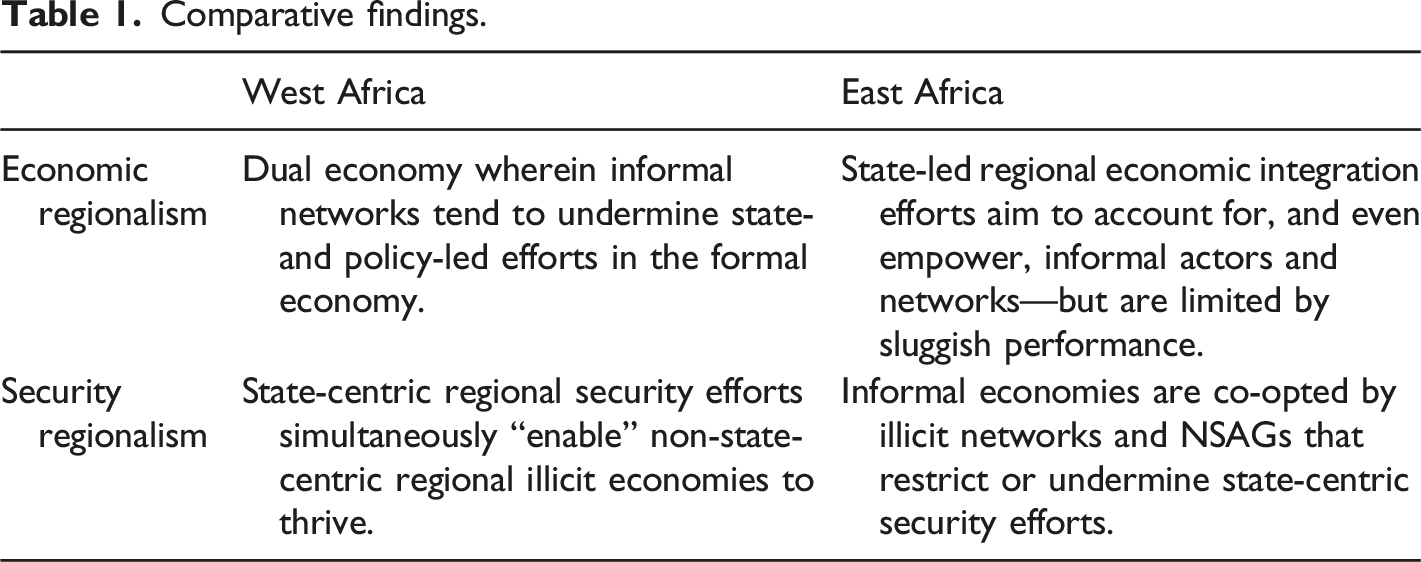
As elucidated in this article, any discussion of regionalism in West Africa and East Africa requires us to examine how it is manifested in, and shaped by, both informal and formal elements, with some aspects being more institutionalized and state-centric than others. To further understand the forces of regionalism in West Africa and East Africa, observers must remain abreast of the politics of each region’s security and economic developments. Even if West African regional security concerns ebb and spike in relation to AQIM and Boko Haram activities, such instability and threats to human security are unlikely to fully dissipate along its northern flank in the foreseeable future. NSAGs have been particularly active in and around Mali after the fall of the Gaddafi regime in Libya. The G5 Sahel Cross-Border Joint Force launched in 2017 has been comprised of non-African (e.g., French) and African troops from Mali, Mauritania, Burkina Faso, Niger, and Chad. This state-centric regional security initiative is wrestling with the informal regional economies and networks transporting illicit goods and trafficked persons from West African coasts across the Sahel, which support the NSAGs in the region. Although ECOMIG’s military intervention in The Gambia is being touted as a success that should inform and guide future responses to unconstitutional changes of government, it is doubtful that ECOWAS will be able to bring appreciable economic development to Gambians. And, to ECOWAS’s southern flank, the tense security situation in non-member-state Cameroon might result in an influx of refugees—a human security and regional security issue that would be beyond the regional organization’s purview.
As in West Africa, a veritable comprehension of regionalism in East Africa must engage with both state and non-state actors in the politics of each region’s security and economic developments. Though chances are slim, a civil war cannot be ruled out in Sudan, which is an IGAD member-state. In the post-al-Bashir era, military-civilian relations are tense, and the outbreak of a Sudanese civil war could foment instability in neighbouring countries like South Sudan and other East African countries via inflows of weapons and NSAGs in the manner witnessed following the fall of the Gaddafi regime and its impact on security and development in West Africa. IGAD’s resources have been stretched thin in the Horn of Africa, and its security logic is extremely dependent on the support from external powers, and in particular donor funding. In fact, without external financing, IGAD would probably not exist. An unstable Sudan could readily subvert the years of the state-centric regionalism efforts of IGAD (and the EAC) that have been seeking to promote regionalization by way of formal agreements, initiatives, projects, and announcements. Non-state-centric regionalism appears to continue apace in the face of volatility originating from Sudan, however, as East Africa’s bustling informal economic activity continues to thrive.
Comparative findings.
Conclusions
This article opened with the argument that regionalism is often conceived too narrowly—and is frequently misunderstood—by both international relations scholars and area studies specialists due to the exaggerated emphasis on state-centric analytical perspectives. This type of analysis is particularly distortive in the case of Africa because it usually results in observers’ claims that regionalism in Africa is “weak,” “fails” to deliver on its goals, and that its processes are separated from the continent’s underlying social fabric. In order to transcend the limits of state-centric methodology, this article takes a completely different approach, which is based on the stance of the NRA that state-centric and non-state-centric regionalism are not dichotomous but intertwined phenomena. Neither can be studied in isolation from the other. In a similar vein, state-centric regionalism is not the sole purview of formal policies and state-sanctioned activities, and non-state-centric regionalism is not purely about informal networks and illicit activities carried out by non-state actors. By implication, there are multiple and overlapping forms of regionalisms, serving different needs, interests, and assemblages of actors—which are consistent with an agential constructivist approach to understanding order and change at local, national, regional, and global levels. This article’s empirical case studies from West Africa and East Africa have illustrated the importance of this more synthetic epistemological stance in accordance with the NRA.
Our study serves as a corrective to the strong tendency among scholars and policymakers to exaggerate the role of state actors while at the same time overlooking the impact of “everyday” non-state actors in processes of regionalization. As we have demonstrated, non-state actors must neither be ignored nor romanticized: sometimes informal trade and financial networks may help to sustain households in economic terms, whereas at other times there are negative repercussions of non-state activities in the region. To be sure, agency among state actors and non-state actors alike plays a role in smuggling, drugs, small arms and light weapons flows, human trafficking, illicit timber extraction, and conflict diamonds and conflict-prone minerals, as they all generate much-needed economic developmental spin-offs—albeit at a cost to regional security and human security. 36
From this perspective, it is necessary to transcend notions of state-centric regionalism as inherently benign and non-state-centric regionalism as inherently malign. With a paucity of employment opportunities in the formal sector, the informal sector is an understandable way of earning a livelihood. Identity-based allegiance to states often has less saliency than that which is based on regional networks, informal agreements, traditions, and configurations—which also underscores the limited successes of formal, state-centric structures of West African and East African regionalism in practice. This political economy of identity politics “on the ground” as experienced by actors as part of the “everyday” performance of governance also aligns with the theorizing of agential constructivism. Hence, it is important to recognize the influence of non-state actors—comprised of small business traders; herders and pastoralists; identity-based networks; private enterprises such as banks, mining, security, and telecommunication companies; and civil society organizations—on forms of regionalization that are changing prevailing structures across these two regions and indeed the continent.
The comparative analysis demonstrates the heterogeneity of regionalisms and the diverse relationships between state and non-state actors. Our empirical analysis illustrates a more complex relationship than that state actors will either respond to or regulate non-state actors. In some cases, non-state networks and regionalization pre-date state-centric efforts and have cultural characteristics. Under these circumstances, state and non-state processes may go in different directions, as seen in the dual economy. In other cases, non-state regionalization replaces failed state attempts at wealth creation through official regionalist policies. Furthermore, non-state regionalization may emerge directly out of state failure, supported by illicit activities such as smuggling weapons and minerals, trafficking persons, and the theft of livestock, as well as licit activities such as the trade of cash crops (e.g., coffee and cocoa) and staple food crops (e.g., maize and cassava). Finally, there is also the alternative that statist policies are able to formalize and regulate the informal. As a result, it is too simplified to believe that this relationship can be conceptualized in terms of a binary whereby state actors will either respond to or regulate non-state actors.
As West Africa and East Africa continue to evolve along their respective trajectories, longstanding economic development and security challenges may persist, become transitory, or erode into less pressing matters, while new challenges will undoubtedly emerge. However, what is more certain is that such regional phenomena will be infused with elements of both the formal and the informal, and that state-centric regionalism and non-state-centric regionalism will continue to unfold in an interwoven manner. These reflections also serve as catalysts for our call for further comparative research on state-centric and non-state-centric regionalism in other parts of Africa as well as other regions.
Hence, the case of Africa has often been perceived as rather “special” in the study of regionalism, and as less relevant for general theory and comparative research. Although “Africa” may feature certain distinct characteristics, we reject generalized claims that Africa is “unique,” “exceptional,” or that non-Western regionalisms are of less importance than Western regionalism for theory-building and comparative research. Thus, we see considerable scope for a “genuinely comparative” research agenda that focuses explicitly on the variegated relationships between state and non-state actors across many world regions. For instance, further research on the interplay between state and non-state agents comprising “networks for peace” (in contrast to “networks for plunder”) would illuminate how diplomats, UN/RIO “experts,” NSAG leaders, NGOs, private firms, and local communities can contribute to human security and regional stability. Going beyond the limits of state-centrism and methodological nationalism that characterize much of the existing theory in the field would generate welcome insights into state and non-state agent interactions that go beyond the declaratory policies of intergovernmental RIOs, which in many cases tend to be either wish-lists or facades for hidden or informal activities. Such an approach could be readily applied to other parts of the globe, including regions of the Global North—as the saliency of the interplay between state-centric and non-state agents and their constituent networks is not restricted to the Global South. Indeed, discursive and rhetorical practices have also played a role in the European context, as illustrated by declaratory and symbolic regionalism, the “circus” surrounding EU summits, the extensive uses of flags, and the many attempts to create a shared political history of the EU.
Footnotes
Declaration of conflicting interests
The author(s) declared no potential conflicts of interest with respect to the research, authorship, and/or publication of this article.
Funding
The author(s) received no financial support for the research, authorship, and/or publication of this article.
