




Abstract
How do international actors move from milder to more serious measures as they handle emotion norm violations that parallel behavioral norm infringements in small communities that would collapse if community members ejected the violator? Here, we trace this process analytically by examining the interaction between President Carter and General Secretary Brezhnev via the Moscow-Washington hotline, which we conceptualize as a small emotional community of Soviet (now Russian) and American leaders of the past, present, and future. Our findings suggest that one community member’s initial mild and tacit demands that the violator emote as expected are followed by other community members in turn committing emotion norm violations, which then erodes these norms. We conclude that such small emotional communities may only survive repeated violations if, at some point, the ejection of the violator becomes possible – for example, following an election loss by the violator – without causing the collapse of the emotional community.
Keywords
Introduction
The study of emotion norms in International Relations (IR) and beyond suggests that these norms have a central role in stabilizing communities, and, thus, in ensuring their survival even at a time of discord and conflict. 1 Emoting in accordance with community expectations allows members to disagree with, or even violate, the behavioral norms of the community and, at the same time, reaffirm the violator’s attachment to the community’s continued existence. 2 Whereas emoting in the expected way sustains communities, when the emotion norms of the community are (also) violated, the community perceives a threat to its existence, and the violators often find themselves reprimanded. They may face remedial demands ranging from calls to repent and apologize to being shunned by, or even excluded from, the community. 3
However, neither studies of emotion norms in IR nor broader norms scholarship offers an explanation as to how and when international actors move from milder to more serious measures as they seek to handle emotion norm violations that occur in tandem with behavioral violations. We start to address this gap by tracing this wider process analytically. We do so by examining the interactions that played out between January 1977 and January 1981 on the Moscow-Washington hotline (MOLINK, Direct Communication Link/DCL), a device that offers an excellent example of an emotional community. The hotline has been a community of past, present, and future Soviet (now Russian) and American leaders in which trust is both the glue that holds communities together and the core value of this particular community. The MOLINK was created to be an island of trust in the otherwise distrustful relations of the superpowers, to help them manage their conflicts in times of crisis without triggering nuclear war. 4 It has done so by compelling its users to express their views, including their disagreements, by adhering to emotions associated with trust.
Exploring norm violations committed via hotline exchanges also has some analytical advantages. First, because the hotline is a small community consisting of only two persons – the Soviet/Russian and American leaders in office – at any point in time, thus ensuring ejection will result in the collapse of the community, the device both encapsulates and magnifies the process we set out to study. Second, President Jimmy Carter, who initiated all his six contacts with General Secretary Leonid Brezhnev via the MOLINK, violated at least one behavioral rule of the community each time he used the hotline. As we show, often – but not always – these behavioral violations went hand in hand with emotion norm violations. This allows us to separate and trace the effects of the latter as we study the hotline-based interaction between Carter and Brezhnev. Proceeding inductively and using process tracing, we argue that, early in the relationship, Brezhnev only pointed out norm violations tacitly, or by requesting corrective measures. However, eventually, until he could shun Carter without endangering the hotline’s existence, the Soviet leader reacted to continuing emotion norm violations by reciprocating these infringements. He occasionally called Carter out on norm violations; but he did not explicitly demand a return to the hotline’s norms.
This study contributes to two bodies of scholarship. First, it offers the first theory-driven case study of the Moscow-Washington hotline in the Carter-Brezhnev years. The scant scholarly literature on head-of-state and nuclear hotlines mostly consists of descriptive and prescriptive studies of the confidence building, crisis management, communication, and technical properties of these devices. 5 Our analysis, by contrast, examines specific instances of the use of a particular hotline 6 with the help of a rigorous theoretical framework based in trust-related emotion norms. Additionally, our insights into the Carter-Brezhnev hotline exchanges expand existing MOLINK scholarship, which has focused on the Johnson and Nixon years. 7 Accordingly, this article not only contributes to the few studies of hotlines that apply a theoretical lens, and particularly to those that call attention to the normative features of this communication device, 8 but also furthers understanding of the role that the Moscow-Washington hotline played in Soviet-American relations during the Cold War.
Second, this study adds to the literature on emotion norms in IR by exploring the process through which actors move from milder to more serious measures against a violator. While research into emotions in IR has become a burgeoning and diverse field of study, 9 interest in the analytical potential of two concepts – emotion norms and emotional communities – that have long been within the purview of social psychologists, sociologists, and even historians 10 has been much more recent, limited, and general. The few existing IR studies about emotion norms have emphasized their role as the glue that – through mutual trust 11 – holds communities together: adherence to expected ways of emoting allows members to carry out their roles and 12 ensures the survival of emotional communities in times of trauma, 13 discord, and even outright violation of a community’s behavioral norms. 14
However, the little we know about how community members react when emotion norms are violated, by themselves or in tandem with behavioral expectations, on a single occasion or repeatedly, remains general and sometimes contradictory. For example, Wong claims that both the observation and violation of appropriate ways of emoting can pay dividends for diplomats. 15 Contrarily, Koschut asserts that emotion norm violations adversely affect communities by rocking their foundations. 16 Sociologists agree that disregarding expected ways of emoting can threaten the existence of a community, but suggest that communal harmony can be restored through corrective measures ranging from mild disapproval to the exclusion of the violator. 17 However, research into emotion norms has so far failed to specify how this restorative process plays out. For example, when do actors turn to one or another restorative measure? Under what conditions do negative and positive outcomes manifest themselves to the violator and the community as a whole? Do all emotional communities react the same way? In terms of community features, IR research has only focused on large communities, such as NATO, 18 democratic states, 19 nations and cross-national communities, 20 and the global diplomatic corps. 21 In contrast to these studies, we contend that small communities in which the exclusion of a member equals the disintegration of the community present reactions to emotion norm violations in microcosm, and, thus, provide an excellent opportunity to start investigating this process in detail. Accordingly, we offer the Carter-Brezhnev use of the hotline as an exploratory case study of a small emotional community to gain more specific, albeit potentially less generalizable, insights into community reactions to unexpected ways of emoting.
This article proceeds as follows. First, we discuss the study’s theoretical underpinnings. Second, we outline how we have used the community value of trust and the emotions (and behaviors) associated with it to trace emotions in hotline correspondence, government documents, memoirs, and secondary sources. Third, we show that norm violations – behavioral or emotional – were not the result of ignorance and that, in fact, Carter and Brezhnev were both aware of how the hotline should be used. We then continue by analyzing Carter’s and Brezhnev’s adherence – or lack thereof – to emotion norms and the emotional interplay between the two. Finally, we discuss the insights gained from our case study and conclude that when members of a small community choose to maintain interaction in the face of repeated emotion norm violations, with the object of avoiding the immediate collapse of the community, such recurring breaches of community norms are likely to degrade the relationship by making violations (seemingly) acceptable in the long run. However, such strategy may save the community if (1) the individual committing the violations can be replaced in their community role within a reasonable time frame, or (2) if that individual’s opposite number is themselves sufficiently strongly committed to emotion norms to overlook temporary transgressions.
Emotion norms, emotional communities, and the hotline
Emotion norms scholarship calls attention to the normative nature of emotions and their intentional use in diplomacy. 22 Social norms offer guidance about the situationally appropriate emotional expressions. Thus, emotions are viewed as moral judgments about what one is expected to feel while interacting with others in particular contexts. 23 Emotion norms ‘reflect an intellectual appraisal of present expectations and past experience rather than energetic impulses and passions’. 24 These emotion norms – also called ‘feelings rules’, ‘display rules’, and ‘emotion culture’ 25 – guide the behavior of emotional communities that share common interests, values, and goals. 26 Emotion norms make it possible for interaction to continue, even in cases of discord or the violation of a community’s behavioral norms and rules. Disagreements are inevitable in any community; for while members share some interests, their interests are far from being identical. Differences are expected to be settled by adhering to the appropriate emotional expressions. 27 Adherence to rules of emotional expression sustains communities, especially in times of discord, by providing community members with important clues as to whether an interaction partner still wishes to belong to the community despite acting in a way contrary to community norms. 28 Nonetheless, the emotion norms of a community do not entirely stifle disapproval or negative emotions, such as anger; although such emotions are expected to be expressed in line with the emotional standards of the community. 29
We define the Moscow-Washington hotline (MOLINK) as an emotional community of past, present, and future Soviet/Russian and American leaders. The MOLINK, which was originally a teletype link and is now an email connection with a wide range of capabilities, 30 was established after the Cuban Missile Crisis to provide fast and direct communication between the superpowers. Early on, a few scholars sensed that, for hotline messages to be credible and for the device to fulfil its crisis-management function successfully, it must be more than just a piece of communication equipment. They theorized that it was a symbol of urgency and emphasis and linked it to the values of good will and cooperative intent. 31 In recent years, hotline studies have focused on the normative nature of the MOLINK. 32 In particular, Simon and Simon establish trust as the central norm associated with the hotline. 33 The MOLINK, they argue, has been an effective crisis management device because it has created an island of trust in the sea of distrust that has been the default position in Soviet/Russian-American relations. This way the hotline has enabled Soviet/Russian and American leaders in emergency situations to work toward the shared objective – established during the Missile Crisis between Kennedy and Khrushchev – of avoiding nuclear war by settling their conflicts through cooperation rather than confrontation.
Thus, while trust is the glue that keeps all emotional communities together, it has also been the principal norm of the hotline community. Trust – the emotional belief that another actor does not wish to cause us harm and that they even have our best interest in mind 34 – and distrust – an expectation of harm – have cognitive and emotional dimensions that manifest in behavior, 35 which play an important role in defining acceptable and unacceptable ways of behaving and emoting in community members’ interactions. First, hotline community members have been expected to behave in a trustworthy manner by demonstrating that they are capable, honest, benevolent actors. 36 On the one hand, this has meant that they have had to adhere to behavioral expectations stemming from formal and informal agreements surrounding the hotline: they have had to use it as a private, strictly leader-to-leader, communication device to be invoked in times of emergency with the intent of finding a cooperative rather than a confrontational solution to the problem at hand. 37 On the other hand, members of the hotline community have had to follow trusting behavioral norms in their hotline communications (e.g., interacting frequently, responding promptly, and working toward a joint solution) and avoid behavioral patterns associated with distrust (e.g., withholding information, avoiding interaction, and hedging). 38
Second, more importantly for the purposes of this article, defining trust as the pivotal norm of the hotline community has also prescribed the appropriate ways of emoting for community members. Thus, the hotline has been an emotional community in the sense that its users have been required to adhere to the emotional norms of expression associated with trust while, at the same time, they have been expected to eschew distrust-based emotional discourse. Researchers identify trust with positive emotions, including the feelings of hope, faith, confidence, equality, safety and security, comfort, warmth, and ease of mind. 39 While trust is ‘cool and collected’, its polar opposite, distrust, and the recognition that trust has been misplaced, that is, betrayal, are ‘fiery and frenzied’. 40 Distrustors express strong negative emotions, such as fear, frustration, vengeance, anger, hate, vulnerability, wariness, suspicion, cynicism, skepticism, a desire to dominate, or a feeling of inferiority or of being mistreated; and they often feel they are being dictated to or controlled (see Table 1). 41 As a result of these emotions, they tend to disregard the feelings of others, whereas trustors are empathic, able to see or feel things from the other’s point of view.
Feelings related to trust and distrust.
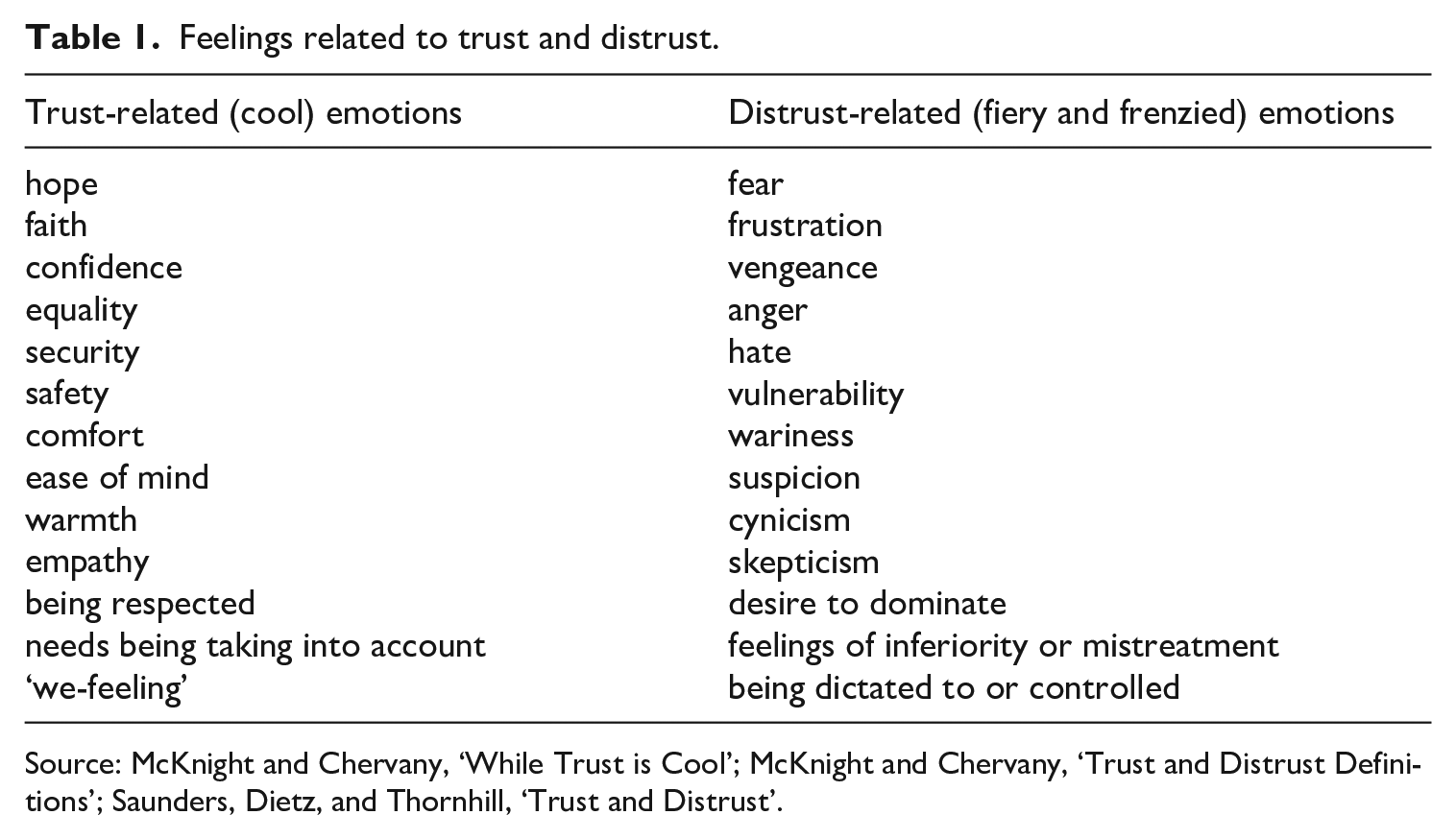
Source: McKnight and Chervany, ‘While Trust is Cool’; McKnight and Chervany, ‘Trust and Distrust Definitions’; Saunders, Dietz, and Thornhill, ‘Trust and Distrust’.
Given that the hotline is underwritten by trust, members of this emotional community are expected to display the emotions associated with trust. There is, of course, no guarantee that, when using the hotline, Soviet/Russian or American leaders will feel as they are expected to. But even when they do not, the hotline prompts them to engage cognitively with their emotions and, thus, regulate their feelings to bring them into line with expectations. 42 When this emotional labor is entirely successful, an actor’s emotions truly reflect the required emotions. 43 In other cases, an actor may simply mimic emotion norms, 44 which, while suboptimal, should be enough to maintain trust-based hotline interaction. Alternatively, an actor may resolve the conflict between felt and expected emotions by ignoring emotion norms. Such violating of the norms of emotional expression can send a powerful message; and it also threatens the survival of the community by undermining its shared norms. Emotion norm violations are particularly serious when they occur in combination with behavioral violations, thus undermining both the behavioral and the emotion norms of the community. Emotion norm violations almost always result in demands for the restoration of balance in the interaction. At their mildest, such demands are for corrective measures (apology, change of behavior). 45 Silence, or a decision to avoid displaying the expected emotion, can be powerful responses too. 46 If users commit one or multiple major violations of emotion norms, they risk harsher responses, such as being shunned by, or even excluded from, the community, because this allows other members of the community to continue to function according to community norms. 47
Emotion norms scholarship has not so far specified how and when actors move from one restorative measure to another, or how emotion norm violations are handled when exclusion from the community would result in the very outcome these measures were intended to prevent, that is, the (normative) disintegration of the community. Even when we set aside the issue of whether emotion norm violations should be treated similarly to behavioral norm violations, the substantially larger literature on norms in IR remains uninstructive. It shows that norms erode if violations are not signaled and sanctioned, if other actors also fail to adhere to the contested norms, if the validity of the norms is successfully questioned in the given situation, and if the environment is unstable. 48 However, even these erosions are discussed only with regard to public – rather than private – international norms, which presuppose large global – rather than small or localized – communities. This article seeks to fill this gap by examining the hotline as an emotional community whose small size makes more extreme remedial measures difficult if the community is not to be dissolved; and it traces responses to emotion norm violations and the conditions under which these reactions have occurred.
Tracing emotion norms in the Carter-Brezhnev hotline exchanges
To understand the extent to which users of the hotline had adhered to the link’s trust-based emotion norms and/or how they had reacted to deviations from these norms, we first interrogated the hotline exchanges between Carter and Brezhnev, starting with the emotions in their hotline correspondence. Because trust is the central value of the hotline community, our investigation focused on whether, how much, and in what way Carter and Brezhnev had expressed emotions associated with trust in their interactions. In the case of violations, we aimed at understanding if trust, or the lack thereof, had been a central issue for Carter and Brezhnev. To see whether trust-based emotions had been present and, potentially, dominated the letters, we compared the emotions identified in the hotline correspondence with the trust-based and distrust-based emotions listed in Table 1. Given that, besides trust and distrust, trust scholars 49 had identified two other trust-related conditions, it might be that a letter had focused on emotions other than those associated with trust or distrust. In this case, trust and distrust was unimportant for the two leaders. Alternatively, they might have felt ambivalent regarding trust, and might have simultaneously expressed high degrees of both trust and distrust. Like distrust, both these situations would signal emotion norm violation, either because an actor had failed to express trust-related feelings or because emotion work was incomplete, allowing contrary emotions to remain present in hotline messages.
We defined emotions as normatively minded, ‘other-directed and intentional [. . .] communicative acts that organize social interactions’ and that communicate to agents how they are supposed to feel in a situation. 50 To recognize emotions, we followed Koschut and colleagues and Koschut, 51 who show that emotions can be discerned from direct expressions and through emotional connotations or secondary meanings. For example, ‘genocide’ is an emotionally loaded word that expresses horror, anger, and hate. Contrarily, ‘freedom fighter’ can evoke pride and sympathy. Temporal markers (e.g., never-ending conflict), expressions of intensity (‘utterly’ or repetitive use of terms), emotional metaphors, comparisons, and analogies provide important clues about the emotional state of actors. Emotional othering, that is, describing the other in negative terms, can express revulsion and disapproval as well as distrust by classifying the other as a member of a distrusted out-group rather than a trusted in-group. 52
Tracing emotions in this way solves the problem stemming from the reserved emotional culture of diplomacy 53 as well as the cool and collected nature of trust-related feelings, which are much harder to decipher than the fierier emotions characteristic of distrust and betrayal. 54 To improve reliability, we coded messages separately and resolved the small number of inconsistencies in the coding via discussion. Then, we triangulated this information with that gained from government documents, including meeting memoranda and lower-level exchanges between the USA and the USSR, and the personal recollections of the major players, which we submitted to similar analysis. These, along with secondary sources, not only helped us to be more certain about the validity of our findings, but also allowed us to gain some insight into the true feelings of actors and learn about the nature and magnitude of the emotion work they undertook.
Behavioral and emotion norms in the Carter-Brezhnev hotline correspondence
Behavioral norm violations
As discussed above, the expectation is that the Direct Communication Link will be used in times of superpower emergency by superpower leaders seeking to communicate privately with each other in search of a joint solution. President Carter and General Secretary Brezhnev sent a total of 10, perhaps 12, 55 hotline messages to each other over the course of 4 years (Table 2). In each of the six exchanges, they violated one or more of the hotline’s behavioral norms (Table 3). First, neither Carter nor Brezhnev wrote with any intention of cooperating about Chinese intervention in Vietnam, the presence of a Soviet brigade in Cuba, Soviet intervention in Afghanistan, or the tense situation in Poland. Regarding Chinese moves in Vietnam, which came right on the heels of Deng Xiao-Ping’s visit to the United States and gave the appearance of US-Chinese collusion, Carter’s intention was to defend his reputation by denying to Brezhnev that the US had any involvement. 56 He received a dismissive response from Brezhnev, who recommended that Carter direct his calls for restraint to the Chinese leadership. 57 In September and December 1979, the US President had a particular idea of ‘cooperation’ which entailed Soviet acquiescence to US demands to remove their training brigade from Cuba and to promptly withdraw Soviet troops from Afghanistan, respectively. 58 Brezhnev stood firm in both cases. He refused to engage in any negotiations about the troops in Cuba 59 and entirely ignored Carter’s demands that he refrain from intervening in Afghanistan. 60 Also, besides showing little cooperative intent, Carter ignored the presumed privacy of hotline communications on two occasions. He discussed the content of the two leaders’ hotline exchange about Afghanistan in the press; 61 and in December 1980, instead of meaningfully communicating with Brezhnev, he merely used the hotline to notify the Soviet leader of a forthcoming American public statement about Poland. 62
Hotline exchanges between President Carter and General Secretary Brezhnev.
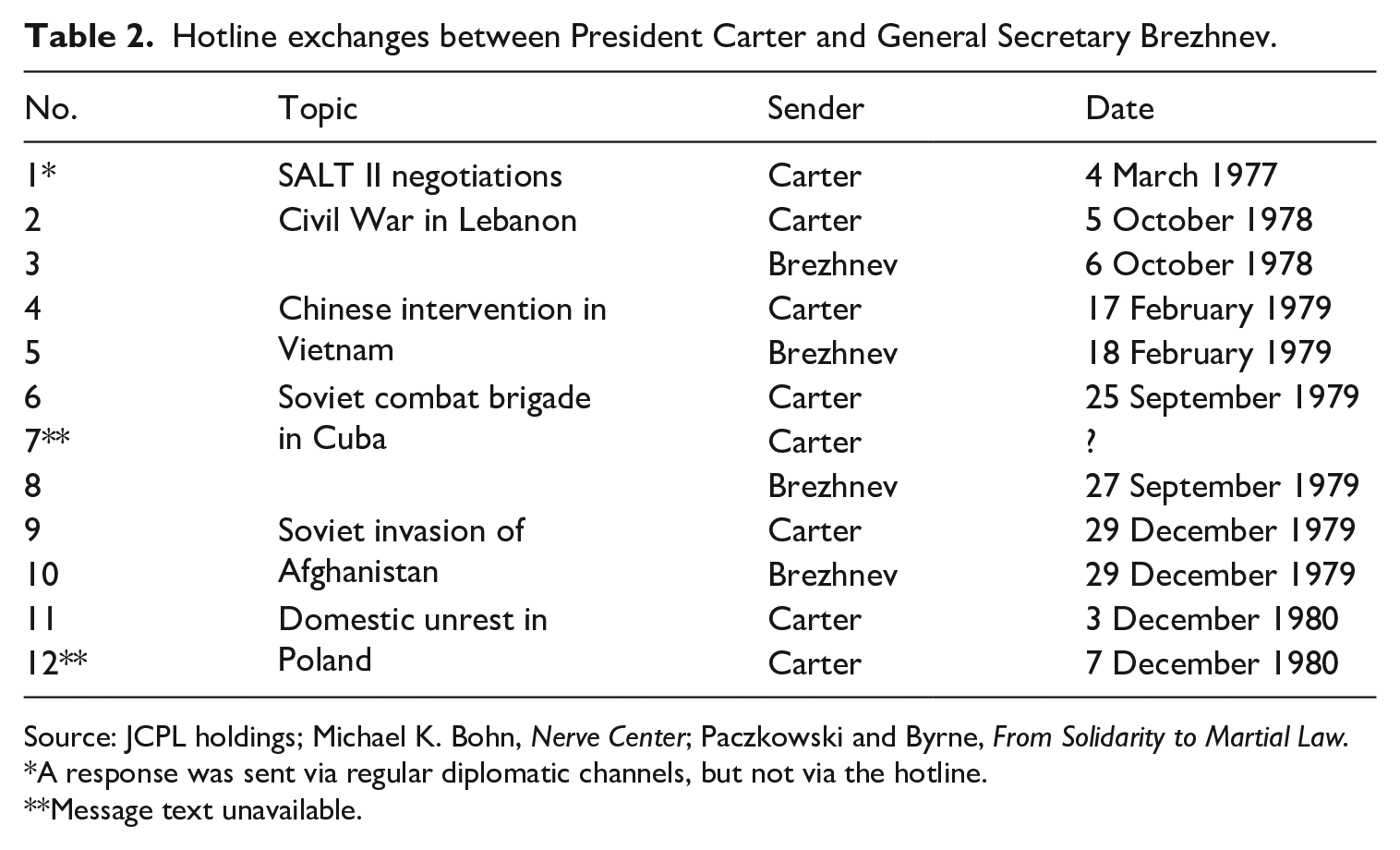
Source: JCPL holdings; Michael K. Bohn, Nerve Center; Paczkowski and Byrne, From Solidarity to Martial Law.
A response was sent via regular diplomatic channels, but not via the hotline.
Message text unavailable.
Adherence (✓ ), or the lack thereof (x), to the hotline’s behavioral norms.
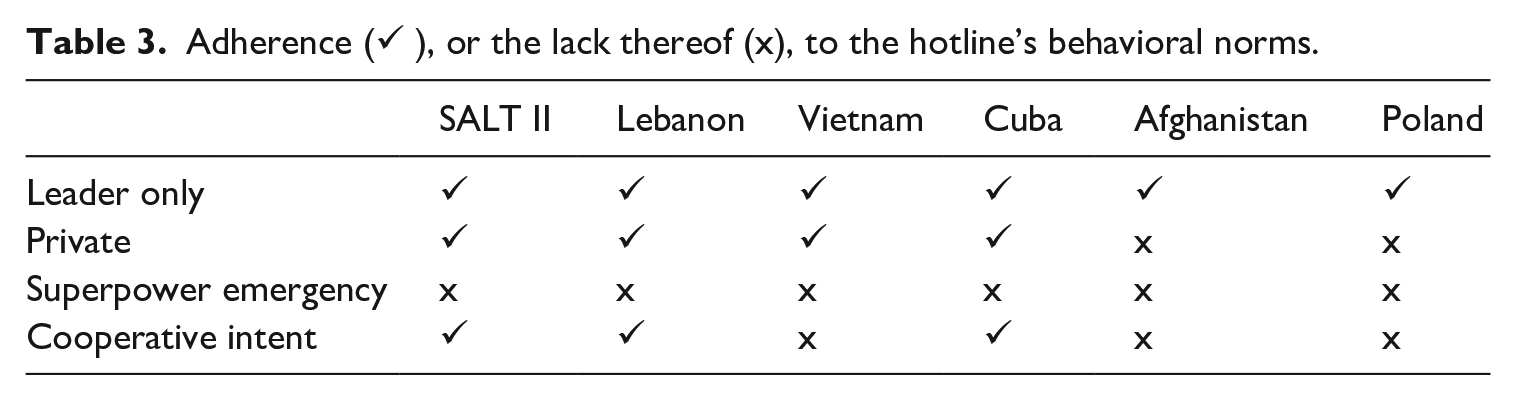
Although in several cases Carter argued the opposite, none of the situations in which the two leaders used the hotline qualified as an interstate crisis between the superpowers with the potential to escalate into nuclear war. The closest Carter and Brezhnev got to agreeing on the nature of the situation at hand, albeit defining it as a regional rather than as a superpower emergency, was the Lebanese civil war. 63 The interpretation of the presence of Soviet troops in Cuba, the Soviet invasion of Afghanistan, and China’s incursion into Vietnam as emergency situations were a point of contention between the two leaders. Despite being privately advised that the ‘discovery’ of a Soviet brigade in Cuba was a problem rooted in a US intelligence oversight rather than any wrongdoing or deception by the Soviet Union, 64 Carter insisted via the hotline that the crisis was not an ‘artificial creation’ as the Soviets claimed, but a ‘genuine and deep concern to the U.S. government’ 65 – a view he did not hold in private. 66 Brezhnev maintained that the crisis was only in the minds of the Americans. 67 Fearing Soviet intervention on behalf of Vietnam – a Soviet protégé – in February 1979, President Carter was equally unsuccessful at persuading Brezhnev that large-scale Chinese hostilities in Vietnam were dangerous for superpower relations. 68 As for Soviet intervention in Afghanistan in December 1979, President Carter insisted in vain that it was a ‘clear threat to peace’ with ‘adverse implications both for the region and for the world at large’, which would ‘inevitably jeopardize the course of US-Soviet relations throughout the world’. 69 The Soviets found the President’s claim incredible and a gross exaggeration: they saw the invasion as a regional issue and ‘exclusively a matter for the USSR and Afghanistan’. 70
Regarding the SALT II negotiations in March 1977, and a potential Soviet intervention in Poland in December 1980, there were no claims of an emergency on either side. Rather, President Carter knowingly initiated dialogue over the hotline in non-crisis situations. He was thoroughly briefed about the MOLINK and its use as part of a mandatory national security briefing on 12 January 1977, which discussed the hotline under foreign policy crisis emergency procedures. 71 Additionally, a review of superpower crisis communications, made at President Carter’s request, 72 contained a detailed overview of the DCL’s use, unequivocally identifying it as a crisis instrument. 73 Neither this information nor the knowledge that the SALT II negotiations failed to meet ‘established criteria for MOLINK messages’ 74 dissuaded Carter from making ‘a novel departure’ from relevant behavioral norms and using the hotline in a way it ‘had never been used [. . .] before’. 75 This norm violation was then used as precedent for employing the MOLINK unconventionally in December 1980. National Security Advisor Zbigniew Brzezinski successfully argued for the hotline’s use as a deterrent by communicating the threat of worsening superpower relations to pre-empt a possible Soviet invasion of Poland, because ‘we had used the hotline before in non-crisis situations’. 76
Treatment of the hotline’s emotion norms
The Carter-Brezhnev exchanges started with considerable respect for the hotline’s emotion norms. President Carter’s first hotline letter, sent on 4 March 1977, met trust-based expectations. It came as a response to a letter from Brezhnev sent via regular diplomatic channels in which the Soviet leader conveyed his anger at, and disapproval of, Carter’s desire to desist from the hard-won Vladivostok agreement, which had been negotiated with President Ford – Carter’s predecessor – to form the basis of SALT II. Angry, suspicious, and feeling dictated to, the Soviet leader accused Carter of ill will, ‘putting forward deliberately unacceptable proposals’, and he expressed hurt at a complete lack of regard for the Soviet position. Many of his words were derisive, as he talked about Carter’s ‘lofty ideas’, desire to ‘artificially retain’ the question of Soviet Backfire bombers and to ‘complicate things deliberately’ with ‘outwardly appealing’ but otherwise futile ideas. 77 He was upset by Carter’s unilateral advances in arms control and by US intervention in Soviet domestic affairs over what he sarcastically labeled the ‘so-called question of “human rights”’, hurtfully suggesting that Carter was deluded if he believed he would succeed in his machinations. 78
While distrust and disagreement were standard in Soviet-American relations, including regular diplomatic correspondence, disagreement tended to be conveyed in more polite, diplomatic language, especially a month after a president had assumed office and there was some hope for cooperation. Possibly alarmed by Brezhnev’s strong and extremely negative emotions, Carter responded via the hotline. He sought to use the link’s trust-prescribing quality to steer the conversation back to friendlier ground. He did this by first voicing his own concerns about the harsh tone of Brezhnev’s message, which he claimed did not show good faith in Carter’s intentions. In essence, he called Brezhnev out on a norm violation the other had not technically committed, since he had not conveyed his ideas over the hotline. His second ploy, on the advice of Secretary of State Cyrus Vance, 79 was to tone down the emotionality of his message to match the emotion norms of the hotline. The predominant emotion of the President’s message was that of hope, which he expressed on three different counts. In addition, he showed concern for Brezhnev’s views and feelings, asking him to share his ideas and assuring him that he was determined to succeed on a mutually beneficial basis. 80
In response, Brezhnev opted for a dual-track approach, neither track of which involved the hotline. As Carter hoped, Brezhnev’s reply had a more business-like tone and the General Secretary only made one jibe at Carter for his ‘artificially simplified’ solution. Overall, the earlier emotional othering of Carter was replaced by stressing mutual gains and by taking ideas expressed by Carter seriously. 81 On the other hand, the Soviets demanded restorative measures to express their concern about Carter’s non-emergency use of the hotline. By using the hotline in a non-crisis situation, the US president had contradicted the expectation that the link would be used to induce cool and collected emotion norms. Instead of calming things and reassuring their opponents of a US interest in peace, as hotline messages were meant to do, Carter’s unconventional use of the link had created shock waves among the Soviets. They took the use of the DCL very seriously 82 and clearly disapproved of ‘using the Hot Line for nonemergency matters, which [. . .they] felt was an improper use of the link’. 83 Despite their shock, the Soviets decided to convey only tacitly the requirement that the US keep to a conventional use of the hotline, so as not to further endanger Soviet-American relations. The Kremlin therefore separated their demands for a return to crisis-only use of the hotline from their message’s content. Brezhnev’s response to the President’s hotline message did not mention the issue of improper use; but the Soviet leader replied to Carter via regular diplomatic channels, tacitly indicating the proper place of arms control negotiations. Furthermore, the Soviets privately and indirectly asked the President not to use the hotline in this manner again. 84
Regarding emotion norms, the least problematic correspondence was Carter’s hotline message about the Lebanese civil war, which although, again, was not sent in relation to a superpower crisis, adhered to trust-based expressions of emotion. Seeking Soviet cooperation at an impeding UN Security Council meeting on the subject, the American President struck a hopeful, optimistic, and calm tone, voicing his belief that the superpowers could work together to end the violence and that they might even find a solution to the problems plaguing Lebanon. In addition, he demonstrated ‘we-feeling’ in negotiations with the Soviets, conceptualizing the superpowers as part of the international community and as one unit, referring to ‘our governments’ instead of stressing superpower enmity. Carter also showed a great deal of respect for Brezhnev’s feelings, informing him of the US position and efforts to restrain its ally, Israel. The President not only demonstrated some vulnerability as he confessed to the difficulty the US had in influencing Syria – a Soviet ally – in the right direction, but he also put Brezhnev in a position of control by asking him to influence President Assad. 85 Brezhnev fully reciprocated the emotional tone of Carter’s message, not making an issue of the behavioral violation at all. Besides a warm and cordial tone, he expressed his respect mostly via his salutation – ‘Honored Mr President’ – and by ending his letter with ‘respectfully yours’, both expressions the Soviets often used to convey real feelings rather than treating them as mere formalities. The General Secretary also reassured the President of Soviet interest in cooperation. Demonstrating a sense of equality by making a reciprocal request, he asked Carter to keep Israel in check. 86
US reaction via the hotline to Chinese intervention in Vietnam in February 1979 was a curious case of Carter moving away from his original motives and feelings, which would have been in line with the hotline’s trust-function, only to allow suspicion and a complete lack of empathy to dominate his MOLINK missive to Brezhnev. The reason the President wanted to contact Brezhnev on receiving the news of Chinese military action in Vietnam was that he ‘felt that his word of honor was at stake’ and ‘he wished to allay any Soviet fears’, which he thought was best done in a direct message to Brezhnev. 87 In short, he demonstrated empathy by recognizing how the situation might be perceived from Brezhnev’s side and wished to assure the Soviet leader that there had been no collusion with Deng at the U.S.-Chinese summit that had concluded just 2 weeks earlier. Carter’s motivation to clear up a potential misunderstanding by using the hotline was very much in line with the MOLINK’s original purpose of reducing the risk of war caused by misunderstanding or miscalculation. 88
At the 16 February 1979 National Security Council meeting, Carter expressed his conviction that his message 89 had adequately conveyed both US non-collusion and condemnation of China; but the message had, in fact, achieved neither of those objectives. In refraining from making any explicit mention of the issue of non-collusion, the President had failed to show the regard for Brezhnev’s feelings that he had intended. Most of the message shows a great deal of ambivalence, oscillating between a desire to cooperate and a need to dictate the terms of that cooperation, and between demonstrating a sense of ‘we-feeling’ based on ‘earlier mutual effort’ for peace and resentment and blame toward the Soviets. Carter’s moral outrage and condemnation of Chinese action as a ‘serious breach’ of the principle of non-use of force was combined with a haughty lecture to Brezhnev about that principle and an entreaty for peace, ‘wisdom and restraint by our governments’, implying that these were in short supply. 90 Besides openly faulting China and Vietnam, Carter also tacitly blamed the Soviet Union for non-action in the face of US concerns about the situation in Indochina, which was conveyed to the Soviets on both 20 and 26 January. Overall, Carter’s communique expressed a great deal of suspicion of what the Soviets might do 91 and resulted in a tit-for-tat strategy, which Brzezinski hoped would both demonstrate reciprocity and deter Soviet involvement. 92
Unable to shun Carter without suspending or even destroying the hotline community of leaders, the Soviet General Secretary neither called the President out on the emotion norm violation nor demanded corrective measures. Instead, Brezhnev, who felt that his concerns were not being taken seriously, reciprocated the violation. Distrust-based emotions – anger, annoyance, frustration, and suspicion – dominated his message. He expressed his frustration by reciprocating Carter’s tacit blame-game, writing that earlier and repeated Soviet warnings about China’s hegemonic ambitions had fallen on deaf ears in Washington, and thus implying US responsibility for the developments. Upset that the President had conflated the current aggression with earlier Vietnamese intervention in Kampuchea, he gave Carter a history lesson, claiming in no uncertain terms that these were ‘completely different questions’.
93
Annoyed at the President’s appeal for restraint, he told Carter ‘frankly’ that his plea was misdirected. ‘Such an appeal’, the General Secretary wrote, ‘must be directed only to the aggressor – that is, to China’.
94
Soviet feelings at the time, which Ambassador Dobrynin
95
later characterized as suspicious and wary, are best demonstrated by Brezhnev’s treatment of the US role in this conflict. He wrote that
China’s aggression against Viet Nam was undertaken soon after Deng Xiao-Ping’s visit to the USA, during which he made pronouncements openly inimical to the cause of peace, including direct threats to Viet Nam. And is this a simple coincidence?
96
Carter’s next MOLINK communique, on 25 September 1979, about the ‘discovery’ of a Soviet combat brigade in Cuba was close to exemplary in its display of trust-related emotions and, thus, seemingly in line with the hotlines’ trust properties. Apart from a mild and veiled threat of worsening relations, Carter demonstrated considerable warmth and strong ‘we-feeling’. He emphasized his interest in ‘a solution through joint accommodation’, the two leaders’ common interest in peace, and their shared labor toward a SALT II agreement. 97 He also expressed his earnest hope that Brezhnev would receive positively ‘the constructive proposal Secretary Vance presented to Minister Gromyko’. 98
At the same time, Carter also tried to convince the Soviet leader of his sincerity, that is, his ‘genuine and deep concern’ over Soviet military capabilities in Cuba and that, contrary to earlier Soviet assertions, the crisis was not an ‘artificial creation’, but a real one. 99 Such an open discussion of sincerity, however, signaled a problem in this area. Furthermore, what Carter did not do in the message regarding emotion norms is even more telling: he showed no regard for Brezhnev’s feelings or needs and failed to consider the optics of the situation from Brezhnev’s angle. The letter, as well as the US proposals that Carter labeled constructive and mutually beneficial, were attempts at dictating to the Soviets, expecting that they would bend to US demands to withdraw Soviet troops from Cuba. The President failed to see that, after having backed down in the Missile Crisis of 1962, the Soviets could only see any additional one-sided concessions in Cuba as a humiliation and, therefore, impossible. 100 Indeed, the Soviets were not at fault at all, for the Soviet brigade in question had been in Cuba since 1962 and its presence had not been contested in the Missile Crisis. Moreover, treating the situation as a crisis was domestically motivated by the need of an increasingly unpopular American president to demonstrate strong leadership. 101
While Brezhnev indicated that he recognized Carter’s norm violations, he did not demand any action. He called Carter out on his insincerity, saying that ‘we regret that you will support the contrived version about the Soviet combat unit’. 102 However, instead of demanding corrective measures, such as an apology or a return to the hotline’s norms – he simply ignored those norms himself. His letter contained strong emotions, revealing a sense of betrayal and bewilderment 103 expressed as extreme surprise and disapproval that Carter should behave in a way that contradicted the tone and essence of their discussions at the Vienna summit in June of the same year. Notably, for the first time in their hotline correspondence, Brezhnev also reciprocated Carter’s attempts at domination, disregarding the President’s needs and refusing to consider any placatory moves to satisfy US domestic opinion. Instead, he scornfully told Carter to give up his exaggerated and fabricated version of events. Angrily he added, ‘I repeat, there is a military training center in Cuba. It will exist’. 104 Judging by the memorandum that summarized the Politburo meeting’s discussion of Carter’s letter and the Soviet response, the Soviet General Secretary made no effort at emotion work and simply used the DCL to express his true feelings. His opening comment at the meeting was in line with the tone of his letter. Showing annoyance and derision, he said, ‘Last night Carter once again appealed to us via the hotline regarding the issue of the story they have dreamed up about the presence of our military brigade in Cuba’. 105
By the time of the Soviet invasion of Afghanistan, even the pretense of adhering to emotion norms was gone from the two leaders’ hotline correspondence. Both sides displayed very strong distrust-based emotions – especially anger and a sense of betrayal – and used harsh language. Carter’s hotline communication of 29 December 1979 was motivated by vengeance. The goal was ‘to make Moscow pay a price for its brutal invasion’. 106 Shocked and angry that the Soviet move had torpedoed Congressional ratification of the SALT II treaty, the President sent the sharpest message of his presidency, 107 communicating fear and threat, and calling Brezhnev out on violations of trust that the Soviet leader had committed not so much via the hotline but by his behavior. He termed Soviet action unsettling, dangerous, and ‘a clear threat to peace’. 108 Instead of identifying with Brezhnev, he engaged in emotional othering, distinguishing between us and them by referring to ‘my government’, which stood in opposition to ‘the Soviet Union’. 109 He only referred to the superpowers as a unit when he pointed out Brezhnev’s violation of their mutual obligation to preserve the peace and consult each other when it was threatened. Carter expressed his revulsion at what he saw as a moral breach on part of the Soviet Union, because the Soviets had engaged in ‘unilateral action’, ‘brutally executed the former [Afghan] leadership’, and fraudulently claimed to US Ambassador Watson that Soviet troops had entered Afghanistan at the request of the Afghan leadership. Condescendingly, he lectured Brezhnev about the duties of great powers and, trying to dictate to the Soviet leader, threatened him: ‘Unless you draw back from your present course of action, this will inevitably jeopardize the course of US-Soviet relations throughout the world’. 110 Repeating his threat, he demanded prompt Soviet withdrawal.
All this reflected the distrust and betrayal Carter felt privately. He was agitated, incensed, and combative and felt that he had been lied to. 111 He was resolved to deal with the Soviet Union forcefully and wanted to send Brezhnev ‘a very strong message, with no holds barred’ to be accompanied by an equally tough public statement. 112 He wrote in his diary that the invasion made it clear that the Soviets were not to be trusted, and told his wife that the US would ensure that Afghanistan would be the Soviets’ Vietnam. 113 Furthermore, not only did he discuss Brezhnev’s response publicly in a television interview, which went completely against hotline standards, but, on national television, he also called Brezhnev a liar who was ‘not telling the facts accurately’ and whose response had been ‘inadequate’ and ‘false’. 114 The US President was exercised not only by the Soviet action, but also by Brezhnev’s response, and he added sarcastic comments to the margin of the Soviet leader’s letter. 115 Most notably, he scribbled in response to the General Secretary’s claim that the invasion happened at the request of the Afghan government that ‘the leaders who “requested” SU presence were assassinated’. 116
There was little reason for Brezhnev to respond apart from the necessity of maintaining the hotline as a community. Privately, he felt resentment and ‘cursed Carter heartily’.
117
He made no attempt to rein in his distrust in his hotline letter, in which he appeared annoyed, upset, hurt, contemptuous, and condescending. Alongside these feelings, he experienced a strong need to clarify his position, as revealed by nine distinct linguistic markers such as ‘Here I repeat again’ and, ‘We already informed you’, while also showing a great deal of irritation that he needed to repeat what had already been said in Soviet public statements and in a confidential message to Carter.
118
He reciprocated Carter’s lecturing tone and called him out on his accusations, saying they were ‘impermissible’. He called attention to the violation of emotion norms of equality by stressing the need for ‘equal cooperation’, thereby implying that this was missing from both US behavior and Carter’s message. More openly, he recognized a lack of respect on Carter’s side. He pointed out the President’s desire to dictate to the Soviets and mockingly drew attention to Carter’s advice by putting quotation marks around the word for emphasis. He then sarcastically reciprocated, saying ‘Here is our advice to you’.
119
Scolding Carter for a lack of equal treatment, he wrote,
You have reproached us in your message that we did not consult with the USA Government in reference to the Afghani matter before introducing our military contingent into Afghanistan. Permit us to ask you – did you consult with us prior to beginning the massive concentration of naval forces near Iran and in the region of the Persian Gulf, about which it would have been necessary as a minimum to notify us?
120
The President contacted the General Secretary one last time, in December 1980, to try to pre-empt Soviet intervention in Poland. 121 His missive was a mere 134 words and a ‘service message’ in nature, warning Brezhnev of an impending US public statement regarding Poland. Although its tone was less frenzied than their exchange over Afghanistan, the message did reflect Carter’s mixed feelings. On the one hand, he showed empathy and consideration in line with trust-based emotion norms and his true feelings. 122 He promised Brezhnev that the United States was not going to exploit legitimate Soviet security interests in the Eastern bloc. On the other hand, discussing Poland in a public statement and elevating the issue to the hotline was the kind of exploitation and disregard for Brezhnev’s needs that the message sought to assure the Soviet leader would not happen. The President played down the legitimacy of Soviet security needs by implying that the Soviets should allow the Polish people to resolve their internal concerns themselves. In this way the President continued his earlier practice of trying to dictate to Brezhnev – this time in a matter that was unequivocally within the Soviet sphere of influence. Additionally, Carter also threatened Brezhnev by claiming that Soviet use of force would have a highly adverse effect on Soviet-American relations. 123
For the first time, Brezhnev did not return Carter’s message. 124 Similarly to their previous two exchanges, there was little that Brezhnev could have added to influence developments or policy without capitulating to Carter’s demands. However, unlike at the time of their earlier exchanges, in December 1980 Carter could be shunned without endangering the hotline’s community. Having lost his bid for re-election a month earlier, Carter was a lame duck president and irrelevant to both future Soviet-American relations and the hotline’s survival. This snub could have been the result of the deterioration of relations after the Soviet invasion of Afghanistan; but that is unlikely to have been the major or only reason. Evidence suggests that had the Soviets been able to act without regard to the normative demands of the hotline, they would have likely snubbed Carter long before. As early as April 1978, the Soviet government failed to ‘trust any of the statements or declarations made to them privately or publicly by President Carter’ and felt no need to deal with Carter, whom they thought would ‘disappear in 1980’. 125 Despite a temporary improvement in Brezhnev’s evaluation of Carter following their June 1979 meeting in Vienna, the Soviets – doubtful about the US leader’s chances of re-election – started to ‘write off Carter’ once again and wrote him off completely around November 1979. 126 Communication with Carter was likely maintained thereafter only to protect the hotline and its advantages for potential future crises. This conclusion is corroborated by how much the Soviets valued – and prioritized the survival of – the hotline. 127
Discussion
The Carter-Brezhnev hotline correspondence offers interesting insights into the process by which small communities – groups for whom expulsion of a member is extremely difficult if the community is not to be wrecked – handle emotion norm violations that compound behavioral infractions. Early in an interaction, actors are likely to react mildly to inappropriate emoting by sending gentle signals that serve as reminders of community norms. Such mild corrective demands can even be sent via outside channels, so as not to burden a community already facing behavioral issues with even more damaging emotional ones. Early violations are likely to be handled with gentle or tacit reproofs, because actors may be uncertain whether the violations committed are the result of a misunderstanding of the norms of emotional expression, or because they may still have hopes of working together within the framework of community norms.
In the face of repeated emotion norm violations, community members seem to prioritize continuing interaction, to keep the community alive. Indeed, our study suggests that the norm of reciprocity – the normative pressure to respond to a message – may be more fundamental for the survival of a community than behavioral or even emotion norms. However, the continuing interaction will become more and more uncivil in the face of repeated emotion norm violations. Inappropriate emoting is increasingly likely to be pointed out, and in harsher and harsher terms. Yet, restorative measures are not demanded, for such demands would lack credibility coming from a complainant with no ability to sanction non-compliance. Instead, actors engage less and less in emotion work as they extend reciprocity to ways of emoting. As a result, continuing interaction will degenerate into mutual and increasingly vocal emotion norm violations. Such continuing interaction is likely to erode communities and/or their norms by further wearing down their emotion norms. Thus, a short-term gain in ensuring community survival could potentially and ultimately result in the same negative outcome, albeit in the long term.
Such a negative long-term outcome may be forestalled if more serious measures, such as shunning or exclusion of the violator, become possible before substantial damage is done to community norms. Our case study suggests that the exclusion of serious emotion norm violators may happen even in small communities without detriment to the community’s existence, but only when the relationship between current community members is judged to be irrevocably damaged and when one of the actors – President Carter, in the case of the Carter-Brezhnev hotline exchanges – ceases to be relevant politically. However, community members need to value the community highly – as Brezhnev did – to wait patiently for these conditions to occur rather than to allow the community to disintegrate or hollow out.
We suggest that this process may characterize all small emotional communities that face the impossibility of immediately ejecting a repeated violator, but to varying degrees. The process may play out with greater speed and intensity in communities – such as nuclear hotlines – that have been created for special, high-stakes, and dangerous situations. In these communities, return to normalcy is needed urgently, because the community, including its normative underpinnings, needs to be available to handle the danger that they exist to forestall and that may manifest itself at any time. Members of small communities that exist to address less urgent issues may have greater freedom to pursue tacit or gentle reprimands, abide by community norms themselves to lead by example, absorb non-compliance without the erosion of community norms, and revitalize the community once a non-compliant actor has been ejected.
Beyond allowing us to explore the process by which small emotional communities can deal with emotion norm violations, our hotline case study also provides interesting insights into the relationship of behavioral and emotion norms. While our findings do not question earlier research that contends that emotion norms serve as the glue of a community, it does suggest that the relationship between behavioral norms and emotion norms may be more complex than previous research has suggested. While emotion norms can be used to explain away behavioral violations and, thus, emphasize the violator’s high regard for the community, our case study shows the emergence of a different relationship between behavioral and emotion norms. As demonstrated by Carter’s message regarding Soviet troops in Cuba, seeming adherence to emotion norms while violating behavioral ones can result in such adherence sounding like an insult or mockery when it is in stark disagreement with the proposed policy or seems to indicate the sender’s intention of gaining a unilateral advantage and/or forcing their preferred option on their interlocutor. In this case, adherence to emotion norms destabilizes – rather than stabilizes – the community. Our study, in conjunction with previous emotion norms scholarship, seems to indicate that while the two types of norms share some characteristics, they do not operate in tandem, and that even when both are violated, the magnitude of the violations may differ. Therefore, findings regarding the operation of one type of norm should not be automatically extended to the other.
Second, our findings corroborate Simon and Simon’s suggestion that when the MOLINK is used outside its normal scope, decision-makers cannot rely on its trust function to settle their differences. 128 The Carter and Brezhnev hotline exchanges indicate that when the hotline is used in non-emergency situations, it ceases to be an island of trust, and correspondence can become entangled in any general distrust that characterizes interstate relations. However, although the regular distrust-based diplomacy among superpowers was often coaxed into emotionally moderate discourse during the hotline exchanges between Carter and Brezhnev, over time, the language became emotionally hostile. This leads us to conclude that while the hotline does not help decision-makers to draw on trust to resolve their conflicts in non-crisis situations, its trust-based norms do not become entirely irrelevant. Actors remain aware of their existence and, Brezhnev’s reactions suggest, they perceive their violation more in terms of betrayal than just ‘business-as-usual’ distrust.
Conclusion
In this article, we have offered the Carter-Brezhnev hotline correspondence as an exploratory case study of how small communities react to the violation of emotion norms when their size precludes shunning the violator. While results from a single case study should be treated with caution, the use of the MOLINK in 1977-1981 suggests that when, in a small community, repeated infringements of emotion norms are committed, leaders opt to sustain the community by continued communication despite the emotion norm violations. However, such efforts are likely to be problematic in the long run, as parties become increasingly willing to engage in norm violations, which wears down the very norms that are the linchpin of the community. In our case study, Brezhnev increasingly violated trust-based emotion norms, which only did not result in the collapse of the community that sustained interaction was to avoid, because he attached great value to the hotline, and because Carter’s defeat at the November 1980 presidential elections made his ejection from the community possible, which Brezhnev did by promptly ignoring Carter’s December 1980 letter about Poland.
Besides offering pointers for future research on small communities’ treatment of emotion norm violations, the findings above suggest that studying the hotline could yield additional interesting theoretical insights. First, assuming that behavioral and emotion norms have something in common despite their potentially different functions, further studies of the contestation of the hotline’s trust function and conditions of use may enrich the more general literature on norms by contributing to a better understanding of when and how norm decay occurs. Carter did not set out to contest the hotline’s norms, nor to limit their validity, which is often the assumption behind scholarship on norm contestation. Indeed, regarding the SALT II negotiations, Chinese intervention in Vietnam, and even in the case of the Soviet brigade in Cuba, his goal was to extend the MOLINK’s normative coverage to non-crisis situations in order to tackle issues relating to his own reputation and (un)trustworthiness. However, heretofore, only Deibert and Crete-Nishihata 129 have mentioned unintentionality regarding state action in connection with norm contestation.
Similarly, the hotline may be useful in identifying additional structural causes of norm robustness or erosion, and in elucidating the interplay between structural factors, the degree and process of sanctioning, and norm erosion with regard not only to public but also to private international norms. Our results suggest that a structural factor – community size – restricted Brezhnev’s options in tackling norm violation, given that he appears to have wished to avoid the immediate collapse of the community. In addition, norm types may need to be investigated beyond Wiener’s distinction between fundamental norms, organizing principles, and standardized procedures; 130 for the actual nature of community norms seems a likely explanatory factor in Brezhnev’s response to emotion norm violations. Trust being the community norm resulted in the interpretation of Carter’s disregard for this norm as an act of betrayal which triggered a fiery response from the Soviet leader and also made him reciprocate with distrust-related emotions as a hedging strategy against an actor whose betrayals signaled untrustworthiness.
Footnotes
Funding
The author(s) received no financial support for the research, authorship, and/or publication of this article.
