




Abstract
Over the last 30 years, liberal democracies of the Global North have increasingly restricted access to their in-country asylum systems shifting many asylum and migration practices extraterritorially and prompting concern about the status of the universal human right to seek asylum. Most observers explain the trend as liberal states exerting national power and self-interest to ‘externalize’ asylum, ‘evading’ but not breaching international law. This piece adopts a different approach blending research on dynamic legal norms with Brunnée and Toope’s use of Lon Fuller’s criteria of legality. In contrast to explanations based on self-interest and power, I describe how the legal norm governing asylum has evolved over time alongside the shifting asylum and migration practices of liberal states through three phases. First, liberal democracies traditionally practiced an exclusively in-country approach to asylum prior to the late 1990s which only tentatively adhered to the criteria of legality. Second, the legal norm governing asylum shifted during the late 1990s and early 2000s creating new doctrine and legal practices at the multilateral level for reasons that resonated with the criteria of legality. Following contestation, however, liberal states have so far failed to implement the new substantive and procedural guidance despite the availability of more appropriate asylum practices. This account provides a significant qualification to the work on externalization and legal norm evasion, allows for the development of a typology containing three modes of asylum, and points to more legalistic asylum practices than what currently prevail among liberal states.
Introduction
Persecution, wars and conflict have displaced more than 100 million in 2022 including 27 million international refugees. The global asylum system – composed of the United Nations High Commissioner for Refugees (UNHCR) and international human rights law, particularly the 1951 Convention Relating to the Status of Refugees – create a universal human right to seek asylum: the right of all individuals ‘to disengage from an abusive society and to seek protection abroad’. 1 Liberal democracies of Europe, North America and Australia are among the framers of the 1951 Convention and the main donors to UNHCR, but are increasingly restricting access to their asylum systems through an array of extra-territorial measures in Africa, the Middle East, Central America and Southeast Asia. The shift among liberal democracies over the last 25 years – from practicing asylum and migration primarily in country to engaging in more extraterritorially practices – understandably creates concern about the state of asylum.
Some describe the growth of extraterritorial practices like remote detention centres, tent cities and COVID-19 restrictions as the ‘end of asylum’ 2 or ‘death of asylum’. 3 Such accounts resonate with theories of ‘norm death’ whereby norms, once shaping state behaviour, are disregarded. 4 Extraterritorial practices have indeed made accessing asylum in liberal democracies increasingly difficult. Yet these countries have not renounced their asylum obligations. They continue to craft global asylum rules, issue legal justifications for extraterritorial practices and usually adhere to the core provision of the 1951 Convention – non-refoulement and not returning a person to a place of persecution. These observations challenge the view that extraterritorial practices are a clear-cut case of norm death.
If turning asylum seekers back prior to entry and harsh offshore detention facilities do not constitute clear breaches of the 1951 Convention, however, it should prompt deep reflection about the adequacy of our traditional conceptions of international law – grounded in the pre-eminence of treaties – to adjudicate legal adherence. Most scholars account for the gap, between the ostensible permissibility of controversial extraterritorial practices under the formal provisions of the 1951 Convention and the observed impact of those practices, by turning away from formal understandings of law. Liberal states, it is said, use extraterritorial practices to ‘evade’ traditionally defined territorial obligations 5 requiring them to provide refugees with rights unambiguously enumerated in the 1951 Convention. Scholars inspired by rational choice argue that liberal democracies offered generous access to asylum during the Cold War to discredit the Soviet Union and encourage flight from East to West 6 but now achieve their self-interest in the post-Cold War world by restricting access to asylum while maintaining a reputation for legal adherence by not overtly breaking asylum norms. If Global South countries are to continue hosting 85% of the world’s refugees and thereby preventing vital disruptions to global trade and security that might result from expelled refugees, Global South countries must see legal commitments honoured by liberal states in the Global North. 7 Critical legal scholars describe liberal democracies as manipulators of international law given law’s inherent structural biases and ambiguities privileging the interests of powerful states. 8 For example, the Trump administration’s approach to asylum was said to be enabled by weak asylum norms allowing the US to profess consistency with law while extending their power and universalizing their preferences through a veneer of legal legitimacy. 9
Evasion arguments, however, have significant limitations. First, they continue to focus primarily on formal treaties and miss key developments linked to soft law like Executive Committee (ExCom) conclusions of the UNHCR and other non-binding declarations. Nor can these arguments explain where legal obligation to a particular treaty like the 1951 Convention come from. Second, theoretical frameworks underpinning evasion arguments further limit explanations for the rise of extraterritorial practices. Rational choice sees interests as objectively given thereby missing the intersubjective basis to legal norms in which shared understandings, discourse and practices underpin rules. Given that the 1951 Convention is one of the most interpreted international treaties and numerous forums enable international legal interactions, important insights are lost by ignoring intersubjectivity. Critical theorists do accept some elements of a social ontology like discourse. But their focus on ‘semantic instability and interpretive multiplicity’ 10 compel them to reject genuine intersubjectivity and the logic of argumentation. Finally, neither theory has a rich conception of change preventing us from seeing extraterritorial practices as anything other than legal norm evasion. Rationalists invoke a punctuated equilibrium theory, 11 overlooking change through social learning and deliberation while critical scholars have trouble even conceiving of change since international law is largely indeterminate.
Scholars have not seriously considered the possibility that extraterritorial practices of some variety, may constitute part of an evolved asylum practice for the 21st century. Erika Feller, former UNHCR Director of Protection, stated ‘There is a bit of a tendency, particularly in the advocacy community, to see extraterritorial processing as only motivated by self-serving politics, without really going into whether there might be a place for it in the panoply of responses to refugee challenges’. 12 Liberal democracies have increased their contributions of development and humanitarian assistance to countries hosting refugees such as the 5 billion Euro EU-Africa Trust fund and are the top contributors to the UNHCR’s budget which has grown from $2.7 billion in 2010 to $10.7 billion in 2022. 13 If only motivated to adhere to refugee law for reputational or cynical reasons, why go to such financial lengths?
A richer vision of law is needed, taking seriously the weaknesses of formal conceptions while allowing for a more complete picture than evasion arguments provide. I draw on untapped theoretical insights from second generation research on dynamic legal norms and use Brunnée and Toope’s invocation of Lon Fuller’s criteria of legality to examine the rise of liberal states’ extraterritorial practices. Three novel insights emerge. From the 1950s–90s, liberal states accepted and practiced an exclusively in-country approach to asylum which tenuously adhered to Fuller’s criteria of legality. Second, following deliberations during the 2000s, key actors in the legal normative community challenged the traditional approach to asylum using arguments that resonated with the criteria of legality and proposed new practices for reform including extraterritorial ones. Finally, contestation and debate gradually shifted shared understandings creating new possible asylum practices at the multilateral level. Liberal states have, however, so generally failed to appropriately practice these new rules.
Dynamic legal norms and qualities of legality
Constructivist research on norms examines how actors with particular identities and beliefs interact to construct intersubjective norms, shared understandings, guidelines and rules that in turn shape their practices, interactions and identities. 14 Another characteristic of a legal norm is that they should be practiced by a community of practitioners through reciprocal ‘deeds and rhetoric’ to retain influence and integrity. 15 Legal norms are a more comprehensive concept with which to study international law compared to approaches that only look to formal treaties. In the past constructivists studying legal norms examined patterns of emergence, diffusion and effects. Second generation research treat norms as ‘dynamic moving pictures’ 16 in which scholars examine the processes and mechanisms behind legal norm change like pragmatic reasoning among actors governed by a legal norm and whose actions are influenced by the norm’s perceived legitimacy. 17
Scholars justifiably criticize these accounts of law stating that ‘Western’ states dominate international law
18
and ‘legitimate’ change through Habermasian argumentation is misplaced.
19
To be sure, constructivism on its own provides no substantive guidance on ethics
20
nor the capacity to distinguish legal from non-legal behaviour.
21
Some research agendas, however, place legal norm properties at the centre of their analysis.
22
One of the more sophisticated and recent uses of qualities of legality comes from Brunnée and Toope’s use of Lon Fuller’s ‘criteria of legality’:
Legal norms must be general, prohibiting, requiring or permitting certain conduct. They must also be promulgated, and therefore accessible to the public, enabling citizens to know what the law requires. Law should not be retroactive, but prospective, enabling citizens to take the law into account in their decision-making. Citizens must also be able to understand what is permitted, prohibited, or required by law— the law must be clear. Law should avoid contradiction, not requiring or permitting and prohibiting at the same time. Law must be realistic and not demand the impossible. Its requirements of citizens must remain relatively constant. Finally, there should be congruence between legal norms and actions of officials operating under the law.
23
Brunnée and Toope argue these criteria are not ‘exclusionary and value-laden liberal internationalism’ regarding what is substantively good or bad in society like democracy or free markets. 24 They represent a ‘procedural version of natural law’ which may eventually lead to the creation of substantive laws. 25 Fuller’s ‘thin conception’ of international law is thought to be useful for global society because it accommodates diverse actors with competing world views. It requires only a commitment to autonomy and communication (i.e. listening and a willingness to modify positions), so the approach is different than Habermas’s communicative action requiring a common life world. 26 Their use of Fuller is also different from other qualities of legality because of the final congruence criterion linking back into constructivist work. In other words, intersubjectivity and legal norms are created and transformed through ongoing practices that must in turn be congruent with the other criteria of legality.
This legal norm concept captures more than traditional perspectives prioritizing treaty formality as the critical indicator of law. Formality – along with rational choice and critical legal treatments of law – cannot explain how states acquire a sense of legal obligation because treaties alone are not enough to foster behavioural change. Without examining intersubjective shared understandings and legal practices that adhere to a criteria of legality, our explanations will be limited since formality can mask a sense of obligation. 27 Many liberal state parties rhetorically support the 1951 Convention but engage in extraterritorial practices that deviate from intersubjective guidance. Secondly, intersubjective legal guidance is frequently contained in ‘soft law’ instruments like non-binding declarations and conclusions liberal states have co-created which should be considered when determining legal guidance. This legal norm account allows for the role of ‘soft law’ which may even generate more obligatory force than formal treaties under the right conditions. Treaties are of course important features of law but not simply because they are understood as formal. Treaties can crystalize shared understandings at a given point of time and help achieve criteria of legality since they are usually promulgated, clear, non-contradictory, etc. 28 Treaties can also be important since they often call for the creation of oversight committees and reporting mechanisms that promote further interactions, deepening shared understandings and legal practices.
This approach to international law provides useful conceptual tools to examine both the substantive and procedural qualities of the legal norm governing asylum over time and offers novel insights for the rise of extraterritorial practices among liberal states. I now outline a longitudinal model of legal norm transformation in which the convergence of both frameworks will be clearer through stages of (1) dynamic stability, (2) uncertainty and contestation and (3) transformation.
Stage 1: dynamic stability
Actors create and sustain legal norms through social interactions within international normative communities. 29 These communities generate intersubjective shared understandings and practices providing legal norms with a reciprocal quality. 30 This community is simply a collection of actors with shared understandings about the need for normativity and law to shape interactions and communication on a particular phenomenon and can therefore accommodate significant diversity of membership. 31 From that point onwards, normative communities can foster shared understandings about cause and effect relations, purposes regarding the governed phenomenon and rules and practices. When a legal norm succeeds, they emerge at the multilateral level through specialized normative communities who come to practice the norm through domestic legislation, discourse, judicial decisions and bureaucratic procedures. 32 As shared understandings and practices develop to embody legal qualities found in the criteria of legality, actors will be more likely to develop a sense of legal obligation. As actors practice the law, legal norms are not static but represent dynamic ‘moving pictures’. 33 Actors consciously use legal norms to reason with distinguishing them from ‘habits’ and unreflective aspects of social relations. 34 Exogenous shocks, new information and actors that collectively learn mean that norms always possess some uncertainty since they cannot provide complete guidance for every conceivable situation. Actors continually interpret new stimuli through the lens of the legal norm. 35
This process is not completely fluid, however. First, the criteria of legality shape expectations actors have about a legal norm’s scope and the detection of uncertainty (i.e. the criteria of legality provide guidance for change). 36 As actors practice legal norms through discourse and policies, they update their shared understandings, beliefs and legal practices: overlapping rule structures may generate clashing prescriptions for responding, threatening the criterion of non-contradiction. At other times, shifting shared understandings about governed phenomena like asylum seeking can reveal ambiguities threatening the clarity criterion. The criteria also provide guidance about how to address uncertainty and introduce new rules which should be promulgated, apply generally and be non-retroactive among other criteria.
The second feature managing dynamism is the adjudicative role of normative communities. In addition to defining appropriate legal practices that provide an actor with community recognition, normative communities possess legal expertise where uncertainty is resolved through collective social interactions and the incremental adoption of new practices. 37 As Johnstone puts it, ‘if no one can say with authority what the law is. . . what would be the point of making legal arguments at all?’. 38 Legal normative communities provide an adjudicative role: ‘[I]nternational lawyers serve as guardians of the relative autonomy, cohesion and consistency of international law. . . Lawyers have a keen sense of when the indeterminacy of international law is being taken too far and when the justification given is too far-fetched to be considered plausible’. 39 Normative communities possess expectations shaped by the criteria of legality and enable members to distinguish between legal action and political fiat.
Most of the time, uncertainty is modest, managed through incremental adaptation and introduction of new practices whereby the legal norm is updated to meet evolving conditions and shared understandings. When normative communities agree that uncertainty is manageable, actors will see the foundational features of a norm as worthy of adherence. Put another way, incremental change can stave off pressure ‘to fundamentally question its [the norm’s] underlying social premises’. 40 Ironically, then, this incremental adaptive process promotes the relative stability of legal norms alongside dynamic international conditions and social learning.
Stage 2: deep normative uncertainty and contestation
Keeping in mind that actors’ perceptions are shaped by legal norms, which embody the criteria of legality, external stimuli occasionally trigger deep uncertainty in which actors identify particularly intractable challenges. These challenges may arise from the intensification of legal contradictions and ambiguity or through detection of unusually severe unintended consequences. Actors may discover existing rules and practices perversely make a governed phenomenon more problematic than if those practices had not existed in the first place. Problems may conflict with the criteria of not asking the impossible and predictability. As dissonance emerges between the expected effects of a given rule/practice and the actual outcome, the inappropriateness of a rule/practice is revealed. 41
When incremental adaptation is unable to resolve problems and no clear path forward exists, deep uncertainty will set in. Once stable norms prescribing practices for realizing end goals now leave actors confused about how to respond. 42 This deep uncertainty is generally an uncomfortable situation from which actors seek to extricate themselves. They reflect, deliberate and experiment using new solutions through a creative and contingent process. 43 Because continuing to build on the foundational features of the legal norm no longer mitigates uncertainty, actors make bold proposals for transformation that inevitably creates contestation over an appropriate way forward. As Schmidt describes, ‘the actor must determine not only what means to select to reach a given end, but also what exactly the end or the goal of action should be in the new situation’. 44
Despite deep uncertainty, the legal norm will continue to contain substantive features that shape both the identification of grievances and proposals for new ideas. Actors’ deliberations and arguments should be observable and comprehensible. Fuller uses the analogy of fists versus elbows:
when we use our fists we use them for a definite purpose, and we are answerable to others and to ourselves for that purpose. Our elbows. . .trace a random pattern for which we are not responsible, even though our neighbor may be painfully aware that he is being systematically pushed from his seat.
45
Actors seek to delegitimize the problematic rule or practice while relegitimizing a ‘superior’ version to overcome grievances. Power is a feature of this process. Strong bureaucracies and legal expertise are important resources but actors must devise arguments that speak to the criteria of legality which will be evaluated by the normative community who possess cognitive schemas shaped by the legal norm. 46
Stage 3: norm transformation and implementation
Escaping deep uncertainty and achieving a new legal normative consensus is difficult. Indeed, incremental adaptation of norms is typically more desirable than radical change that replaces existing rules and practices. 47 Fundamental transformation is not smooth and proceeds in a halting, tentative manner. 48 A new legal approach can only emerge by overcoming contestation among actors: ‘To resolve a conflict. . . is more than just quieting the protagonists; it is quieting them by negotiating away the underlying sources of the contestation. Resolve here means more than to end; it means to end through change and transformation’. 49 Whether one proposal wins out or different proposals blend together, resolving contestation will eventually lead to convergence around a new intersubjective consensus. 50 In the end, a transformed legal norm may be either weaker or stronger, more or less clear or more or less specific. 51
The criteria of legality allow for justifiable assessments about progressive or regressive legal norm transformation. A new intersubjective interpretation, if it is to serve as a legitimate convergence point, should accommodate the new shared understandings of about the governed phenomenon, re-establish goals and objectives, reconstitute identities and define new practices that overcome problems better adhering to the criteria of legality. Institutionalization of a new interpretation by a treaty or soft-law declaration can facilitate adherence to criteria of promulgation, generality and non-retroactivity. It can also create opportunities for legal interaction whereby more members join legal communities, practice legality and gradually expand and strengthen global interaction. 52 Finally, for the legal norm to meet the congruence criterion, states must actually practice it through ‘implementation’ and by ‘bringing international law home’ into the domestic sphere. 53
This literature suggests three conjectures:
Legal norms are socially/temporally contingent and relatively stable when grounded in shared understandings and practices that meet the criteria of legality;
When actors discover external stimuli creates deep uncertainty within the legal norm, they will challenge the norm and propose bold transformative ideas;
Following contestation, a new interpretation of a legal norm will emerge better meeting the criteria of legality to be implemented and practiced by the normative community.
Liberal democracies and the right to seek asylum
The most familiar feature of the modern international refugee regime is the 1951 Convention. Following the Second World War, liberal states were among the framers and possessed intersubjective shared understandings about the need for ‘a permanent international machinery’ to legally protect refugees. 54 The Convention and its 1967 Protocol are the most frequently cited sources of asylum law establishing universal rules for the treatment of refugees which met many criteria of legality. It was general, requiring that each state not return a refugee to a place of persecution (Article 33), not penalize refugees for illegal entry (Article 31) and provide refugees with human rights on their territory. 55 The Convention was promulgated so everyone knew what the law required. It was non-retroactive, states would prospectively recognize these rights. The Convention met the clarity and non-contradiction criteria containing a clear definition of a refugee as someone fleeing his or her country from persecution on account of race, religion, nationality, membership of a social group or political opinion (Article 1). States would retain control over regular migration and for further clarity, the Convention framers included the wording ‘coming directly’ from a place of persecution into Article 31 so states would not be responsible for refugees who found protection but travelled onwards helping meet the criteria of constancy and not asking the impossible. 56
The final criterion of congruence, however, was not met by the 1951 Convention at this time since states had yet to implement and practice asylum. The Convention left many questions unanswered: how to identify refugees, where to conduct status determination, what solutions should be provided to refugees and how to uphold refugee rights in a world of high human mobility. Practicing asylum, therefore, is an essential element to not only identifying adherence to the criteria of legality, but also what the legal norm is. Over time, liberal states worked within a normative community to establish crucial soft law guidance on implementation of asylum and a consistent practice of legality. I evaluate the asylum and migration practices of liberal democracies over time in relation to the legal norm and identify three distinct modes of asylum articulated in the typology below: (1) classic asylum; (2) extraterritorial ‘responsibility shifting’; and (3) extraterritorial ‘responsibility sharing’ (refer to Table 1).
Asylum in liberal democracies.
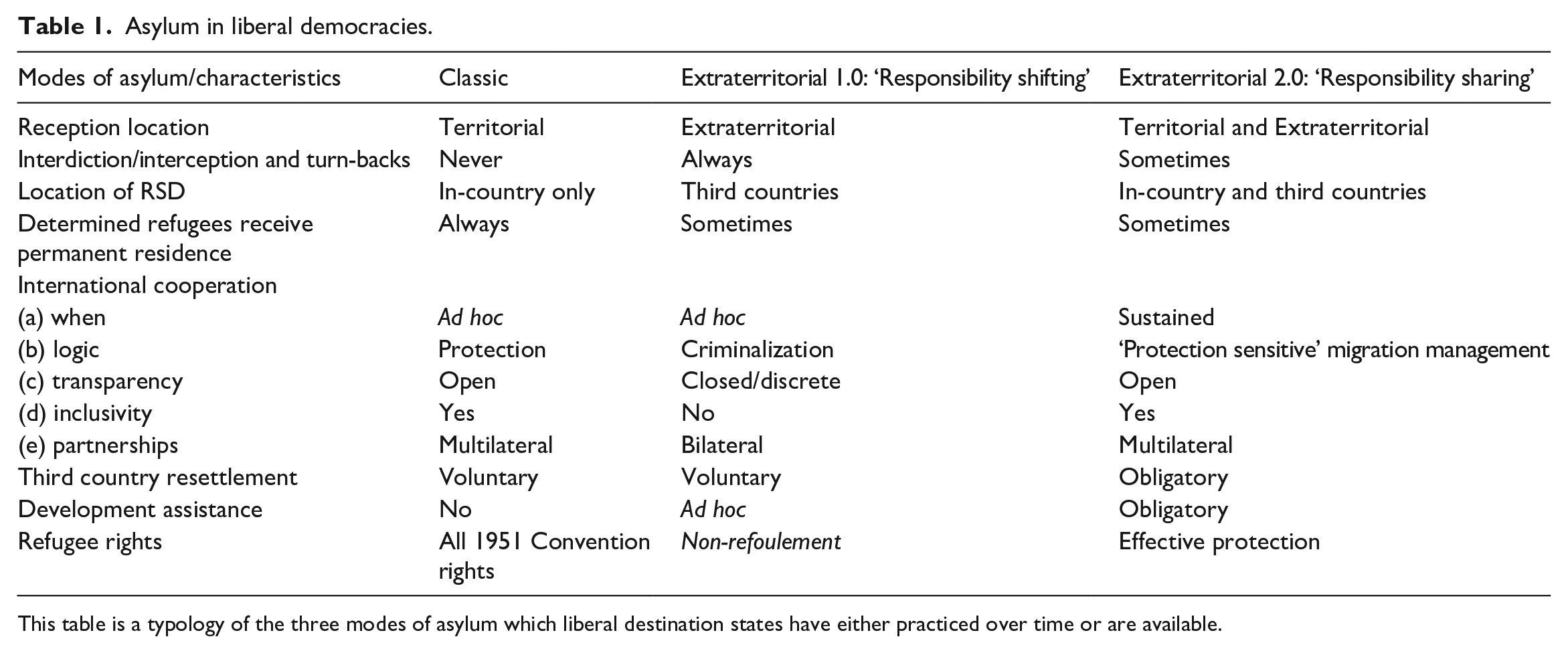
This table is a typology of the three modes of asylum which liberal destination states have either practiced over time or are available.
Classic asylum: dynamic stability (1950s–90s)
As liberal states began practicing asylum in the normative community, they developed rules like not rejecting refugees at frontiers contained in the Declaration on Territorial Asylum in 1967. 57 Liberal states helped create the 1967 Protocol universalizing the 1951 Convention by formally removing its temporal and geographical limitations. Liberal states, following the formation of the UNHCR in 1950, established its Executive Committee (ExCom), the principal normative community on asylum at this time, where states discussed asylum implementation and produced ‘Conclusions’ on rules, to clarify ambiguities. In 1977, for example, ExCom members promulgated Conclusion No. 8 on appropriate procedures for Refugee Status Determination (RSD) and Europe, North America and Australia soon created in-country RSD systems. In 1985, the High Commissioner for Refugees, Poul Hartling recognized the basic practices among liberal democracies where ‘asylum seekers are treated on an individual basis and entitled to significant socio-economic benefits, if recognized as refugees, they are generally accepted for integration leading to eventual naturalization’. 58 In short, liberal states conceived of their obligations territorially, not ‘in a global juridical space’. 59
During the 1980s and 1990s, liberal states of Europe, North America and Australia experienced increased asylum seeker arrivals – 250,000 asylum applicants in 1987; to 850,000 in 1992; to about 500,000–600,000 during the 1990s. 60 Practicing RSD, states noted low-rates of positive determinations. In 1991, 15% of asylum seekers in the United Kingdom were recognized as Convention refugees. 61 Deliberation ensued within ExCom about the challenge. There was growing recognition that a significant number arriving sought labour market opportunities and abused asylum systems by filing multiple claims 62 while others fled wars and generalized violence conditions not clearly recognized by the 1951 Convention’s emphasis on individualized persecution. Liberal states introduced temporary visas for those fleeing war and violence 63 and confronted controversial questions about deterring migration while preserving access to asylum systems. They developed guidance for procedural RSD efficiencies to reduce migration pressures through ExCom Conclusions in 1982 (No. 28) 64 and 1983 (No. 30) 65 recognizing manifestly unfounded claims ‘constitute a serious problem. . .and burdensome to affected countries’. In 1989, the ExCom promulgated Conclusion No. 58 addressing the ‘Problem of Refugees and Asylum Seekers Who Move in an Irregular Manner from a Country in Which They Had Already Found Protection’. 66 Such individuals, the guidance stated, could be returned if they had protection from refoulement and were treated in accordance with ‘basic human standards’ in first safe asylum countries. The most notable instantiation was Europe’s Dublin Convention in 1990 introducing the ‘Safe Third Country’ concept and assigning responsibility for reviewing protection claims to European countries where asylum seekers first arrived like Italy and Greece. 67
Liberal states also shifted interactions about these new developments and responses outside the UN and ExCom forums. Liberal states created more exclusive fora like the Intergovernmental Consultations on Refugees, Asylum, and Migration (IGC) in 1985 to discuss and share sensitive ideas and practices like curbing access to social services for asylum seekers, the use of detention, creation of anti-migrant smuggling practices and forced returns of non-refugees. Though often criticized by advocacy communities, especially when it came to detaining asylum seekers, these regulatory practices adhere to classic in-country asylum approach. The IGC has been described as a forum in which liberal states ‘moulded’ shared understandings about what irregular migration was and defined practices to address it. 68 But they also approached the challenge from a similar intersubjective lens. The IGC coordinator during the 1990s, stated IGC states attempted to maintain ‘the 1951 edifice’ rather than ‘jettisoning it’; ‘it was about making asylum work better’. 69 His successor also mentioned that states came to the IGC from the ‘same intellectual space and decided about how best to respond’ to the challenge of the asylum and migration nexus. 70
There were qualifications, however. To varying degrees, all liberal states adopted visa restrictions and carrier sanctions on airlines for transporting undocumented passengers. Preventing undocumented passengers from boarding inbound airplanes, some of whom could be refugees, deviated from the classic approach preventing access to in-country asylum systems. Second, while Dublin agreement allowed West European states to exclude some asylum seekers from their in-country RSD systems and return them to other European first asylum countries, Europe as a whole never accepted the idea that it could not absorb all arrivals. Some observers point to US maritime interdiction and offshore processing of Haitians in 1981 as the beginning of extra-territorialization.
71
As the following excerpt from a 1995 IGC report clarifies, however, US extraterritorial practices did not shift the normative community’s intersubjective shared understandings that exclusive in-country asylum needed to be abandoned, indeed it was consciously rejected:
comments and reactions to the 1994 IGC Report from a variety of sources indicate that the suggestion of protection in an ‘exclusive’ location faces significant moral (political and humanitarian) and legal obstacles. Politically, it is a controversial scheme that would possibly have a very negative impact on public opinion. Moreover, it contravenes a number of relevant provisions of International Law and also appears to be incompatible with Constitutions and internal systems in many participating states. . .Careful examination of these impediments therefore leads to the conclusion that the ‘exclusive’ option is not feasible and as such, does not deserve further elaboration.
72
It can, therefore, be argued that intersubjectivity proved resilient. Without efforts to deliberate and argue within the normative community, one powerful state deviating from established practices will not succeed in altering legality.
While liberal states largely practiced in-country asylum, perhaps surprisingly these practices did not meet all criteria of legality. On the generality criterion, the Declaration on Territorial Asylum especially the non-rejection rule and the ExCom Conclusions on RSD applied to all states. But the liberal state practice of exclusive in-country screening and the offer of permanent residence for all refugees did not meet the generality criterion because other states did not apply these practices. Keeley, for example, described two uncoordinated refugee regimes at the time: a ‘Northern refugee regime’ of permanent settlement and integration and the ‘normal refugee regime’ in which Global South countries provided temporary protection and voluntary repatriation only. 73 Failing to achieve the generality criterion would eventually generate significant problems for the legal norm discussed below. On promulgation, the legal norm’s adherence was mixed. Deliberations and rule-making through the UN like the Declaration on Territorial Asylum and ExCom Conclusions or the European Parliament’s Dublin Convention were all publicly available allowing observers to know what the law required. Other practices, however, like IGC meetings/reports and bilateral return agreements were not public, avoiding scrutiny and creating conditions in which the immigration bureaucracies of liberal states alone knew what was acceptable. Above all, the two pillars of the classic approach to asylum – exclusive in-country processing and permanent residence for refugees – were never promulgated but became a practice among liberal states.
Classic in-country asylum did meet other criteria, however. The practice of in-country reception and processing pre-dated the 1951 Convention going back at least to the early 20th century in the League of Nations and likely even further. 74 In-country screening and providing permanent residence to all refugees emerged over time and was prospective in application therefore meeting the non-retroactivity criterion. The normative community worked towards ensuring clarity and non-contradiction of the legal norm. Standards were set for RSD and liberal states attempted to adhere to that through policies and legislation. The normative community developed ExCom Conclusion 58 to define secondary movement and Europe sought to practice this by developing ‘safe third country’ principles clarifying legal obligations. Though liberal states engaged in controversial practices to deter economic migration, particularly detention, but also curbing social assistance to asylum seekers, and facilitating returns, without effective enforcement, exclusive in-country asylum could undermine the non-contradiction criterion preventing states from governing sovereign immigration programs while practicing asylum. UNHCR recognized the importance of this work: ‘failure to solve the non-refugee problem undermined the credibility of the asylum channel generally and adversely affected the position of refugees, who genuinely need international protection’. 75
Finally, the classic approach adhered to the criteria of not asking the impossible and constancy but this was primarily because international conditions at the time were so benign. By 1990, Martin observed that in-country RSD procedures had been ‘cobbled together in an era that permitted the leisurely consideration of modest caseloads’. 76 During the 1970s, Western European states reportedly received about 13,000 asylum applications annually. 77 Though arrivals increased during the 1980s and 1990s, liberal states likely retained some confidence that the new enforcement practices could maintain the classic asylum approach. Indeed, IGC reports noted some deterrence success, reducing unfounded claims and increasing refugee recognition rates. 78 Of course, refugee crises occasionally occurred in Hungary, Czechoslovakia, Indochina and Central America resulting in surges of arrivals. But these were seen as temporary, resolvable through a practice of ad hoc multilateralism in which UNHCR instigated a multilateral response to attract voluntary resettlement pledges and financing. 79 During these years, it is conceivable that liberal states understanding of mobility and in-country asylum as manageable therefore meeting the criteria of constancy and not asking the impossible. Such adherence, however, was highly contingent on the shared understanding, indeed material reality, of very modest asylum seeker arrivals. In sum, while some have labelled the 1970s–90s as a kind of ‘golden age’ of refugee protection, 80 the legal norm actually failed to meet key criteria of legality and was highly vulnerable to shifting international circumstances.
Uncertainty and legal norm contestation (late 1990s–2000s)
By the late 1990s and early 2000s, deep uncertainty emerged among key actors in the normative community not only about the practices used to implement asylum but what exactly asylum meant. Irregular migration was now seen as a ‘sustained’ global challenge no longer confined to specific regions and crises. Deliberations centred on the ‘asylum-migration nexus’: a growing recognition that asylum and migration had become blurred confounding the classic in-country approach to asylum. Key actors like the UK, Australia and even academics argued that liberal states’ basic approach to asylum was broken. 81 The UNHCR echoed these concerns launching its Global Consultations on International Protection promising to revitalize the 1951 Convention through new doctrine and practices. 82 Greater consideration was given for extra-territorial asylum practices with some proclaiming a ‘crisis of asylum’ in which traditional practices were unlikely to survive. 83 Interestingly, the number of asylum seekers arriving to liberal states increased only slightly to about 550,000 in 2001. Learning and deliberation within the normative community were key factors in the breakdown of the intersubjective consensus underpinning classic asylum.
The changing shared understandings about asylum seeking and the viability of exclusive in-country practices were informed by observations resonating with the criteria of legality. On clarity and non-contradiction, for instance, concerns focused on secondary movement. In 2000 and 2001, the IGC examined particular ‘caseloads’ of asylum seekers entering liberal states, like Afghans and Iraqis. 84 Despite the majority being refugees entitled to permanent residence under the classic asylum approach, all spent significant time in first asylum countries of Iran and Pakistan. In the Australian context, Hathaway called on observers not to conflate immigration and refugee law stating that Afghan and Iraqi asylum seekers did not have the right to enter Australia’s elaborate in-country asylum system. 85 These observations took seriously Article 31 of the 1951 Convention about refugees arriving ‘directly’ from a place of persecution. Without distinguishing and controlling for refugee onward movement, the legal norm risked not meeting the criterion of non-contradiction, controlling migration while upholding asylum. Identifying refugees with valid reasons for onward movement from refugees adequately protected required clear rules. The Dublin agreement of course defined secondary movement, but only within Europe where a baseline of homogeneity in protection prevailed and not among Global South countries where the quality of protection varied significantly. And while ExCom Conclusion No. 58 included guidance allowing for returns where refugees had protection from non-refoulement and access to ‘basic human standards’, the latter remained unclear.
The normative community saw classic asylum as also generating perverse unintended consequences. Actors pointed to liberal states’ relatively open in-country asylum systems as creating ‘pull factors’, encouraging departures of those who might not otherwise leave. Domestic liberal constitutions and legislation often required providing asylum claimants with additional layers of appeal like judicial review exceeding what international law called for in ExCom Conclusion No. 8. Additional review led to delays, high costs and difficulty removing non-refugees once procedures were exhausted prompting questions about the purpose of RSD if non-refugees could not be removed after the process was completed. UNHCR noted that during the 1980s and early 1990s, an estimated 80% of screened out asylum seekers stayed on, some illegally and some under special programs. 86 Other pull factors included chain migration networks and lobbying of democratic officials for more inclusive policies. 87 Concerns intensified with revelations about people smugglers. Smugglers had long been involved in migration and refugee movement enabling refugees to escape danger. But officials now presented a counter narrative: smugglers ‘marketed’ permanent residence in liberal democracies to asylum seekers and refugees in first asylum and origin countries. The people smuggling business reportedly grew from $3.5 billion in 1994 to $7 billion in 1997. 88 If unaddressed, these problems could swell the number of arrivals undermining the criteria of not asking the impossible and constancy.
The classic approach now created serious inequities through its failure to meet the generality criterion. Australia articulated this to the UNHCR’s ExCom in 2000:
At a conservative estimate, western states are spending, each year, USD 10 billion on determining refugee status for half a million asylum seekers within their borders, of whom only a small percentage are refugees. This is the cost of individual asylum determination in developed systems of administrative law with layers of review. In contrast, UNHCR has an under-funded budget of only USD 1 billion with which to correspond to the needs of more than 20 million refugees and people of concern. It should be noted that savings of just 10% of asylum determination costs would release funds which if provided to UNHCR, could amount to a doubling of UNHCR’s current budget.
89
The new conditions and grievances articulated by key members of the normative community reveal a weakening of the legal norm’s adherence to the criteria of legality which could undermine liberal states’ sense of obligation to asylum if fundamental change was not pursued.
The late 1990s and early 2000s, was a period of contestation within the normative community. Australia’s immigration minister called for ‘a culture of radical reform to build a more effective and fair system’ 90 and the UK’s Tony Blair unveiled a ‘New Vision for Refugees’ to the European Union in 2002–3. 91 Following its Global Consultations, the UNHCR released the Convention Plus Initiative in 2003 with new ideas and practices to address overhaul the implementation of the legal norm. The International Organization for Migration (IOM) convened high-level meetings on ‘migration management’ through the Berne Initiative. 92 It should be acknowledged that IOM and UNHCR are considerably different intergovernmental organizations. It should be expected that IOM – as a service oriented intergovernmental organization with no foundational normative mandate and primarily funded by Global North – was sympathetic to concerns of liberal states. But UNHCR – as the guardian of the 1951 Convention – also called for transformation. To be sure, ethically grounded legal and philosophical scholars also articulated transformative proposals for change based on these problems. 93
Despite their diversity, all of these actors acknowledged the fundamental weaknesses of classic asylum and called for a reformulation using sustained international cooperation. Academics like Hathaway and Neve called for cooperation organized around Common But Differentiated Responsibilities (CBDR) taking account of the differences in abilities and circumstances of states and mobilizing strengths. 94 Australia’s proposal to the IGC and the UK’s ‘New Vision’ implicitly acknowledged CBDR outlining different roles for origin, first asylum, transit and destination countries so no single state would be bare sole responsibility based simply on territorial presence of refugees. All called for major increases in development assistance, technical assistance for RSD and resettlement quotas for host countries towards fairer responsibility sharing. Host countries should provide temporary protection, access to work and self-reliance opportunities, while awaiting voluntary repatriation or resettlement/local integration for those unable to return. 95 While international responsibility sharing was nothing new (e.g. ad hoc multilateralism), it was no longer seen as a voluntary gesture of charity. 96 If the normative community was to overcome the problems described above, responsibility sharing would have to be a sustained feature of asylum obligations. Hathaway and Neve envisioned northern liberal states negotiating return agreements with host countries for RSD and temporary protection to address secondary movement, freeing up resources from domestic systems to be reinvested in regions of origin. 97 Both the UK and UNHCR called for extraterritorial processing, where the majority of asylum seekers would be transferred and processed using UNHCR approved RSD. 98
However, there were at least three areas of contestation. First, if liberal states returned asylum seekers who moved onwards, they needed to ensure adequate protection in regions of origin. Some UK and Australian officials claimed that states were only required to guarantee non-refoulement. 99 This reading of the 1951 Convention ignored soft law ExCom conclusions like No. 58 requiring access to not only ‘non-refoulement’ but ‘basic human standards’ whatever that entailed. Some civil society groups pulled back from discussing ‘basic human standards’ concerned about diluting the 1951 Convention and creating ‘protection lite’. 100 A second point of contention was the framing of a transformed legal norm. While academics and UNHCR hoped to re-ground the legal norm in the refugee regime, others like Australia and IOM preferred framing of ‘migration management’. Australia promoted that to the IGC in 2001 and IOM coordinated the Berne Initiative’s meetings creating a 2004 outcome document International Agenda for Migration Management. 101 Still others like Gibney saw the simultaneous activation of human rights and national sovereignty obligations as irreconcilable arguing for a humanitarian regime. 102 Finally, interception proved challenging. Some argued interception was necessary to control migration given the overwhelming demand to enter liberal states 103 and that interception would ‘flourish unless and until collective action makes it unnecessary’. 104 UNHCR criticized most interception practices as ‘indiscriminate in their application preventing refugees from gaining access to the territory and asylum procedure of another state’. 105 For Hathaway and Neve, states needed to ‘preserve their migration control objectives without blocking access to asylum seekers by resorting to deflection and other non-entrée mechanisms’. 106 Interception could, indeed, run afoul to liberal principles like non-rejection at the frontier, the right to leave one’s country and the right of free movement.
From a review of deliberations at this time, we can observe a practice of legality in the normative community; key actors publicly raised grievances about classic asylum practices which aligned with criteria of legality and identified the need for some form of managed access to these in-country systems through sustained responsibility sharing with significant scope for extraterritorial asylum and migration practices. Actors, however, diverged in how liberal states could exercise appropriate control.
Norm transformation and implementation challenges (2010s to present)
Since the early 2000s, the legal norm governing asylum and many liberal state asylum practices have transformed. Below, I first describe how a growing number of normative community members converged around new intersubjective shared understandings and legal guidance which, I argue, adhered to key criteria of legality. Second, I describe how liberal states have largely failed – both substantively and procedurally – to practice this transformed legal norm. Lastly, I discuss a more genuine approach drawing on an Australian attempt from 2009 to 2012.
A new legal normative context: ‘protection sensitive’ migration management
Deliberations alter intersubjective shared understandings and modify rules making legal norms either weaker or stronger, clearer or more ambiguous. 107 Since the early 2000s key liberal states accepted that despite receiving relatively few asylum seekers compared to certain Global South countries, sustaining in-country asylum systems without at least some extraterritorial practices could undermine their sense of obligation towards the formal provisions of the 1951 Convention. UNHCR and some academic observers were sympathetic to this position as mentioned above. While responsibility sharing has long-been called to support Global South countries hosting large numbers of refugees, the acceptance by different actors of the limited capacity of liberal states’ asylum systems represented a new intersubjective context.
Key members of the normative community came to some middle ground on contentious issues. First, while the traditional framing of spontaneous arrivals through a strict asylum lens no longer captured contemporary reality, addressing irregular migration through migration management alone would insufficiently retain asylum. UNHCR began referring to ‘protection sensitive migration management’ to address mixed migration. 108 The concept of mixed migration involves individuals with ‘mixed’ motivations travelling alongside each other in the same irregular way; some have legal grounds to refugee protection, some have rights under other international laws, while others do not. 109 ‘Protection sensitive migration management’ involved introducing new practices including extraterritorial ones. In 2003, ExCom passed Conclusion No. 96 on Returns stating, ‘efficient and expeditious return of persons found not in need of international protection is key to the international protection system as a whole, as well as to control irregular migration and prevent smuggling and trafficking’. 110 The normative community created ExCom Conclusion 97 in 2003 about the value of interception in addressing smuggling and secondary movement, but the need to observe protection, access to RSD and non-refoulement. 111 To prevent refugees from moving onwards, accessing the full suite of in-country asylum procedures including (judicial review), and returning them to a third country, they needed to demonstrate third countries had preferably acceded to the 1951 Convention and/or Protocol and, if not, possess ‘a practice akin to the 1951 Convention and/or 1967 Protocol’. 112
Crucially, if liberal states wanted to better manage asylum through responsibility sharing, they needed to clarify what protection conditions needed to be available. The normative community attempted to define a concept called ‘effective protection’. Legal scholars developed the ‘Michigan Guidelines on Protection Elsewhere’ requiring refugees have access to all Convention rights with the caveat that rights would accrue over time and be relative to rights enjoyed by others within the receiving state. 113 Liberal states called on the UNHCR to define effective protection and Director of International Protection Erika Feller emphasized non-refoulement, but also family unity, subsistence, economic rights and genuine prospects for durable solutions. 114 She recalled her speech as ‘well-received’. 115 The IGC deliberated in 2004 about how development funds could be leveraged to enhance effective protection. 116 Despite disagreements around nuances of ‘effective protection’, the normative community accepted the need for liberal states to go beyond ensuring mere non-refoulement in their efforts to regulate asylum through extraterritorial measures. Ensuring other key rights helped clarify the ambiguous term ‘basic human standards’ in ExCom Conclusion No. 58 and helped better distinguish refugees states had obligations towards from those they did not thus improving adherence to the criteria of clarity and non-contradiction. Finally, if states could relieve pressure on their asylum systems without harming protection space and potentially even bolster it, the legal norm would better adhere to the criteria of not asking the impossible and constancy.
The emergence of new normative guidance achieved a better alignment with the generality criterion. UNHCR stated that liberal states extraterritorial processing, return and interception practices needed to be hooked into a regional strategy ‘to more fairly distribute responsibilities and enhance available protection space’ across origin, first asylum, transit and destination countries requiring other supportive practices like development and humanitarian assistance, resettlement opportunities and technical support. 117 Regional coordination was essential to ensure extraterritorial practices are not ‘an attempt, in whole or part, by a 1951 Convention State party to divest itself of responsibility’. 118 By improving coordination between Global South and North countries, the legal norm would better achieve the generality criterion and enhance reciprocity among participants.
Finally, this shift in shared understandings and legal guidance upheld other criteria of legality. Deliberations took place through a relatively open process with guidance produced through informal declarations, ExCom Conclusions and UNHCR Protection Notes (e.g. 10-Point Plan on Refugee Protection and Mixed Migration in 2006). While technically defined as informal and non-binding, these statements met the promulgation and non-retroactive criteria. They were accessible to the public enabling participants to know what the law required and would prospectively guide states. The process also appeared to meet the congruence criterion since a normative community possessing a practice of legality would be expected to deliberate when challenges arise leading to new practices and shared understandings.
Extraterritorial asylum 1.0: responsibility shifting
Despite the evolution of shared understandings and legal guidance at a macro level within the normative community, the practices of liberal states have tended to ignore the guidance. The result has shifted responsibility and is characterized by the following features (Table 1). First, liberal states rely heavily on interception seeking to prevent territorial access to the extent possible strengthening visa policies and carrier sanctions on airlines transporting undocumented passengers 119 and frequently engage in maritime interception; Australia since 2001 and Europe since the early 2010s now join the US in blocking most arrivals at sea. 120 Second, liberal states cooperate with third countries for returns and interception where ‘effective protection’, on the balance, is usually unavailable. Australia works with Indonesia and Nauru and Papua New Guinea, Europe cooperates with North African and the Middle Eastern states and the US works in Central America and the Caribbean. Liberal states assist these countries in building border controls, creating detention facilities, while providing some basic humanitarian necessities, access to RSD and guarantees of non-refoulement. Liberal states and their partners in the Global South are often criticized for failing to provide expanded access to resettlement, sufficient development assistance and effective protection. 121 Fourer et al., 122 for example, find no clear correlation between offshore processing and improved human rights in third countries. Third, these bilateral agreements are rarely integrated into broader regional questions of responsibility sharing and protection. When regional cooperation does occur the dominant logic tends to be around criminalization of mixed migration and anti-smuggling rather than protection and responsibility sharing (e.g. Australia’s support for the Bali Process, the US Merida Initiative, Europe’s work with the Khartoum and Rabat Processes). 123
For the criterion of promulgation, bilateral interception and return arrangements are negotiated privately with the text usually unavailable to the public whereas regional meetings may produce some reports but often sanitized without reference to delegate positions. Uncertainty about the content of agreements obscures what counts as law and makes oversight difficult. 124 The ad hoc nature of these practices also challenges the non-retroactivity criterion. Australia, Europe and the US negotiate many bilateral transfer agreements and interception practices as reactions to surges in arrivals rather than just smaller pieces – along with enhancing protection and supporting host countries – of a comprehensive prospective strategy for the future. These practices also appear to fail the generality criterion since controls appear to undermine the grand bargain between Global South and North creating a double standard. If Global South countries were permitted and had the capacity to adopt the same extraterritorial responsibility shifting practices as the Global North, access to asylum globally could collapse.
Current extraterritorial practices can weaken non-contradiction and not asking the impossible criteria. Though classic in-country asylum made it difficult to regulate migration, current extraterritorial practices may create the opposite problem. By strengthening controls to more tightly govern migration through interception and extraterritorial processing in the absence of effective protection, liberal states may achieve control at the expense of upholding asylum. Finally strong interception measures and minimal protection in third countries can be highly punitive creating a chilling effect on would be asylum seekers. A legal norm should not ask the impossible, but if such practices are permitted, it could ask very little at all.
Exterritorial ‘responsibility shifting’ practices weaken the congruence criterion. When bilateral and regional agreements are not promulgated or prospective and fail to adhere to other criteria of legality like generality, states will feel less inclined to rhetorically justify their practices and reciprocity can break down. Liberal democracies, transit states and host countries will be more likely to engage in transactional forms of bargaining and coercive diplomacy. Liberal states may promise incentives (financial aid) or disincentives (visa applications) to compel source countries to control mixed migration. 125 On the other hand, source countries may threaten to facilitate migration to extract payments 126 or ‘blackmail’ destination countries. 127
Extraterritorial asylum 2.0: responsibility sharing
Though a prototypical practitioner of extraterritorial responsibility shifting, Australia pursued a different approach from 2009 to 2012. When the left-of-centre Labor party took over from the conservative Liberal National Coalition in 2007 it briefly restored a more traditional asylum policy. As the number of arrivals quickly increased from 575 from 2002–07 to over 50,000 from 2008–13, 128 the Labor government quickly saw its unsustainability and sought to build a regional asylum policy. Following negotiations, the Bali Process’s 45 member states welcomed the Regional Cooperation Framework (RCF) in 2011 towards a protection sensitive approach to mixed migration. The RCF was based on a UNHCR proposal and included various features. The RCF was a statement of shared understandings that mixed migration was generated through push and pull factors and could only be addressed through practical regional cooperation and coordination among origin, transit and destination states. 129 Second, because law enforcement alone was thought to simply deflect mixed migration to other states, the RCF called for ‘broadening’ regional protection, particularly in non-Convention states through humanitarian and development support to improve access to health care, education, employment and durable solutions like resettlement but also in-country solutions. 130 Finally, the RCF led to the creation of a Regional Support Office in Thailand in 2012, modelled on Europe’s Asylum Support Office. The RSO was a hub for pooling resources for in-country asylum processing, resettlement and burden sharing and returns of non-refugees using development aid and humanitarian support. 131 Even those critical of Australia’s earlier Pacific Solution saw the RCF as a ‘step forward’ for a region with few formal parties to the 1951 Convention. 132
The RCF outlined ‘protection sensitive migration management’ practices to better manage asylum amidst mixed migration including more regionally consistent access to RSD (including processing centres), better exchange of information and returns of those not in need of protection. 133 The proposal envisaged potential use of interception if it was protection sensitive and clarified ambiguities around state responsibilities, in particular rescue at sea. 134 The RCF was an ‘umbrella’ for, among other things, ‘practical cooperation like readmission or transfer agreements from territories of participating States to others’. 135 Australia then negotiated an arrangement with Malaysia in 2011 to transfer up to 800 asylum seekers to Malaysia for processing and temporary protection in exchange for resettlement of 4000 refugees from Malaysia. Though controversial for some, the arrangement was a substantive improvement over previous agreements with Nauru and PNG. Transfers would not be premised on interception and asylum seekers could access Australian territory. Unlike Nauru and PNG, the arrangement involved protection dividends such as durable solutions for 4000 refugees in Malaysia. Unlike remote and impoverished Nauru and PNG, Malaysia was a large transit country ranking in the high development category. 136 Australia attempted to include protection safeguards making a stronger case for access to effective protection (community residence, access to employment, family unity, education for children and health care). 137 Australian officials claimed that Malaysia was planning to use the arrangement as a ‘pilot’ for eventually extending labour rights to all 80,000 asylum seekers and refugees living in the country. 138 Though not a formal partner and expressing its preference for screening in Australia, UNHCR acknowledged the agreement’s safeguards and hoped protection dividends would follow. 139 In the end, the arrangement was struck down by the High Court of Australia. Without having sufficient support in Parliament to amend the legislation and enact the arrangement, Australia returned to processing on Nauru and PNG which was eventually upheld by the HCA in 2016 following legislative amendments.
Procedurally, the RCF, the UNHCR’s guiding document and the Malaysia arrangement were publicly available and published on the Bali Process website. They developed in close consultation with the UNHCR and subjected to scrutiny and so largely met the promulgation criterion. 140 The RCF and Malaysia arrangement was prospective, beginning in 2009 and concluding with ministerial support in 2011. It was about how the region could work together to regulate mixed migration in the long-term. Once promulgated, Australia negotiated the Malaysia arrangement so it was different than ad hoc agreements with Nauru and PNG. The RCF met the generality criterion because it outlined differentiated practices for Bali Process participants towards a shared goal: destination states would develop appropriate border controls, allow protection space and provide resettlement options; transit countries would assist with border management, interceptions, allow protection space and facilitate returns; source countries would accept returns of their nationals not requiring protection. 141 Australia’s arrangement with Malaysia for extraterritorial processing was part of this broader plan.
The RCF and Malaysia arrangement promoted clarity and non-contradiction by establishing clearer rules and practices around effective protection, distinctions between migration and refugee movement and could lead to clarifying responsibilities during rescue at sea and/or interception operations. 142 Rather than being responsible for providing all asylum seeker arrivals with full access to in-country RSD, as was required under the classic asylum mode, Australia could address pull factors by ensuring not all arrivals had guaranteed access to Australia’s elaborate RSD system. On the other hand, the RCF called on Australia to take on more genuine practices towards enhancing regional protection space and therefore was qualitatively different than the minimalist approach of the Pacific Solution. A regional responsibility sharing approach would not of course eliminate all the contingencies inherent in mixed migration flows. But a regional approach could promote the legal norm’s adherence to not asking the impossibility and constancy thereby mitigating major fluctuations in resources states are obliged to provide year over year and improving consistency.
Adherence to the congruence criterion was more challenging. At the multilateral level, negotiations producing the RCF and Malaysia arrangement revealed a practice of legality as highlighted above. Australia’s implementation with Malaysia was more problematic though. Critics focused on Malaysia as a non-party to refugee law treaties, the arrangement’s non-binding quality and the absence of Malaysian refugee legislation. 143 Though formality is not required by the criteria of legality, congruence of practice with the legal norm is important. The arrangement included protection safeguards and dividends and Malaysia already hosted 95,000 asylum seekers and refugees. However, the government did not possess a practice of legality relying on UNHCR to conduct RSD and civil society groups to provide access to health, housing and education systems. Moreover, asylum seekers and refugees were not given clear legal status, relegated to informal work, and many could be detained. 144 Even though commitments were in place, the transfer from a state practicing asylum to a non-practicing one was a problem for the congruence criterion.
Conclusion
Scholars typically explain the rise of extraterritorial asylum and migration practices among liberal democracies as efforts to evade their 1951 Convention obligations. This well-worn perspective relies on two assumptions; international law is defined primarily by treaties and state actors engage with law for purely self-interested or power related reasons. By emphasizing formality as the key indicator of law, scholars miss significant developments and evidence especially related to shifting shared understandings, deliberations of normative communities and creation of ‘soft law’ agreements and declarations. The more comprehensive legal norm concept used here, systemizes neglected evidence, opening new insights and at the very least problematizing standard evasion critiques.
First, liberal states helped establish intersubjective rules on the right to seek asylum and traditionally practiced asylum by processing all arrivals in-country and offering determined refugees permanent residence. Though many see this interpretation of asylum as indicative of a ‘golden age’, it did not actually meet all criteria of legality and was contingent on modest numbers of arrivals which would prove to be transitory. Second, this traditional approach to asylum, practiced by liberal states, underwent deep uncertainty and deliberation within the normative community from the late 1990s to early 2000s. Key actors within the normative community identified its unsustainability based on new revelations and learning. They proposed new ideas – grounded in greater international cooperation – among which extraterritorial processing to some level was envisioned for liberal states. These deliberations and proposals for change met key criteria of legality signalling that motivations for extraterritorial measures were more than just calculations of self-interest, power or security. Finally, most liberal states have not implemented the new substantive legal guidelines, do not adequately embody the criteria of legality, and can be best described as ‘responsibility shifting’. In contrast to theories of norm evasion, however, the analysis provides firmer theoretical foundation on which to arrive at this conclusion. The approach has the added benefit of defining what a more genuine regional responsibility sharing arrangement should look like and how extraterritorial asylum arrangements for liberal states can be consistent with the legal norm.
Footnotes
Funding
The author received no financial support for the research, authorship, and/or publication of this article.
