



Abstract
The discussion between the developing and developed world in Egypt during COP27 brought the history of colonialism and its impact on climate change to the table, as did the earlier floods in Pakistan. The purpose of this paper is to explore the impact of unacknowledged grief, shame and guilt, accruing over centuries, on our ability to move forward to a more sustainable future. At stake is not only a question of ‘loss and damage’ for those who have suffered disproportionately in the past and present, but also the need to acknowledge how past practice has set the stage for inequality and climate change in the global future. In this article we develop concepts of unknown knowns and ungrieved grief, and explore the mechanisms by which populations collectively turn away from uncomfortable or shameful truths. The failure to look at the past has transgenerational consequences, as present distractions contribute to an inability to ‘see’ the consequences of past and present action for future generations. The final section explores the safety paradox that arises from the fragmented safety of turning to conflict and war, and a holistic safety that requires grieving for the global whole.
Keywords
While the debate on the relationship between climate change and colonialism is not entirely new, 1 it burst onto the world stage during the November 2022 meeting of COP27 (United Nations Climate Change Conference of the Parties) at the Egyptian resort of Sharm el-Sheikh. It remains to be seen whether the promised ‘loss and damage’ for those who have suffered disproportionately from the historical legacy will be forthcoming, or whether attention will again be distracted as our gaze turns away. Climate change has been a subject of denial for decades, as evidenced by the lack of substantial progress in addressing it after 27 COP meetings. 2 The acknowledgement of a history of European colonialism throughout the modern era and its legacy in the present, has been no less half-hearted.
We know that climate change is happening. We know that we should act to address it, but we are easily distracted and find arguments for business as usual. We are dependent on fossil fuels to heat our homes and drive our cars. We have to meet the imminent threat posed by the Russian invasion of Ukraine. Or, it is argued, addressing the threat to the environment and fighting the war aren’t necessarily incompatible. After all, the war in Ukraine added urgency to a shift toward sustainable technologies and fertilizers, in order to reduce dependence on Russia for energy and food. In this respect, the war has contributed to action on climate change. On the flip side, the military is the greatest polluter and war destroys the environment, particularly if nuclear weapons are eventually employed. 3 It is a Catch-22. More war contributes to addressing climate change while more war threatens the planet and it is a race to see which comes out ahead.
Some might argue that immediate survival and the potential loss of freedom to an outside power are more important than climate change; yet, European colonialism and transatlantic slavery did take away the freedoms of large parts of the world. From the intersection of climate change and colonialism, a different kind of question arises: about who ‘we’ – the observers - are as well as the division of space and time and its role in how we know in the present. To distinguish the immediacy of war from a future of climate change, and its impact on future generations, is to separate what is happening in the present and future from the past. In any case, climate change is already an issue of immediate survival, in light of the number of unprecedented heatwaves, floods, blizzards bombs and fires in 2022 alone. The consequences of climate change are no less immediate for former colonies that have been most vulnerable to its effects, than the war of Ukraine is to those who suffer from it. To draw a boundary between those who suffer in a context of war and those who suffer from climate change, and prioritise one, is to raise a question of who matters. Colonialism is situated neatly in a past, which is separate from present and future, and no longer our problem or responsibility.
In what follows, we explore a problem of knowing, seeing and grieving, and how the relationship between the three relates to an ability or inability to address the legacy of colonialism in the past and a future of climate change. The first section asks a question about the potential to not know what one knows factually, and develops a concept of Unknown Knowns, based on a distinction between three approaches to the observation-knowledge relationship, followed by a further unpacking of these in relation to the security dilemma. The second section examines the relationship between being grievable and actually grieving, and develops a concept of Ungrieved Grief. Ungrieved grief arises in the space between the grievable and ungrievable, making it difficult to see their entanglement and the importance of grieving for the whole. In the third section, we bring the two together, developing a concept of Collective Agreements not to Know, which deepens the analysis of the dynamic relationship between ungrieved grief and unacknowledged guilt and shame. In the final section, we bring the parts together to explore what we refer to as the Safety Paradox.
The article asks a big question that engages a broad cross-section of literatures. The central insights arise from an ongoing project of the co-authors, a scholar of IR and a therapeutic practitioner. 4 As we are unable to explore the method here, the reader is encouraged to approach the argument as a ‘thought experiment’ regarding the tension between the fragmented safety of traditional security studies and the more holistic safety that is needed to navigate the existential threat of climate change. A thought experiment pushes us out of our comfort zone, to approach difficult problems from a different angle or recognize the limits of what can be known. 5
Recent reports show that climate change is taking place faster than originally thought, yet the world is only beginning to grasp the urgency, or the extent to which assumptions about wealth, gender, racial inequality or nature, and the practices that flow from them, contribute to both the reproduction of seemingly intractable problems, and a failure to move towards more sustainable forms of life. Getting beyond ‘collective agreements not to know’ to a consciousness that is capable of ‘seeing’ the gravity and urgency of the threat of climate change, and its relationship to ungrieved grief from the past, is the greatest challenge we face as a planet.
Unknown knowns
The history of colonialism and the future of climate change are known to us. The factual basis of each is readily available. In this first section, we ask a question of how it is possible to both know and not know a phenomenon at the same time. The possibility of unknowns knowns brings to mind the famous words of US Secretary of Defense, Donald Rumsfeld, at a defence briefing on 12 February 2002, regarding the absence of evidence to establish a link between the Iraqi government and the supply of weapons of mass destruction to terrorist groups.
6
In Rumsfeld’s use known unknowns refers to ‘risks you are aware of, such as cancelled flights’, whereas unknown unknowns are risks that come from situations that are so unexpected that they would not be considered.
7
He further defines the ‘unknown known’ as
We begin with a different concern and use of the latter. On the one hand, historical facts are readily available; on the other hand, we, on some level, don’t want to know, or refuse to look at or understand colonialism or climate change as anything more than ‘events’ in the past or future. In our use Unknown Knowns are things we know but can’t look at or sit with. They remain unknown because on some level we turn away, even while we are aware of their presence. To unpack the significance, we briefly explore three ways to think about the positioning of the observer toward the object of knowledge, and the implications of each for how the security dilemma, one of the defining problems of International Relations, is understood.
From the first position of fragmented knowledge, the observer seeks objective knowledge in a world that is understood to be composed of material and atomistic objects. The theoretical physicist, David Bohm makes the point that individual human beings have also been fragmented into a large number of separate and conflicting compartments defined by categories of race, gender, nation and class, which includes the separation of humans from nature. 9 The fragmentation has its origins in a way of knowing things as inherently divided, disconnected and ‘broken up’ into smaller constituent parts. This fragmentation relies on an assumption of ‘thingness’, derived from classical physics, as well as locality, mechanism and determinism. 10 The scientist is then an objective observer who seeks to discover truth in the world that is said to exist independently of our seeing.
The second position highlights the social and relational dimensions of seeing and knowing. From a position of social knowledge, the world is one of ‘our making’. 11 One example illustrates the point, while recognising that it resonates with a range of traditions that are broadly constructivist. Friedrich Kratochwil questions the assumption of universal science that the world exists out there, independently of our seeing. 12 He looks to David Hume who in the context of the 18th century Scottish Enlightenment, challenged Newtonian arguments which, along with modernity, reified the fragmentation discussed by Bohm. Hume claimed that ‘we are always in the midst things’ and thus cannot ‘view the world from nowhere’, 13 given that it is always in the process of making rather than coming readymade. While questioning the existence of brute facts and ‘things out there’, Hume claimed that knowledge is still possible despite the uncertainty, because it arises from engagement within our common world. Starting with a social world, and recognizing the importance of history, Hume sees human nature as malleable and embedded in time and history. 14 Habit and sentiment then gain priority over rational choice. 15 The world doesn’t exist ‘out there’; we are always within the world, which shapes our thoughts and action. In Hume’s thought, how we observe and understand ‘what is’ is a function of the ‘semantic grids’ that are generated by interests that emerge from ‘commerce and conversation’. 16
Kratochwil draws on Hume to question the ‘god’s eye’ view of science and knowing, and to open up more space for bringing history and temporality in. While presenting a challenge to the fragmented Newtonian world of knowledge based on brute observable facts, Hume’s argument is nonetheless limited, by the extent to which ‘commerce and conversation’ in any one global context, as Fierke notes, 17 place blinders on the ability to see critically beyond the ‘we’ that is its subject. While pushing against the boundaries of scientific discourse in his time, Hume largely ignored the relationship between transatlantic slavery and commerce, from which he benefited, and its centrality to the 18th century global economy. 18 It was impossible to see that his own ‘semantic grid’ of liberal commerce rested on the violence, exploitation, slavery, conquest and occupation of European empire 19 : an unknown known.
The first two positions highlight observation and knowledge of what is readily visible in the materiality of the world or shared social categories, respectively, but can’t accommodate unobservable ‘unknown knowns’. The third holistic position recognizes the positional nature of observation and knowledge, the illusion of ‘universal truth’, and the potential to see and turn toward the unseen and unknown knowns. In Wittgenstein’s famous Duck/Rabbit picture, what is seen is entangled with a further image that blurs into the background. 20 A shift of focus is needed to capture the entangled image of the rabbit, in which case the duck recedes from view. Similarly, Derrida examines the spectre, 21 or what has departed, and what we cannot know precisely, because of the non-present present, i.e. the ghost, which both looks like itself (the King in Hamlet), yet appears invisible beneath its armour - one might say both familiar and known yet unknown. The spectre is devoid of ontological distinctions, and is both visible and invisible, phenomenal and non-phenomenal, both absent and present, living and dead. 22
Judith Butler’s distinction between the grievable and ungrievable relies on a similar relationship between seen and unseen, known and unknown. 23 She emphasises how frames work to differentiate those who we can or cannot see (apprehend, recognise), which organises visual experience and generates the ‘being’ of particular subjects. 24 To be recognizable as life, and thus grievable, the person in question has to conform to certain conceptions of what life is. 25 The frames determine which lives are lives, i.e. grievable, within a taken for granted reality. 26 To return to the context of Rumsfeld, the taken for granted framing of Iraq became, in the aftermath of the exposure of abusive photos from Abu Ghraib, a critically traumatised frame, 27 which made it possible to know and see the prisoners, who had not been ‘recognised’ as lives, as living. 28 We will return to Derrida and Butler in the next section. Position three, like position two, highlights the social and relational dimensions of knowledge, but opens spaces for revealing the unseen and unknown within it.
The arguments of Wittgenstein, Derrida or Butler resonate with the assumptions of quantum physics, and with its parallel, recognised by many quantum physicists, to Daoism or Buddhism. 29 The wave-particle relationship in quantum physics, or yin and yang in Daoism, also arise from a relationship of presence and non-presence. One cannot observe the wave and particle properties of a phenomenon – or of yinyang – simultaneously although they are entangled. The physicist Niels Bohr coined the concept of complementarity, which suggests that observation is always incomplete, i.e. an observed phenomenon is entangled with unobservables, and this relationship is one of movement and change. In Newtonian mechanics, the position of X and Y are known and the distance between them can be measured. By contrast, in a quantum field the position of different variables, e.g. position and velocity, can’t be simultaneously known and a phenomenon does not exist until a measurement has been made, which entangles the position of the observer with the apparatus of measurement. 30 To locate seeing and knowing within a quantum scientific world, or with Wittgenstein, Derrida or Butler, is to replace the binary either/or with the complementarity of presence and non-presence.
In her unpacking of Daoist yinyang, Robin Wang suggests that oppositions of non-presence (yin) and presence (yang), are not static but continuously unfolding as an entangled system of relationships. 31 Opposites do not cancel each other out, as suggested by Aristotle’s law of non-contradiction, but are part of a continuous process of becoming that is reality. Her argument suggests that relational entanglements are neither endogenous nor exogenous. Endogenous refers to a relationship that is internal to itself; exogenous arises from a relationship outside the self. From a Daoist position, insides and outside are only ever temporary, and don’t exist in any permanent sense, given a constant state of change, arising from multiple potentials, and an unfolding field of seen and unseen.
In summary, the third position has many variations, from ancient Asian philosophy, to quantum physics and contemporary social thought, each of which allows for a complementary and holistic relationship between seen and unseen, presence and non-presence, known and unknown; these oppositions are not static but rather dependent on the position of the observer, and will change, as the position of the observer changes within an entangled field that is multi-layered and holographic.
Repositioning insecurity
The first two positions emphasise the observable. A concept of Unknown Knowns is more at home with the third position and is a first step toward understanding how we know something factually but can’t see or won’t look at it. By way of reorienting the apparatus of observation, we map the three positions, i.e. fragmented, social and holistic, as presented in Table 1, onto different ways of conceptualising security or safety within a global system. One of the central hypotheses that has defined the study of security is that states, when perceiving a threat from other states, will respond by arming in self-defence. The act of arming creates alarm in an opponent, who then also escalates, increasing the probability of war. The pursuit of security thus potentially leads to a loss of physical security, which constitutes a security dilemma. The theory provides a point of departure for a hypothesis to explain a particular instance in the world and to predict the future. 32
Positioning the Apparatus.
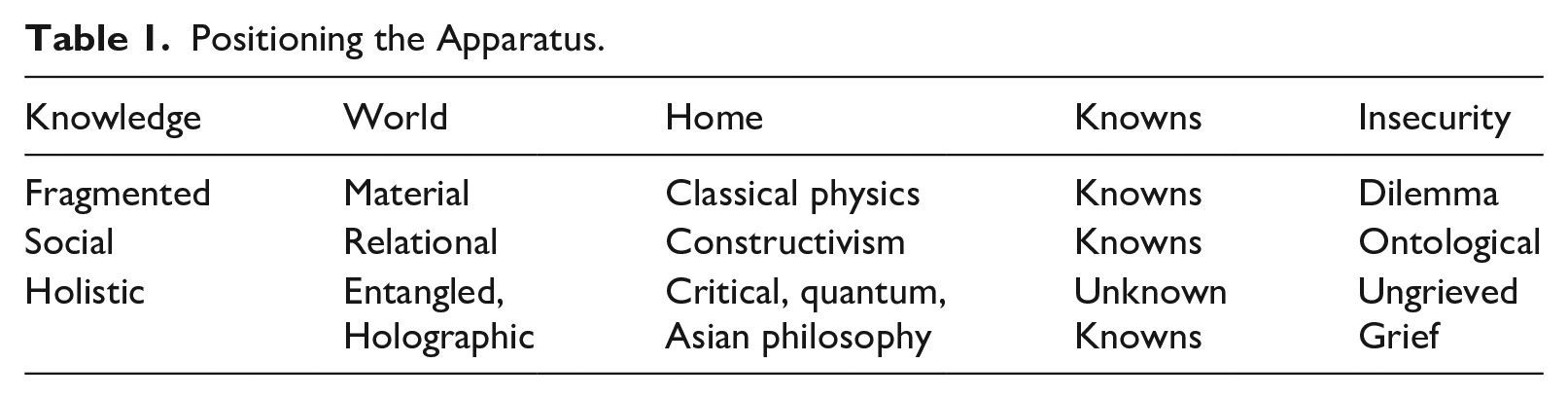
The dilemma arises within a fragmented world of states, defined by their sovereignty. States are prior to any authority above them, which results in a system of self-help. Knowledge, and what it means to be safe, is fragmented (position 1) in so far as each state looks out at a world that is assumed to exist separately, and where their sovereignty and survival trump all else. The realist security dilemma has assumed first and second image causes, relying on the importance of perception, 33 national myths 34 or bureaucratic politics, 35 all of which are factors inside states, and endogenous to their interactions with others. States (their leaders, bureaucracies) observe the actions of others and determine whether they represent objective threats. 36 The security dilemma is assumed to be a pattern that is evident across history. The war in Ukraine appears to be a repetition of the pattern. Western actors express fear about the loss of their freedoms if Russia pushes further into Europe; Russia has said its actions are a response to NATO moving too close to its borders. A series of moves by each side constitutes a dilemma where fighting a war is perceived to be necessary, but could potentially escalate to global war. The fear generated by the spiral is one of competing military power, and a potential loss of sovereignty.
Social knowledge shifts emphasis to the more relational processes by which ‘we’ and knowledge are produced. Drawing on a concept of ontological security, with roots in the work of R.D. Laing and Anthony Giddens, Jennifer Mitzen relocates the source of conflict generated by the security dilemma in the third image, i.e. the in-between place between states, which is exogenous to the logic of competition. 37 The problem, she argues, is less one of the physical need to protect territorial and political sovereignty from material harm by others (i.e. Security Dilemma); the problem is instead a function of routine. Routine, provides a form of ontological security, which states may not want to escape. States, like individuals, seek security of the self through routinizing relationships with significant others, which become attachments. Ontological security may conflict with physical security - even a harmful or self-defeating relationship can provide ontological security, giving rise to an attachment to conflict. Ontological security looks to the continuity of relationships, which, Steele argues are not primarily about survival, but rather self-identity needs. 38 State actors care more about social concerns because to avoid them would disrupt their sense of self-identity, which is just as important as threats of physical security.
If the security dilemma is about state selves observing a world that exists separately from them, ontological security, like the second position, is concerned with the social conditions of the collective self and its relational dynamics. Steele, in taking a critical approach, argues that ontological security risks obscuring or disciplining the kinds of critique envisioned by, for instance, Butler. In its further evolution, the ontological security debate has moved toward the third position, criticizing the priority given to continuity over change 39 or to closures, which require deconstruction. 40 States are not like individuals with ‘selves’ that ‘care’ about their ontological security as rational agents 41 ; rather, autobiographical narratives are used by political actors to provide continuity and familiarity, 42 which is enhanced by reference to collective memory, linking past, present and future. 43 But the continuity may also be disrupted, as ‘narratives of victimhood’ 44 and trauma may upset ‘a certain understanding of the collective narrative’. 45
From the perspective of holistic knowledge, the unknown knowns and the unseen come into view, thereby setting the stage for understanding the problem as one of ungrieved grief. Moving from a discussion of physical security to the ontological security of states, we begin to see a more multi-layered and criss-crossing pattern, the seen and unseen aspects of memory and the scars of violence that have been written into the fabric of the world, 46 not least in the drawing of boundaries between states. From a holistic position, states are less discrete phenomena than a product of historical entanglements arising from war, which has produced the need for fragmented safety. States didn’t spring from the ground like Hobbesian mushrooms, but are part of an interwoven global ecosystem.
Position three involves a reorientation to global entanglements, past and present, and the continuing resonance of memory and practice, which can be cut into from several different angles, e.g. to see entanglements of racial inequality with memories of British empire; of Russian action with memories of its own past of empire and loss; or the memories of World War I or II. World War II was experienced in many different ways. In the context of the Ukraine war, diverse actors invoked memories that harked back to distinct invasions by ‘Nazis’ in that context, as well as rape, massacre and genocide, or of scarcity, 47 as well as further memories of the Cold War relationship between East and West and the potential for nuclear war. At issue is less the causal force of any one object on another (determinism) than how global entanglements with the past bleed into present practices of agents who occupy multiple positions in an indeterminant world. What we see and don’t see is continuously shifting between what is present and non-present; seen and unseen in an unfolding field of relationships. Actors are differently positioned in relation to each other in space and time; they are not ontologically prior units who exist in separation from the engagements by which they have been formed.
Entangled impacts are non-linear rather than linear. The non-linearity is temporal as well as spatial, such that past, present and future unfold in and through each other. 48 Wendt, in his exploration of time, asks a question about changing the past, and its significance for redemption. 49 In what follows we ask a different question about why it is important to see entanglements with the past that have not been acknowledged or grieved. We are concerned with knowing and seeing within a spiral or helix that is always unfolding. Each time a third part enters, there is a reconfiguration and a collapse into a new state, by which the boundary between seen and unseen shifts. The entanglements come neither exclusively from within or without, but are threaded through the various aspects of a relational field, which regards not only a relationship to space but also to time. Once the ‘self’ as an essence that exists unto itself is replaced with a notion of entangled ‘self’, the boundaries that seem to distinguish persons, objects or groups, become fluid and unfolding in multiple directions.
Ungrieved grief
From the position of fragmented security, the physical vulnerability (and safety) of states is a function of a fragmented global system. The security dilemma arises from states looking outward, often on the basis of distorted perceptions, at a dangerous anarchic world, where life is ‘solitary, brutish and short’. From the social position, vulnerability arises from a need to satisfy concerns about identity even at the risk of physical harm. As in the example of Hume, we still don’t see beyond the ‘commerce and conversation’ of a global ‘we’, to see its unseen and unacknowledged victims, although, from this position, there is more potential for turning. From the third holistic position, we move squarely to an exploration of the traumatic entanglements through which holographic and ‘self’-destructive patterns of grievable and ungrievable are reproduced. Seen from the third position, a loss of safety arises from ungrieved grief, which is held in place at the boundary and in the spaces between those rendered grievable and ungrievable.
The problem of unknown knowns is one of turning away and thus being unable to see, even while aware of an unseen presence. From the third position, this assumes a relationship between presence and non-presence, or in particular, between that which we are able to look at and that which we turn away from. In this section, we connect the discussion of unknown knowns to questions of grief and grieving through the unpacking of a number of distinctions.
First, the act of grieving is different than the drawing of boundaries between grievable and ungrievable. Judith Butler argues that grief requires an acknowledgement that everything has changed 50 ; it requires an agreement to undergo a transformation, the full results of which cannot be known in advance. 51 Grief involves a process of seeing and acknowledging, rather than turning away from that which has been lost from a particular relational world. 52 The turning toward grief may be complicated by an experience of trauma. Derrida draws on an analogy to a ’crypt’ to illustrate the consequences of a failure to mourn. 53 The crypt is a place hidden within or beneath, complete unto itself, which is placed as far from the self as possible, yet exists deep within, like a psychic cyst. With the failure to acknowledge traumatic loss, whether by individuals or groups, 54 no mourning can occur. The grief remains ungrieved. As Emma Hutchings and Roland Bleiker argue, how grief is processed or not has implications for how further relations unfold. 55 Grief is a necessary element of acknowledging that everything has changed, and not least in the aftermath of war. It is a positioning of ‘self’, whether individual or affective community, toward the seeing or not seeing of the loss of something or someone valued.
Second, while related, trauma and ungrieved grief are not the same. While ungrieved grief may be a byproduct of trauma, it represents a failure to grieve, a numbing and turning away from loss. Trauma represents a particular kind of impact that arises from a traumatic shock. The experience of trauma is a confrontation with vulnerability and, according to Jenny Edkins, involves a rupture of being. ‘Things’, including the body, are usually experienced as separate from their surroundings; the traumatic experience reveals the radical relationality of all bodies and other ‘things’. 56 When observed in its radical relationality, the body dissolves into the chemical and atomic constituents of the world. Traumatic events ‘tear us from ourselves, bind us to others, transport us, undo us, implicate us in lives that are not our own’. 57 The unknown known, i.e. the vulnerability of ‘bare life’, becomes seen beyond the illusion and experience of separateness.
Ungrieved grief, by contrast, is a byproduct of turning away from the experience of trauma, the packaging and hiding away of the vulnerability, which can have a societal as well as individual dimension. Much like a corrupted computer file, the memory is retained, and in its hiddenness impacts on the functioning of the whole. Ungrieved grief is itself an unknown known. We know it is there but are unable to look at it or sit with it. Grief may not be grieved because the act of grieving is unsafe. Something has happened, but it is not safe to acknowledge it, and the subject is rendered silent. The failure to acknowledge and mourn the loss gives rise to an entanglement between those rendered ungrievable and grievable. The failure to acknowledge may arise from actors in multiple positions, for whom the meaning of safety may differ. Victims may not want others to know, because it would magnify the experience, or due to feelings of shame or the danger presented by perpetrators. Perpetrators also do not want the event to be spoken of, not least because of their own shame, guilt or grief, and thus need to deny that the trauma even happened, while often also denying the existence of the victims themselves. Both sides maintain a silence, which becomes a significant entanglement that passes on to future generations, including those victims of the trauma who have been denied their existence, which adds to the thickness of the entanglement. From this perspective, the boundary between grievable and ungrievable holds both in a position of ungrieved grief.
The third point regards the entanglement of presence and non-presence within a relational system. A failure to grieve the ungrievable is ultimately also a failure to grieve the grievable self, as something is missing, not seen and in need of a place, from which it retains a ghost-like presence. Ghosts hang over death and life, particularly in those spaces of unacknowledged harm, and unresolved life. A concept of ungrieved grief suggests that it is less the presence of the grievable and the absence of the ungrievable that is the issue than the continuing presence of the latter in consciousness and memory, and an inability to see or grieve part of a relational whole that has been lost. 58 Grievable and ungrievable form a relational system, which rests on and is sustained by ungrieved grief.
Gregory Bateson makes the point that mammals are concerned with ‘patterns of relationship’, and how they stand emotionally toward others. 59 Patterns of love, hate, respect, trust, or betrayal – and we would add grief - are crucial because humans and other mammals experience pain when things go wrong, as when, for instance, trust reveals betrayal. Relationships are not purely individual; the most significant points in history, he argues, are those moments when attitudes have changed because of hurt relating to former ‘values’. Bateson uses the word ‘hurt’, which would not in all uses be equivalent to trauma. One can feel hurt by something someone says without it being traumatic. But the two can themselves be different words for a wound, and indeed the word trauma originated with physical injury in battle. In either case, trauma involves a turning away from grief and remaining silent or being silenced.
A relationship between grievable and ungrievable may generate various emotions on either side. Those rendered ungrievable may have experienced betrayal, suffering harm from someone who should have provided protection, or a humiliating lowering of status. 60 The ungrievable dead will not have been acknowledged or had a proper burial. Here we can think of the revelation of the UK War Graves Commission regarding the thousands of unacknowledged brown and black soldiers from World War I, 61 or the large number of unacknowledged dead Russian soldiers in Ukraine, left behind in morgues, 62 as the Russian government looked away from their very high death toll in that context. The grievable, often the victors, may experience shame or guilt for harmful actions toward others. The need to hide this shame or guilt, not least from the self, is proportionate to the need to maintain an image of goodness or power that rests on moral authority. Neither the positioning nor the emotional experience are absolutes. A relational system can change, even while continuing to revolve around distinctions of grievable and ungrievable.
Fourth, transgenerational entanglements emerge at the boundary of ungrieved grief. As Kate Schick notes, a failure to work through trauma can heighten insecurity in the aftermath of conflict for generations to come. 63 An earlier experience may carry over and impact on future generations. However, a claim that victims and perpetrators exist as a binary opposition, which flips in future generations, is an oversimplification. At each point of fracturing, the self stays in a liminal space, unable to look at the loss or let go of who they were. The point is more clearly made in a collective context where we see a series of moments of before, where the self was whole, and after, where there is a loss of self, which resonates out to the collective. The images of Ukrainians going about their business before the invasion by Russia. The point of invasion. The point when the first missile hits. The point at which men stay behind, waving goodbye to wives and children, as mothers and children cross the border to Poland. Each point represents a before/after fracturing and a constant state of existing in a survival mode that is timeless. When people become stuck at a particular before/after fracture, they operate as if still in the past, not in their body, and trying to go back to before.
The shameful parts of the story - the unacknowledged dead, those constituted as ungrievable - are pushed from view. Those who are positioned outside the official story are denied a place for grief for their dead. It is from this place of unseen and unmet grief that entanglements grow. As others turn away, that which is not seen can become a malignant legacy. As trauma is projected onto others, parts of the self that are too painful to look at, become displaced. When in May 2022 former U.S. President George W. Bush referred to ‘the decision of one man to launch a wholly unjustified and brutal invasion of Iraq’, he was intending to point the finger at Putin for his brutality in Ukraine. As a Freudian slip, the gaffe may have arisen from difficulty facing his own actions, as an aging man whose failing memory was having a hard time separating the official story from other narratives within his own conscience. 64 The failure of both sides in a conflict to see beyond their own collectives stories, to acknowledge a more complete picture, has consequences, not least in fuelling a dance between unacknowledged guilt, for the harm done by the self to others, which is an inevitable consequence of war, and unmet grief or shame for losses inflicted on the self. In failing to grieve for the relational whole, individuals and societies render parts of themselves unseen and unacknowledged.
The act of war may itself be undertaken in the pursuit of safety. The act may be a defence against a threatening other, but also provides a means to avoid looking at the weight of one’s own grief or guilt. When grief doesn’t have a place, it contributes to polarization; everything becomes conflict. War becomes a narrative of false safety because it builds on a need to deny a place for grief. Indeed, the security dilemma arises from the need to protect the state self but the safety is false: the state of high alert itself often results in misperception, and unintended conflict or war. The misperception will be shaped and magnified by memories of past harm. Putin justified his invasion of Ukraine, among others, by reference to memories of Nazi invasion. The Soviet Union lost as many as 27 million people during World War II, the highest in the world, and almost double the number of Covid deaths globally today. 65 The place of the Siege of Leningrad in Putin’s own family and cultural memory, 66 and his use of similar siege tactics in Mariupol, among others, might be a useful point for reflection.
The position of perpetrator and victim has changed. The earlier losses were so overwhelming that the subsequent numbing and inability to grieve contributes to a story in which Putin cannot possibly be guilty – the evil lies in Ukraine and its Nazification of the country, a good/evil construction arising in a period of intense vulnerability during the pandemic. That Putin himself did not experience Leningrad suggests the importance of the relational and cultural as opposed to purely individual dimensions of ungrieved grief, 67 and its potential to become transgenerational. What Leningrad experienced then, Mariupol experienced now. In a global context marked by histories of war, dispossession, scarcity, forced displacement and enslavement, trauma is more than an individual or state-level experience. Global entanglements of trauma and ungrieved grief are neither purely endogenous (security dilemma) or exogenous (ontological security). Within a sea of relational entanglements, any one ‘self’ will be like the drop of water that cannot ultimately be separated from the larger bod/ies to which it belongs.
In the midst of trauma, such as ongoing war, the cost of acknowledging trauma will be too high. One needs to ‘soldier on’, maintain morale, show that everything is normal. It isn’t possible to enter into the grieving process while still in the midst of trauma, and indeed, a major trauma such as the Holocaust of Jews in Hitler’s Germany, was followed by decades of silence, 68 and was later mobilized in the politics of Israeli statebuilding. 69 The creation of a boundary between grievable and ungrievable may be mirrored by observers on both sides of a conflict. Ungrieved grief rests on a failure to recognise the ungrievable as a part of the grievable self, which is not merely a product of a single moment of trauma but a changing field of oppositions, in which the ungrieved grief of the Holocaust became the trauma of the Palestinian al Nakba. 70 The need to make others so ungrievable that they aren’t even human means an inability for anyone to look at their actions, or at related emotions of shame and guilt. Barad’s critique of Butler emphasises that the boundary making process is not only in language but arises from ‘mattering’, 71 or the violent intra-actions that leave scars on bodies and in the earth. The grievability of states comes to be woven into narratives of loss and grieving, which hold the ungrieved grief, along with the ungrievable and unacknowledged dead intact. The entanglements thicken over centuries of war, genocide, scarcity, etc., as these memories become written into the fabric of the world. 72
Collective agreements not to know
In the aftermath of trauma, Edkins argues, states domesticate narratives of what happened, thereby silencing the range of stories that might be told. 73 The domesticated narrative, which provides familiarity and continuity, brings about a closure such that the traumatic memory can no longer circulate through multiple stories. Trauma time, in Edkin’s argument, represents an opening to the politics of bare life. 74 Bare life, a concept from Agamben, is an encounter with our fundamental vulnerability. In our argument, ungrieved grief is a consequence of turning away from the vulnerability of bare life and a subsequent failure to see and acknowledge that everything has changed. Ungrieved grief may then reinforce a selective or hegemonic story about the past and, over time, multiple overlapping and shifting performances of grievability, which constitute layers of unseen and ungrievable others. The single domesticated story contains a forgetting of aspects of historical experience and a collective agreement not to know, which constitutes distinctions between the grievable and ungrievable that are held in place by spaces of ungrieved grief, and a triangulation of seen and unseen. Our puzzle regards the difficulty of grieving for relational wholes, which arise from overlapping patterns of grievable and ungrievable.
Epigenetics has identified a potential for traumatic experiences from the past to carry into subsequent generations. 75 The literature on historical trauma has highlighted the extent to which traumatic memories of oppressed groups may find expression in the bodies of later generations, 76 whether due to a continuation of the structural conditions that surrounded the original trauma, or to potentials that lie dormant but may be revived in circumstances that resemble an earlier experience. The ‘embodiment’ of memory is more than the individual experience. Many of the traumas that individuals carry have their origins in historical political events or social upheavals, which have been experienced from different positions in social, political or global space. The ungrieved grief from any one historical trauma will be larger than any one individual, and more than the particular narratives that have been attached to it in the present for particular political ends. 77 Aspects of an historical system that are ‘unseen’, for instance, because they have been hidden or silenced, remain entangled with successor generations, and may come to life in circumstances that share a family resemblance with the earlier experience. Time is not linear. Past is in present, and both may constitute potentials from which the future unfolds. 78 Memory combines with modes of action that were associated with safety at an earlier point in time. A part of safety ‘then’ was to turn away from grief, such that the numbness only grew; memory piles on memory, forming a thickening density of entanglements that arise from not seeing, as individual stories are swiped away and covered up by a single story of good and evil, which, in a conflict, may be mirrored by both sides.
The consequence is a fragmentation that is solidified through the social cohesion of the collective ‘we’ which, as in Hume’s time, produced collective agreements not to know aspects of the liberal global economy. In recent years, a spate of literature from both history and political thought has pointed to the paradox of liberal imperium: the inability to see and acknowledge the seeming contradiction between the freedom and equality at the core of Anglo and French thought, on the one hand, and the harsh reality experienced by the subjects of empire, on the other. 79 A related literature has highlighted the failure to see how some political constructions, while claiming to be colour-blind, have constituted hierarchies of race and a tendency to see only ‘whiteness’. 80 Similarly, a ‘collective agreement not to know’ involves ’unknown knowns’, that is, we know certain things factually but are unable to look or see them in a more visceral sense, to grieve or even recognise them as grievable. It is perfectly possible to know the history of European colonization, or of American or Caribbean enslavement, and to not ‘see’ the shameful aspects of either phenomenon. Both compute as facts of history but without a visceral acknowledgement of the human suffering, focusing instead on the celebration of goodness inherent in ‘our’ history, for instance, in abolishing the slave trade. 81
It is assumed, from a position of fragmentation, that knowledge arises from the observation of fact, yet the writing of history is fraught with debates about the problematic nature of the enterprise, and, as Priya Satia notes, the practice of writing history was bound up in the construction of empire. 82 Consciousness is not purely a product of individual mind, but habitual ways of making distinctions, of memory and telling stories, categorizing peoples or acting in the world that are cultural and political. 83 As cultural and political consciousness becomes bound up in structures of power, it can limit whose story is heard and whose suffering is seen and unseen. Indeed, remembering some things involves the forgetting of others. As Bill Schwarz states, ‘ memory and forgetting are not separate practices, but are interlinked, the one a function of the other. . .but we need to distinguish, in this case, between a desire to forget and an inability to forget’. 84 That which couldn’t be spoken in one sphere of British society in the context of empire might appear elsewhere on the social landscape. The appearance may have been less than conscious, but was nonetheless packed with meaning, while referring to a past that could not otherwise be spoken. 85 Jill Lepore likewise notes the history of silences surrounding the practice and institutions of enslavement in the U.S. 86
That which it is desirable to forget has a way of retaining its presence, popping in and out, changing its form. Forgetting happens among individuals as well as collective bodies, often giving rise to an agreement not to know uncomfortable truths. For instance, the inability to reckon with the history of slavery in the U.S., or to face emotions of guilt, hate, or shame that have emerged around it, has meant that the wound remains open and continues to impact on successive generations. Similarly, denial and an inability to see the impact of climate change on future generations takes the form of a ‘collective agreement not to know’. One source of the not knowing or not seeing is a belief in ‘our way of life’ and its value, which requires ‘not seeing’ how the pursuit of prosperity and industrialisation in the past involved the exploitation of human labour, often constituted around a colour-line, and the appropriation of land for purposes of profit, which has brought humanity to the point of destroying its own habitat. 87 Ungrieved grief can be passed on through generations, both individually or collectively, and can help to cement ‘collective agreements not to know’ or to see habits that benefit some while causing suffering for others.
Triangulating collective agreements not to know
Stories are silenced when they are painful and hard to sit with, e.g. because they involve guilt and shame or because survival or victory have come at the cost of others. Parts of a story may be glossed over for purposes of ‘safety’, and indeed the concept of sovereignty presumes, in a condition of anarchy, a responsibility of states to protect their populations. A ‘collective agreement not to know’ may be held in order to belong and to be safe within a community, culture or state. Once accepted, it is difficult to see or hear anything outside of the dominant narrative because it becomes the source of a version of ‘safety’. Peter Mitchell highlights how World War II and the atrocities of Hitler functioned to absolve Britain’s empire of guilt. 88 The absence of moral equivalence between Hitler’s expansion and the British empire, as well as its victory in the war, meant that the evils of the latter could be pushed from sight. 89 Satia approaches the problem in terms of the management of conscience, and of denial, which is necessary for people to be able to engage in crimes while feeling that they were acting with good intention. 90 The public memory of empire, she argues, required redemptive myths that would mask an abysmal history of looting and pillage, policy driven famines, the brutal crushing of rebellions, torture, concentration camps, racism and humiliation. The question is how the collective story, and an ability to grieve or not grieve, is sustained over time, even when formal structures of slavery and/or empire appear to have collapsed, or the war is over.
While the holistic position emphasises the continuous unfolding of oppositions, a further concept of triangulation provides an understanding of how a particular pattern of grievable and ungrievable may be held in place. 91 In generic terms, triangulation suggests a process by which a third part, whether idea, person or collective, may be pushed out of sight by the collusion of two other parts as illustrated in Figure 1. A complementary opposition is not singular and fixed in space, i.e. binary, but always fluctuating; what on the surface appears to be a two-way opposition may give rise to a triangulation, as a field of oppositions unfolds. The field may not be purely local, but potentially involves an entanglement across space and time. In this respect, collective stories in the present may come to express a triangulation which has been more or less continuously reproduced but without conscious awareness of the habit or what it does. Patterns of storytelling may facilitate an inability to see or know a part of the triangle. In this respect, the story rests on a ‘collective agreement not to know’.
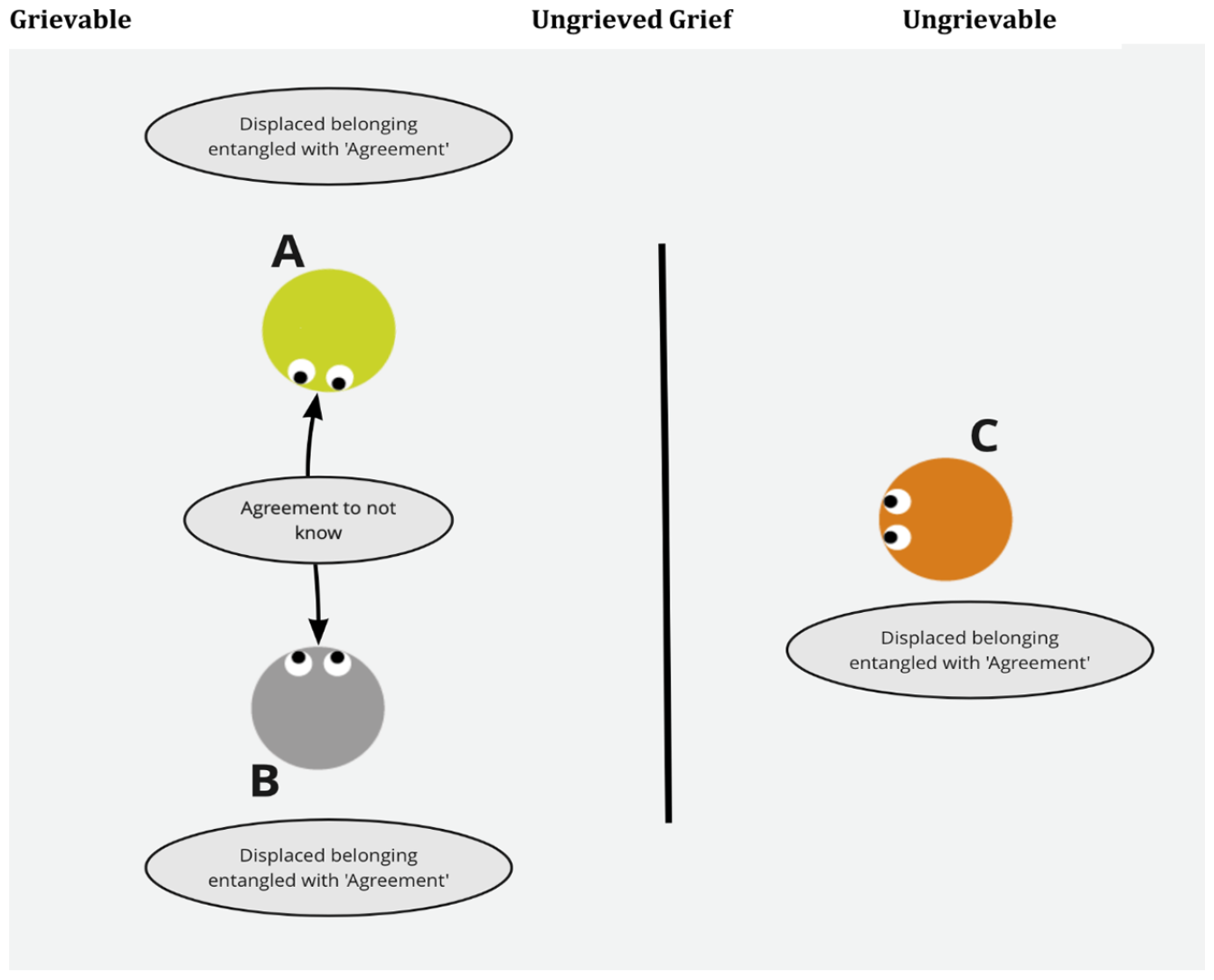
Triangulation of the unseen.
A three-way relationship of this kind was evident in the aftermath of the U.S. Civil War, where the polarity between Black enslaved and White enslavers became bound up in a collusion between White citizens who suffered defeat and White citizens who won back the union. The triangulation was expressed, for instance, at the fifth anniversary of the Battle of Gettysburg, which included Whites from both North and South, while excluding Black soldiers. It rested on an agreement to remember the Civil War as a war over states’ rights rather than slavery. 92 The triangulation involved a degree of collusion to suppress the lived experience of the formerly enslaved. 93 The collective agreement not to know had variations in the United Kingdom and other European states that were connected to the slave trade, and in this respect the patterns of entanglement arose from a global system, while also finding more localised and contextual expression. In its collective story, Scotland was the victim of England and innocent in the slave trade. 94 The story obscured Glasgow’s involvement in and profit from the latter. This history, as David Haymen suggests, was written with the intention of not ‘seeing’ or ‘knowing’, expressing a national amnesia that was both wilful and deliberate. A relational system, rather than individuals per se, worked to erase the unseen. The collective narrative made it possible for all to participate in the obfuscation of reality. The transatlantic slave trade and many more tragedies of history are all facts that most will on some level be familiar with. The reality of the pain and the loss suffered by those who survived, those left behind or those who died, is far more hidden.
A contemporary relationship remains bound up in a system of entangled belonging from an earlier time, which no one is free to look at because the costs are too high. Each position holds ungrieved grief. 95 An unwillingness to look at the cost of the ungrieved grief may contribute to a hateful rather than compassionate response. The cost of looking is too great. The hate is safer, as it doesn’t threaten the transactional nature of the safety and belonging that results from not seeing. The dynamic leaves the burden of the histories of enslavers or colonizers with those who were enslaved or colonized. ‘White’ people don’t have to see or feel this entanglement on a daily basis but it informs the lived experience of people of colour, 96 a point that is further reinforced by the disproportionate experience of the consequences of climate change for post-colonial states that contributed little to its emergence.
From the position of fragmented safety, the distinction between ungrievable and grievable is a valuation, which designates who matters and who is disposable. From the perspective of holistic safety, the fragmentation constitutes a space of ungrieved grief that entangles the parts. In failing to see the entanglements, the grievable are no more able to acknowledge that everything has changed, and to grieve those parts of the self that are a part of the ungrievable and thus must be turned away from. Ungrieved grief arises at the boundary between the grievable and ungrievable, making it difficult to see the entanglement of both and the importance of grieving for the whole. The articulation of the safety paradox, in the next section, highlights the impossible necessity of grieving for the whole and is brought back to the initial problem of the relationship between climate change and colonialism.
The safety paradox
Triangulation holds a particular boundary between grievable and ungrievable in place. A ‘collective agreement not to know’ stands in the way of seeing, acknowledging and grieving. Such agreements can be found anywhere in the world, in a matrix of intersecting relationships of various kinds. In the context of the Covid pandemic, we saw some movement in breaking away from certain agreements. Think, for instance, of the enhanced ability to see the working of a Black/White polarity in the aftermath of George Floyd’s murder in the U.S. in the spring of 2020, and the spread of Black Lives Matters, which opened a space for the surfacing of ungrieved grief belonging to a history of transatlantic slavery. A further unfolding of oppositions distracted the Western gaze. By February 2022, with the breakdown of the post-World War II agreement for peace in Europe and the Russian invasion of Ukraine, Western attention shifted away from racial inequality to the opposition between a good democratic West and an evil Russia. Through the glare of the false safety of war, it became more difficult to see not only the past of racial inequality in the West but a future for children in a world shaken by climate change. The dynamic reverberated in multiple directions, through further oppositions between those seen and welcomed as refugees (Ukrainians), who are the byproduct of a war inflicted by the evil East, and those who have often been shunned as migrants, both as people of colour or previous subjects of Western and European intervention, now and in the past. The false safety of a new war, energized by memories of World War II and the Cold War, constituted new lines of grievable and ungrievable. The billions going into the war has had priority over ‘loss and damage’ to those who suffer the brunt of climate change now.
The Secretary-General of the UN, Antonio Gutterez, has emphasised repeatedly the need for global action on climate change and to bring an end to the war in Ukraine, even while global institutions have been less than effective on both counts. At the heart of the problem is a conflict between two definitions of safety, one that arises from fragmentation, and another that requires seeing the relational whole. The search for international security arises from the fragmented safety of anarchy. Being safe in this construction means being prepared for war. Seeing the present through the heavy lens of memories of past wars contributes to misperception. The security dilemma emphasizes perceptions of material power, and the rationality of arming in defence, which in the context of the war in Ukraine fuels ongoing war and a potential escalation to global war.
The security dilemma says little about how or whether the logic changes once the whole, made up of parts constituted as sovereign, is itself under threat. States could, following on the logic of social contract theory, give up a portion of their sovereignty in exchange for global protection. But the security dilemma is precisely about the unwillingness of states to give up their sovereignty, as this would mean they cease to exist, or at least make themselves vulnerable to this eventual outcome. For many the lesson of the invasion of Ukraine will be that once possessing nuclear weapons, giving them up on the basis of a promise of protection, as Ukraine did, is a very bad idea. 97 The Russian invasion contributed to fears that China will act in a similar manner, for instance, by invading Taiwan. The tragedy, against the backdrop of climate change and other global threats, is that a global war will not only result in a loss of sovereignty for some but the loss of all life on the planet. The security dilemma arises from the self-protection of states from other states. The hegemonic story of each state, and the ‘collective agreements not to know’ contained within any one, stand in the way of seeing the global whole, which is necessary for prioritizing the protection of a shared habitat.
The situation is not anarchy as usual, but a far more dangerous configuration. From the perspective of the security dilemma, it is irrational to consider giving up sovereignty as part of a new social contract that is global. In ontological terms, this would represent a shift from the sovereignty of individual states to co-habitation of all under the same roof. In the immediate aftermath of the Cold War, Gorbachev’s new European ‘house’ was an attempt to broaden the space of European security in a new structure, building on the CSCE, 98 neither East nor West albeit regional rather than global. NATO instead constructed its post-Cold War ‘architecture’, which shifted the centre of power Westward, leaving Russia on the periphery. The potential for a European house as an alternative pathway out of the Cold War, and its impact on an evolving reality, leading to the present, is now a counterfactual. At the time, NATO expressed a clear nervousness about occupying a ‘house’ with the former Soviet Union. 99 In the run-up to the 2022 invasion of Ukraine, Putin expressed both disapproval and humiliation about NATO’s enlargement over the past decades. The problem is one of fear that the sovereign self will be lost, 100 the boundaries of which have been hardened over centuries of invasion and defeat, during which vulnerability and grief have been packaged and filed away, always ready to fuel the next onslaught. The imminent threat of climate change should make the vulnerability and interdependence of a fragile planet crystal clear. A loss of shared habitat will mean that we will all become ungrievable because there will be no one left to grieve and no future generations to build on this legacy.
Conclusions
A concept of unknown knowns highlights a tendency to turn away from aspects of life that are painful to see or that we refuse to look at or understand in a more visceral way. The facts may be known, but the ‘event’ is placed in a separate past that has little to do with the present or who ‘we’ are. While knowledge is always positional and incomplete, a more holistic positioning makes it possible to begin to see the unseen non-present in the present and to turn toward the ungrieved grief that arises from diverse global entanglements of grievable and ungrievable
Ungrieved grief represents a slightly different take on the distinction between grievable and ungrievable. The distinction between grievable and ungrievable is one of whose grief is seen and whose grief is unseen which, at the level of affective communities, grants the agency of grief to power and the boundary making process of states, which is different than the act of turning toward loss. 101 The selectivity of grief tends to harden boundaries between the grievable and the ungrievable, reproducing distinctions between life and death at the international level, as the grievable protect the displaced and ungrieved self they carry. States turn inward to grieve the loss of their own soldiers who sacrificed their life for the nation. They do not as a rule grieve the losses of an enemy.
States do not grieve or experience trauma, but their relational fibre is often woven through collective agreements not to know that may keep a shared experience of trauma alive in populations, although often dormant, until invoked by circumstances that resemble the earlier experience. State leaders often perform grief in making a distinction between those within, who are grievable, and those outside, who are not, 102 as part of the emotional governance of an otherwise contested politics. 103 It is not that some are by definition or essence ungrievable; rather some are rendered ungrievable within a fragmented relational system, by which they, through processes of triangulation, become invisible, absent, and without place.
The safety paradox regards, on the one hand, the inability to grieve on a global level, whether for the massive loss of life in the pandemic or of past wars or the threat not only of global war but of global environmental catastrophe, and, on the other hand, the importance of grieving for that whole, to place sufficient value in our shared habitat and life to make it happen. Ungrieved grief highlights the costs of not grieving as a relational whole for the shape of the post-pandemic world and indeed for future generations. Ungrieved grief provides the raw material for the fragmented safety that fuels war, which often involves the wanton destruction of those rendered ungrievable in the name of protecting the grievable. In the present context, we see successor states of former empires lining up to take ownership of the post-pandemic ‘order’, many fuelled by memories of humiliation and betrayal. Against the backdrop of the invasion of Ukraine and climate change, a repositioning is needed. The reorientation requires a rethinking of not only the engagements of the particular ‘I’ and the relational ‘we’, but also the relationship between past, present, and future as it relates to a legacy of collective agreements not to see or know, and an unwillingness to turn toward the shared vulnerability of all life. In light of the impossible necessity of becoming global, it is time to turn toward the ungrieved grief, to re-member a more radical relationality, and to know the unknown known of our shared vulnerability.
Footnotes
Acknowledgements
The authors would like to thank the Human Family Unity Foundation for their generous support of the project, Mapping the Empire: The Contemporary Legacy of Historical Trauma and Forced Displacement, as well as the project participants, and Naomi Head, Andrew Milne, Joost Pietschmann, and Yang Yuanfuyi for feedback on drafts of the paper.
Funding
In order to meet institutional and research funder open access requirements, any accepted manuscript arising shall be open access under a Creative Commons Attribution (CC BY) reuse license with zero embargo. This study is not based on any new or pre-existing data. The article is part of a larger project, Mapping the Empire: The Contemporary Legacy of Historical Trauma and Forced Displacement, which has been funded by the U.S. Human Family Unity Foundation through a donation to the University of St. Andrews.
