




Abstract
This article seeks to explore the quantum notion that to ‘see’ an entanglement is to break it in the context of an ‘experiment’ regarding the ongoing impact of traumatic political memory on the present. The analysis is a product of collaboration over the past four years between the two authors, one a scholar of international relations, the other a therapeutic practitioner with training in medical physics. Our focus is the conceptual claim that ‘seeing’ breaks an entanglement rather than the experiment itself. The first section explores a broad contrast between classical and quantum measurement, asking what this might mean at the macroscopic level. The second section categorizes Wendt’s claim about language as a form of expressive measurement and explores the relationship to discourse analysis. The third section explores the broad contours of our experiment and the role of a somewhat different form of non-linear expressive measurement. In the final section, we elaborate the relationship between redemptive measurement and breaking an entanglement, which involves a form of ‘seeing’ that witnesses to unacknowledged past trauma.
Introduction
When a pair of entangled particles is observed, the entanglement will be broken. (Mahood, 2018: 198)
Memory represents an entanglement with the past. When Syria’s President Bashar al-Assad invokes the Armenian Genocide, or Hungary’s Prime Minister Victor Orbán refers to the ‘Ottoman invasion’, they point to a traumatic past with political implications in the present. Arguments about collective trauma highlight the extent to which the narration of trauma expresses the concerns of successor generations, which may or may not be linked to an underlying traumatic experience of contemporary subjects (Alexander, 2012; Alexander et al., 2004; Sztompka, 2000). In this respect, memory is put in service of a present and future political project, which may be a source of community-building (Hutchison, 2016) and/or aggression (Fierke, 2004; Scheff and Rezinger, 1991). As Edkins (2002, 2003) notes, while trauma is ‘unspeakable’, given that it entails the rupture of everyday safety, it is often domesticated in political discourse.
The political uses of memory often hark back to events that long precede the living, which raises a question of why they would continue to exercise an affective pull on contemporary populations. Lerner (2019) argues that the affective resonance of the past is in part a function of the severity of the trauma or its recurring experience by communities over time. In this respect, the political discourse may express multiple traumas and layers of entanglement that continue to resonate with populations. For instance, the literature on historical trauma emphasizes the continuing impact of past traumas of a political nature on the present health of indigenous communities in particular, arising from interrelated genetic, social and environmental factors (Matthews and Phillips, 2010; Walters et al., 2011), as well as the continuing impact of structural violence on successor generations (Kirmayer et al., 2014: 311).
Starting with a claim that trauma represents an entanglement with the past, this article seeks to explore the quantum notion that to ‘see’ an entanglement is to break it, as well as the implications of this claim for the politics of security. While it is often assumed that the quantum debate in international relations remains at the level of theory (Lamb-Books, 2016), we explore the meaning of measurement, seeing and breaking an entanglement in the context of an ‘experiment’ regarding the ongoing impact of traumatic political memory on the present. How does quantum measurement differ from classical? What does it look like, and what are the implications for the analysis of security practice? What does it mean to say that when an entanglement is ‘seen’ it is broken? The analysis that follows arose from collaboration over the past four years between the two authors, one a scholar of international relations, the other a therapeutic practitioner with training in medical physics. 1 Our ‘experiment’ was motivated by an interest in exploring methods that approach problems of security from an angle different from that of conventional wisdom, thereby opening up new potentials, in the light of increasing questions about the efficacy of existing practices and a ‘crisis’ in the field (Nyman and Burke, 2016). 2
In this article, our objective is to explore a conceptual problem rather than the experiment itself, or the results arising from it, not least owing to the difficulty of communicating an experiential method in language. In the first section, we explore a broad contrast between classical and quantum measurement, asking what this might mean at the macroscopic level. In the second section, we categorize Wendt’s claim about language as a form of expressive measurement and explore the relationship to discourse analysis. The more spatial ‘cut’ into political discourse, while often drawing on memory, does not account for the affective resonance of transgenerational entanglements. In the third section, we explore the broad contours of our experiment and the role of a somewhat different form of non-linear expressive measurement. In the final section, we elaborate the relationship between redemptive measurement and breaking an entanglement, which involves a form of ‘seeing’ that witnesses to unacknowledged past trauma.
Classical and quantum
In classical physics, a particle can only be a particle and thus an independent entity, which gives rise to assumptions of materialism, locality and determinism. One of the central discoveries of quantum physics, as demonstrated in the famous two-slit experiment, is that a particle can become a wave and a wave can become a particle in certain circumstances. Elementary particles are not objective material objects, with characteristics that can be determined, but rather phenomena that arise from an interaction of some kind, or indeed can be seen as the interaction itself. The latter contrasts with classical assumptions that an elementary particle is an independently existing entity. Instead, as the American quantum physicist Henry Stapp (1971: 1303) stated, a particle is ‘in essence a set of relationships that reach toward other things’.
In classical physics, the separateness of objects with pre-existing properties and boundaries makes it possible to measure their interactions. There is an assumed intrinsic separation between the knower, the known and the apparatus of measurement itself. The scientist stands outside of the objects of observation, which are assumed to exist as discrete entities, with a fixed location in time and space. In simple terms, the measurement consists of quantifying the distance between objects. By contrast, in quantum physics the object of measurement is not fixed; the boundary that separates the object from the ‘agencies of observation’ will be heavily dependent on the physical arrangement of the apparatus, and thus indeterminate (Barad, 2007: 114). The apparatus is a crucial part of the measuring process. The choice of apparatus for each measurement creates the condition ‘to give meaning to a particular set of variables at the exclusion of other essential variables’ (Barad, 2007: 113–115). The apparatus and the measurement are entangled, and thus not entirely separable.
As Karen Barad notes (2007: 74), ‘entanglements’ are very specific configurations. However, it is difficult to build apparatuses for their study, because the apparatus changes with each intra-action, and because space, time and matter ‘do not exist prior to the intra-actions that reconstitute entanglements’. The apparatus and the observed phenomenon change alongside one other. The measuring apparatus itself enacts a ‘cut’, which is an ‘intra-action’ from which separation and difference emerge (Barad, 2007: 140). 3 The intra-action between object and apparatus are a part of the phenomenon, which means that measurement practices also constitute the results and are thus indispensable to them. The analyst cannot be separated from the apparatus of measurement, and the measurement itself arises from an act of seeing.
The question is what form the apparatus would take in relation to human intra-actions. Barad conceptualizes the apparatus in broad material-discursive terms, which can take a variety of forms. Wendt (2015) specifies that language itself is an apparatus; language use is a form of measurement that impacts on what is observed. He states that ‘in language what brings about a concept’s collapse from potential meanings into an actual one is a speech act, which may be seen as a measurement that puts it into a context, with both other words and particular listeners’ (Wendt, 2015: 217). The collapse starts with communicative intent (the decision to communicate one meaning rather than another), which depends also on the listener, whose understanding will depend on how what is said interacts with a memory of words and their association. Accordingly, ‘memory structures relate to concepts in the same way that measurement devices in physics relate to particles’, which suggests that quantum entanglement and interference are manifested in actual language use (Wendt, 2015: 217). Insofar as memories are stored not as isolated entities but as networks of related words, their entanglement is evident in how they are activated (Wendt, 2015: 219). The act of measurement begins with an intentional act of language use, by one who reaches out relationally to another. Memory is the repository of meanings from which the specific measurement arises, as wave functions collapse into language, materializing one potential rather than another.
In Wendt’s argument, language use is both an expression of entanglement and the point of departure for the enactment of multiple potentials. What does this look like in practice? To take one example, as discussed elsewhere (Fierke, 2017), the concepts of migrant, refugee and terrorist as applied in the larger context of the European ‘migration crisis’ are, from this perspective, relational and defined in contrast to those who ‘belong’. None of these categories map neatly onto a subject with an intrinsic identity; rather, these are thin identity categories that are superimposed on the thicker sense of self that the incomer carries with them from a place of origin. In the confrontation between host society and incomers, the use of language is a measurement that places people along a status hierarchy that determines the extent of their ‘humanness’. The language already contains a measurement of the identity of particular groups of people as human ‘like us’ or as less than human and a potential source of danger. This, then, also becomes a measure of what we should feel, whether compassion or fear, and how ‘we’ should act toward ‘them’ – that is, whether they should be welcomed or refused entry, held behind barbed wire or a wall, stripped of their possessions, tortured, or even killed. The example reinforces Wendt’s claim that language use results in wave-function collapse around one potential rather than others, thereby instantiating one reality rather than other possible realities.
Expressive measurement
Language expresses a form of ‘seeing’ by the observer as wave functions collapse. The seeing is ‘partial’. The thin concepts of ‘migrant’, ‘refugee’ or ‘terrorist’ define the boundaries within which the ‘other’ is seen, and any one ‘cut’ creates a particular separation between ‘us’ and ‘them’. Another example highlights the role of memory, making it possible to explore the ‘partiality’ of the cut and measurement from a somewhat different angle. In a lengthy interview in 2014, President Bashar al-Assad made an unexpected reference to the massacres of 1.5 million Armenians and identified the perpetrator as Ottoman Turkey. During the interview, Assad compared the Armenian Genocide of 1915 to the brutal killings of civilians in Syria today: The degree of savagery and inhumanity that the terrorists have reached reminds us of what happened in the Middle Ages in Europe over 500 years ago. In more recent modern times, it reminds us of the massacres perpetrated by the Ottomans against the Armenians when they killed a million and a half Armenians and half a million Orthodox Syriacs in Syria and in Turkish territory. (Sassounian, 2014)
Assad’s words were articulated in the context of a dispute with Turkey and were intended to lash back at the Turkish government’s hostile actions against the Syrian regime. 4
The example highlights several points. First, Assad’s use of language is a measurement of the war in Syria that enacts a particular kind of separation between terrorists and states, which is magnified by reference to a particular memory of brutality. Memory, in this reading, is an observational instrument by which a particular ‘cut’ is made. Assad’s reference to ‘terrorists’, associated with Turkey, places them outside of Syria, thereby reinforcing his legitimacy as the leader of Syria, as well as his actions in defence of Syria’s security. A discourse of terrorists and legitimate leaders represents a measure different from that, for instance, of a Syrian ‘civil war’. As suggested by Ricouer (1990: x), the identification of a resemblance between things that would at first glance seem to have nothing to do with each other ‘grasps together’ and integrates scattered events into a single whole. This involves a degree of forgetting, and thus elements that are not seen. The narrative excludes other possible alternatives and is itself selective. Second, the memory constitutes a future that is only ‘there’ as a project to be realized (Kratochwil, 2018: 420). Assad claims the memory as his own and frames it in a particular way that enables him to heighten his own use of violence, thereby drawing power from it. The implicit logic not only becomes a form of forgetting, in the light of its selectivity, but justifies his present and future project to eliminate the ‘terrorists’. ‘Seeing’ happens from a particular position in time and space, which is partial. The measurement expresses a particular ‘cut’ that shapes a relational world in the present, one of Ottoman terrorists and legitimate state actors. An earlier perpetration fuels a perpetration in the present. Assad’s use of language is itself a form of expressive measurement by which he ‘sees’ the world. Third, the measurement of past, present and future obscures the more complex, open field within which the memory remains alive – in all those who were forcefully displaced, died or are otherwise unseen in their suffering, both past and present. As one Syrian blogger in Aleppo stated, during the siege in 2016, the world was not ‘seeing’ their suffering.
Discourse analysis
Assad’s measurement could be analysed with methods of discourse analysis. One might, however, question the added value of associating discourse with abstract ideas about the activity of waves. The quantum argument is that physical systems do not have definite properties until they are measured through memory, and that it is at this point of observation that something comes to life. Assad’s terrorists become agents of genocide as he invokes a memory that then has further physical or material consequences. The act of giving meaning is a collapse into the physical properties of language. While the quantum argument is interesting, discourse analysts have engaged in language analysis for decades without reference to wave function.
The quantum angle is, however, important for beginning to think differently about what it means to measure and how this relates to ‘seeing’. Language-based methods have often been cast as ‘fuzzy’, woolly headed and therefore unscientific (Laffey and Weldes, 2004), and even users may be reluctant to associate discourse analysis with any kind of measurement. Measurement is associated with quantification, which rests on classical assumptions of atomism, as well as an understanding of language as a mirror that more or less accurately reflects truth in the world. Approaching language and measurement from a quantum angle turns this logic on its head. In Wendt’s (2015: 217) argument, language use involves a speech act, which is a measurement that puts words in context, by which they are collapsed from a potential meaning into an actual one. Discourse analysis is the empirical study of relational worlds embedded in meaning structures that have been manifested in the words of political agents.
Discourse analysis is not just concerned with the mapping of relational worlds but, given its roots in Foucault, among others, has been particularly concerned with power relationships embedded in language. The analysis provides a means to ‘see’ the discourse not as a description of reality ‘as it is’, but as expressing a structure of power and exclusion. To take another example, which involves an even more problematic conflation, Hungary’s Prime Minister Victor Orbán stated that incoming migrants represent an ‘Ottoman invasion’. 5 The claim relates to two contrasting forms of ‘seeing’. In the first, Orbán, like Assad, manifests a particular reality by invoking a specific memory. In this ‘seeing’, a population, composed primarily of people fleeing violence and persecution, becomes an invading army. The single claim is embedded in a larger relational world that is meaningful precisely because of the memory it brings to life. To ‘see’, in this use, is to go beyond a descriptive understanding of language to its embeddedness in relational structures of power.
A second form of ‘seeing’ arises from the analysis of the political statements of, for example, Orbán. From this position, we also begin to see not just the multiplicity of relational potentials but also the silences contained in discourse. The analysis might, for instance, juxtapose the ‘invasion’ with other measurements, for instance in Germany, that constructed a different world, characterized by the importance of compassion, relying perhaps on a memory of the plight of German refugees following World War II (see Feindt, 2017). A discourse analysis might also examine the power relationships inherent in either, arguing, for instance, that, even at its most humanitarian, the underlying logic is exclusionary and dehumanizing and thus silences the voices of the refugees themselves (Chouliaraki and Stolic, 2017; Musaro, 2017). As Chouliaraki and Stolic (2017: 1170) argue, the voicelessness of refugees is a form of ‘epistemological violence’ (Paik, 2016), in which the marginalized become entangled with Western practices and discourses that reinforce their own exclusion. The analysis makes it possible to begin to ‘see’ the unseen, along with the suffering constituted by the discourses that surround refugees and migration, thereby breaking the hold of an entanglement.
Placing discourse analysis in a quantum framework reinforces several arguments that have been more or less successfully employed by critical scholars in the past. 6 While our analysis has focused on single texts of leaders, discourse analysis usually looks across the texts of multiple actors and thus tries to reconstruct a relational world. Discourse analysis does not by definition deal with memory, but it has been employed by analysts concerned with memory. A fourth generation of memory studies in the field of history, focused on ‘entangled memory’, represents a shift toward an emphasis on entanglement in discourse across time (see Feindt et al., 2014; Pestel et al., 2017).
The latter, nonetheless, remains limited by the availability of texts and, particularly when looking across time, the absence or destruction of documents or archives, not least relating to those who suffered and are unseen. For instance, a recent BBC documentary (Haymen, 2018) contrasted the myth of Scottish innocence in the slave trade, as well as Scotland’s status as victim of England, with the many ways in which Glasgow, no less than Liverpool or Bristol, was closely bound up in and profited from the slave trade. This history, it was suggested, was written with the intention of not ‘seeing’ and expresses a national amnesia that was wilful and deliberate, written from the perspective of elite white men who controlled the archives, diaries and ledgers, which were often destroyed. National amnesia and forgetting worked at the level of a system that worked to erase, complemented by a public narrative in which all could participate in the obfuscation of ‘reality’. In what follows, we suggest a method that is compatible with discourse analysis but goes further to explore the affective resonance of memory. In other words, in addition to understanding memory as an observational instrument by which a particular ‘cut’ is made, memory can be examined as itself an entangled phenomenon.
As already stated, public narratives are usually written from the perspective of present concerns and future projects (see also Kratochwil, 2018). This raises a question about the relationship between political discourse and entanglement with the past. How is it possible that battles that took place centuries ago have a continuing resonance in the present? Is this resonance on some level prior to discourse and entangled with an experiential past? In the next section, we highlight another form of the expressive measurement that is dependent on quantum effects, and thus on the relationship between collapsing wave functions and language.
Measuring transgenerational trauma
While potentially of tremendous scientific and practical significance, the experiential and experimental aspects of our project are difficult to communicate in words, not least owing to the non-linear nature of the phenomenon and the divergence from conventional social science practice. The emphasis on the experiential as well as the experimental highlights the quantum assumption that the analyst or any participants cannot be separated from either the apparatus of measurement or the outcomes. ‘Experience’ in this case can be contrasted with both third-party ‘objective’ experience, most often associated with Newtonian science, and ‘subjective’ first-person experience, which Wendt (2015) discusses as consciousness of ‘I’. 7 Instead, it can be thought of as a form of second-person experience that arises from an interaction between world and body, or with what Barad (2010: 260) refers to as memory that is ‘written into the fabric of the world’. Our concern was less with the historical detail of what happened than with a diffracted relational pattern of affect that is entangled in memory, which we sought to map. The individuals involved engaged with the affect surrounding a temporal phenomenon – that is, an experience that occurred in past time, rather than an entity, individual or otherwise.
Given space limitations and the primary intention to articulate a conceptual relationship between seeing and breaking an entanglement, we briefly present what the method is about and the relationship between the apparatus and forms of measurement involved. In doing so, we draw on insights and data from the experiment anecdotally to make conceptual points, and minimize the review or references to other literatures, except as necessary, given the numerous connections that could be made across fields in both the natural and the social sciences. While we recognize that the account may raise more questions than it answers, the unpacking of further concepts will have to wait for another time.
The method relies on several quantum assumptions. First, as already suggested, entangled phenomena are by definition non-local, and in this case express entanglements with transgenerational memory. The method takes a step beyond existing non-linear approaches to memory 8 to focus on the wave-function collapse itself and a quantum understanding of time. Barad (2014: 171) draws on the imagery of light behaving as a fluid, which, upon encountering an obstacle, breaks up and moves outward in different directions. Time itself is diffracted, she argues, insofar as it is ‘broken apart in different directions, non-contemporaneous with itself. Each moment is an infinite multiplicity’ (Barad, 2014: 169). Patterns of diffraction, as noted by Donna Haraway, do not mark where differences occur but rather where the effects of differences appear. 9 Our experiment shifts focus slightly to patterns of affective difference that emerge from the mapping of a relational whole, in which past and present are not fully separable.
Second, following on from the last point, entanglements relate to emotions and affect. As Sparrer (2007) notes, emotions do not ‘belong’ to us as stable attributes but can be both non-local and entangled with others, both present and past. The focus of our method is on traumatic entanglements with the past as they relate to political rather than individual memory. 10 It begins with an assumption that war, forced displacement and violence, suffered or perpetuated in one generation, cross over to other generations in such a way that a younger generation may bear the burdens of its parents’ or grandparents’ generations, thereby assuming the latter’s unsanctioned behaviours and related guilt (Dietrich, 2013: 139). The main point is illustrated in a simple example at the individual level, where two men from different belief systems are embroiled in a deeply emotional fight, with each of them carrying the anger and experience of their father, grandfathers, great-grandfathers, etc. The entanglement with the past thus adds to the toxicity of current conflict.
A notion of transgenerational trauma points to a field of affective resonance that is beyond language. As Bessel van der Kolk (1998) noted: a century of study of traumatic memories shows that (i) semantic representations may coexist with sensory imprints; (ii) unlike trauma narratives, these sensory experiences often remain stable over time, unaltered by other life experiences; (iii) they may return, triggered by reminders, with a vividness as if the experience were happening all over again; and (iv) these flashbacks may occur in a mental state in which victims are unable to precisely articulate what they are feeling and thinking.
While Van der Kolk’s focus is individual memory, we suggest that collective memories of trauma are entangled with sensory imprints – that is, the memory is itself an entangled phenomenon that can be triggered by political changes that bring past traumas to the surface.
Third, it is possible to map sensory imprints of transgenerational trauma – or what we refer to as fields of resonance. As we began our experiment, we relied on the basic principles and theory of systemic constellations therapy, which has established a central place for itself within German therapeutic culture, not least in efforts to address the traumatic after-effects of World War II (see Bilger, 2016). 11 The basic idea of systems therapy more generally is that individual problems cannot be viewed in isolation from a larger relational system. While family systems therapy is often concerned with role-playing, systemic constellations go further, to the groundbreaking observation that it is possible, in certain circumstances, for substitutes or proxies – which we refer to as representatives – to experience the physical and affective dynamics of a system during a constellation exercise, thereby bringing insight into its deeper and often hidden affective dynamics (De Carvalho and Klussman, 2010). In other words, those who occupy positions within a relational system are able to represent the bodily sensations, feelings and impulses of someone whom they do not know or, in our experiment, that are associated with categories of memory that are larger than the individual. The phenomenon arises from an intra-action between diffraction patterns of affect, which express a collective experience of suffering in the past, and representatives within the experiment, who experience the affective resonance surrounding this past.
Similar to what many physicists have said about quantum physics more generally, Splinter and Wustehube state that the effectiveness of the systemic constellations approach ‘can be regarded as empirically proven, but a broadly approved scientific explanation of why it works is missing’ (Splinter and Wustehube, 2011: 118, emphasis in original). German psychologist and engineer Peter Schotter demonstrated in a scientific study involving 3000 individual experiences that the perceptions of proxies, who knew nothing of the parties they represented, were not random and were reproducible (De Carvalho and Klussman, 2010). One objective of our project was to determine whether, when moving from individual to political memory, patterns would emerge from the engagement of the representatives during the mapping process. The maps were set up blind, to minimize interpretation by the individuals involved and to establish that any patterns could be attributed to a field of resonance. 12
Fourth, the individual and social or political dimensions of memory cannot be neatly separated, but the latter is the prior condition for the former. As Kratochwil (2018: 328) notes, individual memory is built up through participation in communication processes, which involve common reflections on who ‘we’ are, which is shaped by where we think we come from, none of which can be separated from identities and collective memories that make ‘society’ an ongoing and transgenerational concern among its members. While constellation work revolves around individuals, any one of whom will be entangled with diverse collective memories through their family lineage, the current project seeks to explore collective memory as prior to any one individual. Some work has been done to apply systemic constellations to political conflict, working directly with actors on the ground (see, for example, De Carvalho and Klussman, 2010; Mahr, 2003; Mayr, 2012; Splinter and Wustehube, 2011). While further development of this potential is very important, the present experiment began with an assumption that many current conflicts, such as that in Syria, are too hot or too dangerous to contemplate any direct engagement or, in the case of terrorist violence, also too difficult to address through direct involvement of the parties themselves. This gave rise to a conclusion that, as entangled memories arise from an experience of past generations, it is possible to represent categories of actors in a mapping exercise without going to the physical site of conflict, thereby minimizing risk factors for those involved while potentially bringing great benefits to those who are subjected daily to a diet of brutal violence.
As we worked further with the method, the frequent recurrence of memories of forced displacement led to a further distinction. The constellations are concerned with belonging and who belongs to a system, which in the case of political constellations is concerned with large groups (Dietrich, 2013: 134). The central importance of belonging, and of attachment to and having place within a group, highlights the extent to which forced displacement – as distinct from conflict, which tends to solidify group boundaries – represents the hard case. While forced displacement involves movements of large numbers of people, it represents a shattering of place and belonging within a society. This suggested the usefulness of shifting away from a focus on individuals or conflict per se to memories of migration and forced displacement in the past, to ask how these contribute to the reification of contemporary divisions of belonging and non-belonging.
Discourse analysis provides a method for looking at the representation of phenomena in political discourse. What we refer to as dynamic entangled memory mapping (DEMM), by contrast, involves the representation and mapping of relational patterns of transgenerational traumatic memory, which, it is assumed, remain entangled with the past and fuel the affect surrounding contemporary migrations, among other things. This brings Wendt’s general observations about language back to the context of an experiment in which, consistent with quantum mechanics, measurement brings about a wave-function collapse, which is a by-product of asking a particular question and preparing the experiment in such a way that it can be answered. The quantum effects that arise from the relational map, or more specifically the patterned expressions of affect that emerge out of the mapping process, point to a non-local field of resonance that is microscopic, while having macroscopic effects. 13
The method does not measure a thing with intrinsic properties but relational positions within a system, the shape of which is heavily dependent on how the intentional question is asked. In this respect, the intentional question is the apparatus in our experiment; it animates and becomes a lens through which, for instance, to understand why the refugee/migrant is seen or not seen, and may be distorted by memories of past trauma. The discourse analyst examines representation in political language. By contrast, within our experiment, the representatives, who occupy positions within the memory map, express the relational field surrounding a traumatic past as they engage with one another, thereby manifesting a physical presence of the past in language. Specific maps explore forms of entanglement within a field or intersecting fields in more depth, including the hidden dimensions, which are less obvious in contemporary political articulations, thereby providing an affective measure of a relational whole, including the relationship between the seen (the political articulation) and the unseen (the victims, past or present). 14
The intentional question is the apparatus for setting up an initial map in order to examine the relationship between the different elements of a system. Representatives who occupy positions within that system express, through words, bodily movements or gestures, the affect they experience while ‘standing in’ for any one position. These articulations express a form of wave-function collapse and a pattern of diffracted entanglement, by which the attributes of the system become visible or ‘seen’ as the vibrational frequencies surrounding a particular space, and the affect that arises from it, are transformed into language and thus became available for analysis. 15 If language use is a measure of wave-function collapse, the language arising from a relational system becomes a measure of a non-linear historical trauma field.
The field arises from a particular ‘cut’, shaped by the apparatus – that is, the intentional question – which constitutes a particular relational whole, including the hidden dimensions and the unseen. The three-dimensional memory maps can be contrasted with the one-dimensional field expressed in political discourse. For instance, our EU refugee/migration crisis pilot study began with an overarching question about what was standing in the way of a compassionate response to the refugees. The mapping method made it possible to explore the interplay of entangled memories, some of which were less visible, in constituting the dynamics of the relational field. For instance, as in the public discourse in Hungary, the memory of the Ottoman invasions had an active presence in the maps. One might have expected the Holocaust to be the more dominant influence, given that it is far more recent than the Ottoman invasions. Despite real-time images of refugees packed into trains or being thrown food like animals, which were reminiscent of the Holocaust, the Ottoman invasions had a more prominent place in the mapping. While the Holocaust did come into play, its role was recessive, and pulled back to a much earlier memory, specific to Hungary, namely, the 1848–49 Hungarian revolution against the Habsburgs and Russia, during which tens of thousands of Hungarian civilians participated in antisemitic actions. This memory then became the focus of a separate map.
The reconstruction of multiple interfacing memories goes beyond Orbán’s one-dimensional account of the Ottoman invasions to identify the recessive influence and continuing power of memories of perpetration in fuelling the emotional response to incoming migrants and refugees, even while the surface narrative is one of being a victim. Orbán’s repeated comparison of the arrival of large numbers of refugees in Hungary to the Ottoman invasions is an acknowledgement of past suffering, but one that reinforces a division of pain that highlights Hungary’s past as a victim. Memories of perpetration are more likely to occupy a recessive space and, precisely because they are hidden, to fuel present perpetration. In this respect, a complementary relationship between perpetrator and victim, in which the two are entangled across time, becomes evident. The spaces for migrants, the dead, the migrants’ land of origin and those left behind were also encumbered with separate historical trauma fields. There were layers of memory upon memory, of which we only touched the surface. The added toxicity provided by these memories, and the distortion of the present they provided, will not have been helpful or positive for the healthy integration of incomers and would indeed severely hamper successful integration.
Language functions like the apparatus in a physics experiment, both for the political agents in real time and for the representatives in trauma time. The language of the intentional question, as formulated by the facilitator and case provider (e.g. What is standing in the way of a compassionate response to the refugees? What is standing in the way of delivery of aid to Aleppo? Or, Who can see slavery?), provides a cut that shapes the relational field of exploration, making it possible to discern relationships of belonging and not belonging. Rather than a linear statement of truth, the direct transcription of the words spoken by the representatives provides a non-linear record of a conversation between different parts of an observed system that expresses an entanglement with past experience. While the various conversations corresponded broadly to the historical record in question, they also revealed hidden dimensions that were contrary to the ‘truth’ as expressed in more accepted histories, which, as stated earlier, have often been written for purposes of ‘not seeing’. It would also be feasible to employ a more conventional scientific apparatus to make quantitative measurements of the fields of resonance, measuring either changes in the brain frequencies of those who occupy positions within the maps or the changing frequency of the relational field itself. These forms of measurement are beyond the expertise of the authors but point to areas of potential collaboration with other disciplines.
Redemptive measurement
A further form of measurement provides a more human take on the quantum principle that an act of seeing breaks an entanglement, as well as the claim that measurement transforms the object of observation. What we refer to as a redemptive measurement involves beginning to see that which is hidden or unseen and to give it a place of belonging within the relational field. In this respect, there is a distinction between expressive measurement – that is, discourse analysis or the measurement of the non-linear conversation between representatives – and redemptive measurement, which, with the guidance of the facilitator, involves seeing, acknowledging and giving place to the unseen elements so that the traumatic entanglement is broken and a more positive relationality can begin to be restored. Redemptive measurement transforms a historical trauma field into a historical trauma narrative, in which the suffering is seen and the trauma loses some of its power.
Two distinct forms of language use constitute DEMM. The first is the spontaneous language expressed by the representatives within the map; the second is the more directed language narrative introduced by the facilitator. Unlike discourse analysis, which examines the partial view of political agents from the perspective of their present, the spontaneous language of the representatives expresses the relational whole, including the entanglements with historical trauma that shape the field of resonance. The more directed language of the facilitator, also informed by the intentional question, works with the representatives to change the narrative, thereby breaking the entanglement and provoking wave-function collapse around different potentials. The first expresses a field of habitual memory surrounding a past trauma; the second involves acknowledging and beginning to step outside the trauma, thereby paving the way for a different conversation.
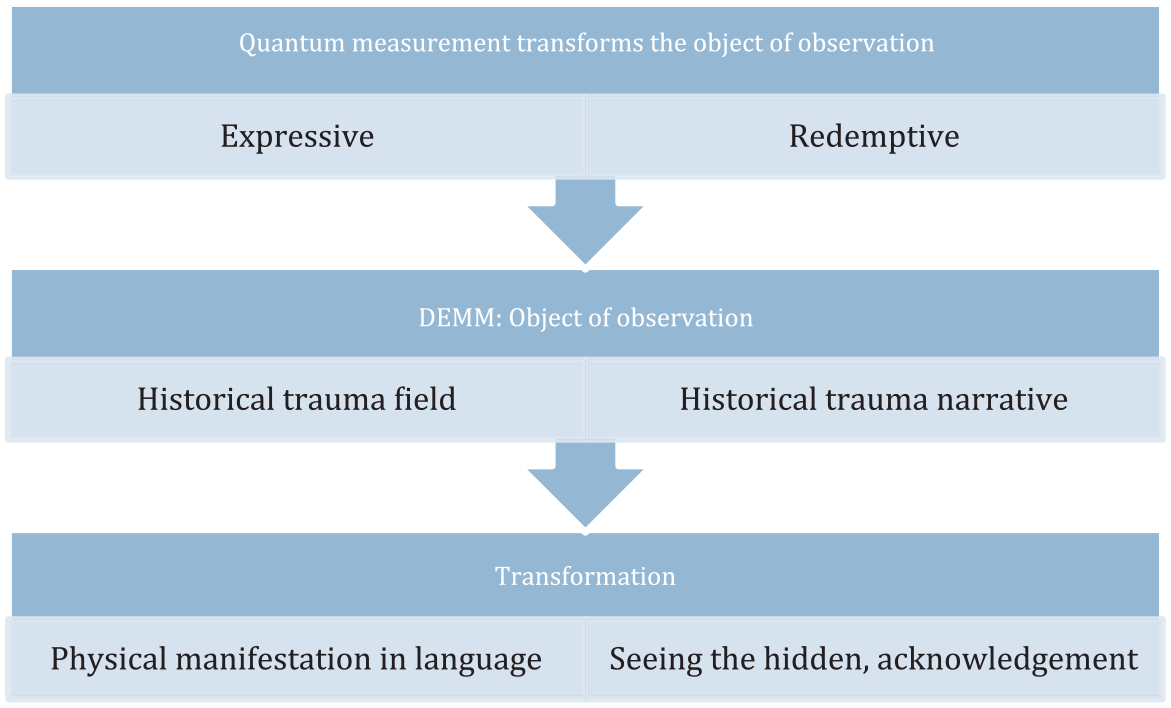
Quantum measurement and memory mapping. (Word Smart Art Graphic, with text provided by the authors.)
A similar principle was expressed by, for instance, the South African Truth and Reconciliation Commission, where it was hoped that the trauma of apartheid would be lifted out of the individual experience of isolation and situated within a social narrative of the past, thereby restoring a sense of belonging within a relational whole, through the construction of a societal narrative. 16 While sharing this broad objective, the current project potentially addresses an ethical problem that has arisen in the context of truth and reconciliation commissions, namely, the estimated 50–60% of participants who were retraumatized as a result of participating in a public process (Hayner, 2001: 144). The other problem also encountered in the context of peace processes is that of getting those involved to meet face to face, given a highly toxic environment. The DEMM starts with a mapping of the trauma field and, in the process of measuring – that is, seeing and expressing a field in language – begins a dynamic process of transforming it into a historical trauma narrative that is redemptive, which, in theory, opens space for a different and less toxic conversation.
The potential impact of redemptive measurement is difficult to judge in the absence of a sustained experiment over several years that would also explore any relevant ethical questions in more depth. The issue here is whether in measuring and acknowledging the roots of traumatic memories in past suffering, an entanglement is broken and something changes in the world itself. The obvious answer, from the perspective of classical physics, is that it definitely would not have impact of this kind. However, on the basis of the quantum principle that measurement changes the object of observation, the DEMM could hypothetically have this impact – and indeed this is the purpose of the constellation method when applied in family and organizational therapy. The redemptive measurement of political memory opens a space for replacing the competition between conflicting memories with a broader conversation.
‘Seeing’
But what, then, is meant by ‘seeing’ in this case? The contrast between the two forms of measurement highlights a number of issues. The first regards the non-local dimensions of both the transgenerational entanglements and the method. Expressive measurement transforms an unobservable field of resonance into language, where it can then be analysed in any number of ways. In the context of the experiment, the emergence of patterns from a blind process – that is, the expressive measurement – suggested that something powerful was going on, even while there is no clear explanation for why it works. 17
Redemptive measurement is far more slippery insofar as it is difficult, if not impossible, to ever know for certain whether the measurement actually changes the object of observation and thus has broken the entanglement. For instance, one of the central themes that arose during the US Politics of Hate pilot study was the inability to ‘see’ slavery. After several days of working with a series of distinct maps, the representatives, who consistently, across separate maps, turned away from the occupant of the ‘slavery’ square, as though he or she wasn’t there, began to engage with it in a way that had not been possible when we began. With guidance from the facilitator, the representatives began to acknowledge both the historical suffering and its continuing toxicity in that context. While any educated person knows the history of slavery in the USA, this knowledge is not the same as ‘seeing’. To ‘see’, in this case, relates not only to acknowledgement of the suffering but also to entanglement within it. To ‘see’ is to witness. To witness is not merely a passive act of observation; it is rather an embodied act that makes the absence of memory present.
The quantum concept of complementarity might suggest that acknowledgement requires a recognition of the capacity for evil, as well as good, in any one self or community. From this perspective, the mutual implication of perpetrator and victim is more clearly evident where, as in the Hungarian case, memories of perpetration relating to antisemitism in Europe interfaced with memories of being victim during the Ottoman invasion. Or, in the case of the USA, its identity as a ‘shining light on the hill’ and a force for good in the world contains within it the barbarity of slavery (see Lepore, 2018). Free and equal US citizens, many of whom carried memories of persecution as immigrants from Europe, were the subjects of a constitution that emerged alongside laws regarding chattel slaves, who had been forcefully displaced from Africa. Once we begin to view the world from a different angle, recognizing ourselves as a part of life that is entangled across generations, as well as the planet, rather than standing outside and above it, the ethical bar for how we act toward others becomes much higher.
Balance in this conceptualization is not a mechanism, such as the balance of power, but an orientation to life, to self and the other in all its forms, of ‘seeing’ the humanity or more broadly ‘seeing’ life in the other, and of conversation with them (see Fierke and Jabri, 2019). While it may be tempting to regard this potential as utopian, particularly as regards the international, this misses the point. What is suggested is an ethical reorientation, and here a contrast is important. Many Western ethical systems rely on a metaphysics of atomistic rational individuals, for whom emotions are or should be absent and who are locally situated in time and space, in which the world is a mechanism and time is a quantitative measure, conceived in terms of clocks. By contrast, complementarity rests on quantum assumptions that the world is life, time is entangled, and affect is fundamental to life, including our humanity, and cannot be separated from reason. Insofar as the latter highlights the claim that harm done to others is ultimately harm to the self as well, it is consistent not only with Buddhist or African Ubuntu philosophy but also with a feminist ethic of care. But here we want to emphasize what this suggests about acknowledgement and the potential for redemption, and why both would be important. To redeem in this case is to acknowledge the reproduction of harm within a particular relational system or structure, which is a first step toward re-establishing balance and rethinking of our security in relation to entangled others.
The second question regards who precisely is better able to ‘see’ as a result. The most straightforward and understandable answer would be that those who participate in the mapping process begin themselves, as a result of their representation of parts within a whole, to ‘see’ the previously unseen. They carry the experience as subjective witnesses during the mapping away from the exercise. While there was indeed evidence of this, as expressed by participants, even a year later, 18 the potential may extend further. For instance, in the weeks following the conclusion of the US Politics of Hate pilot study, the dramatization of far-right toxicity in Charlottesville, VA, made it impossible to ignore the continuing impact of a history of not ‘seeing’ slavery on contemporary politics in the USA. There was a corresponding emphasis in the media on the need for a conversation around the history of slavery. Was this increased ability to see slavery at all related to our experiment in a living room in Scotland? Any kind of causal claim about the relationship between redemptive measurement within the mapping exercise and changes in the world would be premature. 19 One objective of a longer, more sustained experiment would be to track the mapping in relation to multiple changing empirical contexts over time.
A third issue regards the potential for DEMM to have a broader impact on the world. If there were to be a larger impact, it would take the form of greater attention to the ongoing effects of structural violence and, in theory, a reduction in fear and the toxicity attached to the possibility of engaging in conversation about it. The greater ability to ‘see’ as a result of redemptive measurement may relate to those who participate in the mapping, thus making it a potential educational tool or a tool for engagement around policy – for example, examining the transgenerational entanglements between the descendants of European immigrants to the USA, including slave-owners, and those forcefully displaced from Africa. 20 Or, there may be more non-local and difficult-to-gauge changes, such as those suggested by the Charlottesville example. As physicist John Wheeler noted, in a quantum world we are ‘participants in creating the universe’, which requires that we take responsibility for it (Folger, 2002). As entangled participants, any transformation potentially impacts on us all. As suggested in relation to the contemporary ‘crisis’, refugees and migrants may themselves be the obvious victims, whether of conflict or of a lack of compassion by host societies, but the latter, and not least the United States or European countries, are also impacted by the failure to live up to their own core values, a failure that, we argue, is as entangled in memory as the former. Redemption points to our humanity and the ability to see the human in the other, not only in the present but in the past as well, and the other in the self. Redemption is less about changing the past (see Wendt, 2015) than about acknowledging it in such a way that we are changed in the now.
Conclusions
DEMM does not measure the distance between ‘things’ but rather the relationship between positions within a trauma field that is heavily dependent on the apparatus or how the intentional question is asked. The method makes it possible to ‘cut’ into the relational dynamics of specific historical dislocations to make visible the otherwise invisible affective resonance of transgenerational memory and its continuing impact on the present. There remains a question of whether this is primarily useful as a tool of analysis, for gaining insight into some of the hidden dimensions of memory on contemporary politics, or whether the non-local witness to and acknowledgement of historical patterns of displacement and perpetration changes something in the world itself. The mapping process makes it possible to measure a historical trauma field in expressive terms. Out of this process, the hidden dimensions of suffering relating to past trauma, which continue to impact on the present, begin to surface. The corresponding concept of redemptive measurement suggests that in the process of ‘seeing’ and acknowledging this suffering, the entanglement is broken and something in the world itself changes, which is consistent with the quantum principle that observation changes the object of measurement. To ‘see’ is to break an entanglement. Beginning to see the other in the self, and the self in the other, including as this relates to victim–perpetrator dynamics across time, provides the basis for an ethical reorientation toward both the study and the practice of security.
Footnotes
Acknowledgements
This article was written by K. M. Fierke but is a product of collaboration with Nicola Mackay. The authors would like to thank the Centre for Peace and Conflict Studies at the University of St. Andrews and the Netherlands Institute for Advanced Studies for support for various aspects of this project, as well as Sofiia Bairamukova, Olga Burkhardt-Vetter, Roxane Farmanfarmaian, Caron Gentry, Frazer McDonald Hay, Naomi Head, Tony Lang, Mike Shanks, and Nadine Voelkner.
Funding
The author(s) received no financial support for the research, authorship, and/or publication of this article.
