



Abstract
This article studies Sexual and Reproductive Health and Rights (SRHR) at the United Nations (UN). SRHR, a gender equality norm that applies human rights to sexuality and reproduction, have traditionally been supported by a network of actors led by the United States (US) and the European Union. Nevertheless, a rival network has contested SRHR since their conception in the early 1990s. We study the robustness of SRHR in five UN fora between 2009 and 2020, focusing on actor constellations, productive power and norm concordance. Between 2009 and 2016, the normative status quo was maintained, except in the Human Rights Council and the Security Council. In 2017, the US joined the network of rivals and accelerated the norm’s weakening in the Security Council and the Commission on Population and Development. However, to weaken or strengthen the norm further, both networks see a need to address SRHR outside the UN.
Keywords
Introduction
In January 2020, Donald J. Trump became the first sitting American president to attend the March for Life rally, an annual gathering of anti-abortion activists in the United States (US). At the rally, he declared, ‘Unborn children have never had a stronger defender in the White House’. 1 In November 2020, Poland’s Constitutional Court enforced a near-total abortion ban. 2 Both events suggest rising tension around the progress made on Sexual and Reproductive Health and Rights (SRHR) in the 1990s. Recognising this tension during the High-Level Meeting to Celebrate the 25th Anniversary of the Beijing Women’s Conference, France’s president Emmanuel Macron stated, ‘In 2020, the Beijing Declaration would have no chance of being adopted. [. . .] Everywhere, women’s rights are under attack. [. . .] Progress achieved by great efforts is being undermined even in our democracies, starting with the freedom for women to control their own body, and in particular the right to abortion’. 3
SRHR along with women’s full economic and social equality in society and the distinction between biological sex and socially constructed gender roles are the fundamental norms of gender equality. 4 And since 2009, these norms have been openly contested at the United Nations (UN) by a network comprised of states like the Holy See, Russia and China, as well as civil society organisations (CSOs) such as the World Congress of Families (WCF). Advocating traditional values, the network aims to remove women’s rights from the public policy agenda on the basis of respect for religious values and morality.
More to the point, the article centres on the norm of SRHR, which refers to the application of human rights to bodily autonomy and control over reproduction and sexuality. Accepted during the 1994 International Conference on Population and Development in Cairo and the 1995 Fourth World Conference on Women in Beijing, 5 SRHR is a norm with two tails addressing sexual and reproductive health norms on the one hand, and sexual and reproductive rights norms on the other. The norm is promoted by a network of liberal actors that includes the European Union (EU), the US, the Nordics 6 and CSOs such as the Women’s Major Group and the International Women’s Health Coalition.
The article studies the robustness of the SRHR norm by tracing whether or not norm contestation has resulted in norm change, and whether change strengthens or weakens a norm. It is also contemplated the possibility that the norm remains unaltered. It studies SRHR contestation at the UN, the central venue for debating and constructing norms. 7 For this purpose, the analysis that follows studies norm concordance, which relates to the degree to which the norm is reproduced in official discourse and documents. To that end, it builds an analytical framework around actor constellations, which highlights the existence both of a network of actors advancing the norm and of a network seeking the alternative outcome. On top of that, to have directionality and intentionality the network must count among its ranks an actor with discursive and material power. As the article focuses on the institutional arena, we consider the exercise of power in its productive form, where power serves to reshape the meaning of the norm. 8
Norm change is traced in five UN fora: the third committee of the General Assembly (UNGA), 9 the Human Rights Council (HRC), the Security Council (UNSC), 10 the Commission on Population and Development (CPD) 11 and the Commission on the Status of Women (CSW). 12 We employ document analysis based on the compilation of 74 resolutions from 2009 to 2020. And we draw background information from 11 semi-structured interviews with representatives of UN member states and civil society organisations as well as using secondary sources reporting on negotiation processes (e.g. Passblue, Security Council Report).
We divide the study of SRHR robustness into two periods, 13 which are determined by US presidential terms and the release dates of EU Gender Action Plans. The latter specify the areas in which the SRHR norm is to be disseminated and identify several UN fora in which SRHR should be expanded. During the first period, 2009–16, during which a Democratic administration was in place in the US and the first EU Gender Action Plan was published, both the EU and the US defended to a great extent the status quo of the norm. Meanwhile, despite a lack of internal coordination, the rival network showed early signs of willingness to weaken SRHR, passing several resolutions at the HRC that norm defenders responded to rapidly. During the second period, 2017–20, which was marked by a Republican administration in the US and the release of the second EU Gender Action Plan, the rival network, now led by the US, accelerated the process of weakening SRHR by vetoing or blocking any reference to the norm whenever possible. In this second period, the rival network was successful in weakening the norm in fora like the UNSC, but its achievements were not enough to trigger change across the board. As a result, the Trump administration began promoting an alternative version of SRHR outside the UN with a focus on excising the international dimension of sexual and reproductive rights, while reframing sexual and reproductive health in line with the right to life. Meanwhile, the group of norm defenders led by EU member states and supported by liberal CSOs continued to defend the norm status quo but agreed on the need to further strengthen the norm outside the UN. Following this second period, any major change, whether weakening or strengthening the norm, is expected to take place outside the UN arena.
The remainder of the article is organised as follows: In the next section, we put forth our analytical framework on norm robustness. The third section sheds light on how the actor constellations interact with the SRHR norm. The fourth section tackles norm concordance, where we analyse SRHR robustness in five UN fora. Finally, we consider the implications of this analysis for future avenues of research on SRHR and in norm studies in general.
Analytical framework on norm strength
Norms became central in International Relations with the so-called constructivist turn. 14 In this article, we use Katzenstein’s seminal definition by which norms are ‘collective expectations for the proper behaviour of actors with a given identity’. 15 Contrary to other types of rules, norms have a ‘prescriptive (or evaluative) quality of “oughtness”’. 16 Simply put, norms not only tell actors how to behave but also that their behaviour will be scrutinised by other members within the in-group. Alongside this, norm research has attracted such considerable interest to the extent that we can consider the existence of two generations.
As for the first generation, it was assumed that norms have a clear and stable meaning. Works such as Finnemore and Sikkink’s norm life-cycle echoed this, where it was considered that once the norm reached the internalisation stage, it was taken for granted. It suggests that this generation was poised to freeze the meaning of norms at this stage. 17 Undoubtedly, this was helpful as it served, for instance, to analytically assess to what extent a state had compliant behaviour. 18 However, it posed several limitations such as overlooking that norm promotion is not a one-sided effort or that contestation does not only take place at the stage of a norm’s emergence. 19
The second generation moved away from the assumption that norms attain a frozen meaning. Focused on unfreezing norm meaning, this generation’s work echoed Antje Wiener’s analysis positing that norms have a dual quality: norms are stable and contested. Such a claim resonates with Lena and True’s work that norms are work-in-progress. 20 In other words, norms are not finished products, but ambiguous products. And while in the first generation, compliance was seen as the analytical tool to shed light on whether state behaviour matched expected behaviour; in the second generation, norm contestation is seen as better suited since it departs from the assumption that norms make clear behavioural demands. 21 Contestation is seen as a social practice whereby actors discursively express the nascent or continued legitimacy of a norm or challenge its foundations. 22 It is inferred that the content and scope of a given norm usually changes as both the norm setter and norm follower engage in contestation. 23
Relevant to this article is the central role of networks in the emergence and demise of norms. Both generations have shown an interest in studying the relationship between networks and norms. Yet, in line with the second generation we seek to address one of the first generation’s limitations. That is, norms when promoted are resisted by a rival network. Indeed, powerful networks of states and civil society organisations exist on both sides of the norm spectrum: advocating and rivalling. 24 Research has enlightened us to the fact that advocacy networks seek to influence states to adopt a new norm, 25 just as we are increasingly aware that rival networks, in their attempt to halt the norm’s advancement, have mirrored the strategy of the advocacy network. 26 However, the factual impact of rival networks remains largely uncharted territory. While there are accounts of the polarising effects of rival networks in terms of institutional commitment to norms, 27 little is known about whether or not the actions of rival norms have led to norm change.
In the following lines, we set out our analytical framework assessing whether rival networks are successful in achieving norm change, where it is considered that the presence of a major power is key. Bearing this in mind, we study norm change at the UN, as the institution is deemed to be the central site for discussing and building norms. 28
Actor constellations: advocacy and rival networks
Actor constellations are an important feature in the current discussions in norm research. 29 They are antagonistic transnational networks, in which an entrepreneurial network advocates for a norm and an antipreneurial network advocates for its opposite. Actor constellations reveal the existence of networks of states, non-state actors and international organisations supporting or opposing a norm. 30 Differentiating between the networks involved in terms of strategies and tactics is a difficult endeavour, as they employ very similar methods. Both networks can frame issues, promote norms and shape the established norm through their productive power. 31
The battle over ideas, meanwhile, takes place both at the national level and in international fora. Networks seek to advance their understanding of the norm at the national level and international level. 32 For instance, in the case of SRHR defenders, at the international level it seeks to persuade governments either directly by lobbying state parties, or indirectly by shaping their ideas. Simultaneously, at the domestic level, the entrepreneurial network seeks to shape government practice by implementing the norm. Continuing with the example of SRHR defenders, in international fora, the extent to which their claims are perceived as legitimate is critical. Legitimacy is necessary for the claims to be translated into institutional opportunities to trigger normative change in line with defenders’ preferred objective.
Power: productive power
Clifford Bob posits that to trigger change, the strategies of the rival network alone are insufficient. He argues that what matters ‘is its power and effectiveness relative to those of the opposing network, as determined by the full range of conflictual interactions, both rhetorical and material’, where power relates to the ‘ability of one network to squelch the other’s voice, purge it from key institutions, or eradicate it as a viable political option’. 33 Power is key for any network to shape the normative order, and it can be understood as related either to the agent’s will to project power over other actors, or to the agent’s power to enable actors and cater to their identities and interests. Deitelhoff and Zimmermann have echoed this point when they consider that major states or powerful groups are more likely to undermine norm robustness than other groups. 34 Yet, they also consider, mainly in security areas, that power together with other actor-level factors have less explanatory power than what we could initially think. We consider that this is not the case in SRHR, which is a norm embedded in the field of human rights. We posit that a major state can make a difference since it can give the network directionality and intentionality in its quest to alter the norm’s course. 35
Such major actors are equipped with high discursive power (which usually goes hand in hand with material power) being better placed to advocate for their preferred interpretation of the norm than those with a lower level of power. They can bear the burden of contesting the norm as they can afford to breach it and require less cooperation from other parties to pursue their objectives. 36 In addition, being in a better position to advocate for a preferred interpretation of the norm allows such an actor to broaden the membership of the network. Gathering a wide range of actors can translate into greater legitimacy in the attempt to weaken the existing norm. 37 In short, the presence in the rival network of an actor with high discursive and material power can make the normative claim more effective and legitimate.
More to the point, such a depiction of power echoes Barnet and Duvall’s conceptualisation of productive power, which operates through diffuse constitutive relations to produce the situated social capacities of actors. 38 This is a kind of power that concerns ‘discourse, the social processes and the systems of knowledge through which meaning is produced, fixed, lived, experienced, and transformed’. 39 Simply put, the most important aspect of productive power is its ability to shape meanings. 40 In institutional settings, such productive power is the ability to alter the language used in connection with norms, which is seen as a fundamental sign of contestation in international organisations. Actors with productive power are crucial in framing strategies in norm creation and diffusion. 41 Such actors can select issues for adoption, and therefore can potentially lead the rival network to make progress on their final aim. 42
Concordance
This article follows Jeffrey Legro’s definition of norm concordance that reads as follows ‘how widely accepted the rules are in diplomatic discussions and treaties (that is, the degree of intersubjective agreement)’. 43 Thus, norm concordance has a discursive nature that fits the study of norm robustness in deliberative fora such as the UN. In this article, we consider concordance in terms of a norm being referred to as appropriate and accepted. This manuscript takes a narrow approach, 44 as it only traces norm concordance in UN documents and resolutions, specifically by examining whether there are changes in language. Language changes or removals in UN documents are extremely relevant and constitute one of the main features of productive power, as these documents are used to design policies and develop indicators at the global, regional and domestic levels. In other words, concordance is our indicator used to assess whether there has been change in the norm, and the type of change the norm is undergoing. In this vein, we assess norm concordance in three directions: norm weakening (i.e. the content of the norm has been partially or completely removed from the resolution or document); norm strengthening (i.e. the content of the norm has been expanded by being introduced into new resolutions); or norm status quo (i.e. the content of the norm in resolutions has remained unaltered).
Actor constellations: defenders and contesters of SRHR
In this section we explore SRHR actor constellations – that is, the existence of one network that defends SRHR and another network that opposes the norm. Below we present the discursive strategies of each network, where the EU is presented as the representative account of the norm defenders’ network.
SRHR defence network and the EU
In 2015, the EU stated that it has promoted gender equality norms since 1957 and that they are ‘part of the EU’s DNA’. 45 This claim exemplifies the EU projecting itself as a normative leader seeking to upload gender values into multilateral institutions in areas such as human rights. This has prompted authors to speak of the EU as a gender actor. 46 In truth, the EU’s first encounter with SRHR was as a norm follower. Prior to the Beijing Conference, the European Commission and the Nordic member states (i.e. Denmark, Finland and Sweden) did share the need to present a consensus on SRHR during meetings. But an EU consensus on SRHR became possible only after the 1995 Beijing Platform for Action was adopted. 47 Despite its initial start as a norm follower, the EU rapidly became a norm leader. At the EU level, SRHR underwent a strong internalisation process. The 1997 Council regulation on aid for population policies and programmes in developing countries included it, and the 2006 European Consensus on Development (ECD) declared its support for ‘the full implementation of strategies to promote sexual and reproductive health and rights’. 48
The Sustainable Development Goals (SDGs) developed in 2015 provided an opportunity for the EU to articulate a renewed vision regarding this new global agenda. In consonance with the EU Global Strategy (2016) and the SDGs, the EU addressed SRHR within the 2017 ECD. The 34th paragraph of the ECD claims that ‘the EU remains committed to the promotion, protection and fulfilment of all human rights and to the full and effective implementation of the Cairo Programme of Action and the Beijing Platform for Action and the outcomes of their review conferences and remains committed to SRHR, in this context’. 49 The ECD also reaffirms the EU’s ‘commitment to the promotion, protection and fulfilment of the right of every individual to have full control over, and decide freely and responsibly on matters related to their sexuality and sexual and reproductive health, free from discrimination, coercion and violence’. 50 Therefore, it continues, there must be ‘access to quality and affordable comprehensive sexual and reproductive health information, education, including comprehensive sexuality education, and healthcare services’. 51
To achieve the goals listed in its SRHR policy, the EU has developed close connections with CSOs and strategically listed international institutions where the norm should be expanded. The European Commission is aware of the need to be inclusive in the defence and promotion of women’s rights. To that aim, it holds a European Development Day where different state and non-state actors gather to discuss the current state of women’s rights, among other things. In this willingness to work side by side with non-state actors, the European Commission has developed close ties with CSOs such as the ACT Alliance EU 52 and Women in Development Europe. 53 In parallel, in its Gender Action Plans, the EU specifies areas in which the SRHR norm needs to be circulated 54 and identifies several UN fora in which SRHR should be expanded: the UNGA, the HRC and the UNSC, among others. More specifically, the EU sees the UNSC as a key institution for promoting gender equality norms, one in which it aims to pursue the implementation of UNSC Resolution (UNSCR) 1325 on Women, Peace and Security (WPS). The EU Strategy on WPS emphasises the need to introduce mechanisms to provide access to reproductive health for every person who has suffered sexual violence into future resolutions on WPS. 55
With regard to SRHR in international institutions, one EU representative highlighted that EU productive power lies in promoting a more progressive language on SRHR than the UN agreed language. 56 The EU promotes ‘sexual and reproductive health and rights’, which includes elements of body autonomy such as contraception and abortion. 57 The UN, meanwhile, promotes ‘sexual and reproductive health and reproductive rights’ where, in line with SRHR as a two-tailed norm, differentiating sexual and reproductive health from reproductive rights is seen as a way of clarifying that, at the UN level, abortion is not promoted as part of body autonomy rights. 58 The EU is aware that promoting the right to abortion at the UN would be counterproductive as it would risk losing existing support for the norm. 59 Indeed, in the name of forging consensus, the EU defends the UN language at the UN level. And in terms of negotiation dynamics within the UN, the EU is one of the most cohesive regional blocs.
Simply put, EU productive power lies in anchoring SRHR, as agreed in Cairo and Beijing, in UN fora such as the UNGA, the HRC or the UNSC. On top of that, the EU’s and its member states’ promotion of a more progressive version of SRHR than that used at the UN level suggests that the EU would oppose any action seeking to push SRHR language backwards. It illustrates a willingness to opt for entrenchment when the norm is under fire, whilst simultaneously defending a more progressive stance on SRHR than the one present at the UN.
The rival network and its understanding of SRHR
At the 1994 Cairo Conference, the Holy See led the first attempt to weaken SRHR, but the delegation, driven by religious belief, found itself nearly alone on issues of abortion and contraception. Only Libya and Iran joined in opposing language on women’s rights and reproductive rights in the final document. Learning from past shortcomings, at the 1995 Beijing Conference the Holy See presented a new strategy that was able to block any outcome that might be interpreted as a right to abortion. To do so, the Holy See appointed American lawyer Mary Ann Glendon 60 to lead its delegation. The appointment was seen as a political move to persuade less developed countries to join their interpretation of the norm. In the end, Glendon did prevent abortion from being declared a women’s right at the 1995 Beijing Conference. It is worth bearing in mind that while SRHR are broader than abortion itself, norm defenders concur that abortion is not part of the UN agreed language. 61 Indeed, although the 1994 Cairo Programme of Action explicitly recognises that ‘in no case should abortion be promoted as a method of family planning’, 62 contesters are constantly equating the adoption and promotion of SRHR at the UN to the recognition of an international norm on abortion. 63 In the two follow-up events to the Beijing Conference held in New York in 2000 and 2005, opposition forces became increasingly high-profile and organised, garnering the support of the Bush administration in the US. The latter reinstated the so-called ‘Global Gag Rule’ in 2001, which prevents NGOs outside the US from receiving American funds if they use their resources to perform, ‘actively promote’, or discuss abortion as a method of family planning. 64 This policy has been enacted by every US Republican administration since Reagan. And despite that SRHR as such were not the object of intense contestation, the Bush administration paved the way for the contesters’ group to consolidate. 65
Opposition to gender equality norms, particularly SRHR, become more consolidated and better organised at the transnational level over the period studied. Focusing on the UN as the key forum led to greater success at halting the progress of women’s rights. 66 In the last decade, the group of contesters gathered more actors, which grew to include the Holy See, Iran, Russia, Saudi Arabia and international organisations (e.g. the Organisation of Islamic Cooperation, the Arab League and the UN Africa Group). The WCF serves as a bridge-builder, bringing together NGOs in Islamic, Catholic and post-Soviet states. It has had a formal structure since 2016 and now operates under the name of the International Organization for the Family (IOF). In parallel, Belarus, Egypt and Qatar established the Group of Friends of the Family and organised the Uniting Nations for a Family Friendly World event at ECOSOC in 2016. This aimed to promote the family as the natural and fundamental group unit of society while reminding the UN of its obligation to protect and safeguard families formed by the union of a man and a woman in marriage. Similarly, the IOF’s 2016 Cape Town Declaration laid out another characteristic of the group, its diversity, by pointing out that it has ‘no common tongue, culture or creed. We are divided by history and geography, by social customs and forms of government. But in foundations, we are united. We are of one mind on the bedrock of civil society, on the basis of that first and primordial community called the family’. 67
While the network continues to oppose the SRHR definition agreed on by the 1994 Cairo Programme of Action and the 1995 Beijing Platform for Action, it shifted to using a discursive strategy aiming to weaken SRHR in UN documents and resolutions by ‘colonising’ human rights language. 68 As noted by a representative of a liberal civil society organisation, ‘If you read their statements, you just look and it feels like this could be a statement presented by us, minus the exception of the abortion part’. 69 Contesters are employing the language of international human rights declarations and treaties to actively oppose SRHR, by highlighting elements of the Universal Declaration of Human Rights such as ‘the right to life’ (article 3) and article 16.c, which states that ‘the family is the natural and fundamental group unit of society and is entitled to protection by society and the State’. 70 This translates into negotiations in which the rival network attempts to introduce amendments that either remove SRHR clauses or replace the word ‘service’ with the word ‘care’. The latter strategy is rooted in the network’s equating the word ‘service’ with the existence of abortion services.
Productive power in the rival network
If Bush was the first Republican US president to deal with the SRHR norm, Trump’s election as US president once again shifted the country’s role, from norm supporter under Obama to norm contester in 2017. Thus, the US administration issued a 2017 executive order expanding the Global Gag Rule. Indeed, whereas Bush’s Gag Rule was focused exclusively on family planning assistance and affected $500 million in funding, Trump’s applied to all global health assistance and cut $9 billion. Furthermore, under Secretary Pompeo, the US State Department excluded SRHR from its assessments in the 2018 and 2019 Annual Human Rights Reports, which can be interpreted as an inclination to not consider SRHR as human rights, thereby fostering contestation of these rights. This shift was highly influential, as CSOs usually develop their human rights strategies by referring to US reports.
The US also mobilised its productive power to strike references to SRHR from UN documents and resolutions. 71 For example, in 2019 Pompeo tasked Mary Ann Glendon with reviewing the overall role of human rights in US foreign policy, to differentiate ‘unalienable rights’ from ‘human rights claims’ causing ‘tension’. 72 Under the Trump administration, the SRHR norm was subjected to revisionism based on moral and religious beliefs, with the aim of creating a common strategy against the norm. Its most successful discursive tool was the 2020 Geneva Consensus Declaration, a nonbinding document promoted by the US that brought together states such as Egypt, Brazil, Indonesia, Poland and Hungary. The Geneva Consensus Declaration promotes an approach that contesters have long taken, namely, to build opposition to SRHR by framing the norm on the basis of the right to life and values such as the family as the basic unit of society. 73 Where it differs from past actions is that the Geneva Consensus can be used as a framework through which contesters can promote a rival norm that continues to consider sexual and reproductive health as a universal human right whilst relegating reproductive rights to state sovereignty, removing its status as a universal human right as set out in the Cairo and Beijing agendas.
As a result, we can now consider SRHR a complex norm, 74 since contesters jeopardise the validity of reproductive rights whilst they continue to support the adoption of a version of the SRHR norm in other areas.
Norm concordance, the UN and the battle of ideas
Over the last decade, the contestation of SRHR in international organisations has intensified. Currently, the rival network uses rhetoric that describes ‘gender ideology’ as an attempt by supranational entities such as the UN or the EU to impose foreign values on sovereign states. 75 In the following section we pay close attention to SRHR at the UN.
2009–16: the incipient weakening of SRHR
In 2009, the growing backlash against gender equality became noticeable as contesters started to mobilise wide-ranging support within the UN system. 76 At the HRC, a site of conflict vis-à-vis the SRHR norm, 77 several of Russia’s sponsored resolutions – 12/21 (2009), 16/3 (2011) and 21/3 (2012) – state some variation of, ‘a better understanding and appreciation of traditional values shared by all humanity and embodied in universal human rights instruments contribute to promoting and protecting human rights and fundamental freedoms worldwide’. 78 These resolutions advancing so-called ‘traditional values’ clash with human rights universality, thus creating the conditions to advocate that SRHR are not universally accepted, and that sovereign states may decide whether to promote the norm or not.
Resolutions on traditional values at the HRC can be read as a sign of norm weakening. The resolutions were echoed in other UN fora dealing with SRHR-related issues. Contesters mobilised their resources, improving their coordination and reinforcing cross-regional approaches. 79 Their strategy continued to focus on excising SRHR from UN documents. Such a weakening action was noticeable during the 2012 CSW sessions, the UN African Group, Russia, Syria and Venezuela were willing to block the agreed outcome as they resisted the introduction of references to a variety of gender equality norms, particularly SRHR.
Nevertheless, EU member states and the US and Canada reacted and mobilised resources to counter the contestation initiated by Russia. During that period three resolutions were passed at the HRC: 14/12 (2010), 23/25 (2013) and 26/15 (2014), the latter of which specifically referred to ‘promoting and protecting SRHR’. 80 Despite resolutions 14/12 and 26/15 being adopted without a vote, these are so-called ‘kitchen sink’ resolutions, in that they seek to satisfy everyone. 81 This outcome suggests that at the HRC, the SRHR norm is not being strengthened, weakened nor keeping the status quo, but rather is becoming a norm with a lot of interpretative leeway. That is a norm used instrumentally and affirmed without cost.
At the 2012 CSW Session, Denmark spoke out on behalf of the EU 82 against ‘attempts to weaken the internationally agreed agreements on gender equality and women’s rights’, 83 referring to efforts to question and diminish the provision of comprehensive education on sexuality and the importance of ensuring the highest attainable standard of health, including SRHR for women and girls. From this position, Denmark, acting on behalf of the EU and other actors, showed a readiness to counter the contestation’s impact on other countries and on the international norm itself. While the 2012 CSW 84 sessions did not reach consensus, the 2013 and 2014 sessions reaffirmed the agreed language from Cairo and Beijing, and its operative clauses continued to refer to SRHR services. 85 In a similar vein, the CPD resolutions, with the exception of the 2015 session, reinstated the agreed language and reference to SRHR services. The 2015 session was a relevant one since it sought to introduce and integrate the new SDG agenda. As noted in the Chair report, one regional group blocked both the resolution and the Chair’s alternative proposals. 86 This was an important instance of contestation, as the SDG was expanding the scope of SRHR (i.e. strengthening the norm) when compared to the Millennium Development Goals (MDG) where it was almost non-existent. 87
At the UNGA Third Committee, resolutions were adopted by consensus between 2009 and 2016. The resolutions that addressed SRHR tackled the rights of the child, fistulas, domestic violence, genital mutilation and the trafficking of women. More importantly, at the UNSC, the EU (represented by France and the UK) demonstrated that SRHR was neither weakened nor remained unaltered. The norm had been strengthened since it was introduced in the UNSC through WPS resolutions. More significantly, such adoption was supported by the US, China and Russia. Research has considered that both China and Russia wield the power to potentially undermine gender norms, 88 but regarding WPS they decided not to break the existing consensus as they risked being perceived as outsiders. In other words, China and Russia regarding these resolutions cannot be considered major actors holding enough power to strike SRHR down. Resolution 2122 (2013) noted ‘the need for access to the full range of sexual and reproductive health services, including regarding pregnancies resulting from rape, without discrimination’. 89 Moreover, UNSCRs 2106 (2013) and 2122 (2013) on WPS echoed the EU’s normative stance on SRHR in times of conflict with the goal of providing access to health care services free from coercion and violence. 90
Overall, from 2009 to 2013, apart from the HRC, the EU and other norm supporters such as the US contained the norm contesters’ weakening strategy by siding with UN agreed language.
Despite this willingness to safeguard the SRHR norm, however, contestation was also emerging within the EU, seeking to end the existing permissive consensus regarding the norm. 91 This rift emerged publicly in the 2014 CPD session, at which the EU was not in a position to present a unified front; the European Commission acknowledged this situation in its statement that ‘no common view exists in the EU member states regarding SRHR’. 92 The fact that EU internal divisions were able to reach the international level at the CPD is very significant since the CPD is the UN commission tasked with reviewing progress on the 1994 Cairo Programme of Action – in other words, assessing progress made on SRHR. The EU consensus splintered further at the UNGA debate on sexual health in 2016, when the newly elected Polish government led by the populist Law and Justice party began to align itself rhetorically with the contesters’ group, rather than supporting the gender equality rights-based EU positions.
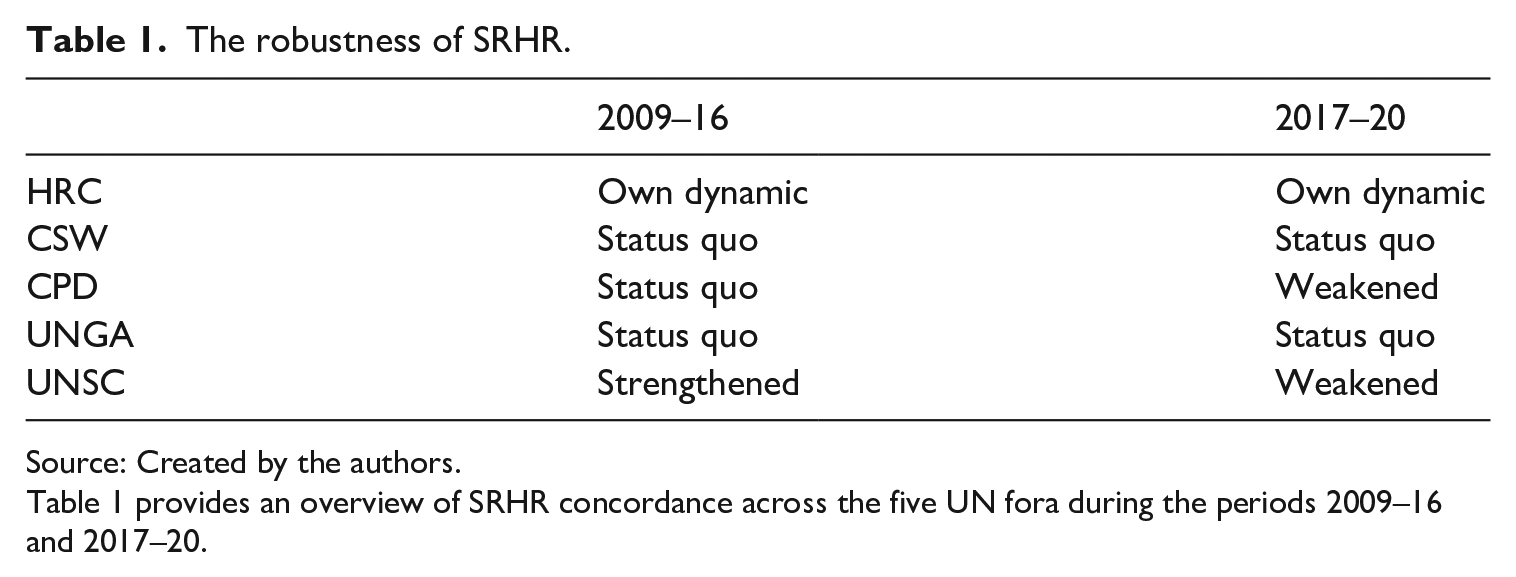
All things considered, contestation at the UN rose over time as contesters were successful, either by passing HRC resolutions promoting ‘traditional’ values, viewed as the normative framework that may facilitate an alternative SRHR norm, or by blocking agreed language that included references to SRHR. Despite this rise, the EU was able to uphold its commitments and not only halted the process of norm weakening at the HRC but also expanded the scope of SRHR in fora such as the UNSC, which shows that the norm was not entering into a weakening trend (see Table 1). At the same time, at the intra-EU level, a few member states started to move away from the EU’s normative stance on SRHR. This paved the way for reluctant EU member states to join the rival network, as a powerful actor started leading it, and for the EU to falter in countering further contestation.
The robustness of SRHR.
Source: Created by the authors.
Table 1 provides an overview of SRHR concordance across the five UN fora during the periods 2009–16 and 2017–20.
2017–20: from norm weakening to a potential rival norm
Once Trump took office in the US, an emboldened rival network flexed its muscle. The 2017 and 2018 CPD sessions did not produce the usual resolutions, as contesters made it clear that no consensual position would be achieved on SRHR without their support. However, in 2019, contesters supported the CPD’s draft declaration to mark the 25th anniversary of the Cairo Conference. Considering the consensual voting dynamics of the forum, the agreed document evidenced contesters’ increasing ability to weaken SRHR. It is highly relevant that the main UN fora addressing SRHR did not include any explicit reference to the norm in the landmark resolution that was to celebrate the 25th anniversary of the conference that gave birth to SRHR. This showcased just how powerful the network was becoming, as it was able to shape the resolution in its own image, and it also signalled to others that it was becoming a relevant institutional actor in the matter.
As a result, during the Nairobi Summit, held in November 2019 to celebrate the 25th anniversary of the Cairo Conference, norm defenders agreed that no declaration or statement would be produced as it was seen as counterproductive. 93 In other words, at the CPD, SRHR went from being reaffirmed to not being mentioned. Such a weakening if compared to the previous period was the direct result of the US joining the contesters’ network. 94
In parallel, during the 63rd session of the CSW in 2019, Romania made history as the first member state speaking on behalf of the EU to omit the previously agreed common position on SRHR. 95 Romania’s move was unusual: in previous debates at the CSW, when other EU member states with strict domestic views on SRHR like Hungary (2011), Ireland (2013) or Malta (2017) had addressed the audience on behalf of the EU, they shared the whole content of the agreed common position with the floor. Romania’s actions openly contested the EU’s common position on SRHR, but the EU’s negotiating position did not change: the statement that was officially circulated afterwards reaffirmed the EU’s commitment to SRHR. 96
At the 2019 CSW session, Saudi Arabia and Bahrain, with support from the US, led the group of contesters wanting to block the agreed conclusions, which included SRHR language. 97 The attempt took place at the end of the formal negotiations when all parties, including Saudi Arabia and Bahrain, had already given the declaration the green light. This surprising move almost succeeded in eliminating references to SRHR from the CSW conclusions, but the chair, held by Ireland, which had recently, and dramatically, switched from norm contester to norm defender, used procedural rules to enable the adoption of agreed conclusions, including references to the 1994 Cairo Programme of Action and the 1995 Beijing Platform for Action. The norm meaning remained unaltered as the declaration continued to make explicit references to SRHR, but the door was open to potential vetoes against conclusions that reference SRHR in subsequent CSW sessions. 98
Broadly speaking, contesters were able to score major victories by blocking declarations at the CPD or nearly blocking them at the CSW, due to a global power, the US, joining and leading the contesters’ group. This chimes with Sanders’ work arguing that the US ‘material and political power allows it to limit the practical implementation of many international women’s rights’, SRHR included. 99
Contestation took place in all five fora, apart from the HRC, which the US pulled out of in 2018. As a result, the HRC continued to follow a dynamic of its own, uncoupled from what was taking place in New York. 100 At the HRC, SRHR continued to be a norm with great interpretative leeway, remaining a point of conflict throughout this period. For instance, between 2017 and 2020 several resolutions addressed SRHR directly, including one put forward by Mexico during the 44th session addressing discrimination against women and girls, whilst other resolutions watered SRHR down, such as one against discrimination in sports that was adopted at the 43rd session. 101
A major shift took place at the UNGA Third Committee, where US actions led to SRHR language, such as in resolutions tackling the rights of the child (e.g. forced and early marriage) or violence against women, no longer being consensual, but instead being consistently put to a vote. These votes would pass with an overwhelming majority of states in favour of SRHR, meaning that the content remained unaltered. Yet, the shift away from consensus is notable. 102 For instance, in 2018, the US wanted to delete operative clause 11 in resolution A/C3/73, which ‘urges states to ensure the promotion and protection of the human rights of all women and their sexual and reproductive health, and reproductive rights’. The UNGA followed in the HRC’s footsteps, with the Third Committee becoming a site of conflict vis-à-vis SRHR. As noted by EU member state representatives, the EU had stopped trying to promote across-the-board SRHR language based on the Cairo and Beijing agendas, and was now poised to rally behind existing UN agreed language, 103 that is, preserving existing resolution from being watered down. US actions at different UN fora led the EU to ‘realise that even agreed language has been brought into question’, while highlighting that there was an increasing domestic polarisation leading to inconsistent support by states for what had been agreed on 25 years before. 104
Although this article focuses on five UN fora, contestation is also present at other international institutions. One such example is the 2019 World Health Assembly (WHA), where the US spoke on behalf of Brazil, Egypt, Saudi Arabia, Indonesia, Haiti, Ghana, Nigeria and Iraq, arguing for the need to produce a new definition for SRHR. 105
In parallel, the EU has encountered serious difficulties in reacting to and limiting the new counterstrategy at both the international and intra-EU levels. CSOs aligned with the contester group have developed close ties with certain EU member states. Such is the case of Hungary, which hosted the 11th WCF in 2017. On that occasion, Hungarian prime minister Viktor Orbán declared that ‘Central Europe [. . .] has a special culture. It is different from Western Europe’. In his opinion, ‘every European country has the right to defend its Christian culture, and the right to reject the ideology of multiculturalism [. . .] and to defend the traditional family model’. Similarly, the 2019 WCF gathered in Verona to celebrate the first-ever city free of abortion in the EU, ‘bringing a wind of change in Europe via a global pro-family movement’. 106 Then-minister of the interior for Italy, Matteo Salvini, emphasised the importance of developing a norm focusing on protection starting at conception based on the idea that ‘if a country does not make children, the country dies’. 107
Overall, there was increasing polarisation regarding SRHR within the EU during this period, as Poland, Hungary and Italy under Salvini embraced a discourse that distanced them from the EU’s normative consensus. Nevertheless, at the international level the EU was not inclined to increase diplomatic tensions with the US over the SRHR norm. 108
The so-called Franco-German presidency of the UNSC in 2019, which showcased the EU commitment to SRHR, provides a good case in which to examine the dynamics of dissent and test the effects of discursive contestation on the strength of SRHR. 109 France and Germany showed their willingness to continue promoting the WPS agenda, which was seen as vital for the EU. Indeed, UNSC members clashed over the adoption of the UNSCR 2467 during the WPS Open Debate in April 2019. 110 For the very first time, the US was determined to use its veto power against language referring to SRHR. 111 The US’s attitude is particularly important here because when there is disagreement over the content of a thematic resolution, the UNSC reverts to the previously agreed resolution on the matter. It suggests that at the UNSC norms can either be strengthened or left unaltered. However, on this occasion, the US decided to tear down the previously established consensus and abandon the agreed SRHR language.
Germany (the penholder), 112 France, the UK and EU ambassador Mara Marinaki 113 perceived this move as a step towards abandoning the gains of recent decades in recognising women’s SRHR. Moreover, Poland, sitting as a non-permanent member, opted for inaction, which can be interpreted as an example of the lack of importance given to the norm. In the end, as penholder, Germany accommodated the US views and omitted the paragraph on SRHR to avoid the US’s veto. The previous UNSCR (2106, adopted in 2013) recognised the importance of providing victims of sexual violence with ‘comprehensive health services, including sexual and reproductive health’, while UNSCR 2467 only affirmed that victims of sexual violence should have access to ‘health care’. The US was not only able to weaken the SRHR norm by rendering it meaningless but also helped to create an environment in which China and Russia could abstain for the first time in WPS resolutions.
The new wording of UNSCR 2467 illustrates the power that the US wields to shape norm meaning. Furthermore, the EU and its member states were reluctant to openly criticise the US’s normative vision on SRHR for fear of further retaliation. Nonetheless, the EU was aware that accommodating US views on SRHR would affect the norm’s fate, as one EU diplomat recognised: ‘If we let the Americans do this and take out this language, it will be watered down for a long time’. 114 The new resolution language’s weakening the norm, together with the EU’s accommodating response, can be seen as evidence that contesters’ actions to erode the norm reached a tipping point in 2019. The events of 2019 suggest not only that contesters were successful in calling for a vote at the UNGA or removing references to SRHR at the UNSC, but also that the US was successful in awakening contesters’ agency, as shown in the case of Saudi Arabia and Bahrain at the CSW. And this is very relevant since, to date, the rival network was united by a shared antipathy and did not necessarily hold a common substantive vision of the norm. 115 In other words, the US was infusing the network with a new directionality and intentionality.
Along these lines, the COVID-19 pandemic accelerated the process within the rival network of building a common substantive vision, serving as the basis for building up more coherent opposition to SRHR and their reproductive rights section. In May 2020, the US Agency for International Development (USAID) administrator sent a letter to the UN warning that ‘the UN should not use this crisis as an opportunity to advance access to abortion as an essential service’ and asking it to ‘remove references to “sexual and reproductive health”’. 116 Whereas the AIDS epidemic led Bush to soften US opposition to SRHR and massively fund programmes on sexual and reproductive health, Trump’s response to the COVID-19 pandemic led the US to increase its ferocity against the norm.
An illustrative example of Trump’s will to move beyond the above exposed SRHR contestation can be found during the October 2020 WHA. On that occasion, the US and other countries, including Poland, Hungary, Egypt, Brazil and Indonesia, presented the Geneva Consensus Declaration. As mentioned previously, the Geneva Consensus was a strategic document that sought to build a coherent political agenda on the contesters’ side. To this end, the document presents a rival norm to SRHR that is built upon values extracted from the Universal Declaration of Human Rights, such as article 16.3 considering ‘the family is the natural and fundamental group unit of society’ in which according to article 3 ‘everyone has the right to life’. 117 Contesters adhering to the Geneva Consensus agreed to promote ‘sexual and reproductive health’ while emphasising that ‘in no case should abortion be promoted as a method of family planning’. Taking as our reference point the UN agreed language, which speaks of ‘sexual and reproductive health, and reproductive rights’, the group was promoting a rival sexual and reproductive health norm based on ‘traditional’ values whilst seeking to contest the validity of bodily autonomy–linked individual rights that are part of reproductive rights. Within the Geneva Consensus, reproductive rights are seen as rights that should be granted by sovereign states and not addressed by international organisations. The rival network expects outreach initiatives to develop around this discursive contestation to persuade other actors to join this rival norm. These initiatives may be intended to target the so-called silent states 118 at the UNGA, which, due to the polarisation around SRHR, are now voting with EU member states against the contesters’ actions. A further sign of this new directionality and intentionality infused by the US came in 2020. During the 75th UNGA Third Committee session, the US ceased to be the only actor presenting hostile amendments against SRHR language as it was joined, for the first time, by Russia.
To counter the contesters’ actions, SRHR defenders agreed that they should further organise themselves by pouring resources into more than just ‘hold[ing] the fort’, as noted by civil society representatives. 119 The contestation of SRHR led like-minded defender states at the UN to launch the Nexus Initiative, a formal network in which CSOs and states meet regularly and mobilise the so-called silent states through outreach events. 120 They argued that by rallying these states behind them, the initiative would prove that SRHR defenders continued to be the majority within the UN, as when they voted against US amendments during UNGA sessions.
At the same time, to mark the 25th anniversary of the Beijing Platform for Action, Mexico, France and UN Women launched a cross-regional initiative, the Generation Equality Forum. The Forum took place in June-July 2021, outside the UN framework, and was seen as an institution that could create new constitutive horizons vis-à-vis women’s rights. It proposed that these rights could move forward under a coalition of the willing, as was the case with disarmament regimes for landmines and cluster munitions. One EU member state representative described the rationale as follows: ‘Once you realise that the context is not ripe for advancing further, and that most of your battles are just keeping the agreed language and keeping the bare minimum, then you have to think of an alternative or processes to continue from a more ambitious perspective’. 121
Whilst norm defenders do see the UN as an indispensable part of the puzzle for pursuing women’s rights, at the same time they are concerned that the UN is becoming less useful for promoting gender equality rights such as SRHR. The dissatisfaction shown by actors vis-à-vis the promotion of women’s rights at the UN and the potential creation of alternative institutions to pursue these rights highlights the possibility that women’s rights may fall to a situation in which multilateralism is contested (see Table 1). 122
Conclusions
This article has studied the case of Sexual and Reproductive Health and Rights (SRHR), a norm that applies human rights to bodily autonomy and control over reproduction and sexuality. It has traced SRHR robustness by studying whether and how the norm changed during the period between 2009 and 2020. Specifically, the manuscript has considered the relationship between actor constellations (i.e. advocacy and rival networks) and productive power to assess the impact this relationship had on the norm’s concordance (i.e. the norm’s presence in official discourse and documents). It has traced the interaction between actor constellations and productive power in relation to norm concordance in five UN fora that held deliberations on SRHR.
In the period of 2009–16, the advocacy network included two important major powers: the US and the EU. The rival network was only able to achieve small victories, mainly at the Human Rights Council (HCR). At that point, the rival network’s discourse began to build on a selective reading of the Universal Declaration of Human Rights with respect to the central concept of the family as the unit of society. This was central to the rival network’s agenda, allowing it to consider the private life of the family an area of concern for the state, whilst women’s rights are relegated from the public policy agenda. However, the advocacy network quickly countered these victories by passing an opposing resolution at the HRC. Meanwhile, in other fora like the UN Security Council (UNSC), SRHR were strengthened during the first period studied.
However, SRHR began to weaken in the 2017–20 period, when the US administration under Trump joined the rival network. This helped the network move towards the strategy of weakening SRHR across-the-board. Although the norm was weakened in the Commission on Population and Development and the UNSC, the progress made by the rival network was not enough to bring about an overall norm change. In fact, the EU-led liberal group mobilised resources to hold the fort. For instance, in the case of the General Assembly, votes on SRHR were no longer consensual, but this did not translate into a weakening of the norm, where the status quo was maintained.
This research has provided evidence that actor constellations and productive power are highly relevant in explaining norm change. The article’s main contribution finds that the productive power of agents is especially pertinent when it comes to explaining why contesters go beyond norm weakening and propose a rival norm. In this sense, agents are important in shaping norm meanings, which is in line with the idea that norms are constantly being re-enacted. As an actor with significant productive and material power, the US appears to have been crucial in shaping the arguments that led the rival network to present a clear political strategy. For instance, the US under Trump used its power to provide an alternative norm, the Geneva Consensus, through which it supports sexual and reproductive health but opposes reproductive rights. That is, the new norm upholds sexual and reproductive health as an international norm and takes control of sexual and reproductive rights out of the international arena.
The US under Trump had the power of attraction to get other states to change their positions, even within the EU itself. For example, in December 2020, the Gender Action Plan 2021–2025 was not adopted unanimously, unlike the previous two plans. Poland and Hungary, which had previously joined the Geneva Consensus, opposed the new EU Plan. This could suggest a dissolution of the EU’s common voice vis-à-vis SRHR. Pertinently, Poland and Hungary could decide not to implement the prerogatives set out in the Plan. In this regard, further research should analyse the EU’s internal dynamics in terms of the politicisation of this issue.
On another note, with the Biden administration re-joining the advocacy network, in 2021, further research analysing the international norm dynamics is called for. It is becoming more relevant since the US Supreme Court repealed Roe v Wade in June 2022, which had guaranteed the Federal right to abortion. This was a highly significant gain for those opposing SRHR. Just how significant this will be on the international sphere, or how much resonance this has on the domestic policies of other States remains to be seen, especially when the US’ domestic contesting position contrasts with its norm defending international position.
All of which leads to consider two more lines of research that should be explored. One concerns the importance of institutional design, which has been tackled implicitly in this research with regards to decision-making procedures. As noted by a representative of a civil society organisation, the organisation’s efforts are now mainly focusing on advancing SRHR implementation at the domestic level (Interviews 10 and 11). This has been the case of Ireland that switched from norm contester to norm defender, but also of Argentina or Colombia. Thus, it would also be worthwhile to study in what terms civil society organisations are developing and increasing their advocacy work at the domestic level.
Footnotes
List of interviews
Interview 1. EU member state representative in New York. 11 September 2020.
Interview 2. EU member state representative in New York. 15 September 2020.
Interview 3. EU member state representative in New York. 22 September 2020.
Interview 4. EU member state representative in New York. 2 October 2020.
Interview 5. EU member state representative in New York. 26 October 2020.
Interview 6. EU member state representative in New York. 12 November 2020.
Interview 7. EU member state representative in Geneva. 16 October 2020.
Interview 8. EU member state representative in Geneva. 23 October 2020.
Interview 9. EU delegation in New York. 18 September 2020.
Interview 10. Civil society organisation representative. 23 September 2020.
Interview 11. Civil society organisation representative. 22 October 2020.
Funding
The author(s) disclosed receipt of the following financial support for the research, authorship, and/or publication of this article: This work was supported by Spanish Ministry of Economy, Industry, and Competitiveness. FPI Scholarship. Grant Agreement: BES-2017-079692; Spanish Ministry of Innovation and Science. Research Project: The Emergence of European Sovereignty in a World of Systemic Rivalry: Strategic Autonomy and Permissive Consensus (EUSOV). Grant Agreement: PID2020-116443GB-I00.
