




Abstract
The 2018 United States (US) National Military Strategy claimed that professional military education (PME) in the US had ‘stagnated’. Since then the 2020 US Joint Chiefs of Staff publication Developing Today’s Joint Officer’s for Tomorrow’s Ways of War can be seen as a direct response to such stagnation. The associated temporal positionings of war from stagnation, to today’s officers, to tomorrow’s ways of war, reinforce the significance of wartime in how professional military education is framed. In this paper I ask: To what extent do professional military education mission statements rely on frames of wartime for a construction of purpose, what are the implications of such framings for goals of minimizing violence and suffering, and how may such potential limitations be addressed in the classroom? A focus on wartime can help us draw out significant strategic and ethical challenges of conflict termination alongside ‘forever wars’, the normalization of exceptional security practices and violence, and the way in which prioritizations of either doing war ‘better’ or minimizing the likelihood of war are in seemingly direct epistemological competition. Given a goal of less insecurity, in an era in which fewer and fewer wars actually ‘end’ or ‘end’ with a sense of victory, I assess the extent to which engaging critical approaches in PME may help or hinder the need to challenge self-propagating dynamics of wartime that may be limiting efforts at lessening violence.
‘Our vision is for a fully aligned PME [professional military education] and talent management system that identifies, develops, and utilizes strategically minded, critically thinking, and creative joint warfighters skilled in the art of war and the practical and ethical application of lethal military power.’ United States Joint Chiefs of Staff 2020
1
‘The driving mindset behind our [PME] reforms must be that we are preparing for war. In future wars we envision all-domain operations to generate effective joint command and control, globally integrate effects, and conduct cross-domain fires and maneuver. . .Globally integrated and all-domain operations present challenges for tomorrow’s warfighters that our educational system must adapt to today.’ United States Joint Chiefs of Staff 2020
2
In 2020, the United States Joint Chiefs of Staff (JCS) responded to the 2018 National Defense Strategy’s declaration that professional military education (PME) had ‘stagnated’ with their report Developing Today’s Joint Officer’s for Tomorrow’s Ways of War. While this does signal that ‘the services are “all in” on the need to reform professional military education’, 3 the shape of these reforms remains to be seen, and requires continued scrutiny given the relational dynamics connecting security and insecurity. For example, despite 20 years of security practices and warfighting in the name of providing greater security, insecurity has been increased for many: From lives lost on all sides and the pain and suffering for survivors both soldier and civilian across multiple fronts, to decreased rights for women and girls in specific fronts such as Afghanistan. The JCS quotation’s reference to applying lethal military power, temporal positionings of future wars as inevitable, and the effort to acquire and ‘sustain an intellectual overmatch’ 4 is claimed to necessitate shifting ‘PME curricula from a predominately topic-based model to an outcomes-based approach. . .in the art and science of warfighting’. 5 This links with an overarching goal to ‘apply the art and science of war to the generation of both creative applications of military force and asymmetric warfighting’, which in order to do, they argue, ‘PME programs will have to ruthlessly reduce coverage of less important topics’. 6 In a context whereby warfighting does not seem to be bringing strategic success and instead increases insecurity for many, why is the response in the educational domain one that perpetuates wartime insofar as it encourages warfighting through a continuous preparation for imminent war?
None of this is particularly surprising given that PME is a military institution of the state tasked with the option of employing violence and using war as a means to some kind of end. However, when we think about the distinction between military education and military training even as they at times overlap, it is no less consequential or problematic. While both have roles to play, in short, ‘Training is the act of teaching a person a particular skill or type of behavior. . .Thus, the primary difference between training and education is that training teaches a person what do, whereas education teaches a person how [notably “how” not “what”] to think’. 7 In this sense, while training would understandably focus on how to ‘do’ war, education would arguably provide space to think about war, including how to minimize the likelihood and degree of war. This is particularly important given the use of military force as last resort, attending to long term strategic goals demanding more than military power to achieve, and the need to counter how, despite at times with the best of intentions, security practices that can actually increase insecurity. Thus an emphasis on warfighting and preparing today for inevitable future war in an educational context would seem to reinforce normalized wartime 20 years following 21st century ‘forever wars’.
Wartime in this article refers to what O’Driscoll and Hom describe (with reference to Dudziak, 2021) 8 as the common view of ‘a period of existential crisis during which exceptional powers and policies take hold and are justified by the idea that they are temporary’. 9 Conversely, as in other aspects of contemporary military culture discussed by O’Driscoll and Hom, it seems that framings of wartime in PME may not be suggesting ‘the possibility of a decisive end to a discrete period of violence, and the promise of a better future’, 10 but may instead be normalizing a continuation of the exception and an ever expanding wartime. Examining a normalization of wartime is not to disagree with the possibility of future war or the need to have sufficient defense preparedness, including the use of military power. Rather, this analysis aims to show how the ontological existence of war as conceptualized through wartime severely limits imagination and openness to thinking about possible alternative futures other than endless war, however such wars are legitimized. In this paper I employ a critical approach to think about professional military education (PME), wartime, and politics by combining an engagement with existing literature, empirical discourse analysis, and 7 years of prior teaching in PME. Throughout this article I ask: To what extent do professional military education mission statements rely on frames of wartime (as a temporal expanse encapsulating a kind of ongoing duration between periods of peace, conceptually speaking) for a sense of purpose, what are the implications of such framings for normalizations of war and violence, in particular given unending cycles of security/insecurity, and how may these implications be addressed in the classroom and through course design?
A ‘critical’ approach here is explained as beginning ‘with the acceptance that wholly objective or neutral knowledge – any kind of absolute or real “truth” – about terrorism [“security”] is impossible and that there is always an ideological, ethical and political dimension to the research process’. 11 This is not to ignore particular and differentiated histories and etymologies forming ‘Critical Security Studies’ (CSS) 12 or the material reality of insecurity. Rather, it is to quite simply position ‘critical’ as a starting point to destabilize unnecessary limitations to understanding, creating space for potential alternative orders, readings, and ways of being. This relates to but is distinct from generalized and undefined references to ‘critical thinking’ 13 so often positioned at the forefront of both civilian and military educational pamphlets and websites. In agreement with Debbie Lisle, ‘Critical thinkers know two things: (1) that “we” are complicit in producing horrific conditions around the world because our privilege is built on the backs of others, and (2) that any solution—no matter how well intentioned—causes its own violence’. 14
The internal tensions and contradictions of wartime critique in such a space pose uncomfortable and important questions for the academic and the practitioner that may help us minimize a range of insecurities through both critical self reflection and better understanding. In this context the aim is to see how a critical lens (which I define as not accepting status quo ‘normals’ as timeless, self-evident, or predetermined, not ‘critical lens’ as an equivalence to pacificism or nonviolence) may help us to destabilize conceptual and empirical implications of wartime in the name of reducing likelihoods of violence and suffering associated with warmaking, whether civilian or soldier, no matter what ‘side’ one is on. Given tensions between our persistent goal of less insecurity and an era in which fewer and fewer wars actually ‘end’, I assess the extent to which framings of wartime in PME mission statements may be hindering these goals of less insecurity, and consider how the classroom is one venue through which to challenge such hindrances.
In this way, to ‘do’ critical is to ‘deliver a critique that not only has logical force, theoretical appeal and political resonance but also demonstrates its practical relevance in showing that “another world is possible”’ (Jessop and Sim, 2016). 15 Attention to positionality and responsibility in education are key, in particular given interplays of wartime and politics in the classroom. Even in acknowledging its limits, the classroom remains an important site within which we can disrupt disciplinary, conceptual, and practice-oriented boundaries preventing us from goals of greater understanding and less insecurity. Part of this breaking free means a simultaneous acknowledgment and disruption of temporal and spatial framings of wartime that constrain what kinds of presents and futures are considered. Constructions of who is an ‘authentic voice’ in critical theorizing and who is the ‘other’ in PME present a space through which to take assumptions of wartime to task. Both CSS and PME can be unnecessarily bounded by self-referential and at times circular claims to authenticity. In academia we refer to ourselves as egotistical ‘navel-gazers’, in military environments you often hear reference to ‘a self-licking ice cream cone’. Both sites are examples of extreme and at times cringe-worthy self-referential legitimation techniques that are unhelpfully limiting to what I argue should be our collective goal: To minimize violence and suffering through theory (understanding) and practice (action), however incremental such minimization(s) may be.
In this sense focusing on PME framings of wartime may help us reassert boundaries essential to maintaining distance from sites of power that taint ethical commitments both in academia and in security practitioner environments, while also challenging boundaries that limit our ability to do so through cycles of security/insecurity dynamics. Damaging us/them binaries interweaving CSS and PME can be exacerbated through wartime framings and political present(s), with necessary questions of responsibility regarding self, other, (de)humanization, and intersubjectivity brought to the forefront of critiquing purpose. Engaging the potential of critical thought through CSS in PME is not to ignore corrupting centers of power in both academia and military environments, but to tackle such centers head on. This includes challenging whether wartime framings in education prioritize doing war ‘better’ or prioritize education as a way to minimize the likelihood and degree of war. Such oppositional starting points are directly related to assumptions of past, present, and future in war. In addition, they influence everything from curriculum decision making and resource allocation, to normalizations of war as inevitable, such that combined pressures of political expediency and an almost dogmatic belief in technological ‘solutions’ contribute to a normalization of war.
This paper is organized along three parts: Analyzing framings of wartime in a selection of US PME mission statements; examining potential implications of such framings through the case study of one course employing CSS in US PME; and potential ways ahead for how we can minimize constraints (however unintended they may be) from such wartime framings that unnecessarily limit goals of less suffering and greater understanding. While there is excellent work on critique in CSS for research practices, 16 this paper focuses on critique for CSS in epistemological spaces of PME linked to wartime. 17 Lesson planning and course design in PME is one way to critique status quo academic theories and status quo state military practices in a largely (though not exclusively) status quo environment. By thinking critically about framings of wartime in PME, we may be able to better challenge ways that warmaking and war become normalized and the conceptual and practical implications from doing so, not least given experiences of violence for all involved.
Wartime and mission statements
In its conclusion a 2020 US Government Accountability Office (GAO) report recommended that ‘The Secretary of Defense should ensure that the Under Secretary of Defense for Personnel and Readiness, in coordination with the Chairman of the Chiefs of Staff, develop and issue a department-wide mission statement for PME that will explain the program’s purpose and goals, and serve as a basis for performance measures’,
18
preparing a path for bringing all PME institutions together in a single mission statement. While mission statements are pervasive in military and non-military contexts, they are not without limitation. As Cavanaugh writes: Mission statements aren’t useful to beyond-horizon strategy in that the variables multiply the farther out from now you go. If your aim is to cure cancer or defeat terrorism or tackle the climate crisis or “bring the world closer together” like Facebook, then mission statements are meaningless because the mission never ends.
19
While in agreement that mission statements do not solve problems, they are not entirely without meaning. The interest here is in how framings of wartime may reinforce missions as never ending, and the implications of this for insecurity across a range of fronts.
Such framings matter as, not unlike other institutions, the ontological existence and identity of PME relies in no small part on its discursive assertion of purpose, with mission statements drivers for and constitutive of PME. As research in relational sociology has underscored through the work of those such as Andrew Abbott, Mustafa Emirbayer, and Charles Tilly, relational ties create entities through a constant drawing and redrawing of identity boundaries, in both social and material ways. In this sense mission statements, while not exhaustive in an explanatory sense, are a useful empirical vehicle through which to think about the impact of wartime in a particular way. The state is continually reconstructed through PME statements of purpose, an example of ‘social interaction as logically prior to the entities doing the interacting’, 20 demonstrating a relational interweaving of self, other, education, the state, and wartime. The contours of this relational interweaving are of particular consequence when considering implications of wartime for PME purpose and curriculum, as well as the implications of PME for wartime, for example how temporal and spatial ideas of war become normalized.
As an empirical snapshot into framings of wartime in PME, this section presents an introductory discourse analysis of mission statements from the US Army War College, Air University, National Defense University, US Army Command and Staff College, the US Naval War College, and the US Marine Corps. More specifically, by teasing out framings of wartime in PME mission statements, we are better positioned to identify ongoing implications of wartime for security as well as how such implications may or may not be addressed through critical security studies and the classroom. The puzzle or interest in this analysis is not that there is ‘a’ focus on wartime, warfighting, and the profession of arms, nor is it to scrutinize intentionality in the writing of mission statements. Rather, it is to think about the potential implications of such observable framings for an educational context and goals of minimizing insecurity.
For the purpose of this analysis I employ an interpretive discourse analysis of PME mission statements drawing on relational and poststructuralist methodologies. The very idea of discourse as ‘mattering’ builds on theoretical arguments in areas of poststructural analysis and security, 21 while the ‘how discourse matters’ draws on work in relational sociology 22 that endeavors to better understand the shaping power of language. 23 By using relational mechanisms such as framing to categorize discursive representations we can better ascertain the shaping power of language across different empirical sites in terms of what is included and excluded. A key goal in this interpretive discourse analysis is to see how certain framings link and situate the identity and purpose of PME across time and space intertextually. It can be seen as a qualitative starting point to better understand how PME is situated as relates to wartime, intersubjective understanding, and curriculum design. It is also an empirical launching pad to see how the PME ‘self’ is constituted relative to representations of insecurity. As such this analysis is not intended to be a deep dive or provide exhaustive analytical conclusions, rather, it is a preliminary exploration to provide beginning observations for further work into wartime, CSS, and security/insecurity dynamics more broadly. This analysis of PME and wartime derived from mission statements is not representative of all faculty, courses, syllabi, students, or other sources of institutional purpose and identity. It is an opening provocation to better understand how framings of wartime may be impacting the very way in which educational spaces position ‘war’, and the epistemological implications of such positionings for mitigating insecurity in the short and long term.
The source selection of PME mission statements was chosen as a starting point to understanding the foundational ontology of PME given their open access accessibility, with institutions chosen based on their prevalence in US PME. The identity of PME, as for any institution, relies on a constant rearticulation of mission in terms of institutional identity and design. While there is some flexibility for curricular decision making by individual faculty members, there is also a direct tasking to PME institutions and faculty from the US Department of Defense as to what ‘Special Areas of Emphasis’ (SAEs) are to be prioritized in PME curriculum. 24 Thus the very make up of PME is unavoidably linked to a particular hierarchal decision making structure, with mission statements providing a kind of initial ontological anchor and empirical source for interpretive discourse analysis into wartime. In terms of the classroom and efforts to demonstrate how discourse constitutes, shapes, and frames us/them dynamics related to security/insecurity, focusing on mission statements is a useful entry to CSS while trying to build resonance in a PME environment. While mission statements are not long in word count, they are prominent in placement, whether in terms of institutional identity grounding or internet presence and website positioning.
Discourse analysis
In this section I provide a brief identification of framings from each set of mission/value statements that relate to wartime before transitioning into the final section that explores lesson planning and time in the classroom from a critical approach. The intent of this analysis is not to engage in a deep analytical dive, but to provide a preliminary interpretive overview of PME mission statements as catalyst for potential future exploration. While there is no unequivocal consistency across mission statement framings, the trend as observed with these preliminary snapshots in PME is a reinforcement of war fighting, the application of the science and art of war, and an overarching assumption of unending preparedness to use lethal force and military power. Though not entirely surprising in the military context, in an educational context it remains notable given minimal reference to objectives of peace, attention to other instruments of national power to mitigate the possibility of war, and overall perpetuation of wartime. 25
US Army War College ‘The purpose of US Army War College at this time in our Nation’s history is to produce graduates from all our courses who are skilled critical thinkers and complex problem solvers in the global application of Landpower. . .engage in discourse and debate on ground forces’ role in achieving national security objectives.’
26
In this statement of purpose we see attention to ‘this time in our Nation’s history’ alluding to a particular temporal moment as well as a prioritization of the ‘Nation’. In addition we see an explicit attention to ‘application of Landpower’ suggesting a continued focus on engagement which would speak to a continuation of wartime in the way that using military power is assumed and unquestioned as central to ‘achieving national security objectives’.
United States Army Combined Arms Center Command and General Staff College (CGSC) ‘Mission. . . The US Army Command and General Staff College educates, trains and develops leaders for Unified Land Operations in a Joint, interagency, intergovernmental, and multinational operational environment; and advances the art and science of the Profession of Arms in support of Army operational requirements. . . Vision. . . We must remain a renowned academic leader in the study of leadership, the conduct of joint and combined land warfare, and the application of Joint, interagency, intergovernmental, and multinational organizations to synchronize all elements of power to achieve national objectives. . . Principles. . . Our current reality demands that CGSC graduates be prepared to assume warfighting duties immediately upon graduation.’
27
Here we see a continued focus on ‘Land Operations’ as well as reference to the ‘art and science of the Profession of Arms in Support of Army operational requirements’, to include explicit reference to ‘application’ and ‘national objectives’ even as there is also reference to non-military actors. The focus on assuming ‘warfighting duties immediately upon graduation’ provides for a temporal urgency related to the continuation of wartime and the temporal dynamics of immediate and continuous preparedness.
US Naval War College ‘Our Guiding Vision. . . We provide today’s decision makers and tomorrow’s leaders with educational experiences and learning opportunities that develop their ability to anticipate and prepare strategically for the future, strengthen the foundations of peace, and create a decisive warfighting advantage.’
28
‘U.S. Naval War College’s mission is to educate and develop future leaders by building strategic and cultural perspective and enhancing the capability to advise senior leaders and policy-makers.’
29
In an interesting departure from the previous institutions the USNWC attends to ‘cultural perspective’ and advising as part of their core mission. They also include reference to ‘peace’, interestingly in juxtaposition to ‘decisive warfighting advantage’. A temporal situatedness merging ‘today’s decision makers and tomorrow’s leaders’ provides for a particular approach to the present and future in terms of ongoing wartime.
Air University, Air Command and Staff College ‘Mission. . . Educate and develop air-minded joint leaders. . . Vision. . . A world-class PME institution inspiring lifelong learning & leadership excellence in the profession of arms.’
30
Air University has the most concise mission statement, and in thinking of the implications of wartime the note of ‘lifelong learning and leadership excellence in the profession of arms’ provides for a departure from other institutional statements, and while references the ‘profession of arms’, does not provide explicit reference to application or the nation as in other statements.
Marine Corps Order 1553.4B
31
‘The Marine Corps PME program is articulated as follows. . .define PME as conveying the broad body of knowledge and developing the habits of mind that are essential to the military professional’s expertise in the art and science of war. . . (c) Endstate: Development of a professional cadre of Marine leaders instilled with, and openly embracing, the significant contribution that career long education opportunities contribute to their excellence in the profession of arms exemplified in sound military decision making leading to improved warfighting acumen.’
32
This document is not the official website of Marine Corps University as that was unavailable at the time of research, but does provide some perspective from 2008. Similar to CGSC we see attention to the ‘art and science of war’, with an end state clearly articulating a focus on warfighting given ‘improved warfighting acumen’ as a goal. This seems to reinforce a state of wartime with no clear end in sight, with the priority being sound military decision making in terms of improved warfighting but without any clarification that this acumen could also include deciding when to not use military force and lethality as core to national security decision making.
National Defense University ‘MISSION. . . NDU educates joint warfighters and other national security leaders in critical thinking and the creative application of military power to inform national strategy and globally integrated operations, under conditions of disruptive change, in order to prevail in war, peace, and competition.’
33
The NDU mission speaks to aspects of critical and creative ‘application of military power’ as well as a focus on ‘national strategy’, but also includes explicit reference to ‘peace’ and ‘competition’ which provide nuance relative to other institutions. The focus is still on applying military power and thus reinforces wartime given a relative silencing of other instruments of national power or strategic levers that could minimize the risk and costs of war.
Summary points
In summary, the dominant commonplaces traced through each mission statement focus on an application of military power (reinforcing the 2020 Joint Chief’s focus on lethality), securing the national self, and the art and science of warfighting. These summary points are a preliminary provocation into the potential implications of wartime framings, and do not represent all curriculum, or faculty and student expertise, all of which go beyond these initial parameters along different pathways. However, if even an initial analysis it still provides us with a snapshot into how PME was resituated in response to 2018 calls of stagnation and the 2020 US Joint Chiefs of Staff publication Developing Today’s Joint Officer’s for Tomorrow’s Ways of War. All the above statements are positioned in a wartime context that educates ‘today’s leaders’ for ‘tomorrow’s wars’, presenting a future state of war and conflict as seemingly both inevitable and with no end in sight.
While on the one hand it is unsurprising that professional military education is focused on applying military power and prioritizes the art and science of war, this does not remove such statements from critical inquiry. To foreground any educational environment in a context of inevitable war is to arguably impact individual and collective perspectives on what ideas may even be seen as worth considering for mitigating insecurity looking ahead: What partnerships seem legitimate, what instruments of power deserve funding, and what curriculum is considered necessary. This is particularly important given increased attention to ‘competition’ and the US military being tasked to engage in a variety of activities that could be seen as ‘pre war’ or other ‘non-traditional’ warfighting arenas. Although not exclusively in the US or in the realm of Special Operations, growing expectations, tasks, and responsibilities that overlap ‘unconventional’ realms are arguably normalizing a state of wartime that may be exacerbated by a focus on applying military power and lethal force as cornerstones to PME. While so called gray zones and hybrid warfare are not in essence anything new, their increased visibility as such seems to be expanding the temporal remit for the application of military power to include larger warspaces (theaters) and longer wartimes.
In addition, an increasingly interconnected and yet simultaneously polarized global environment is being met with a reassertion of national prioritizations, national aims, and a focus on the national self. Again, while not necessarily surprising, it is no less consequential given that many of the security challenges we face (whether climate change, transnational crime, non-state armed groups, and so on) require multinational collaboration. It is not that states are by default ‘bad’, rather, that by prioritizing the nation, there is a risk of perpetuating counterproductive state-driven wartime at the expense of cooperation, collaboration, and humanization. It also may reinforce a kind of relational feedback loop between ideas of the ‘timeless’ nation and continuous wartime, not far from what Tilly wrote in 1985 about war making and state making as organized crime. The ‘nation’ in this kind of framing is seemingly timeless, a view at odds with critical approaches that position the ‘nation’ as a social construct albeit with ideational and material consequence. The numbers of international and interagency students participating in US PME to support ‘“US security assistance,” “international involvement,” and “lasting relationships”’ 34 provide an international dimension but also reinforce the status quo of a state-based international order. As explained by Ruby and Gibler, ‘since 1950, half a million foreign officers have been trained or educated in the US — 9000 officers from over 100 countries in the year 2000 alone’ and each year close to 200 attend ‘year-long PME with their American counterparts’. 35 PME is a national self-reinforced by a military focus, and as stated at the end of the US Joints Chiefs of Staff 2020 report on PME reforms, ‘We have a collective responsibility that demands we act with all due speed. Our Nation deserves and requires nothing less’. 36
In analyzing mission statements it is essential to question how framings of wartime are interwoven with institutional purpose, for example how ‘Educating, Developing and Inspiring National Security Leaders’ whereby ‘Education is our business’ and ‘National security is the focus of our business’ 37 reinforcing the referent object as state and nation. Such characteristics are descriptive and constitutive of PME, constructing educational institutional values and the state whereby purpose, practice, and existence are mutually constituted. PME is framed as a ‘business’, aligning education with connotations of ‘value’ connected to western liberal democracy and market capitalism. While such institutional state-centrism is in opposition to critical approaches that question assumptions of Western state-centrism and war as inevitable, perhaps this oppositional force provides epistemological empowerment that challenges critical approaches to security as well as assumptions of wartime that may be limiting efforts to reduce cycles of violence and counterviolence, of security and insecurity.
An ongoing representation of wartime in PME mission statements is from one perspective essential for the continued existence of not only PME but part of the state itself, and by default its key security actors. If there is no ongoing, endless, or future war if PME is about warfighting, then what becomes of PME? The state represented as a particular entity demanding a particular kind of protection through warfighting marks a point of inquiry in line with critical work given that ‘Language, meaning and experience are bound together in the practice and study of political violence’. 38 For some the state is more violent and illegitimate than non-state actors and a source of insecurity, while for others the state is the ultimate source of security and legitimacy. Depending on one’s positionality a range of actors are our other: academics, soldiers, communists, terrorists, capitalists, etc. By engaging in spaces whereby ontological prioritizations may diverge starkly from our own, perhaps we can disentangle the impact of wartime as well as the intellectual theories we employ in different ways, actively seeking encounters whereby we disrupt our own assumptions of the present to create space for alternative possibilities and futures in the name of less insecurity. In short, framings of wartime in PME mission statements can limit the way in which war is approached both epistemologically and conceptually, as well as how material resources are allocated, providing space for self-reflection regarding theory and practice.
Wartime and the classroom
For critical approaches to security, spaces merging theory and practice are a source of anguish and opportunity, of possibilities to try and create space for considering different questions through different apertures, and of opportunistic strategizing that disciplines in its own damaging ways. Exacerbating such tensions is the ongoing neoliberalisation of the university 39 and pressure to demonstrate impact (often defined as ‘an effect on, change or benefit. . .beyond academia’) 40 along quantified metrics unsuitable for assessing knowledge writ large. 41 Debates on impact in PME range from competitions over resources on the material side, to debates over what topics are considered legitimate given competing priorities. As elaborated by Toros, ‘the “impact agenda” has become embedded in our work and, more worryingly, in the institutional evaluation of our work’, with ‘the famous “so what” question asked about any research has gone from meaning “how does this contribute to knowledge?” to “how does this contribute to knowledge and how can it have relevance beyond academia, including in the policy world?”’ 42 In the context of critical approaches, it has long been noted that ‘scholars will need to think through the practicalities, ethics, and modalities of negotiating the delicate balance between normatively-oriented independent scholarship that promotes emancipation and the security of humans in general, and the demands of being ‘policy relevant’. 43 The jury is still out on the effect of this ‘thinking’ in terms of critical scholarship meeting status quo statist environments. As debated in 2016, ‘It now seems clear that believing we could balance access to policymakers and having policy relevance with prioritizing human security, critiquing the use of violence (including by the state), the promotion of nonviolence, “outsider theorizing,” and antihegemony, was a little naïve’, 44 confronting the counter perspective that ‘praxis in the form of immanent critique and the search for fissures and internal contradictions is possible with state actors and not only in opposition to them’. 45
One effort to walk this line between cynicism and hopefulness in the context of wartime is through course development, lesson planning, and assessment design, through which reinforcing the classroom as a key site for vocational engagements of theory and practice to come together. Responsibility in education includes supporting students reading a variety of literature, being challenged, finding their voice, and gaining intellectual confidence. A critical position more broadly pushes the boundaries of ‘strategic security studies’ as well as ‘critical security studies’. In this context self-reflection on meanings and outcomes as not predetermined can help us to better see that there is always a possibility/responsibility to disrupt assumptions, whether in theoretical parameters or the temporal boundary drawing and framings of wartime. A key part of why the classroom remains an essential site for such disruption is as a space of encounter for faculty and students to all be learning. Not just between professor and student, rather, between students and other students as professional peers, who in PME can share with each other their experiences of/in wartime, and their ideas and thoughts on past, present, and future conflict. A classroom is not the only space of encounter, but it is a central one insofar as it facilitates the exchange of ideas regarding the conceptual foundations to how we even begin to think about war.
This underscores the classroom as a space intended to encourage creative, innovative, and humanizing inquiry to mitigate insecurity, requiring that we view individuals as humans whereby everyone is ‘the self’ even as everyone could be ‘one’s other’. As powerfully stated by Toros, ‘I have met murderers on all sides and they all look the same to me: Human’. 46 This multiplicity of boundary drawing and the limiting or enabling consequences that such drawing brings is of key importance for how we can challenge damaging normalizations from assumptions of wartime. Intellectual freedom and critical thinking demand such a perspective to question state actors, scholars (to include ourselves), and scholarship, each of which can be a source of insecurity. Purpose in the classroom is to prioritize intellectual growth and self-empowerment rather than static information transfer devoid of self-reflection. In this sense we are tasked to think ‘of how our work may be useful for “humanity at large” rather than only “the state and its policymakers”’. 47
Critical approaches destabilize but do not necessarily disparage all aspects of the state. As such this does not preclude state actors from engaging in provocative critiques of the state and critical scholarship in the name of greater understanding and less insecurity. In addition, such critique is not a zero sum game whereby if one critiques the state it means one is anti-state, or that if one critiques critical scholarship one is anti-critical theorizing. In this sense of endeavoring for nuance through critique the university is a place ‘where many people—professors and students, from multiple places of privilege or marginalization—can collectively and collaboratively thrive’. 48 By focusing on the classroom we are forced to critique our role as teachers, debates on vocation(s), and commitments to meaningful social action whereby ‘agency is creativity and contingency’. 49 Such efforts at epistemological mindfulness require self-critique on how we build our courses, teach our classes, and support our students, disrupting the “objectification” of research in efforts to “restore a sense of humanism to the discipline”. 50 The following discussion provides a brief empirical snapshot into the limitations and possibilities of one course design and lesson from a course I taught in the PME context.
Course design
An overarching goal in the elective ‘Terrorism, Counterterrorism, and Insecurity: The B-Sides’ was to introduce theoretical approaches (e.g. feminism, postcolonialism, poststructuralism), topics (e.g. right wing extremism and political violence, the relational interplay of counterterrorism and terrorism, and how counterterrorism can influence insecurity), and assignments (narratives, film reviews, policy brief-critiques) that are often underrepresented in strategic security studies curriculum, whether civilian or military. 51 Critical approaches in this context were positioned as situating mechanisms to pivot us from orthodox theories/issues thus enabling a destabilization of taken for granted parameters, priorities, and assumptions. In this sense the course drew on ‘critical literature’ but focused on employing a critical approach more broadly, to include explicit attention to the contours and lived experiences of contemporary wartime, in particular given the focus on counterterrorism and associated wars against terrorism.
The goal was not ‘here is the critical security studies canon’ to reinscribe unhelpful insider/outsider disciplinary boundary drawing seen in some arenas. Rather, it was to ask how critical approaches may encourage critical readings of terrorism and counterterrorism to support transformative learning that ‘assumes that the learner is prepared to develop high-level critical thinking skills, to show the ability to apprehend different views and interpretations, to be open-minded and to demonstrate democratic values such as accountability, pluralism, tolerance, transparency, responsibility, respect, integrity and curiosity’. 52 For the course ‘critical perspective’ was explained as ‘a way of approaching inquiry that demands a certain type of self-reflective rigor, creativity, and analytical questioning’, underscoring terms such as ‘war’ or ‘terrorism’ as consequential and contested concepts, making the case that we must consider how ‘notions of danger, belonging, and difference’ can misinform understanding and action. In agreement with Vaughn-Williams and Peoples it ‘is this space for ambiguity and contestation that in turn opens the way (and some would say creates a necessity for) critical approaches to security’. 53 For the purpose of this brief article I will only focus on course assignments and one class lesson to link the classroom with our earlier analysis of wartime in PME mission statements.
The first assignment was a narrative self-reflection corresponding with the first course section where we engage Vaughn-Williams and Peoples: Linking directly to Section I, ‘Critical Approaches to Strategic Security Studies’, this assignment aims at encouraging students to consider how our understanding of security and insecurity is constructed through various “cultural artifacts” of identity that we encounter on a daily basis. They must write a self-reflection piece on how an identity (e.g. national) is constructed and how these constructions influence our understanding of insecurity, drawing upon readings from Section I. The piece will be no longer than 700 words and counts for 25% of their final grade. The purpose of this exercise is to facilitate a narrative piece drawing on the first person and experiential learning. You must reference at least a course thematic and one reading, but the purpose here is not to engage with the literature in a ‘typical’ social scientific sense. Rather, it is to write about how we know what we know about security/insecurity through day-to-day constructions of identity that tell stories about events in a particular way by defining us and them. What is the significance of such story-telling for strategic thinking?
This assignment and attention to the everyday in politics and security was intended to encourage students’ creative voices as they embraced an ownership of their writing and experiences. This counters dualist assumptions of ‘doing science’ 54 and speaks to ‘a repositioning of academic writing’ 55 by underscoring the potential ‘for experience-focused and narrative contributions’ to critical projects. 56 A goal was not to tell students what to write, but to empower students by connecting reading academic literature with their own positionality in security/insecurity relations, whether as students, soldiers, parents, or other self-identifier of their choosing.
Including narrative self-reflection as a course assignment is aimed at confronting how ‘Stories of personal experience have often been ignored in the academic pursuit of “real knowledge”’, 57 while also empowering students to engage the very real and often personal consequences of wartime in an academic setting, not least students whose entire careers comprised living wartime in an immediate and enduring sense. Mediums such as narrative are also one way to bring in what Lisle explains as vulnerability to foster ‘multiple ways of knowing, foregrounds empathic modes of encounter, nurtures skepticism toward confident claims of progress, encourages solidarity, and cultivates modesty about its own capacities for political intervention’. 58 Commitments to ‘the politicality of everyday life’ 59 provide one means through which to consider the consequences of wartime differently. Such pedagogical decisions may be in opposition to more traditional status-quo environments, but such opposition also presents an energized opening to critical engagement. Rather than such difference signaling incommensurability, it is precisely these moments of tension and discomfort for faculty and students whereby consequential notions such as wartime can be challenged in the name of minimizing associated insecurities. Framings of wartime perpetuate a constant state of preparing and waiting for war, if not actively engaging in war, while the classroom helps facilitate an opportunity for students to think about the assumptions and logics driving contemporary wartime from a different vantage point.
The second assignment, a film review, corresponded to section two of the course, ‘Understanding terrorism’, where we engaged work from English, Cronin, and Taylor et al.
60
and we watched ’71 together as a group: As part of Section II’s focus on understanding and conceptualizing terrorism, students are tasked with watching the film ‘71 together, to then write a review situated amongst debates considered in this course as well as the broader security-insecurity nexus: How is terrorism represented in the film considering constructions of us and them? The review will be no longer than 1000 words. The purpose of the film review is to promote self-reflective writing that brings together both course thematics as well as your own narrative voice. The assignment must answer the question: How does this film depict insecurity from terrorism and political violence, and what is the significance of this representation for an audience’s understanding of how to best address such insecurity? I want you to consider issues of threat construction, challenges and/or reinforcements of status quo assumptions of what the threat and self are, and how film can be both a positive and negative source of information on a security-related issue.
’71 61 was chosen given Northern Ireland’s geographical and temporal distance from US student combat experiences in 21st century wartime and to provide historical context to terrorism and counterterrorism often missing from mainstream outlets. 62 A goal here is thinking about representations of terrorism by connecting literature with ideas of state versus non-state violence, leading us into section three’s focus on ‘Responding to Terrorism’, how security practices are often counterproductive, however unintended.
The third assignment was to write a policy brief-critique by analyzing an existing official strategy in depth. The literature focus was English,
63
with the analysis of a primary source connecting CSS theoretical readings and narrative writing to official state security documents and a focus on problem solving: Linking directly to Section III, ‘Responding to Terrorism’, students will write a kind of policy briefing paper on an existing counterterrorism policy. Using primary sources as well as class readings, students must assess the effectiveness of the current policy as well as propose what changes should be made considering long-term strategy. The paper will be 2000-2500 words. The purpose of the counterterrorism policy analysis is to engage with some of the critical theoretical perspectives and issue area foci of the course to consider a specific counterterrorism policy currently in operation. This could be a domestic measure such as the United Kingdom’s CONTEST strategy or an international strategy such as that of the United Nations. You must use both official sources (i.e. the strategies themselves and supporting materials) as well as at least five sources from this course (each chapter of an edited volume counts as a separate source, think of separate sources as by author not necessarily by text). In 2500 words or less, give an overarching analysis of your chosen policy, including what may or may not need to be changed considering a strategic perspective.
In short, course design and assignment expectations to include in PME are vehicles through which we can propel critical analyses of wartime in terms of conceptual bases and material consequences. Using the final class session as a space for those wanting to share their briefs to do so was then intended as a way to further transformative rather than transactional learning.
Wartime and class time
It is arguably impossible to think about wartime, to include as situated in PME mission statements, without addressing discourse and identity, with legitimations of war going hand in hand with constructions of self and other. Intended as a brief illustration, this section will discuss one class period focused on discourse, identity, and security to see how doing so may help or hinder the way we think about (and respond to) wartime differently.
Before class, in addition to the readings I distributed the following four questions: How do we understand ‘the social construction of identity’? How do we understand the political significance of identity? How do we engage with different types of knowledge to better understand how certain boundary structures arise over others? How do we interrogate the assumption that language matters in order to create an instructive argument, narrative, story?
Class started by reviewing core concepts from literature drawing on securitization and poststructuralism in CSS, then transitioned into ‘doing’ discourse analysis as a way of doing critique. Our first activity considered ‘[visual securitization]’ and images as ‘communicative texts’ 64 associated with identity and security, with a goal of making conceptual ontological discussions more relatable. I asked them to consider the role of immediacy, circulability, and ambiguity 65 in how we analyze the way images are a source of meaning-making and influence (in)security. As a mental warm up we discussed Figure 1.
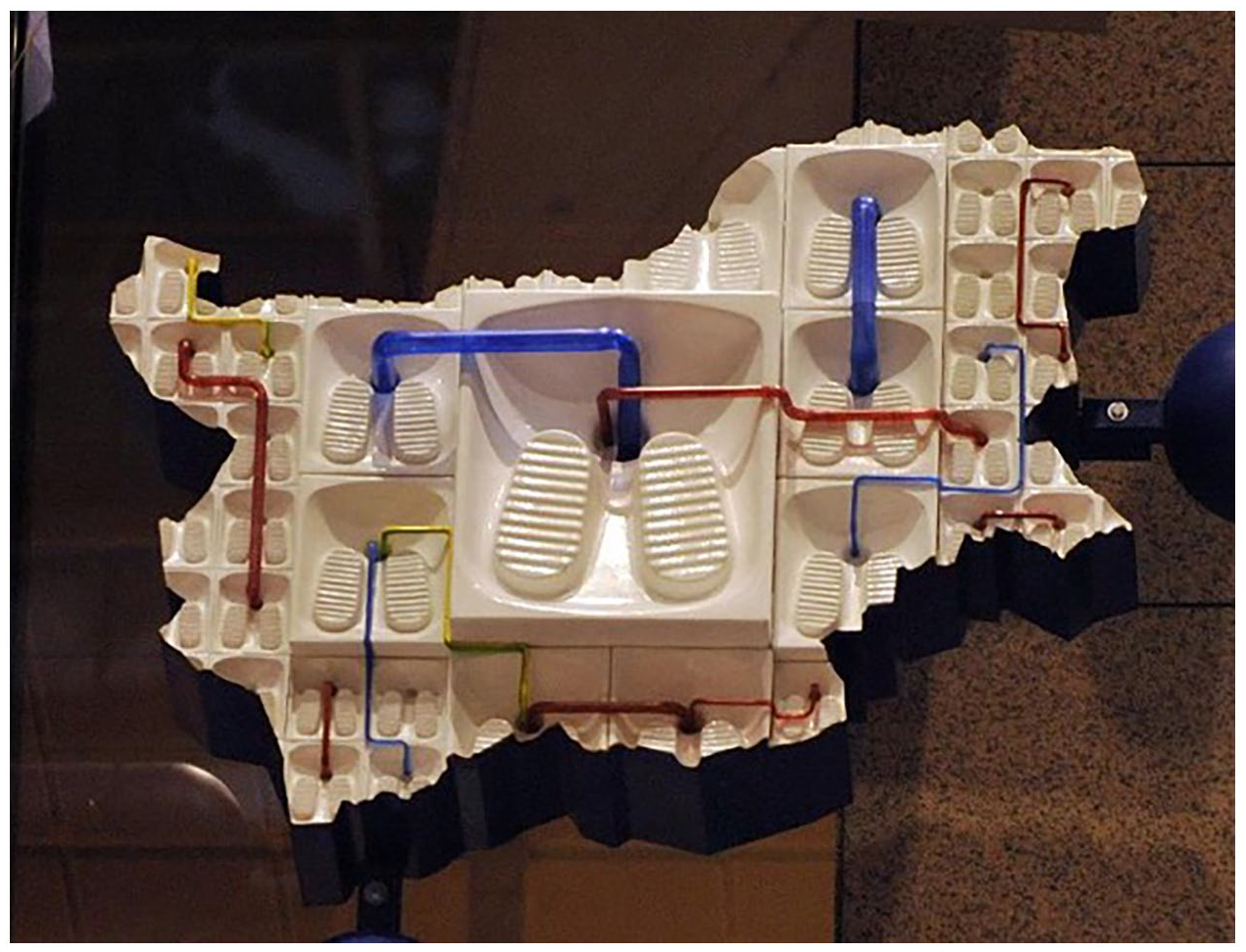
Representation of Bulgaria, ‘A Sculpture of European Stereotypes’.a
I asked students what they thought this represented and how this representation may relate to identity and (in)security. I then explained that it was a representation of Bulgaria in a sculpture of EU member states by artist David Černý, introduced in Brussels in 2009. We discussed reactions to this depiction with reference to some literatures, for example orientalism and processes of othering. There was no predetermined goal for what anyone would or should ‘say’: the purpose was the process of analysis and critique, not the outcome.
We then moved to political cartoons to connect image and interpretation with more traditional areas of security studies. Two examples of how images elicit different meanings were the ‘Muhammad Cartoon Crisis’ of 2005 and the Charlie Hebdo attack in Paris. A teaching objective was to underscore knowledge(s) as plural and definitions as not self-evident. Following this I projected the following in Figure 2 as a way to think about the seemingly unending wars on terrorism, the relational feedback look of security and insecurity, and wartime more generally 66 :
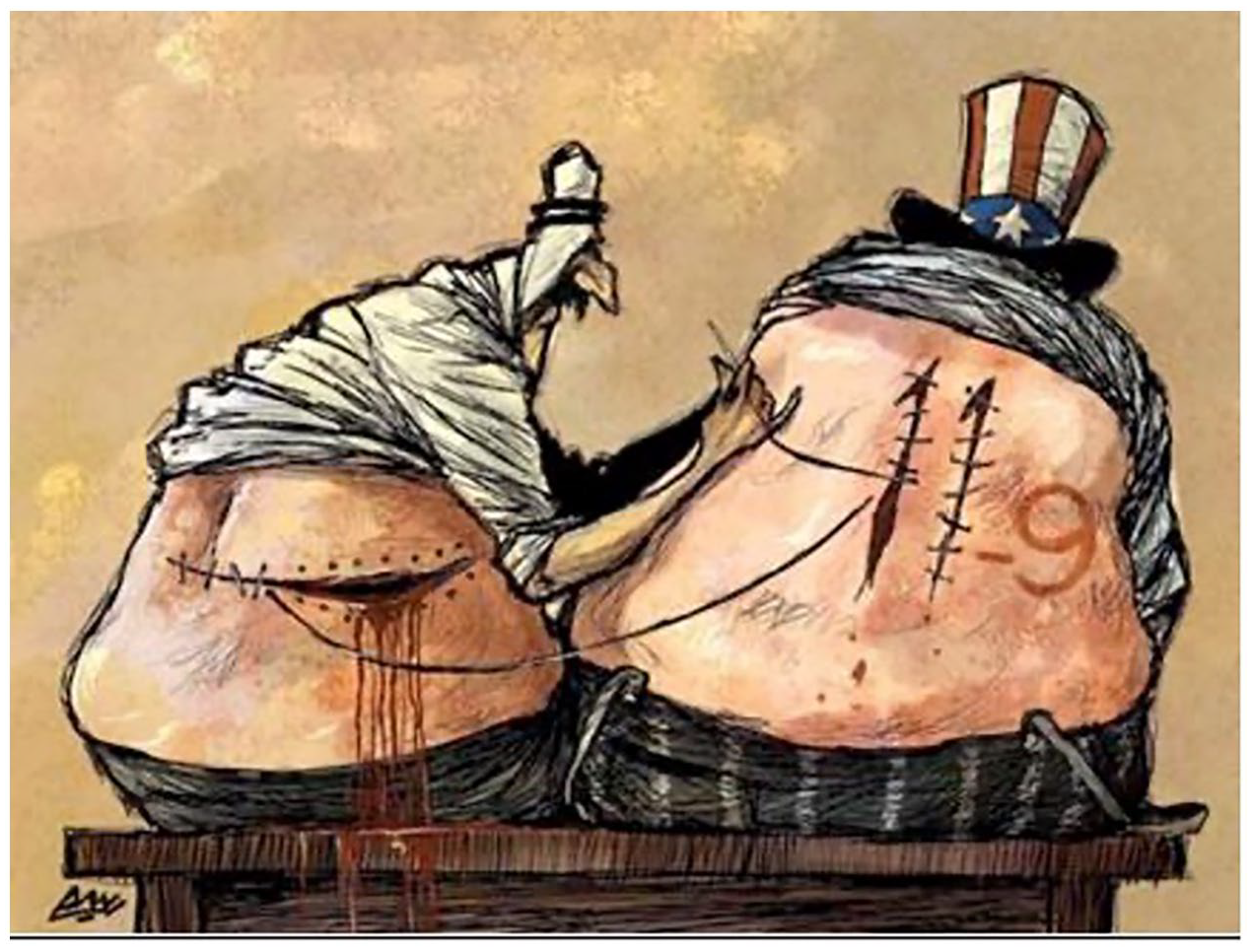
Rasmi, Untitled.a
Discussion was not dictated and there were no predetermined ‘teaching objectives’ of where it ‘should’ go, with class engaging the role of calendar dates, blood, and an inability to stitch both wounds closed at the same time (as one wound close, another wound opens). Through this image we endeavored to visualize the relational interconnectedness of security and insecurity, of violence and counterviolence, and of suffering. Going back to O’Driscoll and Hom, such an image illustrates how viewed from the temporal perspective of wartime, ‘it is tempting to conclude that nobody wins wars anymore; at most, one side loses more slowly than the other’. 67 In terms of teaching and the classroom, exploring images such as this in the context of disentangling the consequences of wartime may be an opportunity to further push how Campbell and Steele 68 discuss the analytical purchase of ‘scars’ in the context of pedagogical purchase. More specifically, whereby ‘historians and political scientists play a role in reopening the scars of violence to enable another narration: one that focuses less on the heroism and dramatics implied in decisive victory, and more on resources for reconciliation that honestly account for the human costs of war’. 69 It is not a zero sum critical exploration, and to reopen “the scars of violence” is not to be careless or dismissive of the exceptionally personal costs of wartime, not least for students who have gone to war and experienced the unimaginable. Nor is it to ignore the heroic feats that do take place in wartime regardless of victory or victor. Rather, it is to push for ‘resources for reconciliation’ and think about the human costs of war beyond state centric frames that can position a ‘legitimation narrative’ that can minimize the human costs of war, and at an extreme can justifies these costs as necessary expenditures on a road of wartime with no end in sight.
The overarching goal in such critical approaches to wartime is not to criticize defense preparedness, or to criticize critical theoretical critiques of state-centric military power. Rather, it is to challenge narratives that enable a normalization of wartime and its consequences given interweaving loops of security and insecurity. Encouraging classroom time to analyze how identity-in-oppositions play out in official and unofficial discourse is just one possibility for how critical approaches to security studies can be illustrated and ‘seen’. Indeed a future class could even link this approach to the earlier empirical examples drawn from mission statements. Given associated us/them legitimizing mechanisms that provide a foundation for wartime and its discursive framings, perhaps through curriculum design and lesson planning we can, however incrementally, begin removing blinders from wartime conceptualizations that limit us to a seemingly unavoidable and endless path to war. In this sense we can reorient our starting position in security studies from how to do warfighting ‘better’, to how to minimize needing to fight wars in the first place.
Conclusion
The classroom is an energizing space through which to challenge theoretical assumptions as well as tackle wartime tensions and oppositions head on, to include normalized framings of wartime and associated social and material consequences of war making and violence. This is of ongoing importance given how processes of boundary drawing within and between states continue to influence processes of humanization and dehumanization that are of constitutive consequence across a range of fronts, including PME mission statements, critical security studies epistemological debates, and material security practices. The classroom is, of course, no panacea for merging theory and practice nor is it presented here as any kind of naïve or idealistic solution to security decision making that increases insecurity or scholarship that reinscribes exclusionary boundary drawing. As discussed by Lisle and referenced early on in this article, we are call complicit in some way to some degree. 70 Failings and failures abound, from falling into traps of looking for ‘impact’ or self-censorship, to reinscribing us/them boundaries that limit critical scholarship and obstruct a more caring and humanistic pedagogy. The extent to which critique such as that of 21st century American wartime can be employed in a status quo state-centric environment is uncertain, as is the future of critical scholarship, whether due to its (our) short comings in making change ‘out there’, or in our inability to tackle our own divisive and damaging us/them boundary drawing.
Thinking through us/them boundary drawing in PME mirrored efforts in the classroom to assign readings attending to identity construction, security/insecurity feedback loops, and supporting students’ in expressing and exploring their own self-reflexivity. On the one hand, the very idea of mission statements supports a course drawing on CSS by attending to the role of discourse, identity, constitutive causality, possibility for change, and critique. Critical approaches to security facilitate interpretive approaches and methodological perspectives attentive to relationality and language alongside materiality. Mission statements provide a clear, direct, and simple empirical example through which students can think about ideas of purpose, being, and legitimation in the context of wartime.
On the other hand, mission statements provide an empirical source through which to think not only about limitations but the possibilities of PME from a learning standpoint if mission statements reinforce a wartime dynamic that obfuscates thinking about security beyond warmaking. When the construction of institutional identity for military education (as opposed to military training that understandably does focus on warfighting) seems to in some ways perpetuate an ongoing state of preparing for doing war, it seems that the role of education in professional military development may be faltering. In this sense exploring how CSS may play out in PME classrooms is not to presuppose in naïve fashion that war and its institutional frameworks do not exist. Rather, it is to maintain space for alternative explorations for how we define our ‘other’, legitimize the use of violence, and may be engaging in security practices that encourage insecurity. By attending to everyday levels of engagement in the classroom we may be able to both employ and challenge the potential of CSS epistemological and normative priorities, if even from within a status quo environment. It is in this sense that the choice to focus on CSS and not Critical Military Studies was intentional. While there is an excellent wealth of research in CMS of relevance to PME mission and wartime, the focus in this article and related course design necessitates going beyond a military centric lens. While CMS can and does bring nuance to critical perspectives of military power, CSS arguably situates such critiques in a broader context to show how us/them and security/insecurity relational dynamics can be particular to, but not exclusive to, military environments.
In 2010, a U.S. Congressional report concluded ‘We are concerned by the lack of a coherent, comprehensive, and effective program to improve critical thinking skills among all officers continually throughout their careers’.
71
Six years later, Murray wrote: the guiding standards for academic rigor in JPME are low. Indeed, they are far lower than the standards demanded by Congress, or claimed by the services themselves. They are also low when compared to the equivalent level of civilian academia.
72
One way to respond to this and more recent calls for ‘unstagnating’ PME is to bring humanization to the forefront of curricular efforts. This seems particularly pressing given that whether in theory or in practice, all of us seem to always have an ‘other’ in mind, the othering of which can quickly translate into legitimations of exceptional and exclusionary practice. One way to strengthen PME is to reassert a focus on critical (broadly defined) scholarship, approach, and pedagogy, redirecting the focus of education toward critical thinking and understanding, not information transfer or skills memorization which are better suited for training environments.
Being uncomfortable and having our sensibilities and assumptions unsettled around notions of wartime, as both scholars and students, is arguably a key part at minimizing insecurity, and this includes PME insofar as it provides the opportunity to take a step back from warfighting so each student can prioritize their thoughts and voice on wartime. Perhaps discomfort can help us meet the need for ‘more robust dispositions of ambivalence that refuse the seductions of resolution and certainty, keep us focused on the horrific global conditions we currently face, and prevent us from turning away’. 73 If our goal is less insecurity, we must push ourselves through a variety of perhaps unexpected spaces to take normalized assumptions of the present and future to task, whether theoretical assumptions of problem solving ‘versus’ critical theories, or representations of timeless being and inevitable warfighting as justification for an ongoing wartime with no end in sight.
Footnotes
Acknowledgements
The author would like to thank invaluable critique, comments, and feedback from external peer reviewers, the International Relations Editorial team, Luke Campbell, Andy Hom, and Terilyn Huntington.
Funding
The author received no financial support for the research, authorship, and/or publication of this article.
