




Abstract
How does the international system impact a civil war? Does polarity affect the war’s outbreak, character and how long it lasts? Systemic Realists argue multipolarity makes inter-state war more likely, but is this also true of intra-state war? Using the Syria conflict (2011-present) as a case study, this article suggests a connection can be found. It argues that the end of US-dominated unipolarity, and its interaction with a new multipolarity in the Middle East region impacted the behaviour and calculations of foreign states involved, contributing to the outbreak of war and how it progressed. The same interacting multipolarity paradoxically also shaped Russia’s decision to intervene in 2015, ultimately edging the war towards a conclusion, something that Systemic Realists would not expect. This study of the systemic effects in the Syria conflict suggests that the Neo-Realist concept of polarity continues to have relevance and can be useful in understanding intra- as well as inter-state conflict. It points to the importance of the interaction between regional and global systems in generating these effects, and it suggests a reconsideration of the Neo-Realist view that multipolarity always makes wars harder to end.
Introduction
This article explores the outbreak and course of the Syrian civil war and its relationship with polarity in the global and regional system. It contributes to the growing field of Middle East-focused International Relations (IR) scholars showing how IR theory can strengthen our analysis of the region’s politics and how Middle Eastern cases can, in turn, inform scholarly theories. 1 It argues that the concept of polarity, one favoured by Systemic Realists and defined by Barry Posen as how the, ‘distribution of power in the international political system affects the behaviour of the states that compose it’, can enhance our understanding of the Syria conflict (2011-present). 2 In particular, the Syria war supports Realists’ claims that the balance of power (and threats) in an international system affects the behaviour of state governments to the point that it can impact both the likelihood and course of conflict. It will suggest that Systemic Realists’ usual focus on how polarity impacts inter-state wars can be expanded to include civil wars like Syria’s, something particularly relevant given a general decline in direct inter-state wars and the growth of external actors playing out their rivalries through intra-state conflicts. 3
This study contributes to literature both on the Syria war specifically and scholarship on conflict in general. Scholars of the Syrian civil war have rarely engaged with IR theory. One set of authors, notably Samer Abboud, Sam Dagher, Emile Hokayem and David Lesch, frame the conflict as primarily domestic in origin that later drew in external actors. 4 As such, their points of reference gravitate towards theories of state development, identity politics and political economy, with little reference to IR theory. A second set, notably myself, Raymond Hinnebusch, Adham Saouli and Soren Schmidt, place more emphasis on the significance of international factors in driving the conflict from the beginning and some do utilize IR theory. 5 However, even then, few have sought to use the Syria case to make a broader contribution to our understanding of international conflict. This article seeks to build on the work of this latter set of authors, particularly myself Battle for Syria, by expanding on the theoretical element. It shows in more depth the mechanics of how one aspect of an IR theory, polarity, can help explain the Syria war. It also argues that the Syria case is useful to add new insights into scholarly discussions on conflict, particularly the debate on polarity. In doing so, it reemphasizes the continued value of Neo-Realist concepts, challenging those who believe polarity has lost its meaning. 6
In showing how global and regional polarity impacted the Syria conflict, this article makes two major arguments. Firstly, that the Syria case suggests that polarity in an international system impacts civil wars as well as inter-state wars and that the regional system is as important as the global. 7 Indeed, Syria shows the importance of the interaction between both regional and global systems. Secondly, that as well as helping the conflict break out and expand, the multi-polarity of the global and regional system also contributed to its end. This opens questions about the Realist expectation that multi-polarity makes war more likely as, in 2015, the greater complexity and fluidity of the international system allowed space for Russia to decisively intervene. Both these arguments help make the broader point that the Syria case points to a relationship between regional and global polarity and intra-state war.
The remainder of the article is divided into six sections and a conclusion. Sections 1 and 2 outline the theoretical context. Section 1 explores the debates over polarity and conflict among IR scholars and argues there is a need to widen Systemic Realists’ observations about inter-state conflict to include intra-state wars. Section 2 then discusses the importance of regionalism and how the Middle East’s shift to a regional multipolarity and its interaction with the end of global unipolarity impacted the behaviour of states in a way that would impact the Syria conflict. Section 3 explores whether a connection can be found between intra-state conflict and the type of regional and international system in the Middle East from the Second World War to the present. It offers a broad longitudinal comparison to suggest that civil wars are more prevalent and involve more international actors during eras of regional and global multipolarity. Finally, Sections 4–6 explore this hypothesis in detail by examining the mechanisms by which the dynamics of regional and global multipolarity impacted behaviour in the Syria conflict. It will look at how this aided and encouraged the outbreak of war, shaped the conflict’s characteristics and contributed to its resolution.
Polarity and conflict
Systemic Realists believe the balance of power in an international system, measured by a state’s relative capabilities such as the size of its economy, population, level of development and willingness to convert these into military power, influences a government’s behaviour. Though this structure does not determine their actions it, ‘shapes and shoves’, presenting constraints and creating incentives. 8 Kenneth Waltz argued that these structural conditions made inter-state conflict more likely in an international system that was multi-polar rather than bi-polar. 9 The increased number of potential enemies and allies impacts the calculations of states, making war more likely. 10 Realists argue that this was the case for most of history, until 1945, seeing more conflicts than the comparatively stable bi-polar order of the Cold War and the uni-polar era of US hegemony that followed it. 11 Waltz and his followers did not claim this structural theory explained all features of international politics, but rather, ‘a small number of big and important things’, such as the outbreak of inter-state wars. 12 As such, Waltz did not concern himself with how polarity and structure might impact intra-state conflicts, however, this article posits that this structural Realist framework can help explain civil wars such as Syria’s as well.
It is rare for civil conflicts to operate in a complete vacuum and the external balance of power greatly impacts how domestic combatants and their external allies can operate. Syria’s conflict, from the very beginning, was influenced by external actors, notably the US, Russia, Turkey, Iran, Saudi Arabia and Qatar and their actions were greatly constrained and incentivized by the international system in which they operated. Indeed, their behaviour in the Syria conflict was impacted by systemic factors in the same way Systemic Realists see state rivals impacted in inter-state wars. The fact that the international system was undergoing a shift away from unipolarity was particularly significant, and several features of multi-polarity highlighted by Realists are relevant. First, multi-polar systems are more fluid than bi or uni-polar ones. As John Mearsheimer states, ‘a bipolar system has only one dyad across which war may break out’, while, ‘a multipolar system is much more fluid and has many dyads’. 13 The large number of states involved in Syria, not aligned into one bloc or two opposing blocs, impacted how these states behaved.
A second feature is the divided attention of players involved. Barry Posen notes, ‘with many possible allies or adversaries, states will tend to see the possibility for incremental gain; for example, if State A concludes that State B is otherwise occupied with State C, that presents opportunity’. 14 For the six external states that were major protagonists in Syria, the conflict was one of several arenas of regional and international competition, meaning their actions were frequently conditioned by events elsewhere as much as in Syria itself.
Finally, Posen notes a third feature, that, ‘fear of countervailing coalitions imposes caution’. This caution also was in much evidence, with actors frequently intervening incrementally rather than to the full extent of their capabilities, due to fear of others’ counter-escalation. While there are other ways in which multi-polarity impacted players’ behaviour, these three serve as useful illustrators for the Syrian case. It is this kind of ‘shaping and shoving’ that this article highlights.
In doing so, it aims to show the continued relevance of polarity in helping to explain conflict. This challenges those such as Randall Schweller who argued that, ‘polarity has become a largely meaningless concept’, during the age of unipolarity after the Cold War ended. 15 Schweller argued that the US’ dominance in the 1990s and 2000s meant that it was processes rather than structures that constrained actors’ international behaviours. However, as will be illustrated, the fact that the shift from global unipolarity to multi-polarity, and a similar shift at a regional level, contributed to the outbreak and character of international involvement in the Syria conflict emphasizes how important structure continues to be. In placing the international system at the centre of explaining the conflict, the article similarly questions counter explanations for the drivers of conflict. Neo-Classical Realists, for example, emphasize the role of domestic politics in determining foreign policy, while Constructivists focus on identity and norms. 16 While these offer valuable additional layers to our understanding of conflict, domestic and identity factors remain constrained and shaped by the structural environment in which they operate. 17 The Syria case underlines how much in a conflict is shaped by the international system – Waltz’s small number of ‘big and important things’.
Multipolarity in the Middle East region
The global system’s impact on civil war is conditioned by its interaction with another key structure: the regional system. Early Realists took little interest in how the global balance of power delivered different outcomes in different regions. As Benjamin Miller notes, ‘Realism is. . .unable to explain the differences among regions. It cannot explain why regions with similar multipolar distributions of power are differently prone to war’. 18 Regions should not be seen as subordinate to global systems, but independent systems of their own – what Buzan and Waever call, ‘distinct stories’. 19 The extent of this independence is debated. Katzenstein sees a ‘world of regions’, but one that is embedded within a dominant US unipolar ‘imperium’, while Buzan and Waever suggest greater fluidity depending on context. 20 Importantly, as Buzan and Waever state, region is not always as important as the global system, but it is, ‘consistently significant’. In short, understanding how the global system impacts civil war is impossible without exploring how that system interacts with its regional context. In the Syria case, both the global and regional system were undergoing change and their interaction impacted the calculations of actors. As shall be discussed in Section 3, the interaction of the regional and global systems had long had an impact on the nature of civil war in the Middle East, but the particular combination of global and regional multipolarity made the post-2008 era especially combustible.
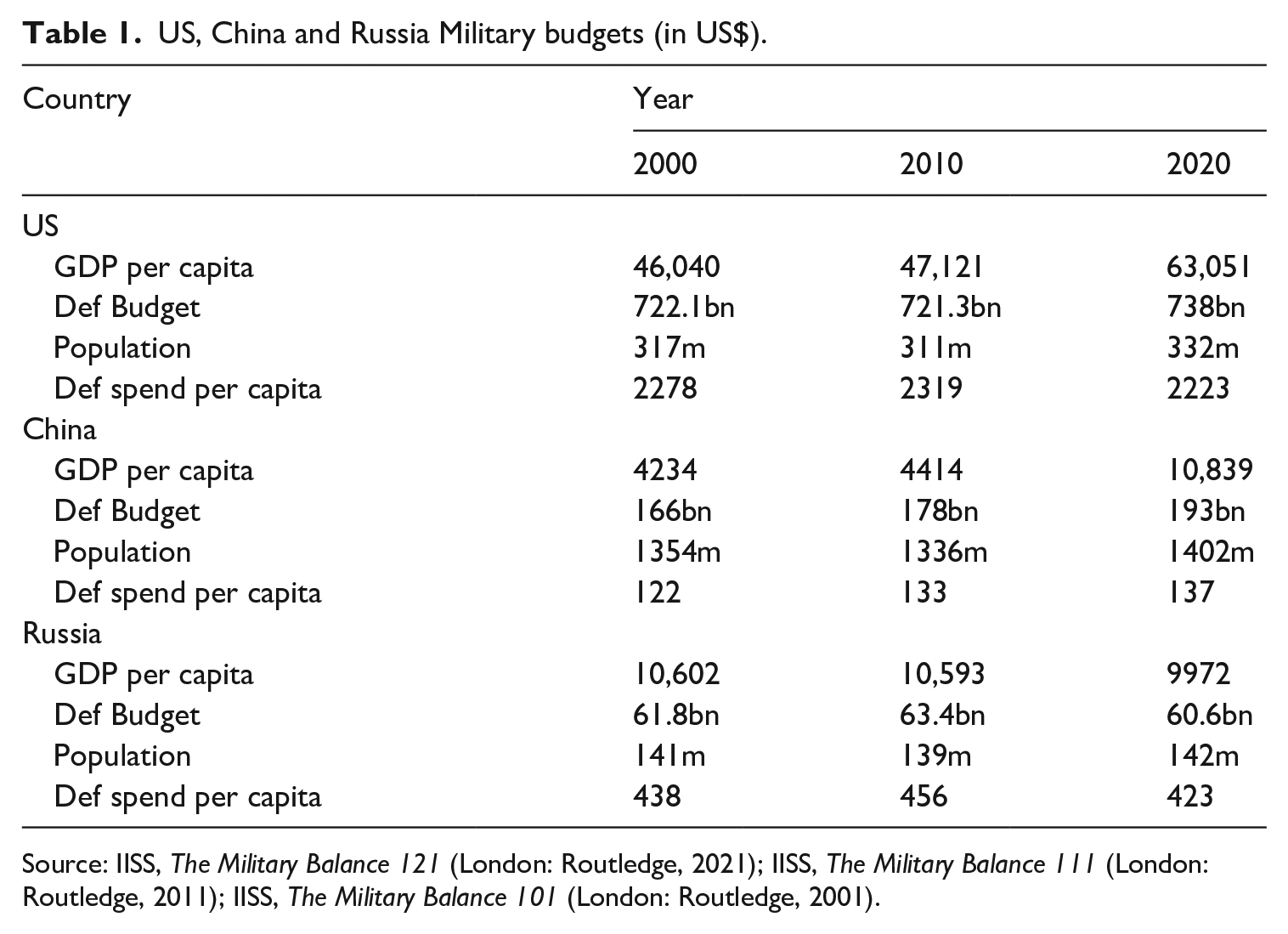
At the global level, the international system began shifting towards multipolarity in the late 2000s. Though the extent and effectiveness of US power during the ‘unipolar moment’ of the 1990s has been exaggerated, the 2000s still saw a relative decline in US global power compared to its rivals. 21 Christopher Layne, among others, argues convincingly that US decline had economic drivers, primarily the shift in the centre of global economic power from the west to Asia and the rise of competing great powers, notably China. While the US is still just about the world’s largest economy, it shrank from having 23% of the world’s GDP in 1995 to 18% in 2014. In contrast China rose from 6% to 15% in the same time and is forecast to surpass the US completely in the 2020s. 22 This increase in economic capacity did not immediately translate into a corresponding growth in military power, but over time China has spent more on defence. From 2000 to 2020 China’s defence budget grew 16% from $166bn to $193bn (See Table 1). In the same time period the US’ defence budget did not match the increased Chinese investment proportionally, growing only 2% from $722.1bn to $738bn. On the one hand some could argue there is no need for increased spending given the US defence budget remains the highest in the world and is still over three times that of China. However, Layne and others argue that this combined economic and military growth has increased China’s capacity to the extent that it can now be regarded as a global power able to challenge US dominance in certain arenas, diplomatically, economically and militarily. Indeed, Chinese military and economic power, such as its ‘Belt and Road initiative’, means it is now an equal of the US or even the dominant external power in parts of Asia and Africa.
US, China and Russia Military budgets (in US$).
Source: IISS, The Military Balance 121 (London: Routledge, 2021); IISS, The Military Balance 111 (London: Routledge, 2011); IISS, The Military Balance 101 (London: Routledge, 2001).
Alongside the growth of China, two other factors have contributed to the shift to multipolarity. One is the resurgence of Russia, particularly in the Middle East and Europe. While Russia’s economic and military power have not greatly increased since 2000 (See Table 1), its willingness to utilize it has – and a willingness to convert capacity into power has important impacts on the balance of power, according to Posen. 23 This was seen first in the 2008 Georgia war, and later in Ukraine, Syria, Libya and Kazakhstan. While the outcome of the 2022 Ukraine-Russia war remains unclear, Vladimir Putin’s willingness to act there and elsewhere seems to derive partly from a perception that pushback from the US would be limited and not decisive, showing how the international system can condition a state’s behaviour. 24 Russia is only competing with the US in certain regions, but its challenge to US hegemony in those regions, alongside China’s global challenge, contributes to the end of unipolarity. This has contributed to the growth of a multi-polar order rather than a bi-polar order determined by US-Chinese rivalry. 25 Similarly, the US’ failures in Iraq in 2003–2011 contributed to US decline. While this did not affect its capacities directly, it did impact its willingness to convert them into military action, with domestic backlash against foreign deployments adding further constraints to US politicians. Arguably this backlash represented a diminishment of US military capacity: pressure to avoid putting ‘boots on the ground’ meant the US could not deploy its armed forces in the same way as it had in 2003, when there was enthusiasm for deployment. Shifts in China, Russia and the US therefore all contributed to an end of the unipolar order and the ushering in of a more multi-polar world. The Syria conflict would help exacerbate these trends, but they were already present before 2011.
This was significant as the Middle East’s regional system, embedded within this global order, was also changing. The regional system was odd in that, from the late 1980s, the dominant military player was an external actor: the US. While the US’ enemies and allies had their own military capabilities, the presence of the US and its seemingly unparalleled capabilities shaped certain behaviour from regional powers. The US’ enemies: Iran, Iraq, Syria and Libya, knowing they could not match Washington in a conventional conflict, instead sought non-conventional military tools such as sponsoring non-state actors. In contrast some of the US’ allies, especially Saudi Arabia, Egypt and Israel, leant on their alliance with Washington to project more power than they had alone. 26 The result was a regional system in the 1990s and early 2000s, that scholars characterized as either unipolar or weak bipolarity – the weak challenge coming from Iran and others. 27
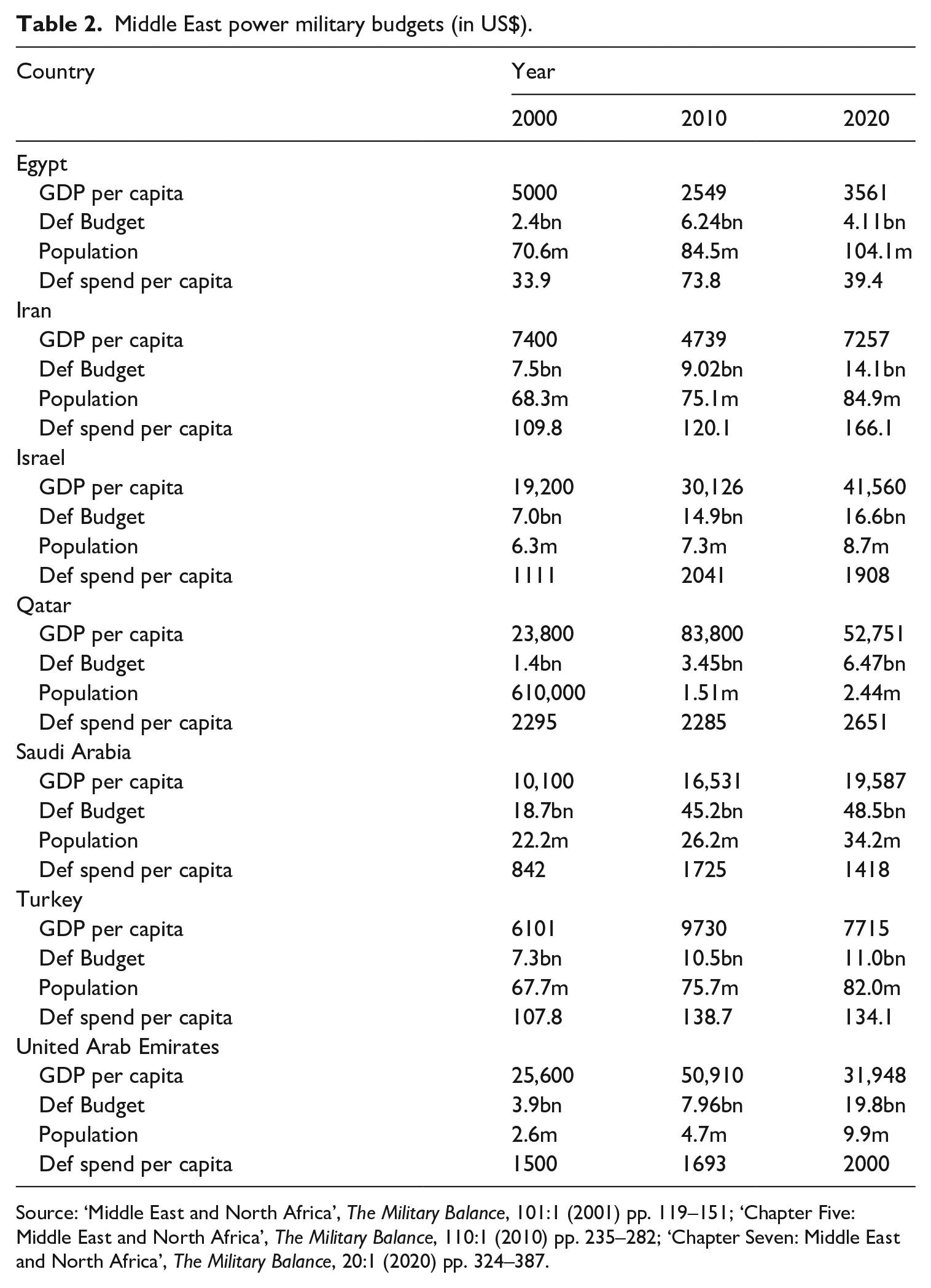
The catalyst for the shift in this regional order was the 2003 Iraq war and its consequences. The fallout of the conflict shifted the capacity of the external hegemon, contributing to the new constraints on the US discussed above and a reduction in its dominance. Arguably, the distribution of populations, resources and capabilities makes the Middle East naturally multi-polar but the imposition of superpowers over it since the Cold War prevented that from happening. The relative retreat of the US after 2008 removed that constraint. In addition, the Iraq war and its consequence altered the capacities and willingness to act of several regional players, reinforcing the multi-polar regional order, as outlined in Table 2.
Middle East power military budgets (in US$).
Source: ‘Middle East and North Africa’, The Military Balance, 101:1 (2001) pp. 119–151; ‘Chapter Five: Middle East and North Africa’, The Military Balance, 110:1 (2010) pp. 235–282; ‘Chapter Seven: Middle East and North Africa’, The Military Balance, 20:1 (2020) pp. 324–387.
Firstly, Iran was ‘shaped and shoved’ to be more active in the region. The fall of its enemy, Saddam Hussein in Iraq, removed a major obstacle. In addition, the boom in oil prices brought on both by the Iraq war and the rise of China saw Iran’s economy grow, which it translated into increased military power. Its defence budget increased by 20% between 2000 and 2010 and leapt a further 50% in the following decade. This was up from $7.5bn to $14.1bn in total, representing an increase defence spend per capita of over 50% in 20 years. Iran used these new capacities to intervene more in Lebanon, Iraq and Yemen. This, alongside the oil boom, altered the behaviour of another regional player, Saudi Arabia, which increased its capacity to be more involved in the region to contain Tehran. For decades Riyadh had spent heavily on defence equipment, but its primary strategy was to sponsor others like Iraq and the US to confront its enemies, rather than get involved itself. 28 Yet the 2000s and 2010s saw Riyadh massively increase its defence budget, by 140% between 2000 and 2010, from $18.7bn to $45.2bn. It used this new military to both deter any Iranian attacks and project its own power into the region, without relying so heavily on the US as in the past.
However, this did not produce a regional bipolar order as neither Saudi Arabia nor Iran were powerful enough to either corral the other powerful regional players into their camp, or scare them into allying with the other – what Stephen Walt calls Balancing or Bandwagoning. 29 Turkey, for example, became a regional player for the first time. Here the space opened by the US stepping back combined with domestic political and economic factors – the Islamist-leaning ideology of its ruling AK party and the hunt for new markets for a booming manufacturing sector, greatly helped by new construction contracts in post-war Iraq. This saw Turkey also increase its defence spending, by 43% between 2000 and 2010. More significantly it meant Turkey’s immense armed forces, with its $10.5bn defence budget, was introduced into the Middle East for the first time, injecting a major new player into the balance of power. On top of this, Qatar and the UAE similarly benefitted from the oil boom brought on by the Iraq war and China’s rise and translated this into increased military capacity. Qatar’s defence budget increased by 65% from 2000 to 2010, while the UAE’s grew by 104%. Though not as significant as Turkey, each would use their increased military capacity to back new proxies and, in the UAE’s case, even intervene directly itself. Added together, the defence budgets of the main regional powers in 2020 was $120.6bn, compared to $48.2bn in 2000, an increase of 150%. This massive increase in regional defence spending, at a time when the US only increased its budget by 2%, is an indicator of how polarity impacted behaviour. The stepping back of the US created a vacuum that multiple players sought to take advantage of, prompting massive increases in defence spending to ensure both maximum advantage and to balance against the threat of regional rivals that were also rapidly arming.
A related significant structural shift was the growth of fragile states: creating new arenas in which the regional powers could utilize their increased capacities to play out their rivalries. 30 Previously Lebanon had been a major battleground for regional rivalries. The collapse of Iraq after 2003 and growing instability in Yemen added two new battlegrounds. The increased porousness and fragility of these states allowed Iran, Saudi Arabia, Qatar, the UAE and Turkey to gain experience sponsoring proxies and cultivating clients. When the 2011 Arab uprisings added Syria, Libya and (briefly) Egypt to this list, it was unsurprising that they continued the practices they’d developed the previous decade. The Middle East’s fragile states served as a feedback loop for regional multipolarity. The growth in fragile states coupled with increased capacity for regional players and a decreasing willingness for the US to act as regional hegemon created more incentives for these regional powers to intervene. In doing so they made the states’ even weaker, incentivizing more intervention and perpetuating regional multipolarity.
Therefore, on the eve of the Syrian civil war, the Middle East’s ‘distinct story’ had been greatly impacted by both global and regional shifts. Globally, the rise of China and decline of the US had ushered in the end of unipolarity and the US was less willing to act as the regional hegemon than before. Regionally, the Iraq war, which had also contributed to this global shift, had created economic and military incentives for greater regional activism from multiple regional powers, ushering in an era of regional multipolarity. As will be discussed, this would go on to ‘shape and shove’ their behaviour when Syria erupted in crisis in 2011.
Polarity and conflict in the Middle East
It is worth asking why the shift to multipolarity had such an impact in Syria. After all, the region experienced multipolarity in the past. To understand the significance of these changes this section will look at the different global and regional orders the Middle East has experienced since 1945 and the civil wars that occurred to see what impact the international systems may or may not have had on state behaviour. Such a long-form analysis suggests there is a significant pattern: civil wars are more prevalent and involve more international actors during eras of regional and global multipolarity combined.
Since the Second World War, when the Middle East shifted from predominantly colonially run states to predominantly independent states the regional balance of power has undergone several evolutions. It is possible to identify broadly four different eras. 31 The first era, roughly from 1945 until 1967, could be characterized as regional multipolarity, within a global bipolarity. The residual presence of colonial Britain alongside an initial disinterest in the Middle East by Stalin, meant that the region was not immediately drawn into the same superpower rivalry seen in Europe and East Asia. 32 In this context regional powers competed with one another to gain advantage or ensure their own survival, often seeking or accepting the patronage of a global power to achieve this. The interest of multiple global players allowed regional powers such as Nasser’s Egypt to ‘shop around’ for different patrons rather than committing to a single bloc in a bipolar system. While pro and anti-Nasser Arab states would eventually form a loose bipolar rivalry, what Malcom Kerr termed the ‘Arab Cold War’, beyond these Israel, Iran and Turkey all pursued independent policies. Walt has shown how this regional and global system impacted government behaviour, contributing to power balancing and (less frequently) bandwagoning by the regional players. 33
The second era, roughly 1967 until 1990, saw global and regional changes shift the region into an era of loose bipolarity within a more rigid global bipolarity. The system that emerged after the 1967 Six Day War pushed regional players to look more to the two superpowers for alliances. 34 As a result, the Middle East came to reflect more the global bipolarity. Perhaps because there were no regional hegemons to ground the superpower alliances, the blocs were far from fixed, so for example the US’ ally Saudi Arabia aligned with Soviet clients Egypt and Syria from 1967 to 1979. 35 This was similar to inconsistencies in the western alliance in Europe, such as France’s downgrading its ties to NATO and West Germany’s Ostpolitick. Even more than in Europe, relationships were complex and regional players were no puppets of the superpowers, with the 1973 October War and Israel’s invasion of Lebanon in 1982 examples of conflicts initiated against the wishes of the superpowers. Superpower rivalry was one factor among many contributing to regional politics, not the driving characteristic. 36 This still represented a shift from the 1950s and 1960s, with regional powers more clearly in super-power ‘camps’. ‘Camp switching’ in this era, like Egypt in the late 1970s, represented dramatic shifts rather than the more fluid ‘shopping around’ seen in the earlier, multipolar era.
The decline of the Soviet Union and the ascendency of the US arguably began with the flipping of Egypt and culminated with Operations Desert Shield and Storm in 1990–1991. Desert Storm, coming alongside the collapse of the Soviet Union ushered in an era of global unipolarity and regional unipolarity/weak bipolarity that lasted until roughly 2008. This saw a dramatic increase in the US’ military presence in the region, impacting regional players’ behaviour. From new Gulf bases, the US was able to restrict two regional powers, Iraq and Iran, via Dual Containment. The US’ regional allies, Egypt, Israel, Saudi Arabia and, more distantly, Turkey enjoyed an era of dominance, utilizing their alliance with Washington to project power beyond their means. Though spoiler powers continued to operate outside the US umbrella such as Libya, Iran, Iraq and, at times, Syria, their choices were constrained by the system, forcing them into non-conventional options in the face of US dominance. Iran, for example, opted to back non-state militia like Hezbollah, Hamas and Islamic Jihad to pressure the US and Israel, rather than their conventional military.
As discussed above, 2003–2010 helped usher this era to an end, leading to a regional multipolar order. However, this was not a re-run of the 1950s and 1960s. This new regional multipolar order was framed not by the emerging bipolar order of the Cold War, but by the collapsing global ‘unipolar moment’ and the emergence of global multipolarity.
Identifying these four eras is useful in trying to understand the relationship between the international systems and civil wars in the Middle East. Table 3 lists Middle East civil conflicts since 1945 and the main foreign states that intervened. ‘Civil conflict’ here has been defined using the common political science definition of a civil war being 1000 combat deaths on either side within a country within a calendar year. Wars of independence from colonial powers have not been included, nor have low-level internal conflicts that are widely agreed to have seen fewer than 1000 deaths. ‘Intervention’ is defined as significant material support by a foreign actor for one side in a civil conflict, whether that be money, training, weapons or direct involvement. Here ‘Middle East’ – an arbitrary colonially constructed concept – is defined as from Libya in the West to Iran in the East and from Turkey in the north to Yemen in the south.
Middle East civil wars and foreign interventions 1945-present.
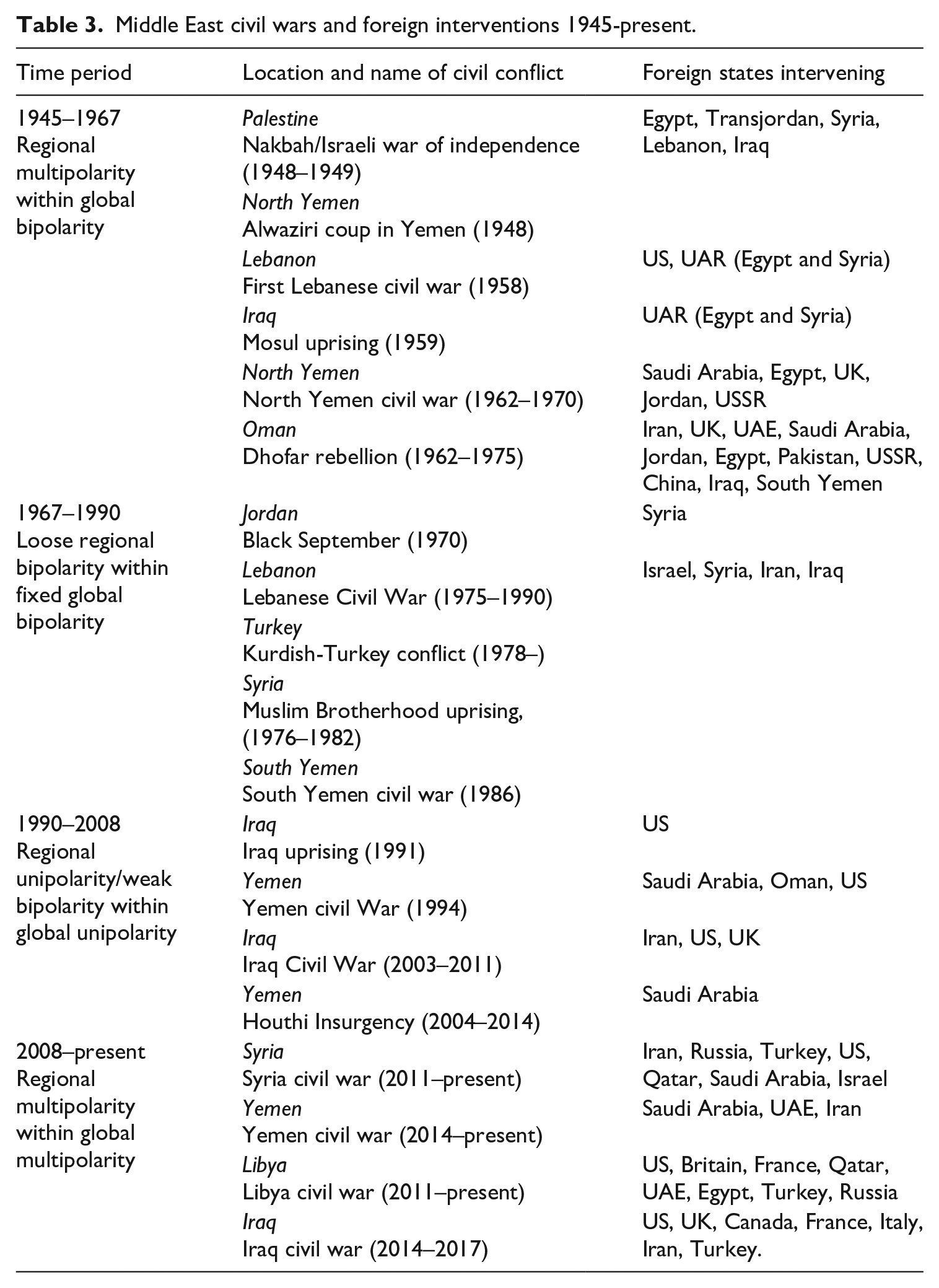
This table highlights several interesting observations concerning the relationship between regional and global polarity and civil conflict. One is the number of states experiencing civil war. The table suggests that the era of global unipolarity and regional unipolarity/weak bipolarity (1991–2008) saw the fewest states experiencing internal wars, with only Iraq and Yemen seeing civil conflict. In contrast, five states saw civil war in the 1945–1967 and 1967–1990 eras, and four in the 2008-present era. A further observation is the difference in how many civil conflicts attracted external intervention. Civil wars in the most regionally bipolar era (1967–1990) attracted little external intervention, with only two of the five conflicts drawing in foreign players. Moreover, intervention was mostly from regional not global powers. Interestingly this era saw considerable involvement from superpowers, but in inter-state conflicts rather than civil wars. This was unique to the bipolar era as all other eras saw external involvement from both regional and global powers in most civil conflicts.
A final observation is that a significant feature of the current multipolar era is the number of external players involved in each civil conflict. The four civil wars after 2008 all attracted involvement from 4 to 8 external states. While individual civil conflicts from earlier eras attracted similar numbers of foreign participants, such as the 1962–1975 Dhofar Rebellion in Oman, this was exceptional. On average the Middle Eastern civil wars from 1945 to 2008 attracted 2.4 foreign interveners each. Since 2008, the four civil wars have attracted an average of 6.5 each. While the table suggests that civil war may be somewhat more likely in a regional and global system that is multipolar, the pattern that stands out more is that the number of interveners has significantly increased in today’s structural conditions of global and regional multipolarity. 37 This might suggest that the absence of the restraining international and regional structures of bi and uni-polarity increases the incentives for external actors to become involved in civil wars while reducing the constraints.
Multipolarity and the outbreak of Syria’s civil war
Having suggested a relationship between regional and global multipolarity and the likelihood of intervention in civil wars, the second half of this article will explore the mechanisms of how this plays out by applying it to one particular case: the Syrian conflict (2011-present). Section 4 will examine how external actors contributed to the escalation of a domestic dispute into an internationalized civil war. Section 5 will note how they contributed to certain characteristics of the conflict. Section 6 will then look at how Russia helped the conflict draw to an end. In each case I show how the behaviour of these key external actors was greatly shaped by the polarity of the system.
Syria’s uprising began in March 2011 with a series of protests inspired by ‘the Arab Uprisings’ elsewhere in the region. The ruling regime of President Bashar al-Assad responded violently, and security forces killed dozens of protesters, causing the protests to swell. There was some violence from the opposition, but the movement was largely peaceful, in contrast to the government. There is scant evidence that either the majority of protestors or regime loyalists were being mobilized by foreign forces and the early months were domestic in origin, though inspired by events elsewhere. 38
Scholars of civil war have shown how external forces can escalate domestic disputes. Foreign material support and even the expectation of it by domestic actors encourages military solutions. 39 This clearly happened in Syria. Assad’s allies, Russia and Iran each supported Assad’s violent escalation. From 2011 to 2013, Tehran sent military and media advisors, followed by Iranian and aligned Shia fighters, as well as offering $4.6bn in loans. 40 Russian vetoes at the United Nations Security Council in 2011–2012 derailed attempts by Assad’s western and regional enemies to initiate UN sanctions, while sending aid and helping Syria bypass the economic sanctions western powers unilaterally imposed. 41 On the other side, foreign players encouraged the opposition to take up arms. Turkey hosted newly formed rebel groups from July 2011 and, along with Qatar and Saudi Arabia provided rebel fighters with money, arms and support. 42 Western states called on Assad to stand down, backing his opponents, and from Spring 2012 the US was covertly facilitating arming the rebels and a year later began openly sending weapons. 43 These external actors all encouraged the domestic actors to pursue maximalist demands and helped escalate the dispute into a civil war, with none seriously urging their Syrian allies to compromise. 44
These actions were shoved and shaped by the multipolarity of the regional and international system. At this stage the conflict had primarily two domestic players – the embryonic opposition and the Assad regime – but their external allies and enemies were not operating in a bipolar regional or global system, and so did not approach the two domestic players as part of two united international blocs. Instead they acted individually in a more fluid system with multiple dyads rather than just two or one, a characteristic of a multi-polar system as Mearsheimer notes. Russia and Iran, though they would later co-operate, behaved independently for the first few years. Though their aims aligned – keeping Assad in power – their reasons differed. Iran sought to keep Syria in its orbit to maintain pressure against its enemy Israel, while Russia actually had close ties to Israel and saw protecting Assad as a means to hold back the US. Later in the war Russia would even collaborate with Israel to permit limited strikes on its Iranian, Syrian and Hezbollah allies. This independence from Iran was incentivized by the multipolar system. Tehran and Moscow were not in a bi-polar bloc facing a common enemy determined to avoid one actor in the alliance being weakened. Rather they faced multiple players in a multipolar system and their threat perception of each differed.
The same was true of Assad’s enemies. Saudi Arabia, Qatar and Turkey all backed the rebels but did not unite to back a single actor as they might in a bi-polar system. Turkey and Qatar favoured those linked to the Muslim Brotherhood (MB), while Saudi Arabia, who feared the MB both at home and abroad, backed anti-MB rebel groups. For Saudi Arabia, Iran was its principle regional enemy and so wanted to topple Assad as a means to weaken Tehran, but the MB was a significant secondary enemy, meaning it was suspicious of their backers. Here we see how the multiple dyads impacted Riyadh’s behaviour: the existence of the third Qatar-Turkey-MB regional bloc, alongside Iran’s and its own meant it held back from embracing a united Syrian opposition. The same was true of Turkey and Qatar: Saudi’s support for the anti-MB coup in Egypt in 2013 made them suspicious of Riyadh, while neither shared its view of Iran, whom both traded with extensively and had reasonable ties. Had the system been bi-polar and either Turkey and Qatar had seen Iran as the primary threat, or Saudi Arabia had seen the MB-bloc as a minor issue compared to Iran, they might have intervened in a more coordinated manner. As it was all intervened individually, like Iran and Russia. This gave domestic players multiple sources of arms and support, helping the war escalate.
A good illustration of how the Multipolar system contributed to the escalation of conflict is the failed Arab Peace Plan of December 2011–January 2012. This saw the Assad regime agree to halt its violent crackdowns and the newly formed opposition militias agree to a ceasefire while Arab League monitors were deployed in Syria. However, it broke down within a month as neither side stuck to the terms, though there were far more violations from Assad. Assad was disinterested in the plan’s success, as seen by his violation of an earlier version in November 2011. Yet he agreed in December under pressure from Russia. 45 Moscow had already vetoed an anti-Assad resolution at the UNSC in October 2011 and wanted to avoid having to do so again so soon, fearing the Arab League would refer to New York if this plan also collapsed. However, Assad’s other ally, Iran, offered different advice. Leaked emails reveal the political attaché to the Iranian embassy suggested Assad used, ‘powerful and violent’, language while the monitors were in Syria, and it did not step down the Islamic Revolutionary Guard Corps advisor mission that it had sent. 46 Only one of Assad’s allies was therefore urging compliance with the plan – once again Iran and Russia not approaching the conflict as a united front. This allowed Assad the confidence to do what he actually wanted – to torpedo the plan and continue his violent crackdown, knowing Iran at least would support him and Russia would likely come around, as it eventually did. In contrast a united Iranian-Russian bloc at this point urging him to observe the plan might have made him think twice. The fluidity of the system facilitated his escalation of the conflict.
The Arab Peace Plan also shows how multipolarity contributed to violent escalation on the opposition side. The chief sponsor of the Peace Plan was Qatar, then holding the presidency of the Arab League, and the mission was primarily funded by Doha and Riyadh. However, like Assad the opposition at this point had little faith in the plan. During the observer mission the then-chairman of the opposition in exile, Bourhan Ghalioun, said that he only cooperated with the Arab League as a means to expose Assad’s duplicity and a first step towards western intervention against him. His backers endorsed this position too. Qatar was already funneling weapons and money to the armed opposition even as it sponsored the peace plan, while Saudi Arabia pulled its funding of the mission in less than a month, bringing about its premature collapse. According to insiders, neither Doha nor Riyadh had any interest in the mission and saw it as a steppingstone to military intervention against Assad. 47 Indeed, a few weeks after it collapsed, both publicly called for the opposition to be armed. 48 Again, were either to seriously pressure Ghalioun and other oppositionists to take the plan seriously, it may have had more chance of success.
This is not to say the war occurred just because of the way the multipolar system shoved and shaped the behaviour of the external players. Agency should not be taken away from domestic actors. President Bashar al-Assad is especially culpable for deliberately creating the conditions to help turn the opposition violent to justify his crackdown. 49 Likewise, the opposition made a conscious decision – albeit one that was highly debated – to abandon their peaceful origins and take up arms in the face of Assad’s violence. 50 However, external decisions facilitated and exacerbated those domestic choices. Assad wanted to escalate, but Russian and Iranian support helped him feel confident he could survive any external consequences. Those oppositionists urging a violent route were given weapons and money by foreign patrons, allowing them to dominate the peaceful activists. Clearly domestic and external factors interacted to promote a slide to war but, importantly, the decisions of the foreign powers involved was shaped by the multipolar system.
Multipolarity shaping Syria’s war
Once the war was underway, its character was similarly shaped by the behaviour that multipolarity promoted. While an array of the war’s characteristics were influenced by outsiders, here I will focus on two in particular: the fragmentation of the political and armed opposition and the unwillingness of the US to intervene against Assad. Divisions within the opposition were greatly exacerbated by external players. The political opposition in exile, for example, the Syrian National Council, was formed in August 2011 but factions soon emerged, sponsored primarily by Saudi Arabia on one side and Turkey and Qatar on the other. 51 The same was true when the opposition was ‘relaunched’ as the Syrian Opposition Coalition (SOC), in 2013, with influence fought over by Riyadh, Doha and Ankara. This led the first leader of the SOC, Moaz al-Khatib, a credible alternative to Assad, to resign, stating, ’When there are regional hands interfering and making decisions inside the country, it means the people inside have lost their ability to decide their own fate’. 52 The Coalition lost credibility and ultimately came to be seen as a puppet of first Saudi Arabia and later Turkey. 53
A similar story played out with the armed opposition. The Free Syrian Army (FSA) formed in Turkey in 2011. Subsequently many rebel militias formed and adopted the FSA label, but in reality many were independent and the commanders in Turkey had little control. 54 There were ideological and personal differences between the various militia, but foreign players exacerbated these. 55 Despite officially supporting only the FSA central command, Qatar backed a range of militia outside the FSA umbrella. Turkey similarly aided non-FSA groups. Though Riyadh stayed loyal to the FSA the longest, it eventually also backed a non-FSA Salafist group, Jaysh al-Islam, from 2013. Backing multiple groups rather than a single entity weakened the opposition as the various militia often found themselves competing for foreign funds, weapons and fighters rather than working together. On occasion, the external rivalries between patrons even led to battlefield losses. One example was the 2014 Battle of Yabroud, when Saudi Arabia ordered the rebels it backed to retreat from a besieged town leading to the defeat of the remaining rebels inside – those backed by its rival, Qatar. 56
The behaviour of Saudi Arabia, Qatar and Turkey was greatly shaped by the fluidity of the international system. This ensured they acted as individuals in Syria, backing rival groups that splintered the opposition. This was aided by another feature of multipolarity noted by Posen: divided attention. Because the system was multipolar and fluid, Syria was only one component of a wider regional competition taking place among multiple actors. Different players prioritized some arenas more than others, often depending on features such as proximity and level of investment. For Qatar and Turkey, for example, backing the Syrian rebels in 2011–2013 came alongside support for the new MB government in Egypt and the MB-aligned government in Libya. Saudi Arabia’s desire to ‘take over’ the SOC in 2013 was partly a way to push back this Qatar-Turkey-MB alliance and came amid it backing a coup against the MB in Cairo. 57 This in turn prompted different responses from Turkey and Qatar. Turkey, a neighbour of Syria, was angry at losing influence in Egypt, but doubled down its involvement in Syria. In contrast Qatar, a long way from Syria, focused instead on Libya, lessening its involvement in the Syria conflict. Meanwhile Saudi Arabia lost interest in Syria as it got distracted by a more proximate war in Yemen from 2015 and then a blockade it initiated on Qatar in 2017. This again impacted the war in Syria as the rebels became ever more Turkish proxies in the absence of other patrons. The divided attention of the multipolar system, with Saudi Arabia and Qatar ultimately prioritizing other conflicts, as opposed to all uniting in a single bloc against a common enemy, shaped the later stages of the war and helped weaken the opposition further.
The US’s decision to not intervene against Assad directly was likewise greatly shaped by the conditions of multipolarity. President Barack Obama called on Assad to stand aside in August 2011 and since then many inside and outside Syria expected Washington to impose regime change by force as it had in Iraq in 2003. The US evidently had the military capability to do this, as seen by it leading an intervention in Libya in 2011 and then in Syria in 2014 against ISIS. It backed anti-Assad rebel groups and even looked ready to strike Assad directly in 2013 when the Syrian leader used chemical weapons, although the proposed attack by Obama that he eventually called off was a limited missile strike to deter further usage rather than regime change. 58
Again, the conditions of multipolarity played a considerable role in shaping these decisions. Another of Posen’s features of multipolarity, that, ‘fear of countervailing coalitions imposes caution’, is relevant here. Unlike either ISIS or Muammar Gadhafi’s Libya, Bashar al-Assad was neither a non-state actor nor an international pariah and had powerful external allies, as outlined above. Russia had a naval base in the Syrian port of Tartus, and the US was sensitive that Moscow would not give this up without a fight. Indeed, US diplomats unsuccessfully tried to persuade Russia that they could retain this base if they dropped their support for Assad. 59 Though they did not expect either Russia or Iran to take on a US invasion directly, the experience of Iraq where Iranian-backed insurgents caused significant casualties instilled caution from the White House. 60 As Obama stated in his public address announcing that he was postponing the strike on Assad in 2013, ‘This nation is sick and tired of war. My answer is simple. I will not put American boots on the ground in Syria. I will not pursue an open-ended action like Iraq or Afghanistan’. 61 While the US retained superior capabilities, intervening directly in Syria presented too great a cost relative to what Obama felt he could accept domestically.
Divided attention also played a role in American inaction. Unlike in the unipolar Cold War, Washington was not focussing on a single geopolitical rival, and therefore did not view the Syria war the same way it viewed, say, Vietnam. Indeed, the assurances it tried to offer Moscow about Tartus show that it was not seeking Assad’s ouster to achieve geopolitical gain over Russia. As a result, it did not prioritize the Syria conflict over other geopolitical concerns. At the time it was seeking to negotiate with Iran on its nuclear weaponry, nudging Obama to be even more cautious against Assad. As this was not a bipolar system, Washington did not view Iran and Russia as a single bloc to oppose, but as two separate actors. Interestingly, while Obama sought to woo Iran and isolate Russia, especially after its annexation of Crimea in 2014, his successor Donald Trump sought to do the opposite: being friendly with Putin’s Russia and hostile to Iran. Yet Trump was just as restrained as his predecessor regarding Assad. When Assad used chemical weapons again in both 2017 and 2018 the Trump White House did opt to launch strikes in retribution, but these were minor military punishments rather than serious escalations and had little impact on the Assad war machine. Yet in a sign of how he too was constrained by structural conditions and genuinely fearful of Russian counter-escalation, Trump warned Moscow before the 2017 strike to ensure Russian personnel were evacuated from the bases being attacked first.
The Syrian and foreign actors’ decisions were therefore conditioned by the multipolar systems in which they operated. Qatar did not face pushback from a bipolar regional rival, for example. Assad’s brutality was not swiftly halted by a unipolar global or regional hegemon. While we cannot explain the character of the civil war without understanding the complex domestic, regional and global players involved, we similarly cannot explain their actions without understanding how the global and regional systems constrained, incentivized and facilitated their actions.
Multipolarity and the war’s ‘end’
The preceding analysis has largely endorsed the Systemic Realist view that multipolar regional and global systems make wars, including civil wars, more likely. The same approach argues that multipolar systems make concluding wars more difficult as well, with Posen adding that multipolarity disincentivizes potential intermediaries to intervene early in civil wars to forestall their escalation. 62 The early years of the Syria conflict seemed to reflect this, when numerous multi-lateral UN peace efforts ended in deadlock. However, later the war tipped in Assad’s favour, and is today edging towards a close. Like much of the conflict, this was due to external factors: Russia’s substantial military intervention on Assad’s side in 2015. That this helped tip the balance raises questions about the relationship between multipolarity and war. As will be discussed in this section, Russia’s intervention was shaped by the regional and global multipolar order as was the partial regional and global rehabilitation of Assad that followed. That the multipolar order seemed to help the war end as well as begin raises some interesting questions about the relationship between polarity and civil conflict.
Until Russia’s intervention, the Syria conflict was relatively balanced. Assad had lost territory but was just about surviving. The various rebel groups held significant pockets in the north, centre and south of Syria; ISIS had captured swathes of the east but was challenged by YPG-dominated Kurdish forces. As discussed above, each received significant support from the outside, whether money, weapons, training or personnel. Until September 2015, this support represented what civil war scholars call a ‘balanced intervention’ – outside players were giving domestic combatants enough to survive, but not enough for anyone to win outright. 63 Each time one external player increased support to a Syrian ally, this was sufficiently matched by a rival foreign player on the other side, cancelling out any benefit.
This pattern continued, prompting Russia’s direct involvement in 2015, a departure from earlier reciprocal balanced interventions. Putin raised the stakes, deploying his own air force alongside special forces, in conjunction with newly arriving Iranian-aligned forces. This amounted to what scholars call a ‘decisive intervention’. In conjunction with the new Russian led ‘Astana’ diplomatic process this military dominance allowed pro-Assad forces to push the rebels out of every province bar Idlib by late 2018, and reconquer ISIS-held territory up to the Euphrates. It seemingly removed any possibility that the Syrian president would be toppled – effectively resolving the conflict’s primary casus belli.
The regional and global system shaped Russian behaviour in at least two ways. Firstly, militarily the absence of unipolarity or bi-polarity reduced the risks of a counter-escalation or even direct confrontation by a rival, notably the US. In this Putin was in a different position to Barack Obama earlier in the war. As the declining hegemon the US was shifting from a position of dominance in which intervention carried less risk, to one of increased risk in which Russia (or Iran) might offer a costly challenge. Compared to the regional and global unipolarity of the 1990s and 2000s, the relative risk was increased. In contrast, the relative risk for Russia had declined. Compared to the bi-polarity of the Cold War or the Unipolar moment, in which the threat of US action might deter intervention, Putin correctly assessed that the US was no longer committed to Middle Eastern hegemony and the risks of intervening declined. Had the system been bipolar or even unipolar, Russia would have expected and possibly been deterred by the prospect of a US counter-escalation. Indeed, a sign of this shift was that just hours before Putin launched his intervention, a Russian general entered the US’ Baghdad embassy to pass on a warning to American bombers already in Syria fighting ISIS, stating, ‘We launch Syria air strikes in one hour. Stay out of the way’. 64 These are not the words of a plucky upstart challenging the hegemon, but someone who sees themselves as a peer, or near-peer in a regional and global system that is no longer unipolar.
Secondly, diplomatically, the absence of a hegemonic bloc and divisions among the anti-Assad powers allowed Putin to peel off Turkey from the anti-Assad forces. Though Ankara still opposed Assad’s rule, it had become more concerned by Kurdish militants operating in Assad’s absence along the Syrian-Turkish border. Moreover, its ally Washington had backed the Kurds against ISIS. The fluidity of the international system, however, presented Turkey with an alternative to this problem: Russia. In exchange for joining the Russian-led Astana peace process, which laid the groundwork for Assad remaining in power and reconquering most of Syria, Moscow permitted Turkey to occupy parts of northern Syria to keep Kurdish militants off its border. Importantly, this was not Turkey ‘flipping’ to the Russian camp in a regional or global bipolar system, akin to Egypt switching sides in the Cold War. Turkey remained in NATO and continued a close, if somewhat strained, relationship with the US. Rather this was a sign of a multipolar regional and global system whereby a powerful regional state like Turkey could pick and choose allies according to its immediate needs and interests – not unlike Egypt’s behaviour in the multi-polar 1950s. The characteristics of the multipolar system therefore presented both Turkey and Russia with incentives to act in a way that neither unipolarity nor bipolarity would have.
The multipolar regional and global system also made it easier for Assad to re-integrate into the international community as it incentivized regional powers to move from hostility to reengagement. 65 In bi- or unipolar regional orders, regional or external hegemons are usually able to marshal allies to endorse or reject the outcome of a civil war. Middle powers are greatly incentivized to bandwagon with their patron. During the unipolar moment, for example, the US kept Saddam Hussein globally isolated after he overcame internal opposition after the Gulf War. During the bipolar Cold War, after Mao won the Chinese civil war in 1949, the US successfully encouraged most of its allies to disengage until its own détente with Beijing. However, while today the US is urging its allies to keep Assad isolated, it struggles to command the same authority. As with Turkey and Astana, there are fewer incentives for middle powers to toe the US line, and there are potential rewards for re-engaging Assad, whether it be currying favour with Russia or gaining access to possible reconstruction contracts. This contributed to non-western powers like India, Brazil and South Africa refusing to cut ties with Assad during the civil war. 66 It also has shaped the decisions by former anti-Assad powers to warm ties. The UAE reopened its Syrian embassy in 2019, with Bahrain following. Even some European US allies have considered reengagement Assad, with Greece, Hungary and Austria leading the calls to end EU economic sanctions on Damascus, seemingly undeterred by Washington’s threats.
Conclusion
This study has aimed to contribute to the literature on the Syria conflict, by showing the value of utilizing an aspect of Structural Realism, Polarity, to help explain the behaviour of foreign governments in the outbreak and course of Syria’s conflict. It has also aimed to add to the study of conflict in general, by suggesting that intra-state conflicts have systemic effects such as those identified by Realists in inter-state wars. It has added a new case study, the Syria conflict, to the growing literature on the relationship between regional and global systems, endorsing Buzan and Waever’s idea that regional systems are not subordinate to global systems, but rather that the two interact to produce an influential external structure. In doing so, it has challenged Schweller’s idea that Polarity has less value, instead showing its continued relevance in today’s international relations.
It has further suggested that global and regional multi-polarity helped move Syria’s war to a conclusion, which raises some interesting questions about the international system and the end of conflicts. Realists suggest that, as well as making war more likely, multi-polarity makes war harder to end. Yet Russia’s intervention in Syria seems to question this. There is certainly scope to investigate more cases to see if Syria is unique in questioning this aspect of Realist thought. Comparison with other civil conflicts might also prove a means to test some of the article’s other claims. This study suggested a relationship between regional and global multipolarity in the outbreak and character of Syria’s war. The same conditions existed in the outbreak of civil wars in neighbouring Libya and Yemen. Both conflicts saw extensive interventions by foreign governments, including the US, Saudi Arabia, Iran, Qatar, UAE, Russia and Turkey. It would be interesting to explore whether the same structural conditions ‘shoved and shaped’ these players’ behaviour in the same way seen in Syria. There is also scope, moreover, to explore conflicts beyond the Middle East in regions experiencing multi-polarity within the current global multipolarity. The current conflict in Ethiopia is one obvious example worth considering.
This article focused on one aspect of Neo-Realist thought: the balance of power and polarity, but there is scope to apply other elements of Realism to the Syria conflict, such as the security dilemma, offensive and defensive balancing and threat perception. 67 There is also space to compare and contrast rival theories’ explanations for the conflict, that is beyond the scope of this study. Similarly, it would be interesting in future studies to explore further questions I raised in the Battle for Syria about shifts in perceptions of global and regional power versus actual shifts. 68 The conflict in Syria, while tragic, is also a rich vein for IR theorists to examine, given the number of external players involved, but one that is currently under-explored by the discipline. This study intends to go some way in correcting this and hopes to open the way for more to follow. Beyond Syria, with proxy wars now more common than inter-state conflicts, there is a particularly pressing need to explore the connection between polarity and civil war in more depth. The implication from this research is that the multipolar global system in which we now live will see an increase in civil wars in regions that are also multipolar. The fact that multipolarity may sometimes also allow greater flexibility for an invested power to end the war, through force rather than negotiation, is little consolation.
Footnotes
Acknowledgements
I would like to thank Morten Valbjørn, Jef Huysmans and the two anonymous reviewers for their feedback and guidance on earlier versions of this article.
Funding
The author(s) received no financial support for the research, authorship, and/or publication of this article.
