



Abstract
Populism and nationalism are often grouped together as phenomena challenging international cooperation. This article argues that, despite these similarities, international relations and foreign policy scholarship can and should distinguish analytically between them. Populism and nationalism differ in how they visualise and articulate the boundaries of the political community and its relationship with political authority. Also, populism can be distinguished from nationalism in that the political community it discursively constructs and mobilises is temporally and territorially particularistic, holding different interests from those of the historically universal nation. These differences imply that populism and nationalism express themselves in distinct, although often overlapping, discourses in foreign policy. The article develops a typology of foreign policy discourses created by the intertwining of populism and nationalism and applies it to an analysis of Greek foreign policy during the decade of the Eurozone crisis (2010–19).
Introduction
The global rise of populism has generated a growing interest in its impact on international relations and foreign policy. 1 But despite this welcome increase of interest and many important insights generated by a burgeoning literature, important questions about the populism-international relations nexus still remain open. In this article I aim to answer three such questions.
The first question I address concerns the impact of populism on foreign policy. Although scholarship on populism and foreign policy has increased exponentially in recent years, the influence of populism is still often conflated or presented only in conjunction with other ideological factors. Crucially, comparative analyses juxtaposing populist to non-populist foreign policies are still relatively few, although the distinct influence of populism would logically be better borne out through such a contrast. The second question flows from the first and concerns the relationship of populism with nationalism. In public debates today, the conflation of populism with nationalism in international relations is widespread, perhaps because most successful populist parties in Western democracies are also nationalist. 2 Many foreign policy traits of populists, like a focus on sovereignty 3 or distrust of international institutions, can also be attributed to nationalism. This means however that it is only by analytically disentangling the two that the added value of populism as an analytical lens of foreign policy can be demonstrated.
These two questions build up to an overarching third one about how we should conceptualise populism in a way that is fruitful for international studies. The answer is also the core theoretical claim of the article: that populism and nationalism are best understood as discourses articulating and visualising political conflict in spatial terms, along two different but cross-cutting axes. The vertical conflict is between elites ‘up there’ and the people ‘down here’, while the horizontal one presents an ‘inside-outside’ differentiation between members and non-members of a nation. The foreign policy influence of populism and nationalism must be seen less in terms of concrete policy preferences and more in how foreign policy articulates pre-existing, or introduces new, lines of opposition, exclusion and mobilisation in domestic politics.
Of course, if we accept that ideas and discourses matter in the real world, the specific shape of the discursive populism/nationalism nexus is still important for foreign policy making. Applied foreign policies may appear broadly stable over time, but framing them in substantially new ways, for example, as a struggle between the ‘people’ and the domestic or international ‘system’, delineates over time the field from which responses to future challenges are chosen. More importantly, different articulations of foreign policy along top-down and/or inside-outside axes signify substantially new ways that a political community identifies with official power, and by extension that states incorporate domestic societies into the international system.
The article demonstrates this argument through an analysis of the foreign policy of Greece during the years of economic crisis (2010–19). Greece is a good case for this exercise because its foreign policy has long been influenced by nationalism 4 and its politics has often exhibited traces of what is widely considered populism. 5 One could counter that Greece during the crisis is perhaps a too obvious case to study the effects of populism and nationalism, arguably facing a concurrent explosion of these two phenomena as its relations with the EU almost collapsed in a way no other member-state has ever experienced. But this case allows for the uses and effects of populist and nationalist discourses to be demonstrated more emphatically and the differences between them to be appreciated better, all the while we can accept that in most other cases these discourses usually play out over the longer term and with more nuanced effects.
The article starts by discussing populism and nationalism as political discourses. The second section discusses how populism and nationalism appear in foreign policy separately or in tandem and develops a relevant typology. The third section applies this discussion to the foreign policy of Greece during the years of economic crisis. The final section summarises findings.
Populism and nationalism as political discourses
Distinguishing between populism and nationalism is always difficult. 6 The key similarity is their shared emphasis on sovereignty, the idea that a group of humans is entitled to rule itself and whose will and interests serve as the ultimate legitimation of political authority. 7 In nationalism, this group is the ‘nation’, characterised by common bonds and origin and possessing a certain territory. 8 For populism, it is the ‘people’. 9 This common attachment to the idea of sovereignty makes nationalism and populism often appear interchangeable, especially in periods as today when the limits and prerogatives of statehood are reassessed and political rule becomes increasingly internationalised. 10 Reflecting this reasoning, Brubaker recently argued that populism expresses the ‘intersection of vertical and horizontal oppositions’ in a ‘two-dimensional vision of social space’, 11 making the horizontal division commonly associated with nationalism an integral part of his definition of populism.
A further source of confusion is the malleable and varying ideological content of populism and nationalism. Scholars generally agree that both prescribe only a very basic vision of political organisation and that more specific aspects of public policy must be derived from thicker ideologies. Making use of Freeden’s understanding of nationalism as ‘thin-centred ideology’, 12 many scholars of populism use the same designation in their work as well. 13 As a result, examining the programmatic proclamations or material preferences of political leaders would not be very helpful to distinguish between populism and nationalism, since, logically, the specific positions of politicians should reflect primarily the tenets of their thicker ideologies.
If populism and nationalism are both preoccupied with sovereignty, draw strong divides between members and non-members of a community and are essentially ‘thin’, what then remains to differentiate effectively between them? Here it is useful to return to what we encountered in Brubaker’s analysis – that populism and nationalism order the political field according to potent spatial imageries – but go a step further in viewing this function in discursive terms. For this I build on De Cleen and Stavrakakis 14 who argue that populism orders politics along a vertical axis pitting the ‘top’ of a political system versus the ‘down’, the people against the elites. It is catalysed by unmet demands connected in a unified call for representation towards an unresponsive system. 15 Nationalism on the other hand puts forth a horizontal axis of differentiation between the ‘inside’ and the ‘outside’ of nations, usually defined by some inherent traits, as opposed to populism’s view of the ‘people’ as a purely political entity united only by its demand for representation. 16
While nationalism sees the state as the incarnation of its ideal for political representation of the nation, populism mistrusts political power. 17 Populism understands the main divide to exist inside the political community, between the people and the elites. Nationalism on the other hand sees the main difference as the one between the political community and outsiders. This distinction however is not ironclad. Nationalism can become a source of internal division for example, against minorities that differ from prevalent ethnic definitions of the nation. 18 Populism on the other hand can extend beyond the limits of the nation when it adopts a transnational understanding of the people. 19 And of course, populism and nationalism also cross-fertilise each other, like when the far right in Western democracies frames its enmity to minorities and immigrants as a defence of the ‘real people’ against an unholy alliance of liberal elites and ethnic aliens. 20
The discursive approach also proposes a consistent methodology in how to identify the differences between populism and nationalism. First, populism differs from nationalism in that it uses the ‘people’ as an empty signifier, an entity defined by its calls for representation and recognition, without any additional national or ethnic criteria of membership. Second, populist discourses can be distinguished based on whether the ‘people’ is located centrally or peripherally in the rhetorical constructions of political actors. 21 While these criteria help to contrast fully populist with fully non-populist discourses, they also allow for the theoretical possibility that non-fully populist discourses may differ between them based on (a) how peripheral the popular signifier is in their articulations and/or (b) how rigid or exclusive the national content attached to the ‘people’ is. Thus, the discursive perspective can be reconciled with other strands in the populism literature viewing populism as a gradated concept and phenomenon. 22
To this I would add a third point of differentiation, namely whether the political community is articulated in terms of universalism or particularism. I associate universalism primarily with nationalism’s temporal dimension: a nation does not only include its contemporary members, but also those who came before and those to come after them. 23 Secondly, once the criteria of membership to the nation and its fit with a specific territory have been established – a process that, to be sure, can entail violence, dislocation and irredentist projects against other states – the logic of the nation in principle is to encompass all members of this nexus. Civic variants of nationalism are characteristic of its universalist potential. 24
Populism on the other hand has universalist aspirations – to establish a new definition of the whole political community on the basis of the features of the excluded ‘real people’ 25 – but it necessarily starts off prioritising a part of the political community pitted against official power and its supporters. 26 In addition, while the nation is ancient and eternal, the ‘people’ is defined by its immediate condition of exclusion. Even though populists may make historical allusions – often to an idealised ‘heartland’ where the real people once resided 27 – this refers usually to a specific point in time, not a long-term historicity. Thus, temporal and territorial particularisms are interconnected in populism, positing a rooted and settled people with demands tied to their actual experience. 28 As we will see, the distinction between universalism and particularism is especially important for foreign policy.
Populism and nationalism as discourses of foreign policy
One implication of thinking of populism and nationalism as discourses is to understand their influence not in terms of applied policies but as articulations of political conflict. This is a corrective to the tendency in the literature of populism and foreign policy to look for a direct policy impact, a needlessly demanding benchmark to evaluate populism’s importance given that foreign policies rarely respond automatically to fluctuations in party politics and government composition anyway. 29 Indeed, more nuanced analyses of populism and foreign policy now acknowledge that its policy impact is often limited. 30 Rather, articulations of foreign policy reflect domestic strategies of boundary-making 31 and different visions of the relationship between state and domestic society.
Of course, populist and nationalist foreign policy discourses are often articulated together by the same actors. As we saw, Brubaker considers this ‘tight discursive interweaving’ of horizontal and vertical oppositions as a key feature of populism. 32 De Cleen and Stavrakakis have also accepted that populism and nationalism can co-exist, although it is crucial to examine which of the two occupies a central position in a political discourse. 33 Importantly for them, any hint of ethnic-national understanding of the ‘people’ disqualifies a discourse as truly populist, placing it rather in the realm of nationalism. Elsewhere, populism and nationalism are seen in a partially overlapping and dialectic relationship, as universalist and particularist understandings of the boundaries of the community are successively imposed by official power and contested by its challengers. 34
To clarify the relationship between populism and nationalism in foreign policy, I draw on Jenne’s work. She understands populism and nationalism ‘as orthogonal technologies that are used to mark out the height and breadth of competing sovereign imaginaries’. Their use, combination and reconfiguration in foreign policy helps ‘produce alternative visions of the idealized sovereign community’. She also considers ‘populism an up-down (elite-mass) discursive antagonism organized around nodes of “people” and “elites”, whereas nationalism is an in-out (national selves-national others) discursive antagonism organized around the node of “nations.” The practice of inscribing such boundaries maps onto claims for internal self-determination (populism) and external self-determination (nationalism)’. 35
Jenne constructs a four-fold typology of sovereign imageries based on the intersection of nationalism’s horizontal (broad or narrow) and populism’s vertical (tall or low) boundary-making. Liberal cosmopolitanism posits a ‘community that is highly integrated in the international system and has a broad communal membership’. Liberal nationalism is ‘tall’ (anti-populist), accepting ‘technocratic governance, expert knowledge and international integration’. Internally however, it posits ‘a sovereign framed as a homogenous core nation in competition with other nations’. Liberal nationalism appears ambiguous about its internal vision of the community, ranging from the civic Scottish nationalism of Nicola Sturgeon to exclusivist ‘welfare chauvinism’. Populist cosmopolitanism posits a broad vision of the community in horizontal terms, but exclusivist along the vertical dimension, distrusting domestic and international elites. Finally, populist nationalism articulates the most constrained political community, fearful of external and internal (ethnic) outsiders, and their enablers in national and international elites.
There is much I share with Jenne’s analysis. Like her, I view populism and nationalism not as sources of specific foreign policies, but as articulations of the boundaries of the political community and its relationship with political authority (external and internal sovereignty). Her two-by-two typology captures a broad spectrum of real-world foreign policy discourses, while accurately depicting their consequences for national politics as ideological underpinnings of different visions of the political community.
Having said this, Jenne’s framework can be refined further. The main tweak is to account for the gradated nature of populism and nationalism, as discussed in the previous section. Consequently, the four types created by the intermixing of populism and nationalism need not be seen as unitary and delineated ‘sovereign imaginaries’, but as broad categories to each of which multiple foreign policy discourses can belong even if they exhibit between them different degrees of intensity and centrality of populist and nationalist articulations.
Second, while Jenne focuses on the intersection of populism and nationalism, she does not elaborate on how each operates alone. After all, two of her types – ‘liberal nationalism’ and ‘populist cosmopolitanism’ – can be considered, respectively, as pure expressions of nationalism and populism in foreign policy, since the other discourse is absent. Semantically, it is interesting that she uses ‘populism’ as an adjective in ‘populist cosmopolitanism’, whereas one would expect it to be the noun, that is, to be treated as the main feature of this foreign policy discourse where nationalism, with which it is often conflated, is absent. Liberal nationalism on the other hand raises the theoretical possibility that a foreign policy posits alignment with supranational institutions and elites, while at the same time defining the national community in restrictive terms.
I develop a model around two axes. The horizontal axis extends from strong nationalism on one end to internationalism/cosmopolitanism on the other. As one moves rightwards, we expect foreign policy to articulate increasingly exclusionary – ethnic, racial etc. – membership criteria of the political community. We expect more inclusionary, civic criteria to predominate in political discourses located around the centre of the axis. A fully internationalist foreign policy discourse on the far left adopts the interests of humanity as a whole as its referent, highlights inclusive and milieu goals and deems that what is good for the world is good for the state as well. 36 Cosmopolitan foreign policy discourses of course will also articulate a civic, inclusionary understanding of the national political community 37 but, differently to civic-nationalist ones around the centre of the axis, this community will be part of a broader transnational entity that will be the main referent.
The vertical axis extends from strong populism at the bottom to strong anti-populism – liberal technocracy or traditional conservative elitism – at the top. Populist discourses articulate foreign policy as a struggle against elites, who in a context of deepening internationalisation and regional integration encompass domestic and international actors. 38 The primary purpose of foreign policy is for the people to reclaim democratic control. 39 Anti-populist discourses near the top of the axis though will present foreign policy as a complex endeavour that must be insulated from popular impulses and managed by experts, technocrats or traditional foreign policy elites, using evidence-based policymaking, objective ‘best practices’ etc. 40
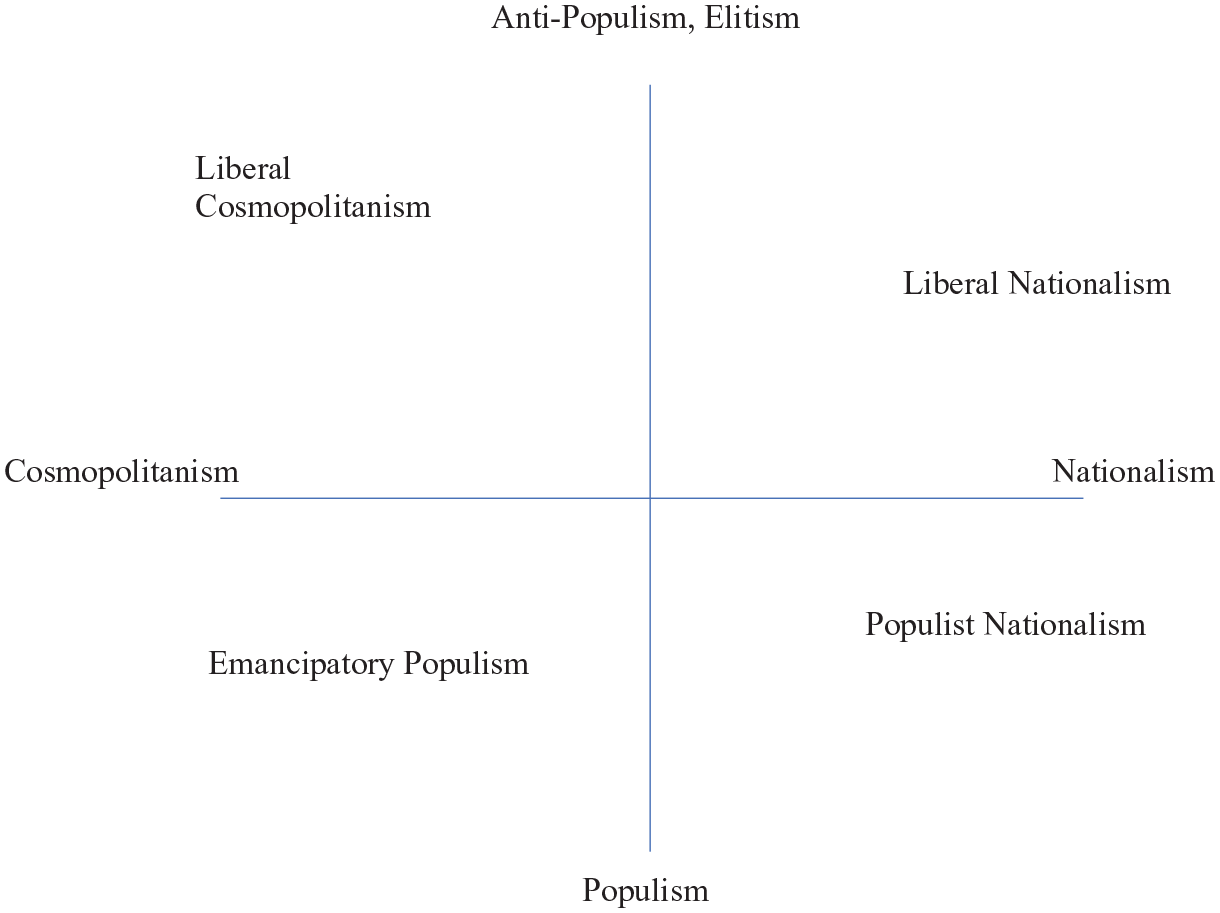
Four foreign policy discourses.
The resultant four foreign policy discourses largely align with Jenne’s typology. On the upper right quadrant of liberal nationalism, the state interest is the main legitimation of foreign policy. While a nationalist foreign policy discourse should prioritise independence from international constraints, an alignment with international institutions is possible if foreign policy is viewed as an elite undertaking 41 that allows national elites to maintain some influence over supranational structures and, through participation in them, insulate themselves from domestic popular demands. 42 Nationalism’s temporal universalism reassures that the nation will survive historically even if its sovereignty is tempered momentarily, and its ideological universalism legitimises cooperation with other nations with similar interests to one’s own. 43 An internationalist foreign policy discourse should theoretically temper strong notions of ethnic belonging, but domestic dynamics can sometimes result in foreign policy internationalism being combined with exclusive conceptions of nationality at home. In this case, a foreign policy discourse will be located near the upper right corner of the two-dimensional space.
On the lower right quadrant, populist nationalism exists when the vertical and horizontal imageries of populism and nationalism combine to present the nation as a downtrodden ‘people’. Here, the ‘people’ is understood in national, and often ethnic, terms, 44 while the nation is threatened not only by other nations or ethnic groups but also by international elites and institutions. 45 This is the space where we expect the foreign policy discourse of the European and North American populist radical right to operate.
Liberal cosmopolitanism, when both populism and nationalism are absent from foreign policy articulation (upper left quadrant), sees the strengthening of international institutions and the resolution of global challenges as values in their own right. Immediate national interests – bilateral disputes, the fate of ethnic kin abroad, economic interests – are toned down or reformulated in order to facilitate the smooth process of international institutions. Politics at home and abroad is presented as inclusive, universal and evidence-driven governance. 46 Diplomacy, multilateralism, and the gradual transposition of elements of the democratic process to the international level are the objectives that this foreign policy discourse articulates.
Finally, emancipatory populism presents foreign policy as a struggle against domestic and international elites. Crucially, foreign actors are presented as enemies because of their power, not because they are foreign. 47 Contrary to nationalists opposing other nations, populists are not fearful of other peoples 48 and populist foreign policy discourses can seek allies in downtrodden groups beyond the state’s borders. 49 But while emancipatory populism is distinct from nationalism, its emphasis on popular sovereignty often leads ostensibly internationalist and leftist forces to territorialise the imagery of the struggling people. 50 This hybridity is evident even in cosmopolitan projects like DiEM25, whose discourse oscillates between the sovereignty of a transnational ‘European people’ and defence of democracy at the national level. 51 Of course, emancipatory populism differs from discourses on the far right of the horizontal axis in that it views the sovereign democratic community in civic and inclusive terms. However, the exact location of an emancipatory populist discourse on the left half of the axis – whether near its cosmopolitan end or closer to its centre, where the nation-state (however inclusive) is still articulated as the main subject of foreign policy – will determine whether it will espouse a fully transnational understanding of the ‘people’, or focus on the sovereignty of a specific political community.
Foreign policy discourses in Greece during the Eurozone crisis
Populism and nationalism were both highly prevalent in Greece during the Eurozone crisis. The nature of the crisis – externally imposed economic austerity – meant that populist and nationalist sentiments were often expressed in tandem. 52 As a subset of the crisis literature, Greek foreign policy scholarship has examined the impact of crisis on foreign policy, 53 but a consistent effort to link conceptually populism with developments in foreign policy has been lacking. Contrary to most of these works, I examine Greek foreign policy as a field of articulation of existing or emerging lines of competition in domestic politics, and especially of the boundaries of the political community and its relationship with political authority.
Methodologically, the article adopts a cross-temporal comparative design, whereby different prime-ministerships (Papandreou 2009–11, Samaras 2012–15, and Tsipras January-July 2015 and July 2015–2019) serve as sub-cases. This comparative framework is combined with a discourse-analytical methodology that identifies foreign policy discourses based on: (a) whether the ‘people’, the ‘nation’ (or ‘state’, as the nation’s institutional expression) or neither are the nodal point, that is, the central reference of a discourse; (b) if central references are made to the ‘people’, whether this is an empty signifier, so we can speak of pure populism, or its content and boundaries are defined by national or ethnic criteria; (c) if central references are made to the ‘nation’, whether these are of an ethnic-exclusionary or a civic-inclusionary variant; (d) if ‘nation’ is absent, whether central references are made to a cosmopolitan community of a global or regional scope; (e) finally, if references to the ‘people’ are absent, whether there are direct references to domestic or international structures of authority requiring deference and obligation by the political community.
The analysis focuses on how Greek leaders (especially prime ministers) articulated in their foreign policy discourse horizontal or vertical topographies of political competition, the boundaries of the political community and its relationship with authority. It examines representative examples of official statements, political debates, parliamentary speeches and press quotes to demonstrate which type of foreign policy discourse was dominant in a specific period, although due to space constraints the analysis is not exhaustive. Statements are collected pertaining to the most salient foreign policy issues in Greek public debate in a given period, including relations with Turkey, the EU, and Russia, issues like sovereignty in the Aegean, energy security and the Macedonia name-dispute, as well as assessments of Greece’s geopolitical environment.
Liberal cosmopolitanism with populist undertones: George Papandreou 2009–11
The crisis arrived in Greece under prime minister George Papandreou of the socialist PASOK party, who had been foreign minister in the late-1990s and early-2000s, when Greece had undertaken a moderation of relations with Turkey and the Western Balkans and their pursuit through the framework of EU enlargement. 54 As prime minister, Papandreou intended to continue on the same principles. But the economic crisis and the signing of a bailout agreement with the EU and the IMF generated a wave of Euroscepticism in a previously pro-European country. 55
Papandreou espoused a civic understanding of the Greek national community. In 2006 he had supported a Muslim woman as candidate for governor of the region of Eastern Macedonia and Thrace, a nod to Greece’s Muslim minority in Thrace. As prime minister, he voted in a new law that facilitated the granting of citizenship to children born in Greece of migrant parents. Debating in parliament, he argued that Greekness is not an innate ethnic characteristic. In an interesting rhetorical twist, he used the famous slogan of his father, emblematic arch-populist prime minister of the 1980s Andreas Papandreou, that ‘Greece belongs to the Greeks’ to say that ‘Greece indeed belongs to the Greeks. But who can be called a Greek? You can be born Greek but you can also become one’. 56
Papandreou provided an overview of his foreign policy philosophy in a speech in Brookings in March 2010, presenting European integration, the EU accession of Turkey and the Western Balkans, and the overcoming of nationalist antagonisms among Greece’s neighbours as major goals. Even more, he strongly endorsed ceding national sovereignty to construct a stronger Europe: ‘At a moment when a series of global crises urgently requires increased global cooperation, we in the European Union ceded a part of our national sovereignty so we can more effectively defend our common interests in the face of these global challenges’.
57
Despite his cosmopolitanism, Papandreou was not always an apologist for international institutions, and especially the EU who was demanding harsh austerity measures from him. To be sure, he presented the crisis as a problem that transcended borders and made more global governance imperative: ‘[S]overeign nations must [collaborate] to face problems that transcend their borders like climate change and economic globalisation [. . .] We must cooperate. We must manage this planet. There must be some kind of governance of this planet’.
58
But contrary to nationalist populists who put forward the demand for national sovereignty, Papandreou tried to project the question of austerity to the supranational level and politicise it there. 59 He was keen on using his role as president of the Socialist International to frame austerity and the global economic crisis as a transnational competition between progressive and conservative forces. 60 This critique reminded at points of emancipatory populism, challenging the ‘conservative establishment of the EU’, although it never went as far as to speak for a popular identity juxtaposed to political power, as done later by SYRIZA.
In sum, the most consistent feature of Papandreou’s foreign policy discourse was his horizontally broad definition of the boundaries of the political community. Within Greece this concerned an inclusive and civically defined citizenry, while internationally he identified Greece’s interests with those of a supranational EU. His response to domestic reactions against austerity was to double down on the cosmopolitan imagery of political contestation at the EU level, where progressive solutions like European debt mutualisation and fiscal integration should be found. Thus, any criticism of the EU in Papandreou’s discourse concerned essentially that it did not move quickly enough with supranational pooling of national sovereignty and finances.
Liberal nationalism: Antonis Samaras 2012–15
After formation of a technocratic government in 2011 and double elections in 2012, a coalition led by conservative New Democracy in collaboration with a much diminished PASOK took over. ND leader Antonis Samaras became prime minister. In 2010–12 Samaras had opposed Papandreou’s bailout framing it as threat to Greek sovereignty. Eventually he changed course and supported a second bailout. Several right-wing anti-austerity politicians left ND to create the anti-austerity party Independent Greeks (ANEL). 61 By the time he became prime minister, Samaras had turned into a staunch defender of bailouts, passionately pleading for Greece’s place in the EU. 62 This put him on a collision course with opposition parties like SYRIZA that saw the fight against austerity as a struggle of the ‘people’ for representation and recognition. 63
But unlike Papandreou, Samaras understood Greek participation in European integration through the lens of nationalism. Indeed, while he castigated the ‘populism’ of the anti-austerity opposition, Samaras’ rhetoric placed next to his Europeanism intense national symbolism drawing on Greece’s classical and Orthodox identities. In the 2012 election campaign he pleaded voters to give him ‘the power of a nation’ so that he could negotiate more effectively with the EU. 64
The nationalism of Samaras was restrictive towards outsiders. He often made statements on law and order that transparently presented immigration as a threat.
65
His government adopted a hard stance, forcing undocumented immigrants and refugees to stay in enclosed camps. At the same time, Samaras’ nationalism drew on highly idealistic themes. He was prone to using poetic quotes and impassioned phrases when referring to Greek history and identity. These reflected the romantic idea of the continuity of the Greek nation since ancient times and the universality of the ideal of Hellenism: ‘Our party is strategically pro-European. It is identified with the best spiritual traditions of Hellenism! Universal thought, open horizons, longing for return to ‘Ithaca’. The best guarantee of our European orientation is the deep commitment to the national interest, to our Greek Tradition. The national interest is fully compatible with our European identity’.
66
Samaras’ nationalism was articulated in foreign policy as strong emphasis on national security influence. While he often referred to milieu goals like stability and peace in Greece’s region, these were used as an excuse to highlight Greece’s strategic importance. With unrest across the Middle East, Ukraine and the Mediterranean, Samaras often spoke of Greece as an ‘island of stability in a region of instability’ – a reference to Greece’s nautical identity as well as a reminder to Greece’s partners of its geopolitical importance despite its economic woes.
67
Thus, while Samaras adopted as Greek goals the interests of NATO and the EU, this was presented overwhelmingly through the lens of national priorities. For example, energy cooperation in the Eastern Mediterranean with Cyprus, Israel and Egypt was presented by Samaras as complementary to EU and US energy security, but he linked it also with Greece’s goals to raise its geopolitical profile, boost its security and draw economic benefits: ‘Europe must protect itself from the dangers coming from its south [like] migration waves [. . .] The EU must make its presence felt in its neighbourhood, the Mediterranean plays a vital role for the security and international standing of Europe [. . .] It is part of our European property [. . .] Declaring Exclusive Economic Zones belongs to the jurisdiction of member-states, but the EU can support these member-states so that this takes place soon’.
68
The use of the term ‘liberal’ to describe Samaras’ foreign policy discourse may appear paradoxical, since he has long been considered the staunchest right-wing nationalist in the Greek political establishment. It is important however to remind that the concept of liberal nationalism here describes strictly a foreign policy discourse, not the ideology or policies implemented. Liberal nationalism designates a discourse combining a focus on the national interest, the predominance of the ‘nation’ as the central referent drawing a clear boundary between the inside and the outside of the political community, and the absence of populism, or even the energetic opposition to it. None of this precludes that the nation is articulated in strict ethnic terms, as Samaras did. This would just place him further to the right in the upper right quadrant of our typology.
So, designating Samaras a liberal nationalist is a way to account precisely for the fact that his foreign policy rhetoric combined a strongly exclusivist and nation-centric perspective of the political community at home with a strong identification with the EU, the US and NATO and corresponding limitations on Greek national sovereignty. Samaras cannot be considered a liberal cosmopolitan of course, but nor is he a populist nationalist, as anti-elite themes were completely absent from his rhetoric. If anything, Samaras’ case highlights what is theoretically interesting about the concept of liberal nationalism as foreign policy discourse: how nationalism’s universalism (the eternal nation operating in a world of nations) may actually legitimise limits on sovereignty; and how structures of liberal regional and global governance like the EU, despite their cosmopolitan proclamations, may very well tolerate, indeed rely upon, exclusivist and authoritarian boundary-drawing inside their member-states.
Emancipatory populism: the first SYRIZA-ANEL government 2015
In January 2015, an anti-austerity government was elected led by SYRIZA leader Alexis Tsipras, who surprised many by turning to ANEL to form a coalition of a party of the radical left with a right-wing nationalist party. But the coalition made sense from the perspective of the main issue in Greek politics: austerity and the relationship with the Eurozone. 69 The crisis had been an opportunity for a small party of the left to broaden its appeal by adopting the identity of the ‘people’ pitted against domestic and international power structures. 70 Yet this also meant that a party that had been anti-nationalistic and strong proponent of multiculturalism now also defined popular sovereignty along an inside-outside – instead of a purely top-down – axis.
The first 6 months of the SYRIZA-ANEL government were dominated by the confrontational negotiation with the Eurozone of Greece’s bailout program, culminating in a referendum in July 2015. Continuing on his opposition rhetoric, Tsipras used a populist discourse that often had a transnational character, framing Greece’s struggle as a contest between a conservative EU establishment and the peoples of (especially Southern) Europe.
71
However, Tsipras also drew on historical experiences to underpin this populism with distinctly national overtones. References to the Greek resistance against German occupation during World War II were often used, given the central role of Germany in Eurozone politics, with the new government raising the issue of German World War II reparations towards Greece: ‘This government will work hard so that all unfulfilled promises towards Greece and the Greek people are met. Just as we are ready to fulfil our obligations, so must all sides’.
72
Thus, while populism’s vertical top vs. down imagery dominated in the discourse of Tsipras and his government, he was not averse to drawing on the themes of national sovereignty if this meant that SYRIZA could reach beyond its core leftist electorate. The tradition of the anti-Nazi national resistance provided a potent discursive framework for this, as it allowed for the ‘nation’ to be articulated not in exclusivist, ethnic or irredentist terms, but as a democratic entity fighting against oppression from foreign elites and their domestic ‘collaborators’.
In the new government, ANEL leader Panos Kammenos took over the very important as well as symbolic ministry of national defence. Under his leadership, the military parade of March 2015 to celebrate the Greek national holiday – normally an orderly and hierarchical affair serving to update the authority of official institutions and the identification of nation and state – was followed by folk dance and music performances to celebrate Greece’s ‘liberation’. This was one of the many ways in which nationalism’s horizontal, inside-outside character was deployed to underpin populism’s top-down dimension, but with the latter remaining dominant.
Paradoxically it was members of SYRIZA’s hard-left wing who made use of even stronger inside-outside themes. Minister of energy Panos Lafazanis, who never hid his view that the only way for Greece to escape austerity was to exit the euro, often spoke of ‘foreign occupation’ and the contradiction between EU membership and Greece’s ‘national interest’.
73
Minister of finance and responsible for the debt renegotiation Yanis Varoufakis also oscillated between a transnational rhetoric presenting Greece’s struggle as part of a fight between a European ‘people’ against an oppressive international establishment, and his role as representative of a ‘sovereign country’. Crucially, this understanding and legitimation of ‘sovereignty’ lay not in the ethnic character of the Greek nation, but in the right of a political community to democratic self-rule: ‘The only way one proud nation can respect another proud nation is if it is sovereign. So, re-establishing our sovereignty is a prerequisite for us to be able to overcome any animosity with other nations. Our sovereignty is a prerequisite for friendship’.
74
The coalition with ANEL and the intertwining of inside-outside (nationalist) and top-down (populist) themes in the SYRIZA government’s discourse in the first half of 2015 provoked a heated debate in Greece about the coalition’s real ideological character. Its opponents, especially in the pro-European centre-left, often described it as ‘nationalist-populist’. 75 However, a closer reading of its foreign policy discourse shows that this is misplaced.
Its populism, its massively expanded voter base and the nature of the Eurozone crisis indeed made SYRIZA much more preoccupied with sovereignty and national independence than what a cosmopolitan, internationalist party of the radical left would normally be. 76 But even when national referents were employed, these were secondary to a predominant vertical imagery of political struggle against Brussels and Berlin, coupled with an unambiguously broad understanding of the ‘people’ both inside Greece (encompassing ethnic outsiders) and outside, appealing to the whole of Southern Europe to fight austerity. 77 ANEL on the other hand were indeed a party of exclusivist nationalism, but in the context of the crisis this thick ideology decidedly took a back seat to their opposition to austerity and the EU, the main issue on which they attracted support and which made the coalition with SYRIZA possible after all.
Populism was also evident in how the new government welcomed, and sometimes fostered, suspicions that it would reorient Greek foreign policy away from the EU and NATO. This did not necessarily mean a break in actual policies: one of its first actions was shedding doubt over its support for renewal of EU sanctions against Russia, although in the end it did not veto them. 78 Rather, the more welcoming tone towards non-Western powers like Russia and China, seen as potential sources of financing Greek debt, underpinned Greece’s new defiant stance against the geopolitical powers it had long bowed to. Even though previous pro-European governments had made openings to non-Western powers like signing energy deals with Russia in the late 2000s and welcoming Chinese investments in the early 2010s, for the SYRIZA-ANEL government this was used as a reminder of its mission to restore sovereignty to the Greek people from the international (Western, and especially EU) structures that subjugated them. 79
Emancipatory populism, liberal nationalism or liberal cosmopolitanism? The many faces of Greek foreign policy under the second SYRIZA-ANEL government 2015–19
After accepting a new bailout in July 2015, foreign policy became for Tsipras a field for his rehabilitation on the international stage and bolstering his damaged profile at home. One foreign policy issue that offered an opportunity to Tsipras was the refugee crisis. Arriving right after the Eurozone crisis in summer 2015, the refugee crisis put again Greece in the international spotlight, although this time in a much more sympathetic light as a country bearing the brunt of massive refugee flows.
Tsipras initially used the refugee crisis to rejuvenate his populist rhetoric by highlighting Greece’s inferior position as a country ravaged by austerity and at the frontline of waves of refugees who really just wanted to go to Northern Europe.
80
At the same time, as the fault line of the refugee crisis ran between anti-refugee nationalist governments (especially in Eastern Europe) and EU institutions and Germany’s Angela Merkel, Tsipras’ pro-refugee discourse aligned with international and European liberal mainstream opinion. In this context, his call for a European response reflected Greece’s need for EU assistance, but was also a departure from his antagonistic discourse during the Eurozone crisis: ‘Greece is fighting a battle to address the refugee question as a common problem of all European countries [. . .] Greece is fulfilling its obligations on sheltering and identifying refugees. But Europe must also realise that Greece today is guarding the borders of the EU’.
81
Here Tsipras comes close to a long-standing elite discourse about the EU in Greece that fuses the national interest with identification with a supranational, liberal political order to which Greece belongs. Using ‘Greece’ and ‘Europe’ interchangeably as the core referents of this discourse, Tsipras was straddling the limits of liberal nationalism and cosmopolitanism, a departure from his populism that had defined the sovereign ‘people’ in opposition to Brussels.
During Tsipras’ second term, an important role in foreign policy was played by foreign minister Nikos Kotzias. Kotzias had been relatively quiet during the economic renegotiation of the first 6 months of 2015. But after the summer of 2015, with Tsipras purging the left wing of SYRIZA and Kammenos’ role receding, he emerged as an important presence due to his ability to appeal to different constituencies in his foreign policy rhetoric. Kotzias could use emancipatory tones like after the failed UN-backed talks for resolution of the Cyprus issue in 2017: ‘Defending the homeland and human rights is a democratic struggle. Fighting to extinguish Cyprus’ Ottoman past and secure its independence is dignified and democratic [. . .] Some cynically call upon us to surrender. In other words, that Hellenism was wrong to fight in Thermopylae, in Albania [against Italy in World War II], in the resistance against the occupation and the junta’.
82
The statement is remarkable for a foreign minister, because Kotzias here refers to the Greek nation (encompassing Greece and Cyprus) as a popular actor struggling against oppression. In perfect reversal of populist nationalism, which fills the content of the ‘people’ with innate national-ethnic characteristics, Kotzias turns the nation into a popular-democratic entity waging ‘resistance’ to international elites. The use of this discourse was strategic for Kotzias, as it deflected criticisms that he sabotaged the Cyprus reunification talks, a charge usually reserved for nationalists on the Greek and Turkish side.
83
Kotzias however could also adopt the logic of the state interest as belonging to a regional and European security order, like when he defended the agreement Greece signed for the name-change of North Macedonia in 2018: ‘We are doing this agreement with our northern neighbours not because they want to join NATO and the EU. Most of all, we are doing it because it is in our and their national interest, which is the interest of security and stability in our region, the interest of Europeans and of the EU’.
84
The name-change agreement with North Macedonia showed how far Tsipras had moved from populism. The deal was opposed by the majority of Greek public opinion. Observers of Greek politics saw in it a transparent effort by Tsipras to redraw the boundaries of party competition domestically, from a people vs. elites dimension which had led SYRIZA to a coalition with ANEL, to a revamped left-right axis that would allow Tsipras to attract moderate, centre-left supporters of the name deal. 85 His gamble seemed to pay off at least partly, as the centre-right New Democracy’s liberal pro-European leader was forced to come out against the agreement to avoid losses to his right, although this did not keep SYRIZA from ultimately losing in the 2019 election.
In his argumentation, Tsipras, just like Kotzias, emphasised not only how the agreement resolved the issue in a positive way for Greece, but also how Greece benefited from the support of its EU and NATO partners and from stability in the Balkans. 86 With the agreement hailed by the EU, Tsipras’ rhetoric oscillated between liberal nationalism – an emphasis on state interests pursued through international processes and institutions – and liberal cosmopolitanism, adopting broader milieu goals of stability in the region and overcoming nationalist antagonisms, something that appealed to his party’s leftist tradition that many felt had been ignored due to the populist turn and the coalition with ANEL. Rather than the ‘nation’, which in debates over Macedonia had usually been used as an argument against any deal, the central node in Tsipras’ argumentation was Greece as a state containing a political community with broad and inclusive membership. The ‘people’on the other hand was adopted as signifier by opponents of the deal in massive demonstrations in 2018–19, although this ‘people’ was defined generally in ethnic-national terms.
In sum, by the end of his term in 2019, the foreign policy discourse of Tsipras had moved significantly from the firebrand days of 2015. While populist themes remained, they were subdued. SYRIZA maintained its open understanding of the national community – symbolised powerfully in its welcoming rhetoric towards refugees in 2015–16 – but also came much closer to the logic of the national (state) interest. Tsipras resorted to this eclectic mix of populist, cosmopolitan and liberal-nationalist themes primarily as a matter of domestic political expediency, trying to redraw lines of political conflict in Greek party politics and renew the purpose of his party after compromising with the EU over austerity.
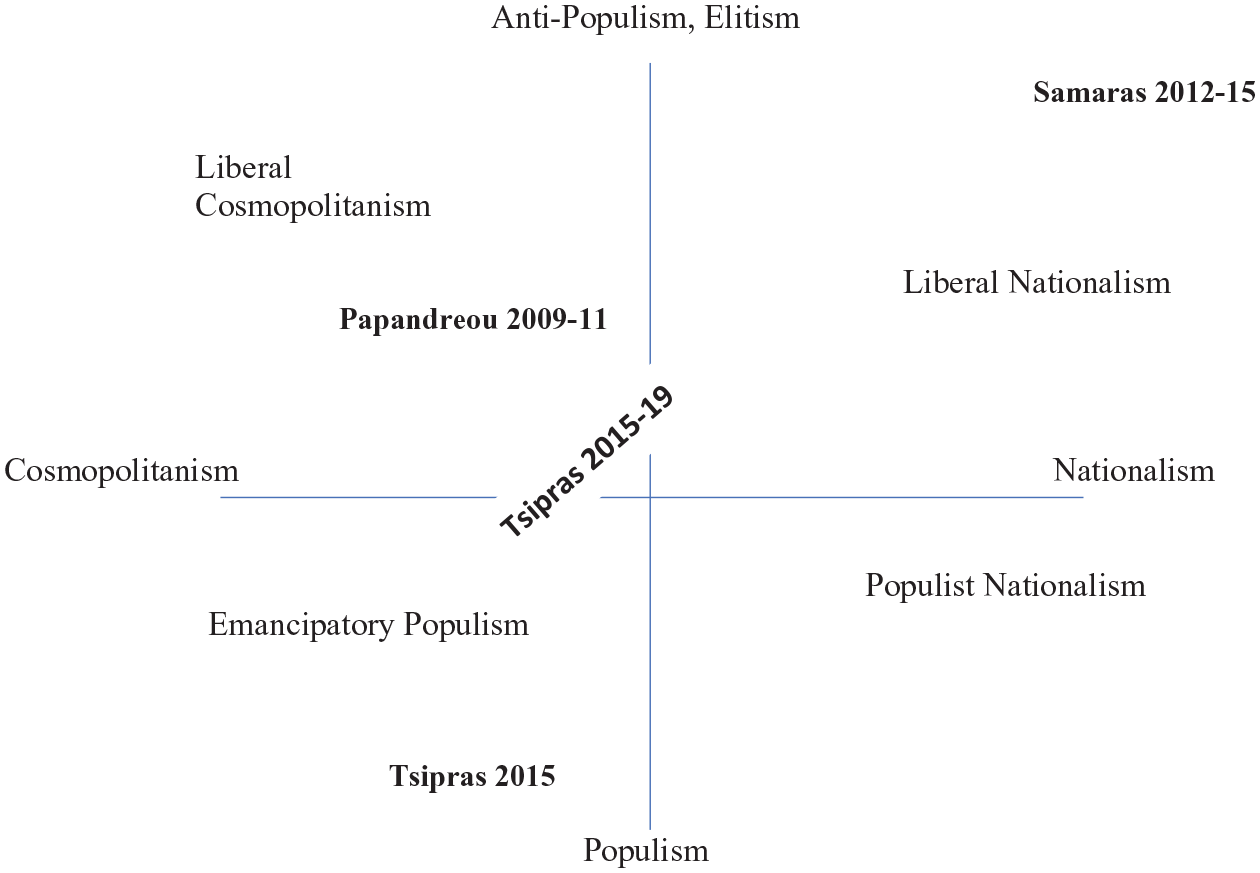
Foreign policy discourses in Greece 2010–19.
Conclusion
Using Greek foreign policy as a case study, this article has shown that, despite their similarities, key among which is their shared emphasis on sovereignty, populism and nationalism can be distinguished analytically. As discourses, populism and nationalism use different spatial imageries to order the political field, draw membership boundaries and articulate the relationship between political community and authority: a vertical opposition between the people and the elites for populism, a horizontal differentiation between the nation inside and non-nationals outside for nationalism. In addition, they display a second major difference, namely that between the particularism of immediate popular demands and the universalism of the historical and idealised political community represented by the state. These different understandings of the temporal and spatial character of the community underpin the vertical and horizontal imageries respectively.
The case of Greece yields some interesting insights. First, contrary to what many would expect, nationalism need not equate opposition to international institutions. When combined with a strong anti-populist attitude as the one Samaras exhibited, nationalism can draw on universalist themes to justify limitations of sovereignty in the name of the timeless national interest. This implies that the foreign policy attitudes associated with populist nationalism like Euroscepticism, protectionism and mistrust of the international liberal order cannot be attributed solely to nationalism. Rather, they are a result of the combination of populism and nationalism that neutralises nationalism’s universalist potential and frames national sovereignty in more parochial terms, not just as independence from outside influences but as mistrust of international institutions.
Although I did not examine a case of populist nationalism in Greece, the liberal nationalism of Samaras can be juxtaposed to the rhetoric of populist nationalist politicians for the distinct effect of populism to be understood. Even more, the concept of liberal nationalism helps capture the seemingly paradoxical situation of politicians advocating alignment with international institutions and limits on national sovereignty, while constructing the boundaries of the political community at home along restrictive, ethnic lines. This paradox can be understood better if we accept that alignment with supposedly liberal and cosmopolitan projects like the EU is also an elite strategy of anti-populism, that is, a way to articulate, update and legitimise a hierarchical and deferential relationship between the people and authority.
A second way the distinctiveness of populism can be understood is in how foreign policy was articulated on the left side of the political spectrum, by Papandreou in 2009–11 and Tsipras in 2015–19. While both embarked from internationalist foreign policy attitudes and a civic, inclusive view of the political community at home, the latter’s populism up until 2015 contained much more sovereigntist tones, especially against oppressive international power structures like global finance and the EU. Even when Tsipras defined the ‘people’ in transnational and inclusive terms (‘the South against Brussels’), this more often than not was co-articulated with themes adjacent to nationalism like independence and mistrust of outside actors. This ambiguous nature of populism may blur its distinctiveness as a foreign policy discourse, but it should not obscure the fact that it still is fundamentally distinct both from populist nationalism that defines the ‘people’ exclusively along national lines; and from liberal cosmopolitanism that sees international institutions as consistent with, indeed enhancing of, popular and democratic sovereignty.
Finally, it is worth reminding again that this analysis concerns foreign policy discourses rather than policies. Despite differences between prime ministers, Greek foreign policy exhibited in practice quite a lot of continuity. The rapprochement with Israel, initiated by Papandreou in 2010 and continued by Samaras, was followed also by Tsipras, despite SYRIZA’s historically pro-Palestinian ideological stance. Despite changing tones, policy towards the Balkans also remained stable in its basic outlines. 87 All Greek governments during the decade sought improved relations with the US and pursued investments from China. Even the near-rupture with the EU at the height of the populist contestation of austerity in the first half of 2015 was scaled back, as SYRIZA reverted to more mainstream actions and rhetoric (albeit very slowly in some areas, demonstrating that discourses can also leave sticky traces in the real world). 88
Despite this mixed picture in terms of applied policies, the discursive view has helped distinguish between populism and nationalism, as well as demonstrate their importance, in how foreign policy is used to draw political boundaries in domestic society and embody an antagonistic or deferential relationship between political community and authority. Thus, foreign policy is highly important as a field where the ideas and values under which a state incorporates its domestic society are contested, reinforced or modified, especially in periods of political instability and near-rupture of state-society relations like the 2010s in Greece. Second, even when policies remain stable, how they are legitimated matters for the identity of the state internationally 89 and for creating a repository of argumentation that conditions or enables foreign policy decisions in the future. 90 The resolution by Tsipras of the Macedonia name-issue for example was strengthened also by his skilful use of cosmopolitan, populist and liberal nationalist themes that had been developed in the previous years of crisis. In sum, populism, nationalism and the foreign policy discourses created by their interweaving survive as argumentative frames, to be used by political actors faced with varying domestic and external opportunities and constraints in the future.
Footnotes
Funding
The author received no financial support for the research, authorship, and/or publication of this article.
