




Abstract
This article asks how Donald Trump’s foreign policy rhetoric during his presidential campaign and presidency has affected US foreign policy in the area of overseas counterterrorism campaigns. Looking at two case studies – the May 2017 Arab Islamic American Summit and the US role in the counter Islamic State in Iraq and Syria (ISIS) campaign, it is argued that Trump’s foreign policy rhetoric has failed to accurately describe or legitimate his administration’s counterterrorism strategy, as per the conventional wisdom. Instead, Trump’s foreign policy rhetoric has largely been aimed at creating a sense of crisis (as populism requires) to mobilise his domestic base. In making this argument about the purpose of Trump’s foreign policy rhetoric, not only does the article contribute a new perspective to the extant literature on elections, rhetoric, and US foreign policy, but also to the burgeoning scholarship on governing populists and their foreign policies. Although these findings could be unique to Trump, the article’s novel framework – combining International Relations and populism scholarship to elaborate on how the foreign arena can be used to generate a state of perpetual crisis – can hopefully be applied in other contexts.
Introduction
In line with the focus of this special issue (Lacatus and Meibauer, 2021), this article asks how Donald Trump’s foreign policy rhetoric 1 on the campaign trail and in the White House has affected US foreign policy. More specifically, this article focuses on the area of overseas counterterrorism campaigns, or what was originally known as the ‘War on Terror’. This area of foreign policy was chosen because of the prominence of the issues of terrorism and counterterrorism during the 2016 election campaign, with 80% of American voters answering that ‘terrorism’ would be ‘very important’ to their vote in said election (Pew Research Center, 2016). Consequently, Trump emphasised the threat of terrorism during his first presidential campaign, but also repeatedly focused on defeating the Islamic State in Iraq and Syria (ISIS) as a central part of his foreign policy. In this sense, if we ought to see a link between Trump’s rhetoric and government policy (as has been found in the case of other presidents; see Bentley, 2017; Jackson, 2005; Payne, 2021), counterterrorism seems a likely case. This is especially relevant given that counterterrorism represents a particularly costly area of foreign policy which (theoretically at least) has to be justified to the American people: American troops are involved in combat in 14 different countries (Grant and Goldsmith, 2018) and these campaigns cost approximately US$60 billion a year (Crawford, 2018). Finally, there has been little written on the Trump administration’s counterterrorism strategy thus far (Neumann, 2019: 5), so this article attempts to contribute to this lacuna.
The article is structured as follows. The first section reviews how the Trump administration runs contrary to the extant scholarship on foreign policy rhetoric: not only has Trump’s foreign rhetoric failed to legitimate counterterrorism policy, but he has also gone against the notion that an incumbent president should run a positive re-election campaign. To explain this, the second section of the article engages with scholarship on populism, which argues that populists rely on a sense of crisis, even while governing. This scholarship is combined with the International Relations work of Campbell, which provides a relevant framework for how a state of perpetual crisis might be rhetorically generated. Using primary sources from Trump’s campaign and during his presidency, 2 the third section of the article looks at Trump’s crisis rhetoric regarding terrorism and counterterrorism. On both the campaign and in the White House, Trump has identified Muslim immigrants and the Washington establishment as the drivers of this crisis, while on the campaign trail he promised strategic revolutions to solve the issue of terrorism. The fourth section of the article assesses how Trump’s campaign rhetoric has matched up to his government’s policies. Looking at the May 2017 Arab Islamic American Summit in Saudi Arabia and the US role in the counter-ISIS campaign, it is argued that there has been a significant disconnect between rhetoric and reality, which can be explained by considering the purpose of Trump’s populist foreign policy rhetoric. Fifth, the article looks at how the targets of Trump’s exclusionary populist rhetoric have moved away from terrorists and towards immigrants, which provides further evidence of how Trump’s rhetoric primary relies on the notion of crisis to mobilise political support.
Foreign policy rhetoric on the campaign trail and in government
Working chronologically, it is conventionally assumed that foreign policy rhetoric for challenger candidates aims to criticise the record of the incumbent government (Armacost, 2015: 119). These criticisms are normally coupled with proposed alternative foreign policies which would resolve the failures of the previous administration (Armacost, 2015: 119). In this way, candidates can use their foreign policy rhetoric to establish their credibility as a future commander-in-chief (Boys, 2021), highlight particular issues that they care about, or contrast themselves to other candidates (Johnstone and Priest, 2017: 4).
While realists would deemphasise the importance of foreign policy rhetoric altogether, for critical constructivists and liberals, foreign policy rhetoric in government is largely assumed to follow an instrumental logic: to generate necessary political and material support for foreign policies. As critical constructivist Jackson (2005: 1) puts it, ‘the enactment of any large-scale project of political violence – such as war or counter-terrorism – requires a significant degree of political and social consensus’. For liberals, ‘democratic leaders are reluctant to wage wars’ precisely because of ‘the requirement of securing a broad base of support’ for war (Maoz and Russett, 1993: 626 in Bueno de Mesquita et al., 1999: 792). Where these approaches differ is with regard to the importance of rhetoric in the generation of public consent. According to democratic peace theorists Reiter and Stam (2002: 132–133), although ‘democratic leaders can sometimes shift public opinion at the margins’, consent is not something that can be ‘easily manufactured’ by policymakers. In contrast, critical constructivists assume that elites ‘are constantly attempting to guide political mobilisation toward a particular outcome and for a political goal by using symbols, metaphors and cognitive cues to . . . fix meaning to events’ (Barnett, 1999: 8–9 in Holland, 2012: 34). As Jackson (2005: 2) argued in the context of the War on Terror, the Bush administration’s ‘carefully constructed discourse . . . [was] designed to achieve a number of key political goals’.
When running for re-election as an incumbent, the president is expected to treat the election as ‘a referendum on his record’, offering a positive message by highlighting the achievements of their administration and ignoring unfulfilled campaign promises (Armacost, 2015: 104). Certainly, presidents can use more negative foreign policy rhetoric, such as Bush’s claims that electing the Democrats in 2004 would ‘invite disaster’ on the national security front (Trubowitz, 2011: 89), but on the whole presidents would rather run a positive campaign in relatively tranquil and crisis-free international circumstances (Armacost, 2015: 92).
However, there are issues with this conventional account of foreign policy rhetoric. At the broadest level, it appears that US counterterrorism campaigns abroad have moved beyond the process of legitimation. As Kreps (2018: vii) has written, US governments have ‘increasingly worked to shield its population from the costs of war’, meaning that individuals are ‘less politically engaged’ with the wars fought in their name. The light-footprint model of counterterrorism – adopted by the Barack Obama administration and carried on during the Trump presidency – reveals a way of using force without significantly affecting the domestic population (Staniland, 2018). The end result has been that ‘Washington need not even bother to propagandize the public’ with regard to these ongoing conflicts (Bacevich, 2018). Put simply, the instrumental purpose of foreign policy rhetoric has been lost; if even global military campaigns do not require legitimation to the US public, then foreign policy rhetoric might well act as a ‘vessel’ to generate support domestically (Fisher and Taub, 2016).
More specifically to the Trump era, one can observe the rhetorical uniqueness of Trump as president. That is, not only has Trump aimed his foreign policy rhetoric at specific audiences (as Holland, 2012: 35 rightly highlights in the case of the Bush administration), but his rhetorical strategy appears to be aimed towards polarisation, rather than unification (Simon, 2017). Trump (2018c) may have spoken at his 2018 State of Union Address of how he wanted the future to include ‘all of us, as one team, one people, and one American family’, but more often his presidential rhetoric has continued in the vein of his campaign in going well beyond accepted discursive boundaries, such as his portrayal of the Democrats as a threat to national security (Glasser, 2018). Indeed, Trump has attempted to ‘maintain a state of semiconstant political mobilization’ (Wojczewski, 2019: 14), reflecting the populist tendency whereby ‘governing [is] a permanent campaign’ (Müller, 2016: 43).
This mobilisation strategy runs at odds with the idea that an incumbent campaign will attempt to persuade other potential voters beyond those who elected them; as Trump put it, ‘I think my base is so strong, I’m not sure I have to do that’ (Bennett, 2019). Zelizer has contended this electoral strategy as being ‘built for the new partisan era’, as it is largely geared towards mobilisation, rather than persuasion (Bennett, 2019). In attempting to achieve this goal, although Trump’s re-election campaign is ‘Keep America Great Again’ (Watkins, 2018), it is noticeable that Trump’s campaign message in the White House has continued to primarily rely on the themes of fear and crisis to mobilise his supporters, rather than emphasise the successes of his administration. In the words of one commentator, ‘the familiar slogan has been updated . . . but the tone of the show has not’ (Bennett, 2019). As this article will argue, this perpetual need for crisis relates to the inherent features of populism, and foreign policy rhetoric has played a crucial part in this.
Populism and foreign policy
The relationship between populism and populists in government has been relatively understudied (Verbeek and Zaslove, 2017: 384). Consequently, the connections between populism and foreign policy have also been underexplored, as recent works have attempted to address (Biegon, 2019; Destradi and Plagemann, 2018, 2019; Löfflmann, 2019; Nabers and Stengel, 2019; Wojczewski, 2019). In this sense, this article aims to answer Destradi and Plagemann’s (2018: 299) call for further comparative studies on the relationship in question. As noted in the introduction to this special issue (Lacatus and Meibauer, 2021), the focus of these essays is not the ‘conceptual debates about the nature of populism’. Instead, scholarship on populism is used here as an analytical tool in explaining the relationship between Trump’s rhetoric and his administration’s foreign policy. Put another way, without an understanding of populism, we cannot fully comprehend Trump’s foreign policy rhetoric.
Populism is defined here as a form of political rhetoric which (a) places a moralistic notion of ‘the people’ (or alternative signifiers) at the centre of its rhetoric; (b) argues that there is a nefarious ‘establishment’ conspiring against the interests of ‘the people’; and (c) declares the presence of crisis to generate political support (Moffitt, 2016: 29, 43, 45; Müller, 2016: 2–3; Oliver and Rahm, 2016: 191; Rooduijn, 2014: 572). With this definition, populism has a ‘chameleonic’ nature: it can be associated with leftist, centrist, or rightist ideologies; it can be bottom-up or top-down; and it can be inclusionary or exclusionary (Mudde and Kaltwasser, 2013: 153). In this article, however, the focus is on right-wing populism, which is conceived here as being inherently exclusionary (Verbeek and Zaslove, 2017: 395–396). As Mudde (2007: 74) argues, right-wing populism views the outside world as ‘a hostile place’ and consequently ‘has an inherent distrust’ of external groups, hence the exclusionary anti-immigration stance commonly taken by right-wing populist parties. This manifests itself in terms of how the notion of ‘the people’ is often implicit, whereas it is normally made clear who is outside of this group via the rhetorical demonization of outsiders (Mudde and Kaltwasser, 2013: 166).
The definition employed here states that a sense of crisis is an inherent part of populism: ‘if we do not have . . . crisis, we do not have populism’ (Moffitt, 2015: 190). Why is this so? It relates to the urgency that crisis brings to populism; as Pirro and Taggart (2018: 257) have eloquently put it, the ‘concept of crisis etymologically subsumes a choice between stark alternatives and, thus, demands action’. Accordingly, crisis is determined by widespread recognition, rather than any objective criteria (Moffitt, 2015: 194, 197). Summarising the work of Hay, Moffitt (2015: 197) notes that although policy failure may establish favourable structural conditions for a crisis, there is no inherent link between the two terms. Instead, ‘crisis is very much what we make of it’ (Moffitt, 2015: 195). However, there is a challenge for governing populists, namely, how to continually generate a sense of crisis while in charge of national policy. Moffitt (2015: 207) argues that this normally occurs in one of two ways: either by changing the ‘notion of crisis’ employed, or to ‘extend the purview and size of the crisis’. Looking at the former, this article illustrates how Trump, in line with the conceptualisation of right-wing populism employed here, has changed the focus in his foreign policy rhetoric on another dangerous ‘other’.
In this way, Trump’s rhetoric is a continuation of previous trends in US national security discourses. As Campbell’s (1998: 196) prototypical work Writing Security argued, American national identity has been continually reproduced by rhetorical ‘strategies of otherness’. 3 Only via the identification of an ‘other’ could the ‘us’ of the US exist (Campbell, 1998: 68), much like the exclusionary nature of right-wing populism. In Campbell’s reading, the othering of the Soviet Union during the Cold War was not an aberration but merely ‘another episode in the ongoing production and reproduction of American identity . . . rather than as simply an externally induced crisis’ (Campbell, 1998: 132). To be clear, Campbell is working at a different level of analysis to this article; Writing Security is not interested in explaining specific foreign policy practices or partisan politics, but rather how foreign policy rhetoric serves as a ‘condition of possibility’ for national identity and statehood (Campbell, 1998: x, 13). However, Campbell’s identification of the repeated process of othering in US national security discourses is certainly relevant here, particularly in terms of crisis generation. For Campbell (1998: 170), the structural changes associated with the end of the Cold War meant that the United States would ‘require new discourse[s] of danger’ that identified different threats to the homeland. Albeit played out at a more microlevel below the issue of statehood, it is those insights – in terms of othering and repeated crisis generation – that are discussed in the context of the Trump presidency in the rest of the article.
Trump’s crisis rhetoric
Analysing Trump’s campaign speeches, Homolar and Scholz (2019: 345, 360) identified a ‘three-fold rhetorical strategy’ in his ‘decidedly populist crisis rhetoric’: the declaration of a crisis, the identification of the agents behind this crisis, and a promise of a resolution to the crisis by supporting his candidacy. In this section, I analyse Trump’s rhetoric on the campaign trail and in the White House regarding terrorism and counterterrorism by applying this threefold distinction, while also highlighting some distinctly populist tropes throughout.
On the campaign trail
First, Trump repeatedly emphasised the threat of terrorism. The first sentence of political content in Trump’s announcement speech was ‘how are they [other presidential candidates] going to beat ISIS? I don’t think it’s gonna happen’ (Trump, 2015b). While Trump often conflated the issues of terrorism and immigration (one tweet speculated without evidence that ‘eight Syrians . . . caught on the southern border’ were ISIS members and that consequently ‘WE NEED A BIG & BEAUTIFUL WALL’; Trump, 2015a), I contend here that Trump portrayed terrorism itself as the greatest threat to national security during his campaign. In an interview with the New York Times, Trump declared that terrorism was ‘the big threat’ facing the world today (Sanger and Haberman, 2016). Furthermore, Trump argued that in the ‘very, very troubled times of radical Islamic terrorism’, the world was actually ‘more dangerous now than it has ever been’ (Nabers and Stengel, 2019: 119). Finally, Trump (2016a) used clearly existential tones by pronouncing that taking in refugees from Syria (who he assumed to be potential terrorists) would lead to ‘the destruction of civilization as we know it!’
Second, Trump elaborated upon the identity of the agents behind the growth of ISIS and the spate of terrorist attacks in America. In his first foreign policy address as a candidate, Trump (2016b) began with a scathing attack of US foreign policy since the end of the Cold War, as per populism’s anti-establishment posture. In particular, Trump (2016b) lamented how American actions in the Middle East had ‘helped to throw the region into chaos and give ISIS the space it needs to grow and prosper’. Elsewhere, as per the populist idea that the establishment had worked to aid a foreign enemy (Wojczewski, 2019: 5), Trump claimed that Hillary Clinton had received and ignored intelligence that ‘the Obama administration was actively supporting Al Qaeda in Iraq’ (Jacobson, 2016), and repeatedly stated that Obama was ‘the founder of ISIS’ (Jacobson and Sherman, 2016). Furthermore, in line with the features of right-wing populism, Trump characterised terrorists (who he declared as ‘animals’; 4 Healy and Haberman, 2015) exclusively as Muslim. Often this was connected to immigration, but sometimes it was solely related to the issue of faith, such as Trump’s claims that ‘thousands of people were cheering’ on 9/11, or that ‘in San Bernardino, people knew what was going on’ (Neumann, 2019: 34–35). This islamophobia came to its logical conclusion when Trump (2015c) infamously announced that he was calling ‘for a total and complete shutdown of Muslims entering the United States until our country’s representatives can figure out what the hell is going on’. Later in the campaign, Trump would also call for the surveillance of mosques in the United States (Johnson and Hauslohner, 2017).
Third, Trump (2015b) promised to provide the solution to the crisis that he emphasised: as he stated in his announcement speech, ‘nobody would be tougher on ISIS than’ he would be. Using populist tropes, Trump (2016b) argued that it was ‘time to invite new voices and new visions into the fold’, rather than listening to ‘those who have perfect résumés but very little to brag about except responsibility for a long history of failed policies and continued losses at war’. Instead, Trump (2016b) claimed that his foreign policy would ‘always put the interests of the American people . . . above all else’. In terms of counterterrorism, this meant that ‘all actions’ in the Middle East ‘should be oriented around’ the goal of defeating ‘radical Islam’ (Trump, 2016c). 5 Defeating ‘radical Islam’ would require the end of ‘the era of nation-building’ (Trump, 2016c) and new alliances, with Trump speaking of how he would like to ‘get together with Russia’ to defeat ISIS (Whewell, 2016). At a more specific level, Trump continued to ‘portrayed himself as tougher than tough’ (Neumann, 2019: 2), calling for extreme measures such as the reinstatement of waterboarding, or the killing of family members of suspected terrorists (Fisher and Taub, 2016). Finally, in line with the personalisation of policy associated with populism (Wojczewski, 2019: 11), Trump claimed that he knew ‘more about ISIS than the generals’ did, but that he did not to disclose his ‘secret plan’ because he did not ‘want the enemy to know what I’m doing’ or other candidates stealing his plan (Tan, 2017).
In the White House
During the first year of his presidency, Trump continued to emphasise the threat of terrorism to America. This was most clearly seen with Trump’s first executive order as president (commonly known as the ‘Muslim Ban’) and his reaction to the legal ruling preventing its enforcement. In a series of tweets, Trump pronounced that ‘many very bad and dangerous people may be pouring into the country’ as a result (Trump, 2017a), and that the judge in question had put the ‘country in such peril’ (Trump, 2017b). The use of the term ‘pouring’ clearly evokes the civilizational tone that Trump used in the campaign, while these tweets also conform to a typically populist motif: that intermediary institutions conspire against the will of ‘the people’ (Destradi and Plagemann, 2018: 288). Just the next day, Trump (2017j) proclaimed in a speech to senior US military members that ‘all over Europe’, terrorist attacks were occurring ‘to a point where it’s not even being reported and, in many cases, the very, very dishonest press doesn’t want to report it’. As Müller (2016: 32) has written, this conspiratorial tendency emerges ‘from the very logic of populism itself’, as there is always something in the way of the true representation of ‘the people’ and the policies that would bring their security.
The agents identified here – the judiciary and the media – already speak to the malleability of a crisis to governing populists. However, the primary dangerous ‘other’ remained the same during this period: terrorists labelled as Muslims. In November 2017, Trump retweeted three videos with the captions ‘Islamist mob pushes teenage boy off roof and beats him to death!’, ‘Muslim Destroys a Statue of Virgin Mary!’, and ‘Muslim migrant beats up Dutch boy on crutches!’ (Beinart, 2017). Furthermore, Trump has applied different standards of judgement to attacks committed by Muslims and non-Muslims, as shown by the president’s responses to two attacks in October 2017. In Las Vegas, a gunman killed 58 people and wounded 546 from his hotel bedroom. In New York, an immigrant to the United States from Uzbekistan 7 years prior drove a pickup truck down a bike path, killing eight and injuring 11 (Bump, 2017). In response to the former, Trump stated 2 days later that there would be no changes to gun-ownership policies (Bump, 2017). Reacting to the events in New York, not only did Trump tweet that he had ‘ordered Homeland Security to step up our already Extreme Vetting Program’ (Trump, 2017c), and that ‘Congress must end chain migration’ (Trump, 2017d), but he also spuriously claimed that the United States would be ‘hitting them [ISIS] ten times harder’ in direct response to the attack (Borger, 2017). In Trump’s rhetoric, the attack by a Caucasian American was an unpreventable tragedy, whereas the attack by an Asian immigrant was caused by their otherness and a lax immigration system.
Having established the first two elements of the threefold rhetorical strategy identified by Homolar and Scholz, the next section looks at Trump’s promises to resolve the crisis of terrorism, and these rhetorical claims have related to his administration’s counterterrorism policies.
The Trump administration’s counterterrorism policies and Trump’s rhetoric
Trump quickly acted upon his campaign promise to ‘unite the whole civilized world in the fight against Islamic terrorism’ (Trump, 2016c) by making his first overseas visit as president to the Riyadh Summit which aimed at countering terrorism in the Middle East. In this visit, Trump (2017e) contended that the issue of terrorism in the region could not be solved by American power, but instead had to be one solved by a clear disavowal of terrorism by countries within the region. In material terms, Trump (2017e) used the speech to announce the opening of both the ‘Global Center for Combating Extremist Ideology’ and the ‘Terrorist Financing Targeting Centre’, as well as a $400 billion investment deal between the United States and Saudi Arabia. Trump’s rhetoric in the next 6 months was full of self-congratulation for the events at the Riyadh Summit, such as his declaration that ‘people have said that there has really never been anything even close in history’ (Trump, 2017g).
And yet, Trump’s visit to Riyadh – despite representing an attempt at one of the central objectives of Trump’s declared foreign policy – soon dropped out of his rhetoric. Why was this so? Noticeably, the speech failed to generate (favourable) media attention – something that a Newt Gingrich (2017) op-ed (and tellingly republished on the White House website) lamented. In addition, Trump’s policy announcements were long-term goals, so the results remain unclear at this point unless one was as confident as Trump. Indeed, thus far Saudi Arabia has largely failed to live up to its commitments made in Riyadh (Neumann, 2019: 156). Finally, this was a rhetoric of success, which runs at odds with the description of populism above.
Similarly to his rhetoric on the Riyadh Summit, Trump often emphasised the achievements of his administration’s counter-ISIS campaign and his own agency in this process. In just his second week in the Oval Office, Trump signed a memorandum to defeat ISIS live on television which was meant to ‘convey to the world and to our allies the strength of our resolve’, according to one senior official in the administration (Miller, 2017). This was despite the fact that the memorandum was remarkably short and uninformative, including statements such as ‘it is the policy of the United States that ISIS be defeated’ (Trump, 2017f). As early as April 2017, Trump (2017h) spoke of how the dropping of what was known as the ‘Mother of All Bombs’ in Afghanistan was indicative of ‘a tremendous difference’ in American military results ‘to what’s happened over the last eight years’. With regard to the counter-ISIS campaign, Trump (2017i, 2018c, 2019c) claimed in 2017, 2018, and 2019 that ‘almost 100 percent of the land’ previously held by ISIS had been recaptured, and that this ‘all took place’ since the beginning of his presidency (Neumann, 2019: 94). According to Trump, the differences in results essentially stemmed from his own decisions. In one instance, Trump declared that ISIS fighters were ‘now giving up . . . raising their hands . . . walking off’ and that ‘nobody has ever seen that before . . . because you didn’t have Trump as your president’ (Cohen and Merica, 2017).
However, contrary to Trump’s claims, there were no significant changes in the counter-ISIS campaign, with policy being largely a continuation of the Obama administration’s campaign led by the same key personnel (MacDonald, 2018: 416, 421; Neumann, 2019: 101–102; Ryan, 2019: 223). Even in a press conference seemingly designed with the purpose of emphasising the success of the Trump administration’s counter-ISIS campaign, then Secretary of Defense James Mattis (2017) was forced to admit upon being questioned that ‘we’ve accelerated’ the campaign that began in 2014 when ISIS was on the attack and that he was ‘not saying it all started with us’. This is but one example of what a group of scholars (McCrisken et al., 2019: 3–4) have referred to as the ‘ordinary presidency’ of Trump, where despite the ‘extraordinary’ ‘style, process, words, rhetoric, and promises made’ by the president, policy has been ‘ordinary . . . rather than revolutionary and radical’. Indeed, the broader area of counterterrorism strategy has shown a surprising degree of continuity, with changes only really occurring at the tactical level (Miriello, 2017; Neumann, 2019: 7). 6 Although the administration’s National Counterterrorism Strategy included a characteristically Trumpian foreword written by the president, the rest of the document was a remarkably ‘normal’ document (Hall, 2018). As such, the document is an excellent illustration of how Trump’s rhetoric might act as a ‘vessel’ to his domestic supporters, rather than being an accurate reflection of a surprisingly ‘ordinary’ set of counterterrorism policies.
What’s more, where the Trump administration has made changes in terms of its counterterrorism strategy, they have often been without much fanfare. The aforementioned NCS was not published until October 2018, despite leaks of the strategy occurring in May 2017 (Tankel and Geltzer, 2018). Furthermore, there has been no explanation of the changes regarding the use of drone strikes in noncombat theatres such as Libya or Somalia (Rosenthal and Schulman, 2018). There have been media reports of how the Presidential Policy Guidance (PPG) was replaced by the Principles, Standards, and Procedures (PSP) initiative regarding the use of force (Savage and Schmitt, 2017), but nothing was officially announced, and Mattis (2017) even declared that there had been ‘no change to our rules of engagement’. Again, this comes back to the purpose of Trump’s rhetoric, which is less concerned with generating support for these day-to-day operations (or even explaining their basic rationale), and more with using foreign policy rhetoric as a way of appealing specifically to his domestic base.
Changing targets in Trump’s rhetoric
As mentioned previously, there has always been a degree of conflation between the two in Trump’s rhetoric, but there has been a discernible shift in the primary dangerous ‘other’ identified by Trump, from terrorists to immigrants. This shift was identified qualitatively when reading official government pronouncements, but was supported quantitatively via a simple word count of Trump’s Twitter account, as presented in Table 1 (see also Lacatus, 2021). Trump’s Twitter account was used in the analysis because of the extent to which the president has used the format to not only determine the salient political debates but also to ‘try and cut out the middleman’ in pursuit of authentic communication with ‘the people’, like other governing populists (Müller, 2016: 34–35).
The shifting emphasis in Trump’s tweets from terrorism to immigration. a
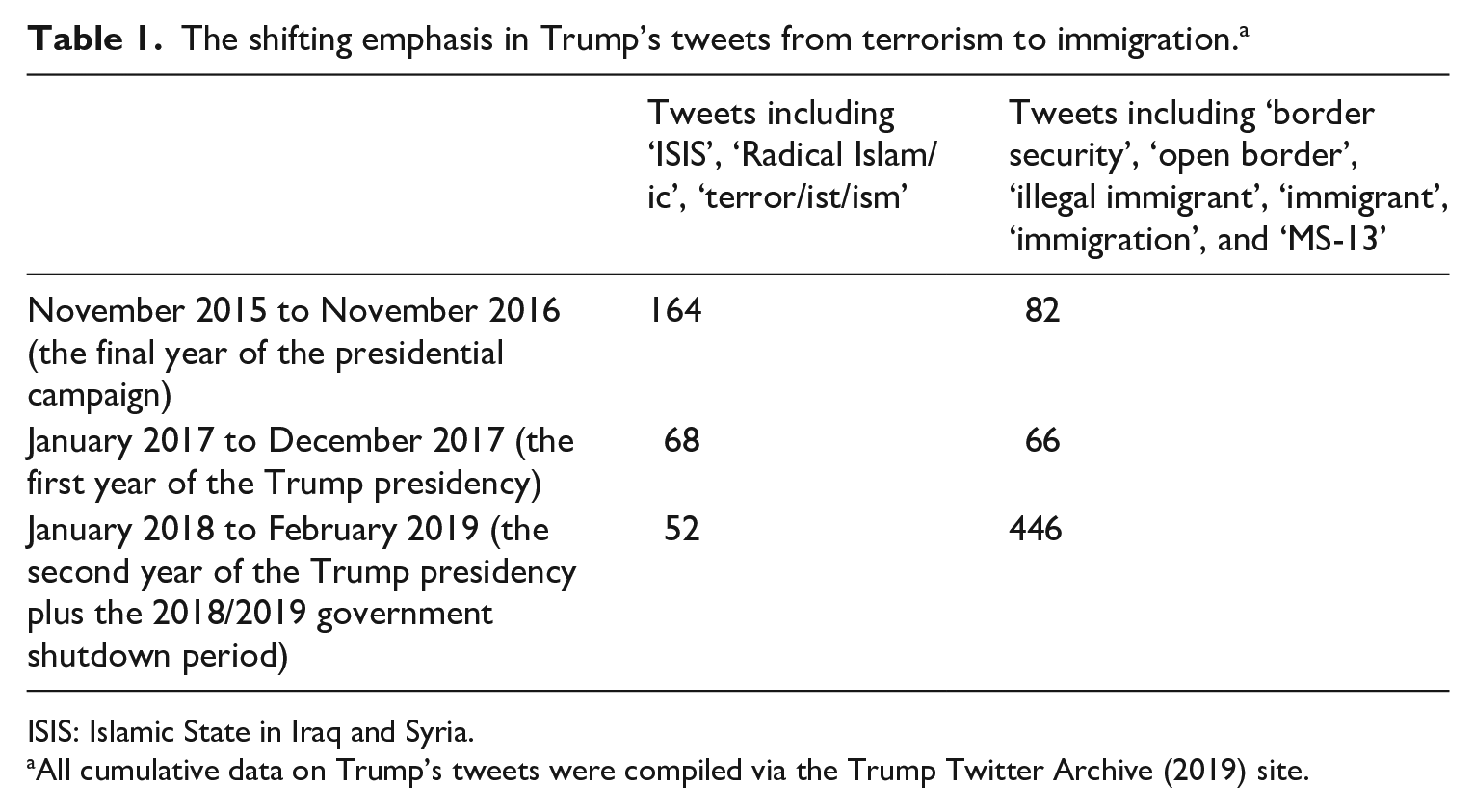
ISIS: Islamic State in Iraq and Syria.
All cumulative data on Trump’s tweets were compiled via the Trump Twitter Archive (2019) site.
The shift in Trump’s rhetoric is best seen first by his reaction to the Central American migrant caravan heading towards the United States in the lead up to the November 2018 midterm elections, and latterly by the president’s rhetoric regarding illegal immigration between December and February 2019. In the period before the midterm elections, Trump placed the issue of the nearly 5000 people strong migrant caravan from Central America at the heart of his electoral campaigning. As Trump (2018e) put it, ‘it’s going to be an election of the caravan’. In line with the picture of right-wing populism presented above, the president described the caravan as ‘an invasion’ of the United States (Trump, 2018a), claimed that the caravan had ‘criminals and unknown Middle Easterners . . . mixed in’ (Trump, 2018b), and suggested that the Democrats ‘had something to do’ with the formation of the caravan for their own political purpose (Trump, 2018d). No convincing evidence was presented for any of these claims, and this was all in spite of the fact that approximately a third of those travelling in the caravan were under the age of 18 (Blitzer, 2018). The political logic, however, was clear, with 75% of Republicans in October 2018 considering illegal immigration a ‘very big’ problem for the United States, and just 19% of Democrats thinking the same (Pew Research Center, 2018).
Although this shift in Trump’s rhetoric initially coincided with the midterm elections, it continued beyond this date, as per the picture of governing populists outlined above. In both December 2018 and January 2019, there were more than 90 tweets by Trump including the phrases ‘border security’, ‘open border’, ‘illegal immigrant’, ‘immigrant’, ‘immigration’, and ‘MS-13’ as his administration attempted to convince the public that the United States was ‘in the midst of a crisis at our southern border’ (Pence, 2019). Trump’s 2019 State of the Union Address spent much more time on MS-13 (another group described by the president as ‘animals’; The White House, 2018) and how ‘year after year, countless Americans are murdered by ‘criminal illegal aliens’ than he did on the threat of ISIS (Trump, 2019a).
On 15 February 2019, Trump (2019b) declared a state of national emergency to increase funding for his administration’s southern border wall, again claiming that ‘we’re talking about an invasion of our country . . . with all types of criminals and gangs’. At this speech, Trump praised the parents of children killed by MS-13 members, claiming that ‘the press doesn’t cover’ their lobbying, but that they were loved by ‘the real country, our real country’. The disputed nature of Trump’s claims about the southern border can be seen in the rejection of the national emergency by Congress, with 14 and 12 Republicans in the House and Senate, respectively, voting against the proclamation before Trump’s veto (Zanona, 2019). Similarly to the above however, 73% of Republican voters supported Trump’s initial declaration, which has allowed him to present himself as the their emblematic representative against Congress (Salvanto et al., 2019).
How can we explain this rhetorical shift, and how does this fit in with Trump’s foreign policy rhetoric detailed in this section? This first question is particularly acute because of how commentators have argued that highlighting the threat of terrorism is ‘politically useful’ for Trump (Neumann, 2019: 158), or that ‘it makes political sense for Trump’ to denigrate ‘terrorists’ (Beinart, 2017). The answer to both questions, I contend, relates back to the fundamental purpose of right-wing populist rhetoric, especially the need to continually perpetuate crisis. As has been shown by governing populists such as Victor Orban or Tayyip Erdogan, ‘there is never a dearth of enemies outside of ‘the people’’ (Müller, 2016: 42). As Campbell shows us, there is always someone else to blame, and in right-wing populism it is those outside of the polis; a dangerous ‘other’ deemed to be a threat to the stability and safety of ‘the people’. In this particular case, the territorial defeat of ISIS and the relative decline of prominent so-called ‘lone wolf’ terrorist attacks in the West has caused a shift in the ‘notion of crisis’ (Moffitt, 2015: 207). Given the way in which terrorism and immigration were conflated previously, and the extent to which immigration merges both otherness and closeness, the new primary target in Trump’s rhetoric should not be a surprise.
Conclusion
This article has argued that Trump’s foreign policy rhetoric regarding terrorism and counterterrorism has served a different purpose to conventional wisdom. Trump’s rhetoric has been disconnected from the surprisingly normal counterterrorism strategy employed by his administration, as he has both overstated the difference when speaking to appeal to his domestic supporters, while also saying little about where changes have occurred. As such, his foreign policy rhetoric has failed to accurately describe or legitimate his administration’s counterterrorism strategy. Instead, Trump’s foreign policy rhetoric has been largely to appeal to his domestic base and to generate a necessary sense of crisis to mobilise his supporters. With the territorial defeat of ISIS and the relative decline of ‘lone wolf’ attacks in the West, Trump has simply changed the primary target of his crisis rhetoric from terrorists to immigrants.
Not only has this article attempted to contribute to the discussion of this special issue on elections, rhetoric, and US foreign policy, but also to the burgeoning scholarship on governing populists and their foreign policies. Looking at case studies from the Global South, Destradi and Plagemann (2018: 297–298, 2019: 727–729) have argued that although populism (conceptualised as a ‘thin’ ideology) has no intrinsic relationship to foreign policy, it has primarily impacted upon the style and process of foreign policy, rather than producing substantive policy shifts. Although this article conceptualises populism as a form of political rhetoric, it echoes these arguments. That is, there are some even areas within this case study where Trump’s rhetoric has fallen closer in line with his administration’s policies, such as trade (Biegon, 2019: 583; Löfflmann, 2019: 121–122). Furthermore, as populism has a chameleonic nature, we should expect to see an equivalent level of variety in the area of foreign policy. However, given right-wing populism’s exclusionary nature and populism’s inherent need for crisis, it is hoped that the framework provided here – on how the outside realm has proved to be a fruitful one for ‘othering’ and perpetual crisis generation in the name of political mobilisation – could offer an avenue for further research elsewhere.
Footnotes
Funding
The author(s) received no financial support for the research, authorship, and/or publication of this article.
