



Abstract
After more than 25 years of scholarship, the deliberative turn in international relations (IR) theory is ready to be revisited with a fresh perspective. Using new methods from automated text analyses, this explorative article investigates how rhetoric may bind action. It does so by building upon Schimmelfennig’s original account of rhetorical entrapment. To begin, I theorize the opposite of entrapment, which I call rhetorical hollowing. Rhetorical hollowing describes a situation in which actors use normative rhetoric, but instead of advancing their interests, such rhetoric fails to increase their chances of obtaining the desired outcome because the normative force of their rhetoric has eroded over time. To provide plausibility to both entrapment and hollowing, I present two mechanisms by which language is connected with action in the United Nations Security Council. Finally, I run a series of time-series-cross-section models on selected dictionary terms conducive to entrapment or hollowing on all speeches and an original Security Council resolution corpus from 1995 to 2017. The research shows that while mentioning ‘human rights’ is consistently associated with increased odds of authorization of force; the word ‘terrorism’ is associated with a decrease of odds for intervention. This finding suggests that some terms may not only entrap or hollow but also normatively backfire.
Keywords
Introduction
Samantha Power once argued that the United States avoids the term genocide out of fear that it will morally obligate it to use military force. 1 During the years of the Syrian Civil War, Ms. Power tried to persuade President Obama to use force by urging him to cite the likelihood of an impending genocide. Eventually, her efforts failed. The United States did not intervene. Neither did the United Nations.
This analysis starts from the vantage point that words matter in political conduct. Taking Ms. Power’s claim seriously entails a belief that individual words may force actors into taking concrete actions. The idea that words can cause political action can be linked to a well-established debate in International Relations (IR) theory often labeled the ‘deliberative turn’. 2 Originating in a subfield of German Political Science, 3 the ‘deliberative turn’ has generated a quarter of a century worth of scholarship in Europe, the United States, and beyond.
Adding to this rich literature, this explorative article offers a complementary account of speech acts, which I call rhetorical hollowing. 4 Derived from Schimmelfennig’s original idea of rhetorical entrapment, rhetorical hollowing describes a situation in which the usage of a normative term fails to advance an actor’s bargaining position instead of promoting it. This article uses both concepts to investigate whether rhetoric binds actions. More concretely, it asks, which terms entrap or hollow in the United Nations Security Council?
To this end, I theorize two mechanisms by which words are translated into actions. I illustrate the logic of my argument in the United Nations Security Council (UNSC) speeches and resolutions. The Security Council 5 is responsible for dealing with threats to ‘international peace and security’. 6 Under Chapter 7, the Council may use a wide range of measures to ‘maintain or restore peace’. 7 The most egregious crimes, or strongest breaches of peace, can be addressed by any military means, including air, sea, and land forces. 8 Before almost all actions, the SC holds public debates to discuss which measures should be taken and which countries favor which course of action before voting on a resolution.
By applying methods from automated corpus linguistics, 9 we can investigate such Security Council debates and resolutions systematically to examine whether rhetoric matters. To do this, I merge existing data on Security Council speeches 10 with an original corpus on UN resolutions from 1995 to 2017 and then select possible terms that may entrap or hollow. I translate these dictionary terms into a series of logit regression models. Controlling for the permanent five, characteristics of the countries participating in the debate, and time dynamics, I find that mentioning the term ‘human rights’ is consistently associated with an increase of odds of authorizing the use of force. However, I also find that mentioning the term ‘terrorism’ decreases associated odds of authorization. This finding indicates that both rhetorical entrapment and rhetorical hollowing operate in the Security Council. Furthermore, some terms seem to normatively backfire – undermining the chance to obtain a desired outcome.
The article proceeds in six steps. First, I discuss relevant theoretical literature that could be used to build a bridge between the ‘deliberative turn’ and quantitative text analysis. Second, I theorize two mechanisms that may lend rhetoric causal force. Third, I survey extant research on the UNSC to arrive at possible terms that may entrap or hollow. Fourth, I develop a dictionary algorithm that identifies whether a resolution authorizes the use of force. Five, I run a series of statistical models to estimate whether rhetoric binds actions. Six, I discuss my explorative study’s implications for future research and highlight causal limitations of text-as-data approaches with peace and conflict research.
Theory
Frank Schimmelfennig thought that the strategic usage of words with a normative imperative would entrap policymakers into action. In his seminal work 11 he demonstrated that controlling for preferences of individual member states, EU enlargement happened due to rhetorical entrapment. As a result, Schimmelfennig found a concomitant third way of speech acts. These are bargaining sequences that are backed up by reasons and justifications, ‘even though the communicative logic is dominated by consequentialist behavior’. 12 Language is used strategically but operates under the premise of morals or values to bring about the desired outcome. Beyond articles authored by Schimmelfennig himself, few studies built upon his work directly. 13
In this study, I want to further Schimmelfennig’s idea. Like him, I also believe that normative rhetoric is not cheap. Indeed, normative language may be very costly. How actors appeal to morals, and highlight values – even if they do so instrumentally – does something to these normative concepts. Moreover, it might have advantageous or disadvantageous consequences for the actors themselves. Schimmelfennig thought that actors made themselves vulnerable by falling into the possible trap of using language with a moral connotation or an ethical imperative. 14 Once mentioned in a public forum, other actors could use such normative terms to talk this actor into a corner, making him or her do something that they otherwise would not. 15 If we follow this reasoning, we can see that words can compel actors to do something. 16 But what if morals or normative terms fail to compel? What if they are used in vain? Can they become so empty that they lose all of their normative force? This is the phenomenon that I call rhetorical hollowing. It describes a situation in which an actors’ use of normative rhetoric fails to advance their interests and will not increase their chances of obtaining their desired outcome.
Rhetorical hollowing may not only flow from specific norms or values. More generally, I think that rhetorical hollowing may occur whenever actors use language that contains a (moral) imperative to act. If these imperatives either a) repeatedly fail to provoke the desired action or b) are used in vain, 17 their imperative might hollow. Hollow terms will no longer unleash any (normative) force and will instead fail to advance the interest of their speakers.
Before I explain the two mechanisms that connect entrapment and hollowing with action, I want to emphasize that this study is exploratory in nature. To my knowledge, no other article has tried to connect the vast literature on the deliberative turn with systematic quantitative text analysis. While I have chosen rhetorical action as my theoretical avenue in this article, the deliberative turn is much richer.
In decades of research, the deliberative turn has produced many other fruitful strands that I cannot possibly do justice to in this brief article. However, I will highlight a few of them to show that my analysis is explorative and in no way exhaustive. Other theoretical tenets can be equally well-suited to investigating whether rhetoric matters.
The most obvious of these ‘other approaches’ is constructivism and theories that emphasize deliberation, reasoning and discourse. 18 These approaches would often use a logic of appropriateness and a modus of communication to explain how actors reach specific outcomes in international politics. When connected to intervention, these accounts offer an equally rich base to derive theoretical expectations. 19
Additionally, there are deliberative turn variants that emphasize the deliberation aspect. These can be found in deliberative system theory and in deliberative democracy research. 20 In many cases, the philosophical foundations of these accounts are based on speech-act-theory. 21 Applied to the arena of world politics, the Copenhagen school offers a lens through which one can understand the implications of framing something in terms of a security crisis. 22 Another deliberative turn variant takes a broader understanding of actions and communication, embedding it in practices. 23 All of these accounts, and many more, offer justified places to start connecting rhetoric with action in a systematic fashion.
Coming back to rhetorical action and hollowing, I propose two mechanisms that make language conducive to exert force. The first is best illustrated with the introductory scene of this article. In Ms. Power’s own words, policymakers ‘steadfastly avoided the use of the word ‘genocide’, which they believed carried with it a legal and moral (and thus political) imperative to act’. 24 Put differently, in a political context, specific terms are associated with certain actions. Therefore, citing the term genocide could have rhetorically entrapped President Obama, prompting him to use force in Syria. Accordingly, rhetorical entrapment assumes that normative terms, or terms that entail some sort of ethical imperative to act, compel policymakers to use force. Non-action would damage their credibility among their constituency or the international community. 25 Hence, compliance with prior policy commitments seems to matter with audience costs. 26 If people are paying attention, policymakers are seemingly frightened by stark contradictions or flip-flopping on issues that enjoy political salience. Thus, rhetoric is likely to affect a person’s behavior if there is a certain probability that one’s wording is observed by an audience. 27 This audience could be domestic, consisting of liberal democracies, or foreign. 28 In the Security Council, this audience may also consist of other member states that the actor in question needs to win over to authorize their desired course of action. The UNSC requires 9 out of 15 affirmative votes for any resolution, with no veto by a permanent member.
Therefore, the first mechanism entails a pressure to be consistent in one’s wording. Electoral scholars have demonstrated that policymakers are keen on representing a coherent account of their policy goals and language 29 – because voters associate consistency with authenticity 30 which is linked to positive approval. On the other hand, inconsistency might be associated with flip-flopping and negative audience costs. 31 The repeated and consistent use of terms might not merely be a form of legitimacy talk. 32 Instead, such repetition is meant to make the desired outcome more likely. Political scientists using signal entropy in sentence processing have shown that audiences get primed for a specific action by continually using the same term. 33 Therefore, possible audience costs may create consistency pressure, pushing actors to be consistent in their message.
On the other hand, consistently using a term and then failing to follow through on its implication might also lead to rhetorical hollowing. If actors repeatedly ‘promise’ to change something in the name of, for example, justice and then stall or fail to pursue such action, over time, the ‘promise of justice’ might become an empty phrase. Likewise, describing a situation in a moral imperative but then acting in a way that stands in contrast to the moral claim might also damage the term’s credibility. If such misapplications persist over time the normative force of these terms may wear down.
The second mechanism is related to venues of legitimacy and power. Ian Johnstone believed that the UNSC comes closest to a forum in world politics where the ‘better argument has a fighting chance to win’. 34 Most accounts that deal with the Security Council describe for it a role as a legitimacy-granting institution 35 or at least one of the most powerful institutions in world politics. Building upon Erik Voeten’s concept of the Security Council as an elite pact in world politics, 36 the second mechanism assumes that states do not only consider audiences as external onlookers but also see their peers – other Members of the Security Council – as vital audiences. Security Council members may be interested in seeing the Council operate effectively to uphold its legitimacy. Since international regimes are often thought of as places ‘where actors expectations converge’, 37 it is not unreasonable to believe that once there is a growing consensus in the room that favors intervention, some member states might feel reluctant to challenge this consensus as they are afraid of appearing as a ‘spoiler to their peers’. As such, regime pressure, the second mechanism, might operate at the Security Council because of the institution's elite pact rationale. The fear of ruining an established consensus might compel actors to authorize force because, otherwise, they would imperil the legitimacy of an effectively operating institution.
To subject these two mechanisms to a plausibility probe, I propose focusing on the UNSC and taking the authorization of force as our desired outcome. While both regime and consistency pressure are theoretically plausible, empirically, they are not easy to falsify. Because of this exploratory article's brevity, it seems reasonable assess their working as observable implications post-analysis. Since the findings give credit to both mechanisms indirectly, future research could try to observe them directly.
Before I survey extant literature for entrapment or hollowing candidates, I want to explain this approach’s logic. Crucially, the analysis follows the idea that individual words might carry normative power. 38 Even amongst moral imperatives to act, there might be some sort of hierarchy between the terms – mentioning genocide might carry a stronger imperative than, say, humanitarian crisis. Therefore, a core assumption of the following word selection is that actors choose these terms strategically. They care about the individual use of specific terms because they know that mentioning genocide might entail extremely high enforcement costs, whereas humanitarian crises might imply lower costs. This approach is well-suited to investigating rhetorical entrapment or hollowing because it can scrutinize the individual word’s magnitude. Depending on the relationship with authorization of force – whether it is positive and significant – we can also infer whether the term entraps or has hollowed.
Other approaches, such as Medzihorsky et al., 39 use a much broader dictionary to show that actors may use language to frame a given crisis in terms of civil conflict management when wanting to intervene. While their analysis is indeed convincing, they remain unable to decipher which of their selected terms carries force. They can show that the ‘responsibility to protect’ shapes rhetorical responses by major powers, but they cannot identify individual effects of specific words. While carrying insightful implications about civil conflict rhetoric, their approach cannot investigate terms that entrap or hollow.
Because it is hard to know which terms will entrap or hollow a priori, I remain open to the possibility that they can do either. Empirically I expect that (normative) words with no statistical association with the authorization of force might have hollowed, and words that hold a positive and statistically significant relationship may entrap. When formulating a hypothesis, I will simply state that ‘it should have an effect’ to underline the idea that these terms are likely to carry normative force.
Searching for (Normative) Imperatives to Act
To identify plausible candidates, we need to examine secondary literature for terms that exhibit a normative or otherwise ethical imperative to act. The first term that deserves scrutiny is relegated to Samantha Power’s argument about the properties of the term genocide. Amongst others, Beardsley & Schmidt 40 and Binder 41 have renewed support for the argument that the UN intervenes in those conflicts that show the highest amount of human suffering. The horrific atrocity of genocide is undoubtedly an incident where we would expect the utmost human suffering imaginably. As such, in cases where policymakers mention a genocide in Security Council speeches, the authorization of force in Security Council resolutions should become more likely. On the contrary, of course, stands the abysmal track-record of cases where genocide was committed, but international actors failed to prevent it 42 – suggesting that genocide might entrap or hollow.
Hypothesis 1: The mentioning of the term ‘genocide’ in Security Council Speeches should have an impact on the authorization of the use of force in Security Council resolutions.
The second plausible candidate is ‘humanitarian crisis’. This term responds to the idea that not all human suffering has to take on the form of genocide to entrap or hollow. The idea here would be that policymakers are less deterred to employ force because the costs of a lower-level operation (such as a humanitarian crisis) might devour fewer resources and might not translate into an indefinite occupation with no end in sight. Accordingly, policymakers might find the term more appealing. Since it is plausible that the words were used to justify interventions where the ‘humanitarian’ element of the case was questionable, the term might also hollow.
Hypothesis 2: The terms ‘humanitarian crisis’ in Security Council Speeches should have an impact upon the authorization of the use of force in Security Council resolutions.
The third term is supported by constructivist scholarship in IR. A broad literature has shown that norms matter in international conduct. 43 One specific norm is the ‘responsibility to protect’ (R2P). Many scholars assume it to be one of the most powerful and far-reaching 44 . Moreover, at the UN World Summit in 2005, the norm was endorsed and later reaffirmed by the Security Council in resolution 1647. 45 Since then, the language of R2P has been applied to several grave humanitarian crises 46 . Most prominently perhaps, it has been used in resolution 1973, authorizing military force in Libya using a large array of aerial bombing. 47 To recall briefly, R2P is a norm that assumes that every ‘individual state has the responsibility to protect its populations from genocide, war crimes, ethnic cleansing and crimes against humanity’. Suppose a state manifestly fails to prevent its population from said atrocities. In that case, the UN Security Council retains the authority to assess that said state poses a ‘threat to international peace and security’. It may therefore authorize military action to protect its population from grave harm. 48 Given this context, R2P appears to be a good justification for the use of force. However, keeping the aftermath of the Libyan intervention in mind, it might be the case that R2P has already begun to hollow. 49
Hypothesis 3: The Responsibility to Protect in Security Council Speeches should have an impact on the authorization of the use of force in Security Council Resolutions.
Lastly, there is substantial research on the prevalence of human rights and its impact on states' behavior in world politics. 50 The sheer need to intervene given prior human rights rhetoric in Security Council speeches should prompt policymakers to authorize force in Security Council resolutions. However, human rights rhetoric might have been used in a past crisis as a trojan horse for intervention 51 . Therefore, human rights might have hollowed instead.
Hypothesis 4: The term Human Rights mentioned in Security Council speeches should have an impact on the authorization of the use of force in Security Council resolutions.
All of the terms mentioned are united behind the idea that addressing human suffering entails a moral imperative to act. Yet, other (moral) imperatives might also exert force on rhetoric. A starting point for these words are realist assumptions about global governance and international institutions. Realists discussed with some prominence the intricacies of military intervention, often taking a unilateral position. 52 The intervention was then sometimes described ‘as a means [. . .] to promote the interests of individual nations’. 53 Out of fear of losing face, states would not justify force by merely saying that they want to further the parochial interests. Instead, policymakers would justify their endeavors along with a common denominator, in the cases of intervention, the idea of international security. Since the UN will, for legal reasons, always introduce an authorization of the outright use of force with the words ‘to maintain international peace and security’, selecting the keyword ‘security’ would lead to an unbearable number of false positives. Therefore, a more fine-grained terminology is in need. Most security deliberations at the UNSC are centered around regions where the P-5 maintains some sphere of influence or where existing crises are projected to create spill-over effects to bordering countries. 54 In 1974, Oscar Schachter already suggested that, among other things, the UN is involved in a conflict if the ‘territorial integrity’ of a member state is threatened. 55 However, to capture the idea that security might not only relate to a specific member state but rather that the world has seen more complex regional warfare beginning in the 1990s 56 the words ‘regional security’ is included in the account.
Hypothesis 5: The term(s) ‘regional security’ mentioned in Security Council speeches should have an impact upon the authorization of the use of force in Security Council resolutions.
The following term refers to democracy promotion. After 9/11, democracy promotion and regime change became part of the Bush administration's newly formulated foreign policy credo and rose to agenda prominence in the Security Council. 57 Democracy promotion, just like the imperative for human rights, might have been applied when other interests outweighed its justified usage. Moreover, enforcing democracy might also be a questionable practice from a normative standpoint, making the term a plausible candidate for hollowing as well.
Hypothesis 6: The term ‘democracy’ mentioned in Security Council speeches should have an impact upon the authorization of the use of force in Security Council resolutions.
The last term included captures the rise of terrorism in international affairs. Although terrorism is not a recent phenomenon, its agenda prominence rose after 9/11. 58 Beginning with the war in Afghanistan, the George W. Bush administration saw the ‘war on terror’ as an overarching foreign policy goal. In prior years, terrorism, specifically the strategic usage of suicide terrorism to force political goals, was seen as a matter of national sovereignty. However, the subject received newfound attention with the perceptions of one of the P5 changed. Chantal de Jonge Oudraat has argued that if more than one Member of the Security Council perceives a crisis as a threat to international peace and security, chances are heightening for intervention. 59 Therefore, the word terrorism is selected as a term that might entrap. Because terrorism also seems to be a malleable concept that can be used and ‘abused’ by policymakers, it might have also hollowed instead.
Hypothesis 7: The terms ‘terror or terrorism’ mentioned in Security Council speeches should have an impact upon the authorization of the use of force in Security Council resolutions.
Research Design
The unit of analysis in this study is the individual Security Council country-speech. Hence, the data to be inspected is written text (Table 1). This calls for special techniques of examination. The method for analyzing text-as-data stems from a growing research field in political science sometimes called quantitative text analysis. 60 Since there is no corpus dataset on Security Council resolutions, I utilized the programming language ‘R’’s web scraping algorithms to download all Security Council resolutions from 1995 to 2017 and transformed them into a machine-readable original corpus including full-text for each resolution.
Descriptive Statistics on Selected Terms.
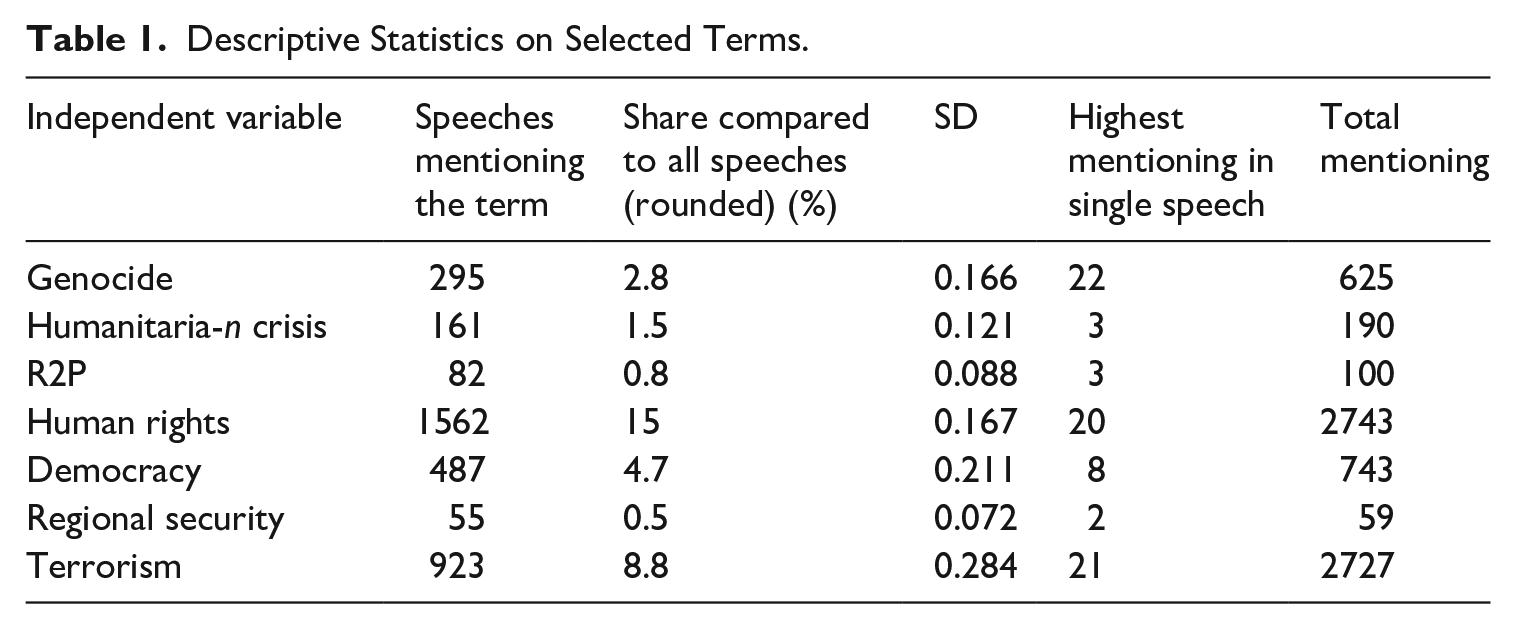
In a second step, I augmented the data by removing unnecessary page headings, whitespaces, insignia and set each document to lowercase. Next, I merged the newly formed UNSC Resolutions corpus with an existing seminal corpus on UNSC speeches. 61 By matching each speech to its corresponding resolution, I deciphered which numbers of speeches were related to the passing of which resolution using the SPV number. All in all, I examine all 1397 resolutions and all 10,435 speeches between 1995 and 2017. In a third step, I used exact-pattern-matching to detect when our words were mentioned during a speech–corresponding to the terms selected in the theory chapter.
Dependent Variable ‘Authorization of the Use of Force’ 62
The dependent variable and parts of this section are drawn from an unpublished MA thesis.
The dependent variable (DV) is the authorization of the outright use of force. 63 The term stems from the UN scholar David Malone. 64 It refers to the usage of a specific legal action by the UN Security Council. That is, it decides under Chapter VII of the Charter of the United Nations that a particular danger constitutes a ‘threat to international peace and security’. Further, that the UNSC is authorizing either a member state or a coalition of the willing to act nationally or through regional organizations to address this threat – if necessary with all necessary measures, including the use of outright force. 65 The phrase ‘all necessary measures’ is to be taken literally. Any military action performed through land, air, and sea forces is specifically allowed (UN Charter Article 42). Such action could entail troop deployment, the enforcement of a no-fly-zone, even the use of aerial bombardment.
The concept of authorization of the outright use of force is not universally used in the relevant literature. In fact, many scholars refer to arguably the same phenomenon as either peace enforcement 66 or forcible military intervention. 67 In this study, authorization of force is defined as a legal action taken by the Security Council allowing a non-consensual coercive military intervention in a given conflict under a Chapter VII mandate. To observe it, three criteria have to be satisfied.
First, a resolution featuring a force authorization must allow for intervention in a non-consensual manner. Non-consensual means that troops and airstrikes will be deployed regardless of whether the given state, inhibiting the crisis, agrees. This criterion marks a strong demarcation towards ordinary peacekeeping missions in general, for they are employed as a consensual non-coercive force. 68 However, it allows for the incorporation of robust peacekeeping forces since I would argue that these fulfill the necessary means to be labeled a coercive force. 69
Second, authorization of the outright use of force can only be present in a given resolution if that resolution features a legal phrasing or speech pattern which authorizes coercive military action. Third, such a speech pattern is only valid if it is given under a Chapter VII mandate. Therefore, the relevant resolution has to feature a reference to Chapter VII of the Charter of the United Nations. Although the Security Council is not required to refer to any relevant articles from a legal standpoint, when allowing coercive military action, the practice is to cite Chapter VII. 70 If all of the three criteria are satisfied, the concept of outright use of force applies.
Empirically verifying the DV entails designing keywords or key phrases that signal when any or all three conceptual criteria are satisfied. What complicates the matter is that diplomats at the UN use jargon that may not immediately signal authorization. For example, if one searches for ‘military intervention’ in all UNSC resolutions from 1995 to 2017, one returns with two hits: Resolution 1580 (2004) and Resolution 2216 (2015), and both of them are false positives. This is a classic issue in quantitative text analysis. In designing a keyword, a scholar has to balance a delicate trade-off between the accuracy of the phenomenon to be observed (ensuring measurement validity) and a parsimonious level of observation (ensuring that no false negatives result). The way to overcome this obstacle lies in a combination of suitable variables to signal when authorization of the outright use of force is present.
After carefully examining hundreds of Security Council resolutions, I arrived at a list of phrases that signal the legally binding use of force. These are: ‘take all necessary measures’, ‘using all necessary means’, ‘use all necessary means’, or ‘with all necessary means’. Under a Chapter VII reference, these exact phrasings allow for the non-consensual use of any military force. As such, 139 resolutions authorize the utmost use of force or roughly 9% of all resolutions passed from 1995 to 2017.
Figure 1 illustrates the average authorization rate over time. The line plot exhibits a quasi-cyclical nature. At the beginning of each cycle lies a phase of relative decline in authorization. From a base-level rate where roughly 10% of all resolutions authorize force, the authorization rate declines steadily, implying that the UN has taken steps to address these crises. Then follows a rapid growth phase in authorization, signaling that the UN becomes aware of new (or recurrent) crises. Authorization peaks in several years, the highest of which is 2008–with a mean of 20.6%. In that year, all of the resolutions address either Somalia (pirates at the coastline), Afghanistan (extension of ISAF), or former Yugoslavia (extension of EUFOR and NATO mandate). These cases illustrate that one should not take authorization peaks as a first-hand indicator for world insecurity in a given year. Instead, from a legal perspective, to alter a Chapter VII mandate (this also applies to the extensions of military occupations), another Chapter VII reference needs to be given. 71 Therefore, a sizeable chunk of these authorizations is related to the renewal of prior interventions because intra-state conflicts tend to rebound again, and continued military presence might make violent resurgences less likely. 72
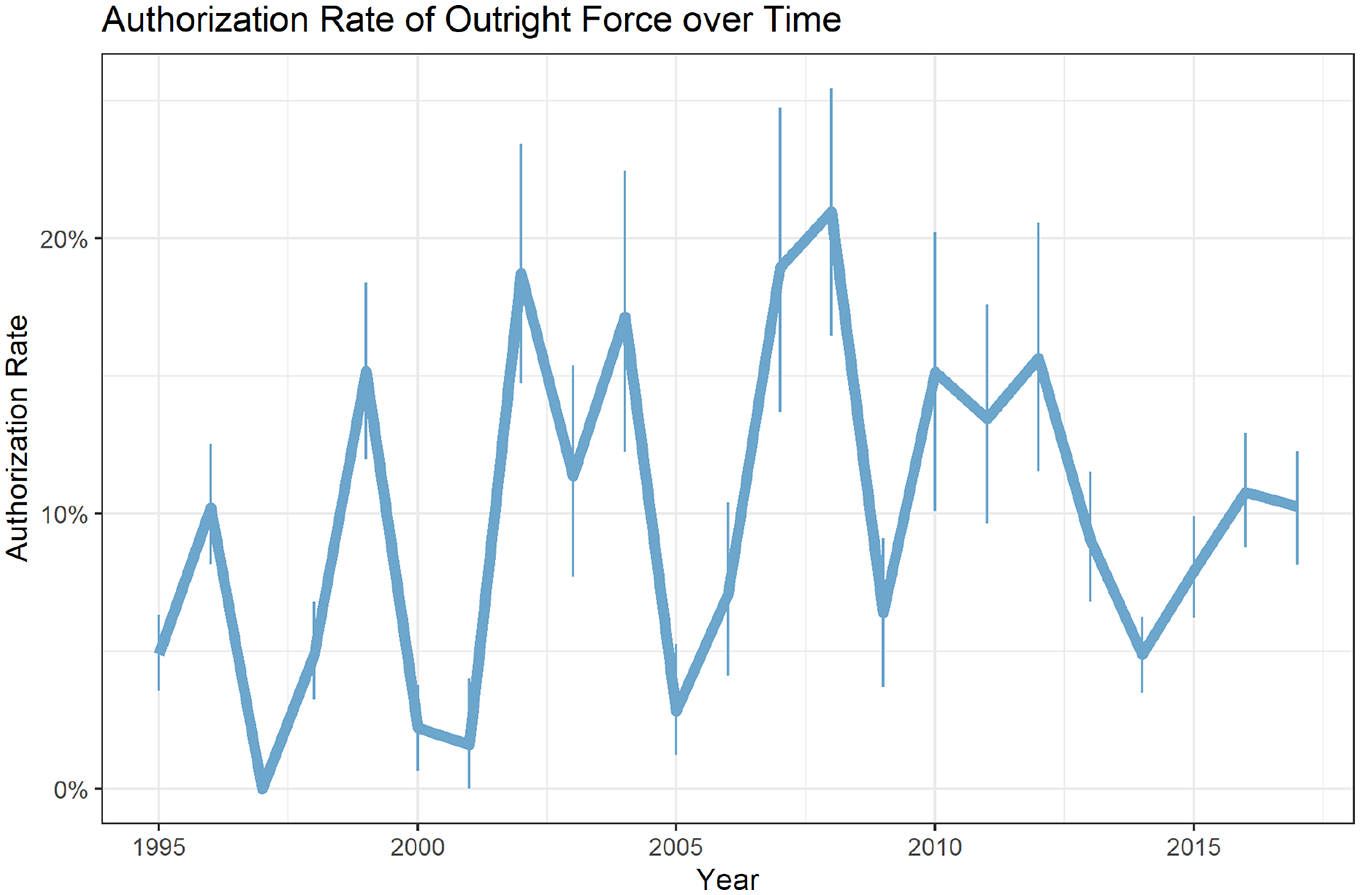
Authorization rate over time.
To ensure that my dependent variable captures virtually all authorization of force, I performed manual validation steps. First, I made sure that I did not overlook any authorization in a Security Council resolution. To do this, I created an algorithm that scanned resolutions that were denoted as ‘false’ (no force should be given here). Then, I wrote an algorithm that would give me the verbatim text of these resolutions to verify that no authorization was issued. I repeated this process four times. In total, I read 200 Security Council resolutions, which is roughly a seventh of the entire corpus, and found no false negatives. Then, to ensure that all of my 139 authorizations of force were accurate, I read them all individually, one by one. Again, I found no false positives. Cases such as Mali or Haiti are counted towards an accurate observation. As stated above, robust peacekeeping missions fulfill the requirements as long as they are mandated under Chapter VII and feature either the key phrase ‘to take all necessary measures’ or any of its denoted synonyms.
Results
To investigate whether mentioning specific terms increases the likelihood of authorization, I estimate four different logit model specifications in the main text (Table 2). Each of these models has been estimated on a country-speech level of analysis. Therefore, an authorization outcome has been added to each individual country-speech.
Logistic Regression Models on Authorization of Force, 1995–2017.
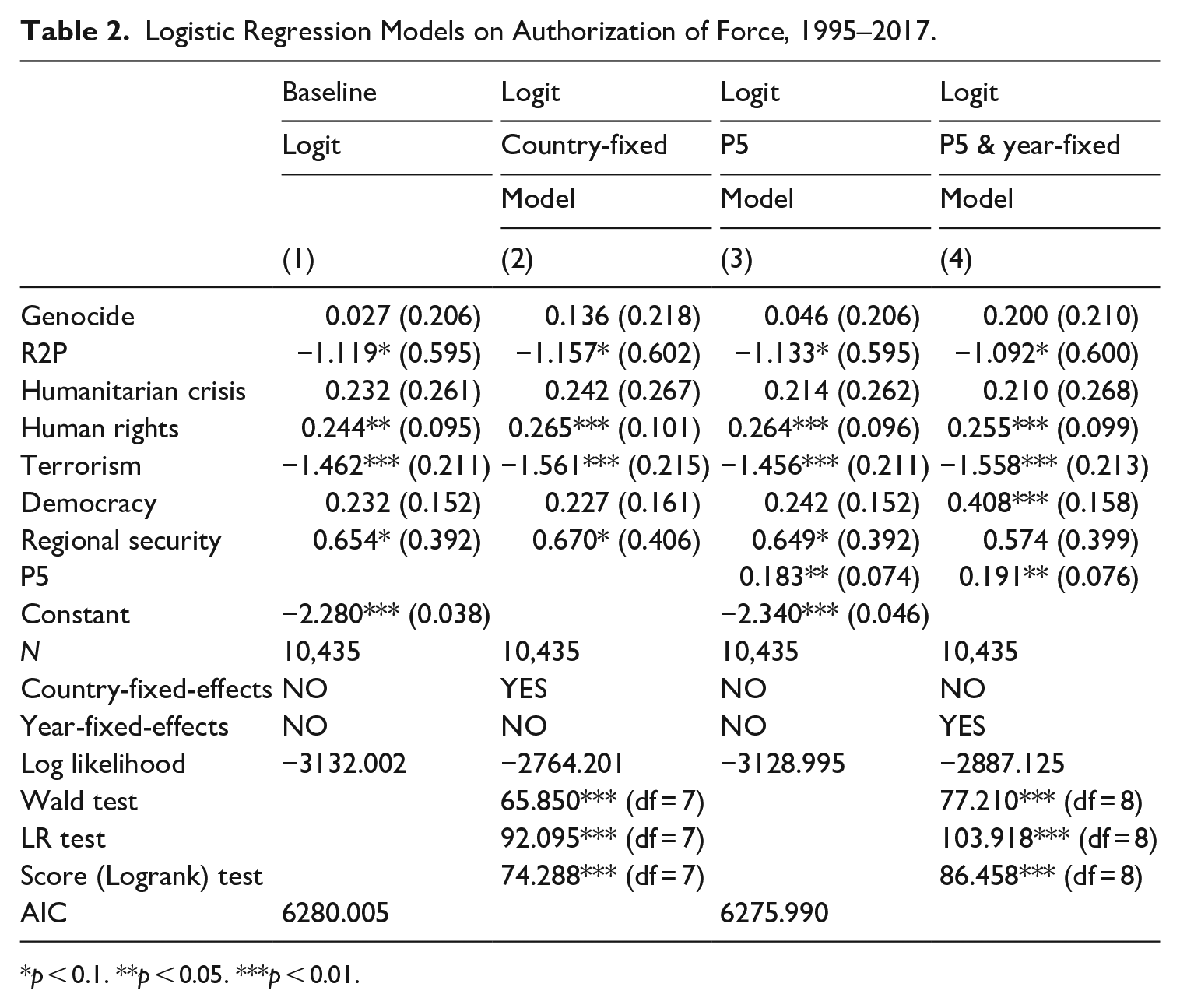
p < 0.1. **p < 0.05. ***p < 0.01.
Furthermore, while rhetorical hollowing implies a temporal dimension, during which the normative force of terms may have depleted, this explorative study takes each independent variable as a fixed point in time. This means that – once we run our regression models – terms either have already hollowed or have entrapped. Showcasing their change in normative force over time would indeed be a valuable contribution, but due to the brevity of space cannot be facilitated. However, by publishing the original Security Council corpus data, I hope that other scholars will find ways and means to model the temporal dimension of rhetorical hollowing. In each of the following models, I take authorization to be binary (0 or 1). The first model, our baseline model, estimates the association with the use of force with each of our selected terms.
The second model does the same and uses a within-estimator (in this instance, country-fixed-effects) to address time-invariant-change that relates to the countries that participate in the debates. The idea here is to control for any possible bias that might result from the countries’ characteristics that use these terms. For example, trends stemming from countries’ characteristics in the data might drive both authorization and our selected independent variables. Such bias could include hidden factors like the culture of the respective country. Perhaps there is a latent affinity for values such as freedom of the press or strong civil liberties – or their geography; maritime powers might have a ‘natural preference’ for authorization because they can intervene and project power using their fleets, etc. Essentially, the model reduces all estimates to be ‘within’ each country. Thus, controlling for the influences of the specific countries participating in the debates.
The third model follows the different logic. Extant research has shown that permanent five members’ (P5) interests significantly affect which crisis the Security Council deals with. 73 Because proxying material interests in a study that observes text-as-data as its unit of analysis can be tricky to facilitate, 74 I use the P5 as a stand-in for assumed material and symbolic power hierarchies. Therefore, in this model, we assume that it does make a difference whether a permanent member uses our selected terms (instead of any elected member). In the UNSC, permanent members hold the right to veto any action they do not desire. It is plausible that their word enters a debate with a different power level. This model includes, in addition to all other variables, a control variable whether the speaking country is a member of the P5.
The fourth and final model keeps all variables mentioned before and adds year-fixed-effects to the equation. We do this to control for any possible time-related bias in the data. Since we observe a long time-span, it is reasonable to assume that time itself might have some bearing on authorization or our main explanatory variables. For whatever reason, it could be that authorization of force became more likely over the years. It could also be the case that our selected words' mentioning grew in likelihood over the decades. To account for this possible bias, we add a year fixed-effects estimator to the model.
As with any statistical model, these four models serve as an abstraction of the phenomenon studied. Their analysis should not be grounded in judgments whether the ‘model is true or false’ but instead whether it is useful or not. That being said, across all models, the terms human rights maintain a positive and highly significant association (p < 0.01) with authorization. This suggests human rights might be a strong candidate for rhetorical entrapment. Effect sizes vary across model specifications: Hence, I standardize them and interpret them within each model. Converted to odds-ratios, the mentioning of human rights is associated with the increase of odds of authorization by a range of 23-% to 30-%. Since this effect size is substantial and robust, we should take seriously the idea that human rights have the ‘power’ to compel actors into authorizing force. The finding further shows that human rights still enjoy enough support among Security Council members. Prior questionable applications of the term do not seem to have hollowed it.
Surprisingly, the term terrorism does not only fail to increase the odds of authorization but has a statistically significant negative relationship with the associated likelihood of intervention. Consistent across all model specifications referring to terrorism during a Security Council debate decreases the associated odds of authorization (p < 0.001). This finding suggests that terms may not only hollow over time – but can at some point – become so hollow that they normatively backfire. In this sense some terms may become counterproductive rhetoric. 75 Using them will make a certain outcome rather unlikely than likely. Because the performed analysis does not model normative force over time, we cannot say at what point the term started to backfire. However, what we can say with some certainty is that mentioning terrorism is counterproductive for the use of force. It will rather decrease the odds of authorizing than increase the odds of authorization.
Effects sizes of terrorism vary across models, with a range of 12 percentage points, between 60-% and 72-%. While the effect sizes are large, we should keep in mind that this study only analyzes the outright use of force. It is plausible that the UNSC authorizes various kinds of sanctions, blockades, consensual peacekeeping forces, and other coercive measures while referring to terrorism. 76 Still, we should be cautious about overinterpreting this finding because we lack data on the dyadic relationship between the speaker – who mentioned terrorism – and the country being targeted. 77 Concerning military intervention, relying on a verbal strategy that emphasizes terrorism alone will make military action not more but less likely. Speculating on the implications of this finding, it could mean that there were too many instances in the past where observing members concluded that the rhetorical use of terrorism was normatively unjustified. Examples could include the US’ war on terror or Russia’s use of the term to justify military interventions in bordering countries. 78 At some point the normative force of this terms seems to have reversed, making it counterproductive rhetoric towards the use of force.
The responsibility to protect also has a negative effect on authorization across all models. However, its p-value borders on acceptable standards of scientific conduct (~ p < 0.06). Hence, we should treat the finding with some caution. Its negative coefficient would suggest that it is a counterproductive term and could normatively backfire. After the intervention in Libya in 2011, which was primarily justified on R2P, many scholars wondered whether the norm suffered. Some scholars also argued that R2P would not recover from this authorization. 79 . 80 That being said, the analysis does only consider the outright use of force. It is very much plausible, and practice, to cite R2P in relation to peacekeeping, sanctions, blockades and other UNSC measures.
The term that carried arguably the strongest moral imperative – genocide – is statistically insignificant in all model estimations. Mentioning the word does not compel policymakers to intervene and seems to be rhetorically hollow. The same can be said about citing humanitarian crises.
Democracy is in all models, except the fourth, statistically insignificant. Since we address time-related bias in the fourth model, it might be that there is an inbuilt time dynamic that soaks up the significance of the term in all other models. Whether this means that democracy promotion or regime change builds up force overtime needs further research. It might also be that the word ‘democracy’ is not a perfect stand-in for democracy promotion or regime change. Future research will hopefully establish a more nuanced dictionary here. 81
Whether a permanent member uses our selected terms does indeed make a difference. The P5 control variable is consistently significant, underscoring prior research about the influence of this powerful group. While this finding can be read as suggesting that rhetorical entrapment and hollowing might also be related to who uses the term, we should not forget that human rights remained significant even controlling for the P5 influence. This suggests that rhetorical entrapment and hollowing does not only result from the words of powerful actors.
Regional Security only borders on acceptable standards on significance (p < 0.09) and fail to reach those levels in the fourth model. The positive effect sign might be in line with an entrapment strategy, but its low level of statistical certainty should prevent us from reading too much into this result.
Conclusion
Bearing the analysis in mind, where does this leave us? At the beginning of this explorative article, I emphasized the underlying purpose of this research to connect the deliberative turn literature with novel methods stemming from automated text analysis. The task was to investigate whether rhetoric matters systematically. More concretely, I tried to answer which terms or phrases are conducive to exert force to rhetoric? With the statistical analysis results, we have good reasons to say that, indeed, rhetoric matters.
Moreover, we also have seen systematic evidence that some terms increase while others decrease the associated odds for authorization. Consistently across all models, mentioning the terms human rights is associated with an increase of authorization, while mentioning terrorism is associated with a decrease in odds for authorization. These results highlight that (normative) rhetoric may not only make a desired outcome more likely but less likely. Essentially, this implies that a term may not only loose normative force but – at some point in time – become so contentious that it normatively backfires – resembling counterproductive rhetoric.
Making causal claims with this kind of observational data requires assumptions that make the relationship between words and action plausible. I have theorized two mechanisms that possibly connect rhetoric with action. While this analysis underscores their validity as observable implications, future research could try to capture them directly.
When Schimmelfennig discussed rhetorical entrapment towards EU enlargement, he ruled out every other possible explanation. 82 Eventually, he landed on rhetorical action. Can we do the same for the Security Council? At what point can we comfortably say that actors were entrapped to authorize. Or the reverse; at what point do we think that a specific term lost so much traction that it hollowed? Moreover, when does a contentious term start to normatively backfire, reducing the chance for authorization? While I think that the evidence presented here goes beyond mere descriptions, I leave it to future research to demonstrate its causal nature. This is so for two reasons. The first is that this research was exploratory. Due to the brevity of space, I can only show that rhetoric matters, even controlling for countries’ characteristics, the powerful P5 status, or time-inherent dynamics. I cannot show that it matters more than the material interests these countries have invested in the resolution target. The second limitation lies in the fact that text-as-data approaches even have a higher bar than ordinary methods of statistical analysis to formulate a causal identification strategy. I am confident that if future research can overcome the limitations of this study, we might even investigate whether rhetoric matters more than material factors. 83 To help future research tackle these obstacles, I illustrate them below.
Large-n, text-as-data approaches generally shy away from making strong causal claims because text – as the unit of analysis – is not easily comparable with other sorts of observational data. Statistical matching on text data would be one way to arrive at a causal identification strategy, but only recently have political scientists begun to develop such methods. 84 Regarding the Security Council, matters are even more complicated as it is not immediately clear on what common identifier one could merge non-text data and text-data to begin a process of matching. The unit of analysis in this study is the Security Council country-speech. While it is reasonable to assume that the relationship the target country has with participating SC members affects the likelihood of authorization, not all resolutions mention one specific country. In fact, many resolutions will address themes such as ‘the threat of nuclear proliferation’ or ‘women in conflict’ and still authorize action. Since many cofounders are collected on a country-level, it is not immediately clear how one could combine these two kinds of data in a meaningful way. 85 One possibility to overcome this problem may lie in a different level of observation. Future research could try to identify specific conflicts in each debate, using, for example, a series of topic-modeling-techniques. On this conflict level, we could then collect characteristics of the crisis and dyadic data that details the relationship that each actor maintains with stakeholders in this crisis. Finally, combining these data with aggregated resolution-debates.
The second limitation lies in the fact that I chose one out of many accounts of the deliberative turn. In the theory section, I highlighted other theoretical avenues that could be used to analyze speeches in the UNSC. Rhetorical entrapment offers the theoretical advantage to understand why rational actors would use normative language to compel an actor to do something they normally would not. But it also raises a high bar to be observed empirically. 86 Many Security Council decisions are made behind closed doors, leaving room for many public debates but few contested votes. It is not unreasonable to assume that rhetorical entrapment works precisely in those moments when authorization of force is contested. However, we cannot rule out the possibility that other speech act theories are better equipped to represent the organization’s inner workings adequately. By publishing my original Security Council resolution data, I hope that other scholars will have a chance to go beyond the limitations of this study and model temporal dynamics and proxy vested material interests. In short, future research would greatly benefit if other theoretical lenses of the deliberative turn would be connected to automated text analysis and applied at the Security Council and other international organizations.
Footnotes
Acknowledgements
I am greatly indebted to Peter Katzenstein, Christian Rauh, Thomas Risse, Frank Schimmelfennig, and Matthew Stephen, who read different versions of this article and improved it tremendously. I also want to thank Martin Binder, Timon Forster, Mirko Heinzel, Thomas Sommerer, Lora Viola, and Michael Zürn for excellent feedback. Furthermore, I want to thank the editors and three anonymous reviewers for their productive suggestions. Lastly, the manuscript has benefitted from the Global Governance Colloquium at the WZB Berlin Social Science Center in March 2019, a panel on International Organizations in the 21st Century at the 2020 ECPR General Conference, and a panel at the DVPW IB Sektionstagung 2020. I want to thank all participants of these sessions.
Declaration of conflicting interests
The author declared no potential conflicts of interest with respect to the research, authorship, and/or publication of this article.
Funding
The author(s) disclosed receipt of the following financial support for the research, authorship, and/or publication of this article: Research for this contribution is part of the Cluster of Excellence ‘Contestations of the Liberal Script’ (EXC 2055, Project-ID: 390715649), funded by the Deutsche Forschungsgemeinschaft (German Research Foundation). The author would further like to gratefully acknowledge a scholarship from the Friedrich-Ebert-Foundation (FES).
