




Abstract
Radical right parties and their nativist ideas have gained considerable momentum, compelling non-radical parties to “engage” with this nativist “Zeitgeist.” Yet, aside from general trends such as tougher stances on migration, we know little about the strategic choices of parties when balancing their commitment to core policy goals and the need to be “timely,” that is, to respond to changing environments. Theoretically, parties may either adapt their ideological “core” to signal commitment or merely attribute nativist ideas to secondary issue areas to signal general responsiveness. Drawing on Austrian, German, and Swiss manifestos for over two decades and establishing a novel dictionary to assess parties’ use of nativism, we find that while previous studies showing right-wing parties compete with RRPs using nativism in the same domains are correct, the strategic choices around this competition are more complex. How much commitment to nativist ideas parties show depends on whether radical right parties use the same domains to construct their nativist claims. For research on party competition, this means that more attention should be paid to how rather than if parties “engage” with their rivals.
Introduction
Radical right parties (RR) have gained considerable momentum during recent years and decades (Rooduijn, 2015) and are posing a serious electoral threat to other parties in their systems. Since parties adapt to their environments so as to maximize their vote shares (Downs, 1957), they engage with their opponents, albeit to varying degrees and in various ways. As RRs become more “respectable” in the eyes of voters and push into mainstream electoral territory (Akkerman et al., 2016), their nearby center-right counterparts (Bustikova and Kitschelt, 2009) but also left-wing parties (Hjorth and Larsen, 2022) increasingly discover the programmatic appeal of nativist ideas adapt their policy profiles in hopes of siphoning radical-right voters (Downs, 2012; Spoon and Klüver, 2020).
Such studies largely point to programmatic convergence around tougher migration and anti-EU stances at a composite level. Yet, not all ways of adapting policy programs to the RR challenge are uniform. In particular, if we take the perspective that the success of RRs points to a demand among voters for nativism, which is at the core of the radical right ideology, non-radical right parties have strategic choices that go beyond the adoption—non-adoption nexus. Thus, the guiding question for our analysis is: How do non-radical right parties engage with nativist ideas, and do they adopt nativist language into their manifestos strategically?
To answer this question, we investigate to which extent parties in non-radical right party families adopt nativism into their ideological core, thus signaling commitment, or into less central policies. We also investigate whether this decision is strategically related to the RR’s use of nativism or the non-RR ideology. To this end, we establish a novel dictionary designed to identify nativism in Austrian, German, and Swiss election manifestos for the last two decades (Habersack, 2022). Furthermore, we combine this with a novel conceptualization and measurement of ideological cores based on the policy categories provided by the Manifesto Project (Volkens et al., 2020). We find that while previous studies showing right-wing parties to compete with RRs using nativism in the same domains are correct, the strategic choices around this competition are more complex.
Theory: party strategies in reacting to nativism
It is well-documented that radical right (RR) parties have pushed far into mainstream electoral territory (Akkerman et al., 2016), and have at times formed new alliances with center-right parties (De Lange, 2012). Whether RRs “drag” others toward themselves or non-RRs actively “mainstream” their opponents, the concerns of the radical right—from issues of migration and asylum, welfare state policies to opposition to European integration—have influenced other parties’ agendas (Meijers, 2017; Schumacher and Van Kersbergen, 2016). Increasing demand for nativism, which seeks to prioritize the native population (Betz, 2018) and promises protection from various foreign threats, has accelerated this development and critically contributed to the rise of the RR (Mudde, 2007: 119–137). As mainstream parties lack the capacities to easily absorb this blow given their long-term policy commitments (Han, 2015), party strategies toward the RR—despite a general nativist “Zeitgeist”—vary greatly. In the following, we focus on policy accommodation as one particularly dominant form of response.
Engaging with radical right challengers
When newcomers to a group change the dynamics of this group or when existing members alter their behavior such that it becomes hostile to that of all others, the rest of that unit can react in different ways to deal with this challenge (Wolinetz and Zaslove, 2018: 3). To analyze party strategies toward RRs, a common starting point is to distinguish “engaging” and “disengaging” strategies (Downs, 2001), with all its facets and strategic choices that lie in between, such as ignoring competitors, imposing legal restrictions, excluding parties from coalitions, co-opting policy claims, and collaboration in government as forms of engagement. Further distinctions are made between holding, defusing, and adopting strategies (Bale et al., 2010) as well as between strategies of selective issue emphasis (Budge, 1994) and blurring (Koedam, 2021; Rovny, 2012).
Typically, parties employ such strategies in a struggle for “issue ownership,” either through diverting attention away from one battleground to areas of their competence, by policy divergence and confrontation, or by accommodating positions of their rivals (Meguid, 2005) in hopes of “siphoning” voters (Downs, 2012). Policy accommodation means that non-RRs adapt their programs to bring them in line with the positions of the RR (Meguid, 2005: 348), for instance, in the form of tougher migration stances or law-and-order policies. While some authors regard this strategy as futile, others argue that non-RRs can indeed successfully marginalize radical rights’ electoral prospects through accommodation (Spoon and Klüver, 2020). Importantly, while non-RRs’ commitment to nativism may be uncertain, the “policy power” rests with them and therefore adoption of nativist ideas serves as a signal to voters who care for policy change (Van Spanje, 2018: 73).
Indeed, studies overwhelmingly testify that positional accommodation takes place, especially with respect to immigration and asylum policies (Abou-Chadi, 2016). For right-wing parties’ programs, this impact even cuts across most issue areas (Heinisch et al., 2020b), also including positions toward the EU and European integration (Meijers, 2017), social and welfare state policies (Schumacher and Van Kersbergen, 2016), issues of national identity, traditions and positions on multiculturalism (Han, 2015). Furthermore, parties not only react when under immediate electoral threat but also niche parties and newcomers causally affect the programmatic strategies of the mainstream (Abou-Chadi and Orlowski, 2016; Adams and Somer-Topcu, 2009).
However, while party research has already illuminated various facets of disengaging strategies and identified softer strategies such as “ignoring,” “diffusing,” “holding” all the way to harder strategies of erecting “cordons sanitaires” or even imposing “legal restrictions” (Heinze, 2018), the mechanisms of engaging strategies largely remain in a black box. Research in this vein typically focuses either on the level of policies such as co-optation of positions or on the level of politics and active collaboration (Heinze, 2018). Policy choices within “engaging” party strategies have to date received fewer attention. This is a crucial gap in the literature as it can be assumed that ideological shifts that motivate how parties engage with and construct nativist claims may exert even longer-lasting effects on party competition than temporary collaboration in government. We fill this void by explicitly focusing on the ways in which nativist language cuts across policy fields to investigate how parties construct claims traditionally associated with the RR.
Furthermore, studies have so far focused predominantly on composite positions that might hide a whole range of different ways to strategically accommodate. Measurements like the general left-right dimension but also policy positions such as anti-immigration or Euroscepticism are necessarily composites of a range of policy proposals. Two parties with the same general position do not necessarily propose to implement the same policies (Heinisch et al., 2020a). When, for instance, a center-right party moves their immigration position toward that of an RR party, this might happen by taking on exactly the same specific policies or different policies with a similar general intended effect. While the overall position might be the same, the impact of specific policies varies. The same is true if we focus on how non-RRs incorporate more general sets of ideas, like nativism, into their policy programs.
Ideological cores and strategies of incorporating nativist ideas
Nativism, which “holds that states should be inhabited exclusively by members of the native group (‘the nation’) and that nonnative elements (persons and ideas) are fundamentally threatening to the homogenous nation-state” (Mudde, 2007: 19), is at the core of the RR ideology. 1 While nativism does not include the intellectual robustness and internal consistency of a full-fledged ideology, it goes beyond specific policy positions. Thus, we conceptualize nativism broadly, as more than anti-immigration policies, because the “non-native” threats might also include aspects of globalization, Europeanization, religious ideas, or non-native cultures that are not connected to (recent) immigration. At the same time, nativism is not congruent with nationalism, which refers mainly to a political disposition that focuses on the value of the nation and the belief in its superiority (Barrington, 1997).
While nativism is at the core of the RR ideology, non-RRs have different ideological backgrounds, such as conservatism, liberalism, or socialism. These are the policies that, for instance, make a Green party green or a Conservative party conservative, thus identifying their ideological core. Grounded often in traditional cleavages or new issues based on changes in value patterns in Western societies (Inglehart, 1977), these ideological cores are, even though to varying degree and partially declining over time, crucial for these parties’ identity and position in the party system, the connection to their voters, and role in government. As these ideological cores are reflected in the policy proposals parties offer, they are decisive for voters to know which party best represents their interests but also to which parties they ascribe problem-solving competency. This ideological core is also a distinguishing feature and idea behind party families (Beyme, 1985; Ware, 1996).
Since the success of RRs signals increasing demand for nativist ideas by their country’s voters, non-RR parties have an incentive to react by adopting positions that communicate responsiveness to this demand. However, parties have strategic options on how they incorporate nativist ideas into their own programs. In particular, these parties need to decide how to balance their core ideology with responsiveness toward nativism (see also: Koedam, 2022).
From a strategic perspective, we argue, non-radical right parties have two major options: first, a non-RR may want to directly and decisively counter the competition by RRs and signal a high level of commitment to nativist ideas to their supporters. This party would adopt nativism into the policy fields that are core to their own original ideology and that they have the issue ownership over. Second, a non-RR may merely want to signal its general responsiveness to the nativist demand and would, thus, incorporate nativist ideas into policy areas that are adjacent to their core ideology and that voters would not attribute to them. This strategy would have the advantage of not risking to alienate their traditional core voters or their own members, for whom the ideological core is important. Neither strategy would require the party to fundamentally alter its ideological core.
Since the question about how non-RR parties adopt nativism into their program remains open, we first need to investigate the prevalence of these two strategies. To do this, however, we need to define the ideological cores of the parties in our study. The parties of our three case countries fall into the following, well-established party families: (a) Conservatives have the core principles of defending limited politics, and opposing radical political and social change (b) Christian Democrats have as their core the insertion of Christian values into the institutions of the state and political decision making; (c) the Social Democratic core lies in economic policies that “extend the principles of freedom and equality valued by democrats in the political sphere to the organization of the economy and society” (Jackson, 2013: 349); (d) the core ideology of Liberals combines economic right-wing position with equality in socio-cultural matters (Close, 2019: 326); (e) the Green core is focused on ecological restructuring, radical democratization, ecological law, and pacifism (Humphrey, 2013: 423; Van Haute, 2016: 313); (f) the Radical Left party family has at its core economic policies that promote the control of the economy by the state and radical economic equality; and (g) the Regionalist family promotes subsidiarity as well as economic, social, and cultural policies specific to their respective region (Mazzoleni and Mueller, 2016).
At this point, it is important to note that our concept of the ideological “cores” differs from “issue ownership” (Petrocik, 1996). Both concepts assume that parties represent groups of voters along certain cleavages and thus have a relatively static ideological profile that gives them voter recognition. However, while issue ownership presumes that, at least from the voters’ perspective, only one party can legitimately lay claim to an issue, the concept of ideological cores refers rather to the ideological roots of parties, which they can also share with others. As Abou-Chadi (2016) states, “green parties’ issue ownership (…) of the environment issue is much higher than radical right parties’ issue ownership of immigration” (2016: 421). This is because as soon as ownership is contested, it ceases to exist.
How does this inform parties’ responses to the RR and which party families are most or least likely to adopt nativist ideas into their core? First, we assume that non-RR parties react to the strategic challenge posed by the RR party. While RRs share certain policy positions qua definition, for example, anti-immigration, the specific policy areas to which RRs connect their nativism might differ depending on systemic aspects, like the salience of specific policy areas for economic, historical, or cultural reasons. In which policy areas the national RR party highlights its nativist messages should affect non-radical right parties because these policy areas might overlap with their own ideological core. If the RR party uses its nativism in policy areas that are at the core of another party, this poses a heightened electoral threat for that non-radical right party. This is because the RR party, at the same time, competes on this policy area and connects it with a highly salient set of ideas. Thus, we would expect the non-radical right party to attempt to counter this threat by equally attributing nativism to its ideological core.
Second, we assume that the nature of their ideological cores makes parties more or less likely to adopt nativism into their core. While we cannot theoretically develop a hierarchy of party families from least to most likely, we can follow the broad distinction of left and right party families. Of course, ideological cores are more internally complex than condensed left-right positions, but the heuristic helps us formulate a general hypothesis about likely strategic reactions by different party families. In particular, as left parties have values of equality and universalism at their core, they should be less likely to adorn this with the more divisive concept of nativism than right parties, for whom distinguishing different societal groups is more readily compatible.
Empirical approach and case selection
To investigate whether and how non-RRs adopt nativism, we take an automated text analysis approach and study election manifestos of all electorally relevant parties from three German-speaking countries: Austria, Germany, and Switzerland. As the focus of our analysis is the different use of nativism among non-radical right party families and not on cross-country differences, we choose countries in a way to minimize methodological problems. While a cross-time analysis would enable us to investigate the strategic reaction by non-RR parties to the changing success of RR parties, the short time span of our data does not sensibly allow such an analysis. Thus, we assume a general, system-wide challenge to non-RR parties by a general demand for nativism as well as an election-based challenge by the RR manifesto. The latter assumption itself is based on the preposition that non-RR parties, at any point in time, know the RR party program, which seems sensible given the abundance of communication of parties with the public. We then use the policy codes provided by the Manifesto Project/MARPOR to investigate to which issue areas parties link nativist ideas.
Case selection
The choice of three German-speaking countries allows us to keep the language environment of our text analysis stable while being able to vary the political factors included in our hypotheses. Of course, even German is used in slightly different ways in our three countries and language does not exist outside a specific context. Furthermore, we restrict our analysis to the last 20 years because language itself also changes over time. Restricting our analysis in this way minimizes the language-based risk 2 while still allowing us to apply our dictionary to political texts in different national environments. Aside from the common language, our three case countries differ vastly in terms of their population, their party landscape, in particular the presence and age of RRs, institutional parameters like the degree of direct democracy, and general political conditions (e.g., EU membership).
At the same time, we find broadly the same party families as well as an influential RR party in the three countries. The Swiss SVP is an established governing party that is currently the largest party and dominates the political agenda (Albertazzi, 2008). The Austrian FPÖ has exerted influence on the mainstream in the past, although its electoral success has been anything but linear. Germany, by contrast, did not feature a strong nativist challenger party represented at the national level until the recent transformation of the AfD into a populist radical right party (Arzheimer and Berning, 2019). In sum, our case selection provides us with the possibility to compare different patterns of how parties react to nativist challenges and whether there are similar response patterns across otherwise different countries.
Empirical strategy
As data, we draw on the parties’ national election manifestos as provided by MARPOR (Volkens et al., 2020). These manifestos are the only regularly recurring outlet for parties’ policy programs that have been collected for a long period. We use the manifestos of the RR parties as benchmark against which we assess the manifestos of non-RR parties. We restrict our analysis to election manifestos since 1999 and include all elections since the appearance of the RR party in question. While we do not analyze the data over time, this research design still allows us to draw on multiple documents in a small number of German-speaking countries.
MARPOR provides these manifestos in their coded forms, split into quasi-sentences and attributed with one of 56 policy-categories. A quasi-sentence is a unit of text no longer than one grammatical sentence, containing one policy statement (Werner et al., 2014). We analyze the texts at the quasi-sentences level to identify nativism, but simultaneously also utilize the MARPOR policy categories to identify ideological cores (Supplementary Table 1, appendix, displays the number of quasi-sentences for each party-election dyad).
In a first step, we develop a dictionary consisting of Regular Expressions to identify quasi-sentences expressing nativist ideas based on the criterion that these sentences contain at least one element present in our dictionary. These Regular Expressions only feature unigrams in few instances where the nativist idea can be inferred from the usage of the word itself (e.g., “asylum industry” or “refugee wave”). A string-of-words approach allows us to look at words in context and to take sentence structure into account—which for instance ensures that words like “migration” are used negatively to express ideas of being “overrun by migrants.” Our indicator of nativism is the relative frequency of quasi-sentences, identified as nativist by our dictionary, in a party’s election manifesto.
To recap, while nativism prominently manifests itself as anti-immigration positions, it can also take on other forms and attach itself for instance to economic, cultural, or religious issues to express concern for in-group “homogeneity.” To capture these different facets of nativist ideas, we establish a dictionary starting with Guia’s (2016) operationalization, but also draw on previous dictionaries that measure adjacent concepts in media discourse (Thiele, 2019) or anti-immigrant sentiments and Islamophobia in party manifestos (Kortmann et al., 2019). To apply our dictionary to all countries, we only adjust these expressions in cases where patterns refer, for example, to “the [COUNTRY’S] culture and traditions.” Based on our pre-existing knowledge of election campaigns and the RR’s use of nativist language, we created different versions of the dictionary and manually tested the resulting identification of nativist statements. On this basis, we refined our dictionary until further adjustments did not result in any significant improvements in recall (0.71) and precision (0.76).
We tested and evaluated the dictionary for its accuracy in terms of face validity and compared the results to manual coding, and to expert ratings. First, we assessed the face validity of our results, which suggests that we measure what we intend to measure. In all three countries, RRs and the Swiss Regionalists are the ones that score significantly and consistently higher on their use of nativism than any other party family. Second, we manually coded the entire corpus of the 2017 Austrian election manifestos. As coding scheme, we relied on the same conceptualization of nativism as for our dictionary (appendix, p. 5). We coded 7226 quasi-sentences and compared them to our dictionary results (Supplementary Figure A3, appendix). 7001 sentences were coded the same way in both methods, 3 leading to a balanced accuracy of 0.84, an acceptable Krippendorff’s α of 0.7 (Krippendorff, 2004: 242) and an AC1 of 0.96 (Gwet, 2021). 4 Third, we compared our nativism scores for the last election in each country with expert surveys’ assessments of these parties’ nativism (Meijers and Zaslove, 2020a, 2020b). The results (Supplementary Figure A1–A2, appendix) highlight the validity of our dictionary. The Nativism Dictionary is freely available on GitHub (Habersack, 2022).
It is important to note that our dictionary approach measures how often and where parties use words associated with nativist ideas. From the vantage point of our theoretical argument, this does not automatically mean that parties with a higher share of nativist language express deep commitment to those ideas across dimensions. Rather, parties have the means to construct or transform certain ideological concepts in accordance with their own “core” beliefs when engaging with nativist challengers. Parties in this way not only decide on the basis of individual policy claims (rather than multifaceted policy packages) and may or may not choose to incorporate these policy claims into the core of their manifesto. This is especially important as parties have strategic incentives to signal responsiveness to systemic demands through selective claim adoption to avoid voter alienation.
Identifying the ideological core of party families
Operationalization of party families’ ideological cores using MARPOR categories.
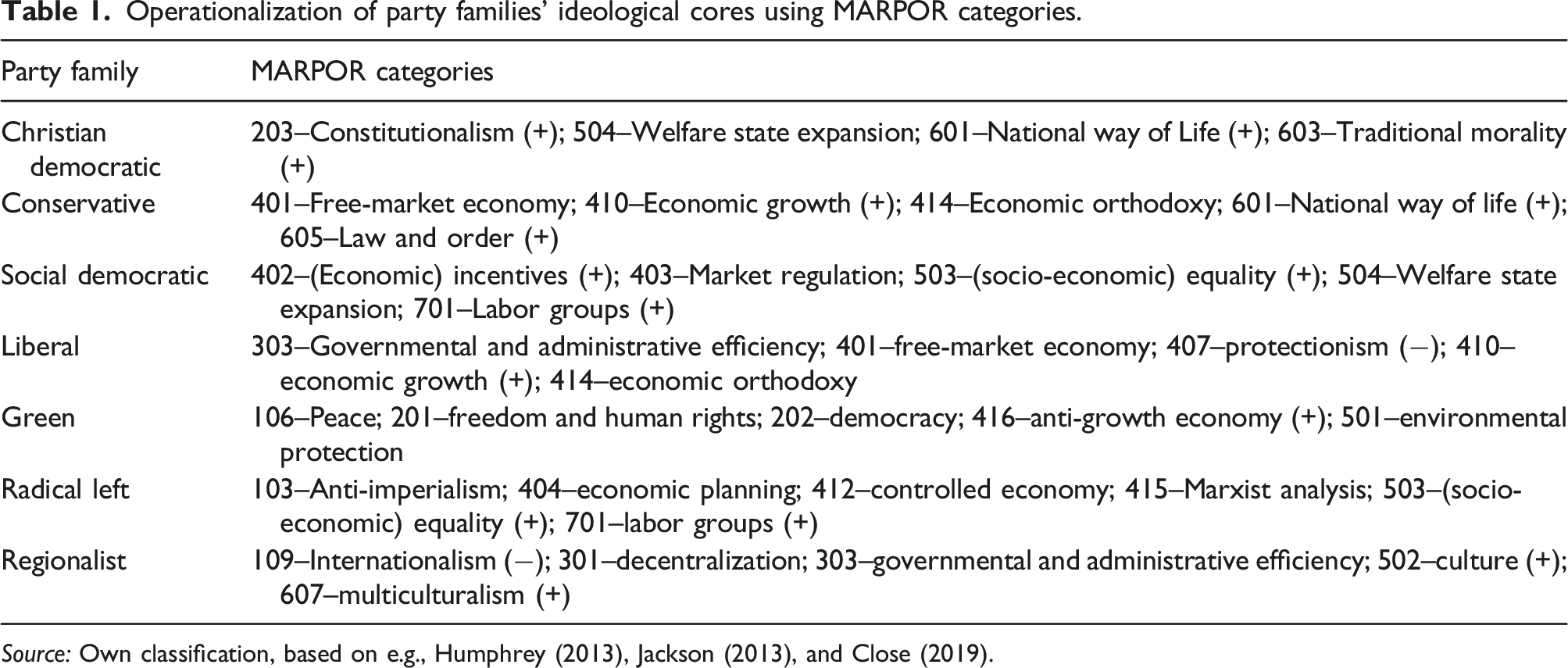
Source: Own classification, based on e.g., Humphrey (2013), Jackson (2013), and Close (2019).
In addition to the literature on party ideologies, we draw on the party families’ actual manifestos as a source for our operationalization of cores. Figure 1 displays the top-15 MARPOR categories in each families’ manifestos, relative to the respective most salient policy issue. We can see that our classification reflects the relative issue importance in party families’ manifestos. With the exception of “constitutionalism” in the case of the Christian Democrats, “peace” in the case of Greens, “economic planning” in the case of the Radical Left, and “multiculturalism,” all policy issues in Table 1 regularly appear in the respective party families’ manifestos (see Supplementary Figure A4–A6, appendix, for detailed country-based results). Saliences relative to the most frequent issue in families’ manifestos. Note. MARPOR categories: 105–Military (−); 107–Internationalism (+); 108–European Community/Union (+); 109–Internationalism (−); 110–European Community/Union (−); 201–Freedom and Human Rights; 202–Democracy; 301–Decentralization; 303–Governmental and Administrative Efficiency; 305–Political Authority; 401–Free Market Economy; 402–(Economic) Incentives (+); 403–Market Regulation; 406–Protectionism (+); 407–Protectionism (−); 411–Technology and Infrastructure (+); 412–Controlled Economy; 413–Nationalisation; 414–Economic Orthodoxy; 416–Anti-Growth Economy (+); 501–Environmental Protection; 502–Culture (+); 503–(Socio-economic) Equality (+); 504–Welfare State Expansion; 505–Welfare State Limitation; 506–Education Expansion; 601–National Way of Life (+); 603–Traditional Morality (+); 605–Law and Order (+); 606–Civic Mindedness (+); 607–Multiculturalism (+); 608–Multiculturalism (−); 701–Labour Groups (+); 703–Agriculture and Farmers (+).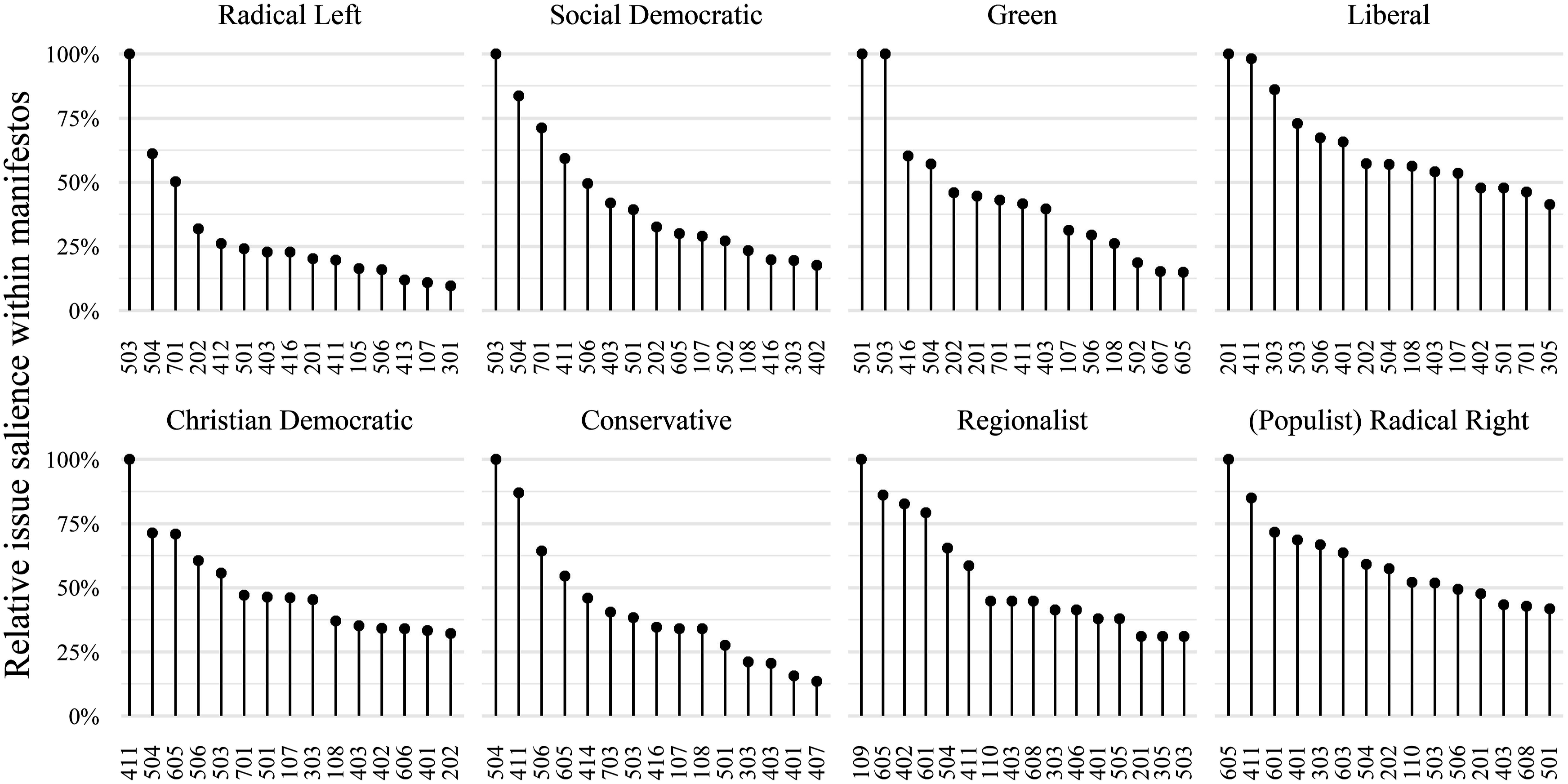
It is important to reiterate here, however, that no strict relationship exists between “core” (as opposed to ownership) and the frequency with which party families’ address these issues. Though parties may not “own” and therefore talk about an issue at length, the issue can nevertheless be inextricably linked to a families’ ideological roots. Indeed, we find that core policy statements only account for a quarter of parties’ election manifestos. Parties strategically weigh the costs and benefits of talking about their preferred issues versus responding to their opponents or the general public; this may in fact even lead to both strategies being pursued simultaneously at different intra-party levels (Ennser-Jedenastik et al., 2021).
Nativism in radical right and non-radical right parties
Nativism in party families’ manifestos
In the first step of our analysis, we investigate which non-RR party families generally use nativist language to construct their claims. Overall, we analyze 107,064 manifesto statements 5 and the non-RR party families in our three countries use nativism in 3–5% of them. While this is a rather conservative estimate, it demonstrates that statements sympathizing with nativist ideas are by no means rare.
Figure 2 shows the average share of nativist language for the party families in each country, pooled over time. As we would expect, nativist ideas are present but least prevalent in the manifestos of left-wing or radical-left parties. The number of statements is significantly higher for all other party families (between 300 and over 10,000) and, thus, results are more robust. Not surprisingly, the RR family—which we only include here as a reference—uses a clearly higher share of nativist statements than all other mainstream parties, averaging between 7 and 12% of their manifestos. However, Figure 2 also shows that the Swiss regionalist parties, Lega dei Ticinesi (LdT) and Mouvement Citoyens Genevois (MCG), have the highest shares of nativism in their manifestos. This is owed to their anti-immigrant stances, their focus on delineating their regional identity and advocating for protection whilst simultaneously and somewhat paradoxically, also taking a firm nationalist and Eurosceptic stance and advocating for national sovereignty (Mazzoleni and Ruzza, 2018). Although MCG has campaigned on a similarly rightwing platform and politicized the center-periphery cleavage as the LdT, it has not been as successful as its Ticino counterpart (Mazzoleni, 2016: 152). Thus, it is unsurprising that this form of regionalism in southern and western Switzerland shows strong affinities with nativist ideas, albeit, as our results suggest LdT scores higher (0.2) than MCG (0.1), which is thus roughly level with the SVP. However, the regionalists, when taken together, still rank significantly higher than all other parties in their party system. Nativism in non-radical right parties in Austria, Germany, and Switzerland. Note. Lines represent margins of error at 95%, N = 107,064.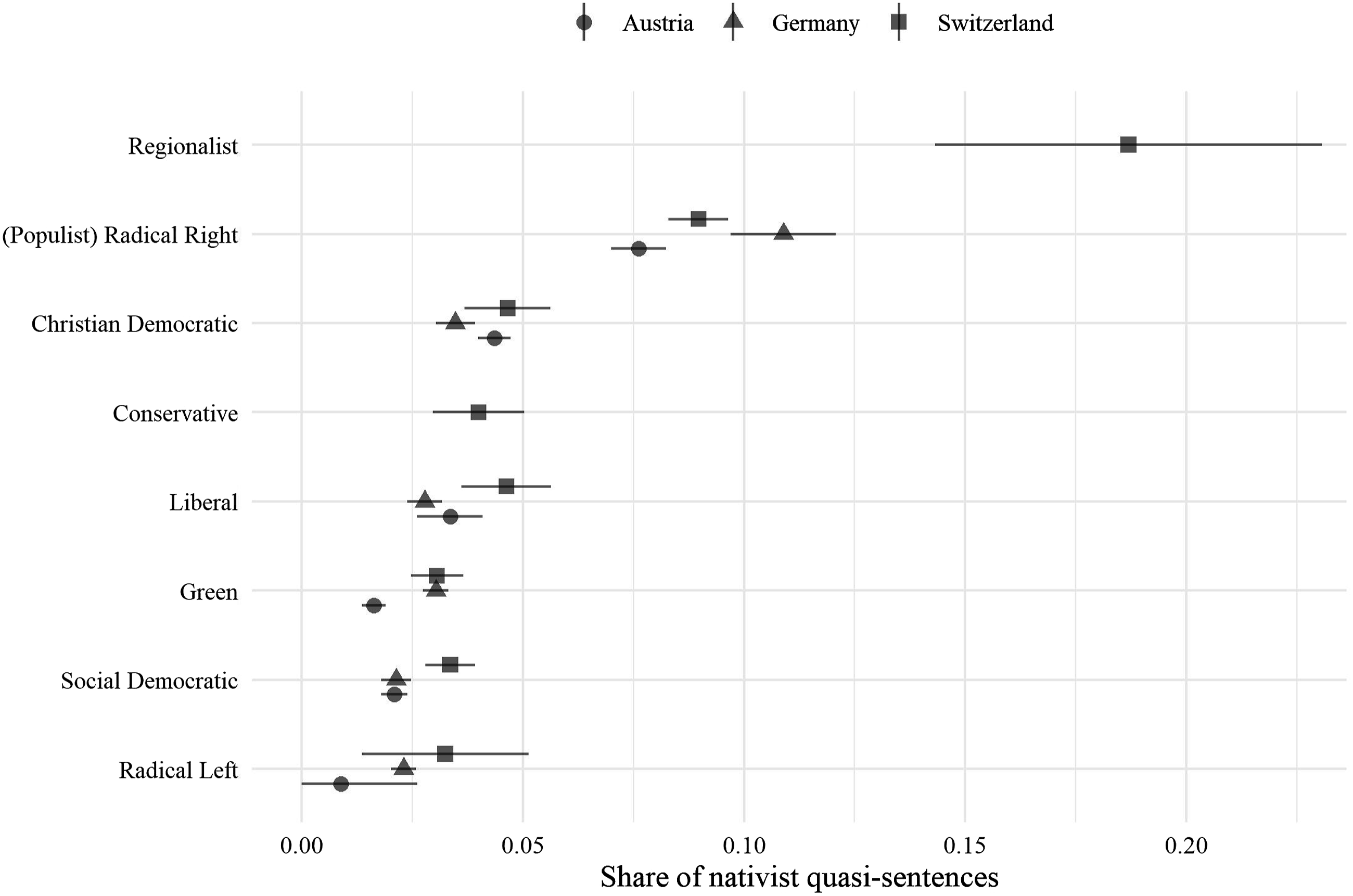
Incentives for non-radical right party strategies
To lay the basis for testing H1, that parties are more likely to adopt nativism into their ideological core if the RR connects its nativism to their core policy areas, we need to investigate which policies RR parties connect their nativism to and whether these overlap with the ideological cores of the non-RR parties. To this end, we analyzed the manifestos of the three countries’ RRs along the same lines as the non-RR manifestos. We first identify all nativist statements and measure the share of these statements connected to the non-RR ideological cores. Figure 3 shows whether and how much the RRs in our three countries use nativism in conjunction with policies that belong to the ideological core of these party families. It shows that RRs are most likely to connect their nativism to the policies at the Conservative and Christian Democratic core, who thus have the highest incentive to adopt nativism into their core (H1). While Regionalists seem to speak the language of the radical right (Figure 2), the RR does not appear to speak the particular dialect of regionalist nativism (Figure 3). Nativism has a special appeal for regionalists because of the centrality of the center-periphery cleavage to their ideology, yet, RR parties tend to associate nativism with their value conservatism and issues that are classically part of the common core of right-wing parties. This intersection exists predominantly between Conservatives, Christian Democrats and the RR, less so between regionalists and the RR. Radical right nativism in non-radical core policy areas.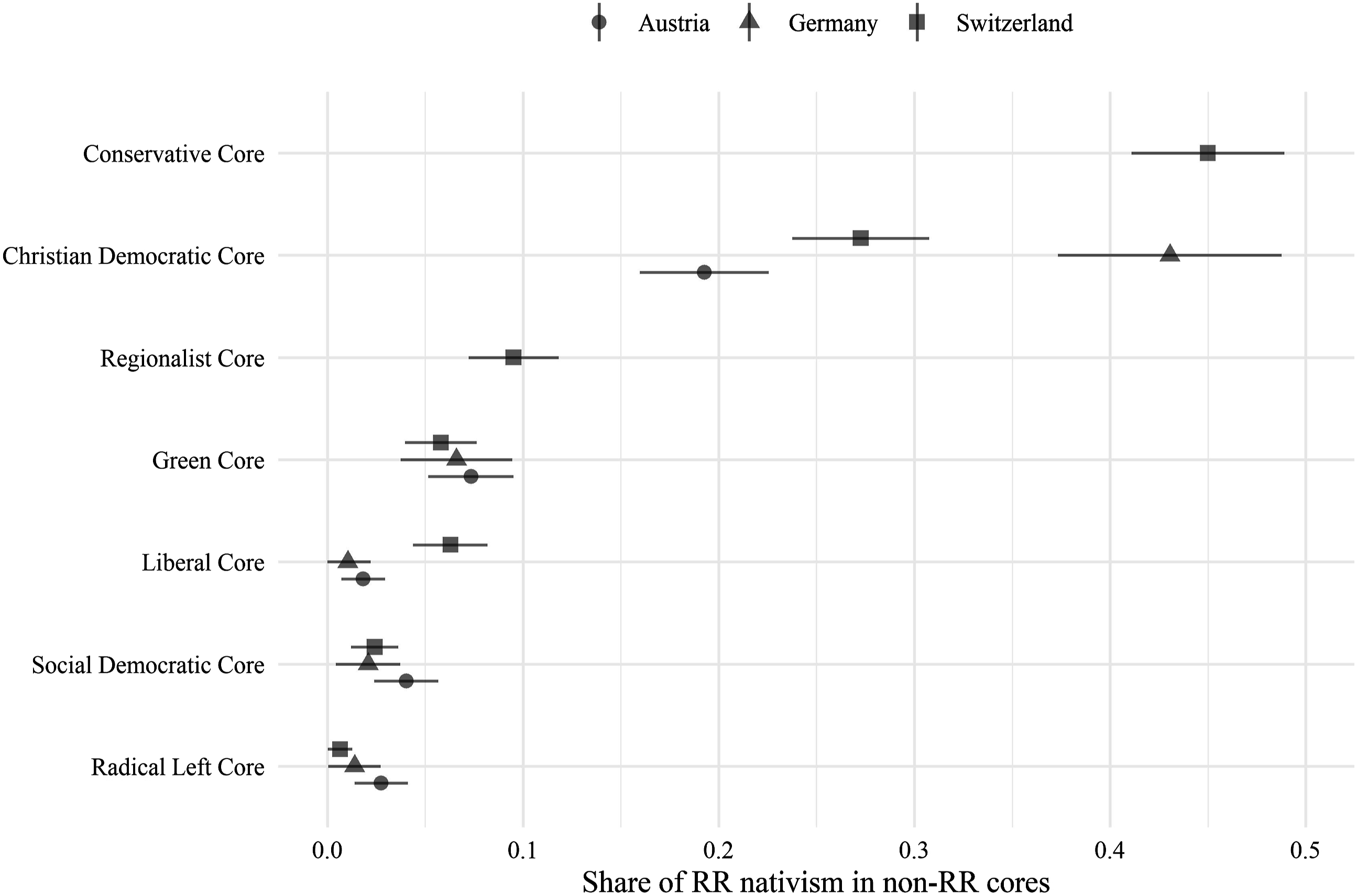
When considering the ideological cores of Liberal and left-wing party families, RRs are most likely to attribute their nativism to the Green core. However, the gap to Conservative and Christian Democrats cores is sizable while the variation among left and liberal cores in Figure 3 is small. Thus, we should see a sizable gap in adoption of nativism into the ideological core between these two groups.
Nativism and ideological cores
Next, we analyze which party families incorporate nativism into their ideological core policies, testing both H1 and H2. While the empirical patterns for these two hypotheses overlap, they do predict slightly different patterns. If H1 has explanatory power, and based on the analysis before, we would see high levels of nativism adoption into the ideological core by Conservatives and Christian Democrats and a sizable gap to all other party families. If our results follow H2, predicting that right-wing party families are more likely to adopt nativism into their core ideological policies than left-wing party families, we would expect adoption rates more on a continuum running from right to left.
For our investigation, we pool the manifestos of all parties in the same party family, analyze which MARPOR categories are attributed to the nativism statements and whether these policy categories are part of the individual party families’ ideological core as defined in Table 1. It is important to note that the reference for this analysis are quasi-sentences that contain nativist ideas, not the whole manifesto. Furthermore, it is crucial that we are not measuring how nativist the ideological core is. Instead, our measure determines how much of the nativism is attributed to the ideological core versus the rest of the manifesto. Thus, a value of 100% does not mean that the whole ideological core is nativist, it means that all nativist statements in the manifesto appear with policy statements at the ideological core.
Nativism in and out of ideological cores of non-radical right parties.
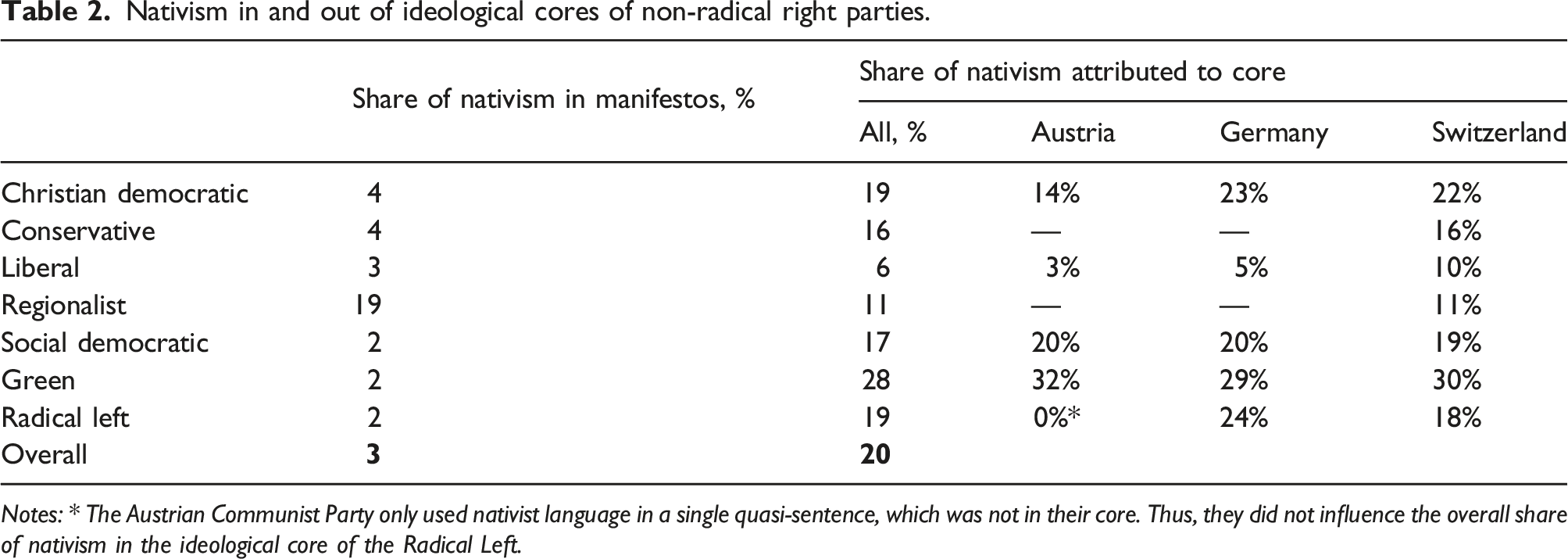
Notes: * The Austrian Communist Party only used nativist language in a single quasi-sentence, which was not in their core. Thus, they did not influence the overall share of nativism in the ideological core of the Radical Left.
When we compare the patterns in Table 2 between Conservative and Christian-Democrats and all other party families as well as between right- and left-wing party families, we find little evidence for H1 or H2. While right-wing parties tend to have a higher share of nativism in their manifestos overall, they seemingly do not attribute this nativism more often to their core ideological policy areas than left-wing party families. Across the three countries, Christian Democrats, Conservatives, Social Democrats, and the Radical Left all attribute between 16% and 19% of their nativist statements to policies in their respective ideological cores. Thus, Table 2 would lead us to reject our hypotheses.
One particular outlier runs particularly counter to H2: consistently in all three countries, Greens attribute about 30% of their nativist statements to their ideological core. To be clear, Greens are at the opposite end to the RR on the cultural dimension; they are generally the least nativist, support European integration and multiculturalism. Barely two percent of their manifestos contain nativist language. However, the few nativist statements they make are attributed over-proportionally to their ideological core. In the case of Austrian green parties (Greens, PILZ), for instance, this manifests itself in a “light version” of nativism as expressed in “Our native environment is threatened” (Green party manifesto, 2019), or “Pushing back the influence of political Islam (…)” (Green party manifesto, 2017). Other phrases and slogans include “For our homeland, Austria” and “Defending our homeland” (Pilz, 2017). Additional validation of Green parties adapting nativist ideas can be found in local campaigns of the Austrian Greens, with slogans such as “Protecting our homeland” (DiePresse, 2018) and controversies about an anti-migration strategy paper entitled “Austria first” (DiePresse, 2017). Our findings thus corroborate observations by which green parties have occasionally become less rebellious and more pragmatic (particularly towards right-wing coalition partners) over the course of their existence and mainstreaming (Van Haute, 2016).
Returning to Table 2, it is important to bear in mind that these figures do not take into consideration the size of party families’ ideological cores. Comparing the number of policies that fall into the ideological core of each party family (see Table 1) but also taking into consideration that generally some parties focus on a smaller number of policies than others, the space the ideological core takes up in manifestos should vary. Indeed, Table A3 (appendix) shows that the share of manifestos attributed to the ideological core ranges from 9 to 40%. This is important because when the ideological core takes up more space in the manifesto, it is more likely that any nativism statement can be attributed to one of these core policies. Thus, we need to reevaluate the share of nativism in parties’ ideological cores, considering the core sizes of the manifestos. To weigh the share of nativist language within the core of parties’ election manifestos, we apply the following formula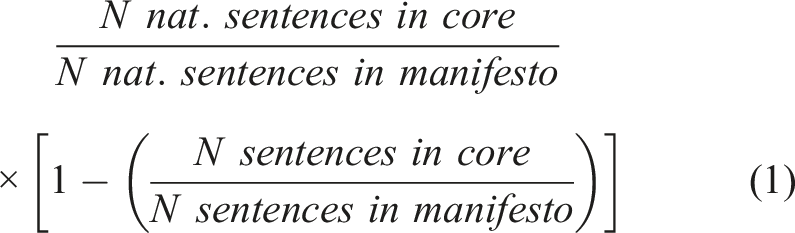
Figure 4 shows the nativism in ideological cores in this context: the x-axis denotes the overall average share of nativism in party manifestos and the y-axis shows the share of these nativism statements in the party families’ ideological cores weighted by the core size. While the values on the y-axis are somewhat difficult to interpret directly, we know that higher values mean more nativism are in the ideological core, once we account for its size. Distribution of sentences related to nativism by party family.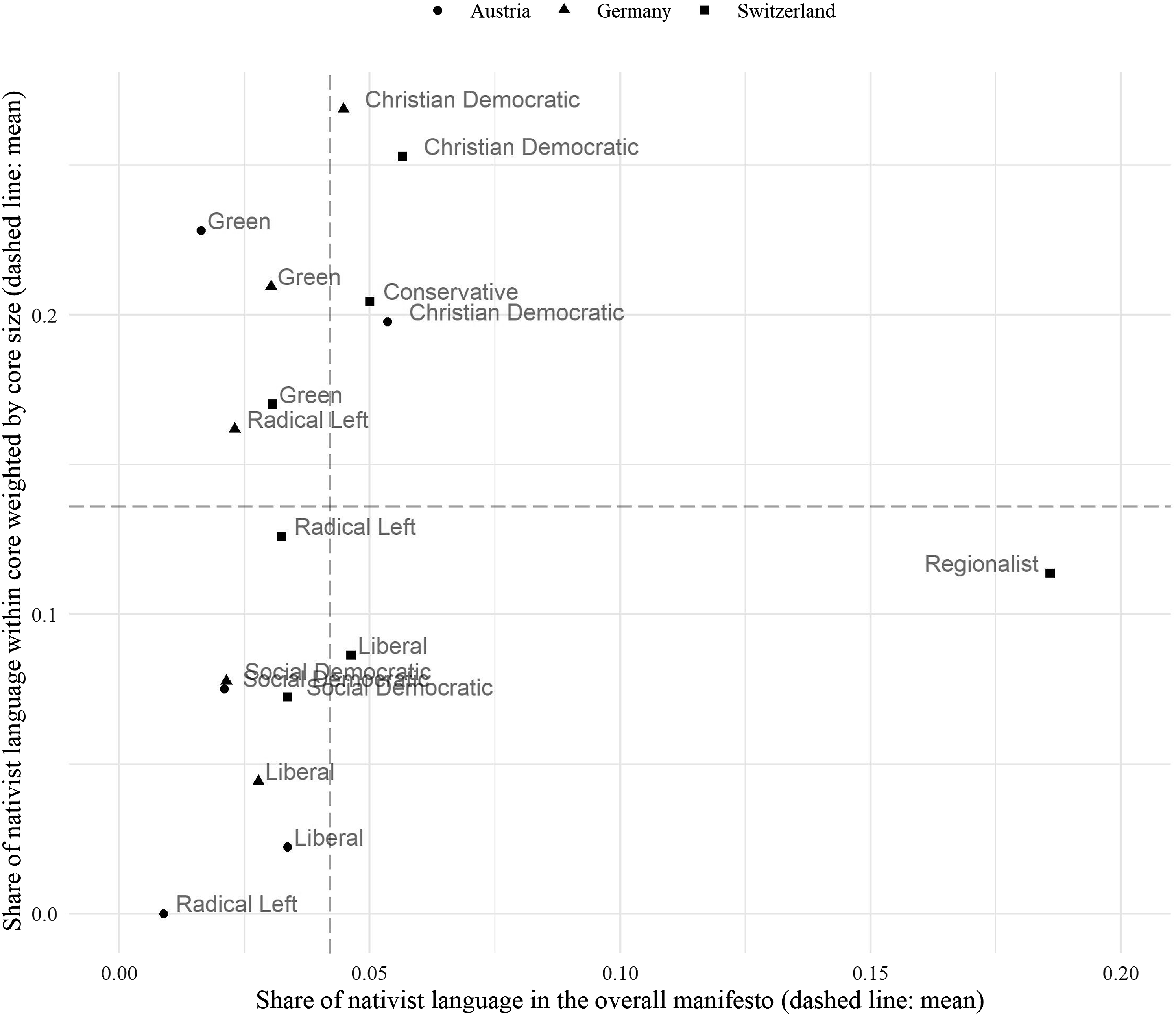
Returning to H1, that there are differences between party families who see RR parties attributing their nativism to the party family’s core, Figure 4 changes the picture of Table 2 and partially confirms our argument. Having taken care of the ideological core size, the Christian Democrats and Conservatives indeed now attribute the highest share of nativism to their core. Figure 4 also confirms that the Regionalists are outliers in terms of their much higher share of statements expressing nativist ideas. In terms of the attribution of these statements to their ideological core, they are close to the average of all families, that is, in between center-right and left-wing parties. Social Democrats and Liberals are located at the lower end of the scale. This largely confirms H1. However, especially the Austrian and German Greens along with the Radical Left, range at a rather high level. Thus, even when taking care of the size of parties’ ideological cores, the evidence for H1 is somewhat mixed. While those party families most challenged by the RR—because the latter attributes its nativism to the former’s ideological core—indeed attribute more of their nativism to their own core as well, the differences between the non-RR party families are not sizable. The data available, unfortunately, does not allow a more sophisticated analysis that could determine the significance of these differences.
Conclusion
The starting point for this analysis has been the observation that non-radical right parties have over time increasingly faced the challenge of nativist parties gaining momentum, which compelled them to engage with demand for policies that promise to restore national sovereignty and prioritize the “native” population. Yet, aside from tendencies toward tougher migration stances among center-right but also occasionally social-democratic parties, we know remarkably little about how non-radical right parties accommodate nativist ideas. The party literature has therefore not only been limited in scope, in terms of case, issue, and party selection, but also in its conceptualization and modelling of party competition around policy positions.
This analysis takes a step toward overcoming these limitations. It applies a novel theoretical framework that rests on the assumption that non-radical right parties can strategically engage in competition with RRs and signal responsiveness to their voters. Among the strategic choices, we focus on the level of commitment to nativist ideas that non-radical right parties can signal by attaching nativism to policies at their ideological core or to other, less central policies. First, we hypothesize that non-radical right parties should commit to nativism when RRs place them into the policies of their own ideological core, as this represents a direct competition for their voters. Taking this one step further, we argue that right-wing non-radical right parties are more likely to adopt nativism into their ideological cores than left-wing party families. In this framework, we do not test whether non-RR parties react strategically to the electoral success of the RR in their midst, which would require a longitudinal and, thus, much larger study. Instead, we investigate the general pattern of non-RR parties adopting nativism in a way that signals commitment or not, and assume that non-RR parties react to the general challenge posed by the existence of the RR party in their system and by the RR party program at the same time.
To test this framework, we analyze Austrian, German, and Swiss election manifestos from the last two decades of all political parties and develop a dictionary allowing us to tap into nativist ideas. Our quantitative text analysis shows that right-wing parties are not more or less likely to attribute nativist ideas into their ideological core policies than left-wing parties—the relative commitment of party families to these ideas much rather coincides with the centrality of the cultural dimension to their ideology and voter mobilization. This extends the scope of previous party research, as we not only demonstrate that right-wing parties are more likely to be nativist but our findings also indicate that there are complex incentives in parties’ adaption to nativism.
We also test whether strategic considerations play a role in how much non-radical right parties attribute nativism to their core ideological policies, by investigating the impact of RRs’ use of nativism. We find some evidence for this logic. Conservative and Christian Democratic parties see their cores threatened by RRs and react by adopting nativism to their core. Thus, we find some indication that it is not necessarily the “receptive” core but the strategic challenge to the core that might drive the decision of committed or non-committed adoption of nativism.
Thus, our results confirm previous research that has found that RRs trigger other parties to adopt similar composite positions, for example, on immigration, yet they also show that these can include a multitude of specific policies more or less crucial for the non-radical right parties. While we do not doubt the validity of previous studies on the level of policy composites, our results caution against over-interpretation as these general adoptions can hide important differences. Other recent research points into a similar direction, showing that the distinction between “hard” and “soft” Euroscepticism (Heinisch et al., 2020a) and the relationship between populism and “more democracy” (Zaslove et al., 2021) are highly complex and cover up important strategic choices. Relatedly, Koedam (2022) finds that the centrality of the economic or cultural dimension of political contestation to a party determines its strategic balancing of adaption to new issues and the need for ideological continuity. Our results speak to this growing literature as they suggest that (a) there are differences in how policy claims are adopted, for instance, between conservative, green, or regionalist logics, and (b) we see that even when non-RR parties adopt nativism in identifiable ways, this does not automatically show deep commitment to nativist ideas.
Supplemental Material
Supplemental Material - How non-radical right parties strategically use nativist language: Evidence from an automated content analysis of Austrian, German, and Swiss election manifestos
Supplemental Material for How non-radical right parties strategically use nativist language: Evidence from an automated content analysis of Austrian, German, and Swiss election manifestos by Fabian Habersack and Annika Werner in Party Politics
Footnotes
Declaration of conflicting interests
The author(s) declared no potential conflicts of interest with respect to the research, authorship, and/or publication of this article.
Funding
The author(s) received no financial support for the research, authorship, and/or publication of this article.

Supplemental Material
Supplemental material for this article is available online.
Notes
Author Biographies
References
Supplementary Material
Please find the following supplemental material available below.
For Open Access articles published under a Creative Commons License, all supplemental material carries the same license as the article it is associated with.
For non-Open Access articles published, all supplemental material carries a non-exclusive license, and permission requests for re-use of supplemental material or any part of supplemental material shall be sent directly to the copyright owner as specified in the copyright notice associated with the article.
