



Abstract
Transnational regional networks of regulatory bodies play a prominent role in complex systems of human rights governance. Despite their growing importance, we still have much to learn about the roles regional networks play as regulatory stewards in the field of human rights. I draw on the literature about regulatory stewardship to analyse a recently formalised regulatory network operating in Europe – the European Network of National Human Rights Institutions. The analysis proposes a model of global governance for human rights that includes networks of national human rights institutions as intermediaries. Moreover, it draws on some of the main concepts of network analysis to assesses the European network’s development into a ‘network administrative organisation’ and applies the model of regulatory stewardship to analyse the institutional network’s use of hierarchical and managerial stewardship to: support its member institutions; stimulate intra-network communication and learning; gain access to international networks; and to shape the regional human rights agenda.
Keywords
Regulatory networks are increasingly important actors in global and regional arenas. Organised in communities centred on shared technical interests and common areas of practice, networks can play a role at all stages of policy innovation, especially within specialised sectors such as finance, environment, or human rights. 1 They can offer innovative solutions and causal explanations for policy choices and support governments to identify their preferences and interests. Networks can be a valuable source of information and mediation between international and regional regulators, such as the United Nations (UN) and the European Union (EU) and national governments as targets of international policy and often are successful in influencing the form and content of national and regional policy outcomes.
The realm of human rights promotion and protection is no exception. In recent decades, the human rights regime has transformed to accommodate a dense network of state and non-state actors that operate through increasingly complex relationships at the bilateral, multilateral, regional, and trans-governmental level. Existing scholarship has provided ample evidence about the important role that regulatory networks have played in the diffusion of human rights norms across borders, shaping these norms and supporting the efforts to monitor their implementation. 2 Transnational networks, such as the Global Alliance of National Human Rights Institutions (GANHRI) and its regional counterparts offer good examples, as they are network-based regulatory structures made up of national regulatory bodies mandated to promote and protect human rights – national human rights institutions (NHRIs) – that have been key to the continued development of their institutional members. NHRIs and their peer networks function as intermediaries in a global order in which, generally, international and regional (in Europe) organisations are the main international regulators of international human rights law and national governments are primary targets showing different degrees of compliance international law.
In recent decades, NHRIs have become increasingly important institutional actors in Europe. Described as ‘domestic non-judicial institution[s] for the implementation of human rights law’, 3 NHRIs are regulatory intermediaries 4 that serve to embed international norms in local structures. 5 As the primary independent domestic bodies charged with the implementation of international human rights treaties ratified by governments, 6 human rights ombudsmen and human rights commissions play the dual role of promoting and protecting rights at the national level. NHRIs are key to countries’ efforts to address adequately a range of rights-related issues like the protection and promotion of fundamental rights, social and political rights.
In recent years, NHRIs in Europe have organised to formalise the development of a consolidated regional network of peer bodies, the European Network of National Human Rights Institutions (ENNHRI). Founded in 1994, the European Group of NHRIs met irregularly until 2002 under the auspices of the Council of Europe (CoE) and relied on its administrative and financial support to continue its informal activity. The network consolidated its powers and formalised its centralised administration in an international context in which resistance to human rights has been on the rise and funding cuts to human rights institutions are commonplace. What explains the recent rapid development of ENNHRI as a regional regulatory network of human rights institutions in a global context that is increasingly less favourable to human rights?
To address this question, I turn to the recent International Relations scholarship on regulatory stewardship. Defined as ‘the assignment of mutual-monitoring and support responsibilities among intermediaries themselves, with the goal of safeguarding against capture and enhancing performance’, 7 stewardship occurs in regulatory systems with multiple intermediaries 8 and explains the performance of intermediaries and their influence on regulatory interactions. Compliance scholarship identifies two categories of explanations for the behaviour of stewards. First, managerial explanations propose non-coercive strategies to support targets that genuinely want to comply but find that they cannot. 9 Second, instrumental accounts address compliance problems occurring in regulatory contexts with strong distributive and value conflicts, principally resistance by the target to the implementation. 10 In the realm of human rights, the ‘compliance gap’ between international law and national performance is a case in point. In this context, NHRIs represent a remarkable innovation in the sphere of human rights monitoring – as regulatory stewards, they act as intermediaries that help close the gap between human rights ambitions (through treaty ratification, for instance) and uneven practices on the ground. 11 They are intended as bodies that can both monitor state compliance and offer national governments support with human rights law enforcement.
This article argues that ENNHRI’s recent formalization as regional intermediary is the outcome of the network’s overall successful use of two main mechanisms of intermediary stewardship – managerial and hierarchical. Since the beginning of its activity, the regional network has facilitated managerial stewardship by promoting information sharing, knowledge exchange, and learning across member institutions. With the formation of ENNHRI’s Secretariat began also efforts to streamline communication and coordinate learning through the formation of working groups and by offering specialised assistance with the accreditation process when member NHRIs seek to become members of GANHRI. In addition, I argue that throughout its two decades of existence, ENNHRI has engaged in two main types of hierarchical stewardship. At the start, the network created avenues for hierarchical stewardship for a handful of active NHRIs who wanted to meet once a year under the umbrella of the CoE and often represent their own interests. These very NHRIs laid the foundation for the formation of the ENNHRI Secretariat, securing financial resources for it and defining a strategy for development. A second form of hierarchical stewardship was made possible by ENNHRI’s formalization and increased powers. While it began to consolidate its position as a network administrative organisation, ENNHRI created new avenues to exert influence both inside and outside the network. The Secretariat represents the network’s interests at the EU and the UN, seeking to carve out a line of activity and of influence that represents a regional NHRI agenda. Inside the network, ENNHRI has demonstrated the ability to influence policy-making by intervening in cases when the independence of national NHRIs were under threat, as was the case of the Polish Ombudsman in 2017, as well as parliamentary and public debates in states considering the establishment of a new NHRI, such as Italy. ENNHRI’s assistance to NHRIs is complementary to the work of older existing networks, such as the International Ombudsman Institute (IOI) that has a long-standing tradition of organising and assisting ombudsmen around the world.
To map ENNHRI’s development, I analyse factors explaining its still ongoing transition from a ‘participant governance’ model to ‘a lead organisation’ and, more recently, to a ‘network administrative organisation’. 12 Drawing from the scholarship on regulatory stewardship for human rights, I analyse two logics of intermediary action explaining the consolidation of a regional human rights network – ENNHRI, – focussing on the main determinants of ENNHRI’s consolidation, namely, the enabling quality of formal rule frameworks, and the practical policy approaches that ENNHRI has pursued in practice, and its capacity to manage targets’ resistance. The analysis is based on qualitative evidence collected through the analysis of institutional documents and over 40 expert interviews with current staff at the network’s secretariat in Brussels, former leaders of the regional network, and with staff members at NHRI in eight European countries, during November 2016-June 2018. The interview data have allowed us to examine a number of factors that the literature identifies as central to regulatory stewardship in systems of human rights governance.
In a global environment where support for human rights is declining and often resulting in a decreased willingness of states to offer support to human rights internationally, the successful consolidation of the network can appear surprising. ENNHRI’s success can be an indication that NHRIs are actively pursuing a more prominent regional role as a form of additional insurance policy in a context in which other human rights international organisations traditionally advancing human rights are facing less support from some of its members and might eventually weaken and lessen their capacity to continue supporting NHRI activity (this might be the case of the CoE). At the same time, the consolidation of ENNHRI was made possible by financial support offered by the EU and administered by the OHCHR, indicating an effort by international organisations to counter-act the decline in support for human rights in certain countries around the world.
In what follows, I will discuss the role of networks as regulatory intermediaries for human rights governance. The study then turns to the implications that orchestration has had for the European network of human rights institutions, focussing on two general logics of action for human rights intermediation: managerial and hierarchical stewardship. The article concludes by discussing what the analysis means for regional and global human rights governance more generally.
Networks as regulatory intermediaries
Most academic research to date has focussed on the diffusion of human rights ombudsmen and commissions, 13 providing explanations for states’ decisions to establish NHRIs. In addition, several institutional reports and academic articles explore the effectiveness with which NHRIs carry out their mandates and improve human rights records, 14 offering evidence in favour of the role that NHRIs play for improving human rights outcomes. Recent scholarship has enhanced our understanding of why states decide to grant NHRI certain mandated powers, 15 offering evidence that the Paris Principles, a global normative standard endorsed by the UN, 16 and the global and regional networks created to enforce this standard, have had a significant impact on countries’ decisions to establish NHRIs and offer them continued support.
Networks have played key roles for the creation and development of NHRIs. 17 Acting as a go-between the international regulator, the UN Office of the High Commissioner for Human Rights (OHCHR), and the national governments, 18 GANHRI offers a global multi-level model of network governance based on information exchange, support to member institutions, and monitoring of countries’ human rights performance. At the regional level, four institutional networks are some of the most influential intermediaries connecting global and regional regulators of human rights with national governments around the world – ENNHRI, the Asia Pacific Forum of National Human Rights Institutions (APF), the Network of National Institutions for the Promotion and Protection of Human Rights in the Americas and the Network of African National Human Rights Institutions. Of the three networks, the APF is the first to have consolidated itself as a formal regional network and, as a powerful entity in the regional human rights governance, was an early model in the consolidation of ENNHRI. These networks have facilitated knowledge exchange and coordination amongst national bodies on particular human rights issues, 19 encouraged and supported with the development of new national bodies, 20 assisted with the process of NHRI accreditation 21 and effectively developed outlets for participating in UN activities. 22 While existing research has provided ample evidence about the significance of regulatory intermediation for human rights at the national and global levels, 23 we have a limited understanding of the ways in which regional networks of human rights act as intermediary actors.
Typically conceptualised as a two-party relationship between an international regulator, who is a rule-maker with authority and capability to regulate, and a local target, whose behaviour makes them the rule-taker, 24 regulation models have expanded to allow for the inclusion of third-parties. In the realm of human rights, targets are national governments and regulators are international organisations such as the specialised UN agencies and regional bodies such as the CoE, the EU and the OECD. The existence of a regional form of government at the European level – the European Union – adds another target to the regional governance of human rights, in addition to national governments. In this context, NHRIs and NHRIs with a sub-national mandate (for instance, the Scottish Human Rights Commission) are intermediaries. NHRIs have created additional intermediaries that operate regionally and globally and that take the form of institutional networks – the International Ombudsman Institute and the regional networks of NHRIs (Figures 1 and 2).
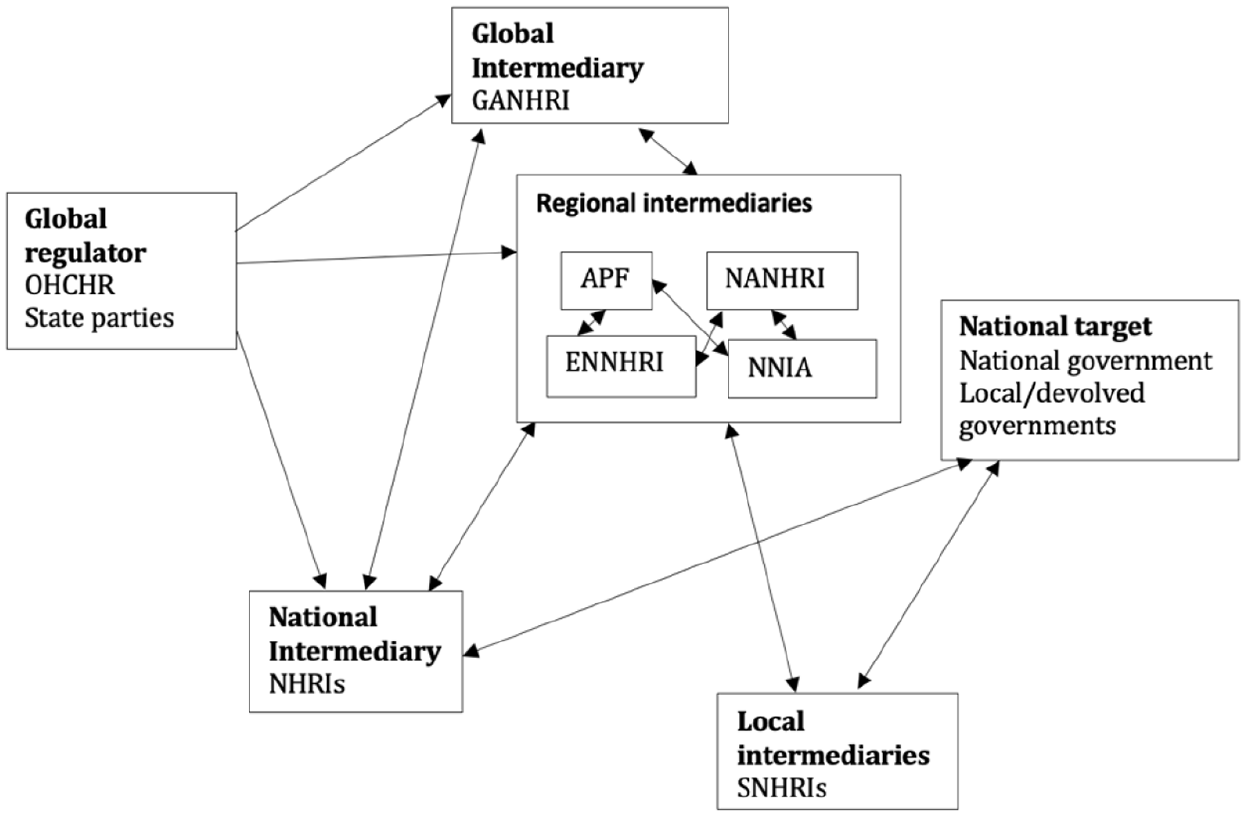
Global stewardship for human rights including regional NHRI networks.
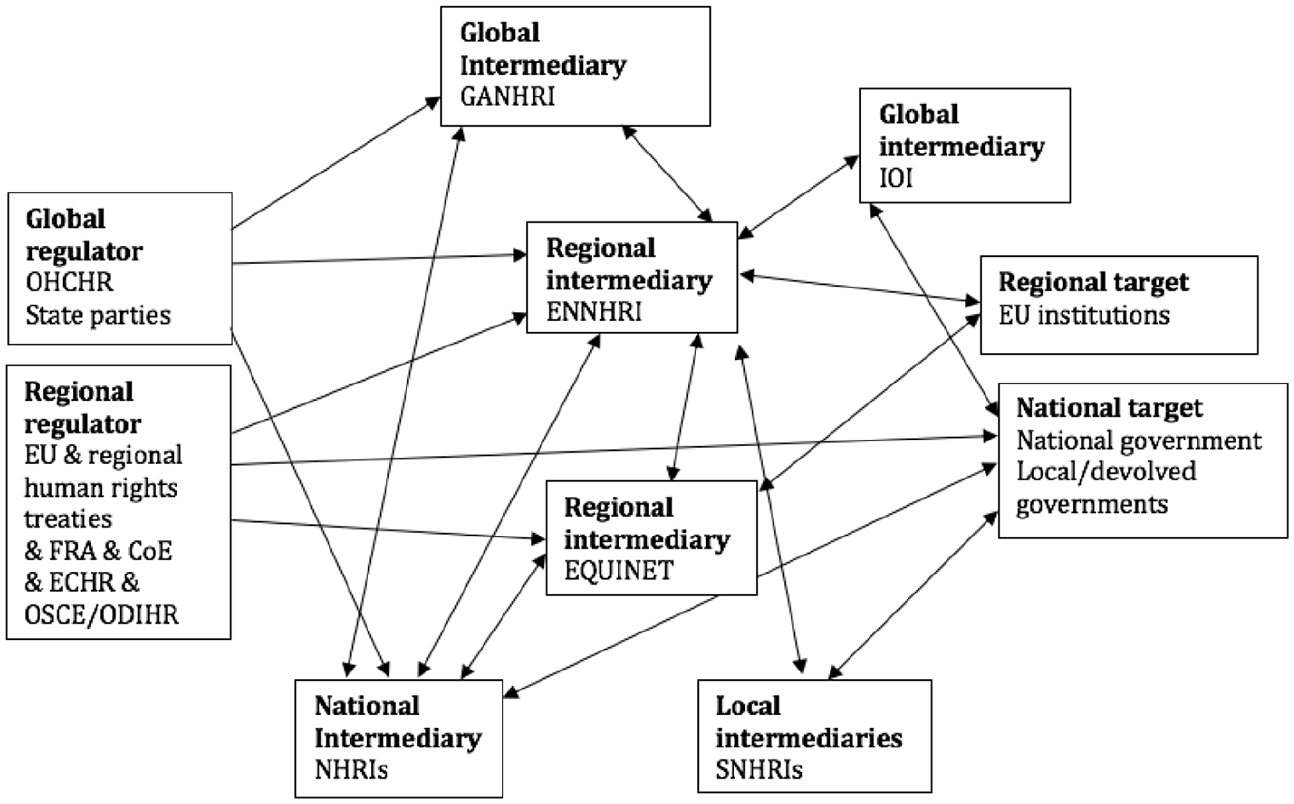
Stewardship for human rights governance in Europe: the main actors.
In the context of European human rights governance, NHRIs and their networks are regulatory stewards. Regulatory systems with more than one intermediary, particularly where the risk of capture control is higher, rely on the existence of regulatory stewards. Stewardship facilitates the complex web of relationships intermediaries forge with each other as well as with regulators and targets. An increasingly viable mode of global governance, regulatory stewardship offers formal and informal systems of mutual-monitoring and support amongst intermediaries, with the goal of enhancing performance and safeguarding against capture. 25 Stewards are key actors in complex regulatory settings where targets are more strongly motivated to resist the implementation of policy directives. 26
Networks can play important intermediary stewardship roles. They can provide action frameworks that facilitate the implementation of targets’ goals and facilitate policy convergence and institutional similarities amongst their members. 27 Arguably their most significant feat is their capacity to provide collaborative intermediation. Although some members can take on leadership roles, networks have a broadly fluid and flexible structure that does not rely on fixed structures or hierarchical reporting. Their largely non-hierarchical nature facilitates the exchange of information and the provision of mutual support to respond better to rules provided by policy-makers.
Nonetheless, networks can face a number of challenges. As they lack an organisation based on international treaties or similar agreements, networks rely on volunteer member contributions and generally have weak governance structures. 28 They need to overcome free-rider problems and to maintain repeated contact amongst members and high levels of trust inside the network. 29 In environments where they are faced with relative resistance, as is sometimes the case in the realm of human rights, networks face the risk of capture. 30
Networks of human rights institutions as regulatory stewards
Networks are key actors in the global structure of human rights governance. As recent scholarship has shown, the OHCHR in general and the UN Country Teams are orchestrators that have strived to exercise a margin of independent action beyond the limits of state agreement. 31 Over the years, the OHCHR has encountered great challenges due to the lack of sufficient material resources, 32 resistance to its recommendations for action and compliance by some member states as well as attempts at micromanagement by its political body, the Human Rights Council. 33 These two global orchestrators have enlisted the help of a number of intermediaries in their efforts to maintain their influence in domestic performance and ultimately increase countries’ compliance with international human rights law. They work indirectly through intermediaries, like non-governmental organisations (NGOs), like Amnesty International, 34 and through NHRIs and their networks. 35
Networks of NHRIs represent a notable innovative effort at intermediary stewardship in the field of human rights. A more formal way of enlisting intermediaries than working with IGOs, the relationship between the OHCHR and NHRIs has developed on the basis of both material and ideational channels of influence in a network structure. In direct consultation with NHRIs at a workshop organised by the UN Centre for Human Rights in 1991, the UN developed the Paris Principles, a set of normative standards for the design of NHRIs. This non-binding agreement has had a direct impact on the rapid adoption of NHRIs globally as well as the promotion of more independent designs of NHRIs. 36 NHRIs can seek accreditation with GANHRI on the basis of a voluntary application process and demonstrated compliance with the Paris Principles. They can become members of GANHRI with three possible grades. A-status is a formal acknowledgement of full compliance with the Paris Principles and grants NHRIs decision-making powers within GANHRI, a stronger voice at OHCHR, and participation rights before various UN bodies, including the Human Rights Council. When states that seek accreditation are found to be only partly in compliance with the Paris Principles, their NHRIs are given B-status and observer status with GANHRI. C-status used to be granted to institutions that are not in compliance with the Paris Principles. As of 2018, C-status no longer exists. A-status accreditation grants NHRIs the right to full membership in one of the four existing regional networks, depending on their geographic location.
Networking has played an important role in the evolution of NHRIs 37 and has offered institutions in their regions incentives to conform with best practices. 38 They have made possible information exchange and coordination amongst national bodies on particular human rights domains, 39 offered national NHRIs support with the process of NHRI accreditation, 40 supported with the development of new national bodies 41 and effectively developed outlets for participating in UN activities. 42
Regional networks of NHRIs have provided a formal regional structure of intermediation in the global architecture of human rights governance. All four networks hold increased social power by virtue of having direct access to otherwise weakly connected institutional human rights actors, such as sub-national human rights institutions and NHRIs that do not have accreditation or are not in compliance with the Paris Principles. For instance, the Czech Ombudsman has recently been granted observer status with ENNHRI, despite not having accreditation status. With a couple of notable exceptions (the U.K.-based human rights commissions), human rights institutions with local and sub-national mandates are often not included in GANHRI and cannot apply for accreditation. However, they can seek membership in regional networks, even if granted limited rights, and can benefit from information-sharing and cooperation inside the network. Similarly, countries with institutions that are partly or not compliant with the Paris Principles can become active members of regional networks and part-take in capacity-building activities, working towards A-status in the accreditation process.
In the global architecture of human rights governance, regional networks can be one of the most powerful governance actors. 43 They have a high level of network centrality, 44 understood as a measure of the large number of ties with global, regional, national and local actors. Relationships in a network can be directional, when one actor is the main initiator of the relationship and another actor is the receiver. In the global and regional networks in this study (Figures 1 and 2), the relationships between global regulators and other actors in the network (intermediaries and targets) are directional. At the same time, intermediaries engage in nondirectional relationships with other intermediaries and with national targets (i.e. governments). Unlike their global counterparts, regional regulators in Europe engage in nondirectional relationships with intermediaries and targets (Figure 2), access to most other actors in the governance architecture of human rights, regional networks possess social power and thus easier access to resources and information. The only missing direct tie is between regional networks and the national targets, as the influence of regional networks on national governments is indirect and mediated by NHRIs as national intermediaries. The alignment of standards for membership in both the regional networks and GANHRI, based on the accreditation process and compliance with the Paris Principles, reinforces the powers and effectiveness of the networks. All else being equal, such reinforcement can lead to higher likelihood of convergence with international standards amongst network members, increased international cooperation 45 and, as intermediaries, a lower risk of capture. 46
In the two global and regional models of human rights governance (Figures 1 and 2), several bodies act as human rights regulators operating both globally and regionally – the Office of the High Commissioner for Human Rights as well as the state parties to human rights treaties are global regulators. Regionally, Europe has several institutions that constitute regulatory bodies – the EU, the body of regional human rights treaties as well as specialised organisations like the Fundamental Rights Agency (FRA), the CoE, the European Court of Human Rights, the Organisation for Security and Cooperation in Europe (OSCE) through its Office for Democratic Institutions and Human Rights. Generally, national governments are the main targets of international human rights regulators aiming for compliance with international law. But at the regional level, Europe has an additional trans-national regulatory target, the EU. As an intermediary, the ENNHRI Secretariat does not work directly with national governments. However, national governments remain the ultimate target of regulatory work in the realm of global governance and also of the efforts of ENNHRI as a network made up of individual NHRIs that seek to work with national governments to improve compliance domestically. In addition, a host of intermediaries aim to monitor and facilitate the relationship between regulators and targets and, ultimately, increase the likelihood of compliance (Figure 2).
The relative network centrality of ENNHRI, when compared to the other three regional networks, is arguably higher (Figures 1 and 2), due to the comparatively higher number of links ENNHRI has with other actors in the global governance of human rights, because it operates in a more complex regional architecture of human rights governance, consisting of national and global regulators as well as an additional set of regional regulators and targets linked to the EU, the CoE, the OSCE and regional human rights treaties. This context favours more numerous and, in some cases, also stronger ties to other agencies in the region. At the same time, the longstanding tradition of institutionalised human rights protection in Europe makes for a potentially competitive environment in which ENNHRI has to carve out a new place for itself and gain credibility as an independent actor with a strong regional agenda. Nevertheless, the regional actors involved in human rights promotion and protection, such as the OESC, the EU, the CoE and the FRA have offered European NHRIs assistance and support over the years. ENNHRI’s recent successful development seems to indicate that its position in the formal governance of human rights in Europe is a clear sign of network consolidation. Despite the economic recession and a relative weakening of national support for rights systems, which interview partners have described as a ‘shrinking space for human rights’, ENNHRI has grown significantly in both capacity and membership since its inception as a formal regional network with a legal basis in 2013.
The formation and consolidation of ENNHRI – a brief historical overview
In the early days, the European network relied on participant governance, involving the participation of members without any specialised governance structure. 47 The CoE, in particular the Commissioner for Human Rights, was instrumental in offering support to existing NHRIs and facilitated the administration of the regular meetings of network members until 2002, when the members approved the Group’s Rules of Procedures and agreed to meet annually on the margins of the International Coordinating Committee (now GANHRI) Annual Meeting in Geneva. 48 The close collaboration with the CoE has remained strong over the years. As interviews indicate, this relationship may only be weakened by future financial limitations as a result of a reduction in the CoE’s budget linked to Russia’s decision to suspend its annual payment to the CoE 49 and its consideration to withdraw its membership in the near future.
One year after the establishment of the International Coordinating Committee (now GANHRI), NHRIs in Europe first met at the CoE in Strasbourg, on 9 November 1994. One resolution adopted at this meeting addresses directly NHRIs in the region, advocating for the creation of new NHRIs, for increased compliance with the Paris Principles, and the value of investing in a range of relationships with between NHRIs and regional regulators. Such cooperation efforts would result in improved information exchanges, assistance with the formulation of new statues as well as training and capacity building of staff at new institutions. The early initiatives of the European Group lay the foundation for the more structured activities of ENNHRI. For instance, some of the working groups established in the early days of the network, like the Legal Working Group, has successfully continued their activity until today.
The second meeting took place in Copenhagen on 22 January 1997 and marked a new step in the consolidation of the network, as it began its transition towards a lead organisation model of institutional governance. 50 In Copenhagen, participating members set up a European Coordinating Group (ECG) composed of the Danish Centre for Human Rights (chair), the National Human Rights Office of Latvia, the Human Rights Commission under the President of the Russian Federation, the National Advisory Commission on Human Rights of France and the Ombudsman against Ethnic Discrimination of Sweden. 51 The main role of the network’s leadership was to ensure further cooperation and networking among existing NHRIs in Europe as well as facilitate cooperation with the CoE, the Organisation for Security and Cooperation in Europe and UN’s OHCHR. In 2003, the ESG was granted observer status with the Steering Committee for Human Rights of the CoE. The ECG of the network would continue be elected by members among A-status member NHRIs and would take place on a rotational basis. The establishment of the network’s leadership structure helped the network to gain strength by member NHRIs providing mutual support in their efforts to pursue their domestic and network goals.
2013 marked the year when the network began to formalise its transition to a new mode of governance, the network administrative organization. 52 The European Group of NHRIs had aspired to establish a Permanent Secretariat for many years. 53 However, it took until 2013 to create one in Brussels with the help of a start-up grant from the OHCHR and recruit a Secretary General. 54 Consultations with two other regional members, AFP and NANHRI, offered valuable insights into the day-to-day administration and the broader challenges of a regional network of NHRIs. 55 The cross-network communication was critical in the strategic approach towards consolidating ENNHRI and its Secretariat.
During the first years of existence, the Secretariat consisted of one person, the Secretary General, Debbie Kohner. Since then, the Brussels-based team has been in a process of continued growth. At the time of interviews, ENNHRI was recruiting new staff members. By the end of this round of expansion and re-organisation, the Secretariat will have 11 full-time members, including more staff with technical expertise on the Paris Principles and the accreditation process, to contribute to the strengthening of tailored support ENNHRI can offer its members towards the process of accreditation. 56 Currently, ENNHRI has 43 members. 57 The governance structure of the networks grants A-status NHRIs voting rights during the General Assembly and the right to be part of decision-making and the network’s Finance Committee. 58 B-status institutions do not have voting rights but can speak at the General Assembly and can participate in working groups. Associated members are NHRIs that formerly held C-status (now no longer granted), who only have the right to offer comments that ENNHRI can consider at its discretion. Observer status is given to some NHRIs without accreditation as well as a number of regional and international organisations and external observers invited specifically to General Assembly meetings. 59
According to official documentation and research interviews, arguably ENNHRI’s most significant accomplishments to date are that: (1) it facilitates communication and information sharing among members; (2) it offers tailored technical support to member institutions regarding the (re-)accreditation process; (3) it provides a regional perspective when it collaborated with other intermediaries, such as through participation in GANHRI working groups, and when it works with regional regulators; (4) it has contributed to the advancement of specific policy agendas at the regional level, through advocacy work with EU institutions on issues such as the rights of migrants, the rights of older people and the rights of people with disabilities.
ENNHRI as a regional steward
This section analyses the process of consolidation of ENNHRI as a networked regional steward, following the transformation of ENNHRI from engaging in a ‘participant governance’ model as an informal network to ‘a lead organisation’ and, more recently, to a ‘network administrative organisation’. 60 To do so, the analysis draws on recent scholarship on the determinants of regulatory stewardship for human rights, 61 focussing on the main determinants of ENNHRI’s consolidation, namely, the enabling quality of formal rule frameworks, and the practical policy approaches that ENNHRI has pursued in practice, and its capacity to manage targets’ resistance.
In recent years, ENNHRI has developed institutionally and has also consolidated its position in the human rights governance architecture in Europe. Its recent growth has been largely the result of leadership and mobilization on the part of a number of representatives from stronger member NHRIs, such as the Scottish Human Rights Commission, the Danish Institute for Human Rights and the Croatian Ombudsman. Whether contributing with financial resources funnelled into projects and working groups, or through representing the network at international fora, these active national institutions have driven the creation and consolidation of the European network.
Yet, ENNHRI is a young administrative network and it continues to face challenges. Arguably its most significant trials stem from the its efforts to consolidate a position for itself as an independent regional human rights body that could successful represent member NHRIs at the EU and also shape a regional agenda of human rights. Internally, one of ENNHRI’s greatest challenges is to mobilise support and motivate participation across all member NHRIs. These difficulties are likely to become greater when domestic environments in the region are increasingly resistant to human rights and the international institutions that promote them. How does ENNHRI make use of managerial and hierarchical stewardship to consolidate its powers as a regional network administrative organisation?
The development of the formal rule framework
ENNHRI operates within a complex rule framework that defines the operation of the network, its system of governance, the main goals linked to advancing the interests of member NHRIs and the main relationships with regulators and other intermediaries. The formalization of the rules of operation in law facilitated the network’s transition away from a ‘participant governance’ 62 at the start of the network’s existence when it was dependent on the informal commitment of a small number of European NHRIs to continue meeting annually. New formal rules were defined in 2014 and specified in the statutes of the network as an international not-for-profit association under Belgian law, ENNHRI’s Operational Plans and two Strategic Plans. 63
As the Strategic Plans show, the general vision of the network, to support the achievement of universal enjoyment of human rights throughout Europe, has remained the same over the years. The mission changed slightly in the second Strategic Plan, voted in November 2017 and in effect in 2018. In the first Strategic Plan, the main mission of ENNHRI was to strengthen the capacity of NHRIs to better address human rights in Europe, 64 while in 2018, the mission specified strengthening, supporting and connecting NHRIs in the region. 65 The modification came as a result of an extensive consultation process of members 1 year prior to the end of the first Strategic Plan and upon recommendations from an advisory group made up of volunteer member institutions. 66
Overlap of mandates for member NHRIs with mixed mandates informs also the relationships that ENNHRI has established with other transnational institutional networks. In addition, the long-standing cooperation with the International Ombudsman Institute (Figure 2), for instance, has driven ENNHRI’s recent work on supporting NHRIs in areas of active conflict as well as in post-conflict states. 67 ENNHRI has also a close collaboration with the European Network of Equality Bodies (EQUINET), on projects involving institutions with mandates including both human rights and equality work (Figure 2). Being older formalised networks, the IOI and EQUINET supported the work of specialised NHRIs long before ENNHRI was formalised.
Formal structures of network governance at ENNHRI facilitate hierarchical stewardship both inside and outside the network. A-status institutions can take on leadership roles in ENNHRI. The board of the network, the European Coordinating Group, consists of six elected member institutions in full compliance with the Paris Principles, led by a chair. They are responsible for setting the strategic priorities and for managing the network. They manage access, by reviewing and making decisions on applications for membership. Together with the Secretariat, they coordinate the relationships with regional EU regulators. As members of the Committee, individual NHRIs can contribute to shaping the direction of regional policy, having access to the regional regulators and the individual member institutions that oversee the domestic implementation of regional human rights law. A politically sensitive issue at the regional level, for which ENNHRI has sought to advocate in recent years, is NHRI accreditation as a binding commitment in the accession conditionality for EU membership. 68 At the time of the interviews, this was an ongoing process making relatively slow progress. The possible future success of this process is viewed by ENNHRI as a strong sign of regional support for NHRIs by regional regulators and a clear demonstration of commitment to strengthening the national apparatus for human rights implementation.
Furthermore, member institutions can represent the regional network at the UN. On particular issues, individual members with A-status can speak on behalf of ENNHRI and its members at the OHCHR. They can also partake in the activities of GANHRI’s working groups. Individual member representation of ENNHRI in global fora serves a twofold governance purpose. It helps to define and shape a regional voice for NHRIs in Europe at a relatively early stage of the network’s existence. Also, it seeks to be inclusive of a range of voices across the region. Given that B-status NHRIs and other institutions that are members of ENNHRI do not have a voice in international fora, a regional perspective would ideally also integrate their views and interests. At least in principle, the design of ENNHRI’s governance structures makes it possible for NHRIs with weaker roles in global networks to exercise a form of indirect hierarchical stewardship through ENNHRI.
Interviews have revealed concerns about the network’s ability to understand and represent the interests of all member institutions equally. While the network represents a platform for stronger NHRIs in the region to continue to exert their influence over regional human rights policy, some NHRIs find that it is very important for their participation not to be considered simply a ‘box ticking exercise’. 69 Despite reporting that individual assistance and help from former and current staff members at ENNHRI with a lot of experience working in the field has provided valuable help in moments of domestic crisis, to them, the national contexts in which they operate are complex, and unequal participation in some of the network-coordinated activities runs the risk of not addressing specific national challenges appropriately. Seeking to mitigate such a concern, ENNHRI’s Secretariat encourages wide involvement and participation from all its members, including also non-accredited NHRIs that are willing to join the network’s activities, and offers financial support to members that might not have sufficient budgetary resources from their national governments to attend specialised workshops and annual meetings at ENNHRI. In practice, ENNHRI membership rules are tied to possible future accreditation, thus excluding a number of existing institutions in countries with more than one institution whose mandate might be partly dedicated to the promotion and protection of human rights.
ENNHRI’s practical approaches to policy
Through its Secretariat, ENNHRI facilitates members’ engagement in different forms of managerial stewardship. ENNHRI offers different types of support to a number of thematic working groups run by member NHRIs based on institutional priorities and interests. The main five working groups are formally established, have individual action plans, and meet regularly – Legal Working Group (focussed on the European legal structures), the Convention on the Rights of Persons with Disabilities, Asylum and Migration, Business and Human Rights, Economic and Social Rights. They receive support with logistics, such as documentation, communication and setting up meetings. 70 These working groups create fertile grounds for learning across institutions and sharing best practices, in particular with respect to changes in relevant legislation in Brussel. Working group members seek also to assist members with targeted advice about working with national governments on the implementation of international and regional law into national policy. 71
Three other working groups are less formalised and do not receive as much support from the Secretariat – Human Rights and Conflict, Education and Human Rights, and the Communication Working Group. Due to limited material and staff capacity at the Secretariat, ENNHRI offers these informal networks support on a rotational manner. The order of priority for informal support is decided on the basis of issues of interest for ENNHRI, usually motivated by the policies for which it decides to advocate at the regional level. 72 Collaboration across members exists also within the framework of individual thematic projects. Member participation is based on expression of interest by NHRI members that volunteer to participate and support the project. 73 Usually, individual projects are partly or fully funded and led by one of the participating NHRIs, as for instance the project focussing on the rights of older people, which is coordinated by the Danish Institute for Human Rights.
Arguably the most significant challenge ENNHRI encountered in the process of formation as a network administrative organisation was to define its distinctive approach to the governance of human rights as a regional intermediary. While ENNHRI has created new avenues for hierarchical stewardship for individual member NHRIs, the network continues its efforts to balance the pressing need for financial and human resources to strengthen the Secretariat, with the pressures to justify the need for the existence of an NHRI network in Europe. Before the establishment of the Secretariat, GANHRI representatives did not understand the need for a regional network in Europe. Although diminished in intensity, these concerns have continued since 2013. 74
To mitigate resistance, early ENNHRI leadership reinforced the need to streamline communication and knowledge exchange across NHRIs in the region, with a particular focus on strengthening member institutions in Central and Eastern Europe and offering them support for (re-)accreditation. 75 The technical expertise of staff at the Secretariat would represent a valuable source of information and support for individual NHRIs. This seeks to set up ENNHRI on a mutually beneficial collaborative footing with GANHRI, both working towards managing the relationships between individual NHRIs and the UN as global regulator. To reinforce the network’s commitment to strengthening NHRIs in the region, ENNHRI’s leadership decided to appoint Croatia’s Ombudsman, Lora Vidović, as the second Chair of the network (2016–2018).
A remaining challenge for ENNHRI is to continue consolidating itself as a network that is influential in becoming a collective ‘human rights voice’ for member institutions, working with EU agencies as regional orchestrators and with GANHRI global intermediary. This is arguably easier to achieve in Europe, where there is a longstanding tradition of human rights governance at the regional level. Nevertheless, the network will continue to face the difficulties inherent to creating cohesiveness and consensus amongst members, as prerequisites for shaping a single voice speaking for all. Relatedly, some interview partners have expressed fears that, in the future, the network could be perceived as having ‘more power than its members’, 76 which could lead to ENNHRI’s Secretariat prioritizing the promotion of human rights issues it deems important and possibly the advancement of its own best interest over the interests of its members.
Mitigating resistance and anticipating new forms of opposition
The continued consolidation of ENNHRI is dependent on the willingness, financial resources and the leadership of member NHRIs in the region. In domestic environments where government’s resistance to human rights policies is stronger, such as Poland and Hungary today, NHRIs face greater challenges to carry out their mandates and be active members in regional and global networks, institutional commitment to participation in ENNHRI might be weaker. Human rights institutions dedicate their strained resources to maintaining good operations despite political opposition and decreased budgets, as is the case with the Polish Ombudsman, staff at member NHRIs might perceive participation in regional and global networks as an additional operational burden. 77 In other domestic contexts, like Macedonia, active participation in ENNHRI is tied to the lack of financial resources, the perceived overall inefficiency of the Ombudsman institution and the high likelihood of political capture. 78 The disparity of financial resources across network members and the almost exclusive reliance on individual member institutions’ willingness to lead on network-level projects can result in an uneven representation of members in shaping the future direction of activity for ENNHRI.
In response to domestic challenges faced by member NHRIs, ENNHRI has sought to provide assistance in cases of member institutions that operate in hostile domestic environments and that cannot carry out their mandates unobstructed, such as in the recent case of the Human Rights Defender in Poland. 79 In response, ENNHRI can intervene by addressing national parliaments or governments directly, or by collaborating with the CoE or the European External Service, seeking to address country governments’ support for NHRIs. An additional form of response by ENNHRI is to report annually to GANHRI on specific problems encountered by member national institutions, such as funding cuts, limited access to visiting sites to assess human rights violations or lack of political will to implement recommendations by NHRIs.
In an effort to strengthen its presence in the region and consolidate its mandate as a regional network, the ENNHRI Secretariat has focussed on a key area of activity strengthened by the latest re-structuring and new wave of hires – member assistance in preparation for (re-)accreditation. Generally, members tend to find the documentation required by the OHCHR to be very technical and they turn to ENNHRI for assistance. This challenge is even greater for NHRIs that have never undergone accreditation before and/or lacking the institutional capacity to carry out the process single-handedly (Senior staff member, ENNHRI). To address these challenges, staff at the Secretariat offers advice and, when needed, directs interested NHRIs to accredited peer institutions in the region for support. All research interviews with ENNHRI staff show that, at the time of field research, accreditation support was the area in which the Secretariat found the network to be most impactful and most able to assist all interested member institutions.
A stronger and more formalised ENNHRI has the power to define, shape and advance human rights polices it considers of import to its members. To that end, the ability of the Secretariat to maintain full financial and operational independence from project-based funding from the EU can be considered important to the continued consolidation of ENNHRI as an accountability mechanism for human rights promotion and protection in the region. 80 ENNHRI’s future power to facilitate hierarchical stewardship for its member NHRIs and for its own Secretariat does not simply depend on limitations linked to varying levels of support by national governments. All interview partners mentioned that the network and their members faced a greater global challenge, which was unanimously described as ‘a shrinking space for human rights’. They expressed fear at the long-term consequences of the recent rise to political prominence of far right parties in several states around the world and in Europe as well as the diminished public support for rights agendas and liberal policies. At the same time, they reiterated the importance of the work that NHRIs carry out and the growing need for regulators, intermediaries and targets alike to strengthen their commitment to human rights promotion and protection.
Conclusions
This article analyses the formation and consolidation of a regional network of national human rights institutions in Europe, through the lens of recent scholarship on regulatory stewardship. A network in existence since the early 1990s, ENNHRI has only recently consolidated its formal structure and represents an innovative regional solution to human rights governance in a region with a complex human rights architecture, consisting of multiple regulators and targets. Despite decreasing government support for human rights across several European states in recent years, ENNHRI has grown, established a Secretariat and formalised relationships with regional and global regulators for human rights.
This analysis offers insights into the dynamics behind the successful development of a newly formalised regional institutional network of NHRIs. ENNHRI has engaged in managerial stewardship inside the network and in hierarchical stewardship in their relationships with other regional and global networks of intermediaries and in their rapport with member institutions. ENNHRI facilitates peer-learning and capacity-building activities, seeking to find targeted solutions for institutional challenges faced by its member institutions. Through its Secretariat, the network has also provided technical advice and practical assistance to members preparing for (re-)accreditation with GANHRI. ENNHRI offers a formal channel for its members to shape regional agendas and represent the interests of NHRIs in the region at OHCHR fora. A-status NHRIs, which are active network members, can express interest in speaking on behalf of ENNHRI at annual GANHRI meetings. The regional network has consolidated its position as important human rights actor with increasing power to shape human rights policy.
The analysis has broadened the empirical spectrum of regulatory intermediation for human rights, by examining ways in which individual NHRIs can benefit from engaging actively in regional networks of peer institutions. As they may seek to consolidate their own powers, human rights networks in other regions such as the Americas or Africa, can learn from ENNHRI’s recent development. While regional networks have opportunities for further development with the right financial and institutional, they also face challenges to demonstrate added value, mobilise member participation and operate in an increasingly hostile environment towards human rights.
The growing complexity of global governance systems in the 21st century has created space for a growing number of regulators and targets and has embraced regional networks as central to regulatory processes. This increased complexity has brought greater challenges of communication and co-ordination. In this context, regional networks offer some valuable and creative answers to these challenges. When functioning well, regulatory networks can make possible the coordination of efforts among actors operating at the national, regional and global levels. They can offer increasingly stable structures of orchestration between regional regulators, and national and local targets. Importantly, as the case study shows, they can enable more direct interactions between international organisations and national actors in a collaborative manner that is not threatening to national regulators.
Footnotes
Funding
The author received no financial support for the research, authorship, and/or publication of this article.
