



Abstract
This article elaborates on ideas concerning future generations and whether they are useful in understanding some aspects of the concern for the global ecological commons. The article’s main scholarly contribution is to develop analytical tools for examining what a concern for future generations would require of current generations. It combines the scholarly literature on future generations with that of solidarity. The ideas concerning future generations are interpreted in terms of an ideal typical concept of solidarity with future generations. This concept is divided into four dimensions: the foundation of solidarity, the objective of solidarity, the boundaries of solidarity and the collective orientation. By applying these four dimensions in the context of the political process leading to Agenda 2030, the potentials and limitations of the concept are evident. The article concludes that the absence of reciprocity between current and future generations and uncertainty about the future are both crucial issues, which cut across the four dimensions. We cannot expect anything from people who have not yet been born, and we do not know what preferences they will have. This shows the vulnerability of forward-looking appeals to solidarity with future generations. Nevertheless, such appeals to solidarity may give global political processes a normative content and direction and can thereby contribute to understanding common concerns for the global ecological commons.
Keywords
Introduction
Since the early 1970s, there has been an increasing recognition of the finite nature of the planet’s natural environment including the atmosphere, the ozone layer, the global system cycles, the climate system, as well as genetic and species diversity. These physical resources do not belong to any state and are not subject to state sovereignty. They are global ecological commons that all states and non-state actors can potentially exploit. As such, the natural environment is increasingly understood as the world’s common heritage for current and future generations. 1
However, the global commons represent a problem for collective action, and any attempt to develop environmental cooperation can easily lead to the logic of the tragedy of the commons. 2 While in theory free riding and non-cooperation should be rife, the global commons have, at least until today, been characterized by peaceful interactions and cooperation. 3 One way of explaining international cooperation concerning global environmental challenges is to emphasize that states retain their capacities and power by developing regimes. 4 No single state has sole power to protect itself from climate change. One way of monitoring progress towards safeguarding the global ecological commons is to pressure states to live up to their promises, and cooperation relies on states’ voluntary pledges and actions. 5 Moreover, in terms of a constructivist international relations approach, ideas shape the social interaction of international actors and their identities and interests. 6
This article elaborates on if and how ideas concerning future generations can be useful to understand some aspects of the common concern for the global ecological commons. As recognition of the finite status of the planet’s natural environment has become more widespread, the concern for future generations has increasingly been included in legislative and policy measures. 7 But, what is meant by future generations? It often refers to our children and grandchildren, perhaps also great-grandchildren, that is, to specific descendants we can imagine. Future generations are also more abstract: they will be born, but there remains uncertainty regarding who, where and when. They are people we know nothing about beyond the fact that they will live in a world we leave behind. This article defines future generations as all age cohorts that come after the living generations, and this includes children as well as the unborn. 8
Behind this increased political attention paid to our descendants is a concern about highly problematic consequences if present generations leave irreversible environmental damages to individuals who will be born in the future. Today’s generations have the capacity to affect the future ecosystem more than any previous generations. While climate change is the current headline issue, biodiversity is also gaining increased importance. 9 An increasing awareness of how present harm to the environment will have adverse consequences for the quality of life in the future enhances the visibility and importance of this issue. 10 Scholarly literature has emphasized that any use of natural resources needs to be assessed in relation to what is left to future generations, and that the contemporary way of life in large parts of the world will lead to escalating global environmental damage. 11
The fields of economics, law, political science and political philosophy have explored the concept of future generations. Scholars such as Caney, Gough, Lawrence, Page, Rawls, Sen, Taylor and Tremmel have developed general principles of justice between generations, also termed intergenerational justice. 12 These principles are based on contractual approaches, understandings of stewardship, common heritage of mankind, human rights approaches and/or theories of needs and capabilities. In general, this literature captures the complexities and tensions underlying concerns for future generations. It provides abstract principles of justice between generations that extend globally, which are overlapping themes discussed in theories on both cosmopolitanism and international relations.
However, general principles of intergenerational justice are not effective as analytical tools for examining what a concern for future generations would require. At least three knowledge needs can be identified. Firstly, there is a lack of empirical studies on the inclusion of concern for future generations in current political processes. Secondly, few studies have an interdisciplinary approach combining philosophical, legal, economic and political literature on future generations with conceptions of solidarity. Thirdly, contemporary research develops either abstract or narrowly defined analytical tools and is thus difficult to apply to empirical analyses. To sum up, there is a need to improve our understanding of how ideas concerning future generations can be interpreted in terms of solidarity.
By combining scholarly literature on future generations with that of solidarity, this article aims to fill this gap. Solidarity has commonly included mutual obligations and entitlements within some kind of community such as religious or political groups, classes, local places and nations. 13 Nation states have boundaries, and the distinction between insiders and outsiders is important to maintain internal solidarity. 14 While national solidarity is still essential, we increasingly observe calls for solidarity that are transnational and cosmopolitan. 15 Appeals to cosmopolitan solidarity are based on a growing awareness that complex policy challenges such as environmental degradation require common global concerns for the global ecological commons.
However, solidarity with future generations differs in many respects from solidarity with contemporaries. We can neither expect anything from people who have not yet been born, nor know what their preferences will be. To understand the ideas concerning future generations, the main enquiry question raised in this article is: What kind of binding commitments to collective actions – on the part of present-day nation states – would solidarity with future generations require? Or, formulated in another way: What kind of self-imposed commitments are necessary for living generations to act in solidarity with those who come after us?
Elaborating on this question, the article explores whether ideas about future generations can be crucial for understanding aspects of the global commons. It develops an ideal typical concept of solidarity with future generations and applies it to the global ecological commons. More specifically, the article examines how an ideal typical concept in the Weberian tradition can be useful to increase our understanding of what solidarity with our descendants would require. Ideal types are neither normative descriptions of a desired state, nor empirical descriptions of how the world really is. 16
The ideal type is used to evaluate empirical data and decide the concept’s potential and limitations as an analytical tool to understanding political processes. Accordingly, the concept is used to examine the main UN resolutions leading to Agenda 2030, including the Sustainable Development Goals, which was adopted by 193 UN Member States in 2015. It traces the political process by studying if and how solidarity with future generations is framed and operationalized in the main treaties, declarations, resolutions and intergovernmental decisions leading to Agenda 2030. Moreover, it concentrates on the political process from the early 1970s until 2015.
The next section elaborates on how the concept of solidarity can be divided into four dimensions and applied to future generations. The following four sections explore how each of these dimensions can be applied to a concept of cosmopolitan solidarity with future generations. The article then examines the usefulness of this concept for the political process leading to Agenda 2030. The final section summarizes and concludes that a concept of solidarity with future generations has both potentials and limitations, which are evident in the political process leading to Agenda 2030. This shows the vulnerability of forward-looking appeals to solidarity with future generations.
Solidarity with future generations
In this article, solidarity is defined as a political-normative concept. Several academic contributions explore how the political and normative aspects of solidarity are intertwined, and there are various ways of conceptualizing this. 17 Here, I emphasize how solidarity concepts outline a willingness for self-imposed political bindings. This builds specifically on how Habermas, Banting and Kymlicka define solidarity as based on shared commitments of a community, which goes beyond both self-interests and rights-based humanitarian obligations. 18 Solidarity requires more from states than simply the pooling of interests and it involves more than justice alone. The main concern is how solidarity involves a form of a political community and is based on expectations of reciprocity. 19
Moreover, the concept rests on how solidarity has been used historically in European thinking. In his seminal book on solidarity in Europe, Stjernø examines how the concept has been used historically in the three main traditions of thinking in Europe: classical sociology, socialist theory and Christian social ethics. 20 Stjernø highlights four variables or dimensions: The foundation of solidarity; defining the objective of solidarity; defining the boundaries of a community; and the requirements for the degree of collective orientation? By dividing the concept of solidarity into these four dimensions and applying these dimensions to future generations, we can analyse each dimension separately and reveal how the various combinations of the dimensions change the meaning of the concept. This means each dimension can be operationalized and applied to empirical analyses of how existing political and legal practices reveal various combinations of the dimensions.
As Stjernø argues, there are some core values embedded in these dimensions of solidarity: that an individual should identify with others and that a feeling of community should exist between the individual and others, and as a consequence all these ideas of solidarity imply some sort of inclusiveness. 21
However, one may question whether a concept of solidarity rooted in a European and Christian tradition can be applied to the global level and simultaneously include future concerns. The four dimensions developed by Stjernø include basic elements that are not necessarily European or Christian. One can extract the ideal of equity from the religious context and transform it into a general principle. An ideal of equity, as the basis for solidarity, can also be found in other traditions and cultures. For example, some indigenous cultures emphasize equity rather than justice, as Ytterstad notes in his analysis of indigenous knowledge on climate change as good sense. 22 The idea of equity does not require common faith.
The multidimensional concept of solidarity allows for a high degree of variation within each dimension and each combination changes the meaning of the concept. By applying them to future generations it is important to remember that the concern for future generations is visible worldwide and across cultures, religions and nationalities. 23 Around the world, people recognize that living members of a community benefit from sacrifices and investments made by previous generations. We may draw a parallel with human rights, which are also partly influenced by Western thought. They are formulated in such a way that they are accepted, but not necessarily implemented, internationally. Furthermore, the broad agreement on Agenda 2030 may signal the emergence of a broader normative consensus. 24
Moreover, Stjernø argues it is possible to stretch solidarity in different directions according to the various actors’ needs and circumstances. This implies the concept might be stretched so far that the actors apply conflicting ideas of solidarity. Therefore, it is worthwhile to develop an analytical ideal typical approach that might allow for the simultaneous existence of different types of solidarity. 25
Solidarity with future generations differs from solidarity with contemporaries in all four dimensions. While the ideal typical national concept is useful as a point of reference, the global ecological commons require a concept that takes into account how environmental challenges cross national borders and require global solutions. Moreover, these resources need to be sustained for individuals who will be born in the future. I suggest the analytical framework in Table 1.
Contrasting ideal typical concepts of solidarity with current and future generations.
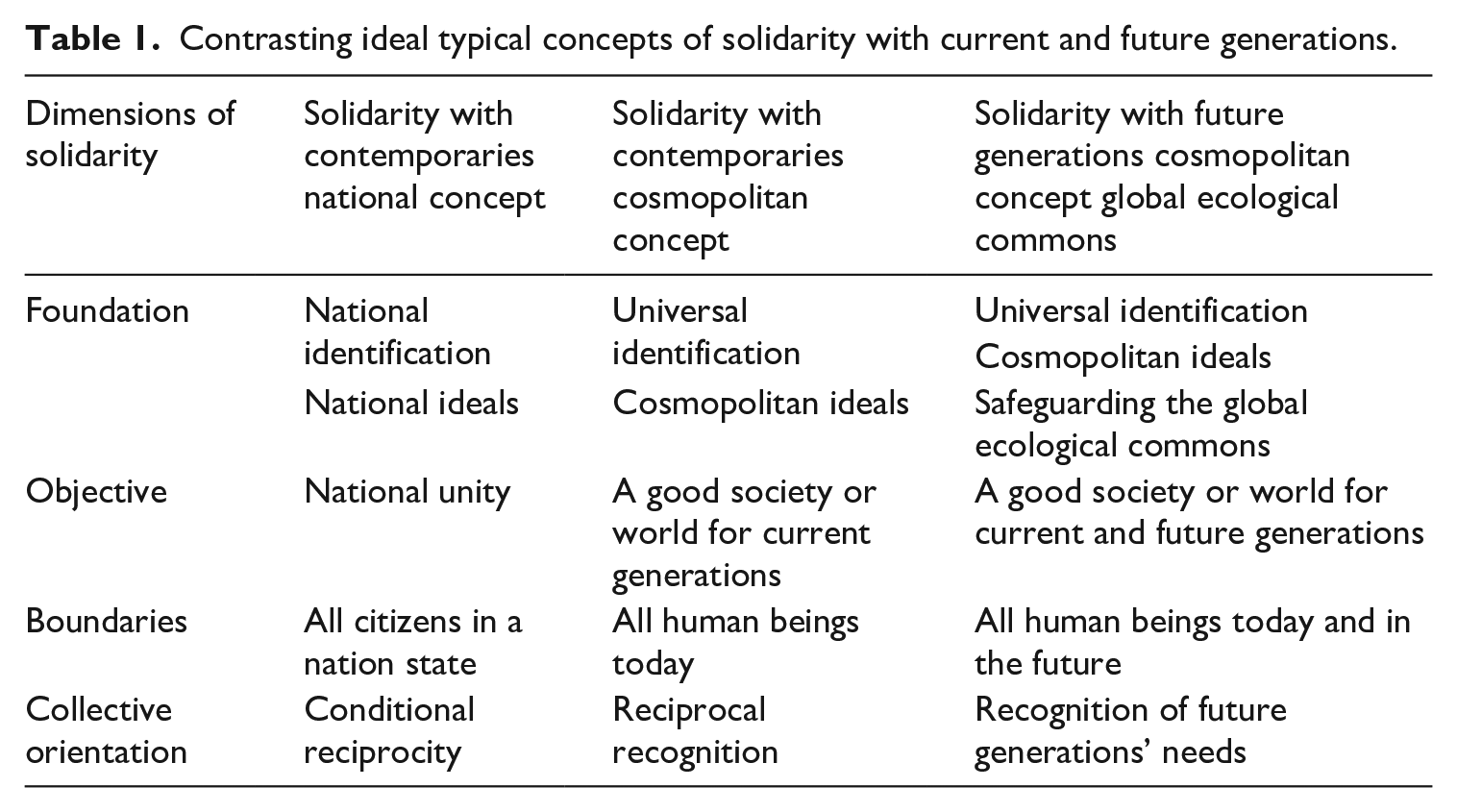
The following four sections explore how each dimension can be combined with the scholarly literature on future generations and developed into an ideal typical concept of solidarity with future generations. Within each dimension the potentials and limitations of the concept are discussed.
The foundation: safeguarding the global ecological commons
The foundation or sources of solidarity can be common interests, sameness or altruism. 26 While the foundation for an ideal typical national solidarity is national identification, a cosmopolitan solidarity centres on universal identification and cosmopolitan ideals. 27 An ideal typical concept of solidarity with future generations would differ from solidarity with contemporaries as the foundation is based on a concern for the consequences if present generations leave irreversible environmental damages to future generations. Accordingly, the foundation for solidarity could be defined as a matter of safeguarding the global ecological commons.
The potential of such a concept is associated with a new awareness that use of natural resources needs to be assessed in relation to what is left to future generations, and that the contemporary way of life in large parts of the world will lead to escalating global environmental damage. 28 However, the limitation is that the consequences of this awareness are unclear as there is no common agreement about how to safeguard the global ecological commons. Why and how should the living generations safeguard the global ecological commons for people who do not yet exist?
To answer this question, it is useful to build further on how political philosophy scholars have developed general principles of justice between generations, also termed intergenerational justice. Most principles are based on theories of justice between contemporaries and adapted to relations between current and future generations. 29 Three principles are frequently used. Firstly, ‘justice as impartiality’ is based on Rawls’ original position theory in which the ‘veil of ignorance’ is applied to an intergenerational context. 30 The main point is that nobody knows to which generation one belongs and would therefore threaten the viewpoint of each generation equally. Rawls’ contribution was one of the earliest in the debate on intergenerational justice and most of the debates in 1970s and 1980s were reactions to this. However, this approach has limitations. Rawls assumes later generations will be better off than previous ones, and he did not take into account a possible loss of well-being due to ecological destruction.
Secondly, ‘justice as equality’ can be defined as a principle of action to which equal cases must be treated in the same way. To achieve equality, unequal cases must be treated unequally. This approach also has limitations as generations are unequal, not necessarily with regard to their needs but to the time of their existence. This inequality makes the principle problematic to apply to intergenerational relations. 31
Thirdly, ‘justice as reciprocity’ could be seen as justice as mutual advantage. It is a contractarian conception based on symmetrical exchange, and those who cannot return anything are not taken into consideration. This should not be confused with compassion or generosity as these are asymmetrical relations and belong to the realm of moral behaviour. 32 Justice as reciprocity also has crucial limitations as it fails to provide adequate justifications for our obligations towards future generations. We cannot expect anything from future generations. Justice is not the same as solidarity, although it is a central part of the concept.
However, in terms of the foundation of solidarity with future generations one promising solution could be to emphasize ‘indirect reciprocity’, in which each generation receives from its predecessors and makes contributions to later generations. 33 This could also be seen as a kind of stewardship, which is central to green approaches to international relations. 34 As discussed above, solidarity involves a form of a political community and is based on expectations of reciprocity. 35 Consequently, appeals to solidarity with future generations make it worthwhile to accentuate indirect reciprocity as a central tenet of the concept. Hence, indirect reciprocity is limited to the vicarious concern for safeguarding the global ecological commons of currently living generations.
The objective: a good society or world for future generations
The objective of solidarity can be to unite interests, unite people or to surmount conflicts. 36 Accordingly, the ideal typical national concept is based on the objective of uniting all individuals belonging to a nation. 37 This has been crucial to the nation building process, and the ideal is that all individuals should be equal within the nation. 38 The cosmopolitan concept is also based on the idea of equal individuals, but it embraces all individuals and the objective is to create a good society or world. 39 By building further on the cosmopolitan concept, an ideal typical concept of solidarity with future generations would imply the objective to create a good society or world not only for current but also future generations.
The potential of such a concept would be the establishment of a common set of guiding norms for binding commitments to collective action in the global ecological commons. How could current generations establish common norms to achieve such an important aim for future peoples’ lives?
To answer this question, it is useful to combine the normative aspects of the concept of solidarity with scholars’ analyses of how commitments to coming generations are incorporated in international agreements and laws, for example, as a common heritage of mankind and trusteeship and/or as human rights extended to future generations. 40
In terms of solidarity, it is useful to build further on how Habermas distinguishes solidarity from both self-interest and rights-based humanitarian obligations. 41 His argument is that solidarity must be distinguished from justice both in the moral and legal sense of the term. While moral command should be obeyed out of respect for the underlying norm itself, obedience to the law is conditional on the sanctioning power of the state. In contrast, Habermas argues solidarity is more related to sittlichkeit, which he defines as ethical life. 42 Such obligation can neither be based on the categorical force of a moral duty nor coincide with the coercive character of law. However, Habermas also delineates solidarity from obligations which are rooted in ties of antecedent existing communities such as family ties. He argues solidarity cannot rely on pre-political communities. In contrast, solidarity presupposes political contexts of life that are legally organized and is thus a political concept. 43 The concept of solidarity depends on the expectations of reciprocal favours over time.
Habermas’ concept of solidarity is based on relations between contemporary generations. To develop solidarity with future generations, the most promising aspect would be to emphasize indirect reciprocity, as also discussed with regard to the foundation of solidarity. At the nation state level, an intergenerational solidarity based on indirect reciprocity can be found in constitutions. As national constitutions are intended to endure for many generations, they are the most important intergenerational contracts in modern states. 44 Obligations to safeguard the natural environment for future generations have been included as protection clauses in several national constitutions, and among them are Bolivia, Ecuador, Germany, Kenya, Norway and South Africa. 45 Furthermore, 1,587 climate lawsuits (not necessarily referring to future generations) were registered in the world between 1986 and 2020. 46 By including the protection of future generations’ access to a healthy natural environment in constitutions, the current generations have committed themselves to taking future people into account in contemporary welfare state considerations.
Can we see such commitments to future generations at the global level and in relation to the global commons? According to Taylor, there are tentative signs of communitarian values and their articulation in international agreements and treaties regarding the rights of future people. 47 The argument is that these represent small cracks in the order of state-centred international law. Seen in isolation, each of these developments has limited impact on the realm of realpolitik but taken together Taylor sees a trend towards the transformation of law and governance for the global ecological commons. 48 Such a trend is promising, but it requires a willingness to conceptualize and accept guiding norms for collective actions.
One way of institutionalizing such guiding norms for collective action is to establish a form of representation for those who will be born in the future. One concrete suggestion has been to establish a type of guardian or representative institution. 49 According to Aguis, a guardian for future generations should speak at various international fora, particularly at the UN, for two reasons. 50 One is to bring out the long-term implications of actions and present alternatives which are important for the well-being of future generations. The other is to incorporate a longer time horizon for the resolution of issues traditionally confined to the here and now. 51 Future generations could thereby be given a voice by appointing a guardian to promote a common set of guiding norms for collective action that can be articulated in policy and law. This could be seen as compensation for the lack of reciprocity.
The boundaries: all people today and in the future
The boundaries of solidarity can be drawn in relation to nations, continents or the whole world. 52 While the boundaries of the ideal typical national concept distinguish all citizens in the nation state from others, the cosmopolitan concept includes all human beings. 53 An ideal typical concept of solidarity with future generations would differ from solidarity with contemporaries as the boundaries cannot only be drawn in relation to territorial space and administrative units, but also require an extension in time.
By drawing boundaries in terms of time, we need to include various understandings of the relationships between past, present and future. We constantly develop our perceptions of these relationships and combine them with territorial spaces and administrative units. 54 Within the framework of the nation state the past is crucial. According to an ideal typical notion of national solidarity there is a sense of continuity with past generations, which is transmitted to future generations understood as future citizens of the nation state. 55 This perception of continuity could also be based on the aim of repairing negative experiences such colonial exploitation. As Anderson argues, the central concern is how the national genealogy is the expression of an historical tradition of serial continuity. 56 A cosmopolitan concept of solidarity is justified with references to how contemporary challenges cross national borders.
In emphasizing solidarity with future generations, one accentuates the future, rather than the past and the historical traditions, to define the boundaries of solidarity. Such an ideal typical concept emphasizes that today’s actions have an important future dimension, as people born in the future have become increasingly dependent on current decisions due to ecological limits. This way of emphasizing future consequences of current actions has potential to increase our understanding of common concern for the global ecological commons. However, one important limitation is that it lacks the historically defined national boundaries that typically help determine with whom one should act in solidarity. 57
While the main concern here is that the concept of solidarity with future generations is forward-looking, some ideas are required regarding how far into the future the boundaries should be drawn. Scholarly literature on future generations discusses the question of how many generations in the distant future the current generations are responsible for. 58 Regarding the global ecological commons, this question ought to be reformulated to how many generations it will take to repair the environmental damages caused by the current generation. One telling example is that plutonium has a half-life period of 24,110 years and needs to be stored and guarded for more than 300,000 years. 59 This requires political stability and well-organized societies throughout this period, and thus a belief in future solutions.
In this respect, Koselleck’s approach to the conceptualization of different approaches to time is useful. One of his arguments is that the Enlightenment era’s belief in progress in human evolution was crucial to the historical consciousness that emerged in the late 18th century in Europe. Through the idea of progress, the circular view of history was abandoned, and the future became an open horizon. 60 This perception of an open future has often been combined with perceptions of progress. It is therefore crucial to recall that a basic idea of modernity has been that future progress will reduce human vulnerability to nature. While the idea of modernity implied that through the development of science and technology one would control more of peoples’ environments and create better conditions for human existence, the opposite has taken place. Today, environmental damages represent a challenge to the idea of future progress, and particularly the way progress is combined with global economic growth. 61
An ideal typical concept of solidarity would be developed within the semantic field of sustainability, and here the main goal for the future is just to sustain or endure. This implies an important limitation of the concept. While progress, posterity and economic growth have a positive goal in the future, sustainability lacks a positive idea of the future. One potential, however, is that the idea of transferring a heritage to future generations can give the concept of sustainability a normative direction. The new generations are bringing hope for the future. 62 This hope is again combined with a general belief that future generations will be better off than the living generations. An important challenge here is, however, that today’s global environmental damages will presumably lead to a situation where the coming generations receive an inheritance from their predecessors that is worsening over time.
The collective orientation: recognition of future generations’ needs
Solidarity can also be defined in relation to the strength of collective orientation. Stjernø defines this as a question of the extent to which solidarity implies that the actors (e.g. individuals, states or non-state actors) should relinquish autonomy and freedom in order to achieve collective interests or values. Moreover, he distinguishes between strong and weak collective orientation. 63 The ideal typical national concept has a strong collective orientation based on national community, democratic polity and redistribution based on conditional reciprocity institutionalized through the welfare state. 64 In contrast, in the cosmopolitan concept states, the collective orientation is weak and is built on ethical ideals of reciprocal recognition. 65 An ideal typical concept of solidarity with future generations would build further on the cosmopolitan concept and in addition be based on the recognition of future generations’ needs.
However, compared to solidarity with contemporaries the uncertainty is high, and this implies a crucial limitation of the concept. How can we expect the involved actors to relinquish autonomy and freedom in order to achieve a collective orientation when the future is characterized by uncertainty?
To answer this question, it is useful to elaborate on how different conceptions of sustainable development would make available a varied scope of actions to those who come after us. Sustainable development was defined by the UN World Commission on Environment and Development (WCED) as: ‘development that meets the needs of the present without compromising the ability of future generations to meet their own needs’. 66 A vast body of scholarly literature has stretched this concept in different directions, both in terms of the combination of ecological, economic and social aspects of sustainability and related to global inequality.
While we know what future generations will need in some basic terms, we have limited knowledge of their preferences and technological abilities. It can thus be useful to draw on literature discussing what well-being means for the current generations and thus predict what will be important for people in the future. 67 More specifically, two theoretical approaches are useful for elaborating ecological issues, the challenges of global inequality and future sustainability: Amartya Sen’s capabilities approach and Ian Gough’s theory on universal human needs. 68
Sen’s point of departure is a critique of how the UN World Commission on Environment and Development defined sustainable development. He criticizes its emphasis on conserving the ability of each generation to meet its own respective needs. In contrast, Sen proposes a freedom-oriented view, in which we focus on the enhancement of human capability. One central concern for Sen is that we see human beings as agents who can think and act, not just as patients who have needs that require satisfying. 69 This means each generation should be given the freedom and possibility to evaluate and identify its own wants.
Gough asserts Sen’s capability approach is difficult to operationalize, and therefore leaves scant protection for future generations. His essential premise is that all individuals around the world have certain basic common needs, which must be met to avoid harm, to participate in society and to reflect critically. Gough argues that needs should be given priority over preferences as they imply ethical obligations to individuals and claims of justice on social institutions. This way of defining universal needs makes it, according to Gough, possible to plan for and measure progress towards social and environmental goals. The argument is that climate change is global, long-term, persistent and cumulative. It not only confronts social policy with a qualitative new agenda, but it will also make the pursuit of economic and social needs and rights more difficult. Moreover, Gough argues climate change is the global threat posing existential danger, which is difficult to coordinate globally, but the affluent North has special responsibilities towards the planet and the peoples of the East and the South. 70 However, climate policy alone could be unjust and inequitable, and it must therefore be combined with the pursuit of sustainable wellbeing for all peoples as well as for future generations.
This way of approaching the needs of future generations requires a collective orientation in which the current generations are willing to relinquish autonomy and freedom. Due to the uncertainty about future generations’ preferences this willingness might be stronger regarding future generations’ needs than the willingness to enhance their capabilities. This implies, however, that ecological systems are maintained in such a way that future generations can meet their needs.
UN Agenda 2030: for future generations
UN Agenda 2030 was signed by 193 countries in 2015. With its 17 Sustainable Development Goals (SDGs) and 169 targets, the agenda represented a new turn towards a sustainable pathway for current and future generations. The agenda includes themes ranging from poverty, health, education and inequality to energy, infrastructure, climate change, marine resources, peace, security and good governance. Unlike its predecessors, the Millennium Goals, the SDGs apply to the North as well as to the South. Above all, as Gough argues, the SDGs take the concern for future generations’ social conditions seriously. 71
However, to what extent and how can the four dimensions of the ideal typical concept of solidarity with future generations be useful for analysing the political process leading to this agreement? This section examines this with the aim of exploring whether ideas about future generations can be crucial for understanding some aspects of the common concern for the global commons.
Since World War II, a growing number of international agreements, declarations, charters and UN General Assembly resolutions have expressed concern for the welfare of future generations. In relation to the natural environment this concern emerged as a central theme for the first time at the UN Conference on the Human Environment, which produced the Stockholm declaration in 1972. 72 This declaration states we have reached a point in history when we must shape our actions throughout the world with more prudent care for their environmental consequences: ‘Man. . .bears a solemn responsibility to protect and improve the environment for present and future generations’. 73 This sentiment expressed in the first principle is reiterated with the second principle: ‘The natural resources of the earth, including the air, water, land, flora and fauna and especially representative samples of natural ecosystems, must be safeguarded for the benefit of present and future generations through careful planning or management, as appropriate’. 74
With this declaration, the foundation of solidarity with future generations is emphasized, as the natural environment was framed as a global ecological common that needs to be safeguarded for all people today and in the future. As discussed above, this is based on an understanding of indirect reciprocity. This is in line with how the WCED defined sustainable development in 1987 as development that meets the needs of the present without compromising the ability of future generations to meet their own needs. The WCED refers to needs. This makes it, as Gough argues, easier to plan for and measure progress towards environmental goals, 75 but it requires the current generations to have a collective orientation and be willing to relinquish autonomy and freedom. Moreover, the WCED appealed to intergenerational justice with a normative ethos.
We borrow environmental capital from future generations with no intention or prospect of repaying. They may damn us for our spendthrift ways, but they can never collect on our debt to them. We act as we do because we can get away with it: future generations do not vote; they have no political or financial power; they cannot challenge our decisions. 76
According to these statements the foundation for solidarity with future generations cannot be based on ‘justice as reciprocity’ between current and future generations. It can be interpreted as a foundation of solidarity based on indirect reciprocity, as the current generations are seen to be responsible for safeguarding the common ecological commons for those who will be born in the future. Since the publication of the WCED report, its definition of sustainable development has functioned as a common guiding norm in several UN documents. These documents underscore the central concern of the objective of solidarity; to establish shared norms and principles to guide policy, but also efforts to achieve a good world for current and future generations. 77
This objective was emphasized in Rio de Janeiro in 1992, when the UN Member States adopted UN Agenda 21. The agenda emphasized a ‘common concern’ and encouraged governments to adopt a national strategy for sustainable development. Such strategies should protect the resource base and the environment for the benefit of future generations. 78 Moreover, Agenda 21 encouraged governments: ‘To incorporate environmental costs in the decisions of producers and consumers, to reverse the tendency to treat the environment as a ‘free good’ and to pass these costs on to other parts of society, other countries, or to future generations’. 79
This was an appeal to nations to handle the collective ecological commons as something that needs to be safeguarded for all people today and in the future. It can be interpreted as an argument for a collective orientation that touches on the tension between national actions and cosmopolitan ideals. This also implies an extension of the boundaries regarding partners in solidarity.
Similar types of arguments were used in 2000, when UN Member States adopted the Millennium Declaration, which defined eight Millennium Development Goals (MDGs) to reduce extreme poverty by 2015. The objective of the MDGs was to establish common guiding norms for the development activities of the UN, for national priority-setting and the mobilization of stakeholders and resources towards common goals. Similar to Agenda 21, this declaration refers to how unsustainable patterns of production and consumption ‘must be changed in the interest of our future welfare and that of our descendants’. 80 Again, the boundaries of whom one should act in solidarity with was extended to future generations.
In 2012, in Rio de Janeiro, (Rio +20) UN Member States endorsed the outcome document The Future We Want. This document is a comprehensive action plan for achieving sustainable development. It starts by presenting a common vision to renew the commitment to sustainable development and: ‘. . .to ensuring the promotion of an economically, socially and environmentally sustainable future for our planet and for present and future generations’. 81 The Future We Want addressed the need for promoting intergenerational solidarity as a path towards sustainable development, recognizing the needs of future generations, and it invited the Secretary-General to present a report on this issue.
In 2013, the UN Secretary-General published the report Intergenerational solidarity and the needs of future generations. 82 This report analysed how intergenerational solidarity was embedded in the concept of sustainable development and referred to examples from international and national documents. It did not, however, define a concept of solidarity. The report presented options for possible models to institutionalize concern for future generations at the UN level. The most important recommendation was to establish a High Commissioner for Future Generations, as an international entity within the UN system. This would have a scope of action significantly different from national institutions that serve the needs of future generations. 83 Such a High Commissioner, as yet unrealized, would be a way of institutionalizing guiding norms for collective actions as suggested in the scholarly literature. 84
The UN Agenda 2030 from 2015 is presented as ‘a call for action to change our world’. 85 The resolution refers to how 70 years ago an earlier generation of world leaders came together to create the UN from the ashes of war. Agenda 2030 was presented as a charter for people and planet in the 21st century, which involves all people from the international to the local level of civil society. Agenda 2030 states:
The future of humanity and of our planet is in our hands. It lies also in the hands of today’s younger generation who will pass the torch to future generations. We have mapped the road to sustainable development; it will be for all of us to ensure that the journey is successful and its gains irreversible. 86
These statements highlight the concern with safeguarding the global ecological commons of the currently living generations. There are no expectations of reciprocity, rather it is based on a perception of indirect reciprocity. In Agenda 2030 we can find references to future generations, including the future of humanity or of all people. 87 These references include both the objective of establishing a good world for current and future people, and the extension of boundaries in terms of time as the aim is to include future generations. Agenda 2030 also refers to the protection of the planet from degradation ‘so that it can support the needs of present and future generations’. 88 This would require a collective orientation. However, all references to the concern for future generations are limited to the preamble and declaration. 89 Solidarity with future generations is defined and included as a general guiding norm. Agenda 2030 is operationalized in 17 Sustainable Development Goals (SDGs) and 169 associated targets, but none of these mentions future generations. The UN Member States have not agreed to plan for and measure progress in terms of solidarity with future generations within the framework of the SDGs and associated targets. Although there may be an emergence of a broader normative consensus, the binding commitments to collective actions are thus rather weak.
Agenda 2030 is defined as ‘a call for action to change our world’, but this is not meant to be a transformation of the traditional state system. The resolution confirms every state has full sovereignty over its wealth, natural resources and economic activity, and Agenda 2030 is to be implemented in a manner that is consistent with the rights and obligations of states under international law. However, Agenda 2030 also confirms that ‘planet Earth and its ecosystems are our common home, and ‘Mother Earth’ is a common expression in a number of countries and regions’. 90 This creates a conflict between state sovereignty and common concerns for the global ecological commons – unless the states apply the common norms and come together to find solutions to the environmental challenges. 91
Summary and conclusion
This article explores ideas concerning future generations and whether they are useful in understanding some aspects of the concern for the global ecological commons. The article’s main scholarly contribution is to develop analytical tools for examining what a concern for future generations would require of current generations. It combines the scholarly literature on future generations with that of solidarity. The ideas concerning future generations are interpreted in terms of an ideal typical concept of solidarity with future generations.
Dividing the concept of solidarity with future generations into four dimensions shows each dimension’s potential and limitations. Moreover, by applying the four dimensions of solidarity in the context of the political process leading to Agenda 2030, these potentials and limitations are evident.
The foundation of solidarity means there are references to a common understanding of the global ecological commons that need to be safeguarded for future generations. The potential of this conceptualization is associated with a perception of ‘indirect reciprocity’, in which each generation receives from its predecessors and makes contributions to later generations. This approach is limited, however, because the consequences of this perception for specific political actions are unclear. These potentials and limitations are evident in the political process leading to Agenda 2030. We can observe that the natural environment is framed as a global ecological common that needs to be safeguarded for all people today and in the future. This can be interpreted as indirect reciprocity, but its implications for common policies in the global ecological commons are unclear.
The objective of solidarity with future generations is to shape a good society or world for current and future generations. Its potential would be linked to the establishment of a common set of guiding norms for binding commitments to collective actions which also consider future generations. It is limited by its requirement of a willingness to accept such norms for collective action in the global ecological commons. The documents in the political process leading to Agenda 2030 emphasize the central concern of the solidarity objective; to establish shared norms and principles to guide policy, but also efforts to achieve a good world for current and future generations. The appeals for solidarity with future generations are formulated as guiding norms only in preambles and declarations and are excluded from the binding commitments, such as the 17 SDGs and the 169 associated targets. This is a crucial limitation by omission.
The boundaries of solidarity are not only drawn in relation to territorial space and administrative unit but also require an extension in time to include future people. One potential here is that the idea of transferring a heritage to future generations can give the concept of sustainability a normative direction as new generations are bringing hope for the future. A crucial limitation is, however that a concern for future generations represents a challenge to the idea of future progress, and particularly the way progress is combined with the perception of global economic growth. Regarding the political process leading to Agenda 2030, the younger generation is referred to as a normative foundation for including future challenges in contemporary decisions.
The collective orientation of solidarity implies that future generations’ needs are recognized and included as a decisive premise for contemporary political processes. The potential of this conceptualization is that ecological systems can be maintained in such a way that future generations can meet their needs. An important limitation, related to the uncertainty about future generations’ preferences and technological abilities, is evident in the political process leading to Agenda 2030. Future generations’ needs are recognized, but binding commitments to collective actions are weak.
The absence of reciprocity between current and future generations and uncertainty about the future are both crucial issues which cut across the four dimensions. We cannot expect anything from people who have not yet been born, and we do not know what preferences they will have. This shows the vulnerability of forward-looking appeals to solidarity with future generations. Nevertheless, such appeals to solidarity may give global political processes a normative content and direction and can thereby contribute to understanding common concerns for the global ecological commons.
Footnotes
Funding
The author disclosed receipt of the following financial support for the research, authorship, and/or publication of this article: The author received financial support from NOVA, Norwegian Social Research, OsloMet, Oslo Metropolitan University.
