



Abstract
This paper proposes a typology of four possible states of concepts: unquestioned, contested, essentially contested, and destabilized. The typology serves as a frame of reference and as an analytical tool for IR researchers who wish to study concepts and conceptualizing processes as a way of understanding politics. It argues that, within a context, every concept is in one out of four possible states. The typology rests on the relationship between experiences, perceptions, and concepts, aiming to rectify the lacuna of minimal attention to the experiences of many IR works which mainly focus on the inter-subjective sphere and actor-structure tensions. Thus, using the example of sovereignty in Jerusalem during the Israeli-Palestinians negotiations (1993–2001), a new state of concept, the destabilized state, is introduced.
Introduction
Political behavior is founded on concepts and breathes life into concepts. Identities and interests of political actors are shaped by concepts and concepts define political boundaries and content. At the same time, the way that political actors use concepts breathes meaning into them. It is no wonder, then, that political researchers and practitioners pay attention to concepts in an effort to understand and to act within the political arena.
International relations (IR) scholars frequently stress the political dimension of attributing meaning to concepts. They suggest that each understanding of a concept presents a different set of plausible political activities. Many scholars are constructivists or critical scholars, as they share similar premises about the importance of ideas, the central role of the inter-subjective sphere and the impact of actor-structure tensions in shaping the political world and political behavior. 1 Most of the (constructivist/critical) IR literature on concepts and conceptualization processes focuses on the inter-subjective sphere and actor-structure tensions, leaving aside experiences and material aspects. 2 Indeed, some researchers have critiqued how constructivists and IR researchers generally relate to the social context, focusing first and foremost on the role of norms, rules, inter-subjectivity and identity. 3 They argue that we should pay greater attention to more social structural forces. I agree with their basic criticism and propose that the experiences 4 and perceptions of reality as factors in the process of conceptualization should supplement the intentional critical reflective action of attributing meaning in social-political discourses and attributing meaning through the discursive maneuvers of the elite.
The present paper aims to rectify the lacuna existing in the minor attention paid to the experiences and perceptions aspects of the conceptualization process. Thus, it has two aims: first to contribute theoretically to the research on the relationship between experiences, perceptions, and concepts by introducing the idea of a destabilized concept. The second aim is to continue and develop the research on concepts by humbly accepting the challenge of proposing an analytical framework that integrates many of the former ideas into a comprehensive picture and leads the epistemological discussion into the political field. It therefore proposes a typology, a frame of reference, and an analytical tool for IR researchers who wish to study concepts and conceptualizing processes as a way of understanding politics.
First, the philosophical foundations must be established. Though it may seem too far to leap from a philosophical debate to political research, this is a necessary step. One cannot investigate the political role of concepts without first exploring what a “concept” is, and this is the essence and aim of the philosophical work. Much of the IR debate regarding the political role of concepts, starts at the societal level and lacks the fundamental and necessary condition for coherent discussion – an agreed upon concept of “concept.” So, many times we end up with a dialogue de sourds. Thus, we must start with an explanation of my definition of concept and conceptualization which will set a common ground for deliberation. Embracing the phenomenological perspective and presenting the consequential road from conceptualization to politics, I highlight the important, but too often neglected, role of experience and cognitive perception dynamics in the political process.
In the second section, based on the philosophical foundations, I introduce the notion of states of concepts, which takes us to political research. The state of concepts idea stems from the specific understanding of concept and conceptualization presented in the first section and can serve as an analytical tool for exploring concepts and politics. This idea proposes that, in the social-political field, concepts are in different states that represent different kinds of political-epistemological-ontological constellations, setting the boundaries for plausible political activity. A typology of four concept states is proposed: unquestioned, contested, essentially contested, and destabilized, in which each state arises from different constellations and relations between knowledge, public discourse, the elite’s political maneuvers, and experiences. I weave the existing literature about concepts into the analytical framework, while also introducing the idea of a destabilized state, which can only be identified after acknowledging the role of experience and perception in the conceptualization process. In the last section I elaborate on the importance of conceptualization processes to politics, calling on researchers and practitioners to attend to the state of concepts.
Concept and conceptualization
To understand and apply the “state of concepts” idea, first let me explain the meaning I attach to the concepts of “concept” and “conceptualization” and their functions. To that end, I follow in the phenomenological footsteps of Wittgenstein, Schutz and others. Accordingly, the meaning of concepts stems from their function and use, 5 so that to understand the meaning of concepts, the guiding questions are: Why do we need concepts and why do we conceptualize? The answer given by the phenomenological viewpoint is that human societies and individuals with their restrictedness and finiteness essentially inhabit an infinite reality that they can never know as a whole. 6 In order to be able to make sense of this reality and to perceive, describe, understand, and imagine a future, and act in it; in order to attribute meaning to this reality and themselves, in order to communicate and cooperate with others, they must differentiate and select phenomena from the “stream of life” and create order. To do this, they assemble their experiences and interactions with reality into an interpretive scheme of concepts: they conceptualize. 7
Conceptualization has two constitutive steps: The first involves constructing
Similarly, the schools of conceptual history suggest a two-stage process in charting the history of a concept – a diachronic account which explores how a concept is structured by previous historical usages and interpretations, and a synchronic analysis which considers the way concepts are understood and challenged at a specific moment. 10 As noted above, and in congruence with the conceptual history approach, the act of attributing meaning is reflective. However, and here I wish to contribute to the constructivist IR literature, there are always some phenomena which constitute our lifeworld and experiences that do not receive our attention yet have a strong influence on our praxis and knowledge and on the basis of our attention. 11 In order to illustrate the attention given to phenomena that grants them their meaning, Schutz used the metaphor of a cone of light which illuminates part of the stream of life: Unreflected phenomena outside the cone of light have no meaning. But as Schutz would agree, those phenomena, whether attended or not, comprise the whole stream of life and are the very “source of the light.” This means that a change in the stream of life changes the nature of the cone of light, affects the actor’s attention and perception, and hence the meaning the actor ascribes to phenomena and the construction of the mental representation of reality and theoretical knowledge. That is why experiences are a fundamental part of conceptualization and must be incorporated into the process we wish to understand better.
Thus, conceptualization is an endless historical process, which includes the inevitable praxis of attributing meaning to mental representations by looking backward and differentiating phenomena from “the stream of life” in Schutz’s words, while relying on past established connections. 12 On the other hand, concepts are acts of conceptualization occurring in a specific time and place. They are pictures of assembly, association, use and feedback in a particular context. Do not be mistaken; although a concept is a picture at a moment of time, this does not mean that it is defined. If by “definition” we mean an act of b/ordering an exhaustive entity, then concepts cannot be defined. 13 Concepts cannot be defined as portraying a finite or ultimate meaning because the historical act of conceptualization is part of what defines a concept, which has no meaning detached from its contextual use. 14 Neither can a concept be defined by an exhaustive description of its values, due to its infinite nature and historicity. Therefore, using the term “category” as synonymous with “concept,” as many researchers do, is misleading. 15 To paraphrase Nietzsche, concepts defy definition because they concentrate an entire historical process, and “only that which has no history can be defined.” 16 So a better metaphor for a concept is a moving picture without clear boundaries; a picture of a historical instance along the lines of Derrida’s infinite path of traces. 17
Although concepts have not been and cannot be defined, they can certainly be used, valued, attributed with meaning, and serve as a final authority. 18 The concept meaning stems from a concept’s manner of use, place and relationship with other concepts, its relationship with its sender and recipients and the physical medium supporting their existence in a given discourse and context. 19 Language is the main tool for conceptualization 20 and as Saussure has said, “In the matter of language, people have always been satisfied with ill-defined units.” 21 Accordingly, we use concepts, which are a never defined, ever historical, infinite construct, in order to create, understand and act in an infinite ever-changing reality, in order to imagine a never-to-be future, to plan never-to-be executed acts, and to communicate and cooperate with never-to-be known Others. It seems that concepts are truly the right tool for that.
Concepts are not private, internal, individual constructs. They are social mental representations of physical, social, or psychological phenomena. 22 They crystallize, emerge, and transform by and through social interaction in inter-subjective space. Mental representations which are intrinsic to a concept are produced and evaluated in relation to the intersubjective sphere. These social processes of constructing and using concepts are what bind a social group, differentiate it from other groups, and shape its collective theoretical knowledge. 23 In the intersubjective sphere, concepts constituted by communication, and they allow communication, and hence cooperation, and thus construct the identity of the subject and the group, with their interests and political constraints. 24 Therefore, concepts and their use in language not only represent a subject or an object, but help to form them; they do not just represent part of the world in the mind, they are part of it. 25
These inter-subjective understandings regarding the social character of concepts are where most constructivist and critical scholars start the inquiry. Consequently, it is easy to understand how, for example, Ish-Shalom suggests that, “theoretically, there are two ways to attach meanings,” one in which people as rational beings critically reflect on the meaning of a concept and participate in “the political process of conceptualizing concepts,” and the other, in which this political process is conducted by the elite, leaving lay persons out of the discussion and expecting them to embrace the meaning which emerges from the elite’s struggle. 26 This can also be seen in Bueger and Bethke, who suggest that what gives life to concepts are “mainly texts and actors producing these texts, reading these texts and adjusting their behavior to these texts.” 27 It is not that they are wrong, but they fail to complete the picture with relation to unintended behavior, to unreflected presentations, and to unattended experiences. By incorporating these aspects into the conceptualization process, we gain better insights and can identify and present a more nuanced and richer picture of the field of concepts and politics.
Last but not least, although the individual is embedded in a physical and social structure, there is still room for selective choice, which brings the opportunity to influence and modify social theoretical knowledge 28 – and hence, responsibility and accountability.
The states of concepts
The above premises set the stage for the next focus in my discussion: the social-political research field. As we take the presented idea of “concept” from the philosophical realm and use it in social-political discussion, it loses its abstract character and becomes situated in a specific context with a specific constellation of power relations, knowledge, practices, and experiences; in other words, meaning. I argue that, within a specific constellation, concepts are in one of four possible states.
To argue that concepts have different states in the socio-political field I have echoed the term “state of matter.” As there are numerous materials with different features, there are endless concepts with different qualities; as we can assemble different materials into groups based on shared values, we can assemble different kinds of concepts which share similar features under a category; and as there are four basic states of matter based mainly on the qualitative difference in properties of their volume, shape and behavior of their particles, there are four basic states of concepts based on the different constellation of power relations, knowledge, practices, and experiences. This is of course simply a metaphor, not a call for full equivalence.
The political literature already describes kinds of concepts and even several states of concepts and their characteristics, although it uses different language and sometimes different conceptualizations of the concept of “concept.” Thus, in the literature, we can find the idea of “metaphors” which display the attaching of unnecessary-related subjects/objects/phenomena. 29 We can find the idea of “basic/central/fundamental concepts” which share features of prominence in the social-political world. 30 We can find the idea of “political concepts” 31 which emphasize the intersubjective contestedness over their meaning and Krasner’s idea of “organized hypocrisy” relating to a specific successful hegemonic maneuver. 32 We can also find the idea of essentially contested concepts which, as I will explain below, is actually a state of concept.
The above philosophical discussion helps me to assemble and weave the former literature, which might seem controversial or overlapping, into one comprehensive analytical tool, and introduce the idea of state of concept, while incorporating the new idea of a destabilized concept. The following outlines the possible states of concepts.
Unquestioned concepts
To say that a concept is unquestioned does not imply that it is defined. I have suggested above that it is not. What we need to accept from Saussure and from Wittgenstein’s observation is the idea that even if a concept’s margins, if any, are not well bounded and clear, and even if the rules of the “linguistic game” are not entirely clear, most of the time, for the majority of concepts, people know how to play the game; therefore, most of the time, most concepts are unquestioned. 33
An unquestioned state of a concept implies a perceived and experienced congruence between the mental representation of past experiences (theoretical concept), the mental representation of the perceived phenomena (perceived reality), the experiences of the user, attended or not, and the way it uses those mental representations. In the unquestioned state, the act of discerning phenomena from the stream of life and attaching them together in a familiar pattern based on past experience is an automatic act, calling for almost no effort and no attention to the act of composition, the act of attachment. The recurrence and re-experience of the same phenomena in the same order and with the same salience, and the ability to recognize and reorganize these phenomena using familiar terms, reinforces the existing knowledge and validity of past connections.
For a concept to be unquestioned, it should meet expectations. The internal retrospective and feedback from the environment (social and material) after using the constructed mental representations should reaffirm the construction reached from past experience and associations with that experience. In Gramscian terminology, the concept’s meaning as determined by its use and the specific act of the composition of phenomena becomes the commonsense. Thus, an unquestioned concept enables effective communication between individuals and groups while the behavior of the other reaffirms and reinforces the concept’s social meaning. A concept is unquestioned when no other concept can explain perceived phenomena better and guide the activities relating to the phenomena, when there is no doubt as to which concept should be used in a specific context in order to understand and describe perceived phenomena, project a future act based on them and act to realize that projected future act. A concept is unquestioned when no other actor suggests a different meaning for it and when using the concept creates no political or epistemological tensions calling for changes in the next usage to come.
As mentioned, most of the time, most concepts are unquestioned. This is as true for the domain of politics as for the other domains of human life. Almost no one will disagree that, in the political domain, concepts such as palace, chair or rock are constructed and used in an unquestioned manner (One should remember though that, for the architect, the king’s palace it is not just a palace and for the geologist the rock is not just a rock, rather well deserved and questioned concepts indeed). But in many cases, even the more “political” concepts are in an unquestioned state. In specific contexts, concepts such as “state,” “democracy,” “border,” “territory,” and “government” can be constructed and used automatically, received by the audience as such, with no resistance or questioning, and allow communication to flow, and society to imagine a future act and execute it.
Essentially contested concepts
Although the most common state for a concept to be is unquestioned, there may be other states of concepts. One of these is the essentially contested state introduced by Gallie. Gallie presents a specific constellation and relations between knowledge, politics and experiences that in a specific context construct a concept as essentially contested, that is, he presents the idea of an essentially contested state. Gallie suggested that the use and construct of certain concepts in a specific context can indeed be questioned. He proposed that a concept may be used when there is no social agreement about the “right” way to construct and use it, but nevertheless, despite this disagreement (which becomes part of the concept’s meaning), the concept still allows effective behavior and communication, based on a shared reference field (a shared theoretical concept), which he calls an “exemplar.” 34 An essentially contested state is when one “sign” receives multiple meanings and meets seven necessary conditions: (1) “it must be appraisive in the sense that it signifies or accredits some kind of valued achievement”; (2) it must have multiple components which jointly construct its meaning; (3) each side of the contestation must attribute a different meaning to the concept by attaching a different weight or value to its constitutive components (concepts); (4) its meaning must be open to modification as circumstances change; (5) there must be political and epistemological struggles over its meaning, in which each side is aware that its meaning and interpretation of the concept is not accepted by others and each side tries to convince others that its views of the concept’s meaning and usages are correct. While the concept’s multiple meanings are recognized, there is no dynamic of convergence into one meaning; 35 (6) a concept is essentially contested only when it has an exemplar that locates the parties within the same reference field and defines the contestation borders and possible alterations. Unless there is a shared reference field in the form of an exemplar, in other words a theoretical concept, it can be argued that the parties actually use the same sign, but for completely different concepts. The ongoing competition between the sides is what allows the original exemplar to be optimally sustained and/or developed. But note that a different exemplar can be constituted in different contexts for the same “sign”; (7) finally, a concept is essentially contested only when there are no agreed criteria or judges to determine the right meaning for the concept. 36 If society agrees on criteria or gives authority to agreed judges/elite to determine the right way to use a concept, it will stop being contested.
So, in this state, although the concept is contested between parties, the contestation is restricted by a shared theoretical concept and the awareness and (implicit) acceptance of the legitimacy of other meanings. More importantly, the permanent contest over its meaning becomes an essential part of its meaning. 37
In the IR research field, it is not rare to find researchers who consciously treat concepts as essentially contested. Good examples can be found in Waldron’s
38
discussion regarding the “rule of law,” Sarooshi’s
39
consideration of “sovereignty,” or Daly’s
40
thoughts on “philanthropy.” Although there are disagreements between them regarding the meaning and proper use of “essentially contested concepts,” many attempts to identify a concept as essentially contested in its essence, detached from its specific context and use. Some IR scholars even argue that any important political concept is by nature essentially contested.
41
I must question the usefulness of this idea. The study proposes that any concept
Contested concepts
Not all contested concepts are essentially contested. A concept can simply be contested. The idea of “contested” is close to the idea of “essentially contested” in most of the above features, except that the boundaries of the contestation are more loosely defined by a shared reference field of an agreed theoretical concept, and more importantly, the contestation does not become part of its definition and the mere existence of other meanings does not gain legitimation.
The contested state is best characterized as a political and epistemological struggle between different actors over a concept’s meaning. It is a struggle where each side uses its resources to try to win over the commonsense. It is not just that different actors hold different meanings of the same term in different contexts. To be contested, different actors must hold different meanings of the concept in the same context and struggle to convince other actors of their view. What places them in the same field is not necessarily an agreement over a theoretical concept, but their direct contestation over a “sign.” This concept state is generally transitional until one side triumphs completely or the opinions converge into a single, accepted meaning of the concept, converging into consensus and an unquestioned concept. If this convergence/triumph fails to take place, the contested concept could eventually settle into an essentially contested state. Therefore, in a case where a concept’s meaning is contested with no agreed theoretical concept, if the sides do not acknowledge the right of others to hold different meanings and if the contestation does not become part of the definition of the concept, the state of that concept is (simply) contested. In the political field, the Gramscian description of hegemonic and counter-hegemonic contestation provides good examples of contested concepts.
Piki Ish-Shalom provides us with such an empirical example. 42 He describes how, in the aftermath of the 2006 violent confrontation between Israel and Hezbollah, a political contestation emerged in Israel. Embracing Antonio Gramsci’s notions of hegemony, Ish-Shalom describes how political agents have consciously struggled to win the commonsense regarding the definition and meaning of the recent confrontation by suggesting a different name for it. In this case, the contested concept was the phenomenon of confrontation with Hezbollah. Each political agent was aware of the other meaning of naming and the political consequences it entailed, and avoided providing legitimacy to the contested meaning/naming. Eventually, the political struggle was resolved by the triumph of one side; the phenomenon became known and unquestioned as the “Second Lebanon War.” But, throughout the political struggle, for a period of time, it was contested.
Destabilized concepts
But there is another state of concept apart from the abovementioned, one in which experiences play a conductive role in constructing it, and which, until now, has not received the proper attention from the IR literature: the destabilized state.
As noted, the act of attributing meaning is a reflective act. But our attention can only reflectively grasp part of our whole experience. There are always certain phenomena which constitute our lifeworld and experiences that do not receive our attention, yet strongly influence our praxis and knowledge and focus our attention. 43 This means that changes in the stream of life, in experiences, affect the actor’s attention and hence the meaning the actor ascribes to phenomena and the construction of the mental representations of reality and theoretical knowledge. That is why experiences are a fundamental part of conceptualization.
A destabilized concept is one which has lost the social consensus over its usage within the shared interpretive scheme of the social discourse in a particular context, due to changes in experience and/or in the perception of reality. But it does not imply other actors or multiple meanings associated with the concept. To paraphrase Schutz, theoretical knowledge is what one knows; it is an outcome of our past experience. Theoretical knowledge also helps to interpret the unknown in terms of the known using former connections. As our experiences become increasingly familiar and commonplace, so does our projected act and the means to achieve it. Our concepts become progressively more unquestioned. But when the subject meets new phenomena and has first experiences, she may be unsuccessful in connecting and synthesizing former connections into familiar mental representations. This leads to questioning former concepts and to the feeling that something is not right with theoretical knowledge and must be changed. 44
The conceptualization of a destabilized concept is different from the contested and essentially contested states in several ways. First, like the (simply) contested state, the divergences in meaning are more “open” and less restricted by a particular exemplar as a reference field, especially when constructing the perceived mental representation; hence the modifications in the concept’s meaning are not bound solely to the change in interrelationship between the components or to the value attached to them. New features (other concepts) can also enter the field and old components can disappear or be pushed out.
Second, destabilized concepts differ from contested and essentially contested concepts in the necessary conditions of the multiplicity of theoretical meanings, the actors’ awareness of them, and the absence of agreed criteria and judges. For a concept to be contested, the actors must be aware of other actors who attribute a different meaning to the concept. There is no need for such awareness or even the presence of other actors when a concept is in a destabilized state. A concept can be destabilized by changes in experience without any awareness of them. Unlike the contested and essentially contested states, a destabilized concept may be constructed through agreed criteria and judged by an accepted jury. Despite an apparently strong consensus over the theoretical meaning of a concept, it can nevertheless be destabilized by changes in experience and/or changes in the actors’ perception of reality. I suggest that the emergence of the new perception of reality with its new phenomena and experiences actually challenges the existing meaning of the concept and not the alternative meaning held by competing actors. Finally, the destabilized concept is not essentially destabilized. Contrary to essentially contested concepts where the “contested” element becomes part of the concept’s meaning and hence mitigates the tensions caused by the contest, destabilization is not part of the concept’s definition or meaning. Hence, conceptualizing the destabilized concept continues to create tensions and to undermine communication, society, and identity.
As opposed to an unquestioned state, a destabilized state of a concept is when new experiences challenge the construction and use of the theoretical concept and is not in congruence with past experience. In a destabilized state, perceived mental representations are constructed and used while presenting new and unfamiliar connections alien to former experience and theoretical knowledge. Thus, it requires more time and resources to process information and construct a perceived mental representation as it does not automatically reproduce a familiar one, and raises questions about the ability of the subject to communicate and act effectively within the inter-subjective realm. 45
As this state of concept is a new suggestion offered by this paper, and no research provides us with a good example, let me expand at this point and provide a more detailed example. As an illustrative example I bring the case of sovereignty in the Israeli discourse in the context of Jerusalem and negotiations with the Palestinians.
Sovereignty in Jerusalem as a destabilized concept
In Israeli 46 discourse in modern times, the state and function of the concept of sovereignty relating to Jerusalem has been variously transformed following changes in political situations, political hegemonic struggles, and experiences. Sovereignty over Jerusalem has assumed several states in the Israeli-national-Zionist discourse over the years. This has been due partly to changes in perceptions and experiences, partly to struggles and changes in the hegemonic group, and partly to changes in the ideological Israeli elite and society discourse and identity. 47 The next paragraphs do not provide a full conceptual history of sovereignty in Jerusalem, but rather focus on a specific time and context – the Israeli discourse during negotiations with the Palestinians in the Oslo Process (1993) to Camp David II negotiations (2001) – a time and place where the concept became destabilized.
After the capture of East Jerusalem in 1967, the question of Israel’s sovereignty over the city became a prominent political issue, both internally and internationally. The elite saw an opportunity to attach the concept of sovereignty to Jerusalem and to use this to strengthen its own power and identity. It tried to realize its theoretical concept of sovereignty which, inter alia, asks for congruence between territory, authority, responsibility, and law, and overlap between the identity of population, places and the sovereign. Several steps were taken, including: discursive maneuvers to portray a united Jerusalem as the major achievement of the war, relocation of several government institutions to East Jerusalem, construction of Jewish neighborhoods (illegal settlements according to international law) in the eastern part of the city, application of Israeli law to East Jerusalem, and more. This continued even more intensively after the rightwing rise to power in 1977. 48
But it was not an easy task to construct sovereignty in an unquestioned state. Although East Jerusalem now fell under Israeli law, it was not annexed to Israel. In one city, supposedly under one rule, residents and territories had different legal statuses and different social and political rights. Moreover, in East Jerusalem, first Jordanian, and then increasingly Palestinian institutions became active players in providing the local Palestinian population with services that the Israeli government and municipality failed to or could not deliver. 49 Among the main challenges to the theoretical concept of sovereignty was the situation over Temple Mount/Haram-Al-Sharif. In many ways, the status-quo arrangement established after the 1967 war marked a contradiction and deviation from the Israeli conception of sovereignty described above. Despite claiming sovereignty over Temple Mount, Israel allowed many of the authorities held by the Jerusalem Islamic Waqf to continue. Ever since 1967, Israel has been unable to fully guarantee freedom of movement and access to Temple Mount/Haram-Al-Sharif or to enforce its rule over this site. 50 Moreover, Israel has failed to gain external recognition for its conquest of East Jerusalem. International debate over the sovereignty of Jerusalem has persisted, and practically no foreign embassies were based in the city. Moreover, during the first intifada, internal recognition of Israel’s sovereignty over the eastern part of Jerusalem declined. 51
Notwithstanding these major deviations and challenges to the theoretical concept of sovereignty, until negotiations began in 1993, the elite managed to entrench the idea of Israeli sovereignty over Jerusalem in Israeli discourse as an unquestioned concept.
52
The effort was shared by all main parts of the Israeli political map, and the above deviations were pushed to the margins of the discourse. The lack of another dominant, capable political actor with significant access to Israeli discourse who could highlight and use these deviations to promote political or theoretical changes in the concept of sovereignty helped the Israeli elite in that task. Consequently, the concept could be and was used to describe and understand the reality in Jerusalem, to communicate internally and with others, and to portray the future and how to achieve it, and no alternative meaning or concept was offered. The efforts are reflected in PM Rabin’s words at the time:
“. . .Jerusalem is not for negotiation. It is not an issue for bargaining. . . Jerusalem was and will be forever the capital of the state of Israel under Israeli sovereignty, the heart of the Jewish people.”
53
This was changed with negotiations and their consequences which led to a change in experiences and destabilized the concept. During the negotiations, the Israeli discourse continued to construct the theoretical concept of sovereignty no differently to preceding the negotiations. The Israelis have continued to construct the theoretical concept of sovereignty, employing several key concepts. First and foremost, the state. All states and only states have an equal right to sovereignty, guaranteeing territorial integrity, political independence, and freedom from fear of external intervention and physical threats to their existence. The Israelis linked sovereignty to the idea that the “people” are the source of political authority and of congruity between authority, responsibility, territory, law, and identity. According to this conception, a territory must have one, definitive, exclusive authority with the sole legitimate right to legislate, hold, and use force in it; and the sovereign should have absolute control over its defined territory; these sovereign rights should be recognized internally by the population and externally by other states and international organizations. 54
But as negotiations advanced, and with them, changes in experiences, it became increasingly difficult for the elite and public discourse to keep the concept unquestioned. Three important dynamics promoted increasing departures from the theoretical concept of sovereignty and challenged it:
First, after the Israelis agreed to engage in negotiations with the Palestinians, a new actor, the PLO, became relevant and more accessible to the Israeli discourse. This external actor’s demands regarding Jerusalem conflicted with Israeli demands, and although the PLO’s aim was not to destabilize the notion of sovereignty but to achieve sovereignty for itself, it certainly worked to expose and highlight all the Israeli actor’s deviations regarding sovereignty over Jerusalem during the negotiations. 55
Second, the internal Israeli debate within the elite which occurred in the framework of the existing discourse with its meaning of sovereignty, helped to destabilize the concept. The different sections of the elite conflicted over the best way to alter reality and create the needed congruency to restore the concept to the unquestioned state, trying not to escape the “captive of sovereignty.” While some worked to strengthen the unification of the city under Israeli sovereignty in order to minimize the deviations, 56 others pushed to divide the city for the same purpose. 57 Even though their goal was not to destabilize the concept of sovereignty, or to propose a different theoretical meaning to it, jointly with the PLO they nevertheless exposed and underscored the deviations from the theoretical concept, making them apparent to the wider public, and rendering the concept difficult to use.
Third, the signing of the Oslo agreements and the implementation of parts of them – including the establishment of the Palestinian Authority and the changes on the ground, and new experiences that these brought with them – intensified the challenges to realizing the concept of sovereignty according to the accepted Israeli view. Examples of these “new experiences” were that, although they lived in a territory which Israel claimed to have sovereignty over, the Oslo agreements gave the Arab residents of East Jerusalem the right to vote in the Palestinian parliament and presidential elections. For some Israelis, this was tantamount to accepting the partition of Jerusalem. 58 Palestinian governmental institutions were established and run from East Jerusalem and many of the routine services were now supervised, regulated, and administered by the Palestinian Authority. In practice, the Palestinian Authority now governed the Arab neighborhoods of East Jerusalem even in aspects of security, politics, and justice which, for the Israelis, symbolized the essence of sovereignty more than other spheres. 59 Israeli political actors saw the above experiences as fundamental deviations from the Israelis’ idea of sovereignty and they stressed the tensions these deviations brought. 60
In sum, although the theoretical concept of sovereignty was still constructed by the same concepts, the composition of the perceived concept became much harder and more confusing. It also became less clear how and when to use the concept. The encounter with the other group with its political activity and access to the Israeli discourse, the Israeli elite’s internal political contestations, and the changes in experiences all helped to destabilize the concept of sovereignty in the context of negotiations over Jerusalem. 61 It became increasingly difficult to use it effectively, to communicate with it and to project a future picture, and work towards achieving it. Furthermore, once the deviations were exposed, the elite could no longer credibly use the concept of sovereignty in this context. It could no longer successfully stress the boundaries of the concept or gain affirmative feedback regarding the concept’s meaning from Israeli society and the environment in which Israel operated. But neither could the elite relinquish the use of the concept in this context having worked so hard and for so long to position it essentially as part of its group identity and a legitimate source of its hegemonic position. They have remained “captives of sovereignty,” yet they did not know how to “play the game.”
In the case of sovereignty in Jerusalem, the concept of sovereignty was central to both Israelis and Palestinians in order to construct the political issue between them in Jerusalem. The concept of sovereignty was neither contested nor essentially contested as apart from the elite’s debate behind closed doors, which failed to crystallize into political action, 62 none of the negotiation participants proposed or promoted an alternative meaning for sovereignty, and it never became a subject for public debate. Yet due to changes in experiences and changes in perceptions that came with them, and with political actors’ efforts, the concept of sovereignty in Israeli discourse has stopped being in an unquestioned state. The concept of sovereignty in Jerusalem was destabilized due to the growing discrepancy between experience and the theoretical concept and because of the elite’s inability to disregard the concept in this context and continue orchestrating the hypocrisy surrounding it. The concept could therefore no longer be effective for envisioning a solution to or description of the political reality in Jerusalem, although it continued to be central and was used in this context.
As the theoretical section has argued, this contributed to inefficient negotiations, misunderstandings in communications between actors, and demands for further cognitive, discursive, and material resources in order to understand and act in this context. The failure to render the concept unquestioned also threatened Israeli identity for which the concept of sovereignty with its centrality to Israeli-Zionist discourse generally played a key role, making it more challenging for the protagonists to reach an agreement.
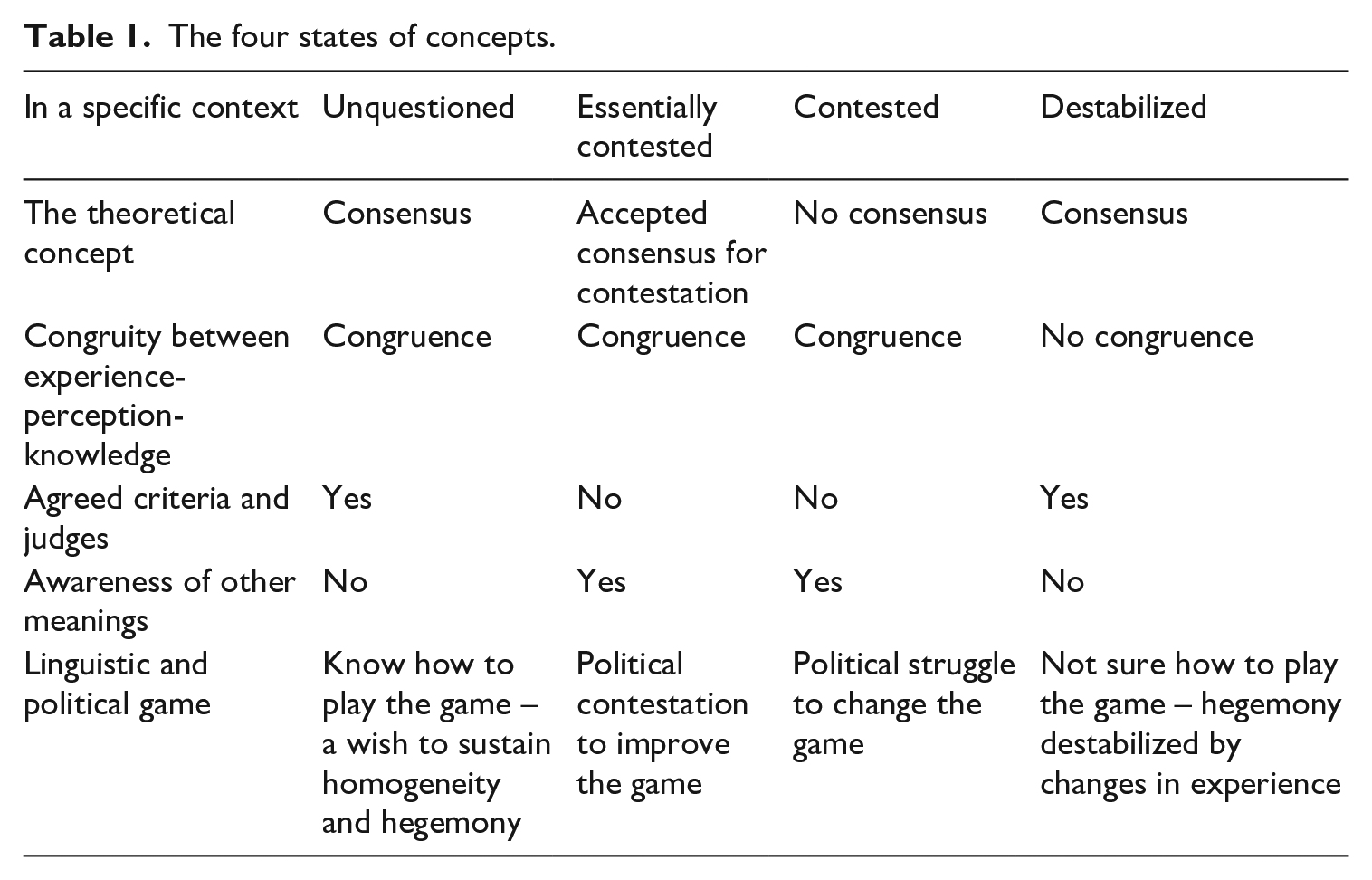
Table 1 presents an outline summary of the four concept states:
The four states of concepts.
The state of concept and politics
The above typology is a political one. It suggests that in a given context concepts are always in a state composed of a kind of relationship between power structure and relations, 63 former experiences organized within established connections and new experiences. It aims to help us recognize these relations in a given context. Conceptualization is not always, and mostly may not be, an intended action, but rather an unintended act. A concept is politicized when the act of construction involves an intended action, thus intentions must be considered.
All concepts can be politicized and intentionally constructed, regardless of their state. Naturally, contested concepts and essentially contested concepts are politicized because they involve apparent struggles. But even an unquestioned concept whose construction and uses are constantly affirmed can stem from an intended action. Krasner provides us with an example, presenting the idea of “organized hypocrisy” which describes the success of the elite in the nineteenth and twentieth centuries in establishing a consensus over the meaning of sovereignty despite the challenges posed by experience. 64 This is also the case regarding sovereignty in Jerusalem between 1967 to 1993.
There is inherent tension within the elite’s political actions: between their desire to create an ambiguous concept and their wish to keep it unquestioned and preserve their hegemonic position. If a political actor creates a concept which is ambiguous yet unquestioned, she has more room for political maneuvers. Political actors are free to stretch the boundaries of a concept’s meaning and make it more ambiguous – as long as those boundaries and usages are accepted by the audience’s discourse; 65 as long as the feedback from the environment does not undermine the needed congruence. If the elite’s concepts cease to be accepted and their usage is rejected, or if they fail to convince society that their associations which construct the concept are congruent with that audience’s past concepts, experiences, and perceptions, the elite loses political power and credibility. Moreover, facing disagreements over the “right” meaning (i.e. way of use) of a concept puts the entire group into question. 66
As for the destabilized state of a concept, it is hard to imagine a political actor who acts intentionally to produce destabilized concepts; it is more likely to be a by-product of changes in experiences or other political contestation such as the struggle between the Israelis and the Palestinians over sovereignty in Jerusalem which unintentionally destabilized the concept. A destabilized concept usually results from an unintentional act of failed attachment, not an intentional action. A concept can be destabilized by different actors’ behavior without a struggle between agents over its meaning or efforts to preserve its meaning as a manifestation of power relations. But destabilization is a state which creates tensions and invites political struggles. While actors become aware that the concept is destabilized, a chain of reaction may occur: The judges and criteria may lose their credibility and power to establish its meaning, which can lead to destabilization of the consensus about the theoretical concept, and to a call for creating better congruence between the theoretical concept and perception, and hence to formulation of new steps in the “game.”
It is tempting to suggest a theory of essential connections between different concept states and political outcomes. It seems, for example, that one can intuitively suggest that a destabilized state will interfere with communication, cooperation and execution activity, creating inconsistent behavior leading to conflict. But what if actors, while recognizing the destabilized state of the concept, choose to push it to the margins and use another concept that elicits greater cooperation in a particular context? Thus, again, I do not offer a theory, but an analytical tool. Examination of the conceptualization processes and concept state offers insights into the political processes that construct a concept’s context, meaning, and usage. And the entry point for the inquiry is always the context.
There are several reasons why the state of a concept is important and why it warrants further study. The first, as I just argued, is that if we can identify which state a concept is in, it can further our understanding of political phenomena. Secondly, in the political field, political actors and other social agents can achieve greater flexibility in their political maneuvers by acknowledging that concepts have different states and different meanings in different contexts. This will allow them to use their knowledge and abilities to identify and analyze the states of different concepts, and plan and execute political behavior mindful of this state. Thus, the state of a concept can be part of social knowledge. Acknowledging a concept’s state is by no means deterministic; quite the contrary. Regarding Jerusalem for example, if political actors recognize which state the concept of sovereignty is in, they can, say, take more calculated steps, not to preserve sovereignty unquestioned as they attempted to do; but rather to bring sovereignty to an essentially contested state – as a normative step towards achieving greater flexibility in the discussions over Temple Mount/Haram-Al-Sharif. For example, negotiators could bring to the table other meanings of sovereignty from other contexts – such as the “Good Friday” agreement, which connected sovereignty to power-sharing – in order to solve the controversy over Temple Mount/Haram-Al-Sharif.
One could argue that the politicians’ desire to maintain the concept’s ambiguity and gain greater maneuverability will cause them to embrace a destabilized concept. However, as our example shows, a difference, albeit a fine line, exists between unquestioned ambiguous concepts and destabilized concepts, and when the line between ambiguity and instability is crossed, politicians seek to return to an unquestioned state. This is because a destabilized concept undermines the congruency needed between the perception of reality and the concept’s construction and application. And without that congruency, there is less room for political action.
Thirdly, as we have seen, attributing meaning to a concept is an epistemological and political matter. Given that the concept of “sovereignty,” like other concepts, is part of an ongoing attempt to reconstruct the objects and subjects of reality and how they are perceived, and to guide political behavior, the question of what sovereignty means is a political question. The awareness, say, of the destabilization of sovereignty in Jerusalem focuses on these issues and opens them up to normative debate. Although, as we have seen, there is a price for a destabilized concept, it can also offer opportunities when recognized. When concept is recognized as destabilized, a transformation of state commences, and normative questions enter the discussion. The first question is: Who should participate in tackling the concept’s destabilization and what form should that participation take, and/or how should the new meaning of the concept be constructed. Here, Habermas’ normative call for rational open debate in the public sphere offers a positive direction to strive for, especially if we embrace Wittgenstein’s proposal to circumvent sovereignty by embracing the authority of language and the speaker’s responsibilities. Secondly, regarding the state of concepts, the question is: Is an unquestioned concept always desirable as the normative state? History is full of examples of horrors which were made possible when concepts were left unquestioned. Consider the countless wars following an unquestioned concept of territory. Would it be more moral in some cases to transform unquestioned concepts into essentially contested concepts? This would indeed contribute to acknowledging diversity and giving people a voice. It would also bring different actors to a shared field of reference and facilitate productive communication and a shared goal to strive for.
Conclusions
This paper had two aims: First, to rectify the lacuna in the research of concepts and politics which does not pay adequate attention to experiences and perceptions, by introducing the idea of a destabilized concept, and second, to suggest a typology of states of concepts as an analytical tool. The paper has presented sovereignty in Jerusalem as an example of a destabilized concept and used this example to demonstrate the characteristic of this state of concept.
Using the analytical tool of the state of concepts can provide us with a better understanding of the political phenomenon, and the conceptual and epistemological elements which are parts of the political phenomenon. This study proposes to investigate what shapes and constructs the social and political interests and identities we often take for granted. The state of concepts analytical tool allows us to tell a comprehensive story and provide explanations for political behavior. Its advantages are revealed with the new insights and explanations it provides regarding political behavior. But even more than that, its advantages are most clear when it helps the researcher to free herself from taking for granted basic assumptions about the subject and from taking as givens, interests, structures and even identities. Thus, it emphasizes the contingency of any political situation, and leads us to ask new questions.
One can use variety of methods while implementing this analytical tool. I used Critical Discourse Research while analyzing different texts from Israel-Palestinian negotiations. But one can use other discourse analyses, historical investigation or even quantitively computerized models as methodology. What is essential is for the method to help reconstruct for a given concept in a given context, the theoretical concept of the relevant actor/s, their perceived concept and the relevant phenomena and experiences, and to examine the congruity and relations between them all.
Future research should examine the effect of the state of concept on an actor’s behavior and political field of action, and ask such questions as: What are the effects and consequences of each state on the actor’s identity, resilience, and/or relations with other actors? What strategies can help us deal with different states? Does the transformation into new states of concepts take place in fixed order? Aside from internal tensions, communication problems, and the need for additional cognitive, discursive, and material resources in order to understand reality and construct a mental representation of it and apply this effectively – what are the consequences of a destabilized concept? And there are many more questions. Although these questions seek generalizations, intuitively we sense that each case and context has its own dynamic.
What the article advances is thus less a theory than an analytical tool for investigating concepts and politics. Normatively, this tool can help us expose processes which are regarded as inevitable but which in fact present a contingent power structure. Exposing these processes is useful for conceptualizing alternative power structures, becoming active political agents, and contributing to public deliberation in the pursuit of power relations and structures that are more moral.
Footnotes
Funding
The author received no financial support for the research, authorship, and/or publication of this article.
