



Abstract
Cisgender males remain less likely to report depressive symptoms or initiate mental health conversations with primary care providers. Guided by the Health Belief Model and Gender Role Theory, this study examined how cisgender males perceive and address depression, with a focus on their comfort with the Patient Health Questionnaire-9 and factors influencing their willingness to discuss mental health concerns. An anonymous mixed-methods survey link was disseminated to 62 cisgender males between November 2024 and January 2025. Quantitative items assessed preferences for mental health discussions, willingness to initiate conversations, and experiences with the PHQ-9. Qualitative responses were analyzed to identify perceived barriers, attitudes toward screening, and beliefs shaped by masculine role norms and health-belief constructs. Most participants (n = 48, 77.42%) preferred in-person mental health discussions with primary care providers. Half (n = 31, 50%) had previously received a mental health screener. Despite this, a large majority (n = 54, 87.10%) reported comfort completing screeners such as the PHQ-9 independently. However, n = 14 (22.58%) were unlikely to initiate mental health conversations. Qualitative findings revealed 3 dominant themes stigma, fear, and trust, that shaped comfort with screening and willingness to disclose symptoms. The HBM highlighted perceived barriers and low perceived susceptibility, while GRT contextualized how masculine norms discouraged disclosure. Cisgender males show readiness to engage with depression screeners when tools are accessible, yet stigma, fear, and trust remain central influences on disclosure. Integrating the PHQ-9 into routine primary care with deliberate conversations and strengthening patient-provider trust may enhance early identification of depression.
Keywords
Introduction
Despite the male to female ratio being about even in the United States, 1 there is still a limited understanding of the diverse experiences of cisgender males across different racial, age, cultural, and socio-economic backgrounds. 2 Research shows this limited understanding can be attributed to multiple factors including insufficient survey evaluation by the patients provider with evidence-based tools like the Patient Health Questionnaire-9 (PHQ-9), the unconscious propensity of practitioners to ignore male distress, stigma, and reluctance to report on the part of cisgender males due to societal pressures to name a few.3,4 These contributors unfortunately lead to a larger problem in the United States: the underdiagnosis and undertreatment of mental health conditions among cisgender males. 5 In high-income countries, cisgender males die by suicide at a rate more than twice that of women, according to the World Health Organization. 6 Similar statistics are reported by the National Institute of Mental Health, where male suicide rates are nearly 4 times higher than female suicide rates. 7 Research further suggests that cisgender males are significantly less likely than females to seek mental health treatment, resulting in a higher prevalence of untreated mental health concerns and an increased likelihood of substance use disorders. 8 Untreated mental health concerns may also manifest as irritability and anger rather than sadness or despair, which can obscure underlying conditions and delay intervention.9 -11 This pattern of reduced help-seeking is well documented, with studies consistently showing that cisgender males are less likely to pursue treatment for mental health conditions, contributing to elevated rates of suicide, depression, and substance abuse.8,12 National mortality data further underscores this disparity, as males account for 79% of the 38 364 suicide deaths reported, 4 times the rate observed among females.13,14
Cisgender males are also noticeably underrepresented in the field of mental health care, both in terms of providing and receiving services; despite the evident need for interventions aimed at this population. 15 According to Comacchio et al, females tend to dominate the fields of psychology, counseling, social work, and other mental health care professions. 16 Cisgender males may be disinclined to seek mental health services due to the perception that the profession is feminized, a view reinforced by the gender imbalance within the field. 17 Moreover, the kinds of interventions and services that are offered, are also impacted by the underrepresentation of cisgender males in the mental health workforce, as many mental health programs unintentionally overlook the special needs and preferences of cisgender males because they are created with a gender-neutral or female-centric perspective.16,18 Collectively, these findings highlight not only the prevalence of mental health disorders among cisgender males but also their concerning underrepresentation within the mental health care system.19,20
Moreover, the earlier notation of insufficient survey evaluation particularly related to usage of the PHQ-9 in primary care, is yet another notable contributor.3,21 The PHQ-9 is a widely used instrument for identifying and assessing the severity of depressive symptoms across diverse populations, and also has a standardized structure and strong psychometric performance making it a central tool in both clinical practice and research.21 However, its utility is particularly salient in the context of cisgender males, who consistently demonstrate lower rates of mental health service utilization despite comparable or elevated levels of psychological distress.14,22 Despite growing awareness of gender disparities in mental health, significant gaps remain in the empirical literature regarding how to effectively engage cisgender males in mental health assessment and disclosure.4,15 Existing research has not sufficiently examined how intentional, structured dialog when paired with validated psychometric tools such as the PHQ-9, might improve diagnostic accuracy or increase comfort in reporting depressive or depression-related symptoms utilizing the family medicine specialty as a starting point.23,24 This gap is particularly pressing now, given rising concerns about underdiagnosis, undertreatment, and the elevated rates of suicide and untreated depression among cisgender males in the United States.6 As primary care settings continue to serve as the first point of contact for many individuals, understanding how communication strategies and screening tools can work together is essential for improving early identification and intervention.25,26 To address this gap, this study explored whether administering psychometric tools like the PHQ-9 alongside intentional, patient-centered conversations during routine office visits with family healthcare providers could potentially enhance the accuracy of depression identification and increase cisgender males’ willingness to report mental health concerns.
Literature Review
It is clear prior studies have documented patterns of underutilization, elevated rates of untreated distress, and gendered barriers to help-seeking, offering important insights into how masculinity norms, and stigma influence cisgender male mental health outcomes.3,4,9,19 However, despite these contributions, the existing literature has not fully examined how clinical communication practices and standardized screening tools like the utilization of the PHQ-9 might work together to improve identification of depressive symptoms in cisgender males. The following review synthesizes evidence on (1) why male mental health is an urgent public-health problem, (2) how stigma and masculinity shape disclosure and help-seeking to providers, (3) how depressive symptoms in males may present atypically, and (4) the psychometric strengths and limits of brief screeners, especially the PHQ-9, to highlight the areas where further empirical investigation is needed. Definitions, MeSH terms, key constructs and variables are summarized in Appendix Table 1; terms were operationalized drawing on the Health Belief Model and Gender Role Conflict Theory, and applied consistently during coding, quantitative scoring, and analytic procedures.
Stigma, Masculinity, and Disclosure Barriers
A substantial body of research demonstrates that dominant masculine norms shape how cisgender males perceive, experience, and communicate psychological distress. Connell’s theory of masculinity, alongside related sociological analyses, explains how emotional restraint, self-reliance, and status preservation are culturally reinforced among males, creating barriers to emotional disclosure and help-seeking.13,27,28 Chatmon further illustrates how these norms translate into sociocultural stigma that discourages males from reporting depressive symptoms in clinical contexts.13 Empirical studies consistently show that stigma and masculine role expectations reduce a male’s willingness to voluntarily disclose; internalizing symptoms, thus, increasing reliance on externalizing behaviors such as irritability, anger, and substance use as socially acceptable expressions of distress.3,22,29
Collectively, this literature points to 2 clinically relevant consequences. First, cisgender males are less likely to self-identify or articulate depressive symptoms during healthcare encounters. Second, clinicians may misinterpret or overlook male-typical presentations of depression when assessment strategies rely on instinctive disclosure or prototypical symptom profiles.3,20,28
Symptom Presentation and Measurement Challenges
Evidence further indicates that depressive symptom profiles in males often diverge from classic diagnostic presentations, raising concerns about the sensitivity of brief self-report screeners when used in isolation.26,30,31 Studies documenting externalizing or atypical symptom patterns suggest that standardized instruments may fail to capture clinically meaningful distress if assessment items conflict with masculine norms surrounding emotional expression.32,33 Accordingly, measurement validity depends not only on psychometric properties but also on the communicative and relational context in which screening occurs.26
PHQ-9 Utility and Psychometric Tradeoffs
The PHQ-9 is among the most widely validated depression screening tools in clinical practice.32 Described by Kroenke et al, it is a brief, Diagnostic and Statistical Manual of Mental Disorders (DSM), aligned instrument designed for feasibility in primary care and population-based screening.21 Subsequent research demonstrates strong internal consistency, test-retest reliability, and diagnostic accuracy across outpatient, community, and telehealth settings.34,35 Meta-analytic evidence further confirms robust sensitivity and specificity for major depressive disorder, supporting PHQ-9’s widespread clinical adoption. 36 Nevertheless, comparative psychometric research highlights important tradeoffs. While the PHQ-9’s brevity supports routine implementation in time-constrained settings like family medicine, for cisgender males, particularly those influenced by stigma and gender role norms, the PHQ-9’s efficiency may facilitate screening while still risking under-detection of atypical or externalizing symptom presentations unless paired with targeted clinical follow-up. 37 Conversely, unstructured dialog alone may foster rapport yet fail to prompt systematic symptom disclosure in the absence of a standardized framework.9,37
Why Communication and Screening Must Be Considered Together
We know males may underreport symptoms and present atypically, relying on either screening tools or clinician conversation alone may be insufficient.33,34,37 We also know despite all the complementary strengths outlined in prior research, that empirical studies testing the combined effect of validated screeners (like the PHQ-9) and deliberate clinical discourse on cisgender male reporting and diagnostic accuracy are scarce.38,39 Motivated by this gap, this mixed methods study was guided by the Health Belief Model (HBM) and Gender Role Conflict Theory (GRCT) as complementary frameworks. GRCT postulates that cisgender males experience psychological distress when their emotions or behaviors diverge from culturally imposed masculine roles, leading to restrictive emotionality, delayed help-seeking, and maladaptive coping strategies. 40 Empirical research links gender role conflict to increased depression severity, reduced mental health service utilization, and poorer outcomes, particularly during periods of heightened stress.27,40 The HBM provides a parallel explanation for health-seeking behavior by emphasizing perceived susceptibility, severity, benefits, barriers, and self-efficacy.41 -43 Applied to male mental health, and further described in Supplemental Figure 1 the model suggests that stigma and masculine norms function as perceived barriers that reduce engagement with screening and treatment even when symptoms are present.41,42 When integrated, GRCT explains why males may resist emotional disclosure, while the HBM explains how these beliefs translate into delayed or missed care.40 -43 Together, these frameworks suggest that depression screening among cisgender males may be most effective when standardized psychometric tools are combined with intentional, patient-centered dialog that addresses stigma, masculine norms, and perceived barriers to disclosure.13,44 Thus, reinforcing the study’s research question and investigation into if the effect of administering psychometric tools like the PHQ-9, paired with intentional, structured conversations during primary care visits affect cisgender males’ willingness to report depressive symptoms, and the accuracy of depression identification.
Methods & Materials
Study Design
The study employed a cross-sectional, mixed-methods survey via Survey Monkey to thoroughly examine the lived experiences of cisgender males related to mental health conversations, and their influence on depression reporting. The study design was evaluated against EQUATOR guidelines-specifically using the Mixed Methods Appraisal Tool (MMAT), to ensure that the research question, data collection, and analytic approaches were appropriate for the study aims. 45
Participants and Data Collection
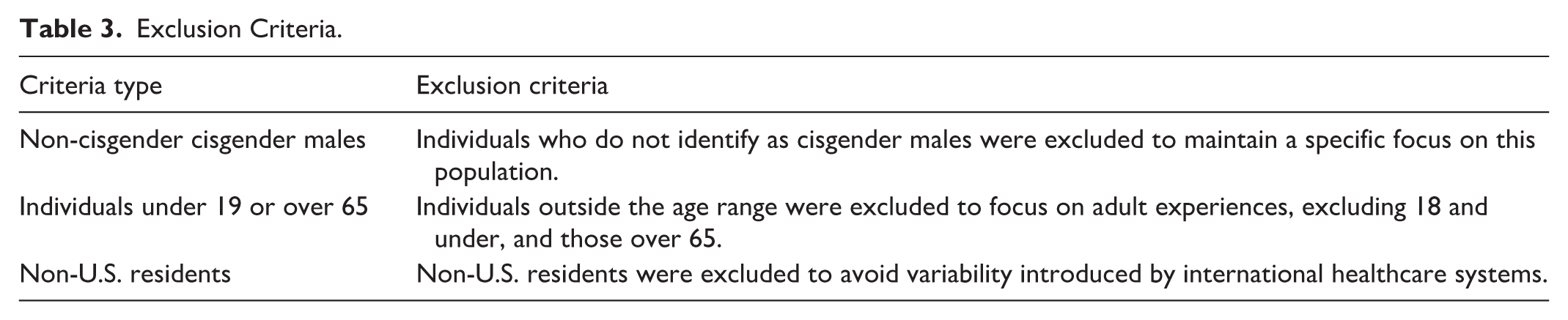
Participants were eligible if they identified as a cisgender male at the time of survey completion, were aged 19 to 65 years, resided in the United States, provided informed consent, and could complete the survey in English; individuals who did not meet these criteria were excluded as seen in Appendix Tables 2 and 3. Participants received comprehensive information about the study via an informative link provided by a trusted family member, friend, or colleague, including its goal, confidentiality protocols, and the voluntary nature of participation, prior to deciding to complete the survey. After providing their consent, participants moved on to the survey’s questions. The final analytic sample consisted of 62 cisgender male respondents. This sample size was appropriate for the study’s exploratory, phenomenological aims, providing sufficient variation to identify shared experiential themes while allowing in-depth qualitative analysis of narrative responses. Consistent with phenomenological methodology, sample adequacy was evaluated based on thematic sufficiency rather than statistical power. 46
Survey Instrument
Participants completed a 15-question survey via the platform Survey Monley designed to assess demographic characteristics, healthcare engagement, experiences with mood-based screening, and perspectives on mental health disclosure in primary care settings. The instrument included a combination of yes/no items, Likert-scale items, and open-ended questions, allowing for both quantitative summarization and qualitative exploration of lived experiences. The survey required approximately 10 to 12 min to complete. Non-identifying demographic items captured age range, race/ethnicity category, and geographic region. Binary items assessed healthcare utilization and prior exposure to mood-based screeners, including frequency of primary care visits and whether participants had previously received a depression screener during a clinical encounter. The Likert-type items assessed trust in clinicians, perceived comfort responding to mood-based screening tools, perceived usefulness of mental health resources, and willingness to initiate mental health discussions with primary care providers. Response scales varied by item and reflected frequency, likelihood, or perceived usefulness. Because the study was not designed to assess depressive symptom severity, a standardized mood screener (eg, the PHQ-9) was not administered. Instead, participants were provided with a brief, neutral description of mood-based screening tools (using the PHQ-9 as an illustrative example) and asked about their familiarity with such tools, prior exposure, and comfort engaging with them in clinical contexts. Open-ended items invited participants to describe their thoughts on routine mental health discussions with primary care physicians and to identify perceived barriers to cisgender males openly discussing mental health challenges.
Qualitative Approach
As alluded to earlier, a descriptive phenomenological approach was used to capture participants lived experiences of mood, disclosure, and help-seeking. Phenomenology was appropriate given the study’s focus on how cisgender males experience and make sense of depressive symptoms and clinical conversations, rather than the frequency or severity of symptoms alone.46 Although phenomenological research traditionally relies on in-depth interviews, this study adapted Colaizzi-informed descriptive phenomenological procedure for written, anonymous narratives. 47 Each narrative was read repeatedly to obtain a holistic understanding of participants’ experiences. Significant statements relevant to mood, disclosure, and help-seeking were extracted, and meanings were formulated directly from participants’ viewpoints. These meanings were converted into concise phenomenological statements and iteratively clustered into thematic groups reflecting shared structures of experience. Thematic clusters were synthesized into an exhaustive description of the phenomenon and subsequently distilled into a concise statement capturing its fundamental structure. Divergent and minority perspectives were intentionally retained throughout analysis to preserve variation and avoid overgeneralization. This adaptation was justified on pragmatic and ethical grounds: anonymity reduced barriers to candid disclosure on a sensitive topic, and the adapted approach allowed for systematic extraction of experiential meaning from multiple shorter narratives while preserving participants’ authentic views.
Codebook Development and Analytic Validation
The codebook was developed using a manual approach consistent with descriptive phenomenological analysis. Initial coding was conducted through hand coding of narrative responses using Microsoft Excel, with code’s generated directly from participants’ words and meanings. Codes were iteratively refined as analysis progressed, with attention to thematic coherence, conceptual distinctiveness, and alignment with the study’s phenomenological aims.
Following initial code development, the provisional codebook and associated thematic groupings were reviewed by 2 study reviewers with qualitative research experience. Reviewers examined coded excerpts and theme definitions to assess clarity, internal consistency, and faithfulness to participants’ narratives. Feedback from reviewers informed the refinement of code labels and thematic boundaries. This process functioned as an analytic validation step, rather than independent parallel coding, supporting interpretive rigor while preserving the phenomenological spirit.
Quantitative Analysis
Quantitative analyses summarized demographic and behavioral variables using descriptive statistics. Associations among familiarity with mood-based screeners, trust in clinicians, and willingness to disclose mental health concerns were examined using correlational and regression models adjusted for key covariates, including age range and healthcare utilization. Given no symptom severity measure was administered, analyses did not include depressive symptom scores. Instead, self-reported familiarity with and comfort using mood-based screening tools, alongside qualitative themes, were used to contextualize participants’ narratives regarding disclosure and help-seeking. Sensitivity analyses excluded low-quality responses identified through attention checks or minimal narrative length.
Ethical Considerations
Multiple strategies were employed to ensure trustworthiness, including investigator review followed by reviewer validation, documenting analytic decisions, peer debriefing with colleagues internal and external to the coding process. Recruitment occurred through professional and community networks; with the Faulkner College of Health Sciences Institutional Review Board approving all procedures prior to data collection. Direct participant outreach was not possible due to participant anonymity; this limitation was acknowledged and partially mitigated by piloting open-ended prompts to maximize narrative richness and by providing investigator contact information in the consent materials for participants who wished to discuss the study or volunteer for follow-up. All data was anonymized, stored on encrypted servers, and accessible only to the research team. Participants were informed that they could skip any question or exit the survey at any time, as the online consent form described the study purpose, confidentiality safeguards such as (participants were advised if they experience or are experiencing any ideas or thoughts of harm to themselves or others, to please stop whatever they are doing, and dial 988, the Suicide & Crisis Lifeline), voluntary participation, and available supports, and it provided investigator contact information for participants who wished to ask questions or request follow-up.
Results
Demographics
Participants ranged in age from 19 to 65 years, with the majority falling within the 35 to 44 age group n = 26 (41.94%) and representing a range of racial and ethnic identities. The second largest group aged 25 to 34 n = 12 (19.35%). Smaller percentages were observed among participants aged 19 to 24 years n = 3 (4.84%), 45 to 54 n = 10 (16.13%), 55 to 64 n = 10 (16.13%), and 65 years of age n = 1 (1.61%) during the collection period. The racial and ethnic composition of participants highlighted the diversity within the sample, offering insights into the unique barriers and preferences faced by different demographic groups. White participants made up half of the sample n = 31 (50.00%); Black or African American participants accounted for n = 15 (24.19%), and were the second highest participant group. Asian participants represented n = 8 (12.90%). Smaller groups of participants include Hispanic or Latino/a/x/e comprising of n = 6 (9.68%), American Indian or Alaska Native n = 2 (3.23%), and 2 or More Races n = 2 (3.23%) Native Hawaiian or Other Pacific Islander individuals were not represented in the sample. Geographically, participants were distributed across several states, with the largest representation from California, Texas, Ohio, Michigan, and Minnesota. Participant demographics were further described by Age, Race/Ethnicity, and top Geographic Locations in Supplemental Figures 2–4.
Primary Care Engagement
Participants reported varying levels of engagement with their primary care providers. The most common occurrence was annual visits n = 33 (53.23%), followed by every 6 months n = 14 (22.58%). On a quarterly basis, n = 4 (6.45%) stated they were engaged with their doctor, while smaller percentages n = 5 (8.06%) and n = 2 (3.23%), reported visiting their primary doctor every 3 months or monthly. Notably, n = 4 (6.45%), indicated they never visited a primary care provider.
On the question of the thoughts of the participant having routine mental health discussions with the participants’ primary care physician, a significant portion of respondents welcomed the idea, while a few expressed reservations or preferences for these conversations to occur in alternative settings. From a welcoming standpoint, several responses such as “I think it’s extremely important” and “I welcome it,” were noted. Comments from some participants such as “That conversation should be had” and “Mental health is a serious issue.” articulated a desire for primary care physicians to play an active role in monitoring and supporting their mental health. On the other hand, some participants expressed a more nuanced perspective, indicating openness to routine discussions but with specific preferences or considerations. For instance, responses such as “If they ask about it, I would be fine talking about it” and “It’d be fine, although I have a psych and have been in therapy for some time.” Despite the positive and provisional acceptance amongst the majority of respondents, notably, there were also feelings of neutrality or indifference amongst a smaller subset n = 7 (11.29%). Cisgender males like, “I don’t know how much it would help because primary care providers would just give me prescriptions” or brief responses such as “Ok” or “Fine,” were evident by participants who either questioned the efficacy of mental health discussions within the primary care setting; already engaged with mental health professionals; or didn’t have a thought either way. Themes and direct quotes addressing these points of conversation can be found in Supplemental Table 4.
Likelihood of Initiating Mental Health Discussions
The survey revealed diverse responses regarding how likely participants were to initiate discussions about their mental health with their primary care providers without prompting. A significant portion of respondents, n = 18 (29.03%), indicated they were “likely” to bring up mental health concerns proactively. This group represented the largest portion of respondents. Similarly, n = 16 (25.81%) of participants reported being “very likely” to start these conversations. Conversely, n = 14 (22.58%), expressed a neutral stance, selecting “neither likely nor unlikely.” A notable percentage of participants indicated reluctance, with n = 10 (16.13%) selecting “unlikely” and n = 4 (6.45%), identifying as “very unlikely” to initiate mental health conversations.
Mood Based Screeners and Participant Comfortability With Them
Despite significant reports of regular visits to a primary care physician, responses to the question of the participants exposure to mood-based screeners, indicated a nearly even split in the participants’ experiences with n = 31 (50.00%) having reported they have received a screener, while n = 28 (45.16%), reported they had never encountered a depression/mood-based screener or similar surveys during primary care visits. A small subset, n = 3 (4.84%), participants were unsure or could not recall if they had received a screener. When participants were asked about their comfort levels with depression screeners, n = 54 (87.10%), expressed comfort in answering the questions independently. Conversely, n = 5 (8.06%) of participants preferred to review the screener in collaboration with their physician. Moreover, n = 3 (4.84%) of participants indicated that the question was not applicable to them, aligning with those who had never received or recalled receiving a screener.
Preferences for Mental Health Engagement
Most participants n = 48 (77.42%), preferred to engage in mental health discussions with their primary care provider through in-person consultations. Other participants expressed interest in alternative communication methods, though at significantly lower rates n = 7 (11.29%) favoring video calls, while n = 5 (8.06%) preferred telephone consultations. A smaller portion of participants n = 2 (3.23%) indicated that they would be comfortable discussing mental health via online messaging platforms. When participants were asked about the usefulness of receiving mental health-related online tools and resources through their patient portal, responses varied. The most common response, n = 21 (33.87%), indicated that these tools would be somewhat useful. Another subset n = 17 (27.42%) of participants found the tools to be very useful, while n = 11 (17.74%) of participants rated that tools provided in the patient portal would be extremely useful. However, n = 10 (16.13%), of participants felt that such tools would be not so useful, while n = 3 (4.84%) of participants reported that they would find this method not at all useful. The results of the participant’s desired methods and usefulness of mental health tools via the patient portal can be seen in Supplemental Figures 5 and 6.
Barriers to Cisgender Males Discussing Mental Health Challenges Openly
As a final survey question to participants’ responses revealed themes rooted in societal expectations, emotional vulnerability, and interpersonal dynamics. According to 1 participant, “Cisgender males are taught to deal with it all,” Second, n = 5 (8.06%) of participants expressed a fear of vulnerability when discussing mental health with providers. This fear was tied to concerns about being judged or misunderstood, as 1 respondent remarked, “Talking about this makes me feel exposed.” The third barrier that emerged as a critical barrier was trust in providers. Several participants n = 9 (14.51%) questioned their providers’ ability to engage in meaningful mental health discussions, with 1 stating, “There’s no setting for these discussions to take place.” This lack of trust was particularly pronounced among those who felt their providers lacked cultural competence or failed to prioritize mental health during visits. Supplemental Table 5 lists a few of the supporting quotes for the barriers mentioned by the participants to mental health discussions.
Discussion
Interpretation of Findings
The study’s findings mapped clearly onto both the Health Belief Model and Gender Role Conflict Theory, offering a coherent explanation for why certain clinical practices may increase cisgender males’ willingness to discuss mental health, while other system-level gaps suppressed disclosure. Across quantitative approaches and written narratives, participants reported a range of preferences for the frequency of mental-health conversations, some preferring yearly or as-needed conversations and others favoring scheduled biannual or quarterly check-ins reflecting heterogeneity in comfort, perceived need, and mental-health awareness. Despite that diversity, a consistent pattern emerged: participants were reliably more willing to engage in conversations when providers initiated them, and empathetic, contextualized clinician language would significantly increase disclosure. At the same time, nearly half of respondents n = 28 (45.16%) reported lack of routine access to or dissemination of screening tools, and many described inconsistent screening procedures as well as lingering hesitancy. Interpreting these personal patterns through key themes, the HBM, and GRCT clarifies the cognitive mechanisms and the identity-based dynamics that shaped participants’ responses and points to concrete, theory-driven interventions.
Key Themes
Stigma was consistently identified as a major barrier, with participants citing societal expectations of masculinity that discourage emotional openness. Statements such as “Cisgender males are taught to deal with it all” and “Feeling of being labeled as weak” reflecting the pervasive cultural narrative that vulnerability equates to weakness.13,19 Additionally, many participants expressed discomfort in initiating mental health discussions, often fearing judgment or misunderstanding. For example, 1 participant shared, “Talking about this makes me feel exposed.” Furthermore, trust was a recurring theme, with participants emphasizing its importance in fostering meaningful engagement. Those who trusted their providers reported greater comfort discussing mental health, while others expressed hesitancy due to perceived provider indifference. Statements such as “You need to trust that your doctor will take you seriously” reflect the critical role of trust in healthcare interactions.
Interpretation of Findings Through the Health Belief Model
HBM was used to interpret how participants described the perceived benefits, and likelihood of disclosing mental health concerns within primary care visits. Across narratives, willingness to disclose was shaped by perceived benefits such as access to support, problem-solving, and monitoring; perceived barriers included stigma, time constraints, and uncertainty about consequences. Perceived susceptibility and severity, and self-efficacy related to navigating mental health conversations. Cues to action emerged as a particularly striking construct, as participants repeatedly emphasized the importance of provider-initiated discussion or routine screening as external prompts that reduced the burden of self-initiation. The reported absence of routine screening-experienced by nearly half of the sample-functioned analytically as a missing cue to action, disrupting the pathway from perceived benefit to actual disclosure. Even participants who acknowledged potential value in discussing mental health concerns described difficulty acting on those beliefs in the absence of structural prompts embedded within routine care. Self-efficacy was also shaped by communicative context. Participants described primary care clinicians explaining the purpose of screening, normalizing mental health discussions, or outlining next steps would help with greater confidence in their ability to disclose. In contrast, uncertainty about what disclosure would lead to, whether anything actionable would occur, was associated with reluctance to engage. These findings suggest that disclosure is not solely a function of individual motivation but is contingent on how clinical environments support or undermine patients’ confidence and perceived control.
Interpretation of Findings Through Gender Role Conflict Theory
GRCT provided an identity-based lens that explained why HBM mechanisms were experienced differently across participants. Participants’ narratives reflected key dimensions of gender role conflict, including restrictive emotionality, emphasis on self-reliance, and concern about appearing weak or dependent. Disclosure of mental health concerns was therefore not merely health behavior, but an action permeated with identity-related meaning. Masculinity-similar framing emerged as a critical factor in reducing gender role threat. When mental health discussions were conceptualized as routine, professional, and practically relevant, participants alluded to less internal conflict between masculine ideals and help-seeking. Empathy further mitigated identity threat by validating experiences without positioning emotional vulnerability as a moral or personal failing. Participants interpreted such framing as allowing engagement with mental health care while preserving a sense of autonomy and competence. Conversely, participants expressing stronger adherence to traditional masculine norms more often preferred infrequent or as-needed engagement, consistent with strategies aimed at maintaining self-reliance. These preferences were not indicative of disinterest in mental health but rather reflected efforts to manage identity tension within existing healthcare structures. GRCT thus clarifies why disclosure barriers persist even when perceived benefits are acknowledged.
Integrated Use of HBM and GRCT
Together, HBM and GRCT explain why neither cognitive-behavioral nor identity-based explanations alone are sufficient to understand cisgender male disclosure behaviors. HBM explains how perceptions of benefit, barriers, and cues influence disclosure, while GRCT explains why those perceptions are filtered through concerns about masculine identity. The integration of these frameworks demonstrates that disclosure is most acceptable when both practical barriers and identity threats are addressed simultaneously. Participants’ descriptions of preferred communication approaches, routine, provider-initiated, empathetically framed, and practically oriented, can thus be understood as mechanisms that align with both frameworks. Such approaches can seemingly reduce perceived barriers, increase self-efficacy, and lower gender role conflict, even among cisgender males who otherwise reported reluctance to initiate mental health discussions.
Primary Care Screening Guidance and Identified Gaps
Current primary care guidelines broadly recommend universal depression screening for adults when systems are in place to support diagnosis and follow-up. 48 These recommendations highlight the importance of standardized tools and recognize primary care as a key setting for early identification of depression. However, guidelines provide comparatively limited guidance regarding how screening should be introduced or discussed, particularly for populations that experience stigma or identity-based challenges. 49 Participants’ self-reporting indicated a gap between guideline intent and patient experience-as mentioned nearly half of respondents indicated that routine screening or structured mental health discussion was absent from their primary care encounters. Moreover, the absence of routine screening was not experienced as neutral; rather, it carried interpretive meaning, signaling that mental health concerns were optional, peripheral, or personally burdensome to raise to some cisgender male participants. This study’s findings suggests that screening guidance focused primarily on administration of a screening tool such as the PHQ-9 may overlook the communicative and relational dimensions that determine whether screening activates disclosure among males. Without attention to how screening is framed and contextualized, existing recommendations may fail to reach cisgender males who experience internal conflict related to stigma and masculine norms.
Practical Implications for Primary Care Practice
Although this study does not test clinical interventions or evaluate provider behavior, the findings suggest several practical implications for primary care settings. First, routine, provider-initiated mental health discussion may function as a critical prompt to action for cisgender males who are otherwise reluctant to self-initiate disclosure.3,9 Second, framing screening as a standard, clinically relevant component of care rather than as an exceptional or emotionally charged activity may reduce both cognitive and identity-based barriers. Third, brief empathetic contextualization, including explanation of purpose and next steps, may enhance perceived benefit and self-efficacy without increasing disclosure burden. At the system level, inconsistent implementation of screening in primary care may inadvertently reinforce norms that deprioritize mental health. Embedding standardized prompts and communication guidance into routine workflows may help align screening practices with patient preferences and theoretical determinants of disclosure, potentially improving the effectiveness of existing screening recommendations without requiring new tools or expanded screening protocols.28,34
Limitations
Several limitations should be considered when interpreting these findings. First, data was collected via self-report and reflect participants’ perceptions, preferences, and recollections rather than observed clinical behavior. As such, findings cannot be used to infer provider practices or causal effects of specific communication strategies absent family medicine clinician insight. Second, the cross-sectional design precludes assessment of temporal relationships or changes in disclosure behavior over time. Third, the sample size, while appropriate for the study’s phenomenological aims, the absence of formal power analysis limits generalizability. Additionally, participants selected into an anonymous survey by family, colleagues, and friends they trust may have attracted individuals more willing to reflect on mental health topics. Finally, although qualitative analysis was rigorous and transparent, coding was conducted manually with reviewer validation rather than independent parallel coding, which may influence interpretive emphasis.
Future Directions
Future research should examine how theory-informed communication strategies influence disclosure in real-world primary care settings, including observational and intervention-based studies that assess patient outcomes. Longitudinal designs could explore how repeated exposure to routine screening and discussion shapes disclosure over time. Research incorporating diverse gender identities, cultural contexts, and healthcare settings would further strengthen understanding of how identity and cognition interact in mental health help-seeking. Additionally, future work could translate these findings into provider-facing training or decision-support tools that emphasize communication strategies aligned with HBM and GRCT constructs. Such efforts as described in Supplemental Table 6 could complement existing screening guidelines by addressing not only whether to screen but how screening and discussion are experienced by patients.
Conclusion
By using the Health Belief Model and Gender Role Conflict Theory as analytic tools, this study advances understanding of how cisgender males interpret depression screening and mental health discussions in primary care. The findings underline that disclosure is shaped by both cognitive assessments and identity-related concerns and that existing screening guidance may miss opportunities to reduce barriers when communication strategies are not aligned with these determinants. Centering patient-reported experiences offers a pathway for enhancing the effectiveness of current screening practices and improving engagement with cisgender male mental health care.
Supplemental Material
sj-docx-1-inq-10.1177_00469580261441133 – Supplemental material for Addressing Depression From the Perspective of Cisgender Males: Mixed-Methods Insights on PHQ-9 Comfort Through the Health Belief Model and Gender Role Theory
Supplemental material, sj-docx-1-inq-10.1177_00469580261441133 for Addressing Depression From the Perspective of Cisgender Males: Mixed-Methods Insights on PHQ-9 Comfort Through the Health Belief Model and Gender Role Theory by La’ Tia Baulckim in INQUIRY: The Journal of Health Care Organization, Provision, and Financing
Supplemental Material
sj-docx-2-inq-10.1177_00469580261441133 – Supplemental material for Addressing Depression From the Perspective of Cisgender Males: Mixed-Methods Insights on PHQ-9 Comfort Through the Health Belief Model and Gender Role Theory
Supplemental material, sj-docx-2-inq-10.1177_00469580261441133 for Addressing Depression From the Perspective of Cisgender Males: Mixed-Methods Insights on PHQ-9 Comfort Through the Health Belief Model and Gender Role Theory by La’ Tia Baulckim in INQUIRY: The Journal of Health Care Organization, Provision, and Financing
Supplemental Material
sj-docx-3-inq-10.1177_00469580261441133 – Supplemental material for Addressing Depression From the Perspective of Cisgender Males: Mixed-Methods Insights on PHQ-9 Comfort Through the Health Belief Model and Gender Role Theory
Supplemental material, sj-docx-3-inq-10.1177_00469580261441133 for Addressing Depression From the Perspective of Cisgender Males: Mixed-Methods Insights on PHQ-9 Comfort Through the Health Belief Model and Gender Role Theory by La’ Tia Baulckim in INQUIRY: The Journal of Health Care Organization, Provision, and Financing
Supplemental Material
sj-docx-4-inq-10.1177_00469580261441133 – Supplemental material for Addressing Depression From the Perspective of Cisgender Males: Mixed-Methods Insights on PHQ-9 Comfort Through the Health Belief Model and Gender Role Theory
Supplemental material, sj-docx-4-inq-10.1177_00469580261441133 for Addressing Depression From the Perspective of Cisgender Males: Mixed-Methods Insights on PHQ-9 Comfort Through the Health Belief Model and Gender Role Theory by La’ Tia Baulckim in INQUIRY: The Journal of Health Care Organization, Provision, and Financing
Supplemental Material
sj-docx-5-inq-10.1177_00469580261441133 – Supplemental material for Addressing Depression From the Perspective of Cisgender Males: Mixed-Methods Insights on PHQ-9 Comfort Through the Health Belief Model and Gender Role Theory
Supplemental material, sj-docx-5-inq-10.1177_00469580261441133 for Addressing Depression From the Perspective of Cisgender Males: Mixed-Methods Insights on PHQ-9 Comfort Through the Health Belief Model and Gender Role Theory by La’ Tia Baulckim in INQUIRY: The Journal of Health Care Organization, Provision, and Financing
Supplemental Material
sj-docx-6-inq-10.1177_00469580261441133 – Supplemental material for Addressing Depression From the Perspective of Cisgender Males: Mixed-Methods Insights on PHQ-9 Comfort Through the Health Belief Model and Gender Role Theory
Supplemental material, sj-docx-6-inq-10.1177_00469580261441133 for Addressing Depression From the Perspective of Cisgender Males: Mixed-Methods Insights on PHQ-9 Comfort Through the Health Belief Model and Gender Role Theory by La’ Tia Baulckim in INQUIRY: The Journal of Health Care Organization, Provision, and Financing
Supplemental Material
sj-docx-7-inq-10.1177_00469580261441133 – Supplemental material for Addressing Depression From the Perspective of Cisgender Males: Mixed-Methods Insights on PHQ-9 Comfort Through the Health Belief Model and Gender Role Theory
Supplemental material, sj-docx-7-inq-10.1177_00469580261441133 for Addressing Depression From the Perspective of Cisgender Males: Mixed-Methods Insights on PHQ-9 Comfort Through the Health Belief Model and Gender Role Theory by La’ Tia Baulckim in INQUIRY: The Journal of Health Care Organization, Provision, and Financing
Supplemental Material
sj-docx-8-inq-10.1177_00469580261441133 – Supplemental material for Addressing Depression From the Perspective of Cisgender Males: Mixed-Methods Insights on PHQ-9 Comfort Through the Health Belief Model and Gender Role Theory
Supplemental material, sj-docx-8-inq-10.1177_00469580261441133 for Addressing Depression From the Perspective of Cisgender Males: Mixed-Methods Insights on PHQ-9 Comfort Through the Health Belief Model and Gender Role Theory by La’ Tia Baulckim in INQUIRY: The Journal of Health Care Organization, Provision, and Financing
Supplemental Material
sj-docx-9-inq-10.1177_00469580261441133 – Supplemental material for Addressing Depression From the Perspective of Cisgender Males: Mixed-Methods Insights on PHQ-9 Comfort Through the Health Belief Model and Gender Role Theory
Supplemental material, sj-docx-9-inq-10.1177_00469580261441133 for Addressing Depression From the Perspective of Cisgender Males: Mixed-Methods Insights on PHQ-9 Comfort Through the Health Belief Model and Gender Role Theory by La’ Tia Baulckim in INQUIRY: The Journal of Health Care Organization, Provision, and Financing
Footnotes
Appendix
Exclusion Criteria.
| Criteria type | Exclusion criteria |
|---|---|
| Non-cisgender cisgender males | Individuals who do not identify as cisgender males were excluded to maintain a specific focus on this population. |
| Individuals under 19 or over 65 | Individuals outside the age range were excluded to focus on adult experiences, excluding 18 and under, and those over 65. |
| Non-U.S. residents | Non-U.S. residents were excluded to avoid variability introduced by international healthcare systems. |
Acknowledgements
I would like to thank all participants who generously shared their experiences, and my mentors Heath Willingham, Ph.D., LPC-S, and Shanna Willingham, Ph.D. for their support. Also, a special thanks goes to the many individuals at the Mayo Clinic who encouraged this work.

Ethical Considerations
The author obtained Exempt IRB approval from Dr. Jeffery Williams, a member of the Institutional Review Board (IRB) board at Faulkner College of Health Sciences on 07.11.2024, prior to beginning this study (IRB number: 241115-17-1).
Consent to Participate
All participants provided informed consent in accordance with ethical guidelines via the survey platform prior to being permitted to take the survey. If informed consent was not provided, an automatic removal from the system was initiated.
Author Contributions
The author was solely responsible for the conception, design, data collection, analysis, and writing of this manuscript.
Funding
The author received no financial support for the research, authorship, and/or publication of this article.
Declaration of Conflicting Interests
The author declared no potential conflicts of interest with respect to the research, authorship, and/or publication of this article.
Data Availability Statement
Data will not be publicly available due to ethical and privacy concerns.
Supplemental Material
Supplemental material for this article is available online.
Guarantor
I served as the guarantor of this work and affirm the integrity and accuracy of the data and findings presented.
References
Supplementary Material
Please find the following supplemental material available below.
For Open Access articles published under a Creative Commons License, all supplemental material carries the same license as the article it is associated with.
For non-Open Access articles published, all supplemental material carries a non-exclusive license, and permission requests for re-use of supplemental material or any part of supplemental material shall be sent directly to the copyright owner as specified in the copyright notice associated with the article.
