




Abstract
Maternal health remains a critical public health concern, particularly in developing countries where disparities persist across different socioeconomic and occupational groups. Working women and housewives often face different levels of access to healthcare, stress, and awareness, all of which can influence pregnancy outcomes. Understanding these factors is essential for developing targeted interventions and policies that improve maternal health outcomes for all women. This study analyzes data from Pakistan Maternal Mortality Survey 2019, which employed a multistage, multiphase cluster sampling to ensure nationally representative estimates of maternal health indicators. In this study, chi-square test, multinomial regression, and clustering techniques were utilized to identify the leading causes of maternal mortality. The results of this study reveal significant differences in maternal health outcomes between working women and housewives in Pakistan. Among the 1177 maternal deaths, 532 (45.20%) were working women, while 645 (54.80%) were housewives. Working women experienced higher rates of seizures (47.62%), chest pain (46.81%), and stress-related conditions, while housewives frequently reported weight loss (52.38%), general abdominal pain, and health issues associated with household environments, such as exposure to polluted water. The principal determinants of maternal death among working women included unhealthy lifestyles, job-related anxiety, and frequent travel. In contrast, maternal health complications among housewives were largely attributed to asthma, carelessness during domestic chores, and lack of exercise. The study highlights the importance of targeted interventions, including better workplace policies for working women and awareness programs for housewives.
Introduction
The demands of modern life often require both parents to work due to financial needs and personal career goals. Women are now increasingly engaged in diverse professional activities beyond traditional household roles. 1 This shift suggests that many reproductive-age women balance domestic chores with extra-domestic work. 2 Certain work environments pose risks to pregnant women and their unborn children, where unfavorable conditions such as inadequate temperature control, poor ventilation, and insufficient lighting can contribute to increased stress and fatigue. Recommendations include reducing work hours or transitioning to less demanding roles during pregnancy. Paradoxically, some women’s workloads increase after childbirth.3,4 In contrast, household chores, despite its inherent value, often goes undervalued, and there is limited research on health risks associated with it. Existing studies indicate physical risks like heavy lifting, exposure to irritants, poisonings, and contact dermatitis. 5 A comparative assessment of socio-demographic attributes, working conditions, and reproductive healthcare facilities is essential for understanding the differences between working women and housewives. Maternal mortality rates are vital indicators of social and human development, reflecting women’s healthcare access and societal support. Understanding these rates, risk factors, and barriers to maternal healthcare is essential for identifying issues, evaluating initiatives, and improving maternal health services. Socio-economic factors, particularly employment status, significantly influence a woman’s lifestyle and reproductive behavior.6,7 Empirical research is needed to assess whether a woman’s employment affects her fertility compared to housewives, with a focus on identifying potential causes of variations in maternal mortality rates between these groups.
Woman’s lifetime risk of maternal death is significantly higher in the world’s poorest regions. 8 Some countries have made progress in reducing maternal mortality, but those with exceptionally high rates face challenges due to weak healthcare systems, high fertility rates, and data limitations. 9 For instance, Indonesia has a notable maternal death rate despite a high rate of deliveries attended by skilled attendants. 10 Maternal mortality ratio (MMR) is a key indicator of the quality of a country’s healthcare services. While developed nations have achieved substantial reductions in maternal deaths, MMR remains considerably higher in developing countries. In Pakistan, for instance, the most recent estimates report an MMR of 186 maternal deaths per 100 000 live births.11-13
A substantial proportion of working mothers in Pakistan choose to give birth at home. 14 This decision is shaped by socio-economic factors including low education, unskilled employment, and partner unemployment. Moreover, limited access to healthcare facilities and restricted decision-making power within households further exacerbate the issue. 15 These findings shed light on the complexities surrounding home births among working mothers in Pakistan. 16
This study addresses a critical gap in understanding the relationship between women’s workforce participation and maternal health outcomes. Industrial and technological progress has increased the demand for skilled labor, leading to greater female participation across various sectors. 17 However, the potential implications of work-related factors on their reproductive health and the health of their offspring remain underexplored.18,19 This study investigates the determinants of pregnancy-related outcomes and maternal mortality to elucidate disparities in maternal health between working women and housewives. The findings aim to guide policymakers, healthcare providers, and employers in designing targeted interventions and workplace policies. These efforts are intended to promote the health and well-being of both working mothers and housewives.
Aim and Objectives
In alignment with PMMS-2019 objective, the study outlined the following goals:
To Examine factors contributing to pregnancy-related issues in both working women and housewives
To investigate determinants of safe childbirth among working women and housewives
To assess factors of maternal mortality in working women and housewives
Materials and Methods
Study Design
This study employs a cross-sectional design using nationally representative survey data, enabling the examination of associations between socio-demographic characteristics, maternal health conditions, and delivery outcomes.
Reporting Guideline
This study follows the STROBE guidelines for cross-sectional studies, 20 with the completed checklist provided as a Supplemental File 1.
Data
In this research data from Pakistan Maternal Mortality Survey 2019 (PMMS-2019) was used. The Pakistan Maternal Mortality Survey (PMMS) 2019 is a nationally representative dataset designed to provide reliable estimates of maternal mortality and key maternal health indicators across Pakistan. Conducted by the National Institute of Population Studies (NIPS) in collaboration with ICF International under the Demographic and Health Surveys (DHS) Program, the survey employed a multistage, stratified cluster sampling technique to ensure comprehensive geographic and demographic coverage. Data collection took place from 20th January 2019 to 30th September 2019. In the first phase, data were collected from women aged 15 to 49 years through structured interviews, focusing on reproductive health, pregnancy outcomes, healthcare access, and causes of maternal deaths.
To reduce the risk of recall and reporting bias inherent in verbal autopsy data, the PMMS 2019 employed a dual-layered validation approach. First, the Direct Sisterhood Method was used to systematically map sibling survival histories, helping respondents recall deaths more accurately by anchoring them within family events and timelines. Second, once a death was identified, a standardized WHO Verbal Autopsy questionnaire was administered. By using this internationally recognized medical framework, the survey reduces the risk of subjective interpretation by household members, ensuring that the resulting maternal mortality data is both consistent and comparable to clinical standards.
Inclusion and Exclusion Criteria
The survey included all households that reported a pregnancy, live birth, or pregnancy-related outcome occurring within the 3 years preceding the survey. It specifically focused on deaths among women in the reproductive age group (15-49 years). Only women who were married at the time of their pregnancy or death were included in this analysis. In addition, verbal autopsy modules were administered to households that reported at least one death among ever-married women aged 15 to 49 years. For the verbal autopsy component, deaths were included if they occurred during pregnancy, at childbirth, or within 42 days postpartum. Conversely, the survey strictly excluded deaths resulting from accidental or incidental causes (such as road traffic accidents or violence), as these do not reflect obstetric. Furthermore, deaths of females falling outside the 15 to 49 age range or cases with insufficient data regarding the timing of death relative to pregnancy were excluded to maintain the integrity and specificity of the maternal health indicators. The verbal autopsies were conducted to ascertain the medical and social circumstances surrounding maternal deaths, enabling a detailed analysis of the underlying causes and associated risk factors. 21
The dataset was thoroughly examined for missing values across key variables, and missing vales were handled systematically to ensure the integrity of the analysis. Variables with less than 5% missingness were handled through listwise deletion, as the proportion was deemed small to bias the results. However, for variables with higher missing vales multiple imputation using chained equations (MICE) was used. Figure 1 below show the flow diagram for the study including the statistical methods and sample selection criterion.

Flow diagram for study design.
Multinomial Regression
A nominal dependent variable is predicted using multinomial logistic regression given one or more independent variables. It generalizes the classification problem of binary logistic model to multi-class problem.22,23 The probability of each level j of the dependent variable with possible values {1, 2, · · ·, J} can be represented by:

for j = J-1 categories, whereas for Jth category the probability is:

The last level J has a different treatment because this is referred to as the reference category.
The term

Clustering
Clustering is an unsupervised learning problem that involves the designation of natural subgroups in a large data. 24 Clustering was conducted on verbal autopsy dataset with the objective of identifying groups of pregnant women who had similar health conditions leading to their death. Once the clusters were identified, profiling of each segment was carried out on the attribute working status.
The data analysis for this study was conducted using R software, a powerful statistical computing tool widely recognized for its versatility in handling complex data. R (V 4.0.2) was utilized to perform chi-square tests, multinomial logistic regression, and k-modes clustering, enabling detailed exploration of the relationships between maternal health outcomes and employment status. The multinom() function from the nnet package is used to perform multinomial logistic regression, whereas cclust() function from flexclust package is used to perform cluster analysis and bar charts.
Results
Table 1 presents summary statistics related to working status of women at the time of their deaths. Amongst 1177 deceased women, 532 (45.20%) were working for wages, while 645 (54.80%) were housewives. Only 32% of working women live in rural areas, compared to over 62% in metropolitan areas. Educational attainment of spouses also differed markedly by women’s employment status. Over 61% of working women’s spouses has at least a basic education, compared to 38% of illiterate husbands. The spouses of 72% of housewives were uneducated. 90 (47.62%) of the women who died during pregnancy (before showing any symptoms of labor) were working for wages. Amongst women who died during childbirth or less than 24 hours of delivery, 110 (46.81%) were working at the time of death, whereas 125 (53.19%) were housewives. Similarly, 62 (56.36%) of women who passed away after 24 h but within 42 days of giving birth were working for wages and 48 (43.64%) were housewives. 40.69% of working women died within 42 days of their abortions, whereas 59.31% died within 1 year of their delivery.
Descriptive Statistics of Verbal Autopsy Data-Set.

According to Figure 2 majority of working women made living via handicrafts in Pakistan. Every city and town has a unique expertise in handicrafts, ranging from cloth, material, and embroidery to jewelry, carving, mirror work, and others. These days, women may be found in many different industries in addition to the handcraft industry. These sectors include farming, forestry, and processing of wood, garments, and food. Some public sector organization for working women includes judiciary, healthcare, and education.
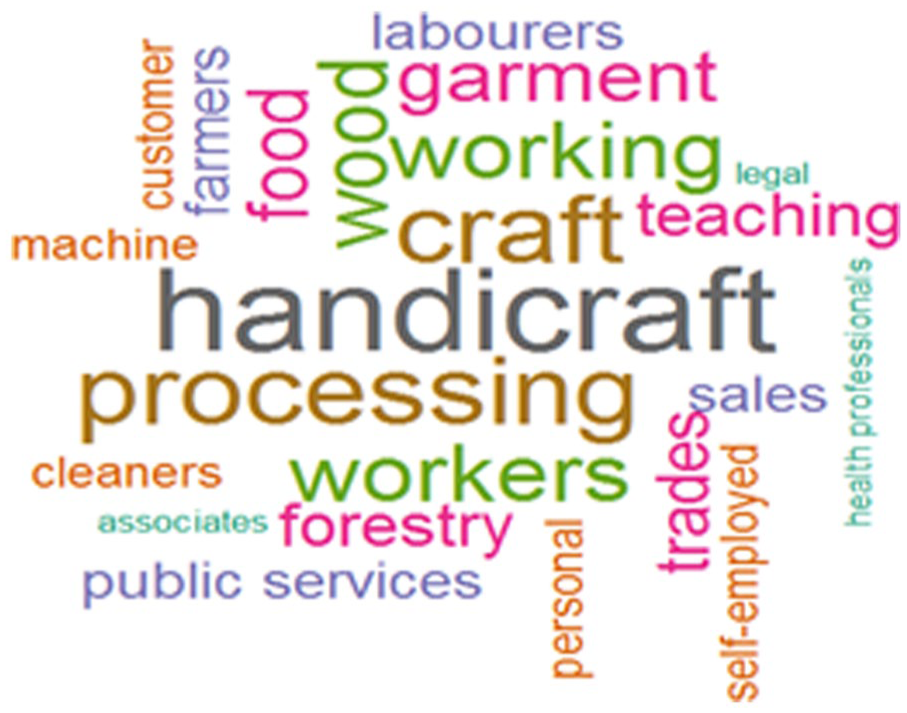
Word cloud for the professions of working women.
Table 2 represents Chi-square test of association between working status of women and complications during most recent pregnancy. Ten out of 26 disorders, including Fits/seizures, headaches, chest-pain, weight-loss, fever, lower abdominal pain, blurred vision, burning during urination, swelling of the ankles and feet, and general abdominal pain were found to be significantly associated with working status of women.
Chi Square Test for Working Status and Various Factors.

Significance at 5% level. **Significance at 1% level.
Assuming there is no natural ordering among delivery type, we consider our response variable as nominal. Table 3 represents multinomial regression model, where normal delivery is considered as reference category. From the model it can be concluded that for normal with force relative to normal delivery, the coefficients of Fits/seizures, chest pain, Weight loss, Lower abdomen pain, Burning urination, Swelling (ankles, feet), and Swelling face were significant. If a woman suffers from Fits/seizures, the relative risk of normal delivery with force would increase by 11.35 times. Similarly, chest pain increase this risk by 34.81, Weight loss by 3.57, Lower abdomen pain by 55.26, Burning urination by 3.54, Swelling (ankles, feet) by 10.51, and Swelling of face by 4.66 times. Similarly, for Cesarean section relative to normal delivery, the coefficients of Fits/seizures, chest pain, Weight loss, Fever, Lower abdomen pain, Blur vision, Swelling (ankles, feet), and Swelling of face were significant. If women suffer from Fits/seizures, the relative risk of normal delivery with force would increase by 23.75 times. Similarly, chest pain increases this risk by 1.05, Weight loss by 17.32, Fever by 1.119, Lower abdomen pain by 67.89, Blur vision by 2.567, Swelling (ankles, feet) by 8.49, and Swelling of face by 2.01 times. Out of 4561 pregnant women who gave birth recently, 1299 (28.5%) underwent a cesarean section, and 140 (3.1%) endured a forceps delivery.
Multinomial Regression Model for Modeling of Delivery Type.

Significance at 5% level. **Significance at 1% level.
Cluster Profiling of Verbal Autopsy Dataset
The verbal autopsy data was employed to generate clusters using k-modes approach. When alternative solutions were compared, it became clear that 3-cluster option was more suited to accomplishing study’s goals. Figure 3 demonstrate profiling of problems during last pregnancies of deceased women.

Detail profiling of clustering solution having 3 clusters.
Profiling of clustering solution for working status of women at time of death is shown in Table 4. Cluster-3 consisted of 372(69.92%) working women and 191 (29.70%) housewives. This suggests that working women’s leading causes of death were hepatitis, high blood pressure, diabetes, TB, heart disease, and blood-related illnesses. An unhealthy lifestyle is leading cause of many of these complications. For example working women generally have high-calorie lunches at their workplaces. 27 By establishing healthy exercise habits and consuming a balanced diet, working mothers might prevent these problems.
Summary Statistics of Working Status of Women In Verbal Autopsy Data-Set.

Similarly, cluster 2 is overwhelmingly made up of housewives, with 392 (60.96%) as opposed to 108 (19.73%) working women. This shows that disorders including asthma, anemia, jaundice, cancer, and water-born were the main determinants of mortality for housewives. Most of the time, the women are exposed to toxic air and water. These women spend majority of their day cooking, cleaning, and breathing toxic air. For most pregnant women, household chores are undesirable, yet they must be completed regularly. As a result, they suffer health complications during pregnancy and lost their life or fetus.
Figure 4 demonstrate profiling of cluster solution of problems during labor and postpartum period of deceased women.

Profiling of clustering solution.
According to Table 5, 394 (74.06%) working women lost their lives due to stillbirths, vertigo, and DNC issues during delivery and postpartum. Working women’s maternal health has been proven to be negatively impacted by an unhealthy lifestyle, long and unassisted travel, and workplace anxiety. During work hours, working women are far more likely to smoke and take drugs. This affects their developing fetus and results in miscarriages or stillbirths.
Cluster Profiling of Problems During Labor and Post Partum in Reference to Working Status.

Additionally, just like frequent travel, professional stress results in fatigue and sleepiness; this interferes with blood supply to fetus and ultimately results in the death of pregnant women. Most housewives do their household chores during their pregnancy. The center of gravity moves forward as the child keeps growing. Leaning backwards as a result of compensating for falling forward might strain the lower back muscles and make back discomfort during pregnancy worse. 30 While performing household chores housewives need to be aware of their posture. As 485 (75.19%) of housewives belong to Cluster-2, their negligence in household duties leads to abortions, placenta difficulties, back discomfort, and other disorders during birth and postpartum.
Discussion
The present study highlights significant disparities in maternal health outcomes between working women and housewives. It emphasizes how occupational and lifestyle contexts distinctly influence the nature of pregnancy-related complications. The findings contribute to the growing literature on women’s health by addressing an underexplored aspect, the contrast between domestic and occupational environments as determinants of maternal well-being.
A key contribution of this study lies in uncovering 2 distinct patterns of maternal health complications. Housewives were more likely to experience posture-related complications during pregnancy. This may be attributed to the persistent involvement of housewives in physically domestic chores, often performed without sufficient rest. The household chores performed with improper posture contribute to an increased risk of back pain and musculoskeletal problems.31-33 In contrast, working women were found to suffer more frequently from anxiety and stress-related conditions. These psychological challenges are linked to the dual burden of professional and family responsibilities. The professional stress and frequent traveling cause fatigue and sleepiness, which in turn disrupts adequate blood circulation to the fetus. Such physiological disruptions contribute to adverse pregnancy outcomes including maternal mortality.34-36
Health conditions and working status of women can influence the type of delivery. Some studies have shown that working women may have a higher risk of cesarean delivery, particularly if they have physically demanding jobs or work long hours. Women who worked in physically demanding jobs, such as agriculture, had a higher risk of cesarean delivery than those who worked in non-physically demanding jobs. However, it is important to note that other factors such as maternal age, education, and socioeconomic status may also play a role in the type of delivery. Healthcare providers should assess each woman’s individual circumstances and make recommendations based on her specific health needs.37,38
Limitations
A limitation of this study is the reliance on data from the Pakistan Maternal Mortality Survey (PMMS) 2019, which primarily focuses on maternal health outcomes during and after pregnancy. The survey does not explicitly distinguish between pre-pregnancy and pregnancy-related health conditions. Although the verbal autopsies conducted as part of the survey provided detailed information about the timing, causes, and circumstances of maternal deaths, allowing us to attribute health conditions and complications to the pregnancy or postpartum period, the potential influence of pre-pregnancy health conditions was not fully captured. Future research that incorporates longitudinal data or additional variables related to pre-pregnancy health would offer a more comprehensive understanding of these interactions.
The analysis does not include certain potentially significant confounding factors, such as the women’s nutritional status, psychological health, and access to prenatal and postnatal care services, which could influence the findings. Furthermore, the study was geographically limited, which may restrict the generalizability of the findings to other regions with different socioeconomic, cultural, and healthcare access conditions. Regional healthcare infrastructure variations may influence maternal health outcomes differently.
Conclusion
The findings of this study indicate that both working women and housewives in Pakistan face substantial maternal health risks. Although the nature of these risks differs according to occupational and lifestyle factors. Working women are more likely to experience complications such as seizures, severe headaches, and chest pain. These conditions are primarily associated with lifestyle factors, including smoking and poor dietary habits, exposure to work-related anxiety, and traumatic life events, including road accidents. Conversely, housewives are more affected by posture-related problems and household environmental factors, including general abdominal pain, anemia, and weight loss caused by indoor air and water pollution. As the baby grows, a pregnant woman’s center of gravity shifts forward, and she leans back to prevent falling forward. This might put stress on the lower back muscles and make back pain from pregnancy worse. Therefore, while workplace health policies and stress management programs are vital for working women. Housewives equally require awareness and education on maintaining proper posture and adopting safer household practices to protect maternal health. Therefore, workplace health policies and stress management programs are vital for working women. Similarly, housewives require awareness and education on maintaining proper posture and adopting safer household practices to protect maternal health.
Implications for Policy and Practice
Based on finding of this study, below are some recommendations for policymakers and health care providers to overcome the issues of maternal mortality:
Supplemental Material
sj-docx-1-inq-10.1177_00469580261436635 – Supplemental material for Statistical Analysis of Maternal Health Disparities Among Working Women and Housewives: A Cross-Sectional Study on Pregnancy-Related Issues, Safe Childbirth, and Maternal Mortality
Supplemental material, sj-docx-1-inq-10.1177_00469580261436635 for Statistical Analysis of Maternal Health Disparities Among Working Women and Housewives: A Cross-Sectional Study on Pregnancy-Related Issues, Safe Childbirth, and Maternal Mortality by Muhammad Atif, Gohar Ayub, Irum Afridi, Muhammad Farooq, Muhammad Shafiq, Muhammad Ilyas and Zia Ur Rahman Rasikh in INQUIRY: The Journal of Health Care Organization, Provision, and Financing
Footnotes

Ethical Considerations
The study is Cross-Sectional in nature and the dataset being used is publicly available on official website of DHS, and did not involve collection of new information from human pariticipants, human biological materials, or laboratory animals. Therefore, ethical approval was not required.
Consent for Publication
Not applicable, as this study was based exclusively on secondary data analysis of publicly available/anonymized datasets and did not involve identifiable individual-level information.
Author Contributions
Funding
The authors received no financial support for the research, authorship, and/or publication of this article.
Declaration of Conflicting Interests
The authors declared no potential conflicts of interest with respect to the research, authorship, and/or publication of this article.
Data Availability Statement
Supplemental Material
Supplemental material for this article is available online.