



Abstract
Women remain significantly underrepresented in the Merchant Marine workforce, and little empirical research has examined how gendered occupational settings influence their perceived well-being. Guided by Bronfenbrenner’s Ecological Systems Theory, this mixed-methods study explored how individual experiences, organizational culture, and policy frameworks interact to shape gender inclusion and occupational well-being among Colombian women seafarers. Seventeen officers (73.9% of the accessible population) completed a descriptive survey and in-depth interviews. Quantitative data profiled demographic and professional characteristics, while qualitative narratives revealed experiences of restricted technical duties, harassment, and limited institutional support within male-dominated environments. Despite these barriers, participants demonstrated strong agency and adaptive coping strategies that sustained professional engagement. Findings highlight that perceived well-being is shaped by micro-level personal factors, meso-level organizational dynamics, and macro-level regulatory contexts. The study contributes to Gender Equity and Occupational Health scholarship by linking individual experiences to institutional and regulatory environments and recommends gender-responsive maritime training, independent reporting mechanisms, and integrated mental-health policies to promote equitable and sustainable seafaring careers.
Practical Implications
This study provides actionable guidance for maritime institutions and policymakers seeking to reduce attrition and advance gender equity at sea in alignment with Sustainable Development Goal 5 and the UN Decade of Ocean Science for Sustainable Development. For Maritime Education and Training (MET) institutions, embedding psychosocial preparedness, mentorship, and training in languages can enhance women’s career continuity and professional confidence.
MET institutions should adopt combined implementation strategies that integrate top-down policy commitments with bottom-up participatory approaches. As demonstrated by Barahona-Fuentes et al 1 involving educators directly in gender-mainstreaming processes through targeted training and collaborative resource development increases institutional capacity for sustainable change. Gender-sensitive teacher training that enables faculty to critically assess their curricula, eliminate stereotypes, and incorporate inclusive language and examples can transform institutional culture more effectively than policy documents alone. Furthermore, creating communities of practice among MET educators to share gender-inclusive teaching resources and methodologies foster collective ownership of equity goals and facilitates knowledge transfer across institutions, an approach that may be particularly valuable for emerging maritime education systems seeking to accelerate progress toward SDG 5.
For shipping companies, implementing confidential reporting mechanisms, clear anti-harassment protocols, and transparent promotion pathways will strengthen retention and foster safer, more inclusive workplaces. For regulators, systematic gender-disaggregated data collection and active monitoring of MLC and STCW compliance, including confidential reporting channels at company and national levels, are essential to transform symbolic commitments into measurable progress. Together, these measures can convert resilience from an individual survival strategy into an institutional culture of safety, inclusion, and sustainable maritime employment.
The Maritime Labor Convention (MLC, 2006) establishes seafarers’ right to a safe and decent workplace, including explicit provisions for welfare and protection from harassment under Title IV. The findings of this study highlight persistent gaps in the implementation of these protections, particularly in reporting mechanisms and psychosocial support for women at sea. Similarly, the forthcoming amendments to the Standards of Training, Certification and Watchkeeping (STCW, 2026) emphasize psychosocial preparedness, behavioral competence, and anti-harassment awareness as integral to professional formation. The evidence presented here reinforces the relevance of these global frameworks and offers empirical support for their national implementation through MET curricula and company-level procedures.
Ultimately, advancing equality for seafarers also advances the sustainability of the Ocean we depend on, recognizing that the well-being of those who work at sea is integral to the health of the ocean itself.
Introduction
Maritime transport moves nearly 80% of world trade 2 and remains essential to global supply chains. Yet life at sea entails occupational stressors: extended isolation, fatigue, and exposure to physical and psychosocial risks that affect health and safety.3,4 Despite advances in safety management, seafarers continue to report high levels of depression and anxiety.5,6 Mental-health concerns are often under-recognized, reinforced by a professional culture that values endurance and self-reliance. 7
Women remain a small minority in this workforce, representing less than 2% of the world’s 1.2 million seafarers. 8 Studies from Europe and Asia show persistent patterns of restricted access to operational duties, unequal promotion, and limited mentorship.9,10 These structural barriers combine with psychosocial stressors that heighten vulnerability to harassment, exclusion, and decreased well-being.6,11 Studies consistently indicate that younger and female seafarers are more vulnerable to occupational stress and mental-health problems, often related to lower job control, social isolation, and exposure to psychosocial risks within male-dominated shipboard cultures. 12
Although international initiatives have promoted diversity in maritime employment, most empirical evidence still derives from Europe and Asia. Research on women’s seafaring experiences in Latin America remains limited. The first Colombian woman qualified as a Deck Officer STCW II in 2015, and by 2023 only 23 women had graduated from the national merchant-marine program. 13 This batch of graduates provides an opportunity to examine how national education, and regulatory reforms intersect with gender inclusion and well-being.
This study is guided by Bronfenbrenner’s Ecological Systems Theory.3,14 The ecological model conceptualizes well-being as shaped by interacting systems: micro (individual seafarers’ lived experiences), meso (organizational and educational structures), and macro (policy and regulatory frameworks such as the Maritime Labor Convention 2006 and the Standards of Training, Certification and Watchkeeping 1978 and subsequent amendments). This multilevel perspective clarifies how gendered experiences at sea are influenced by institutional and structural conditions, emphasizing that improving inclusion and well-being requires both individual agency and systemic change.
Building on this understanding of how organizational environments shape psychosocial outcomes, recent evidence from other maritime regions provides additional context for the competency demands that influence seafarer retention. While research on psychosocial stressors in Latin American seafaring contexts remains limited, European blue economy sectors have systematically documented the critical role of soft and cross-cutting competencies in maritime career sustainability. A comprehensive skills survey conducted across European maritime industries found that communication and teamwork, innovation and problem-solving, and adaptability and resilience are consistently rated as essential competencies across short, medium, and long-term planning horizons. 15 This evidence suggests that technical expertise alone is insufficient, seafarers must also develop interpersonal, cognitive, and adaptive capacities to navigate the complex psychosocial demands of shipboard life a requirement that appears to transcend regional maritime labor markets.
The European findings further identify ocean literacy and cross-cultural competence as emerging priorities, with their perceived importance increasing progressively over time. 15 Whereas European maritime education and training (MET) systems are increasingly integrating these competencies into formal curricula, Latin American programs, including Colombia’s ENAP, have focused predominantly on technical and disciplinary preparation. This disparity suggests that Colombian women seafarers may enter the workforce without adequate preparation for the interpersonal and adaptive demands documented internationally. For women who already face heightened scrutiny and restricted access to informal mentorship networks, the expectation to excel across this expanding and internationally standardized skill set may intensify role strain and contribute to the retention challenges observed in this study.
Research across regions continues to document discrimination, work–life imbalance, and limited mentorship opportunities for women seafarers. Studies of shipboard culture and leadership also highlight the persistence of masculine norms and informal practices that constrain inclusion.9,16 Collectively, this evidence indicates that barriers to gender equity in seafaring are maintained through the interaction of individual experience, organizational culture, and regulatory structures.
Building on this evidence, the present research examines how Colombian women seafarers perceive their workplace environments, inclusion practices, and perceived well-being. Using a mixed-methods ecological design, it combines quantitative demographic profiling with qualitative narratives to identify how individual, institutional, and policy-level factors influence gender inclusion and occupational well-being.
The study addresses the problem that limited evidence exists on how multilevel factors shape inclusion and well-being among women seafarers in Latin America. It contributes to scholarship on Gender Equity and Occupational Health, linking individual experiences to institutional and regulatory contexts and offering one of the first empirical analyses from the region.
The following section presents a thematic literature review organized into 5 analytical areas: (1) motivations and pathways into seafaring careers, (2) psychosocial stressors and retention, (3) harassment, discrimination, and organizational culture, (4) maritime education and training (MET) as a gendered foundation, and (5) policy and structural frameworks for gender equity each analyzed through an ecological-systems lens.
Literature Review
Motivations and Pathways Into Seafaring Careers
Women’s motivations to pursue seafaring include income mobility, international experience, and technical interest, but entry is filtered by gendered norms and limited encouragement during training and recruitment.17 -19 Digitalization is reshaping required skills and may widen pathways into navigation, information management, and hybrid shore-ship roles, while structural barriers remain. 20 In Latin America, empirical evidence is scarce. Within an ecological view, career choice reflects micro-level agency shaped by meso-level opportunity structures in MET and hiring.
Psychosocial Stressors, Mental Health, and Retention
Seafaring has long been recognized as a profession characterized by extended isolation, demanding work rhythms, and psychological strain.3,21 The prevalence of fatigue, anxiety, and depression among seafarers remains consistently higher than in comparable occupational groups.5,22 Svetina 6 and Carrera-Arce and Bartusevičienė 23 both identify the interplay of environmental, social, and organizational stressors as key predictors of mental-health outcomes.
For women, these stressors are compounded by gendered expectations and limited confidence in institutional responses. The ISWAN 24 and Mission to Seafarers 25 surveys show that women report greater loneliness, anxiety, and work-life conflict than their male counterparts. Respondents described feeling “constantly observed,” which contributed to heightened self-monitoring and stress. These findings highlight how micro-level experiences, such as privacy, communication, and recognition directly influence psychological well-being.
New forms of digital isolation also affect mental health. Jensen 26 shows that fragmented shipboard connectivity restricts social contact, increasing stress and reducing help-seeking behavior. Although mental-health programs are expanding, stigma continues to discourage disclosure, and organizational responses remain reactive rather than preventive. 5
From an ecological perspective, psychosocial well-being reflects the intersection of individual coping strategies and organizational environments. When institutional mechanisms for psychological safety are absent, micro-level vulnerabilities, such as stress, burnout, and low perceived support, can escalate into broader turnover and retention challenges within the maritime workforce. 7
Brooks and Greenberg 12 conducted a comprehensive systematic review of 63 studies examining mental health factors among maritime personnel published between 2012 and 2021, revealing that seafarers constitute an exceptionally isolated occupational group due to their unique circumstance of remaining in their workplace continuously during both working and non-working hours with only colleagues for companionship. Their synthesis documents that prolonged separation from home and family, coupled with conflicts across ranks and departments, consistently contributes to loneliness and homesickness. The review identifies multiple stressors operating cumulatively: high job demands, extended working hours exceeding 10 h daily, night and irregular shift patterns, scheduling uncertainties including deployment at short notice and mandatory tour extensions, and lack of job-related autonomy all emerge as significant predictors of emotional exhaustion, depression, and intentions to leave the maritime industry.
Critically, the authors emphasize that uncertainty regarding work scheduling including being deployed without adequate rest, commencing work on unfamiliar vessels without familiarization training, and experiencing mismatches between expected and actual tour durations is perceived by seafarers as directly linked to increased risks to safety and wellbeing. These findings underscore that psychosocial strain among maritime personnel results not from isolated incidents but from the intersection of physical isolation, temporal unpredictability, and limited control over work conditions a pattern that intensifies vulnerability particularly among younger and less experienced seafarers.
Harassment, Discrimination, and Organizational Culture
Studies across fleets document bullying, harassment, and under-reporting, with inclusion shaped by daily interactional norms and leadership practices rather than policy texts alone., Shipboard cultures that valorize endurance and masculine competence constrain women’s access to technical duties and advancement, and perceptions of inclusion vary by rank and multinational crew composition. In ecological terms, organizational culture is a meso-level mechanism that mediates micro-level experiences and limits the practical reach of macro-level standards.
Maritime Education and Training (MET)
MET is the first structured environment where professional identity and expectations are formed. Research identifies persistent stereotyping in curriculum, assessment, and leadership models.11,16 Recent work links targeted education and training to prevention of bullying and harassment and notes the relevance of forthcoming STCW 2026 amendments that require competence in these areas. 27 Program modernization for example, digitally structured cadet training aligned with company supervision: illustrates feasible models to strengthen competence development and feedback. 28
However, implementing gender-inclusive policies in MET institutions requires more than top-down legislative mandates. Barahona-Fuentes et al 1 argue that traditional hierarchical approaches to gender-policy implementation often fail to provide practical tools for application or to recognize the agency of educators who can actively contribute to institutional transformation. Their analysis of MET institutions reveals that despite international gender-equality legislation, specific policies targeting female student recruitment remained limited or nonexistent in most institutions, resulting in persistently low female enrollment rates across a decade of data (2009-2018).
The authors advocate for bottom-up methodologies that empower teachers through gender-sensitive training, enabling them to identify biases, incorporate diverse role models, and develop inclusive pedagogical practices. This approach transforms educators from passive recipients of policy directives into active agents of cultural change, creating ownership and contextual adaptation that top-down mandates alone cannot achieve. Such participatory implementation strategies may prove particularly relevant in Latin American contexts where institutional capacity for gender mainstreaming is still emerging, while digital-skill pathways can also expand access for women. 20 Framed ecologically, MET is a meso-level lever that can reproduce or disrupt the norms later encountered onboard.
Policy and Structural Frameworks for Gender Equity
At the macro level, international regulatory frameworks set the boundaries for inclusion and welfare at sea. The Maritime Labor Convention (2006) and the Standards of Training, Certification and Watchkeeping (1978, amended) established the global baseline for decent working conditions and competence, respectively. Recent policy developments, particularly the anticipated STCW 2026 amendment, explicitly include anti-harassment and gender-sensitivity requirements. 27
Kitada, 16 IMO and WISTA 8 highlight that although policy language now references gender equity, implementation and monitoring remain inconsistent. From an ecological perspective, these policies represent the outermost context influencing all other levels. When macro-level commitments fail to penetrate organizational culture or educational practice, the result is limited behavioral change. Effective gender mainstreaming therefore requires coordination across policy, institutional, and individual domains.
Methodology
Research Design
This study adopted a pragmatic research orientation, recognizing that the complex social realities of women’s work at sea require multiple forms of evidence to generate understanding and actionable insight. Pragmatism enables the integration of quantitative and qualitative strands, valuing both measurable patterns and lived experiences as complementary sources of knowledge. This orientation aligns with the study’s ecological perspective, which views inclusion and well-being as outcomes shaped by dynamic interactions among individual, institutional, and policy systems.
A convergent design was selected because it enables simultaneous collection and equal prioritization of quantitative and qualitative data, allowing for direct comparison and mutual validation of findings within a single phase of data collection. This approach was particularly appropriate given the study’s dual objectives: to characterize the demographic and occupational profile of a small, clearly defined population (quantitative), while capturing the depth and complexity of lived experiences within male-dominated shipboard environments (qualitative). Unlike sequential designs that would require multiple phases of data collection from an already limited population, the convergent approach maximized participant engagement efficiency while preserving the ability to identify both patterns of convergence and points of divergence between numerical trends and narrative accounts.
The study employed a convergent mixed-methods design, combining descriptive quantitative analysis with interpretive qualitative inquiry. Quantitative data were used to contextualize the demographic and occupational profile of participants, while qualitative data provided depth and nuance regarding workplace culture, inclusion, and perceived well-being. Both data strands were collected concurrently and integrated during analysis.
Research Approach
The research followed an abductive logic, moving iteratively between theory and data. A deductive orientation guided the application of Bronfenbrenner’s Ecological Systems Theory 3 as an analytical framework to structure inquiry across micro (individual), meso- (organizational), and macro (policy) levels. Simultaneously, inductive reasoning was used to identify emergent patterns from participants’ narratives, allowing insights to inform interpretation.
Research Strategy and Context
A case-study strategy was selected to enable in-depth examination within a bounded context, specifically, Colombian women Deck Officers trained at the Escuela Naval de Cadetes “Almirante Padilla” (ENAP) between 2015 and 2023. This approach was appropriate given the small population size (23 graduates) and the study’s objective of understanding how national training structures and maritime labor conditions influence women’s experiences at sea. Focusing on a defined institutional and national setting also aligns with the ecological emphasis on nested systems of influence.
Sampling and Participants
The population comprised all 23 women who had graduated as Deck Officers from ENAP’s merchant-marine program since 2015. A census-based purposive sample was attempted to reach the entire group of graduates. Twenty participants were successfully contacted, only 17 consented and completed the full process, representing 73.9% coverage of the total population.
Data Collection
Data collection occurred between October 2023 and April 2024 using 2 complementary instruments:
Structured survey, which gathered demographic and occupational data, educational background, and perceptions of professional development.
Semi-structured interviews, which explored experiences of inclusion, exclusion, well-being, and career aspirations.
Interviews were conducted via Microsoft Teams to accommodate time-zone differences and connectivity limitations for participants at sea. Each session lasted between 40 and 70 min, was audio-recorded with consent, and later transcribed verbatim. The online setting provided flexibility and access to dispersed participants, but may have constrained openness in some discussions due to potential connectivity interruptions and limited privacy. To mitigate these effects, participants selected their preferred time and environment to ensure confidentiality and comfort. All materials were produced in Spanish, transcripts and illustrative quotations were translated into English for reporting, with careful attention to preserving meaning and tone. No back-translation was required because analysis was performed in Spanish by bilingual researchers prior to translation of excerpts.
Ethical Considerations
The Research Ethics Committee of the Corporación Universitaria Reformada, at its Ordinary Session No. 09 held on October 30, 2024, after conducting a comprehensive review of the methodological, ethical, and personal data protection aspects, granted ethical approval for the development and implementation of the research project entitled “The Sociodemographic and Labor Profile of Professional Female Merchant Marine Officers in Colombia and Its Possible Relationship with Their Employment Prospects,” having verified that it fully complies with the ethical principles established in the applicable institutional and national regulations.
This approval is issued in accordance with Rectoral Resolution No. 010 of November 6, 2024, which formally authorizes the execution of the project. As part of the data collection process, participants were provided with a clear and comprehensive information sheet detailing the objectives of the study, the confidentiality measures in place, and the guarantees of voluntary participation. Informed consent was obtained electronically, ensuring participants’ free and duly informed agreement to the terms of participation.
To safeguard participants’ identities, all personally identifiable information was removed and numerical codes were used in the transcripts. Given the sensitive nature of certain topics addressed—such as harassment and discrimination—ethical care measures were adopted to prevent any potential distress, and participants were assured of their right to pause or withdraw from the study at any time without any adverse consequences. Finally, all digital data were securely stored in encrypted files, with access strictly limited to the research team.
Data Analysis
Quantitative survey data were tabulated in Excel and analyzed through descriptive statistics (frequencies and proportions) to characterize sociodemographic profiles and occupational patterns. Given the small-N dataset, inferential testing was not appropriate, instead, the results were used to contextualize qualitative themes. Accordingly, greater analytical emphasis was placed on the qualitative strand, which provided richer contextual insights into the lived experiences underlying the descriptive patterns observed in the quantitative data.
Qualitative interview data underwent thematic analysis guided by the ecological framework. Coding was performed through an AI-assisted qualitative analysis process using a large language model under strict human supervision. The AI tool facilitated initial code generation and clustering of recurrent concepts across transcripts. The research team then reviewed, refined, and validated these codes manually to ensure contextual accuracy and interpretive depth to the original transcript. Themes were cross-checked across researchers to ensure consistency and credibility. This hybrid approach improved transparency and efficiency while maintaining human analytical oversight. Thematic saturation was reached by approximately the 14th interview, as no new categories or insights emerged thereafter, and subsequent interviews confirmed existing patterns, supporting analytical adequacy.
Results from both strands, quantitative and qualitative, were integrated at the interpretation stage through triangulation. Quantitative profiles helped situate individual narratives within broader demographic patterns, while qualitative insights enriched the understanding of how systemic and institutional factors shaped well-being and career projections.
Results from both strands were integrated at the interpretation stage through triangulation using a side-by-side comparison approach. 29 Quantitative demographic profiles and descriptive statistics were first presented to contextualize the participant sample, establishing baseline characteristics such as age distribution, service tenure, and employment status. Qualitative themes were then developed inductively through thematic analysis of interview transcripts. Integration occurred through 3 analytical procedures: (1) convergence assessment, where qualitative narratives were examined to confirm, refute, or nuance quantitative patterns (eg, the inverse correlation between tenure and career projection was explored through participants’ evolving motivations), (2) complementarity analysis, where qualitative data provided explanatory depth to quantitative trends (eg, low employment satisfaction scores were contextualized through descriptions of contract instability and isolation), and (3) divergence exploration, where inconsistencies between data types prompted deeper interrogation (eg, high self-assessed competencies contrasted with reports of restricted technical duties).
Limitations and Reflexivity
The study acknowledges limitations related to its small population and cross-sectional design. Findings cannot be generalized beyond the specific institutional context but offer transferable insights for comparable maritime education and labor systems. Reflexively, the study team comprised female researchers with professional experience in maritime, which facilitated rapport and open dialog but may have influenced interpretation through shared positionality. No standardized psychological instrument was applied to measure mental health. Instead, perceptions of well-being and mental strain emerged qualitatively through participants’ self-reports during interviews.
Results
Participant Profile
Seventeen women completed the survey and interviews, representing 73.9% of the total national population of 23 Colombian women Deck Officer graduates from the Escuela Naval de Cadetes Almirante Padilla (ENAP) between 2015 and 2023. Participants ranged from 24 to 32 years of age and all had graduated under ENAP’s dual defense–merchant-marine curriculum. At the time of data collection, 10 (58.8%) were employed at sea and 7 (41.2%) were ashore or between contracts. Sea-service experience clustered in early-career stages: ≤ 4 years = 11 (64.7%), 5 to 7 years = 4 (23.5%), and >7 years = 2 (11.8%). These figures confirm that Colombia’s women seafarers remain a numerically small, first-generation group concentrated in junior ranks.
Motivations and Pathways Into Seafaring Careers
Only 35.3% (n = 6) reported having relatives in maritime occupations, showing that entry into seafaring was largely self-initiated rather than inherited. Across participants, motivation stemmed from individual agency and curiosity rather than external encouragement. Qualitative narratives revealed 3 consistent motivations:
Exploration and Adventure: the appeal of working at sea and traveling internationally,
Technical and Professional Interest: attraction to a specialized, skill-based career,
Personal Challenge and Self-Development: the desire to prove competence in a male-dominated environment.
“I always liked maritime issues, but I also saw that it was a field underexplored by women.” “I decided on my own, no one in my family is in the sector.”
The maritime school admission process was viewed as competitive but not explicitly inclusive, few recalled female role models or institutional campaigns promoting women’s enrollment. Career projection, rated on a 0 to 10 scale, averaged 6.29 (median 7.0). However, projection declined sharply with tenure (r = –0.69): officers with ≤4 years of experience averaged 7.73, those with 5 to 7 years averaged 4.75, and those with >7 years averaged 1.50.
“You start with dreams, but the longer you stay, the more you want to get off.”
This inverse relationship between tenure and projection demonstrates how micro-level enthusiasm erodes under meso-level structural stagnation. Women’s entry into the profession is therefore characterized by individual ambition but undermined by limited institutional and market pathways for progression.
Psychosocial Stressors, Mental Health, and Retention
Employment satisfaction was low (median 4.0/8). Participants described persistent fatigue, isolation, and anxiety as inherent to life at sea. None reported access to counseling or psychological-health programs during embarkation. Instead, coping relied on personal endurance, prayer, or contact with family during port calls.
“You can’t show fear, not even sadness.” “If you make a mistake, it becomes a reason to say women shouldn’t be here.”
Contract instability amplified stress: 41.2% were ashore when surveyed, often waiting months for re-employment.
“You finish one contract and don’t know if there will be another.”
Longer service correlated with reduced optimism: officers beyond 7 years of experience all rated their career projection ≤3 points and spoke of transferring ashore.
“I’ve learned everything I can here. Now I just want a stable job on land.”
Collectively, these findings indicate that psychological well-being deteriorates with tenure, transforming early motivation into withdrawal intention. Ecologically, individual coping replaces organizational support.
Harassment, Discrimination, and Organizational Culture
All participants referenced gender bias, 82% (n = 14) reported experiencing verbal or relational exclusion.
“They doubted everything you did, even if you had the same rank.” “The worst part is when the captain tells jokes about women in front of everyone.”
Harassment was most often verbal or expressed through isolation rather than physical aggression. Participants described uncertainty about how to proceed when facing harassment or inappropriate behavior onboard. No participant had ever filed a formal complaint, citing fear of retaliation or futility, reinforcing a sense of vulnerability and silence.
“Reporting would just make you the problem woman.”
Crucially, none had received formal instruction on how to respond to or report harassment.
“No one ever told us what to do in those cases, you just adapt.”
This procedure’s absence produced self-adjustment behaviors: avoidance or silence. Only 2 women who served on foreign-flag vessels reported awareness of organizational anti-harassment protocols. The remainder associated “enduring” with professionalism. The lack of preventive guidance converts an institutional obligation into emotional labor by individuals.
At the meso level, this absence of procedural literacy exemplifies the breakdown between macro-level policy and workplace implementation. Cultural change remains leader-dependent:
“When the captain trusted me with maneuvers, everything changed.”
These results show that organizational culture, rather than formal regulation, determines daily safety and inclusion.
Maritime Education and Training (MET)
All participants trained at ENAP, describing its structure as technically rigorous but socially rigid.
“Everything from the uniform to the drills was designed for men.” “In school we learned to adapt to a military culture, you must not show weakness.”
Earlier cohorts reported zero female instructors, later cohorts mentioned isolated seminars on gender equality but no substantive curricular reform. No participant recalled instruction on harassment prevention or reporting.
“They teach you to fight fires, but not to deal with these situations.”
Internship placement was the most cited barrier: 10 of 17 (58.8%) faced delays or rejections because companies “did not want women onboard.” Language and digital-navigation deficiencies further limited access to international contracts.
Quantitatively, 70.6% rated English preparation as “insufficient” or “very insufficient.” Participants associated English competence with employability:
“You can be the best officer, but without English you stay behind.”
From an ecological standpoint, MET operates as the meso-level bridge between individual aspiration and industry norms. Its disciplinary culture reproduces silence as a professional virtue, reinforcing patterns observed later at sea.
The radar chart compares self-perceived (solid line) and peer-perceived (dashed line) competencies across 4 domains: personal, relational, directive, and cognitive. Values represent the proportion of skills identified in each category (Figure 1).
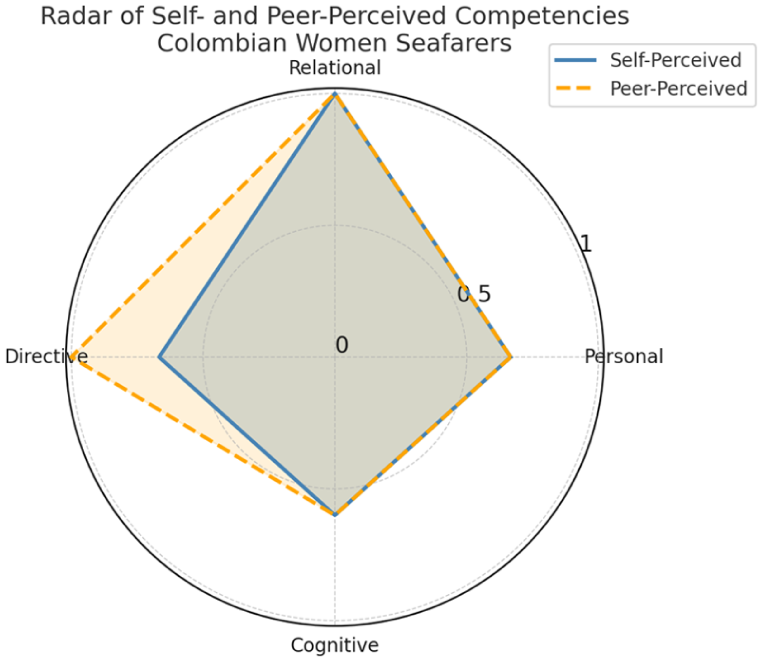
The radar chart compares self-perceived (solid line) and peer-perceived (dashed line) competencies across 4 domains: personal, relational, directive, and cognitive.
The figure shows that participants tend to value adaptability and interpersonal transparency as their main strengths, whereas they attribute success in peers to directive and cognitive competencies such as leadership, risk management, technology use, and language proficiency. These contrasts suggest persistent perception gaps between self-concept and observed professional models.
Policy and Structural Frameworks for Gender Equity
Although participants demonstrated awareness of policies such as MLC 2006 and STCW 1978, none could identify concrete procedures or national contact points for reporting harassment or accessing welfare services.
“We know the rules exist, but no one explained what protection we actually have.”
Most participants confirmed the absence of institutional support or mentoring networks for women seafarers. Visibility initiatives were appreciated symbolically but considered disconnected from operational realities:
“At least they talk about us now”
This macro-to-meso disconnection illustrates how international commitments remain rhetorical without enforcement. Regulatory standards exist, yet no mechanism ensures their translation into company policy, data monitoring, or accountability. Participants’ lack of procedural knowledge demonstrates that structural reform has yet to reach the operational layers.
Across all themes, quantitative and qualitative data converge on a coherent pattern: women’s early enthusiasm and competence encounter cumulative institutional fatigue.
At the micro level, officers display motivation, professionalism, and resilience but internalize the need to self-regulate.
At the meso level, organizational and educational structures replicate hierarchical, masculine norms while lacking procedural clarity and psychological-safety mechanisms.
At the macro level, policy frameworks remain detached from implementation, leaving individuals to navigate inequity without institutional backing.
The correlation between tenure and declining career projection (r = –0.69) quantifies this ecological imbalance: personal endurance cannot substitute for systemic support. The present case demonstrates the emergence of a new professional group whose existence is both a milestone and a warning, visibility has increased, but sustainability and their perceived well-being have not.
These results represent the first empirical account of Colombian women merchant-officer experiences. They reveal that inclusion, retention, and well-being are co-determined across interacting systems and will remain fragile until educational institutions, employers, and regulators align their practices with the gender-equity principles enshrined in international maritime conventions.
Ecological Integrative Model
Figure 2 presents an integrative model that links the quantitative and qualitative findings within an ecological framework. It conceptualizes women’s maritime careers as dynamic systems shaped by reciprocal influences across macro, meso, and micro levels. At the micro level, individual motivation and coping act as initial pull forces but weaken over time under meso-level organizational cultures that normalize silence and endurance. Macro-level policy gaps further intensify this imbalance, allowing institutional and psychosocial stressors to accumulate into a measurable decline in career projection with tenure.
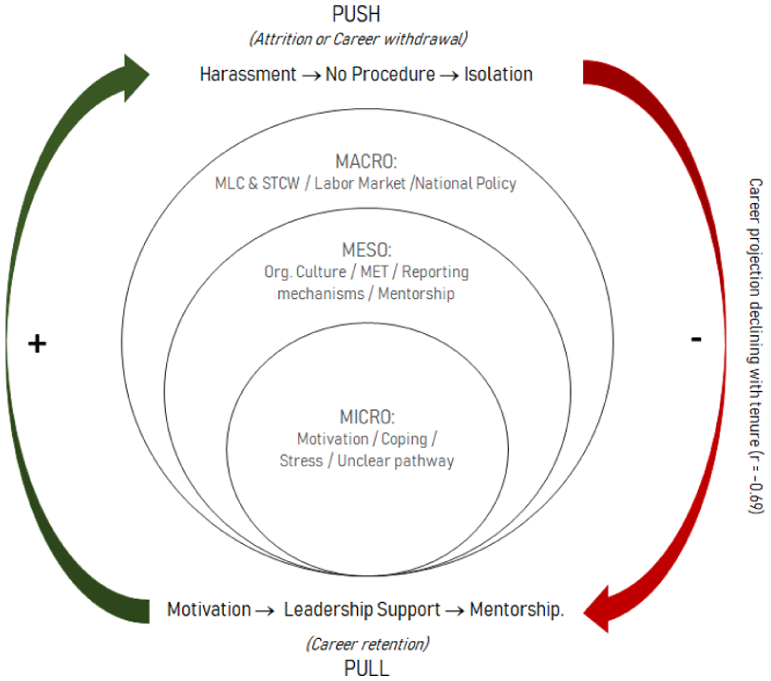
Eco-integrative model.
The model thus proposes a push–pull ecology of inclusion and retention, in which systemic deficiencies can generate attrition. As a conceptual foundation, it offers testable pathways for future research: (a) the mediating role of institutional support between stress and retention, (b) the moderating effect of mentorship on career projection, and (c) the impact of MET reforms and national policy enforcement on well-being at sea. By visualizing how resilience, culture, and policy intersect, the model invites comparative application across regions and provides a framework for evaluating gender-equity interventions in maritime education and employment.
Discussion
This study provides one of the first empirical portraits of women’s seafaring experiences in Latin America, revealing how inclusion and well-being are shaped by cumulative pressures across personal, institutional, and structural levels. Although participants demonstrated motivation, adaptability, and professional commitment, the data expose a progressive erosion of career projection with tenure. Rather than individual disengagement, this pattern reflects a systemic dynamic in which enduring gendered constraints gradually offset early enthusiasm.
Findings echo international evidence indicating that women’s participation at sea remains limited not because of entry barriers alone but due to retention failures linked to organizational culture and perceived exclusion.8,9 Participants described a persistent need to prove competence within male-normed hierarchies and a lack of procedural clarity when facing harassment or role marginalization. Over time, these conditions create a negative feedback loop: as experiences of exclusion accumulate, motivation declines, leading to lower retention and further normalization of under-representation. This cyclical mechanism parallels global findings on psychosocial stress among seafarers, where continuous exposure to inequity amplifies fatigue and emotional withdrawal.5,6
Despite these pressures, women exhibited significant agency and resilience, drawing on solidarity networks and self-affirmation to remain engaged. Yet resilience alone cannot compensate for structural neglect. When formal support systems, such as reporting mechanisms, mentoring, and transparent career pathways are absent, coping becomes individualized and unsustainable. The balance between pull factors (motivation, mentorship, leadership support) and push factors (isolation, harassment, no reporting mechanisms) thus shifts over time, ultimately favoring attrition. The conceptual model developed from this study illustrates this feedback process: systemic gaps at the macro and meso levels reinforce individual strain, producing a self-perpetuating cycle of loss for both workers and the industry.
At the institutional level, the findings underscore the pivotal role of Maritime Education and Training (MET) institutions. Participants identified English proficiency, risk-management skills, and technological literacy as areas linked to professional credibility. Integrating these competencies within curricula, alongside psychosocial preparedness and gender-sensitivity modules, could strengthen both employability and well-being, these recommendations are aligned to recent calls for inclusive MET reforms.16,27 Shipping companies and maritime authorities could further mitigate attrition by developing confidential reporting systems and structured mentorship programs that extend beyond cadetship.
From a policy perspective, the study highlights the need for stronger alignment between international conventions and national enforcement. While the Maritime Labor Convention and forthcoming STCW amendments provide frameworks for decent work and anti-harassment standards, their impact depends on implementation at the flag-state and company levels. 22 For emerging maritime nations such as Colombia, establishing gender-responsive oversight and data monitoring mechanisms is essential to translating global commitments into everyday safety and inclusion practices.
Finally, although the study’s cross-sectional and small-population design limits generalizability, the nearly complete coverage of the national cohort in this maritime education pathway, enhances internal validity and offers a basis for comparative inquiry. Future research should adopt longitudinal and multi-country approaches to examine whether similar feedback loops operate across different maritime cultures and policy regimes. Such evidence is crucial to designing interventions that sustain women’s participation not only through entry, but across the full trajectory of maritime careers.
An additional theme, noted by a small number of participants, suggested that nationality may compound gender-based disadvantage, particularly in multicultural crews or foreign-flagged vessels. Although this pattern was not sufficiently frequent to be generalized, it indicates an area warranting further study. Future research could explore how intersections of gender, nationality, and language proficiency influence inclusion and career progression among Latin American seafarers within global fleets.
Conclusions
This study advances understanding of how gender inclusion and occupational well-being interact within maritime professions by examining the experiences of Colombian women seafarers. Through a mixed-methods ecological design, it reveals that declining career projection over time is not the result of individual fatigue but of cumulative institutional and structural pressures that erode motivation. As women persist in environments that reward endurance over support, resilience becomes a temporary shield rather than a sustainable strategy.
The findings demonstrate that attrition emerges from a negative feedback loop: limited procedural guidance, unstable employment, and cultural isolation progressively outweigh the motivational pull of vocation and pride. Breaking this cycle requires simultaneous action at multiple levels. At the educational level, MET institutions should integrate psychosocial preparedness, mentorship, and gender-sensitivity components alongside technical training. At the organizational level, companies need transparent reporting procedures, leadership accountability, and clear career pathways to convert symbolic inclusion into everyday equity. At the policy level, maritime authorities should strengthen oversight mechanisms that translate international conventions: MLC, STCW, and future amendments, into enforceable national practice supported by data monitoring.
By documenting the first full national cohort of Colombian women Deck Officers, this research offers an empirical baseline and a conceptual model applicable across emerging maritime nations. Sustaining women’s presence at sea will depend on addressing not only who enters the profession, but how systems evolve to ensure that those who enter can thrive, advance, and remain. The voices of these pioneering officers echo beyond their own careers, signaling what must change so that future generations of women at sea navigate with equity and purpose.
Footnotes
Acknowledgements
With gratitude to Anna W. Karunatileke (Sri Lanka), for her essential contributions and commitment to academic rigor. The authors extends appreciation to the women seafarers who participated in this study for their trust and courage in sharing their experiences. Gratitude is also expressed to the Escuela Naval de Cadetes “Almirante Padilla” (ENAP) for granting access to graduate data that made this research possible, and to Juliana Mancera, Education lead of the Colombian Commission for the Ocean (CCO), for fostering research that contributes to the Ocean We Want.

Funding
The authors received no financial support for the research, authorship, and/or publication of this article.
Declaration of Conflicting Interests
The authors declared no potential conflicts of interest with respect to the research, authorship, and/or publication of this article.