



Abstract
The number of convenience stores in Japan has increased dramatically since their introduction in the 1970s, offering a wide range of essential services. However, epidemiological research on their use and public health impacts remains limited. This study aimed to explore the characteristics of frequent convenience store users and the association between daily use and social capital, measured as general trust in one’s neighbors and trust in mutual help/reciprocity among them. This was a secondary analysis of the 2025 Japan Society and New Tobacco Internet Survey (JASTIS 2025)—a cross-sectional, web-based survey. The total number of respondents included in the analyses was 21 282. Convenience stores were used more frequently than supermarkets, with 8.1% reporting daily use, compared with 5.2% for supermarkets. Daily users were more likely to be men, younger, unmarried, living alone, and to have higher but unstable income and multiple health comorbidities. Among teenagers and young adults, daily convenience store use was significantly associated with higher social capital (aOR 2.18 [95% CI 1.14-4.15] for general social trust; aOR 1.88 [95% CI 1.02-3.44] for mutual help/reciprocity), while no such association was observed for supermarket use. Among teenagers and young adults, daily convenience store use was associated with higher social capital, while no such association was observed in older age groups or for supermarket use. These findings suggest that convenience stores may serve different social functions across age groups and warrant further investigation into underlying mechanisms.
Introduction
Convenience stores, commonly referred to as konbini in Japan, have become integral to the fabric of everyday life in the country. 1 Originating from the American franchise model introduced to Japan in the late 1960s and early 1970s, these establishments have played a pivotal role in restructuring Japan’s distribution systems and modernizing its retail sector. By transforming traditional, aging shops into technologically advanced, 24-hour minimarts, convenience stores have continually adapted their offerings—ranging from food and daily necessities to various services—in response to evolving consumer demands. As a result, convenience stores have emerged as a significant commercial presence in the Japanese economy, with the industry generating ~¥11.8 trillion (U.S. $77.7 billion) in annual sales as of 2024. 2
Japan’s Ministry of Economy, Trade, and Industry (METI) defines convenience stores as self-service retail outlets specializing in food products, with a sales floor area between 30 and 250 m2, and operating for a minimum of 14 hours/day. There are currently nearly 56 000 convenience stores nationwide, with three major chains—7-Eleven, FamilyMart, and Lawson—accounting for over 90% of the market. While Japan’s convenience stores have received attention in management studies, business history, and anthropology,3 -7 epidemiological research on convenience store use and health in Japan has been limited. Several studies have shown negative associations, particularly with dietary habits and body size.8 -10 In contrast, others have shown links to older adults’ independence in shopping and collaborative initiatives with local governments to improve quality of life.11,12 Among younger generations, although some evidence suggests negative health associations, 13 one previous study found that convenience store use was linked to well-being. 14 In regions affected by the Fukushima nuclear incident, the emergence of convenience stores has also served as a tangible symbol of resilience and recovery. 15
Drawing on previous reports, 16 we considered convenience stores to be not only a physical community resource—a category that also includes markets, banks, schools, health services, and transportation services—but also a social resource. Social capital refers to such social resources that individuals and groups can access through social networks. 17 Social capital as an ecological property has become one of the well-known social determinants of health. It is measured by people’s recognition of trust, reciprocity, and support, and studies from Japan have provided evidence on its association with not only health behaviors and mortality,18 -20 but also life satisfaction and a lower risk of suicide.21,22 Moreover, existing research suggests an interaction between physical resources and social capital. 23
In 2020, METI published a report titled “Working group on the future of convenience stores: toward innovation in convenience stores in the Reiwa era” after a year of discussions. 24 The report recognizes the convenience store as a new social structure and states that such local stores foster strong personal relationships with customers, enhancing community ties, and could respond to social issues through their diverse functions. It also suggests that data collected by convenience stores could be used to address regional issues, and their roles in the community should be more clearly communicated. However, there is no epidemiological evidence to date that directly demonstrates how a convenience store functions as a physical community resource for connecting to social capital.
The aim of this secondary analysis of nationwide internet survey data is to explore, first, the characteristics of frequent convenience users in Japan and, second, the association between daily convenience store use and social capital—particularly people’s general trust in and reciprocity with their neighbors. To elucidate the results specific to convenience store use, the same analysis was repeated with a supermarket as a traditional shopping site for comparison. Given the distinct characteristics of convenience stores in Japan—including 24-hour operation and diverse services—we hypothesize that their use may show different associations with social capital compared with supermarkets, and that these associations may vary by age and gender. This exploratory study serves as the first step of a research project focusing on the roles of convenience stores in modern Japanese society and highlights the need for future mechanistic studies to better understand the underlying pathways.
Methods
Survey Methods
This study analyzed data from the 2025 Japan Society and New Tobacco Internet Survey (JASTIS 2025), 25 a cross-sectional, web-based survey conducted from January to February 2025, by a Japanese internet research agency, Rakuten Insight. JASTIS is an annual internet research survey to monitor the current usage of new tobacco products in Japan. Participants were randomly selected from Rakuten Insight’s online panel, comprising several million users reflecting diverse demographic characteristics of the general Japanese population. Sampling was stratified by sex, age, and prefecture to represent all 47 Japanese prefectures based on the 2019 population distribution, and recruitment continued until the target sample size was achieved. To maintain data validity, responses were carefully screened using predefined quality-control criteria. Specifically, responses were excluded if they showed inconsistencies or indications of low-quality data, such as excessively short response times (<10 minutes), illogical demographic answers, incorrect answers on attention-check questions, or logically inconsistent reporting. Of the initial 28 000 respondents (aged 15-79), 2576 were excluded based on these rigorous quality-control criteria, and 4242 were excluded for missing data on store use, resulting in a final analytic sample of 21 282 participants.
In addition to items collected through the annual survey for research purposes, the JASTIS database included individually merged data on respondents’ consumption behaviors from Rakuten Insight’s routine panel survey. The collection date for these items was June 2024. The time gap between the two surveys could lead to misclassification of store use, but could also be considered a strength, as it provides some support for a temporal association between the exposure (store use) and the outcome (social capital).
The original JASTIS data collection was reviewed and approved by the following institutional review boards: (blind for reviewers). The proposal for this secondary analysis of anonymous data was reviewed and approved by the JASTIS management team. We confirmed that the reporting of this study followed the STROBE (Strengthening the Reporting of Observational Studies in Epidemiology) statement. 26
Analysis Items
The items listed in Table 1 were used in the present analysis. Social capital was assessed using two outcome measures: “Most people who live in this neighborhood can be trusted” (general social trust) and “Most people in this neighborhood are likely to help each other” (trust in mutual help and reciprocity). Respondents indicated their agreement with each statement on a four-point Likert scale (“agree,” “somewhat agree,” “somewhat disagree,” and “disagree”). Responses were subsequently dichotomized into “agree” (agree or somewhat agree) and “other.” In this exploratory analysis, we focused on the available items relating to cognitive social capital (specifically, trust) among the various multidimensional measures of social capital. These items are commonly used in social capital research in Japan.27,28
Participant Characteristics by Daily Use of Convenience Stores (N = 21 182).

Respondents reported their frequency of convenience store use, which served as the primary exploratory variable, by selecting one of five response categories: “daily,” “1 to 3 times/week,” “1 to 3 times/month,” “1 to 2 times/3 months,” and “once/6 months or less.” We dichotomized these responses to “daily” and “others.” The same approach was used for our comparator, supermarket use.
Other variables were selected based on previous studies that identified factors associated with social capital, including socioeconomic status (education, employment, and income), 29 physical and mental health (comorbidities and body mass index),20 -22 and health behaviors (drinking and smoking).18,19 Although evidence remains limited, some studies have reported associations between convenience store use and health behaviors or health status.8 -10,13 Additionally, socioeconomic status is undoubtedly linked to shopping behaviors.
Statistical Analysis
We first examined the distribution of the main outcomes (the two social capital measures) and exposure variables (frequency of convenience store and supermarket use). Associations between the frequency of convenience store and supermarket use and characteristics of respondents, as listed in Table 1, were assessed using chi-square tests. Multivariable logistic regression analyses were then performed for both social capital outcomes, including frequency of store use and all potential confounders in the model. The analyses were subsequently stratified by sex and by three age groups (age <25, age 25-64, and age 65+) to explore potential differences in store use by gender and generation. 14 As a sensitivity analysis, we dichotomized the frequency of store use to “daily or 1 to 3 times/week” and “others” and repeated the same multivariable analyses. To account for potential multiple comparison issues, we tested interaction terms between convenience store use and both age and sex in the regression models. We used Stata version 18.0 (Stata Corp, College Station, TX, USA) for the analyses.
Results
Convenience stores were used more frequently than supermarkets, with 8.1% and 5.2% of respondents reporting daily use, respectively (Figure 1). As shown in Table 1, convenience store daily users exhibited distinct demographic and socioeconomic characteristics. They were more likely to be men, younger, unmarried, or living alone, and showed clear regional variation. This group was also more likely to be employed or have a higher household income, or to have experienced a decline in income over the past year. In terms of health profiles and behaviors, convenience store users had higher rates of lifestyle-related diseases, psychiatric comorbidities, mental distress, obesity, and frequent alcohol consumption and smoking. Supermarket users (Table 2), in contrast, tended to be women, older, or without young children, and more frequently unemployed. Regional differences were also evident in supermarket usage patterns. Although the variation was less pronounced than among convenience store users, similar differences were observed for comorbidities and drinking.
Participant Characteristics by Daily Use of Supermarkets (N = 21 182).

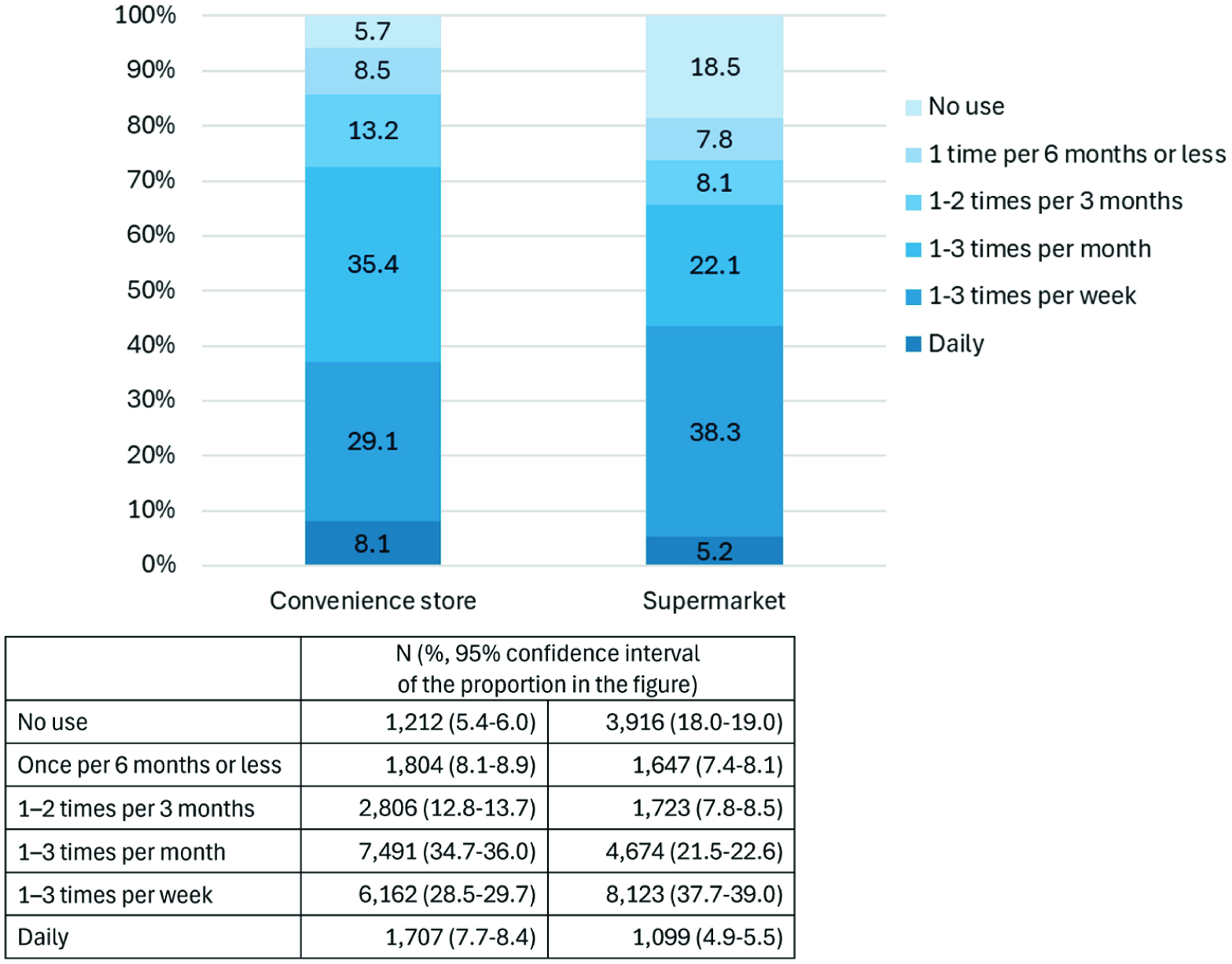
Reported frequency of convenience store and supermarket use.
For social capital measures, the proportions of “agree” responses were 14.6% for general trust and 10.4% for trust in mutual help and reciprocity (Figure 2). Multivariable analyses (Table 3) showed that the daily use of convenience stores was associated with both social capital measures among teens and young adults, with an adjusted odds ratio (aOR) of 2.18 (95% confidence interval [CI] = 1.14-4.15) for general trust and an aOR of 1.88 (95% CI = 1.02-3.44) for trust in mutual help and reciprocity. No statistically significant association was observed for supermarket use. The supplementary analysis with interaction terms supported this pattern. In these models, the positive association between convenience store use and general trust was reduced among women (P = .008) and further reduced with increasing age (P = .003). For mutual trust, the association with convenience store use was also reduced with age (P = .004), while no interaction with sex was observed (P = .653). In contrast, supermarket use showed no significant interactions with sex or age in either trust model (all P > .10). In the sensitivity analysis (Supplementary Table 1), the frequent use of supermarkets was associated with general trust among the middle-aged group with an aOR of 1.14 (95% CI = 1.06-1.22) and among women with an aOR of 1.12 (95% CI = 1.02-1.22).

Levels of general social trust and trust in mutual help (reciprocity).
Daily Store Use and Social Trust: Stratified by Age and Sex.

Discussion
We found that daily convenience store use was associated with higher social capital specifically among teenagers and young adults, a pattern not observed for supermarket use or in older age groups. This age-specific association suggests that convenience stores may serve distinct social functions for young people in contemporary Japan. However, several important caveats must be noted regarding interpretation of these cross-sectional findings.
About 8% of people used convenience stores every day in Japan, a higher proportion than those who used supermarkets daily. Men, younger people, those employed with a higher or unstable income, those with multiple comorbidities or obesity, and smokers were more likely to use convenience stores daily. Another survey of about 9000 respondents in Japan reported that 12% used convenience stores either daily or at least 4 to 5 times/week (4.4% and 7.5%, respectively). 30 The proportions identified in other smaller-scale internet surveys on daily use ranged from 10% to 24%.31,32 Our result falls into the lower range of reported figures. In terms of user characteristics, younger men tend to use convenience stores more frequently, 30 which is consistent with our study.
Daily convenience store use showed a clearer association with health status and health behaviors compared with supermarkets. These results are in line with those of previous studies described above.8 -10,13 The primary reasons for using convenience stores are to purchase food items, including bento boxes, rice balls, bread, and other ready-to-eat foods, followed by sweets. 30 Convenience stores are also a common location for purchasing tobacco products. These patterns of use underline the observed associations with health status and health behaviors. In addition, the association between the daily use of convenience stores and socioeconomic status was somewhat expected, as the main reason for visiting the stores is to purchase goods. The typical expenditure per visit is <¥1000, 30 which may partly explain the higher frequency of use among individuals with unstable incomes.
The most striking result was the association between daily convenience store use and social capital among teens and young adults, a relationship not observed with supermarket use. A survey conducted in 2017 among university students, who were mostly 18 to 20 years old, found that many visited convenience stores almost every day or several times a week to buy food products, including snacks, fresh foods, perishable processed foods, and bento boxes, similar to the above-mentioned primary reasons for store visits among the general public. 14 Most students visited these stores alone, and physical proximity was an important reason for their choice. There was a consensus that shopping at convenience stores contributed not only to individuals’ overall quality of life and the fulfillment of food needs, but also to both social and community well-being—findings consistent with our own results.
There are several reasons why convenience stores might enhance social capital among teens and young adults. Convenience stores have been a constant presence throughout their lives, serving as familiar places of everyday social interaction. 1 It is well studied that young people need a “third place” outside home and school where they can interact with peers safely, feel community belonging, develop identity, and learn autonomy and responsibility.33,34 In contrast, older adults have different shopping and social networking patterns, or distinct service needs and preferences. For example, although not statistically significant, we identified a similar tendency of increased social capital among daily supermarket users among the middle-aged group. Notably, the sensitivity analysis for frequent use did show a statistically significant association. Alternative explanations should also be considered, including the possibility of reverse causation—socially engaged young adults may be more likely to use convenience stores—as well as residual confounding by factors such as urban residence or educational status. We should also consider, as a potential selection issue, that young daily users might be fundamentally different from occasional users in ways not captured by the covariates in our analyses. A 2003 survey among female university students reported that a cluster of frequent convenience store users exhibited poorer health habits and more symptoms of fatigue compared with infrequent users. 13
This study has several methodological limitations. First, the results are based on data from a single, albeit recent, cross-sectional internet survey. As mentioned above, this precludes inferences about the direction of causality. Longitudinal research is needed to establish temporal relationships and test causal hypotheses. In addition to the potential for specific characteristics among daily convenience store users, our internet-based survey panel may itself be subject to a selection issue. Second, this was a secondary analysis of existing data that lacked information on both the outcome and exposure variables and was conducted without a pre-specified hypothesis or sample size calculation. As noted above, the outcome measure was limited to the cognitive dimension of social capital. For the exposure variables, there remains the potential for residual confounding. Additionally, we did not have data on the reasons for the use of and proximity to convenience stores, which limited the scope of our analysis. The data on store usage from the Rakuten Insight survey items had not been previously analyzed or discussed by JASTIS-affiliated researchers. More academic focus on such data related to people’s consumption behaviors is needed. At present, we are expanding survey items related to convenience store use in subsequent studies, which will enable more detailed analyses in the future. Despite these limitations, our findings suggest that convenience stores have the potential to serve as new health and social welfare platforms for younger generations. However, it is important to consider both the social benefits and the potential health risks associated with these environments, such as the availability of ultra-processed foods, tobacco, and alcohol. These preliminary findings should be interpreted with caution and further investigated in different contexts and study designs.
Conclusion
In summary, our findings suggest an association between convenience store use and social capital among teenagers and young adults, highlighting an area that warrants further investigation. Although the cross-sectional nature of this study precludes causal inference, these results provide preliminary evidence that retail environments may influence social capital in age-specific ways. Future research should utilize longitudinal designs, examine service-specific usage patterns, include more detailed measures of social capital, and take geographical distribution into account to better understand the underlying mechanisms. If these findings are confirmed through causal research, elucidating how urban retail spaces relate to social capital formation could inform urban planning and public health strategies aimed at fostering social connections among young people in rapidly urbanizing societies.
Supplemental Material
sj-docx-1-inq-10.1177_00469580261422663 – Supplemental material for Association Between Daily Convenience Store Use and Social Capital Among Young People in Japan: An Exploratory Secondary Analysis of Cross-Sectional Study Data
Supplemental material, sj-docx-1-inq-10.1177_00469580261422663 for Association Between Daily Convenience Store Use and Social Capital Among Young People in Japan: An Exploratory Secondary Analysis of Cross-Sectional Study Data by Aya Goto, Gavin H. Whitelaw and Takahiro Tabuchi in INQUIRY: The Journal of Health Care Organization, Provision, and Financing
Supplemental Material
sj-docx-2-inq-10.1177_00469580261422663 – Supplemental material for Association Between Daily Convenience Store Use and Social Capital Among Young People in Japan: An Exploratory Secondary Analysis of Cross-Sectional Study Data
Supplemental material, sj-docx-2-inq-10.1177_00469580261422663 for Association Between Daily Convenience Store Use and Social Capital Among Young People in Japan: An Exploratory Secondary Analysis of Cross-Sectional Study Data by Aya Goto, Gavin H. Whitelaw and Takahiro Tabuchi in INQUIRY: The Journal of Health Care Organization, Provision, and Financing
Footnotes
Acknowledgements
We sincerely appreciate the reviewers’ contributions in improving the quality of the analyses, data interpretation, and writing. We also thank Oliver Stanyon for editing this manuscript.

Ethical Considerations
The original Japan Society and New Tobacco Internet Survey (JASTIS) data collection was reviewed and approved by the following institutional review boards: the Institutional Review Board of Osaka International Cancer Institute on March 28, 2024 (approval no 20084-12), and the Ethics Committee of the Graduate School of Medicine, Tohoku University on June 27, 2024 (ID: 2024-1-231) and October 22, 2024 (ID: 2024-1-517). The proposal for this secondary analysis of anonymous data was reviewed and approved by the JASTIS management team.
Author Contributions
A.G. planned analyses, analyzed data, and drafted the manuscript. G.H.W. planned analyses. T.T. collected data. All authors interpreted data, contributed to revisions, and reviewed and approved the final manuscript.
Funding
The authors disclosed receipt of the following financial support for the research, authorship, and/or publication of this article: This work was supported by the Institute of Seizon and Life Science Institute’s 2025 research grant.
Declaration of Conflicting Interests
The authors declared no potential conflicts of interest with respect to the research, authorship, and/or publication of this article.
Data Availability Statement
The data are available from the last author upon reasonable request.
Supplemental Material
Supplemental material for this article is available online.