



Abstract
Introduction
Over the past 20 years, there has been an increased focus on the importance of spirituality to human health, including adolescent health outcomes. Leading health organizations, including the World Health Organization and the United Nations General Assembly, have recognized and asserted spirituality as a core dimension of child development and a vital element of quality healthcare (De Conciliis, 2015; Nissen et al., 2021; United Nations General Assembly, 1989; World Health Organization, 2022). More specifically, the National Consensus Project Guidelines for Quality Palliative Care include spirituality as a core domain of care and describe spirituality as a fundamental aspect of compassionate, patient and family centered palliative care (Ferrell, 2019). Despite these crucial efforts, spirituality has not been well integrated into healthcare provider training, and there is an absence of evidence-based programs to address the spiritual needs of patients and families—particularly in adolescent/young adult (AYA) cancer care (Miller & Thoresen, 2003; Rushton, 2014).
A critical barrier to the integration of spirituality in AYAs cancer care is the absence of a clear conceptual understanding and operational definitions of spirituality and its related domains, especially in AYAs with cancer (Holder et al., 2008; Michaelson et al., 2016, 2019; Nissen et al., 2021; Strang et al., 2002; Weathers et al., 2016; Wright et al., 2018). To date, conceptual analyses of spirituality have centered on specific patient populations (e.g., psychiatric nursing and end of life), nursing practice and research, spiritual development, and a range of related constructs such as spiritual well-being, spiritual health, and spiritual crisis or distress (Agrimson & Taft, 2009; Jaberi et al., 2019; Jones, 2020; McBrien, 2006; Monareng, 2012; Murgia et al., 2020; Petersen, 2014; Ramezani et al., 2014; Sadat Hoseini et al., 2019; Sessanna et al., 2007; Smith & McSherry, 2004; Vachon et al., 2009; Weathers et al., 2016). Collectively, these conceptual analyses have advanced our understanding of the importance of spirituality in both adult and other healthy populations of participants, but the meaning of spirituality remains ambiguous due to dissensus in the definition of spirituality among scholars.
Another factor that may contribute to this dissensus is the conflation of spirituality with religion, where some investigators have combined spiritual and religious struggles together within the same construct. Religiosity focuses on a formal institutional and outward expression of an individual's relationship with the sacred, usually in a gathering of individuals with similar beliefs, and is operationalized as beliefs and practices (Cotton et al., 2006; Villani et al., 2019). On the other hand, spirituality focuses on an individual's search for meaning in life and personal connectedness with the divine and transcendence beyond self, other individuals, and the environment (Villani et al., 2019). This conflation of spirituality with religion is problematic because it negates the experience of those AYAs who do not ascribe to a religious tradition (de Brito Sena et al., 2021; Josephson & Dell, 2004; Klůzová Kráčmarová et al., 2019).
Moreover, there has not been a conceptual analysis of the spirituality of AYAs with cancer. The absence of concept analyses of spirituality that are specific to AYAs with cancer creates additional barriers to understanding the implications of spirituality on their health outcomes. The closest analysis looked at spirituality in children with cancer at the end of life (Petersen, 2014). This conceptual analysis focused on situations surrounding the end of life of children, such as being remembered after death, which may not be applicable to AYAs with curative cancer. In addition, due to developmental differences, the needs of AYAs are likely unique to children and adults (Dunkel & Harbke, 2016; Karesh, 2013; Michaelson et al., 2016).
Although existing conceptual analyses have helped advance our understanding of the concept of spirituality and how it relates to different populations and health conditions, there remains a need for a better understanding of spirituality specific to AYAs with cancer. The purpose of this concept analysis is to clarify the concept of spirituality in the context of the AYA cancer experiences and generate an evidence-based definition based on the existing literature examining spiritual development and the role of spirituality in AYAs health and cancer treatment.
Method
Concept Analysis Method
In evolutionary methods of concept analysis, publications are analyzed to identify attributes, antecedents, and consequences of a particular concept (Weathers et al., 2016). For this analysis, we used Rogers’ evolutionary method of concept analysis to gather evidence from the theoretical and empirical literature across a variety of disciplines (Rogers, 1989, 2000).
The method includes six phases that are iterative:
Identify the concept of interest. For this analysis, the concept of interest is spirituality in the context of the AYA cancer experiences. Identify and select the appropriate realm (setting and sample). Since this analysis is literature-based, “setting and sample” refers to publication characteristics that will guide inclusion. Identify the attributes, antecedents, and consequences of the concept identified across the literature set. Attributes are characteristics unique to a concept that critically inform understanding of the concept. Antecedents are events that precede a manifestation of the concept, and consequences are events that follow concept manifestation. This analysis focused on the identification of attributes unique to the concept of spirituality in the context of AYAs’ cancer, antecedent events that influence AYAs’ spirituality, and consequences of spirituality on AYAs during cancer treatment. Identify an exemplar of the concept. Exemplars are drawn from the reviewed literature and used to illustrate findings from the concept analysis. Identify implications for further development of the concept. As an iterative process, it is expected that the organization of the emerging data will lead to additional questions and adjustments in the approach. Identify the concept and associated expressions. The outcome of the analysis is a more precise understanding and definition of spirituality within the context of AYAs cancer.
Data Sources
Sample and Setting
As mentioned in our methods, the “setting and sample” for this analysis were based on the publication period, the perspectives of different disciplines, and the type of literature. Although spirituality in AYA cancer care is still considered an emerging field, spirituality in health and its development are more established. To ensure adequate capture of historical context and newer developments, we included articles published in the last 20 years (2001–2021). We anticipated that most professional disciplines studying the development of spirituality and its relationship to health would include nursing, medicine, developmental psychology, sociology, and social work. Although we include all disciplines in the analysis, this helped to guide our selection of relevant databases for our search. Finally, we include all empirical studies (qualitative and quantitative), including theoretical literature.
Database Selection and Search Criteria
To encompass literature from multiple disciplines, we searched the following databases: (a) CINAHL, (b) MEDLINE, (c) PsychInfo, and (d) Social Index. The following search terms were used: Spirit* AND Adolescence or Young adults AND Cancer*. Our search included peer-reviewed literature published from 2001 through 2021. Here we specify the inclusion/exclusion criteria that guided article selection. Inclusion criteria: (a) scholarly articles that contained a conceptual or operational definition of spirituality in AYAs, (b) articles that presented a conceptual or theoretical framework of spirituality in AYAs, (c) articles that explored the meaning or experience of spirituality in AYAs, (d) case studies with exemplars of spirituality in AYAs, and (e) articles written or subtitled in English. Exclusion criteria: (a) books or book chapters and (b) unpublished thesis and dissertations.
Data Extraction and Analysis
Our initial search resulted in the identification of 86 articles. After reviewing abstracts based on our inclusion criteria, and removing duplicate citations, our final sample included 21 articles. The sample included 16 quantitative studies, two qualitative studies, and three theoretical papers. The majority of the quantitative studies were descriptive studies. The primary data extracted from each article included definitions, spirituality antecedents, attributes, consequences, and terminology.
Consistent with Rodgers’s method, analyses were carried out using thematic analysis (Rogers, 2000). As a first step, the first author read each article more than once and then constructed a coding table to capture all relevant information including definitions, antecedents, attributes, consequences, and exemplars where applicable or available. When a definition of spirituality was provided it was copied word for word in the coding table. Definitions were then examined for commonalities and patterns across articles.
Terms were identified as antecedents if they were described as what happened before the AYAs utilized spirituality. These terms were generally derived from the introduction and the definition of spirituality, and the discussions of the reviewed studies. Terms identified as consequences included outcome measures, but also were extracted from definitions and theories. Attributes were identified in descriptions of spirituality from each article. Once all terms were identified, we constructed separate tables for attributes, antecedents, and consequences to identify commonalities and themes in each category. To ensure the accuracy of the findings, the third author read a subsample of the sources and met to discuss themes identified by the first author.
In providing case exemplars, evolutionary concept analysis recommends the use of real cases instead of constructed cases. Based on Rogers’ suggestions, we have included participants’ quotations from empirical research included in this analysis to buttress the results and explain spirituality from real-life perspectives.
Results
Definitions
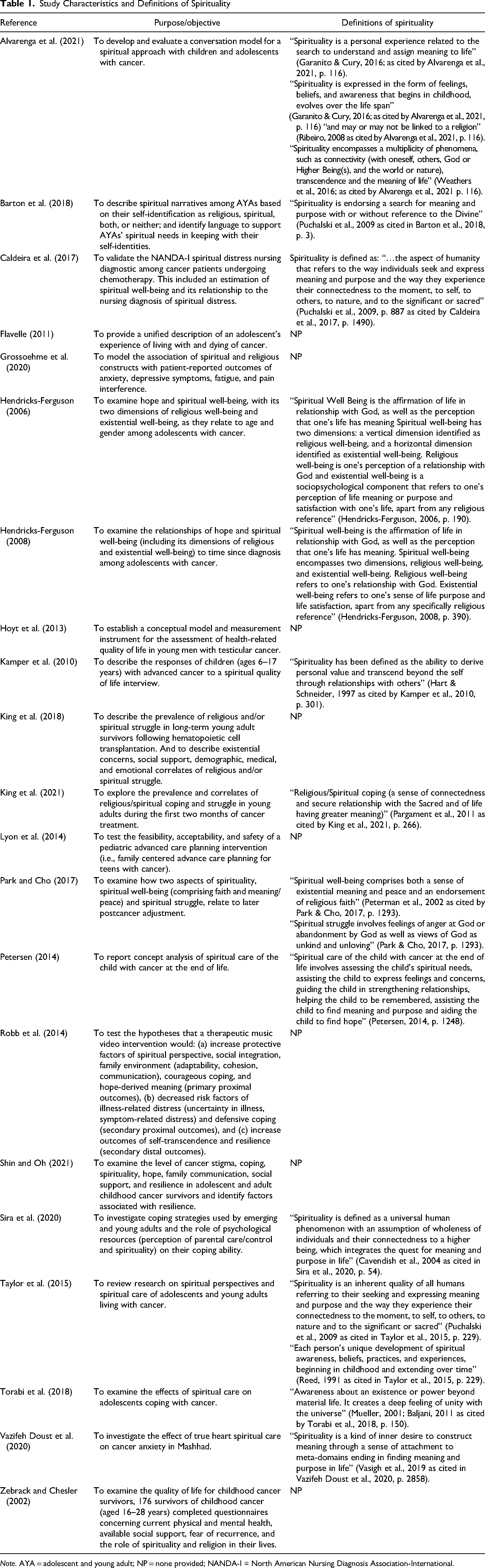
Articles included in this analysis defined spirituality in different ways; however, common features included spirituality as a universal experience (Alvarenga et al., 2021; Robb et al., 2014; Sira et al., 2020; Torabi et al., 2018), a search for meaning (Alvarenga et al., 2021; Barton et al., 2018; Caldeira et al., 2017; Hendricks-Ferguson, 2006, 2008; Park & Cho, 2017; Petersen, 2014; Robb et al., 2014; Sira et al., 2020; Taylor et al., 2015; Vazifeh Doust et al., 2020), and a means for connectedness to others and the divine (Alvarenga et al., 2021; Caldeira et al., 2017; King et al., 2021; Robb et al., 2014; Sira et al., 2020; Taylor et al., 2015; Vazifeh Doust et al., 2020; Table 1).
Study Characteristics and Definitions of Spirituality
Note. AYA = adolescent and young adult; NP = none provided; NANDA-I = North American Nursing Diagnosis Association-International.
Attributes
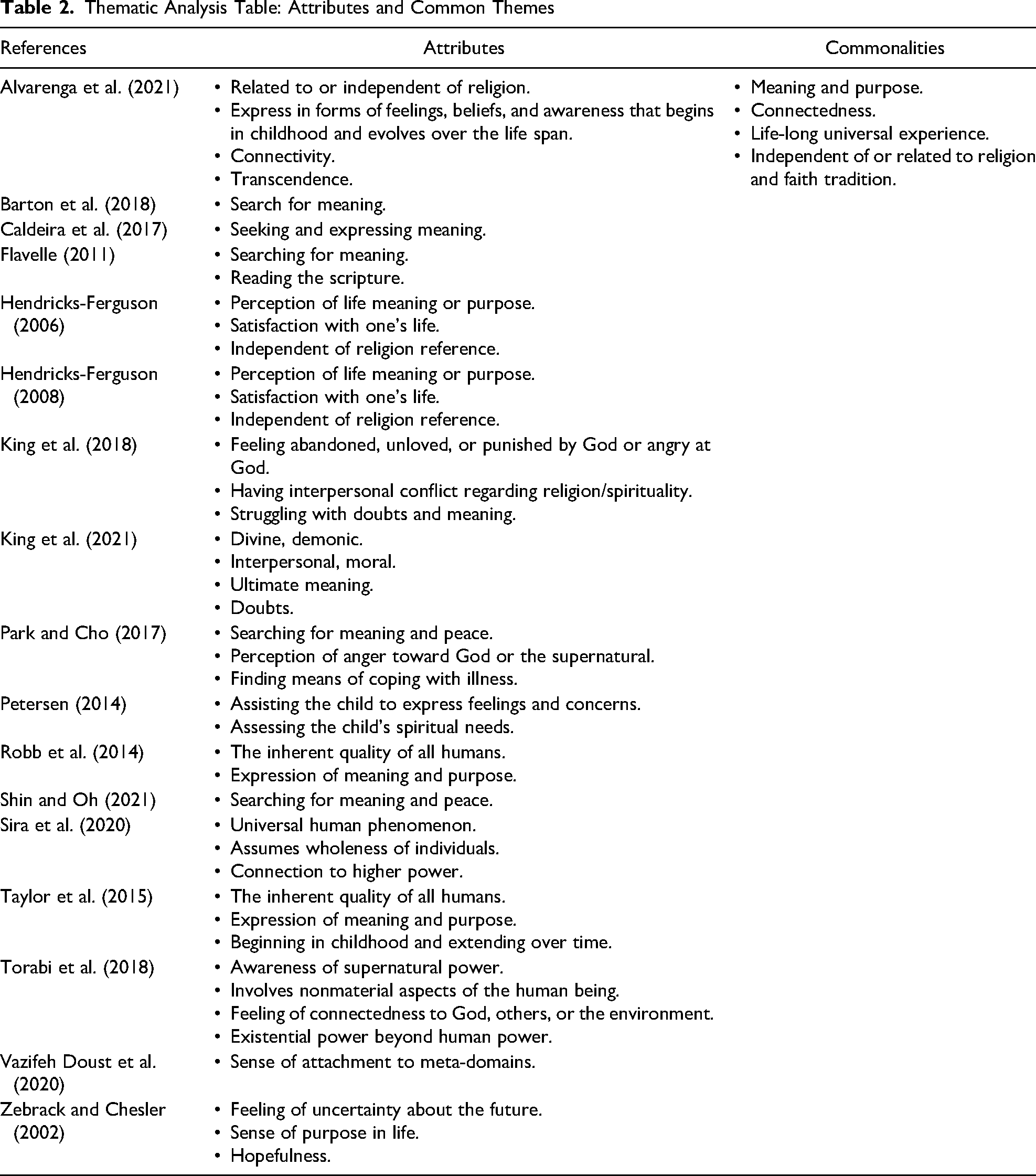
We identified four defining attributes of spirituality in adolescents and young adults with cancer from the data: meaning and purpose (Barton et al., 2018; Flavelle, 2011; Hendricks-Ferguson, 2006, 2008; King et al., 2018, 2021; Park & Cho, 2017; Robb et al., 2014; Shin & Oh, 2021; Taylor et al., 2015), connectedness (Alvarenga et al., 2021; Sira et al., 2020; Torabi et al., 2018; Vazifeh Doust et al., 2020), life-long universal experience (Alvarenga et al., 2021; Robb et al., 2014; Sira et al., 2020; Taylor et al., 2015), and independent of or related to religion or faith traditions (Alvarenga et al., 2021; Hendricks-Ferguson, 2006, 2008; Table 2).
Thematic Analysis Table: Attributes and Common Themes
Meaning and Purpose
Situations such as having a cancer diagnosis and treatment may lead individuals to seek out and ascribe meaning and purpose related to their illness (Barton et al., 2018; Caldeira et al., 2017; Flavelle, 2011; Hendricks-Ferguson, 2006, 2008; King et al., 2018, 2021; Park & Cho, 2017; Robb et al., 2014; Shin & Oh, 2021; Taylor et al., 2015; Vazifeh Doust et al., 2020; Zebrack & Chesler, 2002). In this analysis, almost all conceptualizations of spirituality emphasized the search for meaning and purpose as a core attribute of spirituality (Barton et al., 2018; Caldeira et al., 2017; Flavelle, 2011; Hendricks-Ferguson, 2006, 2008; King et al., 2018, 2021; Park & Cho, 2017; Robb et al., 2014; Shin & Oh, 2021; Taylor et al., 2015; Vazifeh Doust et al., 2020; Zebrack & Chesler, 2002). In addition, several authors discussed evidence supporting the positive relationship between meaning-making and well-being for people dealing with a range of health crises and illnesses such as cancer (Fleer et al., 2006; Park et al., 2008; Simmons et al., 2000). For instance, King et al. (2018) discussed how the emergence of existential issues among AYAs with cancer on treatment often evokes the desire to make meaning or derive a sense of purpose (King et al., 2018). The authors also asserted that existential concerns of identity and meaning can be grounded in fundamental spiritual and religious beliefs, practices, questions, and struggles. Likewise, Barton et al. (2018) discussed adolescents’ struggles with existential questions or a search for meaning about why cancer diagnoses happened to them, how it changed their beliefs, and what they could learn from the cancer experience as an essential attribute of spirituality (Barton et al., 2018).
Connectedness
The second attribute of spirituality identified was connectedness (Alvarenga et al., 2021; Sira et al., 2020; Torabi et al., 2018; Vazifeh Doust et al., 2020). Connectedness may be with oneself, the divine, nature, or others. Haase et al. (1992, p. 146) defined connectedness as “the extent a person perceives that he/she has a significant, shared, and meaningful personal relationship with another person, a spiritual being, nature, or an aspect of one's inner self” (Haase et al., 1992; Phillips-Salimi et al., 2012). For instance, in a qualitative study by Barton et al. (2018), one adolescent with cancer exemplified the attribute of connectedness when he said: “I believe in positive energy … feel that your mind's connected to your body, and if throughout the whole thing, if you can stay positive as you can … it keeps your spirits up, it keeps you strong throughout all of it.” (Barton et al., 2018, p. 16; Table 3). Also, Sira et al. (2020) exemplified connectedness as an important attribute of spirituality in the statement “spirituality has an impact on patients’ health behaviors, medical decision making, and influences how people relate in meaningful ways with each other (friends or family members)” (Sira et al., 2020, p. 54).
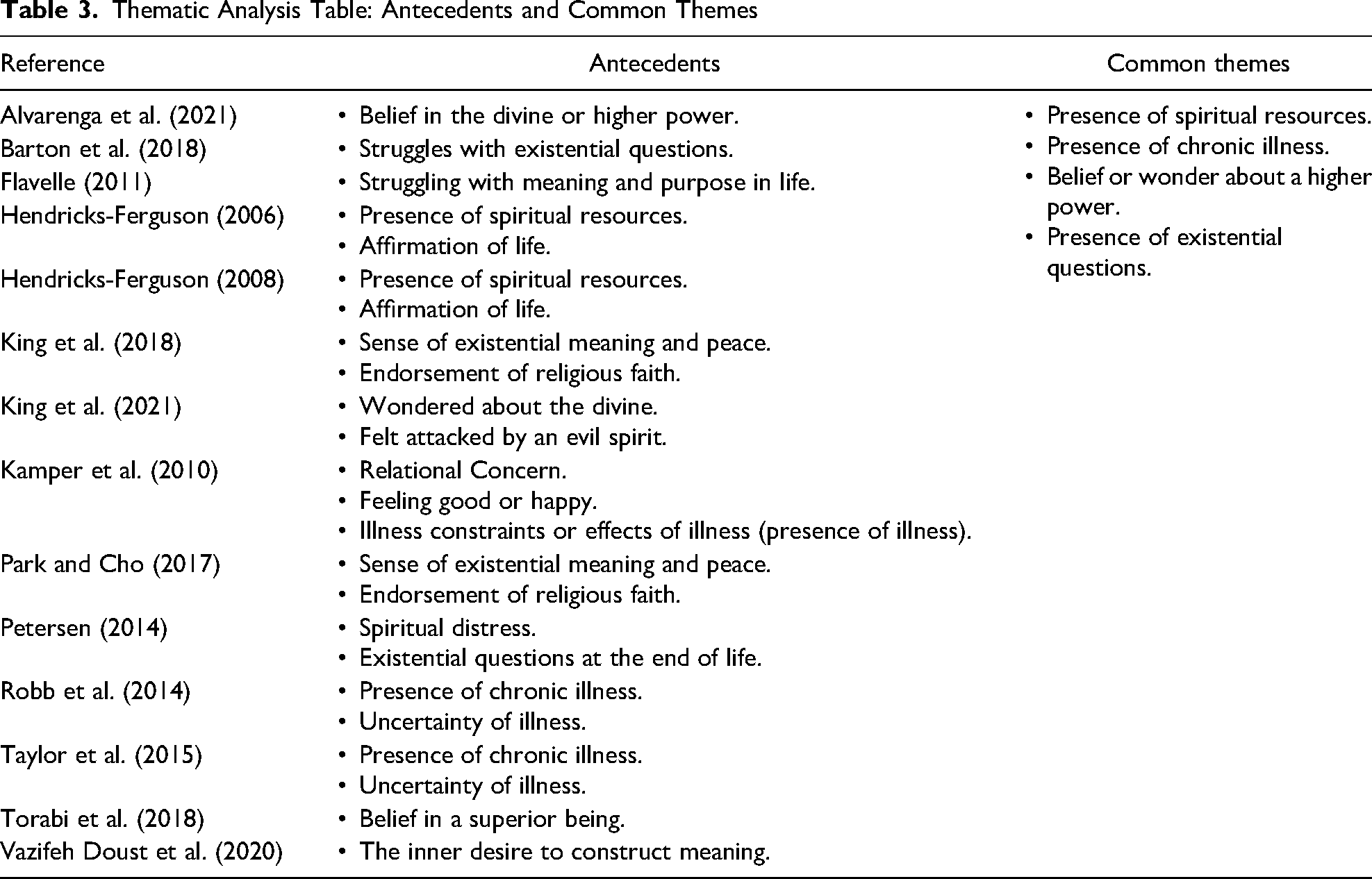
Thematic Analysis Table: Antecedents and Common Themes
Dependent or Independent of Secular-Religious Practices or Beliefs
The third attribute of spirituality concerns the intersection of spirituality with religious practices and beliefs. Spirituality can be related to the religious references of AYAs with cancer, but it can also be independent of religious references (Alvarenga et al., 2021; Hendricks-Ferguson, 2006, 2008). This attribute entails that theists, atheists, and agnostics are also spiritual and engage in spiritual practices with or without reference to a higher power or an organized religious gathering (Remmel & Sillfors, 2018; Sedlar et al., 2018). Therefore, the attribute of spirituality being dependent or independent of religious practices or beliefs is essential to capture the spiritual experience of the atheists and agnostics together with the theists.
Universal Experience
The fourth identified attribute of spirituality is that it is a universal experience—meaning it is an ongoing experience common to all humans—irrespective of their background (de Jager Meezenbroek et al., 2012; Mooney & Timmins, 2007). Several articles included in this analysis described spirituality as an abstract experience that is an inherent quality of all humans (Robb et al., 2014; Sira et al., 2020; Taylor et al., 2015; Torabi et al., 2018). For instance, in their study of relational and spiritual coping among emerging and young adult cancer survivors, Sira et al. (2020) described spirituality as a universal human phenomenon with an assumption of the wholeness of individuals. The authors further asserted that spirituality has an impact on young adults’ behavior and medical decision-making and influences their relations and interactions with others (Sira et al., 2020). The universal experience is relevant in the context of AYAs cancer care because it is an important aspect of AYAs’ experience that warrants attention as much as other age groups.
Life-Long Experience
The fifth attribute of spirituality is a life-long experience that begins in childhood (Alvarenga et al., 2021; Taylor et al., 2015). In their review of spirituality and spiritual care of AYAs with cancer, Taylor et al. (2015) discussed research describing stages of spiritual development. The authors discussed how Fowler's research provides detailed descriptions of how spirituality develops as AYAs mature in age, intellect, and other aspects of their social and emotional development (Fowler, 1981). There are two stages of spiritual development during adolescence beginning with the synthetic-conventional stage when an adolescent accepts the beliefs and values of people around them and progresses toward the individuative-reflective stage when a more mature AYA evaluates their prior beliefs and values and determines the influence of those beliefs and values on their lives (Barton et al., 2018; Karesh, 2013; Taylor et al., 2015). Likewise, in their development of a conversation model to facilitate discussions about spirituality with children and AYAs with cancer, Alvarenga et al. (2021) emphasized spirituality as having developmental stages. Emphasis was placed on the importance of providing developmentally appropriate spiritual care that considers the development and diversity of the child's spiritual experiences (Alvarenga et al., 2021; Taylor et al., 2015).
Antecedents
Antecedents are events that precede a manifestation of the concept—in this case manifestation of spirituality (Rogers, 1989). An event was considered an antecedent if the event was described as a precursor to AYAs’ utilization of their spirituality during cancer diagnosis and treatment. We identified four antecedents: the presence of spiritual resources (Hendricks-Ferguson, 2006, 2008), the presence of chronic illness (Kamper et al., 2010; Robb et al., 2014; Taylor et al., 2015), belief or wonder about a higher power (Alvarenga et al., 2021; King et al., 2021; Torabi et al., 2018), and presence of existential questions (Barton et al., 2018; Petersen, 2014; Table 3).
The first antecedent, the presence of spiritual resources, refers to spiritual supports that are available as a source of adjustment during cancer (Hendricks-Ferguson, 2008). Spiritual resources may be internal like individuals’ religious well-being, existential well-being, and spiritual well-being, such as affirmation of life with a higher power or the perception that one's life has a meaning (Hendricks-Ferguson, 2006, 2008). Likewise, spiritual resources may also be external like services available at religious-affiliated healthcare centers (Hendricks-Ferguson, 2008). For example, Hendricks-Ferguson (2008) states that adolescents on treatment depend on their spiritual convictions as a common coping strategy (Hendricks-Ferguson, 2008). Hendricks-Ferguson further explained that there is a tendency that adolescents from religious-affiliated healthcare settings to acquire spiritual resources at the onset of cancer because of routine support offered by the staff (Hendricks-Ferguson, 2008). Thus, the presence of spiritual resources may lead AYAs to use their spirituality to cope with their disease and treatments.
The second antecedent is the presence of chronic illness (Kamper et al., 2010; Robb et al., 2014; Taylor et al., 2015). Chronic illnesses are defined as a condition that interferes with normal daily life or requires a minimum of three months of treatment during a year (Jin et al., 2017). The presence of a chronic illness or condition was often identified as an event that leads AYAs toward greater exploration and use of their spiritual practices as a means of coping with their disease and treatment. For example, Kamper et al. (2010) interviewed children and adolescents with advanced cancer about their spiritual quality of life. During their interviews, they asked children and adolescents about activities they do to feel closer to God or a higher power. Several of the responses exemplify the presence of a chronic illness as an antecedent to enacting spirituality. One child shared that he did “pray,” but he also liked to “go outside or play an instrument” to feel closer to God. A second child shared, “No, I don’t pray, but I think about God and what he does with us. I believe we are here for his amusement. I was an atheist, but now I prefer to believe in an afterlife” (Kamper et al., 2010, p. 304). These narratives are consistent with the finding of Puchalski who identified illness, pain, or life stress as events that often evoke reflection and use of one's spiritual beliefs and practices in an effort to cope with the event (Puchalski, 2001).
Belief or wonder about the divine or higher power is the third antecedent identified (Alvarenga et al., 2021; King et al., 2021; Torabi et al., 2018). Based on the reviewed studies, AYAs’ belief and wonder about the divine or a higher power during a difficult situation like cancer can evoke the use of their spirituality in dealing with their diagnosis and resulting treatment. King et al. (2021) described the Divine as God or Higher power (King et al., 2021). This was described by adolescents in the study by Alvarenga et al. (2021) and in another study as faith or belief in God (Alvarenga et al., 2021; Torabi et al., 2018). The following participant statements illustrate the relationship of the belief or wonder about the divine or higher power as an antecedent to spirituality and how this occurs regardless of an individual’s beliefs. One participant in the study by Alvarenga et al. (2021, p. 122) exemplified the antecedent of belief in a higher power when he stated, “I believe my treatment will be over soon. That I’m already healed, in the name of Jesus! And that everything has worked out in my life” (Alvarenga et al., 2021). It is evident that this individual is a theist, and his religion influences his spirituality as evidenced by the pronouncement of his belief in Jesus. Another example that illustrates the antecedent of wonder about the divine is exemplified in the study by Barton et al. (2018, p. 5) where the adolescents state that if God or the divine is there, the divine messed up their life because of the cancer (Barton et al., 2018). The adolescent's usage of the conditional word “if” shows that the adolescent is skeptical about the existence of God and that God causes cancer to occur to him.
The presence of existential questions is the fourth antecedent identified through this analysis (Barton et al., 2018; Petersen, 2014; Taylor et al., 2015). Existential concerns or questions about the afterlife or the meaning of one’s life often emerge following a cancer diagnosis and during treatment and can evoke spiritual thoughts and reflection in AYAs (Taylor et al., 2015). In their discussion about the clinical assessment of spirituality and spiritual distress, Taylor et al. (2015) described existential concern as the absence or lack of life meaning and/or concerns about the afterlife (Taylor et al., 2015). Likewise, in their analysis of qualitative interviews of AYAs with cancer, Barton et al. (2018) found that statements about spirituality tended to reflect “…existential questioning, fatalistic beliefs, and intangible healing (e.g., mind–body connections or wellness imbued by supportive loved ones)” (p. 5). The authors also found that most AYAs who endorsed spirituality shared that their struggles with existential questions about why their illness happened caused them to focus on their spirituality (Barton et al., 2018). Existential questioning as an antecedent to spirituality is exemplified in a participant statement from the Barton et al. (2018, p. 6) study, “Sometimes I just look up and say, like how much more are you gonna give me?” (Barton et al., 2018). Spirituality and associated existential questions are well-established components of whole-person palliative care (Barton et al., 2018).
Consequences
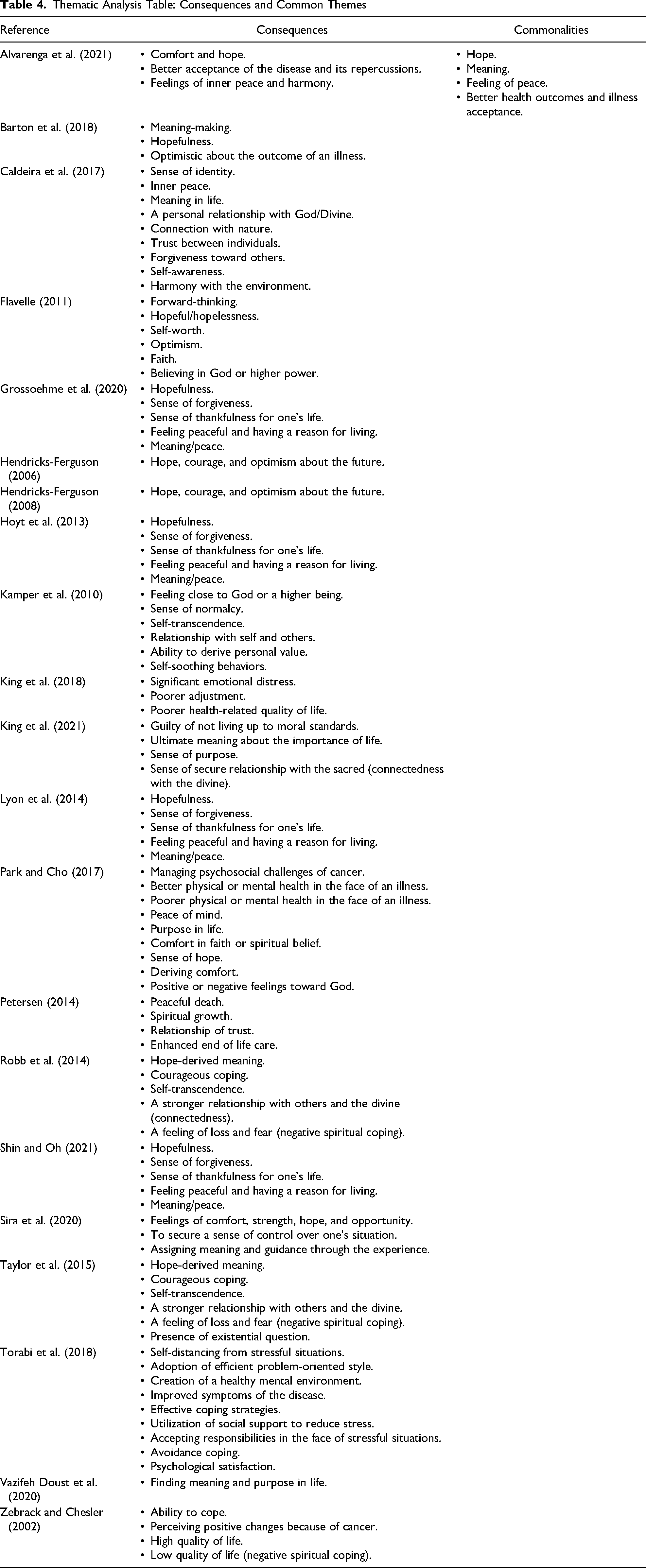
Consequences are events that happen after the occurrence of an event or a phenomenon (Rogers, 1989). In this analysis, we located the consequences of spirituality in the definitions, results, measures, and discussion sections of the reviewed articles. Four main consequences emerged and include: hope (Alvarenga et al., 2021; Barton et al., 2018; Flavelle, 2011; Grossoehme et al., 2020; Hendricks-Ferguson, 2006, 2008; Hoyt et al., 2013; Lyon et al., 2014; Park & Cho, 2017; Robb et al., 2014; Shin & Oh, 2021; Taylor et al., 2015), meaning (Barton et al., 2018; Caldeira et al., 2017; Grossoehme et al., 2020; Hoyt et al., 2013; Lyon et al., 2014; Robb et al., 2014; Shin & Oh, 2021; Sira et al., 2020; Taylor et al., 2015; Vazifeh Doust et al., 2020), feeling of peace (Alvarenga et al., 2021; Caldeira et al., 2017; Grossoehme et al., 2020; Hoyt et al., 2013; Lyon et al., 2014; Park & Cho, 2017; Shin & Oh, 2021), and enhanced well-being and illness acceptance (Table 4; Alvarenga et al., 2021; Robb et al., 2014; Taylor et al., 2015; Torabi et al., 2018; Zebrack & Chesler, 2002).
Thematic Analysis Table: Consequences and Common Themes
Hope
“Hope is the endorsement of a comforting and/or life-sustaining belief that a personal and positive future exists for oneself or others” (Alvarenga et al., 2021, p. 122). From our review and analysis, the concept of hope emerged as a concept that often occurs as a result of one's spirituality (Alvarenga et al., 2021; Barton et al., 2018; Flavelle, 2011; Grossoehme et al., 2020; Hendricks-Ferguson, 2006, 2008; Hoyt et al., 2013; Lyon et al., 2014; Park & Cho, 2017; Robb et al., 2014; Shin & Oh, 2021; Taylor et al., 2015). For instance, one adolescent exemplified hope as a consequence of spirituality in the study by Alvarenga et al. (2021) when he expressed his belief that his illness will come to an end and that he is healed in Jesus's name (Alvarenga et al., 2021).
Meaning
Across the articles reviewed, authors described cancer diagnosis as an event that led AYAs to seek their spirituality which may ultimately lead to AYAs assigning or searching for meaning from their cancer experience (Barton et al., 2018; Caldeira et al., 2017; Grossoehme et al., 2020; Hoyt et al., 2013; Lyon et al., 2014; Robb et al., 2014; Shin & Oh, 2021; Sira et al., 2020; Taylor et al., 2015; Vazifeh Doust et al., 2020). For instance, Sira et al. (2020, p. 54) explained that “individuals rely on their spirituality to retrieve feelings of comfort, strength, hope, and an opportunity to secure a sense of control over their situation and assign a meaning and guidance through the experience.”
Feeling of Peace
Across the reviewed articles, a feeling of peace was described as an outcome of spirituality in AYAs with cancer (Alvarenga et al., 2021; Caldeira et al., 2017; Grossoehme et al., 2020; Hoyt et al., 2013; Lyon et al., 2014; Park & Cho, 2017; Shin & Oh, 2021). The majority of studies used the Spiritual Well-Being Scale of the Functional Assessment of Chronic Illness Therapy–IV (FACIT-sp), which measures both senses of peace and meaning (Grossoehme et al., 2020; Lyon et al., 2014; Park & Cho, 2017; Shin & Oh, 2021). For instance, Grossoehme et al. (2020) used the FACIT-sp to explore the association of religious and spiritual factors with patient-reported anxiety, depressive symptoms, fatigue, and pain among AYAs with cancer. Authors found multiple facets of spirituality were associated with these symptoms and indirectly associated with a sense of peace and meaning (Grossoehme et al., 2020).
Enhanced Well-Being and Illness Acceptance
Enhanced well-being and illness acceptance emerged directly or indirectly as outcomes of spirituality (Alvarenga et al., 2021; Robb et al., 2014; Taylor et al., 2015; Torabi et al., 2018; Zebrack & Chesler, 2002). For instance, two studies referenced Haase's resilience in illness model (RIM), an evidence-based model that guides research on psychosocial adjustments of AYAs with cancer (Robb et al., 2014; Taylor et al., 2015). In the RIM model, spiritual perspective is a factor that drives resilience outcomes of enhanced well-being and illness acceptance. Other articles also described improved mental health, quality of life (Zebrack & Chesler, 2002), and illness acceptance (Alvarenga et al., 2021) as outcomes of spirituality.
Proposed Conceptual Definition
Spirituality in AYAs with cancer is a religious-dependent or independent life-long, universal human phenomenon to derive meaning and connection with meta-domains (i.e., oneself, the divine, nature, or others) that can lead to hope, a sense of peace, and enhanced well-being and illness acceptance.
Discussion
Despite the importance of spirituality to the health and well-being of AYAs with cancer, research has been significantly hampered by a lack of clarity on this elusive concept in this population (Holder et al., 2008; Michaelson et al., 2016, 2019; Nissen et al., 2021; Strang et al., 2002; Weathers et al., 2016; Wright et al., 2018). Building upon previous research, findings from our concept analysis provide a clearer understanding of the attributes, antecedents, and consequences of spirituality among AYAs with cancer. The identification of these components resulted in a clear definition that can be used to guide future research and intervention development.
We identified five attributes among previous definitions of spirituality. Attributes included (a) meaning and purpose; (b) connectedness; (c) universal; (d) life-long; and (e) dependent or independent of religious beliefs or practices. The latter two are important to highlight because these attributes were less commonly described in previous definitions. For example, the life-long attribute of spirituality indicates it is a developmental process and means that spirituality among AYAs may not be as well developed as among adults. Additionally, spiritual resources available for adults may not be appropriate for AYAs. The other attribute (i.e., dependent or independent of religious beliefs or practices) indicates that spirituality also exists among others with no religious beliefs or practices. As such, future interventions need to address spirituality among all AYAs, including those who do not subscribe to a religious belief or practice.
It is important to consider how our findings compare with other conceptual analyses of spirituality. Among previously published analyses, Petersen’s (2014) analysis of “spiritual care” for children with cancer at the end of life is most relevant given their focus on pediatric cancer (Petersen, 2014). However, an important difference was their focus on the concept of providing “spiritual care,” which is an action-oriented construct focused on assessing spiritual needs and supporting children to express their feelings, strengthen relationships, and find meaning. The attributes of “spiritual care” were like attributes of “spirituality” identified in our analysis and included the search for meaning and desire for connectedness. In addition, the presence of distress and existential questions as antecedents, and peace and spiritual growth as consequences were also common across both analyses.
Similar to our analysis, Weathers et al. (2016) used an evolutionary approach to examine the concept of spirituality; however, their analysis was not focused on a particular age group or illness. Likewise, McBrien’s (2006) analysis focused on spirituality more broadly without a reference to a specific age or population. Nonetheless, we found several commonalities among the attributes, antecedents, and consequences in these two analyses and ours. Common attributes included the search for meaning and purpose, and connectedness. Common antecedents included the presence of spiritual resources, chronic illness, belief systems or beliefs, and wonder about the definition. Lastly, common consequences included feelings of peace and better health outcomes, and illness acceptance. Unique to our analysis of AYAs with cancer were two attributes; spirituality as a life-long universal experience and spirituality can be independent of or related to religion or a faith tradition. Differences in our attributes from the two analyses may be in part because our analysis focused on a specific age group and illness as opposed to spirituality more broadly.
An understanding of AYAs’ spirituality in the context of cancer is necessary to develop age-appropriate spirituality assessment tools and develop interventions to support AYAs with cancer. Likewise, an understanding of AYAs’ spirituality during cancer treatment is vital because AYAs are in a critical stage of growth and development that lays a foundation for the rest of their lives. Even prior to having cancer, AYAs are at risk for poor physical and psychosocial outcomes due to developmental struggles with identity development, autonomy, and existential meaning (Weaver & Wratchford, 2017). The challenges of AYAs with cancer include, but are not limited to, symptom distress, uncertainty, infertility, fear of recurrence, spiritual distress (Lina Mahayati et al., 2018; Park & Cho, 2017), social isolation, problems with family communication and relationships, disruptions to developmental tasks (e.g., intimacy and independence), and traumatic stress symptoms (Docherty et al., 2015). As we seek to develop supportive care programs for AYAs with cancer, it is important to consider the developmental nature of spirituality and how spirituality affects related outcomes.
Finally, our analysis revealed a significant gap in the AYAs’ cancer literature—the absence of AYAs’ first-person accounts of their experiences of spirituality in the context of cancer. It will be important to have AYAs’ perspectives to further advance our conceptual understanding of spirituality, and to inform the development of reliable measures and meaningful interventions. To address this gap, qualitative studies of AYAs’ perspectives concerning their spirituality during cancer diagnosis and treatments are needed to advance research in AYAs’ spirituality and cancer care.
It is important to note several limitations to this analysis. First, our search was limited to articles published in English and this poses a potential bias and limits a more diverse, multicultural perspective on spirituality. Second, we limited our search to articles focused on AYAs and this may have resulted in the exclusion of child or adult literature that may be relevant to the AYA experience. Finally, our search revealed an absence of AYA first-person accounts of their spirituality. This limits our findings to theoretical definitions and research findings that are not informed by the AYA experience, increasing the risk that findings do not accurately reflect the experience of AYAs with cancer.
In summary, this analysis represents an important step in providing a conceptual definition of spirituality specific to AYAs within the context of cancer. Unique to this analysis were attributes of spirituality as independent of or related to religion, and spirituality as a developmental process. The absence of first-person accounts of AYAs’ spirituality during cancer treatment was also identified as a limitation that needs to be addressed if we are to advance spiritual care for AYAs during cancer treatment.
Footnotes
Declaration of Conflicting Interests
The author(s) declared no potential conflicts of interest with respect to the research, authorship, and/or publication of this article.
Funding
The author(s) received no financial support for the research, authorship, and/or publication of this article.
