



Abstract
Extreme Risk Protection Order (ERPO) laws are a promising strategy for preventing firearm violence through risk-based firearm restrictions, but effectiveness hinges on implementation. Oregon’s ERPO law went into effect in 2018, but utilization has varied across the state. We interviewed professionals involved in ERPO implementation to understand barriers and facilitators to the use of ERPOs for violence prevention in Oregon. Semi-structured interviews were conducted with 35 professionals involved in ERPO implementation in Oregon, including law enforcement officers (LEOs), judges, representatives from district and city attorneys’ offices, and those working in suicide, substance use, and domestic violence prevention. Rapid qualitative analysis was used to analyze interview data. Implementation challenges identified by professionals included insufficient funding and resources, time constraints on petitioning, safety and timeliness of ERPO service, and limited enforcement mechanisms. While professionals shared the strategies they use to overcome these barriers, such as conducting risk assessments and using a non-confrontational approach to increase safety of ERPO service, they also identified potential policy and practice changes that may bolster implementation. Such changes included cautiously expanding petitioner eligibility, allowing LEOs to petition at any time of the day or week, and requiring ERPO respondents to file a declaration of firearm surrender form with the court and attend compliance hearings. This work helps to increase knowledge about the implementation and use of Oregon’s ERPO law and identify potential gaps in current practices. This work may inform policy and practice changes needed to improve implementation of risk-based laws like ERPOs.
Keywords
Introduction
Extreme Risk Protection Order (ERPO) laws are a promising risk-based firearm removal strategy that utilize a civil court order to temporarily prohibit the purchase and possession of firearms or other deadly weapons when an individual is at imminent risk of harming themselves or others. 1 ERPO laws aim to prevent firearm injury and death by addressing access to firearms or other lethal means when individuals are displaying high-risk behaviors.1,2 As of August 2025, 21 states, the District of Columbia, and the U.S. Virgin Islands have enacted ERPO laws. 1 Provisions of the law (e.g., petitioner eligibility, court hearing processes, duration of the order) vary between states.1,3
In 2017, Oregon became the fifth state to adopt an ERPO law.1,4 This law, which went into effect on January 1, 2018, includes family (i.e., current spouses and intimate partners (IPs), parents, children, and siblings), household members, and law enforcement officers (LEOs) as eligible petitioners. Analysis of the first 5 years of use of Oregon’s ERPO law found that LEOs petitioned most often (60%), followed by family and household members (26%), and that petitions filed by LEOs had a higher approval rating (96%) than those filed by family/household members (66%). 5 The ERPO process is initiated when an eligible petitioner files an ERPO petition with the civil court. 4 An ex parte hearing attended only by the petitioner is held on the same day or next judicial business day of a petition being filed, at which the petitioner must meet a burden of proof of clear and convincing evidence displaying imminent risk. 4 Upon service of a granted ERPO, a law enforcement officer must submit ERPO information to state and national data systems to prevent firearm purchasing. The respondent (the individual subject to the ERPO) must surrender all deadly weapons and any concealed handgun license to law enforcement, a federally licensed firearms dealer, or a third party within 24 h of service. 4 The respondent has the right to request a hearing to contest the ERPO within 30 days of being served the order. If requested, the ERPO may be continued, dismissed, or modified at this hearing. From 2018 to 2022 in Oregon, 22% of respondents of ERPOs that were granted at the ex parte hearing requested a hearing to contest the order and 44% of these contested hearings resulted in the ERPO being dismissed. 5 If the respondent does not contest the order or if the order is continued at the hearing, the ERPO remains in effect for 1 year from the date of the ex parte hearing, with an opportunity to renew the order if risk continues. 4 Figure 1 depicts these steps in Oregon’s ERPO process.
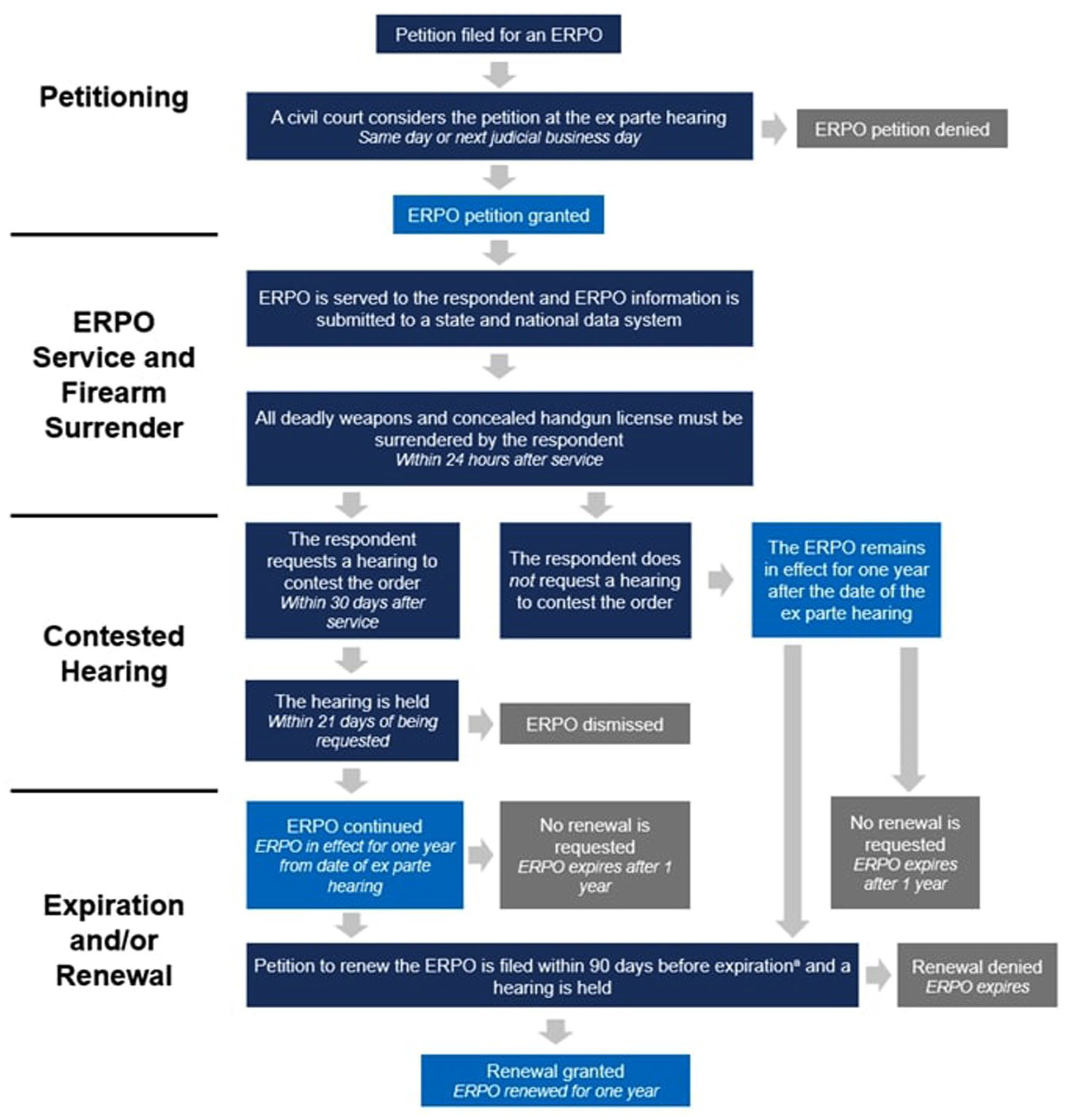
Outline of the steps in Oregon’s extreme risk protection order process.
Research on the effectiveness of this relatively new type of policy is limited. One study of ERPO use in San Diego County, California, found no association between ERPOs and firearm violence reduction at the population level, though the authors noted potential limitations of these findings due to the limited use of ERPOs and small sample size. 6 Other studies have reported promising evidence of effectiveness, particularly at reducing firearm suicide.7 -12 Still, effectiveness hinges on the law’s implementation. ERPO implementation and utilization have been variable across states and jurisdictions, including substantial variation in petitioning between Oregon’s counties.5,13,14 Prior research found that ERPO implementation may be hindered by insufficient resources and police staffing, lack of knowledge and training on the law, and lack of coordination between implementing agencies.9,10,14 There remains a need to further understand the barriers and facilitators to ERPO implementation, including state-specific research due to differences in ERPO policies. For example, implementation studies in other states examined laws with narrower (e.g., Indiana) or broader (e.g., California) petitioner eligibility compared to Oregon. 3 Additionally, Oregon’s ERPO law follows a unique process, by which the ERPO is granted at the ex parte hearing and an additional hearing is only held if requested by the respondent. In other states, a temporary ERPO is granted at the ex parte or emergency hearing and lasts for a short duration until a final hearing is held. 3 Firearm relinquishment is also variable, with some states requiring all firearms be relinquished only to law enforcement or a federally licensed firearms dealer (e.g., California) and others allowing relinquishment to any eligible third party (e.g., Oregon). 3 Additional state-specific research is needed to expand our understanding of the implementation of ERPO laws across a variety of contexts and to inform best practices nationally. This study seeks to improve our understanding of the current implementation and utilization of Oregon’s ERPO law through semi-structured interviews with professionals involved in ERPO implementation.
Methods
We conducted semi-structured interviews with LEOs, judges, representatives from district attorneys’ (DAs’) and city attorneys’ (CAs’) offices, and prevention professionals involved in ERPO implementation or use. This study was approved by the Oregon Health & Science University Institutional Review Board (Approval #23568).
Sample and Recruitment
We employed purposive sampling to ensure a range of participants from both urban and rural counties and counties with varying levels of ERPO utilization. Initial recruitment consisted of both phone and email contacts to relevant professionals and agencies, utilizing the contact information available on agency websites as well as contacts through our informal network of community partners. Those who agreed to participate in an interview received a consent information sheet and verbally provided consent to participate and to have anonymized information from the interviews shared and published prior to beginning the interview. All interviewees were offered a $50 gift card in appreciation of their participation.
Data Collection and Analysis
We used a semi-structured interview guide that included questions about interviewees’ experiences with the various stages in the ERPO process. Role-specific questions were included in interviews with different professional groups, such as questions about ERPO petitioning, service, and enforcement for LEOs and about the adjudication of ERPOs for judges.
These hour-long interviews were conducted in-person and through Webex between July and October 2024. Each interview was audio-recorded. One interviewer and 1 note-taker were present during each interview and discussed the primary insights and takeaways immediately following each interview.
Four analysts trained in public health and injury prevention engaged in rapid qualitative analysis of interview recordings and notes. 15 First, the analysts created interview summaries for 3 interviews to develop the interview summary template. After reaching consensus on the interview summary template, each analyst independently created summaries for the remaining interviews, meeting regularly to ensure reliability. The final interview summary template consisted of 9 domains: personal and professional experiences with the ERPO process; professional training and resources; knowledge and opinions about ERPOs; perceived purpose or utility of ERPOs; current ERPO practices and protocols; changes or improvements to the ERPO law or process; perceived impact of ERPOs; comments related specifically to risk of suicide or self-harm; and other recommendations, suggestions, or comments. One analyst compiled the final summaries into a matrix to allow comparison of domains across interviewees and professional types. All 4 analysts discussed resulting themes and distilled key takeaways.
Results
Thirty-three interviews were completed with a total of 35 interviewees. Our interviewee sample included similar proportions of males (49%) and females (51%) and representation from 15 of Oregon’s 36 counties. The majority of our interviewees (n = 20; 57%) were sworn LEOs; these individuals were employed by departments of various sizes, from fewer than 10 employees to over 1000 employees. Five interviewees (14%) were judges, 5 (14%) were non-LEO representatives from DAs’ or CAs’ offices, and 5 (14%) were those working in suicide, substance use, and domestic violence prevention. Interviewees identified barriers to ERPO implementation and suggested changes or improvements that may strengthen implementation (Table 1). Results below describe these barriers and facilitators, organizing them by their corresponding stages in the ERPO process.
Reported Challenges and Suggested Improvements of Each Stage in the ERPO Process.

Petitioning
Providing Funding and Resources for Implementation
Insufficient resources or staff may impede ERPO implementation. As 1 LEO highlighted, “I think our resources are already stretched. . .I think you have to use the law enforcement and courts, but you also need to fund us for that to allow us to be effective.” Law enforcement agencies must dedicate resources and staff time to complete the petition form, attend court proceedings, and serve the ERPO. Some LEO interviewees said that these processes can take multiple hours or even full days, which may be especially difficult for smaller agencies. As 1 LEO noted, “We have the luxury of being a medium-sized agency, but go throughout Oregon and there are agencies of 5-10 people. They are not going to be able to do it.” Resources are also needed to support additional caseloads for judges and court staff, investigations of non-compliance by the DA’s office, and training across professional groups.
While the ERPO process may not seem resource-intensive, especially given infrequent use, 1 interviewee pointed out:
Sometimes people will say, “Oh, it’s just one more thing that needs to be done.” Well, it’s one more thing that needs to be done by every single person in the system that this piece of paper passes through. (judge interviewee)
Interviewees called for increased funding and resources dedicated to ERPO implementation. Specifically, some LEO interviewees identified specialized teams like behavioral health units and gun dispossession units within law enforcement agencies as critical resources to support ERPO use and implementation.
Increasing Flexibility of Petitioning Protocols
Current petitioning protocols were identified as a barrier to ERPO utilization. LEO and judge interviewees outlined specific procedures for ERPO petitioning in their counties. Typically, petitions that are submitted by a specific time (e.g., by noon) are heard the same day at the hearing scheduled for all restraining orders that afternoon. Petitions filed after this time are heard on the next judicial business day. While this procedure may vary, especially in smaller counties with fewer petitions, interviewees expressed that these protocols limit their ability to respond to crisis situations in a timely manner. As 1 judge noted, “Homicide and suicide threats or feelings or expressions and behaviors don’t only occur during the business day.” To offer greater flexibility and more timely response to crises, some interviewees suggested that courts should adopt protocols used for search warrants, allowing LEO petitioners to call judges on a recorded line to petition ex parte at any hour. Some judges indicated that they already permit petitioning by LEOs via recorded lines. However, they sought clarification from the legislature or a higher court as to whether this practice is technically permissible under Oregon’s current ERPO statute.
Expanding Eligible Petitioner Categories
When provided a list of petitioner groups that are eligible in other states (e.g., ex-spouses/ex-IPs, healthcare providers, and educators), most expressed modest support for expanding petitioner eligibility in Oregon. Interviewees emphasized that expansion should be thoughtful and involve reviewing available evidence of benefits and risks for each potential group. Some expressed concerns that increased eligibility would result in abuse and misuse of the ERPO law. This concern was especially common when discussing expansion to ex-spouses/ex-IPs, although prevention professionals expressed the importance of including these individuals due to the elevated risk they may face when leaving domestic violence situations. Some interviewees, particularly prevention professionals, expressed hesitation around inclusion of mental health professionals and healthcare providers, citing concerns about negative impacts on willingness to seek treatment among Veterans and gun owners and the risk of harming the provider’s therapeutic relationship with the individual in crisis. Regardless of their stance on expanding petitioners, some interviewees suggested that cases should be referred to LEOs to petition so that the LEOs can provide a checks and balances system within the ERPO process to prevent abuse.
Supporting non-LEO Petitioners
When asked why non-LEO petitioners petition less frequently and have a lower approval rating for their petitions, interviewees suggested that non-LEO petitioners may struggle to navigate the court processes and may not have the same level of experience articulating or providing evidence of risk as LEOs may have. Additionally, some LEOs noted that their agencies typically offer to petition on behalf of family members, so some family or household members may be petitioning in cases where LEOs told them that the evidence was insufficient.
Interviewees suggested that advocates who support petitioners with restraining orders and other protective orders should also be educated on and capable of assisting with ERPO petitions. Additionally, some interviewees thought LEOs should petition on behalf of family or household members when possible, noting this ability as an advantage over other restraining or stalking orders. As 1 LEO said, “Most family members are reluctant to be the ones to file the petition. . .We can be the bad guys. You guys can stay out of it as much as possible. I feel like any time we can maintain those relationships, it’s better off.”
ERPO Service and Firearm Surrender
Increasing Timeliness and Safety of ERPO Service
Interviewees identified the need for timely and safe ERPO service but acknowledged that this step in the ERPO process can be challenging. Interviewees emphasized the importance of timely ERPO service because an ERPO does not go into effect until it has been served. Additionally, timely service may enable safer service because ERPO respondents may be hospitalized, in jail, or otherwise separated from their firearms around the time the ERPO is granted. Still, some interviewees commented that timely service is not always happening. As 1 LEO said, “If we file them with the civil deputies at the county, it could be days or weeks before they’re able to get out there and serve it.” To increase the timeliness of service, some interviewees suggested the need for a statutory mandate requiring that all ERPOs be served within 72 h of being granted. Others suggested that LEOs from the agency that filed the ERPO should handle ERPO service, instead of the sheriff’s office.
Interviewees also discussed safety concerns related to ERPO service, identifying risks both to respondents and to officers serving ERPOs due to potential law enforcement-assisted suicide risk and the risk of escalating the situation. Interviewees provided suggestions for increasing the safety of ERPO service based on the practices they utilize, including working closely with respondents’ family or friends, serving ERPOs when respondents are away from home or separated from their firearms, and approaching respondents with a non-confrontational approach during service.
Enforcing ERPOs
Enforcement of ERPOs was the most commonly identified challenge, with 1 LEO succinctly stating, “Enforcement is a real conundrum.” While some interviewees perceived enforcement as successful in their counties, most expressed concerns because, as 1 judge said, “There really isn’t a good legal mechanism to ensure firearm dispossession.” Because firearms can be surrendered to law enforcement, federally licensed firearms dealers, or a third party, LEOs do not always know to whom firearms were surrendered, or if they were surrendered at all. Without adequate mechanisms for confirming compliance, LEOs described having to rely on the word of the respondent that they surrendered their firearms:
When you go in and ask somebody to surrender their weapon, you’re assuming that they’ll say, ‘Oh sure, these are all my weapons,’ but as far as you know, they can have five semi-automatics in the garage. (LEO interviewee)
Additionally, interviewees noted that ERPO respondents have 24 h from the time of ERPO service to surrender their firearms or deadly weapons, raising concerns that the service could escalate the crisis and respondents may act on their threats in this time. As 1 LEO identified: “There is a lag time. . .that makes you nervous. What is he going to do in the next 24 hours? Maybe this sets him off and he goes on some kind of shooting rampage.” A prevention professional echoed these concerns, saying, “The dangerousness increases immediately with the restraining order. . .so if the gun dispossession doesn’t happen immediately, there is a real risk there.”
Interviewees across professional types recommended policy and practice changes to address these concerns around enforcement. Some suggested that firearms should be required to be surrendered immediately upon service as opposed to within 24 hours. Others recommended that all respondents be required to file a declaration of firearm surrender form with the court, declaring to whom their firearms were surrendered or otherwise attesting that they do not currently have access to firearms. Interviewees suggested that respondents who do not file this declaration within a certain timeframe should have to attend a compliance hearing, which would require a respondent to attest to compliance before a judge. While some respondents noted limitations of or concerns around these mechanisms, including the possibility that the respondent may complete the forms untruthfully and the potential strain on court resources associated with compliance hearings, most viewed them as beneficial tools to strengthen the enforcement of ERPOs.
Some LEO interviewees who viewed firearm surrender as successfully occurring in their counties noted the strategies they used to improve compliance, such as using a “warm approach” or nonthreatening approach when talking to the respondent, explaining the meaning of the order and the consequences of noncompliance upon service, and having a specialized unit dedicated to firearm dispossession.
Contested Hearings
Receiving Notification of Contested Hearings
Discussion of the contested hearings raised a few challenges, including trouble navigating the hearing procedures for LEOs and issues with notification of court dates. As 1 judge said, “It’s not your typical role for a law enforcement officer where someone else is doing all this case management work and you just get an email saying when to show up, you know, and then you just testify and then you’re done.” Instead of just showing up to testify, LEOs must prepare the case for the contested hearing and potentially call witnesses, which some found intimidating. Additionally, some interviewees described past experiences where ERPOs were dismissed at the contested hearing because the LEO petitioner did not receive the notification of the hearing date and did not show up to court.
One county shared their strategy for addressing this challenge: collaborating with their CA’s office. Through this collaboration, a paralegal at the CA’s office helps with case management for the contested hearings and ensures that LEO petitioners receive notifications of hearing dates.
ERPO Expiration and/or Renewal
Tracking ERPO Expiration and Renewal
Many interviewees lacked a clear sense of what happens at the end of the ERPO duration, with some LEO interviewees expressing inaccurate assumptions that the court would follow up with them upon ERPO expiration and other interviewees assuming that any follow up would be the responsibility of law enforcement. Overall, law enforcement agencies and courthouses lacked consistent policy and clarity regarding ERPO expiration, which may allow ERPOs to expire despite continued risk. As 1 LEO expressed, “We always have a bunch of reports and documentation where we have to testify. . .I don’t want it to get slipped by the wayside and just not redo it if we’re unaware.”
Interviewees provided various suggestions for ensuring that the need for renewal is investigated prior to ERPO expiration, with some drawing from their personal practices. Suggestions included the use of calendar reminders or spreadsheets to track important dates, collaboration with the CA’s office to provide reminders to LEOs, and the creation of an agency- or state-wide database to track ERPOs.
Submitting Renewal Requests
While many interviewees did not have experience with renewing an ERPO, some judges and LEOs noted confusion as to the renewal process because it is not consistent with other protective orders. According to interviewees, while other protective orders allow a renewal petition to be submitted at any time before the original order expires, ERPO renewal requests must be filed with enough time to give 14 days’ notice to respondents for a hearing. A few judges and LEOs described how this requirement led to judges denying renewal requests despite evidence of continued risk. Judge interviewees suggested that the renewal process should be made consistent with other protective orders to reduce confusion and risk of error. This change would allow renewal requests to be considered as long as the petition was filed prior to the expiration of the original ERPO, even if it meant the original ERPO had to be extended for a few days until a hearing could be held.
Discussion
A policy’s impact relies on its implementation and enforcement. Although Oregon was among the earliest adopters of the ERPO law, with 6 years having passed by the time of this study, implementation across the state continues to be variable.5,16 Through semi-structured interviews with professionals involved in ERPO implementation, this study highlights important challenges to ERPO implementation and utilization that may negatively impact the effectiveness of the law, including barriers to ERPO petitioning, service, and enforcement. In identifying these challenges, interviewees also provided suggestions on how to bridge current gaps in ERPO implementation, including allocating funding and resources, providing flexibility in petitioning, and bolstering ERPO enforcement. Many of these recommendations align with recommendations from model ERPO policy guides and implementation best practices from the Consortium for Risk-Based Firearm Policy, the Johns Hopkins Bloomberg School of Public Health, and Everytown for Gun Safety, as well as existing research into ERPO implementation in other states.14,17 -20 While some of the recommendations that interviewees suggested may require statutory changes to the ERPO law (e.g., expansion of eligible petitioners), other recommendations may be implemented by local jurisdictions or agencies.
To improve the petitioning process, interviewees recommended dedicating funding and resources to ERPO implementation and education, allowing LEO petitioners to file ERPOs at all hours, and cautiously expanding eligible petitioner groups. Oregon’s list of eligible petitioners (i.e., family/household members and LEOs) is more limited than other states. Ex-spouses and/or ex-IPs can petition in 10 jurisdictions, those with children in common in 12 jurisdictions, and medical professionals in 6 jurisdictions. 21 Despite the lack of standing to petition, review of Oregon’s ERPO court records from 2018 to 2022 found that 9% of all ERPOs were filed by ex-spouses or ex-IPs, 21% of which were granted. 5 While some interviewees were opposed to allowing ex-spouses/ex-IPs to petition due to concerns of abuse or retaliatory petitioning, prevention professionals highlighted the risks faced by ex-IPs leaving abusive situations. Review of the ERPO petitions filed by ex-spouses/ex-IPs affirms these concerns, with many of these petitions citing concerns of domestic violence. 5
If petitioner categories were expanded, these additional petitioners may face similar challenges that interviewees suggested the current non-LEO petitioners may encounter, such as difficulty articulating risk and presenting evidence and confusion and apprehension with navigating the court processes. Such barriers were identified by civilian petitioners in Washington as well, but assistance from court clerks and local nonprofits helped petitioners overcome these barriers. 20 Public education and navigators or advocates to assist different petitioner groups with the court process may support both current non-LEO petitioners, as well as any additional petitioners if eligibility were expanded.
In addition to considering expansion of petitioner eligibility and supporting civilian petitioners, interviewees identified a need for resources and flexibility for LEO petitioners. This may be particularly important given that LEOs are the largest petitioner category in Oregon. 5 Law enforcement agencies, especially smaller agencies, may struggle to spare the staff time and resources to have officers at the courthouse petitioning for an ERPO. Research on ERPO implementation in California and Connecticut noted similar challenges to LEO staffing and funding.9,14 Funding for specific behavioral health officers or specialized units, streamlining ERPO processes, and allowing LEOs to petition at all hours may reduce barriers and support ERPO utilization within these agencies. Such efforts are occurring in other states, such as Washington and Maryland, where LEOs can petition 24 h a day, 7 days a week. 18
Under Oregon’s ERPO statute, respondents must surrender their firearms or other deadly weapons to law enforcement, a federally licensed firearms dealer, or other third party within 24 h of being served the ERPO. 4 Court records alone do not indicate whether this firearm surrender is occurring, as nearly 70% of granted ERPOs lacked formal documentation of compliance with firearm surrender in the court records. 5 While some interviewees expressed confidence that this is occurring, many identified enforcement as a major challenge due to reliance on an honor system without legal mechanisms to confirm that respondents have truly surrendered their firearms. Firearm surrender and compliance have been documented as challenges in other states and for other protective orders as well.22 -25 Interviewees noted their approaches to make firearm surrender more successful, including using a warm approach during service and conducting risk assessments. Such approaches have been described as effective and beneficial in the implementation of firearm prohibitions for domestic violence restraining orders as well.22,23 Still, interviewees desired stronger legal mechanisms for enforcement, such as requirements that respondents file a declaration of firearm surrender form with the court and attend compliance hearings. These legal mechanisms are supported by the Johns Hopkins Center for Gun Violence Solutions’ ERPO Model Policy Guide, which recommends requiring respondents to file affidavits of surrender within 2 court days after service and to attend a compliance hearing within a week of the ERPO going into effect. 19 ERPO statutes in some states explicitly include mechanisms of enforcement. For example, Washington’s ERPO law requires a compliance hearing within 3 days of the order being granted and allows the court to issue a search warrant if there is probable cause that the respondent has not surrendered all firearms. 26 Compliance strategies like affidavits of firearm surrender and compliance hearings currently occur in some of Oregon’s counties for ERPOs and other protective orders, but are not standard practice and not statutorily required. 5 Some interviewees expressed continued concerns, saying that respondents could lie during a compliance hearing. King County, Washington, has created a team to further strengthen enforcement beyond these strategies by reviewing available records to determine access to firearms among respondents, interviewing petitioners, examining databases to view the respondents’ firearm purchasing history, and coordinating between law enforcement agencies and the courts. Implementation of this team was associated with increased odds of documented compliance and relinquishment for the state’s domestic violence-related firearms prohibitions. 22 Similar strategies may be explored to bolster compliance, and thus foster greater confidence in the effectiveness of the law, in Oregon.
Interviewees in 1 county identified that collaboration with their CA’s office helped address multiple implementation challenges, particularly in the contested hearing and the expiration or renewal stages of the ERPO process. Through such collaboration, representatives from the CA’s office notified LEOs about contested hearing dates, assisted with court proceedings and case management, and reminded LEOs about upcoming ERPO expiration dates. Collaboration with the CA’s office has benefited ERPO implementation in other states as well. For example, the San Diego CA’s Office developed training for LEOs in the county and funded a team dedicated to the use of ERPOs, collaborating with local police to review ERPO cases and attend court hearings. 13 Over 50 times the number of annual ERPOs were filed in San Diego County in 2019 relative to 2016, accounting for nearly 40% of the total statewide increase in ERPO utilization. 13 While this strategy may not be feasible for all localities, cross-agency collaboration on ERPO implementation, potentially including the courts, law enforcement, DAs’ and CAs’ offices, and service providers, may facilitate ERPO use and lead to the development of more consistent procedures and trainings.
Potential limitations to this study should be noted. Most interviewees reported working in more urban counties or areas and being from counties with more frequent ERPO utilization. As such, interviewees from other counties in Oregon may highlight different themes than those described here. Additionally, those who chose to participate may have different perspectives on ERPOs than those who declined to participate or who were not contacted. Interviewees may also have responded in ways they perceived would match the views of the public health-rooted interview team; a semi-structured interview guide was used to reduce the potential for interviewer influence on interviewees. Despite these possible limitations, this qualitative study of ERPO implementation identified some of the gaps and challenges to implementation of Oregon’s ERPO law and has important implications for future research and policy.
Conclusion
Oregon’s ERPO law is being used to address risks of firearm suicide and homicide across the state, but varied implementation and barriers to utilization may hinder the law’s effectiveness. This study identifies some of these barriers – including limited mechanisms for ensuring ERPO compliance, insufficient resources, and delays in ERPO service – and suggests policy and practice improvements that interviewees believed may facilitate implementation – including requirements of timely ERPO service, expansion of eligible petitioners, and use of firearm surrender forms and compliance hearings. These results may guide policymakers and professionals involved in ERPO implementation, both in Oregon and other states that currently have or are considering ERPO laws, as they work to most effectively implement the ERPO law.
Footnotes
Acknowledgements
The authors would like to thank the study participants for their time and input. We would also like to thank our colleagues at the UC Davis Centers for Violence Prevention, Dr. Garen Wintemute and Dr. Veronica Pear, for sharing their interview guide and consulting on the interview process.

Ethical Considerations
This study was approved by the Oregon Health & Science University Institutional Review Board (Approval #23568) on June 5, 2024.
Consent to Participate
Participants were provided a consent information sheet and gave verbal consent prior to beginning the interview, which was documented in study files. Interviewees consented to participation in the interview and to the sharing and publication of de-identified information and results. The Oregon Health & Science University Institutional Review Board approved a waiver of the requirement to document written informed consent and allowed for this verbal consent process.
Author Contributions
All authors (RV, RT, SR, GS, SD, and KFC) took part in the study concept and design, analysis and interpretation of the data, drafting of the manuscript, critical revision of the manuscript for important intellectual content, and final approval of the manuscript. RV, RT, SR, GS, and SD participated in recruitment and conducted interviews. SD and KFC were responsible for the acquisition of funding for this study. All authors agree to be accountable for all aspects of the work. KFC is the guarantor of the study.
Funding
The authors disclosed receipt of the following financial support for the research, authorship, and/or publication of this article: This work was funded by the Centers for Disease Control and Prevention’s Comprehensive Suicide Prevention grant through contract with the Oregon Health Authority.
Declaration of Conflicting Interests
The authors declared no potential conflicts of interest with respect to the research, authorship, and/or publication of this article.
Data Availability Statement
To protect the confidentiality of our study participants, we cannot make our interview data publicly available. We can share our interview guide and interview summary template as needed.