




Abstract
Twenty-one states, the District of Columbia, and the U.S. Virgin Islands have passed Extreme Risk Protection Order (ERPO) laws, risk-based firearm removal policies intended to reduce firearm violence. Oregon’s ERPO law, which went into effect in 2018, allows family/household members and law enforcement officers (LEOs) to petition a civil court for an order to temporarily restrict one’s access to firearms if the individual is at imminent risk of harming themselves or others. To examine current knowledge and perceptions of Oregon’s ERPO law, and experiences with its use, we interviewed professionals involved in ERPO implementation. We conducted 33 semi-structured interviews with 35 professionals, including LEOs, judges, representatives from district and city attorneys’ offices, and prevention professionals (ie, suicide, substance abuse, and domestic violence prevention). We used rapid qualitative analysis to distil key themes from interview recordings. Interviewees indicated an overall low level of public knowledge about the ERPO law, both among professionals in their fields and among the public more broadly. To increase knowledge and support, interviewees highlighted a need for more professional training, especially for LEOs, and public education on ERPOs. Most interviewees saw ERPOs as effective tools for reducing firearm violence, but some noted a need to incorporate more trauma-informed practices and connections to services for ERPOs to be viewed as a suicide prevention tool. Professionals involved in ERPO implementation in Oregon identified a need for more professional training and public education on ERPOs. Our findings may help inform the development of this messaging and training.
Keywords
Introduction
In 2023, 46 728 Americans died from firearm-related injuries, including 27 300 due to firearm suicide and 17 927 due to firearm homicide. 1 Approximately double this number of Americans experience a non-fatal firearm injury and many more are exposed to firearm violence each year.2,3 Given the lethality of firearm violence, policies addressing firearm access among individuals at imminent risk of harming themselves or others have been explored as promising interventions.4,5
Extreme Risk Protection Order (ERPO) laws provide one mechanism to achieve this aim by allowing certain individuals to petition a civil court for an order to temporarily restrict one’s access to firearms or other deadly weapons if the court determines the individual is at imminent risk of harming themselves or others. 6 As of March 2025, 21 states, the District of Columbia, and the U.S. Virgin Islands have passed ERPO laws.6,7 Oregon’s ERPO law, which went into effect on January 1, 2018, allows family (including current spouses/intimate partners, parents, children, and siblings), household members, and law enforcement officers (LEOs) to petition. 8
Most research to date on ERPOs has consisted of descriptive studies analyzing ERPO court records in various states,9-21 with fewer studies involving interviews with stakeholders involved in ERPO implementation.22-26 Analyses of ERPO court records from multiple states have found that the majority of petitioners are LEOs, the majority of respondents are male and White, ERPOs have been used to address risks to both self and others, and utilization varies across jurisdictions. 27 Analysis of ERPO utilization in Oregon reflected similar trends, also revealing varied ERPO utilization by county. 9 Prior research suggests generally favorable attitudes toward ERPOs, including among firearm owners and LEOs.28-30 Still, questions remain around the acceptability and utilization of ERPO laws that cannot be answered through court records alone. To better understand current knowledge and perceptions of Oregon’s ERPO law, geographic variation in ERPO utilization, and existing training and resources, we conducted semi-structured interviews with professionals involved in ERPO implementation.
Methods
From July to October 2024, team members trained in injury prevention conducted interviews with professionals involved in the implementation of Oregon’s ERPO law. Professionals were eligible to participate if they were current or former LEOs, judges, representatives from district attorneys’ (DAs’) or city attorneys’ (CAs’) offices, or prevention professionals working in Oregon. The study protocol was approved by the Oregon Health & Science University Institutional Review Board (Approval #23568) on June 5, 2024. Study team members followed the standards for reporting qualitative research (SRQR) guidelines (Supplemental File 1). 31
Sample and Recruitment
To ensure inclusion of diverse perspectives, purposive sampling was used to reach a variety of participants across the state, including those in urban and rural counties and counties with high and low ERPO utilization. Over 250 individuals and agencies were invited to participate via email or phone. Interviewees received a consent information sheet and verbally provided consent to participation and to the sharing and publication of de-identified information and results prior to beginning the interview.
Data Collection and Analysis
We used a semi-structured interview guide, with minor details in language tailored to each group of professionals to ensure relevance to their role in the ERPO process (Supplemental File 2). Interview guides were co-created with input from state and local experts and informed by prior descriptive research examining Oregon’s ERPO court records. 9 We employed an iterative design to refine interview questions as needed. All interview guides included questions about perceived public opinion and knowledge of ERPOs, personal views on ERPOs and their efficacy, professional experience with the ERPO process, and available training and resources. Interviews were designed to take 1 h or less. Interviewees were offered a $50 gift card in gratitude for their time.
One interviewer and one note-taker were present in each interview and debriefed after each interview to review notes and discuss initial insights. Most interviews took place by phone or via virtual platform; 3 were conducted in-person. All interviews were audio-recorded.
Recordings and notes from interviews were analyzed using rapid qualitative analysis. 32 One analyst created an interview summary template based on review of notes and recordings, organizing the template by key domains (eg, professional experiences with the ERPO process; professional training and resources; knowledge and opinions about the ERPO process; perceived purpose or utility of ERPOs). Key domains closely mirrored the organization of the interview guides. Four analysts summarized 3 of the same interviews, using interviews with different professional types to test the usability of the interview summary template. The template was revised as needed to maximize consistency in the details included in summaries across interviews and analysts. Four analysts then independently completed interview summaries for the remaining interviews, meeting periodically to discuss themes and ensure reliability. Final transcript summaries were combined into matrices, stratified by professional type, to examine themes across interviewees and professional groups. Four analysts discussed and agreed upon emergent themes based on review of the matrices. Themes were derived from patterns related to ERPO knowledge, perceptions, and utilization. Thematic saturation was achieved.
Results
We conducted 33 interviews with 35 total interviewees. Interviewees reported working in 15 of Oregon’s 36 counties (Figure 1). Males and females were nearly equally represented (49% and 51% of interviewees, respectively; Table 1). Twenty interviewees (57%) were sworn LEOs, 5 (14%) were judges, 5 (14%) were representatives from DAs’ offices or paralegals from CAs’ offices, and 5 (14%) were those working in suicide, substance abuse, and/or domestic violence prevention.

Map of Oregon counties represented by interviewees.
Characteristics of Interviewees.

The prevention professional category includes those working in suicide prevention, alcohol and substance abuse, and/or domestic violence prevention.
Three interviewees described working primarily across 2 counties.
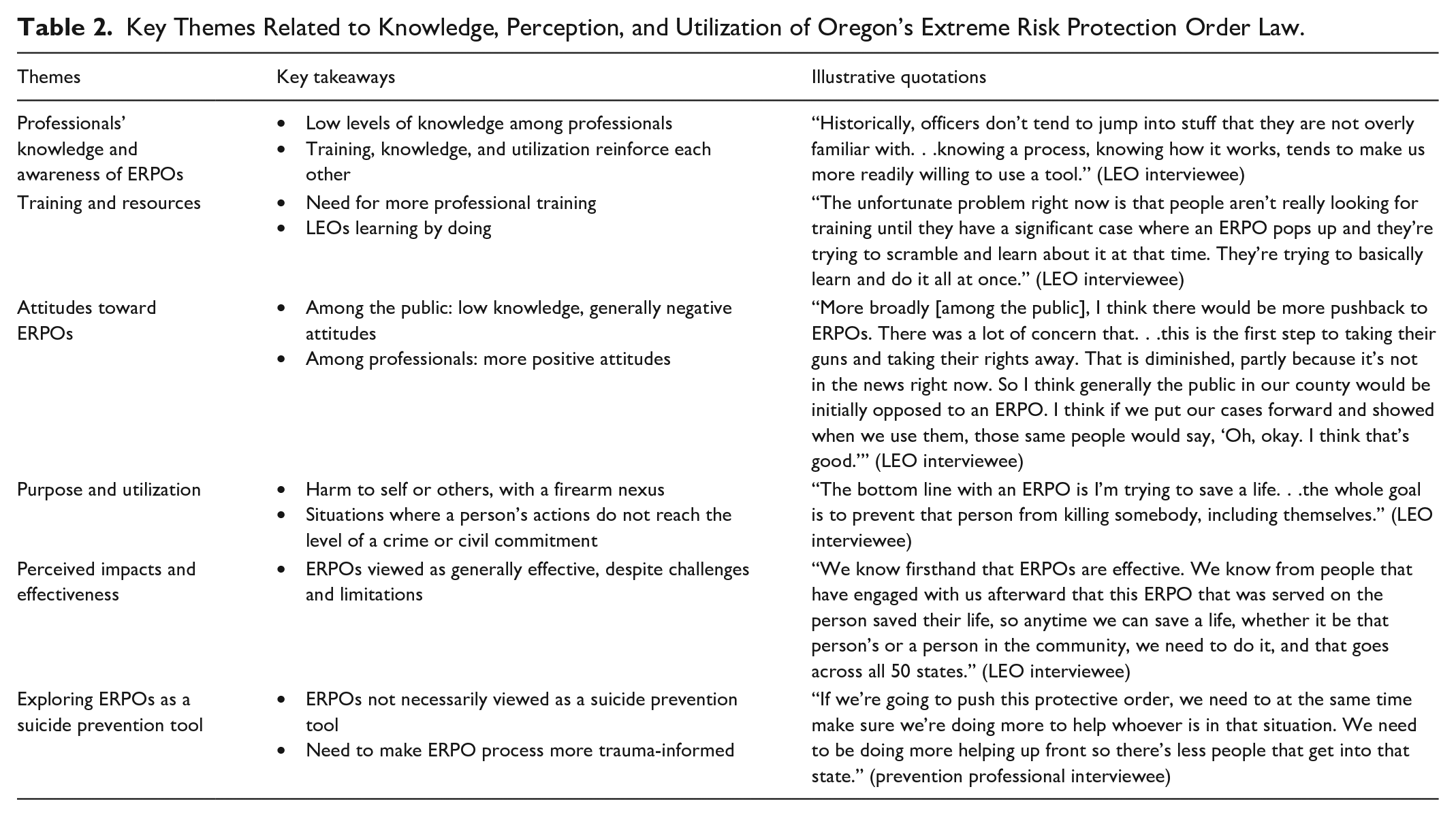
Six themes emerged related to ERPO knowledge, perception, and utilization, including: professionals’ knowledge and awareness of ERPOs, training and resources, attitudes toward ERPOs, purpose and utilization, perceived impacts and effectiveness, and exploring ERPOs as a suicide prevention tool (Table 2).
Key Themes Related to Knowledge, Perception, and Utilization of Oregon’s Extreme Risk Protection Order Law.
Professionals’ Knowledge and Awareness of ERPOs
Interviewees tended to describe low general knowledge about ERPOs among professionals in their field, especially among prevention professionals. Perceptions of knowledge among others in their field were commonly tied to the existence of training and frequency of ERPO utilization in their agency.
Interviewees identified that training, knowledge, and utilization seemed to reinforce each other. For example, one LEO interviewee stated that knowledge made individuals more likely to use ERPOs, saying, “When the information is given to a person. . .they are more likely to utilize it and implement it into their investigation and problem solving.” A judge interviewee also identified that frequent utilization could build knowledge, even in the absence of training: “Volume brings a critical mass of knowledge.”
Training and Resources
Few interviewees had personally received professional training on the ERPO law. While some interviewees were resistant to adding mandatory trainings due to the infrequent use of ERPOs and concerns about resources and time, most viewed such training as important. As one LEO interviewee said, “Low frequency, high risk means you need to train it well.”
Six interviewees reported creating their own trainings to educate their departments or local law enforcement agencies on ERPOs. Their trainings included the basic steps of the ERPO process, requirements in the ERPO statute, case studies of ERPO use, and constitutionality of ERPOs.
Given the lack of widespread training, many LEO interviewees described first learning about ERPOs when they needed to use them. One LEO interviewee described not knowing what an ERPO was until a supervising officer suggested it: “I had never heard of it until my trainer said, ‘I remember this thing called an ERPO. You should probably do one on this guy.’” Another LEO interviewee described struggling to navigate the process without training, saying, “It really kind of felt like wandering through the dark and doing my best to pick my way through.”
Most interviewees thought training was particularly necessary for LEOs given their role as petitioners. LEO interviewees’ descriptions of ideal trainings varied from brief 10-min training videos to a multi-part class covering all types of restraining orders. Most agreed that trainings should educate LEOs on assessing risk, determining whether an ERPO is needed, and navigating the court forms and hearings. Many agreed that all LEOs should be trained initially at the academy, with brief refresher courses each year thereafter.
Judges, representatives from DA and CA offices, and prevention professionals favored brief resources that they could easily reference when questions about ERPOs came up. Judges described the utility of bench cards, which would be created by either local courts or the Oregon Judicial Department and would state key facts about the ERPO statute (eg, petitioner eligibility and evidentiary requirements). Other professionals expressed a desire for online fact sheets or flow charts describing the key details of the ERPO process. Professionals raised the infrequent use of ERPOs as a reason for needing these materials. As one prevention professional said, “If I’m going to use this information once every five years, then having something that I can refer to really quickly in the moment I think is really helpful.”
Interviewees noted that the most important resource is an ERPO expert or point of contact within each agency or county who can answer questions about the ERPO process and support LEO petitioners. One LEO interviewee emphasized the importance of this resource, especially in the current absence of widespread training: I think the most important thing is having someone that is available. . .in the county that has an interest and wants to be like the expert, that is going to be a point of contact for ERPOs as they come up until everybody gets trained on them.
Attitudes Toward ERPOs
Most interviewees did not think that the public in their counties were knowledgeable about ERPOs, with one DA/CA interviewee saying, “I could count on one or two hands the number of people in my county who actually know about this law and understand its purposes.” Still, interviewees noted that, among those with knowledge of ERPOs, attitudes among the public were primarily negative. Interviewees suggested that these negative attitudes may be due to misinformation and misunderstanding (eg, fears that the government is using ERPOs to take away firearms without due process). Interviewees described these feelings as being particularly prevalent among firearm owners, Veterans, and rural populations due to strong firearm cultures and political tensions around firearm policies: Gun culture is so strong. . .Threatening to take somebody’s gun away is a threat to their identity. It’s a threat to their safety. It’s a threat to their patriotism. (prevention professional interviewee)
Most interviewees felt that public opinion could change with time and education. Some observed that public fear and outrage had diminished as time passed. As one DA/CA interviewee commented, “That [backlash] may have just kind of faded away when people saw that there wasn’t this mass taking away of people’s firearms that they were afraid of.” Others believed that once the public understood the situations for which ERPOs were applied, they generally agreed that those individuals should not have access to their firearms at that time. Some interviewees suggested a need for more outreach and education for the public on ERPOs, including presentations targeting those dealing with a family member in crisis, short informational videos, and fact sheets on ERPOs provided at firearm shops or with purchase of secure storage devices.
When describing their own attitudes and opinions or those of their colleagues, responses were more positive. Many described ERPOs as a useful tool. Still, interviewees emphasized the importance of balancing public safety and Second Amendment rights. Multiple interviewees, especially LEOs, emphasized that Second Amendment rights and firearm ownership are important to them and to their communities, but these same interviewees also acknowledged that ERPOs provide a useful tool in certain situations to keep people safe: While I do fully support the Second Amendment, I also believe that there are some people at points in their lives who should not own or possess firearms. It is too lethal a means to be utilized without some sort of reasonable controls. (LEO interviewee)
Additionally, DA/CA interviewees and prevention professionals expressed more nuanced attitudes toward ERPOs. DA/CA interviewees personally expressed support for ERPOs, but mentioned that other DAs may avoid supporting ERPOs due to political consequences, especially in smaller counties. Some prevention professionals were hesitant to endorse ERPOs as a suicide prevention tool because they viewed ERPOs as too “downstream” and feared impacts on treatment-seeking behaviors among firearm owners and Veterans.
Purpose and Utilization
When asked about the situations for which ERPOs may be most suitable, most interviewees described situations of risk of harm to oneself or others, specifically involving a firearm. Common factors included mental health crises, substance use or abuse, and domestic violence. Multiple interviewees specifically viewed ERPOs as addressing a gap in crisis response by enabling law enforcement intervention before a person’s threats or actions rise to the level of a crime or civil commitment. As one DA/CA interviewee described, “We saw this gaping hole of, there’s somebody we know is dangerous, but we have to wait until they actually hurt somebody to take their firearm away.”
Despite these beneficial uses, interviewees treated ERPOs as a last resort, saying they tend to utilize other tools before using ERPOs. As one LEO interviewee said, “It’s not something that we jump to. . . it tends to be more of a situation where there’s a significant ongoing risk, an articulable threat, not that they’re in a brief crisis and we can get them to a hospital and get them some help. . .We tend to utilize other tools.” For situations involving risk of harm to others, interviewees described using restraining or stalking orders (if threats were directed at a specific person) or imposing criminal penalties. For situations involving risk of suicide or self-harm, interviewees described a preference for peace officer mental health holds and more voluntary measures, including temporary out-of-home firearm storage, secure firearm storage, and safety planning.
We also asked interviewees to explain the differences in ERPO utilization observed across the state. Interviewees suggested that these differences may be due to greater funding and resources in larger counties or law enforcement agencies, or differences in political will based on local culture. Some interviewees believed that smaller, more rural counties may be less likely to utilize ERPOs frequently due to the close-knit nature of their communities and the sense that, as one prevention professional put it, “We can handle this on our own.” Other interviewees suggested that law enforcement agency leadership may set different thresholds for what constitutes extreme risk, leading to differences in petitioning among officers within that agency. Importantly, some interviewees from counties with lower ERPO utilization stressed that they did not see lower utilization as a problem or necessarily view higher utilization as a goal since ERPOs are only meant to be used for extreme situations.
Perceived Impacts and Effectiveness
Most interviewees perceived ERPOs as effective at reducing firearm injury and violence, including interpersonal homicide, mass shootings, and firearm suicide. Many described that a primary benefit of ERPOs was the ability to separate an individual in crisis from their firearms, thus creating time and distance to allow the crisis to pass or making the situation safe enough for additional intervention. As one LEO interviewee noted: I view these kind of laws as putting brakes on everything. . . It’s not going to resolve the problem permanently. . .but what it does do is it slows everything down and in my many years of doing crisis work, a lot of times if you can slow things down. . .[people] have that opportunity to reset, whether it’s getting treatment or getting clean or sober, getting back on meds, whatever it is.
Interviewees acknowledged that ERPOs are not a perfect solution, noting significant limitations due to challenges to enforcement and accessibility of firearms through illegal means. Multiple interviewees described ERPOs as “a piece of paper” when noting these limitations to effectiveness. Still, interviewees appreciated ERPOs as another tool to be used for firearm injury prevention. As one LEO interviewee said, “Like a restraining order, it’s a piece of paper, so there’s always some risk that remains, but if we can do everything we can to try to prevent it, we should be doing it.”
Exploring ERPOs as a Suicide Prevention Tool
Some interviewees expressed that they do not view ERPOs as a suicide prevention tool. LEO interviewees reported being less likely to utilize ERPOs for situations exclusively involving risk of harm to self, with some noting that they may not think to use ERPOs in these situations and others expressing that they do not view firearm removal as warranted in the absence of a public safety threat. Still, many LEO interviewees expressed a willingness to use ERPOs for suicide prevention and described that the process would not change regardless of the threats being made.
Prevention professionals described a preference for more voluntary and upstream interventions, noting that these interventions often prioritize hope and individual choice, whereas ERPOs may be perceived as isolating or stigmatizing. Still, these interviewees acknowledged potential beneficial uses of ERPOs for suicide prevention and suggested ways to make the ERPO process more trauma informed.
One suggestion was to change the language used when discussing ERPOs. Prevention professionals commented that the current messaging can feel very punitive or stigmatizing, saying, “The language was not written by suicide prevention people.” In particular, some interviewees raised concerns about terms like “firearm surrender,” noting that it does not convey a sense of care or safety, as well as the name of the law itself, saying that “it feels like I’ve done something wrong.” These prevention professionals identified the need to use more caring language (eg, “You’re important to me. You’re important to our community. And we’re going to help you through this.”) and to frame ERPOs as a lethal means safety measure and as an act of care for the respondent.
Another common suggestion to make ERPOs more trauma-informed was to integrate connections to services into the process. Most interviewees were unaware of any connections to services or follow-up occurring with respondents. Some felt that respondents would have already been connected to services by the time an ERPO was used, but most saw a need for more of these connections throughout the process. Interviewees acknowledged barriers to this practice, including limited availability of treatment services and respondents’ potential resistance to treatment. To address these barriers, interviewees suggested there should be mental health professionals dedicated to working with respondents and that follow-up should occur regularly over the year in which the ERPO is in effect. Interviewees emphasized that treatment and services should not be mandatory for all ERPO respondents, but rather made accessible and respondents given the choice to engage. Interviewees, in particular prevention professionals, emphasized that these connections to services are essential to prioritize safety and well-being, even beyond the time of the ERPO. As one prevention professional said, “The goal with an Extreme Risk Protection Order is to give the person time to get well so that they can have it [the firearm] back. You can’t just take and not provide a pathway to that.”
Discussion
ERPO utilization varies across the state of Oregon, and remains substantially lower than utilization of other protective orders in the state.9,33 In this study, semi-structured interviews with professionals involved in ERPO implementation provided greater insight into potential drivers of these differences in utilization, including lack of professional training and education, limited knowledge about ERPOs among professionals and the public, preferences for alternative interventions (eg, restraining orders, peace officer mental health holds, voluntary firearm removal), and differences in political will and culture. Interviewees expressed positive perceptions of the ERPO law and its effectiveness but noted a need for public education and professional training to improve knowledge and opinions of the law and suggested ways to improve the perception and use of ERPOs as a tool for suicide prevention.
The majority of interviewees identified a need for more professional training on ERPOs, particularly for LEOs. Few reported having received professional training themselves, suggesting a potential gap in Oregon’s ERPO implementation. Lack of training has hindered implementation in other states as well, perhaps to a lesser degree, with one survey of LEOs in states with ERPO laws finding that only 55% of survey respondents had received training. 30 Training and education on ERPOs have been associated with greater support for ERPO utilization across a variety of circumstances and scenarios. 30 More comprehensive ERPO training should be developed for LEOs, in collaboration with LEO professional organizations and those with experience with the ERPO law, to bolster knowledge among these professionals. While trainings are being developed and disseminated, interviewees suggested a local point of contact serving as an ERPO expert may be a beneficial resource for law enforcement agencies.
While interviewees themselves reported generally positive views on ERPOs, they perceived public opinion of ERPOs as primarily negative. These perceptions are contrary to public opinion polling, which estimates that over 70% of U.S. adults support ERPO laws, including over 65% of firearm owners.28,29 Although those in rural areas have reported greater mistrust of ERPOs, negative opinions were only expressed by 11% of those from rural areas in one public opinion study. 34 While this polling is not Oregon-specific, it suggests a potential disconnect between perceptions of public opinion and reality, potentially driven by more vocal response from ERPO opponents. Perceptions that the public view ERPOs negatively may harm willingness to express support for or utilize the law among professionals in positions of power. Past research on public perceptions of firearm safety policies found that firearm owners and non-firearm owners both underestimated the level of support for firearm safety policies among firearm owners and that correcting these misperceptions was associated with increased expression of support for these policies, reduced perceptions of intergroup division, and greater willingness of firearm owners to collaborate with non-firearm owners to promote firearm safety.35,36 Public education could increase knowledge of the ERPO law, address concerns and misinformation, shift the perception that the public at large view these policies negatively, and foster collaboration between firearm owners and non-firearm owners to promote safety.
Still, as many professionals noted, concerns around ERPOs often involve perceived infringement on Second Amendment rights. Public education must adequately address these concerns and highlight the ways in which ERPOs respect due process. Past research on factors that influence one’s opinion on ERPOs found that viewing most firearm regulations as infringing upon the Second Amendment reduced the likelihood that a person supported ERPOs, but knowing a firearm owner for whom an ERPO may be needed (eg, a firearm owner who is perceived to be a danger to themselves or others or who is experiencing cognitive decline) was associated with greater support for ERPOs. 37 Even in the absence of this personal knowledge or connection, sharing examples of scenarios for which ERPOs are being used may similarly increase support and dispel misconceptions by helping others to understand the gravity of the situations for which ERPOs are utilized. Research from the Ad Council Research Institute suggested similar recommendations for messaging, such as providing detailed information on ERPOs, incorporating real scenarios, and making messaging state-specific and localized. 38 Their resulting Communication Toolkit, as well as collaboration with local and state partners, can help inform public education efforts.
ERPOs are designed to address risks to both self and others, as stated in the first model ERPO policy published by the Consortium for Risk-Based Firearm Policy in 2013. 39 While research on the impacts and effectiveness of ERPOs is limited, the existing evidence primarily supports effectiveness for reducing firearm suicide.24,40-42 Previous research has found mixed opinions among ERPO stakeholders regarding the primary or most suitable uses of ERPOs. One survey of LEOs across 15 jurisdictions found greater support for ERPO utilization in cases involving intimate partner violence and lower support in cases of suicide risk, while research on California’s law reported that stakeholders viewed the law as particularly effective for firearm suicide prevention.22,30 In our study, interviewees generally viewed ERPOs as effective for addressing multiple types of firearm violence, but expressed the most hesitancy or resistance to ERPOs as a suicide prevention tool. LEO interviewees reported lower willingness to use ERPOs for situations exclusively involving risk of harm to self. Prevention professionals reported concerns around impacts on treatment-seeking behaviors and perceptions that current language used in discussion of ERPOs is stigmatizing or punitive. Interviewees expressed a need to incorporate connections to mental health and social services into ERPO protocols to address the root causes of the crises, a desire echoed by civilian ERPO petitioners in Washington as well. 43 Analysis of ERPO court records in Oregon identified a potential need for such services among ERPO respondents, as 35% of petitions cited domestic violence concerns, 25% cited concerns of alcohol use or misuse, and many cited concerns of mental or physical health conditions. 9 While 35% of respondents were hospitalized or referred to services in response to the events precipitating ERPO filing, further service connections and follow-up with respondents across the duration of the ERPO are needed. 9 Collaboration with those working in suicide prevention, tailored messaging related to the use of ERPOs for suicide prevention, and incorporation of trauma-informed practices and connections to mental health and social services into ERPO protocols may help to increase favorability and utilization of this tool for suicide prevention.
This evaluation only examined Oregon’s ERPO law. Themes generated may be different than those from interviewees in other states with varied ERPO statutes. While the sample included participants from 15 of Oregon’s 36 counties, approximately half of all participants reported working in just 2 counties. These 2 counties are among the most populous and urban of Oregon’s counties and utilize ERPOs more frequently than other counties. Additionally, nearly 60% of interviewees were LEOs, potentially over-representing their perspectives and under-representing the perspectives of other professionals. The perceptions and experiences of interviewees may differ from professionals in other counties and from those who were not contacted or chose not to participate. However, we aimed to minimize these limitations through purposive sampling, extensive recruitment efforts, engagement of interviewees from a variety of backgrounds and experiences, and the use of separate matrices for each professional type during analysis. Qualitative interview methods risk influence on responses by the interviewers, but this was addressed through the use of a semi-structured interview guide and trained interviewers. Despite these limitations, this study was the first qualitative analysis of ERPO utilization in Oregon and included one of the largest sample sizes of all interview-based analyses of ERPO implementation to date. Insights from this study may inform future research and implementation efforts.
Conclusion
Professionals involved in ERPO implementation in Oregon viewed ERPOs as a beneficial tool for addressing risks of firearm homicide and suicide but identified a need for more professional training and public education to increase knowledge, dispel misperceptions and misinformation, and encourage utilization of the law. Messaging and education around the ERPO law should include key facts about the law and examples of the law’s utilization. Law enforcement officers, suicide prevention professionals, and others involved in implementation should be engaged in the creation of this messaging to ensure that it is trauma-informed and relevant to the diverse stakeholders involved in ERPO implementation. Results of this study may help inform the development of such messaging and training.
Supplemental Material
sj-pdf-1-inq-10.1177_00469580251371379 – Supplemental material for Professional Training and Public Education Can Support Extreme Risk Protection Order Utilization: A Qualitative Study of Professionals in Oregon
Supplemental material, sj-pdf-1-inq-10.1177_00469580251371379 for Professional Training and Public Education Can Support Extreme Risk Protection Order Utilization: A Qualitative Study of Professionals in Oregon by Rebecca Valek, Rebecca Teichman, Shauna Rakshe, Gina Stahla, Susan DeFrancesco and Kathleen F. Carlson in INQUIRY: The Journal of Health Care Organization, Provision, and Financing
Supplemental Material
sj-pdf-2-inq-10.1177_00469580251371379 – Supplemental material for Professional Training and Public Education Can Support Extreme Risk Protection Order Utilization: A Qualitative Study of Professionals in Oregon
Supplemental material, sj-pdf-2-inq-10.1177_00469580251371379 for Professional Training and Public Education Can Support Extreme Risk Protection Order Utilization: A Qualitative Study of Professionals in Oregon by Rebecca Valek, Rebecca Teichman, Shauna Rakshe, Gina Stahla, Susan DeFrancesco and Kathleen F. Carlson in INQUIRY: The Journal of Health Care Organization, Provision, and Financing
Footnotes
Acknowledgements
The authors would like to thank the study participants for their time and input. We would also like to thank our colleagues at the UC Davis Centers for Violence Prevention, Dr. Garen Wintemute and Dr. Veronica Pear, for sharing their interview guide and consulting on the interview process.

Ethical Considerations
This study was approved by the Oregon Health & Science University Institutional Review Board (Approval #23568) on June 5, 2024.
Consent to Participate
Participants were provided a consent information sheet and gave verbal consent prior to beginning the interview, which was documented in study files. Interviewees consented to participation in the interview and to the sharing and publication of de-identified information and results. The Oregon Health & Science University Institutional Review Board approved a waiver of the requirement to document written informed consent and allowed for this verbal consent process.
Author Contributions
All authors (RV, RT, SR, GS, SD, and KFC) took part in the study concept and design, analysis and interpretation of the data, drafting of the manuscript, critical revision of the manuscript for important intellectual content, and final approval of the manuscript. RV, RT, SR, GS, and SD participated in recruitment and conducted interviews. SD and KFC were responsible for the acquisition of funding for this study. All authors agree to be accountable for all aspects of the work. KFC is the guarantor of the study.
Funding
The authors disclosed receipt of the following financial support for the research, authorship, and/or publication of this article: This work was funded by the Centers for Disease Control and Prevention’s Comprehensive Suicide Prevention grant through contract with the Oregon Health Authority.
Declaration of Conflicting Interests
The authors declared no potential conflicts of interest with respect to the research, authorship, and/or publication of this article.
Data Availability Statement
To protect the confidentiality of our study participants, we cannot make our interview data publicly available. We can share our interview guide and interview summary template as needed.
Supplemental Material
Supplemental material for this article is available online.
References
Supplementary Material
Please find the following supplemental material available below.
For Open Access articles published under a Creative Commons License, all supplemental material carries the same license as the article it is associated with.
For non-Open Access articles published, all supplemental material carries a non-exclusive license, and permission requests for re-use of supplemental material or any part of supplemental material shall be sent directly to the copyright owner as specified in the copyright notice associated with the article.
