




Abstract
This study examines how distinct Information and Communication Technology (ICT) engagement profiles impact life satisfaction among older adults, aiming to inform digital inclusion policies for aging populations. Cross-sectional data from 717 older adults in Central China were analyzed using latent profile analysis (LPA) to identify distinct ICT engagement profiles, followed by multinomial logistic regression to examine predictors of profile membership. LPA identified 3 profiles: Quiescent (39.75%), Compliant (42.96%), and Active (17.29%) Users. Active Users reported significantly higher life satisfaction (F = 20.38, P < .001) than Quiescent and Compliant Users. Income, age, and gender predicted profile membership. These findings propose tailored strategies to promote ICT engagement in aging populations, advocating for inclusive digital policies to enhance late-life well-being.
Introduction
In today’s digital era, marked by the pervasive use of Information and Communication Technology (ICT), which is defined as digital systems enabling communication, information processing, and service delivery through devices (eg, computers, smartphones, tablets) and applications (eg, internet platforms, software tools),1,2 the global shift toward an aging society underscores the importance of supporting older adults’ life satisfaction. Life satisfaction, conceptualized as an individual’s holistic evaluation of fulfillment across key domains, including relationships, work, and leisure, 3 is a critical quality-of-life indicator informing policy in countries such as China, the United Kingdom, and the United States. 4 Research consistently demonstrates that higher life satisfaction is associated with positive outcomes, including academic achievement, enhanced workplace performance, and improved mental health. 5 Conversely, lower life satisfaction is linked to social, psychological, and behavioral challenges. 6
China faces pressing challenges due to its rapidly aging population, with over 300 million older adults comprising 18.7% of the total population, 7 projected to reach 365 million by 2050 (Nie et al). 8 The Chinese government has responded by utilizing ICT to promote older adults’ life satisfaction. For instance, the National Scientific Literacy Action Plan (2021-2035) initiated by the State Council in 2021 advocates fostering the digital literacy of older adults and enabling their prosperity in the digital age. 9
While ICT’s potential is evident, previous research indicates that older adults’ attitudes toward ICT and their use of ICT for social interaction can influence their life satisfaction. 10 However, many studies have assumed homogeneity among older adults, treating them as a uniform group without considering individual differences. 11 Although efforts have categorized older adults based on ICT usage frequency and activities, 12 these classifications have not thoroughly explored their varied effects on life satisfaction. Consequently, a research gap exists concerning the diverse impacts of ICT dispositions on older adults’ life satisfaction, necessitating a nuanced investigation.
Given the potential diversity of each older adult’s ICT dispositions, it is critical to examine the impact of diverse ICT dispositions on their life satisfaction. Furthermore, previous research suggests that sociodemographic factors such as age, gender, and educational level can shape older adults’ ICT dispositions. 13 These sociodemographic characteristics may lead to varied forms of ICT dispositions among older adults. Thus, understanding the factors associated with ICT dispositions across diverse profiles is imperative for developing effective interventions to improve quality of life and promote healthy aging.
Therefore, the present study aims to: (1) Identify different profiles of older adults concerning their ICT dispositions, including ICT attitude, usage, self-efficacy, and perceived ICT support, along with their specific characteristics among older adults. (2) Explore the individual background variables of older adults that determine their profile memberships. (3) Investigate the relationship between the identified profiles of older adults and their life satisfaction. The findings of this study may inform differentiated strategies and support mechanisms to enhance the life satisfaction of older adults in the digital era.
Theoretical Background and Literature Review
ICT dispositions comprise a range of cognitive and affective-motivational constructs, 14 encompassing an individual’s knowledge, skills, attitudes, beliefs, and other ICT-related attributes. In this study, older adults’ ICT dispositions are defined through 4 interconnected dimensions: (1) attitudes: emotional evaluations of ICT; (2) self-efficacy: confidence in using ICTs; (3) usage: actual behavioral engagement; and (4) perceived ICT support: the ability to assess and access external resources for ICT use. Attitudes and self-efficacy are foundational to ICT dispositions, as they reflect individuals’ affective evaluations (attitudes) and confidence in their capabilities (self-efficacy) to engage with ICTs, both of which are central to cognitive-affective models of technology adoption. 15 Usage serves as a behavioral manifestation of dispositions, as frequency and diversity of ICT use often correlate with underlying tendencies. 16 While support from family/peers is external, individuals’ perception and utilization of such support reflect their agency in seeking resources to overcome ICT-related challenges, which represents a critical facet of motivational dispositions. 17
Older Adults’ ICT Attitude
Older adults’ ICT attitudes, which encompass beliefs, values, and judgments about ICT, vary widely. While many older adults view ICT as a tool for convenience, leisure, and social connection 18 and embrace digital tools, others hold negative attitudes, feeling overwhelmed or concerned about risks like privacy breaches and scams. 19 Research shows that age, gender, and education significantly shape these attitudes. For instance, adults in their late 70s often resist smartphones due to navigation challenges, while those in their early 60s are more likely to adopt them. 20 Women may exhibit more positive attitudes despite higher technophobia, and higher education levels correlate with greater acceptance of mobile technologies. 21 Positive attitudes are linked to increased ICT use for communication, enhancing social support, and life satisfaction. 10
Older Adults’ ICT Self-Efficacy
ICT self-efficacy reflects older adults’ confidence in digital technologies. 22 High self-efficacy promotes greater engagement and competence with ICT. 23 Positive attitudes and willingness to engage significantly boost self-efficacy, while technology anxiety undermines it. 24 ICT self-efficacy impacts life satisfaction by facilitating better social interactions and support. 25 In contrast, low self-efficacy can lead to isolation and fewer positive outcomes. 26
Older Adults’ ICT Usage
Older adults’ ICT usage includes internet searches, email, and photo organization, with less engagement in e-commerce or financial transactions. 27 They use ICT for instrumental purposes (eg, health information, banking) and social purposes (eg, messaging family). 28 Usage patterns vary: active use strengthens social ties, while passive use focuses on information gathering. 29 Previous person-centered analyses, such as Yamashita et al, 30 segmented older workers into 2 latent classes by digital skill patterns, while Smrke et al 31 identified 4 motivation typologies for technology adoption, and Lau et al 32 classified three proficiency levels using multidimensional indicators. However, these studies often stop at profile identification without linking classifications to life satisfaction, limiting their practical utility. Although Álvarez -Dardet et al. 12 propose theoretical linkages between behavioral profiles and life satisfaction, empirical substantiation of these associations remains limited. This gap impedes a nuanced understanding of how specific ICT behavioral patterns affect life satisfaction, particularly given technology’s dual potential to enhance social connectivity or increase mental health risks. 33
Older Adults’ Perceived ICT Support
ICT support, which includes access to technology, skill development, and enhanced literacy, 34 is crucial for older adults’ life satisfaction. It relieves depressive symptoms, anxiety, and stress, improving psychological health. 35 While younger generations frequently provide this critical support, enhancing older adults’ technological competence, studies by Jun et al 36 and the State Council of the People’s Republic of China 9 emphasize that informal networks of family and friends prove particularly effective in reducing digital disparities. However, the direct relationship between perceived ICT support and life satisfaction remains underexplored, warranting further investigation.
The Present Study
While previous research has explored the impact of older adults’ ICT dispositions on their life satisfaction, there has been limited focus on individual differences and distinct profiles in ICT dispositions. This study addresses the following research questions:
RQ1: Are there distinct latent profiles among older adults that differentiate their ICT disposition levels? If such profiles exist, what key attributes characterize each of them?
RQ2: To what extent do older adults’ individual sociodemographic factors determine their membership within specific ICT disposition profiles?
RQ3: Is there a discernible association between the identified profiles of older adults’ ICT dispositions and their life satisfaction?
Methodology
Procedure and Participants
This cross-sectional study was conducted in Wuhan City, the largest city in Hubei Province and one of China’s nine National Central Cities, from May 1 to August 30, 2023. To ensure geographic representation, participants were recruited from urban, suburban, and rural districts. Eligible participants were 60 and above, reflecting China’s retirement ages: women typically retire at 55 in administrative and public institutions or 50 in enterprises, while men retire at 60 in administrative and public institutions or 55 in enterprises. The study accounted for diverse educational levels, professional backgrounds, and socioeconomic factors such as monthly income and past occupations, to capture a broad range of perspectives. The study adhered to the STROBE guidelines, 37 with the completed checklist provided in the Supplemental File.
To mitigate biases inherent in snowball sampling, we implemented 3 control strategies: (1) stratified seed selection: initial participants (“seeds”) were purposively recruited from diverse channels (community centers, universities for the elderly, retirement associations, and public parks) to maximize variation in age (60-75), gender, education, occupation, income, and ICT proficiency. Each seed received detailed explanations of the research objectives, methodology, confidentiality, and data use; (2) real-time diversity monitoring: during recruitment, the source of each recommendation was documented, and sample diversity was periodically assessed across age, gender, education, and ICT usage proficiency. Recruitment was adjusted to prioritize underrepresented groups when necessary; (3) post-hoc validation: the sample’s socioeconomic indicators were compared with nationally representative data from the National Bureau of Statistics of China 38 and other reports.39 -41 The sample aligned closely with national distributions for education (29.6% no formal education, 25.8% junior high school, 13.9% above senior high school) and income (28% < ¥3000/ month, 33% ¥3000-5000/month, 44% >¥5000/month), enhancing generalizability.
Individuals with vision or hearing impairments hindering engagement with study materials or significant difficulties understanding scales (eg, due to conditions) were excluded. Eligibility was determined through verbal assessments by trained researchers, without standardized cognitive instruments. Of 754 initial respondents, 37 were excluded, resulting in a final sample of 717 participants (95.09%). The sample size was determined based on LPA standards, where 300 to 500 cases constitute minimum thresholds for reliable fit indices 42 and ensured ≥80% power to detect 3-profile models. 43
The study complied with the ethical standards of the 1975 Helsinki Declaration and was approved by the Hubei University of Technology’s Research Ethics and Security Committee (HBUT20240003). Written informed consent was obtained, ensuring participants were informed about the study’s purpose, procedures, risks, benefits, and withdrawal rights. Data privacy was maintained through restricted access and pseudonymization. Paper-based questionnaires were used to accommodate potential difficulties with online surveys, with each survey taking 30 to 40 min. Seven trained college students assisted participants, providing reading glasses and pens as needed.
Table 1 presents the socio-demographic characteristics of the participants. Of the 717 valid responses, 374 (52.2%) were men, 343 (47.8%) were women, with a majority (91.78%) aged 60 to 70 years. Only 44.49% of the participants had a high school degree or higher, and more than half had a monthly income of ¥0 to 4999. Additionally, 84.66% lived with others, and 15.34% lived alone.
Demographic Information of Respondents.
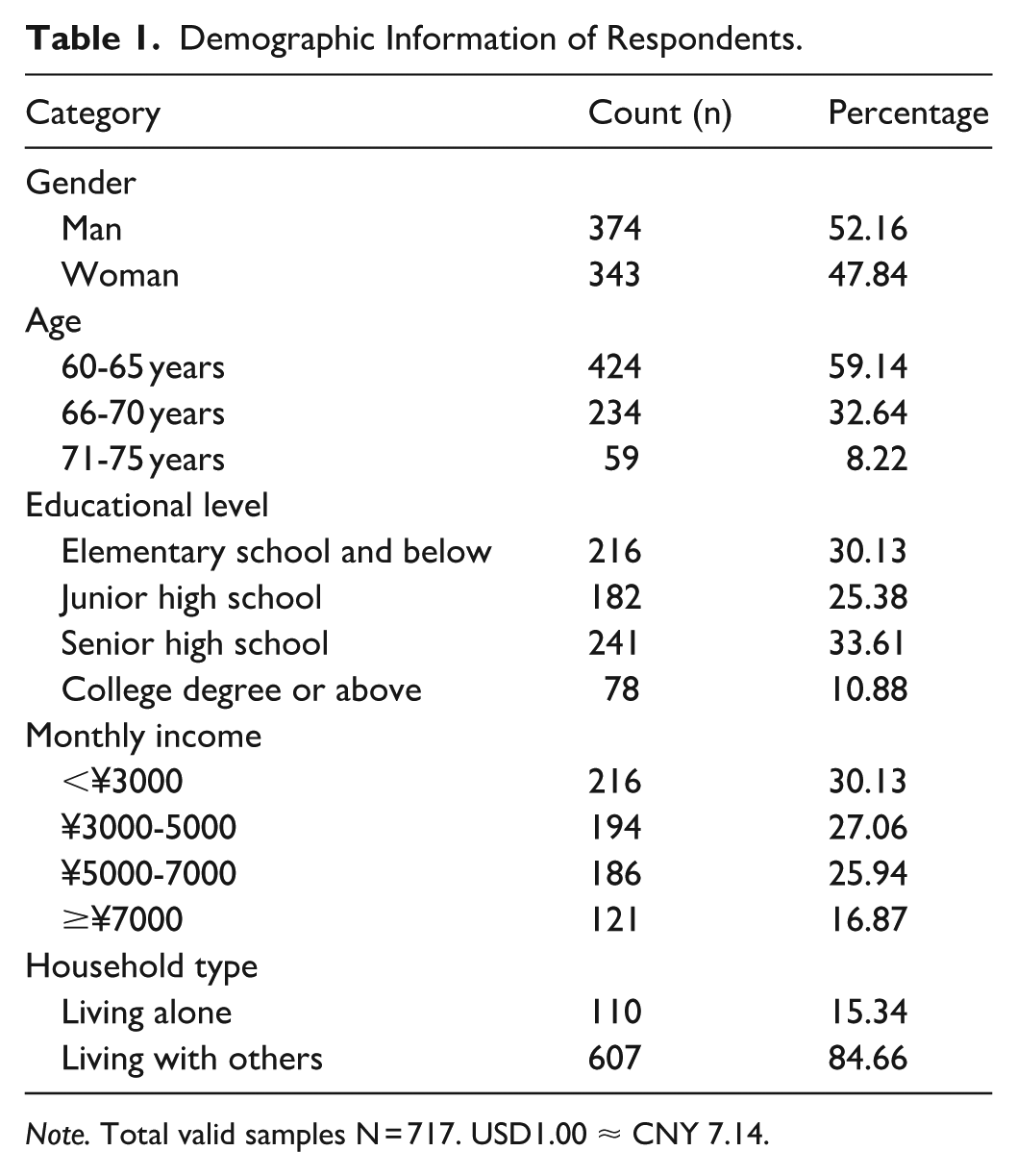
Note. Total valid samples N = 717. USD1.00 ≈ CNY 7.14.
Instrumentation
The survey comprised 2 sections: demographic information (age, gender, education, income, living arrangements) and measures of life satisfaction and ICT dispositions. All scales used a 5-point Likert format (1 = totally disagree, 5 = totally agree). Construct validity was established through a 2-phase protocol: (1) iterative conceptual refinement by the research team, examining operational definitions and measurement models; (2) evaluation by 5 gerontologists, 3 adult education specialists, and 4 educational technologists for terminological precision, contextual relevance, and cognitive appropriateness. The following scales were used:
Life Satisfaction: a 5-item life satisfaction scale adapted from Cheng et al 44 assessed satisfaction with life aspects (eg, finance, social life, family relationships; α = .82).
ICT Attitudes: a 3-item scale adapted from Klimova 45 measured interest in ICT (eg, “I think using smartphones or other electronic devices is interesting”; α = .88).
ICT Self-Efficacy: a 3-item scale adapted from Compeau and Higgins 46 evaluated confidence in ICT tasks (eg, “I am confident in my ability to back up my phone data”; α = .82).
ICT Usage: a 13-item scale adapted from Zhang et al 47 and Chopik et al 48 assesses 2 dimensions: (1) Instrumental Use (α = .85; 6 items): information acquisition (eg, medical information retrieval via websites) and skill development (eg, online healthcare course completion); (2) Social Use (α = .89; 7 items): interpersonal communication (eg, email-based connections) and health-specific interaction (eg, biometric sharing on digital platforms). 10 of 13 items (77%) employ device-agnostic phrasing (eg, “websites,” “online courses,” “digital devices ” ), while 3 items reference mobile contexts (eg, “Watched online courses on smartphone use,” “Video calls with doctors via WeChat,” “Used health monitoring devices”). The scale balances mobile- and computer-centric tasks (eg, “Used email for communication” ) and use platform-agnostic verbs (“use” and “access”).
Perceived ICT Support: a 3-item scale adapted from Zhou and Ding 49 assessed support received for ICT use (eg, “My children or family members teach me how to use smartphones”; α = .82).
Data Analysis
Data analysis for this study involved 4 components: (1) descriptive statistics: means, standard deviations, frequencies, and proportions of key variables after addressing missing values via mean substitution; (2) latent profile analysis (LPA): conducted using maximum likelihood estimation with robust standard errors (MLR) in R (version 2023.06.1) with the “tidyLPA” package. 50 This estimator was selected given the continuous nature of composite indicators. Model fit was evaluated using AIC, BIC, aBIC, Vuong-Lo-Mendell-Rubin (VLMR), Bootstrapped Likelihood Ratio Test (BLRT; P < .05), and entropy (>0.80). 51 Profile selection balanced statistical indices and theoretical coherence 11 ; (3) sociodemographic comparisons: one-way ANOVAs and chi-squared tests examined differences across profiles, followed by multinomial logistic regression to identify predictors of profile membership (P < .05); (4) Life satisfaction analysis: ANCOVA assessed the relationship between ICT profiles and life satisfaction, controlling for gender, education, and income, with Bonferroni-adjusted post-hoc comparisons.
Results
Descriptive Statistics of Older Adults’ Life Satisfaction
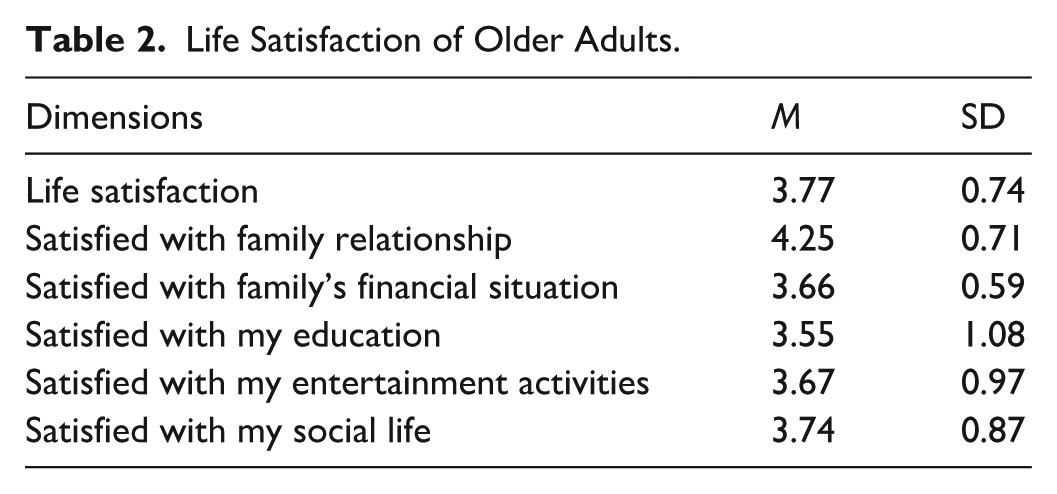
Table 2 shows that the older adults’ mean life satisfaction score was 3.77 (out of 5). Among specific domains, family relationships yielded the highest average satisfaction (M = 4.25, SD = 0.71), highlighting its importance as a primary source of quality of life. Moderate satisfaction was also found in other domains: social life (M = 3.74, SD = 0.87), entertainment (M = 3.67, SD = 0.97), and finances (M = 3.66, SD = 0.59). Satisfaction with education varied most widely (M = 3.55, SD = 1.08).
Life Satisfaction of Older Adults.
Latent Profile Analysis
Number of Older Adults’ ICT Dispositions Profiles
To address RQ1, latent profile analyses were conducted using older adults’ ICT dispositions, including ICT attitude, ICT self-efficacy, ICT instrumental usage, ICT social usage, and perceived ICT support. Table 3 shows model fit indices, including AIC, BIC, aBIC, entropy, VLMR p values, and BLRT p values, and the sample sizes across derived profiles.
Model Fit Indices for Different Profile Solutions.

As shown in Table 3, an increasing number of profiles are associated with the information criteria (ie, AIC, BIC, and aBIC). Notably, although the 2-profile model demonstrated an improved fit compared to the 1-profile solution, with a ΔBIC of −521.14, it was rejected for 2 key reasons. Firstly, there was statistical inferiority: the 3-profile model provided significantly lower AIC and BIC values (ΔAIC = −131.03; ΔBIC = −103.58) and higher entropy of 0.91 versus 0.83 for the 2-profile model. This higher entropy indicated a clearer classification. 52 Secondly, there was a theoretical misfit: the 2-profile solution confused critical distinctions between profile 1 (low ICT engagement) and profile 2 (moderate ICT engagement; low ICT engagement). This was evident from overlapping confidence intervals in ICT self-efficacy, with values of Mlow = 2.45 and Mhigh = 3.89 (P = .12) for the 2-profile model, compared to MProfile1 = 2.10 and MProfile2= 3.36 (P < .001) for the 3-profile model. Turning to the 4-profile model, while it exhibited marginally lower aBIC values (ΔaBIC = 30.36) and a significant VLMR test (P = .04), 2 crucial issues arose. Firstly, there was classification uncertainty: the entropy value decreased significantly from 0.91 for the 3-profile model to 0.74 for the 4-profile model, suggesting a marked reduction in classification certainty. 53 Secondly, there was theoretical ambiguity: the 4-profile model split compliant users into 2 subgroups with overlapping confidence intervals on key measures, such as ICT self-efficacy (M = 3.36 vs 3.41, P = .58). Lastly, although the 5-profile model presented the lowest AIC and BIC values, its smallest subgroups (n = 57, 7.95%; n = 63, 8.79%) lacked both theoretical and practical relevance. Therefore, the 3-profile solution was retained. This decision was further supported by the plateauing information criteria observed in elbow plots (Figure 1) and the robust interpretability of the subgroups within the 3-profile model.

Elbow plot for the information criteria.
Table 4 reports the posterior classification probabilities for the selected 3-profile model in LPA. Participants were assigned to their most probable latent profile with high certainty: Profile 1 (95.10%), Profile 2 (90.10%), and Profile 3 (90.10%). Based on a comprehensive evaluation of statistical indices (eg, AIC/BIC, entropy) and theoretical coherence, the 3-profile solution emerged as the optimal model, balancing parsimony and subgroup distinctiveness.
Average Latent Class Probabilities for most Likely Latent Class Membership (Row) by Latent Class (Column).

Note. Values in bold along the diagonal reflect the average probability that participants were correctly categorized in the given latent profile. Probabilities rounded to 3 decimal places; values < .0005 shown as.000.
Description of the Latent Profiles
Table 5 offers a comprehensive breakdown of these profiles, while Figure 2 visually illustrates them in a diagram. Table 6 details the characteristics across the 3 older adults’ profiles.
Mean Comparisons of ICT Dispositions Across Profiles with Post-Hoc Results.
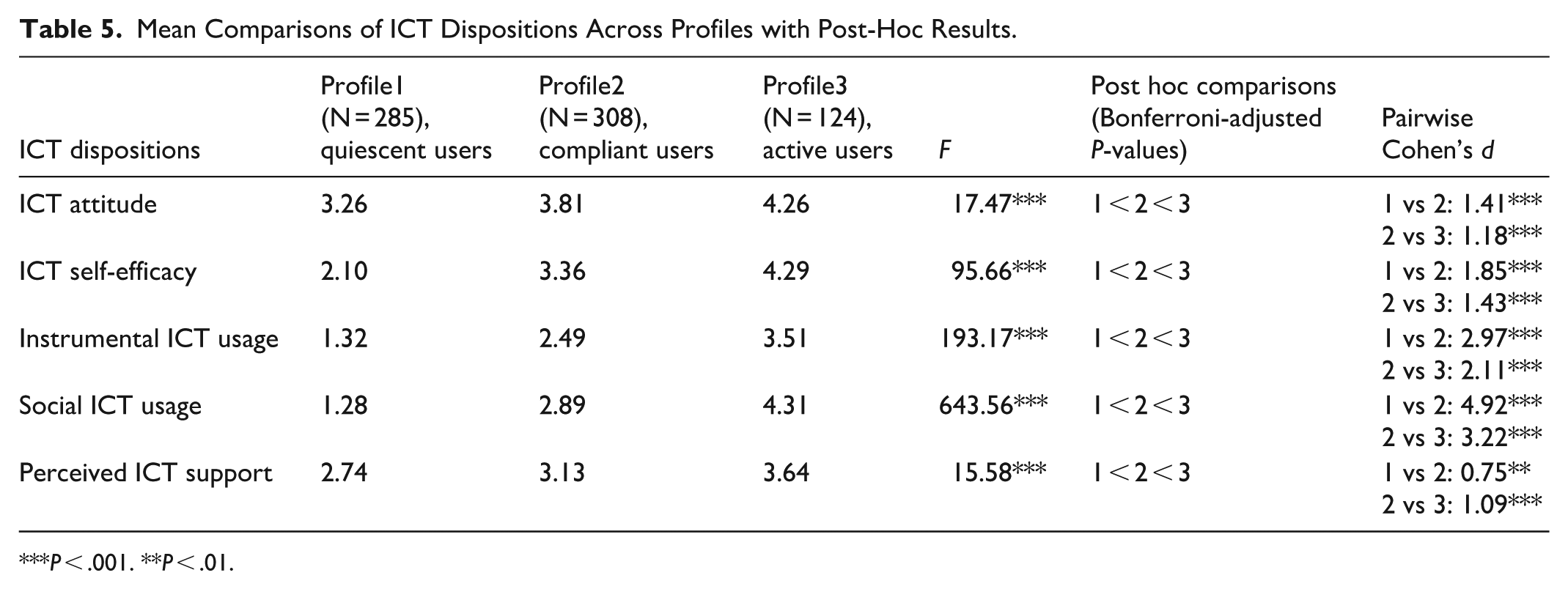
P < .001. **P < .01.
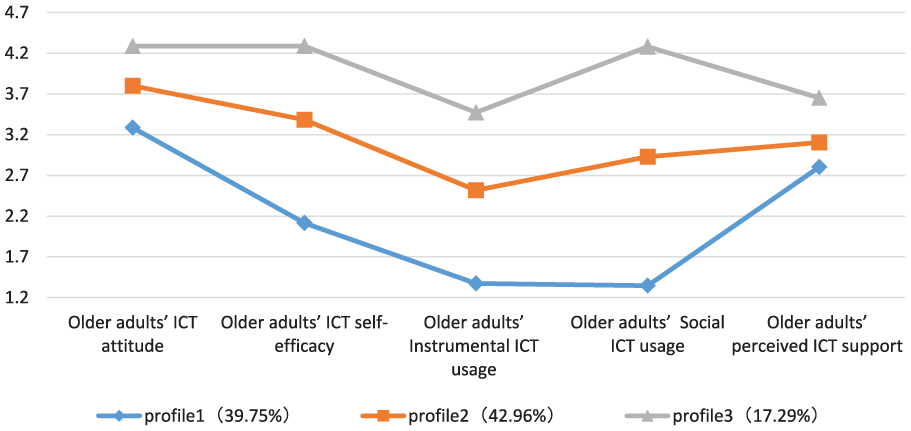
Distribution of the 3 identified profiles of older adults ICT dispositions.
Older Adults’ ICT-Related Characteristics Across 3 Identified Profiles.

Note. Labels reflect relative differences between profiles, not absolute evaluations.
The 3 distinct profiles of older adults were as follows:
Quiescent Users (39.75%, n = 285): This group exhibited relatively lower scores across all ICT-related dispositions, with limited self-efficacy and cautious perceptions toward ICT. Their ICT usage was less frequent compared to the other 2 profiles, characterized by sporadic engagement with basic functionalities such as voice calls or passive content consumption. They received less frequent ICT support, often relying on intermittent assistance from family members to navigate digital tasks.
Compliant Users (42.96%, n = 308): Representing the largest subgroup, these older adults demonstrated moderate competency levels across ICT-related dispositions. They engaged with ICT selectively, primarily for practical needs such as messaging or accessing essential services, reflecting a neutral-to-moderate attitude toward technology. Their occasional ICT use was supported by periodic guidance from family members, though they rarely ventured beyond routine applications.
Active Users (17.29%, n = 124): This group consistently displayed higher engagement across all ICT dimensions, marked by frequent use of advanced features (eg, banking, online shopping, and learning), and proactive exploration of digital tools. They maintained positive attitudes toward ICT, viewing technology as an enabler of social connection and personal growth. Their sustained engagement was reinforced by regular ICT support from both family and peer networks, allowing them to troubleshoot challenges and adopt new innovations confidently.
A 1-way ANOVA with Bonferroni post-hoc tests was conducted to compare ICT-related dispositions across the 3 identified profiles. The analysis confirmed statistically significant differences across all dimensions (P < .001), with the following hierarchy of means: Profile 1 (Quiescent Users) < Profile 2 (Compliant Users) < Profile 3 (Active Users). Post-hoc comparisons further validated this ordinal pattern, revealing significant pairwise differences (P < .001) between all 3 profiles. Table 5 details the mean values, effect sizes, and post-hoc results for each ICT disposition dimension. These results further affirmed the validity of the 3-profile model.
Predictors of Older Adults’ ICT Dispositions Profiles
As shown in Table 7, the sociodemographic characteristics of participants across the 3 profiles were analyzed using descriptive statistics. Group differences were tested via 1-way ANOVA (age, education, income) and Pearson’s chi-square test (gender), revealing significant variations in gender, age, educational level, and monthly income (P < .05 for all).
Profiles Differences in Sociodemographic Characteristics (N = 717).

Profile1 = quiescent users; Profile2 = compliant users; Profile3 = active users.
To answer RQ2, multinomial regression was conducted with sociodemographic characteristics as independent variables. Table 8 presents the multinational logistic regression results. Specifically, age gradients were also found to influence ICT adoption. Younger seniors (60-65 years) demonstrated a substantial reduction in the odds (OR = 0.20, P < .001) of being classified as quiescent users compared to the oldest group (71-75 years), which aligns with life course theory, which posits that early exposure to technology, such as in the workplace, fosters sustained ICT competence later in life. Similarly, mid-older adults (65-70 years) showed a continued negative age gradient (OR = 0.46, P = .05), reinforcing the cumulative advantage of earlier technological socialization.
Multinomial Logistic Regression of Different Older Adults Profiles (N = 717).

Note. Reference group: Profile2 (compliant users).
OR = odds ratio; 95% CI = 95% confidence interval.
Men exhibited 1.47 times higher odds (OR = 1.47, 95% CI [0.33, 0.68], P < .001) of Active User membership, reflecting persistent sociocultural norms that frame ICT proficiency as a masculine domain. This disparity underscores the need to dismantle gendered stereotypes in technology education and access programs.
Older adults with low incomes (<¥3000/month) were found to have 7.04 times higher odds (OR = 7.04, 95% CI [2.26, 21.98], P < .001) of being categorized as quiescent users compared to those in the highest income bracket (≥¥7000/month). Furthermore, low-income older adults exhibited decreased odds of belonging to the Active User profile, further emphasizing the suppressive effect of socioeconomic status on advanced ICT engagement. Among middle-income older adults (¥3000-5000/month), although the association was not statistically significant, a trend emerged suggesting potential mitigation of Quiescent User risks with incremental economic improvements. This finding underscores the importance of addressing economic disparities in promoting equitable ICT engagement among older adults.
Older Adults’ Profiles and Their Life Satisfaction
To address RQ3, an Analysis of Covariance (ANCOVA) was conducted to compare life satisfaction scores among the 3 ICT-related disposition groups while controlling for demographic covariates (gender, monthly income, and age). As shown in Table 9, the ANCOVA revealed a statistically significant main effect of ICT-related disposition on life satisfaction after adjusting for covariates, F = 20.38, P < .001, partial η² = 0.09.
Older Adults’ Life Satisfaction on Different ICT Dispositions.
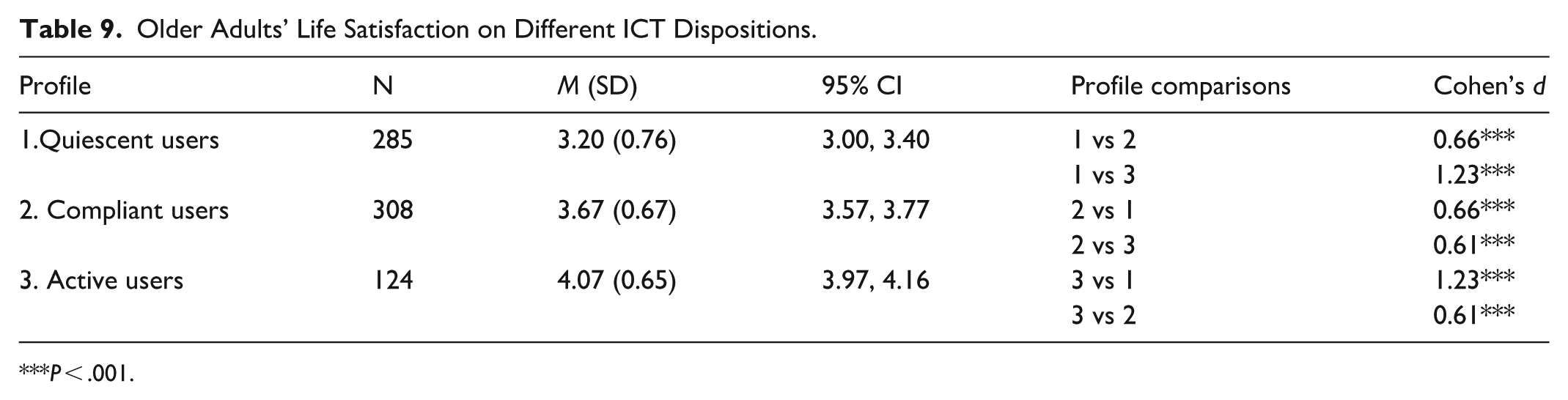
P < .001.
Post-hoc analyses with Bonferroni correction revealed a hierarchical satisfaction pattern:
Active users (Profile 3) reported substantially higher satisfaction (M = 4.07, SD = 0.65) than both Quiescent Users (P < .001, d = 1.23) and Compliant Users (P < .001, d = 0.61). Compliant Users (Profile 2) showed intermediate satisfaction (M = 3.67, SD = 0.67), significantly exceeding Quiescent Users (P < .001, d = 0.66). Quiescent Users (Profile 1) exhibited the lowest satisfaction (M = 3.20, SD = 0.76).
Discussion and Implications
Life satisfaction refers to an individual’s cognitive and affective evaluations of their life quality, has emerged as a crucial indicator of successful aging. 49 As digital transformation reshapes modern societies, understanding the multidimensional relationships between information and communication technology (ICT) engagement patterns and life satisfaction among older adults has become an urgent scholarly priority.33,36 While prior studies have predominantly examined linear associations between technology use and life satisfaction outcomes, this study advances the field by employing latent profile analysis (LPA) to identify distinct ICT disposition subgroups within an aging population. By mapping heterogeneous ICT dispositions profiles and rigorously testing their differential associations with life satisfaction, our findings reveal nuanced pathways through which digital engagement configurations shape older adults’ life satisfaction. This person-centered approach not only bridges a critical gap in the extant literature dominated by variable-centered methodologies but also provides transformative insights for developing targeted interventions that align with the technological realities and life satisfaction needs of aging populations in the digital era.
Profiles of Older Adults’ ICT Dispositions
This study used LPA to identify 3 distinct profiles of older adults based on their ICT dispositions: Quiescent, Compliant, and Active Users. The majority (42.96%) were classified as Compliant Users, while 39.75% were Quiescent Users and 17.29% were Active Users. Quiescent Users, characterized by low self-efficacy and cautious perceptions toward ICT, engaged minimally with ICT for instrumental purposes (eg, seeking health information, banking, shopping) or social purposes (eg, using email or instant messaging), and relied on intermittent family support for basic digital tasks. In contrast, Active Users exhibited high ICT self-efficacy and positive attitudes, actively leveraging ICT for social connectivity and skill development (eg, online courses), supported by robust family and peer networks. Compliant Users demonstrated moderate dispositions across ICT attitude, self-efficacy, usage, and support.
These findings align with previous research identifying subgroups of older adult ICT users but provide a more nuanced categorization based on multiple dimensions. 12 This categorization enables policymakers and community organizations to design profile-specific interventions tailored to the distinct needs and barriers of each subgroup. For instance, Quiescent Users characterized by the lowest ICT self-efficacy and limited ICT adoption require interventions targeting both technical and psychosocial barriers. Specifically, addressing their limited technical proficiency can be achieved through guided ICT use, such as step-by-step tutorials and adaptive interfaces, which aligns with evidence that scaffolded learning enhances digital self-efficacy. 54 Additionally, emotional support and communication strategies, like peer mentoring and family-mediated training, can counteract the anxiety and social isolation often associated with technology avoidance, as supported by social support theory. 55 This dual strategy, combining skill development with emotional reassurance, is essential for Quiescent Users whose disengagement stems from a complex interplay of cognitive and emotional challenges. 56 In contrast, interventions for Compliant Users may prioritize the development of advanced skills. For Active Users, encouragement to take on peer leadership roles and participate in advanced literacy programs can capitalize on their expertise and enthusiasm.
Socio-Demographic Characteristics Among Different ICT-Dispositions Profiles of Older Adults
The multinomial logistic regression analysis revealed significant socio-demographic factors influencing older adults’ ICT dispositions. Older adults with monthly incomes below ¥3000 exhibited 7.04 times higher odds of Quiescent User classification compared to the highest income group (≥¥7000). This stark disparity empirically validates Van Dijk’s 57 digital exclusion theory, wherein economic constraints restrict access to devices, data plans, and skill-building opportunities. The magnitude of this effect surpasses observations in Western contexts. For instance, in Ontario, only 38% of low-income seniors lack home internet access, 58 highlighting the acute ICT marginalization faced by China’s economically vulnerable elderly.
Younger older adults (60-70 years) demonstrated significantly lower odds of Quiescent User membership, with the steepest risk reduction among those aged 60 to 65. This age gradient aligns with life course theory, 59 suggesting that workplace technology exposure (eg, ERP systems, digital workflows) prior to retirement cultivates durable ICT self-efficacy, thereby buffering against later-life digital disengagement.
Men exhibited 1.47 times higher odds of active user classification, reinforcing Moxley and Czaja’s 60 findings on gendered technological socialization. Sociocultural norms framing ICT mastery as a masculine trait (“mastery-oriented roles”) and portraying technology as “complicated” for women likely perpetuate this disparity, necessitating gender-responsive interventions to recalibrate access and training paradigms.
The Relationship Between Older Adults’ ICT Dispositions Profiles and Their Life Satisfaction
Significant differences in life satisfaction levels were observed across the 3 profiles (F = 20.38, P < .001), with Active Users reporting the highest levels, followed by Compliant and Quiescent Users. This finding corroborates existing research by showing that proactive and autonomous engagement with information and communication technologies (ICTs), 61 rather than passive or purely functional use, enhances psychosocial life satisfaction through increased perceived autonomy and social integration. The observed advantage in life satisfaction among Active Users can be attributed to 2 interconnected mechanisms: social enrichment, where frequent ICT-mediated interactions (eg, daily virtual socialization and online community participation) strengthen social cohesion, a strong predictor of life satisfaction 62 ; and self-determined mastery, where autonomous exploration of ICT tools (eg, self-directed learning apps and creative content creation) fulfills psychological needs for competence and autonomy, aligning with self-determination theory. 61 In contrast, Quiescent and Compliant Users, who predominantly engage in transactional ICT activities like passive information consumption or intermittent messaging, experience limited psychosocial benefits and rely heavily on external assistance, thereby restricting empowerment-related life satisfaction gains.
While prior studies established broad correlations between ICT use and life satisfaction in older adults,63,64 they often overlooked motivational heterogeneity. Guided by Self-Determination Theory, 61 which identifies autonomy and competence as essential nutrients for psychological satisfaction, our latent profile analysis reveals a critical nonlinearity: significant life satisfaction enhancement occurs only when ICT engagement evolves from externally motivated controlled competence (Compliant Users; eg, family pressure) to intrinsically driven autonomous mastery (Active Users), wherein technology use satisfies intrinsic needs for volitional choice and efficacy. 65 This threshold effect underscores that superficial digital inclusion is insufficient; authentic life satisfaction gains require internalized motivation where ICT serves as a tool for self-endorsed goals.
Recommendations and Practical Implications
The findings of this study offer significant theoretical and practical implications for enhancing digital inclusion and life satisfaction among older adults.
Theoretically, this study advances understanding of ICT engagement in later life by identifying 3 distinct ICT user profiles (Quiescent, Compliant, and Active Users), and linking them to differential life satisfaction outcomes. These findings align with the Active Aging Framework, which emphasizes purposeful engagement for well-being, as Active Users’ autonomous ICT use enhances life satisfaction. 66 However, the limited benefits for Compliant and Quiescent Users challenge assumptions that technology access alone improves well-being. Refining sociotechnical models of aging. 67 Guided by Self-Determination Theory, 61 the study underscores proactive agency as a critical driver of well-being, calling for nuanced frameworks to address digital inclusion in aging populations.
Practically, based on the distinct profiles of ICT dispositions and their associated socio-demographic factors, the following targeted recommendations are proposed:
Firstly, profile-specific interventions should be implemented to bridge older adults’ ICT engagement gaps. For low-confidence users (Quiescent Users, 39.75%), community tech centers equipped with voice-guided tools (such as large-text interfaces) should be established, and these users should be paired with moderately skilled peers (Compliant Users) for step-by-step guidance, reducing their reliance on irregular family support. Additionally, relaxation techniques (like breathing exercises) should be integrated into training programs to alleviate stress or fear related to technology. For moderate-engagement users (Compliant Users, 42.96%), advanced training clinics should focus on practical, real-life skills—like detecting online scams or using telehealth apps. Offering incentives like free mobile data) can spark creativity and motivate them to explore ICT further. Finally, high-skill users (Active Users, 17.29%) should be involved in designing easy-to-use apps through innovation workshops and trained as community ICT leaders to teach others, thereby expanding digital access across neighborhoods.
Secondly, efforts should be made to promote digital inclusion and enhance their digital readiness based on older adults’ sociodemographic characteristics. First, to level the playing field, discounted ICT packages comprising phones or tablets with subsidized data plans should be made available to individuals earning below ¥3000 monthly. Partnering with phone companies to waive 5G upgrade fees in economically disadvantaged areas can further remove financial barriers, ensuring that cost does not keep older adults offline. Furthermore, to foster equal opportunities for women, who are underrepresented among skilled ICT users, with men 1.82 times more likely to excel in this area. To address this, half of all tech training spots should be reserved for women, and ICT-proficient older women should be trained as instructors. This not only boosts participation but also challenges stereotypes about ICT being a men domain. Additionally, programs for currently employed or recently retired older adults should facilitate transferring workplace ICT skills like inventory software proficiency to personal contexts such as online banking. This skill transfer bridges professional expertise with daily needs, boosting both digital confidence and functional benefits.
Thirdly, cross-departmental collaboration should be strengthened. For instance, tech companies and continuing education institutes should team up to design easier-to-use tools for less confident older adults (known as Quiescent Users), such as apps with larger text and high-contrast colors. Furthermore, youth and elder learning exchange programs could pair practical innovation with cultural value. In these initiatives, teenagers teach older adults digital skills such as video calls and mobile payments, while older adults preserve local history by sharing life stories through recorded interviews. Take, for example, a 75-year-old who learned Zoom through this program. This individual not only mastered the tool but went on to teach peers how to archive family photos online, demonstrating how cross-generational learning can ripple outward.
Limitations and Further Research Directions
Several limitations warrant consideration. First, the cross-sectional design precludes causal inferences regarding ICT use and life satisfaction. Second, exclusive recruitment from Wuhan—a technologically advanced urban center—may limit generalizability to rural or economically disadvantaged regions with underdeveloped digital infrastructure. Third, self-reported measures risk social desirability bias, potentially inflating ICT engagement or life satisfaction scores. Fourth, although our sample size (N = 717) met latent LPA heuristics, the absence of a priori power analysis constrains subgroup comparisons. In addition, cognitive eligibility screening employed researcher observations rather than validated instruments (eg, MMSE), potentially overlooking subtler cognitive variations. Fifth, the study focused solely on life satisfaction, the cognitive component of subjective well-being (SWB), omitting affective components (positive and negative affect).
To address these constraints, we recommend: (1) longitudinal designs to track dynamic ICT- life satisfaction relationships; (2) multi-region sampling encompassing diverse socioeconomic contexts; (3) triangulated assessment combining self-reports, objective device logs, and qualitative interviews; (4) Monte Carlo simulations (eg, Mplus PLANNED) for optimized sampling; and (5) standardized neurocognitive screening for precise eligibility; (6) examining affective dimensions to provide a comprehensive understanding of SWB in the context of ICT engagement.
Conclusion
This study contributes to the existing knowledge of ICT dispositions among older adults, uncovering 3 unique profiles and their relationship to life satisfaction. By connecting proactive ICT use to higher life satisfaction and uncovering sociodemographic influences, it emphasizes the necessity of targeted interventions to mitigate digital stratification. Such efforts can enable older adults to ensure equal access to technology capabilities and improve their quality of life in a more digital world.
Supplemental Material
sj-doc-1-inq-10.1177_00469580251375846 – Supplemental material for Examining Information and Communication Technology (ICT) Disposition Profiles and Life Satisfaction Among Older Adults: A Latent Profile Analysis
Supplemental material, sj-doc-1-inq-10.1177_00469580251375846 for Examining Information and Communication Technology (ICT) Disposition Profiles and Life Satisfaction Among Older Adults: A Latent Profile Analysis by Liqin Yu, Manyu Sun, Harrison Hao Yang, Yang Wang and Fei Wu in INQUIRY: The Journal of Health Care Organization, Provision, and Financing
Supplemental Material
sj-docx-2-inq-10.1177_00469580251375846 – Supplemental material for Examining Information and Communication Technology (ICT) Disposition Profiles and Life Satisfaction Among Older Adults: A Latent Profile Analysis
Supplemental material, sj-docx-2-inq-10.1177_00469580251375846 for Examining Information and Communication Technology (ICT) Disposition Profiles and Life Satisfaction Among Older Adults: A Latent Profile Analysis by Liqin Yu, Manyu Sun, Harrison Hao Yang, Yang Wang and Fei Wu in INQUIRY: The Journal of Health Care Organization, Provision, and Financing
Footnotes

Ethical Considerations
The procedures for human participants involved in this study were consistent with the research ethics and security committee of science and technology of Hubei University of Technology and the ethical standards of 1975 Helsinki Declaration. The approval number is HBUT20240003.
Consent to Participate
Written informed consent was obtained from all participants prior to study commencement. Participants were fully informed about the study’s purpose, procedures, potential risks, and benefits. Additionally, participants were assured of their unconditional right to withdraw at any time. This study was conducted in accordance with the ethical standards of the institutional review board and with the 1964 Helsinki Declaration and its later amendments.
Consent for Publication
Data confidentiality was ensured by restricting access to authorized research team members and analyzing pseudonymized data, in accordance with institutional review board guidelines upholding voluntary participation, anonymity, and data protection. No personally identifiable information is included in any publication or dissemination of the research findings.
Author Contributions
Liqin Yu: Conceptualization, Methodology, Software, Investigation, Funding Acquisition, Formal Analysis, Writing - Original Draft; Manyu Sun: Data Curation, Writing - Original Draft; Harrison Hao Yang (Corresponding Author): Conceptualization, Resources, Supervision, Writing - Review & Editing; Yang Wang: Methodology, Visualization, Investigation; Fei Wu: Visualization, Investigation.
Funding
The authors disclosed receipt of the following financial support for the research, authorship, and/or publication of this article: The study was supported by General Project of Humanities and Social Sciences Research of the Ministry of Education (grant number 24YJC880167), titled Research on Practical Model and Effect Evaluation of “University-Community” ICT Intergenerational Learning to Promote Digital Literacy of the Older Adults, and National Social Science Fund Youth Project (Grant No. 23CRK003), titled Research on the Mechanism and Effectiveness Evaluation of Intergenerational Learning in Promoting Effective Labor Supply.
Declaration of Conflicting Interests
The authors declared no potential conflicts of interest with respect to the research, authorship, and/or publication of this article.
Data Availability Statement
The datasets generated during and/or analyzed during the current study are available from the corresponding author upon reasonable request.
Supplemental Material
Supplemental material for this article is available online.
References
Supplementary Material
Please find the following supplemental material available below.
For Open Access articles published under a Creative Commons License, all supplemental material carries the same license as the article it is associated with.
For non-Open Access articles published, all supplemental material carries a non-exclusive license, and permission requests for re-use of supplemental material or any part of supplemental material shall be sent directly to the copyright owner as specified in the copyright notice associated with the article.
