




Abstract
Although group participation benefits older adults’ health, its effects may vary by group type. The Japanese Health and Welfare Co-operative (Hew Co-op) organises peer-led group participation called ‘Han Kai’ meetings to promote health literacy, but the impact of Han Kai participation on health indicators remains unexplored. This study aimed to examine whether the frequency and duration of Han Kai participation were associated with risk of functional disability. This was a prospective cohort study conducted in Japan between 2018 and 2022. The participants were Han Kai members aged ≥ 65 years who did not receive a Long-Term Care certification. The exposure variables were the frequency of participation in Han Kai per year and the years of participation in 2018. The main outcome was a risk assessment scale score for predicting incident functional disabilities in 2022. Multivariate linear regression was conducted to adjust for covariates. In the study, 2359 older adults participated. Overall, the frequency of Han Kai participation was not significantly associated with disability risk scores. However, participants with ≥10 years of involvement had significantly lower scores (β = –1.95, 95% CI: –3.64 to –0.26, P = .024). Among those aged ≥ 75 years, both frequency and duration showed a significant inverse association with risk scores, with a dose–response relationship. Sustained participation in peer-led group meetings such as Han Kai may help mitigate functional decline, particularly among the oldest age groups. These findings support policies that promote long-term community engagement as part of healthy ageing strategies.
Keywords
Background
Japan has the most rapidly ageing population worldwide. In 2042, the number of individuals aged ≥ 65 years is estimated to reach a peak of approximately 39 million (36.1% of the population). 1 The Japanese Ministry of Health, Labour and Welfare (MHLW) has pointed out the importance of group participation among older adults for the prevention of functional decline. 2 Group participation among older adults varies, including neighbourhood associations; hobby, sports, and political groups; industrial or trade associations; and religious, volunteer, citizen or consumer groups.3,4 Although group participation is associated with health benefits for older adults, such as better mortality, better activities of daily living, and lower rates of depressive mood,3 -5 the effects vary across the types of participating groups in Japan3,4 and other countries. 6
Therefore, investigating the relationship between the type of group participation and health outcomes is important for detecting effective group participation. In Japan, the MHLW has promoted ‘Pay For Success (PFS)’, which is a scheme to pay fees based on the outcomes by the local governments to private sectors. 7 Although local governments need to collaborate with private sectors to provide effective group participation to proceed with PFS, the evidence regarding this is limited. 7 Therefore, examining the relationship between the types of group participation and health indicators is important.
The Japanese Health and Welfare Co-operative (Hew Co-op) provides older adults with an opportunity for group participation. 8 Hew Co-op is a legally defined self-help organisation in Japan comprising 2.9 million members. 8 It has regular gathering opportunities called ‘Han Kai’ or group meetings for regular promotion of health literacy. Each Han Kai comprises at least 3 members, and the members gather at least thrice annually. 8 One of the features of Han Kai is that it provides members with regular opportunities for health checks, such as blood pressure measurement and education on disease prevention, regardless of the presence or absence of chronic diseases, with support from healthcare professionals in Hew Co-op. 8
However, the relationship between Han Kai and health indicators has not been examined. Previous literature has reported that group participation in older adults is related to lower scores on a risk assessment scale for the prediction of incident functional disabilities only among individuals aged ≥ 75 years. 9 Han Kai participation may also have various effects according to age group.9,10 Therefore, we aimed to examine whether the frequency and duration of Han Kai participation predict future risk of functional disability. The research question of the study is ‘Does higher frequency and/or longer duration of Han Kai group meetings independently reduce the risk of incident functional disability among community-dwelling Japanese older adults?’ Findings from this study may inform strategies to encourage long-term engagement in group activities.
Methods
Study Design
This was a prospective cohort study.
Setting
There are 47 Hew Co-op organisations in Japan. We openly recruited all Hew Co-op organisations. Details of the exposure group (Hew Co-op) are provided below.
Hew Co-op is an autonomous organisation, founded under the Consumers Livelihood Cooperative Society Law, where residents deal with issues related to their health and daily life. 8 Hew Co-op owns and operates medical and nursing care facilities and conducts business and activities to solve problems by facilitating cooperation between members and staff. 8 As its important activity, Hew Co-op has organised ‘Han Kai’, which is a health promotion activity by members. 8 Han Kai is a basic unit of Hew Co-op, each comprising 3 or more members. At each Han Kai, resident members assess their blood pressure, urine, and body fat with the cooperation of professional members of Hew Co-op. The members also learn about diseases (cancer, diabetes, stroke, heart attack, Alzheimer’s disease) and risk factors (stress, diet, drinking, smoking). Some Han Kai members also engage in exercise and congregate meals. Health promotion by Hew Co-op is distinct in that ‘individuals get together in their neighbourhood and actively engage in programmes while receiving help from professionals’.
We administered a questionnaire to the participants through Hew Co-op. Hew Co-op has branches all over Japan, and we recruited branches willing to participate in this study. The staff of Hew Co-op handed over and collected the questionnaires. The questionnaire is used in the research of the Japan Gerontological Evaluation Study (JAGES) project.11,12 The JAGES project is one of the largest nationwide research projects on ageing, with >300,000 participants.11,12 The content of the questionnaire is described elsewhere.11,12 The previous literature evaluating group participation in older adults is also one of the papers from the JAGES project. 9
Study Period
We conducted 2 surveys in 2018 and 2022.
Participants
We included Han Kai members aged ≥ 65 years who did not receive a Long-Term Care certification. The eligibility for long-term care needs was assessed by an insurer based on the decline in activities of daily living, with a preliminary categorisation into 1 of 7 levels. 13
Participants with cognitive decline or those certified for Long-Term Care were excluded.
Exposure
The exposure variables were the frequency of participation in Han Kai per year and the duration of participation (years) as of 2018. The questionnaire included the following questions: ‘How many times did you join Han Kai (0–2, 3, 4–7, 8–12, and ≥13/year)?’ and ‘How many years have you participated in Han Kai (<1, 1–4, 5–9, and ≥10)?’
Outcomes
Main Outcome Measures
The main outcome was a risk assessment scale score for the prediction of incident functional disabilities in 2022. 14 This scale evaluates the risk of Needed Support/Long-Term Care certification. 15 The score encompassed age, sex, and a 10-item questionnaire about activities of daily living. 14 It ranges from 0 to 48, with a higher score indicating a higher risk. 14 When the score of the scale is 20, 12.1% of older adults aged ≥ 65 years received certification for long-term care insurance within 3 years, and if the scores are 30 and 40, the proportions of individuals receiving the certification are 35.8% and 59.7%, respectively. The score for participants who died or were certified as needing support or care in 2022 was 48.
Covariates
Based on the previous literature by Tajika et al, 9 we adjusted the risk assessment scale score for the prediction of incident functional disabilities in 2018, including age and sex, educational status (binary variable: less than high school and more than or equal to college), annual household income (binary variable: <1.99 or ≥2 million Japanese yen), depression status (categorical variable: 0-4, 5-9, and 10-15 on the Geriatric Depression Scale), smoking status (binary variable: current smoking or not), living status (binary variable: alone or not), and working status (binary variable: working or not). 9
Statistical Analyses
Categorical variables are described as numbers and proportions. Medians and interquartile ranges are used for continuous variables. Multivariate linear regression was performed to adjust for covariates. We performed a subgroup analysis according to age (<75 and ≥75 years) to examine the effects of Han Kai among the groups. Moreover, we conducted multiple imputations for the missing variables. STATA 15 was used for the analyses.
Ethical Consideration
This study was approved by the Research Ethics Committee of Hew Co-op (the approval number is not applicable).
Results
In 2018, 3273 individuals responded to the survey. Of these, 2359 participated in the second survey (follow-up rate, 72.1%). Participants aged < 65 years and those whose age was not specified were excluded from the analysis (226 and 60 individuals, respectively). We also excluded 19 participants as outliers because their height was >3 m or their weight was >200 kg; we decided these were input errors. The final analysis included 2054 participants. The inclusion–exclusion flowchart for the participants is shown in Figure 1.
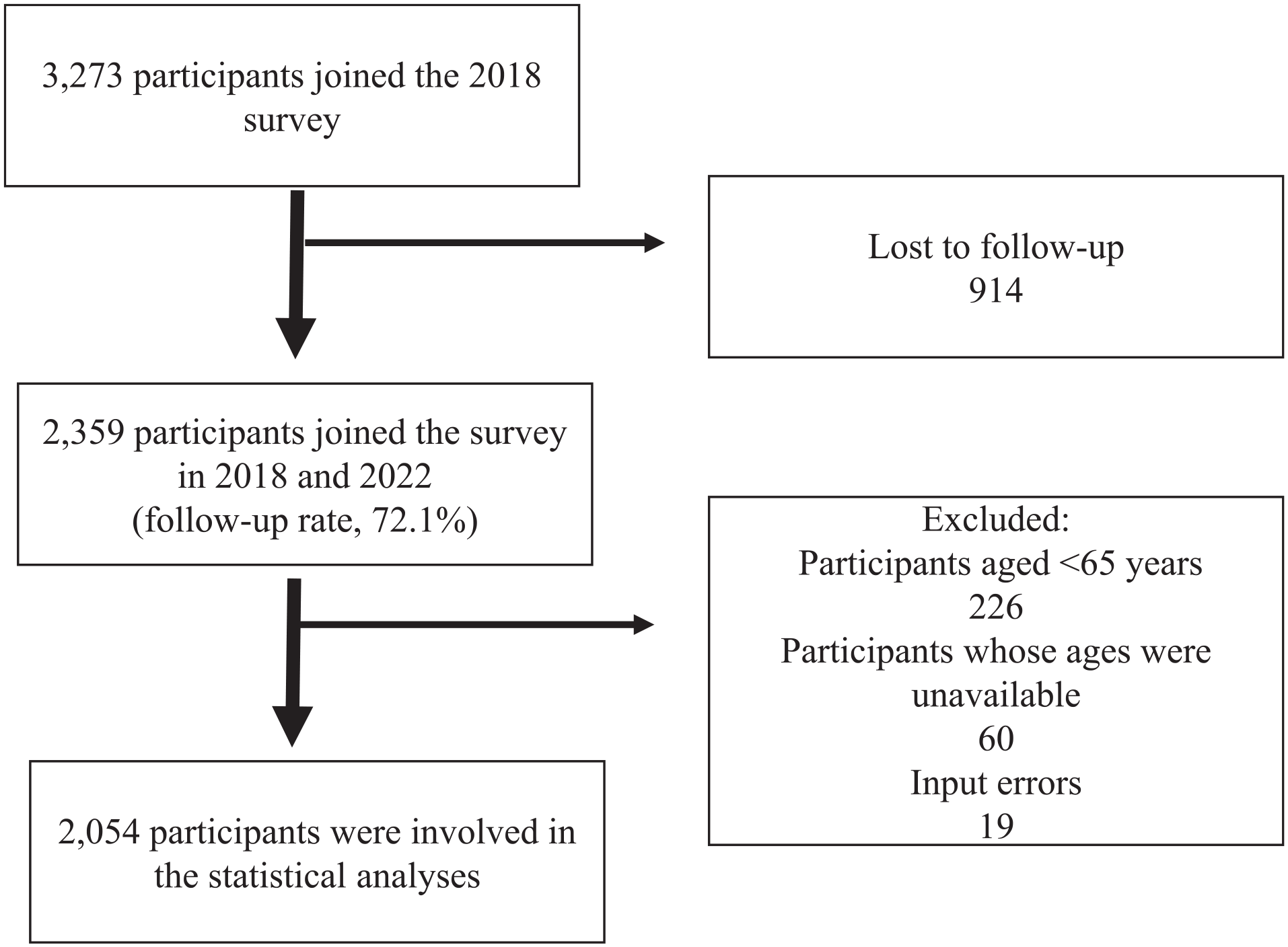
Inclusion–exclusion flowchart.
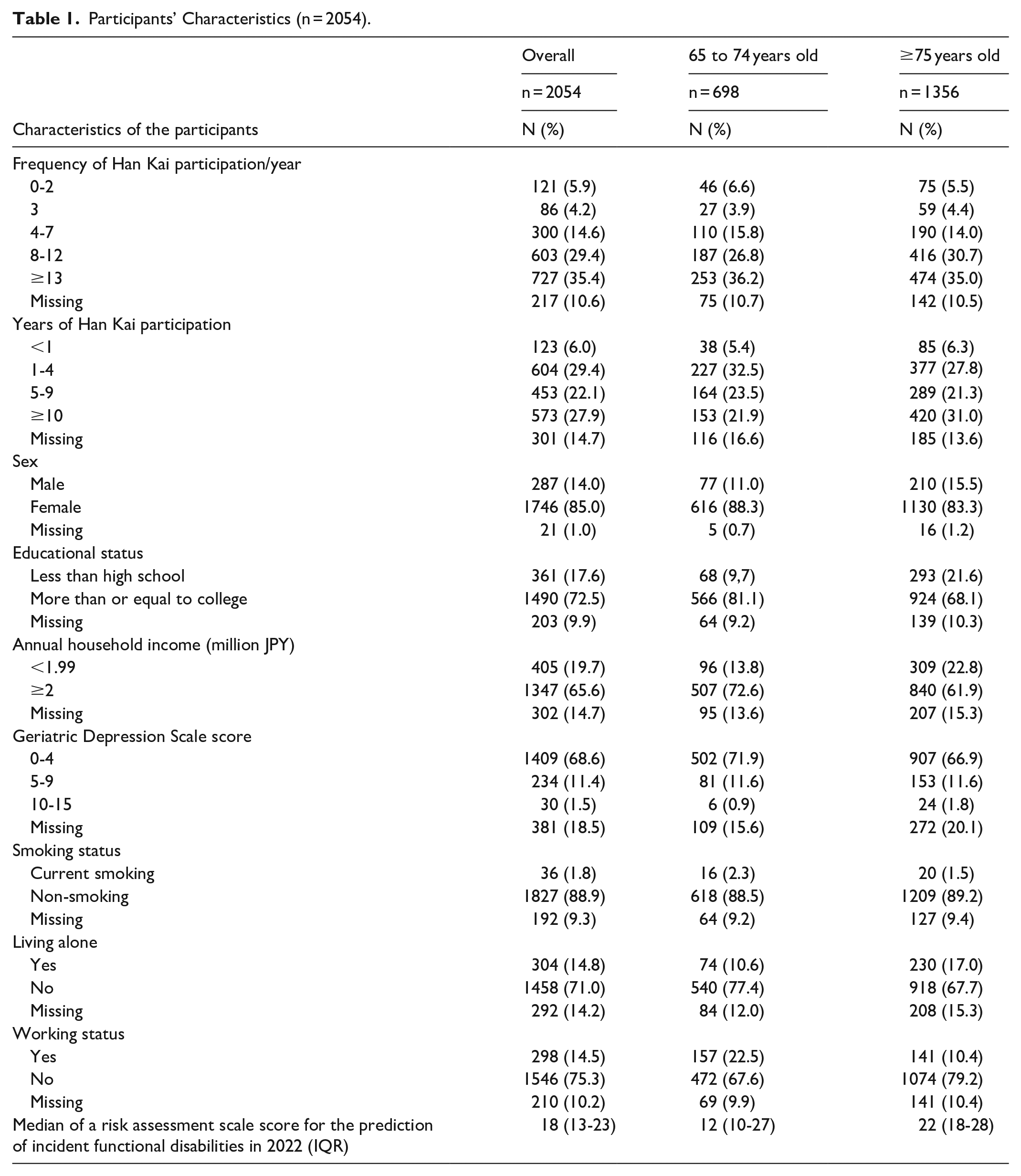
Among the participants, 85.9% were female, and 66.4% were aged ≥ 75 years. Table 1 presents the characteristics of the participants.
Participants’ Characteristics (n = 2054).
After adjusting for covariates, the frequency of participation in Han Kai was not significantly associated with the risk assessment scale score for the prediction of incident functional disabilities in 2022. However, years of Han Kai participation were related to a lower score on the scale among individuals who had participated in Han Kai for >10 years (–1.95 [–3.64 to –0.26, P = .024]). Although other categories, such as Han Kai participation for 2 to 5 years and 5–9 years, were not significantly associated with the outcome, the direction of the coefficient showed similar trends (–1.01 [–2.68 to 0.66] and –1.38 [–3.10 to 0.34], respectively). In the subgroup analysis of individuals aged ≥ 75 years, the frequency and years of Han Kai participation were related to lower scores on the scale. Multiple imputation analyses yielded consistent findings, confirming the robustness of our results (see Table 2).
Crude and Adjusted Coefficients of Frequency and Years of Han Kai Participation.

Adjusted for the risk assessment scale score for the prediction of incident functional disabilities in 2018, including age and sex (continuous variable), educational status (binary variable: less than high school and more than or equal to college), annual household income (binary variable: <1.99 or ≥2 million JPY), depression status (binary variable: <9 or ≥10 in Geriatric Depression Scale), smoking status (binary variable: current smoking or not), living status (binary variable: alone or not), and working status (binary variable: working or not).
Forest plots of the coefficients of the frequency and years of participation in Han Kai are shown in Figures 2 and 3, respectively.

Forest plots of the coefficient of frequency of Han Kai participation.
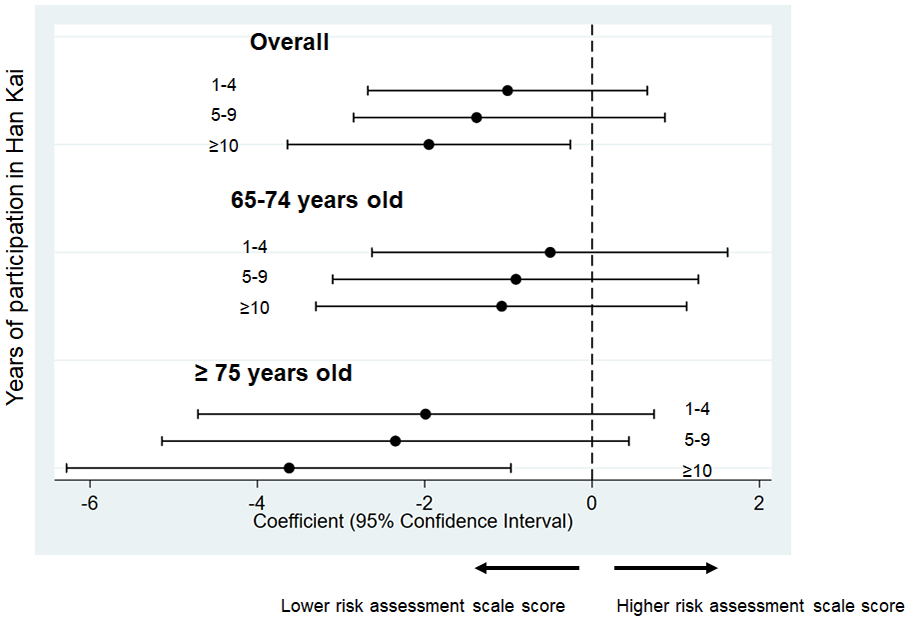
Forest plots of the coefficient of years of Han Kai participation.
Discussion
This study demonstrated that participation in Han Kai for >10 years was associated with a lower score on the risk assessment scale for the prediction of incident functional disabilities. Subgroup analysis among individuals aged ≥ 75 years demonstrated that the frequency and years of Han Kai participation were associated with a lower score on the scale, with a dose–response relationship.
Comparison with the Existing Literature
The results of the present study are similar to those of a previous report by Tajika et al, 9 which assessed the relationship between participation in community gatherings and the risk assessment scale score for the prediction of incident functional disabilities. The point estimates after adjusting for confounding factors were <0, and the results of the subgroup analysis among individuals aged ≥ 75 years were statistically significant. The results are similar to those of Tajika et al.’s study conducted in Japan. 9 Moreover, other studies targeting Japanese older individuals have also demonstrated that social participation may mitigate the risk of functional decline.3,15,16 Individuals aged ≥ 75 years are more likely to have a decline in daily function and receive Needed Support/Long-Term Care certification compared with those aged 65 to 74 years. 17 Therefore, the effects of Han Kai may have been more apparent among individuals aged ≥ 75 years. 9 In this study, the change in the coefficients was approximately 1.0 to 1.9. Because the risk assessment scale score increases with age, the suppression of the increase in the score indicated in this study would be meaningful.
Our findings are consistent with evidence from community-based social-participation programmes in other countries. In Australia, regular attendance at Men’s Sheds—small peer-led groups that combine practical activities with health education—was recently shown to increase light-intensity physical activity and reduce sedentary time among men aged ≥ 60 years. 18 In the United States, a controlled study of a senior-centre health-promotion programme improved 7 of 8 SF-36 domains and was highlighted as a feasible strategy for preventing functional decline in community settings. 19 Neighbourhood-based ‘Village’ networks—another US model in which older residents collectively organise social and practical support—have likewise been associated with greater confidence to age in place and enhanced social engagement over 12 months. 20 These initiatives share 3 core features with Han Kai: (i) regular, geographically proximate meetings, (ii) peer leadership augmented by professional input when necessary, and (iii) long-term membership continuity. Taken together, the international literature and our results support the proposition that sustained, locally embedded social participation can help older adults maintain functional capacity across diverse cultural contexts. Future comparative research should explore how variations in governance (grass-roots vs professionally moderated) and target population (gender-specific vs mixed) influence programme effectiveness.
Implications of the Study
This is the first study to describe the preventive effects of participation in Han Kai on functional decline. Insights into the health impacts of different types of group participation may guide collaborative efforts between local authorities and private entities in developing evidence-based community interventions.
Study Limitations
This study has some limitations. First, selection bias may have affected the results. This is because the participants were individuals who could participate in the 2 surveys for over 4 years. Thus, the participants may have been healthier than other Hew Co-op members who could not participate in the 2 surveys. Second, the contents of Han Kai were not uniform, and this study did not consider them. However, the contents varied and were usually dependent on the Han Kai. Therefore, we aim to further investigate the differences in the effects of the contents of Han Kai. Third, because all study variables were derived from self-reported questionnaires, the findings may be subject to recall bias.
Conclusions
This study demonstrates that years of Han Kai participation were related to a lower score on the risk assessment scale for the prediction of incident functional disabilities among individuals who had participated in Han Kai for >10 years. In the subgroup analysis of individuals aged ≥ 75 years, the frequency and years of Han Kai participation were related to lower scores on the scale. The results of this study will be useful for policymakers in promoting effective collaboration between local governments and the private sector to provide effective group participation among older adults.
Implications for Practice
The results show that the duration of social participation and the characteristics of the participants may influence the effectiveness of participation. Therefore, these issues need to be considered when healthcare providers recommend social participation to patients.
Implications for Policy
This study offers novel insights into how long-term, peer-led group participation may mitigate the risk of functional decline in later life—a key concern for ageing societies globally. The observed associations between prolonged Han Kai participation and reduced disability-risk scores suggest that such community-based programmes can serve as practical tools for population-level health promotion. These findings are aligned with the objectives of international policy frameworks such as the World Health Organization’s Integrated Care for Older People (ICOPE) guidelines, which emphasise the maintenance of intrinsic capacity through accessible community interventions, 21 and the UN Decade of Healthy Ageing 2021 to 2030, which advocates for enabling environments that support older adults’ functional ability. 22
Footnotes
Acknowledgements
We thank Yuiko Nagamine, the Center for Preventive Medical Science, Chiba University, for her assistance in developing the questionnaire and analysing the data.
Author’s Note
Katsunori Kondo is also affiliated to Research Department, Institute for Health Economics and Policy, Tokyo, Japan; Center for Social Common Capital beyond 2050, Institutional Advance and Communications, Kyoto University, Kyoto, Japan.

Ethical Considerations
The study protocol was performed following the Declaration of Helsinki and was reviewed and approved by the Ethics Committee of the Japanese Hew Co-op Federation.
Consent to Participate
The participants provided written informed consent to participate in the study.
Consent for Publication
Not applicable.
Author Contributions
MK designed the study and participated in the implementation, data collection and analysis, and writing of the manuscript. MK also served as a guarantor. FS, HH, TM, KM, YO, KI, and KK contributed to the study design and critically reviewed the manuscript. All authors had full access to the data and took responsibility for the integrity and accuracy of the analyses.
Funding
The author(s) disclosed receipt of the following financial support for the research, authorship, and/or publication of this article: This study was supported by the 2023 Research Development Fund of Yokohama City University (grant number not applicable). The study sponsor had no role in the study design, data collection, analysis, interpretation, writing of the report, or decision to submit this article for publication.
Declaration of Conflicting Interests
The author(s) declared the following potential conflicts of interest with respect to the research, authorship, and/or publication of this article: MK, FS, and HH are members of Hew Co-op and work at a clinic or hospital of Hew Co-op; they receive a salary from Hew Co-op for their clinical work. The Japanese Health and Welfare Co-operative Federation covered the cost of the study.
Transparency
All authors had full access to all data (including statistical reports and tables) in the study and take responsibility for the integrity and accuracy of the data analyses. The lead author affirms that the manuscript is an honest, accurate, and transparent account of the study being reported, that no important aspects of the study have been omitted, and that any discrepancies from the study, as planned (and, if relevant, registered), have been explained.
Data Availability Statement
The datasets generated and analysed during the current study are not publicly available because we did not receive informed consent concerning data sharing from the participants.