




Abstract
Quality of spiritual living (QSL) in old age is closely related to the health and well-being of older adults. It is necessary to explore the psychosocial factors and mechanisms that affect the QSL of older adults. The researchers investigated 512 older Chinese people using the positive social mentalities scale, social participation scale, sense of life meaning scale, and spiritual living self-assessment questionnaire. (1) Positive social mentalities (PSMs), social participation (SP), and life meaning (LM) had significant positive correlations with QSL of older adults; (2) SP and LM had serial mediating effects between PSMs and QSL. PSMs influenced QSL through the serial mediating effects of SP and LM. It revealed the critical psychosocial factors and the mechanism affecting QSL in old age, which can provide scientific reference for implementing an active aging strategy.
Keywords
At present, it is not known whether and how social mentalities affect older adults’ quality of spiritual living and what’s the mechanism behind it.
Positive social mentalities can promote social participation and enhance the sense of life meaning for older adults, thereby enhancing their quality of spiritual living.
This study reveals the crucial psychological and social factors that affect the quality of spiritual living in old age and their intrinsic influence mechanisms, which can provide scientific reference for implementing positive ageing strategies.
Introduction
With the advent of the aging era, in countries with high levels of social security, medical care, and material living conditions, the need for spiritual living among young and middle-aged older adults has become a prominent feature in their daily lives due to their healthier bodies, better economic conditions, more free time, and greater mobility. 1 Spiritual living is a critical field in older adults’ daily lives, an essential measure of human development, and the core component of the overall quality of life and happiness in old age. 2 Spiritual living is essential for all older adults to gain insight into life meaning, adapt to the physiological ageing process, cope with adversity and experience illness, 3 and has a significant impact on health and well-being in old adults. 4
The connotation of spiritual living is always abstract and vague in philosophy. As a result, the research on it has remained in the stage of abstract argumentation, unable to carry out empirical research. In the previous research, 5 we defined spiritual living (SL) as a kind of spiritual creation and experience activities such as learning, esthetic appreciation, leisure, pursuit, and cultivation, which is based on the imagination activities of the brain and carried out by the medium of language symbols, to realize the internal psychological process of individual self-development and spiritual sublimation. SL is a compound concept composed of the adjective “spirit” plus the gerund “living.” In the verb sense, SL refers to a way of life centered on spiritual growth and practice, emphasizing systematic spiritual pursuit, which may include esthetic-creating practice, moral practice, or personal growth.
SL is different from material and social living and are different fields of daily life. Among them, SL focuses on the inner spiritual process of human beings and is the mental experience of the brain. Material living is the production, purchase, and consumption process of materials and other explicit behaviors. Social living is concerned with people’s social interaction and interpersonal emotional processes. Meanwhile, SL is related to material and social living. Material living provides the basis for individual spiritual living, while social living provides a social environment for individual spiritual growth and development. The object and content of SL cannot be separated from certain material forms and social relations.
Earlier studies have shown that the SL of old adults is affected by external conditions such as their educational background, health status, family conditions, and living environments. 6 In the preliminary investigation, we also identified 4 categories of factors influencing SL and well-being in old age: public services, such as entertainment venues and facilities; family circumstances, including economic conditions, family companionship, and children’s achievements; physical health, such as age-related illnesses and overall health status; and living environments, such as neighborhood relationships, residential conditions, and community identity. 5
Among these factors influencing older adults’ SL and well-being are those related to social and living environments, which can impact an individual’s social mentalities, which may be related to his SL. Public service and health status means the chances of social participation in old age. For example, social participation can enrich the SL of older adults by exposing them to various esthetic activities, such as art exhibitions, concerts, and plays. 7 At the same time, by engaging in collective recreational activities, older adults can expand their social circle and strengthen social connections that not only provide emotional support but also significantly reduce their loneliness and depression levels, 8 thus improving the quality of SL (QSL) in old age.
Meanwhile, factors associated with public service, social activities and relations, and family circumstances are closely linked to the pursuit of life meaning in old age, which also motivates older adults to engage in spiritual activities and enrich their SL. Therefore, this study integrates the above factors affecting the SL of older adults into 3 variables that reflect social intelligence in old age: positive social mentalities, social participation, and life meaning, to explore the relationship between them and QSL in old age.
Literature Review and Research Hypothesis
Positive Social Mentalities and Spiritual Living in Old Age
Positive social mentalities (PSMs) refer to an individual’s positive social cognitions, feelings, and responses to social relations and their reality, such as life satisfaction, social security, social trust, social justice, or social identity.1,9,10 Positive social mentalities are internal motivating factors significantly affecting individual social behaviors and results.11,12 For older people, the core components of PSMs, life satisfaction, social trust, and social security, are crucial for improving their social lives, including spiritual living.
Studies have shown that older adults with a higher level of life satisfaction are more willing to participate in social group and spiritual activities, such as community organization, volunteer service, cultural and artistic activities, and sports activities, which can help them increase psychological resilience, relieve loneliness, and reduce the risk of anxiety and depression while maintaining good spiritual experiences and states 13 ; Older adults with a higher level of social trust will more actively participate in social and volunteer activities, which will help improve their psychological satisfaction and spiritual well-being. 14 In addition, social trust can enable older people to more actively integrate into society, form a social identity, and find a sense of social belonging and value, 15 which helps to maintain a positive spiritual state. A sense of social security is also a predictive factor for participation in social activities, pursuing life meaning, and promoting QSL. The higher the sense of social security, the higher the individual’s willingness and level of labor participation, 16 work participation, and social activity participation, 17 and the more life meaning can be gained from it, 18 thus enhancing their lifelong learning willingness and enriching their SL old age. 19
In a word, PSMs affect almost all social and interpersonal behaviors of individuals, help to guide the process of meaning construction within individuals to develop in a positive direction, and have a direct positive impact on the social development process of old adults, such as their enthusiasm for participating in social activities, pursuing the life meaning, and improving their QSL. Therefore, this study proposes the first hypothesis that PSMs positively predict social participation, life meaning and QSL of older adults (
Social Participation and Life Meaning in Old Age
Old adults’ social participation (SP) mainly includes economic, political, volunteer, and leisure participation. 20 SP can promote older adults’ physical health and cognitive ability and delay mental decline in old age. 21 By actively participating in social activities, older adults can build richer social networks, reduce symptoms of depression and anxiety, help maintain mental health and psychological well-being, 22 contribute to a greater sense of life meaning, 23 and improve QSL in old age.24,25
PSMs are predictive of SP in old age. For older adults, the higher their sense of life satisfaction, social trust, and social security, the more they are willing to participate in various social activities,13
-15 thereby improving their QSL. It can be seen that the SP of older adults was correlated with SP and QSL of old adults, and SP was correlated with QSL of old adults. So, this study proposes the second hypothesis that SP has a mediation effect between PSMs and QSL (
Life meaning (LM) refers to the individual pursuing the life meaning. It involves subjective feelings toward life goals and the subjective experience of existence, values, and goals. 26 Exploring, seeking, and experiencing the LM is the essential process of SL and has a significant predictive effect on the overall QSL in old adults. Studies have found that LM can help old adults establish a positive attitude toward life, enhance their sense of control over life and sense of self-worth, and reduce the incidence of depression, anxiety, and other negative emotions. 27 Older adults with a higher sense of LM have higher mental health and more positive spiritual experiences. 28
As mentioned earlier, PSMs were also associated with LM in old age. PSMs mean a higher sense of life satisfaction, social trust, and security. When individuals feel the care, support, respect, and trust of society, they are more likely to find life’s purpose, meaning, and value.
29
In addition, PSMs contain positive social cognition and emotions toward others and the social environment, manifesting as positive psychological capital such as hope and optimism, which can stimulate individuals to actively explore and realize the LM.30,31 Therefore, PSMs can expand older adults’ LM and enrich their QSL. In conclusion, this study proposes the third hypothesis that LM has a mediating effect between PSMs and the QSL (
In addition, SP helps older people to seek and enhance LM. The higher older adults’ SP, the more they can gain meaning from their activities and social adaptation.18,23 On the other hand, SP will give older adults more social support, care, and respect, promoting their sense of LM.29,32 Therefore, this study proposes the fourth hypothesis that SP and LM have a chain-mediating effect between PSMs and QSL (H4).
The Present Study
With QSL as the target variable and PSMs, SP, and LM as the antecedent variables, this study will discuss how PSMs are associated with QSL in old age and the roles of SP and LM to provide references for the development of community education in enriching the QSL of old adults. The following structural model is constructed based on the above research assumptions, as shown in Figure 1.

Theoretical model.
Methods
Participants
A multistage sampling method was used to select a Chinese elderly sample located in major areas or cities in Jiangsu and Guizhou provinces during the summer vacation 2023 with the Tencent Questionnaire, a practical, widely used online survey platform. First, the rural and urban communities as the sample points were randomly selected from the household registration areas of the investigators. Then, every investigator randomly interviewed older adults in the sample communities according to the following criteria: over 60 years of age, having normal mobility and social function.
Using Monte Carlo Power Analysis to estimate the sample size required for this serial mediating model. We set the statistical test power to 0.8, the simulation times to 5000, and the level of significance to 0.05. This analysis showed that to reach a power of 0.80 for the mediation effect, a minimum of 104 participants is required. Moreover, questionnaires with obvious reflective tendencies and long response times are considered invalid data which will be excluded from data analysis. After removing 8 invalid questionnaires, a valid sample of 512 old adults was obtained. The general characteristics of participants are shown in Table 1.
General Characteristics of Participants.

Measures
Positive social mentalities scale
We measured PSMs with 3 subscales of life satisfaction, social security, and social trust from the social mentalities scale, 9 with some items of the social trust scale revised. There are 32 items scored by Likert 5 points ranging from 1 (“completely inconsistent”) to 5 (“completely consistent”). The higher the score, the more positive one’s social mentality. Cronbach’s α coefficients of the total scale and subscales were 0.97, 0.95, 0.95, and 0.96, respectively. The CFA fitting indexes of the scale were excellent: χ2/df = 2.70, RMSEA = 0.06, RMR = 0.02, CFI = 0.96, TLI = 0.90. The standardized factor loads for all items are more significant than 0.7 and range from 0.73 to 0.88.
Social participation scale for older adults
We measured the SP of older adults with the 18-item scale from Liu. 33 It was a unidimensional scale. The responses were rated on a 3-point Likert scale, ranging from 0 (“never”) to 2 (“often”). Cronbach’s α coefficient of the scale was 0.95. The CFA fitting indexes of the scale were good: χ2/df = 3.45, RMSEA = 0.07, RMR = 0.02, IFI = 0.96, CFI = 0.96, TLI = 0.95. Standardized factor load values of all items were more significant than 0.6, ranging from 0.62 to 0.84.
Sense of life meaning scale
We measured LM in old age with the Chinese version of the sense of LM scale, 34 revised from the English version. 35 The scale includes 2 dimensions: the search for LM and the presence of LM. There are 10 items in total; the responses to statements were rated on a 7-point Likert scale, ranging from 1 (“fully disagree”) to 7 (“fully agree”). Cronbach’s αs of the total scale and subscale are 0.93, 0.91, and 0.81, respectively. The CFA fitting indexes of the scale were excellent: χ2/df = 2.53, RMSEA = 0.06, RMR = 0.02, IFI = 0.99, CFI = 0.99, TLI = 0.99. Standardized factor load values of all items were more significant than 0.7, ranging from 0.82 to 0.90.
Quality of spiritual living self-assessment questionnaire for old adults
We measured the QSL in old adults with a spiritual living self-assessment questionnaire for the old adult’s version, 36 which contains 30 items in 5 factors: esthetic creation, leisure and entertainment, adaptive learning, social values, and moral beliefs. All items are scored on a 5 Likert scale. 1 to 5 in the subscales of esthetic creation indicates from “never” to “always”; Learning adaptation indicates “never” to “always”; leisure and entertainment indicates a range from “never” to “always”; Social values indicate a range from “completely inconsistent” to “completely consistent”; Moral beliefs range from “totally disagree” to “totally agree.”
Cronbach’s αs of total scale and subscale were 0.92, 0.86, 0.81, 0.87, 0.95, and 0.94, respectively. The CFA fitting indexes were χ2/df = 3.48, RMSEA = 0.07, IFI = 0.91, TLI = 0.90, CFI = 0.91. Standardized factor load values of all items were greater than 0.7, ranging from 0.85 to 0.96. CR values of all dimensions range from 0.85 to 0.96, and AVE values range from 0.50 to 0.81. It shows that the scale has good structural validity.
Procedures
Using the Tencent Questionnaire to collect data, the interviewers are trained undergraduate students majoring in applied psychology. The elderly with reading ability were asked to complete the questionnaire on an iPad or mobile phone by themselves. For interviewees without reading ability, the interviewer helped them select the answers according to their own will and choice. All the interviewees volunteered to participate in the interview and signed the informed consent form for the privacy of network data collection.
The design and procedure were approved by the Academic Ethics Committee of the authors’ university (Approval Number: HNU-ESS-2023052001). The procedures followed in the study adhere to the ethical standards of the Helsinki Declaration of 1975 and its later addenda. All participants gave informed consent before participating in the study.
The main steps of data analysis were as follows: IBM SPSS25.0 was used for descriptive statistics and correlation analysis of research variables, IBM SPSS Amos 25 was used for the model test, and the Bootstrap method was used to estimate 95% confidence intervals of the direct effects, indirect effects, and total effect, as well as their respective significance levels.
Results
Descriptive Statistics and Correlation Analysis
Table 2 shows the means, standard deviations, and correlations of all the latent and explicit variables in the hypothetical model. The results showed that PSMs, SP, MIL, and QSL were significantly positively correlated, with correlation coefficients between .16 and .56. The correlation between variables supports subsequent hypothesis testing.
Descriptive Statistics and Correlation Analysis of Variables.

P < .01.
Structural Equation Model Fitting
We used Amos 25.0 to test the fitting of the hypothesis model. According to Wu, 37 the structural equation model fitting can be tested by a competitive model approach. It is a common approach for the serial mediation model to merge 2 mediators to form a 3-factor model and compare the fit with the serial mediation 4-factor model. Considering that SP and LM serve as mediating variables and are essential processes for older adults to improve their quality of mental life, they may be combined into one latent variable, and an alternative model with 3 factors can be constructed and tested simultaneously to compare the theoretical validity of the 2 models. The results showed that the 4-factor model of the original hypothesis had the best fit (χ2/df = 2.72, CFI = 0.91, TLI = 0.90, NFI = 0.87, GFI = 0.82, RMSEA = 0.07, RMR = 2.71) and was superior to the 3-factor alternative model (χ2/df = 4.64, CFI = 0.81, TLI = 0.79, NFI = 0.77, GFI = 0.70, RMSEA = 0.11, RMR = 3.25). SP and LM should be entered into the model as 2 independent variables with the best theoretical significance. See Table 3 for the results.
Results of Confirmatory Factor Analysis for the Research Model.

Note. PSMs = positive social mentalities; SP = social participation; LM = life meaning; QSL = quality of spiritual living; CFI = comparative fit index; TLI = Tucker-Lewis index; RMSEA = root mean square error of approximation.
Serial Mediating Effects and Hypothesis Testing
Firstly, we examined the total effect of PSMs on QSL in old adults and found that PSMs had a significant positive predictive effect on QSL (β = .45, P < .001, 95% CI = [0.22, 0.36]).
Then, 5000 Bootstrapping was used to test the serial mediating effects of SP and LM between PSMs and SP (see Figure 2 and Table 4 for the results). The results showed that PSMs had no significant direct effect on QSL (β = −.01, P = .89, 95% CI = [−0.09, 0.08]), and H1 was not validated.
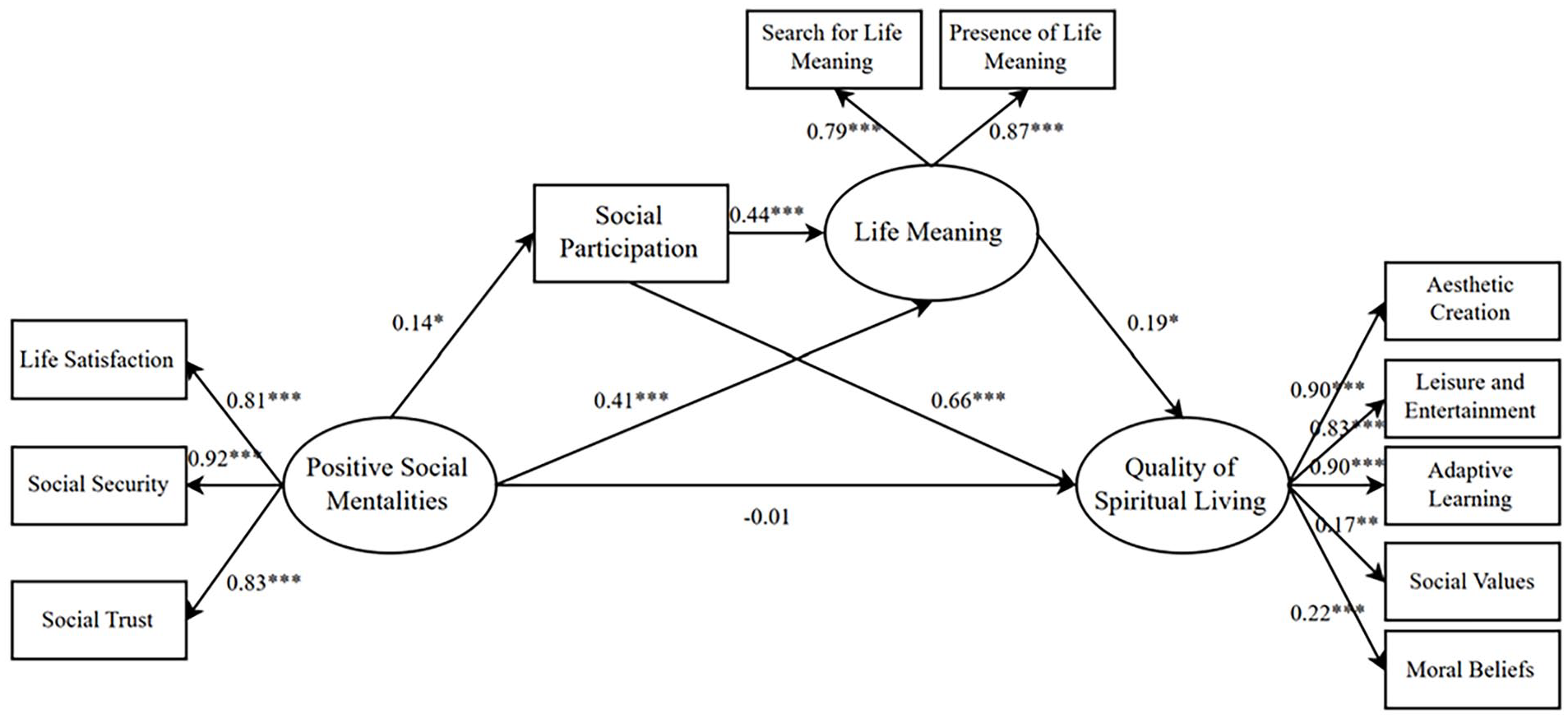
Serial mediating effects.
Mediating Role of Social Participation and Life Meaning.

Note. PSMs = positive social mentalities; SP = social participation; LM = life meaning; QSL = quality of spiritual living.
PSMs had a significant positive predictive effect on SP ( β = .14, P < .05, 95% CI = [0.03, 0.48]), SP had a significant positive predictive effect on QSL (β = .66, P < .001, 95% CI = [0.25, 0.35]). The mediating effect test showed that 95% CI [0.01, 0.17] contained 0, indicating that SP mediated between PSMs and QSL. The mediating effect size was 0.09, which accounted for 47.37% of the total effect size. H2 is true.
PSMs had a significant positive predictive effect on LM (β = .41, P < .001, 95% CI = [0.19, 0.38]), LM positively predicted the QSL (β = .19, P < .01, 95% CI = [0.10, 0.38]). The mediating effect test showed that 95% CI [0.03, 0.15] did not contain 0, indicating that the LM mediated between PSMs and QSL. The intermediate effect size was 0.08, which accounted for 42.11% of the total effect. H3 is true.
The positive predictive effect of SP on LM was significant (β = .44, P < .001, 95% CI = [0.12, 0.23]). Moreover, the mediating effect test showed that 95% CI [0.01, 0.03] did not contain 0, indicating that SP and LM played serial mediating roles between PSMs and QSL. The mediating effect size was 0.01, which accounted for 5.26% of the total effect size. H4 is true.
Discussion
Relatedness Between PSMs and QSL in Old Age
This study found that PSMs, as a prerequisite, were indirectly related to the QSL in old age. PSMs are the positive cognitive and emotional reflection toward fundamental social relations or social realities, which can be regarded as a particular form of psychological capital related to fundamental social existence, manifested as individual self-efficacy, optimism, psychological resilience, self-esteem, 38 and other subject positivity promoting the spiritual practice or experiences of the older adults. This study showed that cultivating and maintaining PSMs can help enrich and enhance one’s QSL. Those with higher life satisfaction, social security and social trust are more willing to participate in various leisure and entertainment activities, participate in university and community learning, engage in artistic and esthetic activities, and are more willing to maintain positive interpersonal relationships and family happiness and abide by social ethics.
Although PSMs were related to QSL, they did not directly affect it. The reason is that a PSMs, as a social motivation factor, can trigger some extroverted spiritual behaviors. Social trust and security, for example, can promote interpersonal communications and group leisure and entertainment activities,39 -41 but it has no direct relationship with internal morals, faith and other introverted spiritual activities. Therefore, the direct effect of PSMs and QSL is weakened to a certain extent.
Attention must be paid to cultural differences in SL due to varying lifestyles and cultural traditions. SL in China has a robust secular color and social characteristics closely related to secular life. In addition to morality, faith, and other introverted spiritual life, entertainment, leisure, adaptive learning, and esthetic creation are the primary spiritual lifestyles of older adults in China,5,36 which belong to social activities. It is very different from the Western people’s spiritual lifestyles, which are dominated by religious beliefs, meditation, and self-awareness. In other words, the SL of older adults in the West is more of a personal or private matter, so whether the social mentalities are still related to introverted SL in the context of Western cultures needs to be verified.
The Mediating Roles of SP and LM
The research showed that PSMs indirectly affected SL in old age through the serial mediating effects of SP and LM. On the one hand, the sense of life satisfaction, social trust and social security helps older adults to participate in social activities and pursue the LM.18,42,43 On the other hand, participating in social activities and pursuing the LM are direct factors in enriching QSL in old age.44,45 According to social interaction theory, individuals can only form social relations and construct social lives in social interaction. The QSL of older adults is also inseparable from the mutual construction process between the individual and society. Good psychological readiness, or PSMs, is a prerequisite for good social interactions. SP and the LM, as social feedback, enrich and enhance the QSL of older adults.
PSMs enrich the QSL of older adults by promoting their SP. Older adults with positive social attitudes trust society more, have a higher sense of security and satisfaction with society, and are more willing to participate in social activities. The more old ones participate in social activities, the easier it is to stimulate the belief that old adults have something to do, to make them realize their value, to promote mental health, and to meet their spiritual needs,46,47 improving the QSL. Studies have shown that SP has a more significant effect on mental health in old adults than intergenerational care. Therefore, it is necessary to guide old adults to actively participate in social activities and carry out appropriate sports based on community to enrich their spiritual needs. 46
LM also enhances QSL in old adults. Older people with a more positive social attitude are more willing to pursue life’s meaning and experience life’s joy. It is consistent with the results of previous studies. This research showed that psychological capital can improve happiness through the mediating effect of the sense of LM. As a positive psychological resource, PSMs help to enhance older adults’ expectations and pursuit of LM. At the same time, PSMs encourage older adults to evaluate social life more positively, thus experiencing more sense of LM. 48 Old adults with a stronger sense of LM have a higher mental health level, more positive spiritual experiences, 28 and a higher QSL.
In addition, PSMs improve the QSL through the chain-mediating effect of SP and LM. SP of old adults positively correlated with the sense of LM, which is consistent with previous research results. 49 According to self-determination theory, old adults can establish a comprehensive and harmonious interpersonal relationship, enhance social-emotional connection and cognitive function, and affirm self-worth to meet their relationship, ability, and autonomy needs through SP. In other words, by meeting psychological needs, SP enhances older adults’ perception of social influence and promotes more goal-oriented behaviors, thus enhancing their sense of LM and enriching their spiritual experience.
Research Significance, Limitation, and Prospect
This study deepened researchers’ understanding of the connotation, form and category of spiritual living and developed corresponding measurements based on the construct of SL, which have theoretical innovative significance. On this basis, it revealed how PSMs, as a “cognitive filter” and “the engine” of social interaction, improve the QSL of older adults by enhancing their psycho-social functions, SP and LM, providing beneficial enlightenment for implementing the strategy of active aging.
In addition, this study revealed how older adults can enhance their social cognition and emotional intelligence, enhance social interaction and effect, and thus enrich their spiritual lives, which provides enlightenment for improving social work for older adults. That is, by strengthening the psychological construction of older adults, we can enhance their social function, ultimately enrich their SL and improve the quality of life of the older adults.
We are aware of this study’s possible limitations. This study adopted a cross-sectional design, but the main variable in the model, PSMs, can change dynamically. Cross-sectional research is difficult to accurately reflect the dynamic developmental nature of social mentalities. So, follow-up studies need to add longitudinal study design and cross-hysteresis analysis.
In addition, due to category differences and cultural differences in spiritual lifestyles, it is necessary to separate introverted and extroverted SL, consider possible cultural differences in influencing factors, construct the influence mechanism models of introverted and extroverted SL, respectively, and verify them in different cultures.
Conclusions
Social participation (SP) and life meaning (LM) were significantly and positively correlated with the quality of spiritual living (QSL) of older adults. Positive social mentalities (PSMs) have no direct effect on the QSL of older adults. However, they indirectly affect QSL through the serial mediating effects of SP and LM. This study has added new knowledge about spiritual lifestyles and types in old age and explored the factors and ways to enrich the SL of older adults. Implementing the active ageing strategy is of great significance. It suggests that we should pay more attention to the spiritual living of older adults and improve their QSL by enhancing their psychological construction and social functions.
Supplemental Material
sj-docx-1-inq-10.1177_00469580241282061 – Supplemental material for Positive Social Mentalities and Quality of Spiritual Living in Old Age: Roles of Social Participation and Life Meaning
Supplemental material, sj-docx-1-inq-10.1177_00469580241282061 for Positive Social Mentalities and Quality of Spiritual Living in Old Age: Roles of Social Participation and Life Meaning by Yifu Wang, Qian Xu, Hemei Tian and Peihao Yin in INQUIRY: The Journal of Health Care Organization, Provision, and Financing
Footnotes
Author Contributions
Yifu Wang: conceptualization, data curation, formal analysis, writing-original draft, writing-revision & editing; Qian Xu: formal analysis, writing-original draft, writing-revision & editing; Hemei Tian: writing-revision & editing; Peihao Yin: writing-revision & editing.
Data Availability Statement
Data will be provided by the authors upon request.
Declaration of Conflicting Interests
The author(s) declared no potential conflicts of interest with respect to the research, authorship, and/or publication of this article.
Funding
The author(s) disclosed receipt of the following financial support for the research, authorship, and/or publication of this article: This work was supported by General Project of Social Science Foundation of Jiangsu Province (22GLB011) and Key Project of Philosophy and Social Sciences of Jiangsu Province (2021SJZDA149).
Ethical Approval
The design and procedure were approved by the Academic Ethics Committee of the authors’ university (Approval Number: HNU-ESS-2023052001). The procedures followed in the study adhere to the ethical standards of the Helsinki Declaration of 1975 and its later addenda.
Informed Consent
Informed consent was obtained from all participants included in the present study.

Supplemental Material
Supplemental material for this article is available online.
References
Supplementary Material
Please find the following supplemental material available below.
For Open Access articles published under a Creative Commons License, all supplemental material carries the same license as the article it is associated with.
For non-Open Access articles published, all supplemental material carries a non-exclusive license, and permission requests for re-use of supplemental material or any part of supplemental material shall be sent directly to the copyright owner as specified in the copyright notice associated with the article.
