



Abstract
Objective structured clinical examination (OSCE) is widely used in health programs and has been applied in medical education to enhance clinical knowledge and help build clinical competence and confidence. It is carried out in different clinical stations that simulate real clinical situations and scenarios and helps prepare students for clinical training and practical applications. The purpose of this study was to investigate the change in professional identity and self-efficacy of occupational therapy students after applying OSCE utilizing simulated learning. A pre-post study design was used. The participants were 48 occupational therapy university students at 1 university in Saudi Arabia. Total scores and subscale scores for professional identity and self-efficacy were compared before and after OSCE using the Wilcoxon signed- rank test. Spearman's rank correlation coefficient was calculated to examine the relationship between professional identity and self-efficacy. There were significant increases in both professional identity and self-efficacy total scores after OSCE (P < .05). Most items in the professional identity, such as choosing occupational therapy again (P < .01) and improving occupational therapy skills (P < .01) and the self-efficacy, such as doing very well in class (P < .01) and ability to learn the material for class (P < .01) increased significantly. OSCE utilizing simulated-based learning plays a supportive role in forming occupational therapy students’ identities as clinicians and can potentially enhance their overall self-efficacy, professional identity and growth. It is a beneficial teaching and learning strategy for occupational therapy educators and considered important steppingstones for students transitioning to real life occupational therapy practice.
Keywords
This study explores changes in both professional identity and self-efficacy among occupational therapy students engaged in objective structured clinical examination (OSCE) utilizing simulation learning in Saudi Arabia. The OSCE has proven to increase student satisfaction, self- confidence, clinical judgments and knowledge acquisition in comparison to other traditional evaluating tools. Simulation-based learning helps turn knowledge into practice, allows students to apply abstract concepts to active hands-on practice, gather measurable data on students clinical competency-related skills, and eventually improves safety measures for practitioners and patients.
The occupational therapy educators have been utilizing the OSCE simulated-based learning into occupational therapy education worldwide and it has proved to be helpful and useful teaching and learning approach. This study is considered the first study to apply OSCE into occupational therapy undergraduate curriculum in the Arab region and Saudi Arabia and will help further validate the adoption of this effective and efficient method and support its applications as an evidence-based approach that could be implemented to support occupational therapy students’ identities as clinicians and can potentially enhance their overall self-efficacy, professional identity and growth throughout their transitioning journey to real life occupational therapy practice.
The present study offers clues to occupational therapy educators and students to further utilize OSCE simulated-based learning into occupational therapy education in the Arab region and Saudi Arabia. It also provides a risk-free environment for learners to practice skills as well as make decisions and encourages them to try new things and learn from their errors in a safe environment.
Introduction
The Objective Structured Clinical Examination (OSCE) is a test format which enables students to be evaluated in a uniform, standardized, reliable, and objective way and is carried out in different clinical stations that simulate real clinical situations and scenarios in health programs and medical education.1,2 It is perceived by both students and faculty as a helpful and useful learning tool that provides invaluable feedback, helps students acquire necessary clinical skills and competencies, and increases critical reasoning, problem solving, decision making, and communication among occupational therapy students/faculty. 3 The OSCE has been used in medical, rehabilitation, and occupational therapy education and proved to be valid and reliable. 4 Integrating the OSCE into teaching and learning process can be performed utilizing a variety of methods with positive multiple effects. For instance, incorporating a flipped learning approach in OSCE occupational therapy related techniques fosters both occupational therapy skills and critical thinking abilities 5 and incorporating OSCE after lectures and core rehabilitation and occupational therapy skills practice improves acquisition, retention, and transfer of knowledge among students, suggesting that OSCE enhances the students’ clinical abilities. 6
Professional Identity (PI) is a crucial element of professional development that helps students shape their future and pursue a career as healthcare professionals. For medical and rehabilitation students including occupational therapy students, promoting PI is shown to effectively foster professional behaviors.7,8 Enhancing PI of occupational therapists is considered an effective method to reduce turnover rates and it has also been found to be a strong predictor of job retention in medical, rehabilitation, and occupational therapy. 9 This indicates that PI has a positive significant impact on the ability of occupational therapists to continue working without leaving the profession. Hence, supporting and strengthening of PI during study period is imperative and crucial. 10 Research has provided different teaching and learning strategies for PI development in medical and rehabilitation schools including occupational therapy. A few examples include integrating problem-based learning, case-based learning, team-based learning, interprofessional education opportunities, and incorporating OSCE simulation-based learning into the curriculum. 11
Self-efficacy (SE) is an individual’s belief in their capacity to act in the ways necessary to reach specific goals and to execute behaviors necessary to produce specific performance attainments and it is very important for learners including medical and rehabilitation students to continue their studies.12,13 Research has shown that higher levels of self-efficacy and social support can reduce academic burnout in medical and rehabilitation students, 14 highlighting the importance of supporting self-efficacy in medical students. Various educational and learning interventions have been used to enhance self-efficacy of medical students transitioning into medical practice including simulation-based learning; however, no definitive conclusions were drawn regarding the most effective educational intervention. 15 Recently, simulation education has been widely adopted in medical and occupational therapy education and proved to effectively develop occupational therapy practice skills. 16 Engaging students in simulation education is promising and involves aspects that enhance various learning outcomes. 17 It has been reported that OSCE utilizing simulation learning helped students feel more confident and better prepared for their next clinical training. 18 However, up to our knowledge and per literature review, there is currently no study that reports on the effects of the OSCE and simulated learning on occupational therapy students in the Arab region and Saudi Arabia. Therefore, the purpose of the current study was to investigate the change in professional identity and self-efficacy of occupational therapy students after applying OSCE utilizing simulated learning. We hypothesize that implementing OSCE could potentially improve both professional identity and self-efficacy of occupational therapy students transitioning to real life occupational therapy practice in Saudi Arabia and contribute to their overall learning journey.
Methods
Design
We have followed the STROBE Cohort Checklist reporting guidelines as this study was a pre-post quantitative research study design, often described as nonrandomized, which is common in medical informatics literature and can be almost as accurate as randomized controlled trial for showing causation.19,20
Participants
The participants were 55 occupational therapy university students at one university in Saudi Arabia who agreed to participate in the study. Universities in Saudi Arabia offer five-year occupational therapy programs with clinical training and internship in the last 3 years of the program. The required minimum sample size was calculated, using the Power Analysis and Sample Size Software (PASS, version 15.0) to achieve a level of reliability with a Cronbach’s α > .70 with the confidence level of 95% and a standard deviation of 12.21,22 The minimum sample size required was 45 with a 20% dropout rate. In the current study, the sample size of 55 was based on the availability of students in the third and fourth year of their program during the study period. Inclusion criteria were being enrolled in the third or fourth year of the occupational therapy program and having clinical-based courses. Students who were not enrolled in a clinical-based course or who did not consent to participate in the study were excluded. Participation was completely voluntary and was not part of students required academic workload. All participants received consent forms explaining study goals and methodology and were asked to respond freely and voluntarily. This study was approved in January 2024 from a medical college research committee (approval # RES-2023-0090) as part of an ongoing research project at the occupational therapy program.
OSCE
The OSCE was integrated into clinical-based courses offered at the third and fourth year of the occupational therapy program at the occupational therapy labs at Batterjee Medical College in Saudi Arabia. The course was semester-based and consisted of 10 sessions (2 h/session) implemented weekly throughout the first semester during the period of September through November 2024 with a total of 20 training hours (see Figure 1). The simulated-based learning included evaluation methods and therapeutic techniques in motor control learning, upper extremity rehabilitation, assistive technology and wheelchair service provision, and patients transfers. These topics were closely supervised and monitored by expert educators and lab instructors in the field of rehabilitation science and occupational therapy. Before the exams for each technique, students engaged in simulated group learning of the knowledge and task simulations applying patient-therapist role-playing.
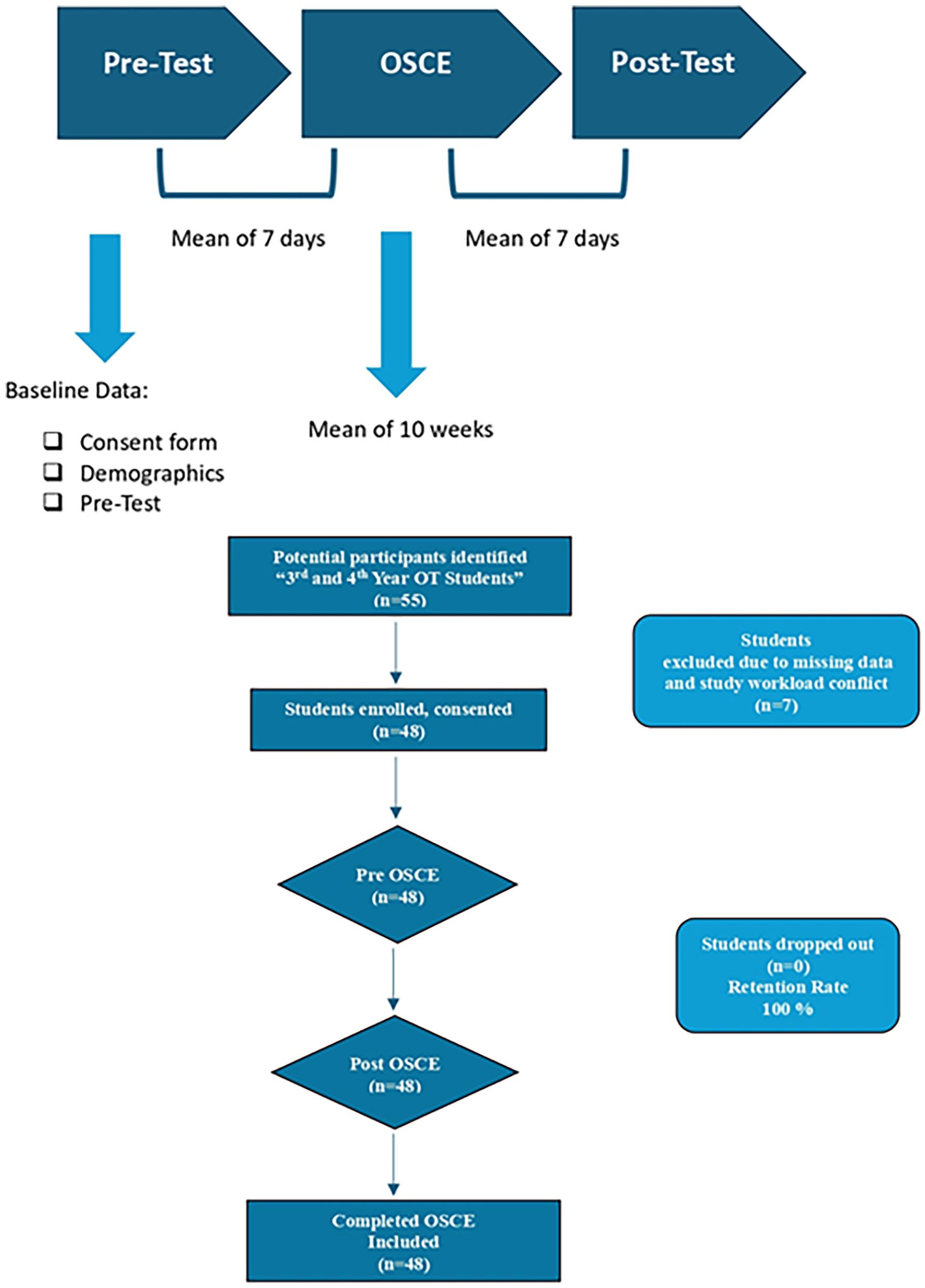
OSCE study flow diagram and procedural chart.
Data Collection
Students participated in two anonymous questionnaire surveys before and after the OSCE. The questionnaires included demographics, professional identity scale, and self-efficacy scale.
Outcome Measures
Professional identity scale
Professional identity was assessed using twelve items created by Hatano (1993), answered on a 5-point Likert scale from “strongly disagree” to “strongly agree,” with higher total scores indicating a stronger professional identity. 23
Self-Efficacy Scale
The self-efficacy scale included 9 items created by Mori (2004), with responses on a 7-point Likert scale from “not at all true” to “very true,” with higher total scores indicating higher self-efficacy. 24
While preserving primary content of the original professional identity and self-efficacy scales and after taking permission from the developers, we modified both with minor change only from “nursing” to “occupational therapy” to appropriately adapt them to occupational therapy context and population. The outcomes were then validated and pilot tested with 20 occupational therapy students to make sure they were understandable and appropriate.
Data Analysis
Cronbach's alpha coefficient was calculated to examine the internal consistency of the scales used. The total scores and subscale scores for professional identity and self-efficacy were compared before and after the OSCE using the Wilcoxon signed-rank test. Spearman's rank correlation coefficient was calculated to examine the relationship between professional identity and self-efficacy. The SPSS version 22 was used for the analysis, with a significance level of less than 5%.
Results
Participants Demographics (n = 48)
Out of the 55 participants, valid responses from 48 participants (87.3%) without missing data were analyzed. The average age of participants was 21.5 years old and the breakdown by gender was 40 females (83.3%) and 8 males (16.7%) (see Figure 1).
Internal Consistency
The reliability coefficients for the 12 items of the professional identity scale were high, with α = .844 before OSCE and α = .964 after OSCE. Similarly, the 9 items of the self-efficacy scale also showed high reliability, with α = .906 before OSCE and α = .936 after OSCE, indicating good to excellent internal consistency respectively.
Professional Identity and Self-Efficacy Before and After OSCE
There were no significant changes in the total scores of the professional identity before and after the OSCE. However, significant changes were seen in most items, such as “If I had to choose a job again, I would choose occupational therapy again” (Z = −2.22, P < .01) and “I want to improve my occupational therapy skills” (Z = −4.62, P < .01) showed significant change (see Table 1). There were statistically significant differences in self-efficacy scores after the OSCE (P < .05) with significant increase in most items, such as “I expect to do very well in this class” (Z = −2.62, P < .01), “I am sure I can do an excellent job in the problems and tasks assigned for this class” (Z = −2.11, P < .02), and “I know that I will be able to learn the material for this class” (Z = −2.10, P < .02) (see Table 2).
Details of Professional Identity Scores Before and After Intervention.
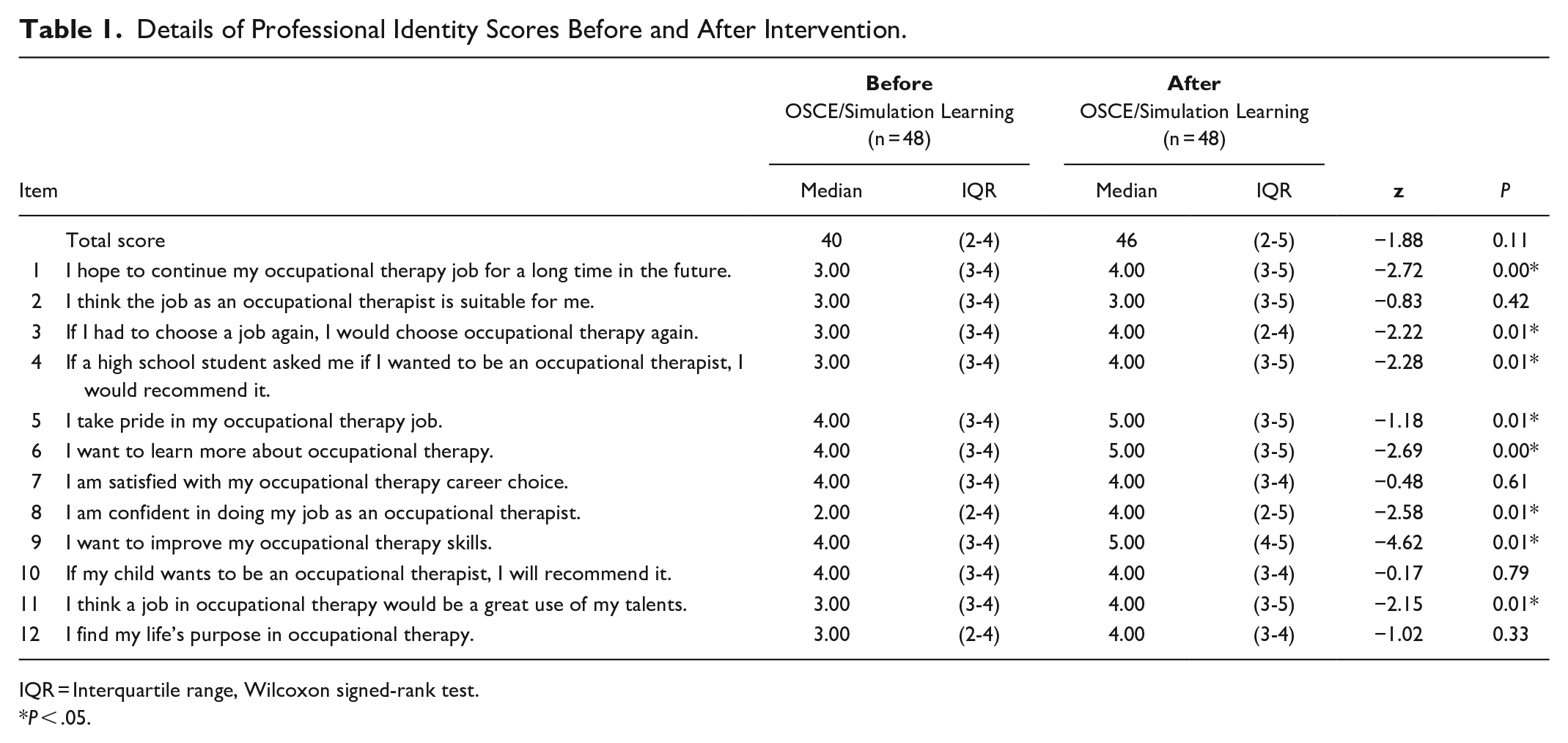
IQR = Interquartile range, Wilcoxon signed-rank test.
P < .05.
Details of Self-Efficacy Scores Before and After Intervention.

IQR: Interquartile range, Wilcoxon signed-rank test.
P < 0.05.
Relationship Between Professional Identity and Self-Efficacy
A significant positive correlation was observed between the total scores for professional identity and self-efficacy before OSCE (r = .354, P < 0.01). Significant correlations were found in 7 items of the subscales for professional identity and self-efficacy before OSCE (see Table 3). Additionally, a significant positive correlation was observed between the total scores for professional identity and self-efficacy after OSCE (r = .581, P < 0.01). Significant correlations were found in all items of the subscales for professional identity and self-efficacy after OSCE (see Table 4).
Correlations Between Professional Identity and Self-Efficacy Before OSCE.

P < .01 (n = 48).
Correlations between professional identity and self-efficacy after OSCE.

P < .01 (n = 48).
Discussion
In the current study, both professional identity scale and self-efficacy scale showed a significant increase in most items after applying the OSCE utilizing simulation-based learning suggestion a positive OSCE impact on occupational therapy students' professional identity and self-efficacy. Professional identity is a crucial factor in the education and career of medical, rehabilitation, and occupational therapy students. Professional identity development in medical and rehabilitation students is influenced by long-term clinical practice experience and the mentors involved.25,26 Gaining self-esteem and confidence in practice positively impacts the development of professional identity.27,28 In the current study, OSCE incorporated simulation-based learning, providing a learning experience that mimicked clinical occupational therapy practices. This simulation experience offered invaluable learning opportunities for students to gain confidence through positive feedback they received from both simulated patients and clinical mentors and to become more aware of their capabilities as promising occupational therapists.
Although there were no significant changes in some items of professional identity before and after OSCE, significant changes were observed in most items. The significant increase in items such as “If I had to choose a job again, I would choose occupational therapy again" and "I want to improve my occupational therapy skills” suggests that practical experiences with simulation education enhanced students’ motivation and understanding of the occupational therapy profession. In addition, repeated simulation training before OSCE and receiving positive feedback on their improvement probably made students more aware of their acquired skills, reinforcing their confidence in their career choice as occupational therapists. Similar findings were reported in previous studies with simulation-based learning significantly increased learners’ confidence alongside knowledge improvement.29,30 The lack of significant changes in other factors might be due to shortage of teaching staff, weakness in the simulation design or because of the relatively short-term simulated scenarios offered and lack of repetitions sometimes due to schedule restrictions and other course workload.
Self-efficacy refers to the belief in one’s own ability to handle difficult situations. The significant increase in self-efficacy scores after OSCE in this study suggests that the OSCE incorporating simulation-based learning effectively enhanced student confidence and belief in their abilities. Research has shown that self-efficacy profoundly influences individual behaviors, motivation, and persistence,31,32 and practical evaluation provides students with opportunities to acquire and confidently apply specific hands-on skills. The high scores on the self-efficacy subscales such as “I expect to do very well in this class,” “I am sure I can do an excellent job in the problems and tasks assigned for this class,” and “I know that I will be able to learn the material for this class” indicate that OSCE is perceived as an effective method to enhance the self-reflection capabilities and problem-based learning skills of students. Additionally, in this study, students repeatedly practiced the knowledge and skills required for the OSCE exam, leading to improved acquisition, retention, and transfer of learned skills and increased self-efficacy in a more broader sense as we received excellent feedback from their clinical supervisors and as per improved academic performance in other relevant clinical courses throughout the academic year.
In this study, weak to moderate positive correlations were observed between professional identity scores and self-efficacy scores before and after OSCE respectively. Students who evaluated their abilities highly before OSCE were more likely to find value in the rehabilitation and occupational therapy profession. However, students with low self-efficacy may lack a clear purpose or direction in their studies. Hence, and as previous studies found that strategies to enhance professional identity and self-efficacy are necessary from the early stages of rehabilitation and occupational therapy studies 33 suggesting that the early support for establishing professional identity and self-efficacy is crucial and imperative. The overall correlation increased from 0.354 before the OSCE to 0.581 after, emphasizing that OSCE effectively strengthened the relationship between occupational therapy students’ professional identity and self-efficacy. The significant increases in the correlations of items such as “I think the job as an occupational therapist is suitable for me” and “I am satisfied with my occupational therapy career choice” suggest that the OSCE enhanced the student sense of career fit and satisfaction with their career choice, resulting in improving their overall self-efficacy. Previous studies have shown that self-efficacy is a strong predictor of identity development. Those with high self-efficacy are more likely to develop a strong sense of self and pursue goals that are consistent with their identity and students with high self-efficacy can improve their professionalism and self-confidence thereby achieving high degrees of career maturity. 34 Furthermore, in the current study the correlation between professional identity scores and self-efficacy scores increased in all items, suggesting that OSCE positively impacted the relationship between these 2 components. These findings highlight the importance of applying OSCE as a helpful and useful strategy and confirm results from previous research that OSCE plays an important role in forming students’ identities as clinicians.35 -37
This study had some limitations. The current study only included students at 1 university in Saudi Arabia which limits the external validity and generalizability of results. For future studies, the inclusion of more students from other medical, rehabilitation, and occupational therapy training institutions is needed. In addition, further studies that integrate more simulated scenarios and more clinical mentors with extended timeframe are important to further enhance students overall clinical competency skills, professional identity, and self-efficacy. Additionally, qualitative studies investigating occupational therapy students’ perceptions of OSCEs’ impact on their learning and readiness for clinical practice through interviewing them in separate focus groups and the application of thematic analysis to identify, analyze, and report themes in the data is recommended.
Conclusions
A well-designed OSCE can potentially enhance the professional identity and self-efficacy of occupational therapy students. Occupational therapy educators and clinical mentors should consider using OSCE as a strategy to enhance occupational therapy students’ clinical skills and prepare them to become competent occupational therapists.
Supplemental Material
sj-docx-1-inq-10.1177_00469580251315351 – Supplemental material for Professional Identity and Self-efficacy Among Occupational Therapy Students Engaged in Objective Structured Clinical Examination Utilizing Simulation Learning
Supplemental material, sj-docx-1-inq-10.1177_00469580251315351 for Professional Identity and Self-efficacy Among Occupational Therapy Students Engaged in Objective Structured Clinical Examination Utilizing Simulation Learning by Hassan Izzeddin Sarsak in INQUIRY: The Journal of Health Care Organization, Provision, and Financing
Footnotes
Acknowledgements
The author would like to express his gratitude and appreciation for all the occupational therapy mentors, lab instructors, and students who participated in this study.
Author contributions
Hassan Izzeddin Sarsak; writing original draft, review and editing, conception and design of the work, acquisition, analysis, and data interpretation. Professional Identity and Self-efficacy Among Occupational Therapy Students Engaged in Objective Structured Clinical Examination Utilizing Simulation Learning. Professional Identity and Self-efficacy Among Occupational Therapy Students Engaged in Objective Structured Clinical Examination Utilizing Simulation Learning
Data availability statement
all contributions presented in the study are included in the article, further inquiries can be directed to the corresponding author (
Declaration of Conflicting Interests
The author(s) declared no potential conflicts of interest with respect to the research, authorship, and/or publication of this article.
Funding
The author(s) received no financial support for the research, authorship, and/or publication of this article.
Ethical/consent statement
Ethical approval was obtained from the Batterjee Medical College research committee to conduct this study in January 2024 (approval # RES-2023-0090). Signed consent forms were obtained from all students prior to their participation in this study.

Supplemental Material
Supplemental material for this article is available online.
References
Supplementary Material
Please find the following supplemental material available below.
For Open Access articles published under a Creative Commons License, all supplemental material carries the same license as the article it is associated with.
For non-Open Access articles published, all supplemental material carries a non-exclusive license, and permission requests for re-use of supplemental material or any part of supplemental material shall be sent directly to the copyright owner as specified in the copyright notice associated with the article.
