




Abstract
Although income and living conditions of residents have greatly improved in recent years, people’s subjective well-being does not seem to increase daily. This study aimed to explore income, self-rated health, and psychological capital on subjective well-being, using data from the China General Social Survey conducted in 2017. A total of 1136 elderly as subsamples data were selected from 12 582 participants, involving general sociodemographic characteristics, income, self-rated health, psychological capital, and subjective well-being. SPSS v26.0 macro was used for descriptive statistics, ANOVA and correlation analysis. PROCESS v3.4 macro was performed to examine multiple mediating effects of self-rated health and psychological capital. The elderly residing in urban (P = .016) and having completed 9-year compulsory education (P = .016) reported higher subjective well-being scores. The findings revealed that subjective well-being was positively associated with income, health, and psychological capital among the aged adults (all P < .001). Self-rated health and psychological capital played complete mediation roles between income and subjective well-being (Effect indirect = 0.040, 95% bootstrap CI [0.022, 0.060]; Effect indirect = 0.027, 95% bootstrap CI [0.013, 0.044], respectively). Collectively, our findings indicate that residing in rural and having lower education levels serve as negative predictors of subjective well-being among the elderly. Although income still affects the elderly’s subjective well-being, self-rated health and psychological capital may be the crucial mediating factors. Therefore, it is of utmost importance to improve health conditions and positive psychological capital for subjective well-being of the older people.
Keywords
MeSH Terms
Aged, Aged, 80 and over, Aging / physiology, Aging / psychology*, China, Cross-Sectional Studies, Educational Status, Education Level, Income, Income Distribution, Female, Health Status, Humans, Living Conditions, Low-Income Population, Male, Marital Status, Personal Satisfaction, Poverty, Quality of Life, Social Conditions, Surveys and Questionnaires, Urban Population / statistics & numerical data*
Income has an effect on subjective well-being of the elderly.
Self-rated health and psychological capital also affect the subjective well-being, and completely mediate the effect of income on subjective well-being among the aged adults.
It is of utmost importance to improve health conditions and positive psychological capital for subjective well-being of the older people.
Introduction
Subjective well-being (SWB) of older adults has become an important area of research globally. What is the significance of studying SWB among older adults? An important reason for this is the irreversible trend of global aging, particularly in China, where it occurs on a large scale and at a rapid pace. The severity of China’s aging problem can be attributed to its low fertility rate and large population base. 1 According to information released by the National Bureau of Statistics of China, as of the end of 2023, China’s elderly population aged 60 and above reached 297 million (21.1%), and the population aged and over 65 was 210 million (15.4%).2,3 In an aging society, it is essential to improve the well-being, security, and benefits of the elderly population. Meeting these needs is the primary goal of creating a prosperous society. The elderly, driven by the rapid advancement of social and economic conditions as well as increased life expectancy, aspire not only to hope to survive, but more importantly, to attain a state of happiness and good health. 4 It should be stressed that SWB has been a subject of extensive research within the field of psychology. Psychologist Diener defined SWB as the positive affirmation and evaluation of one’s mental state, including personal identification with emotions. 5 Many scholars have examined the factors that affect SWB of the elderly, including population characteristics, dwelling environment, Internet use, intergenerational support, and living arrangements.6 -10
Effects of Income on SWB of the Elderly
A study of the elderly from Central and Eastern Europe also found that their life satisfaction is mainly affected by health and income. 11 Researchers have also demonstrated that income is a crucial economic factor associated with well-being 12 and has a significantly positive effect on SWB.12 -14 Adequate disposable income levels and higher stability in income development have also been associated with higher SWB in older adults.15,16 Income may be an important factor affecting SWB in the elderly population. However, an analysis of data from 6 countries shows that income, while important, has become less important to SWB and is not the most important explanatory variable. 12 Easterlin proposed the “Easterlin paradox” suggesting that higher income does not lead to greater happiness, 17 and this idea seems to be validated in China. A previous study mentioned that, despite the increase in income level, people did not feel happier, possibly because of income inequality. 18 However, for older adults who lived before the 1960s, an individual’s absolute income remains an important factor in SWB, especially after retirement. Therefore, we propose the following hypotheses:
Hypothesis 1. Income may have a significant positive relationship on SWB of the elderly.
Self-Rated Health Associated With Income and SWB
In developing countries, promoting active aging and achieving happiness are more important. For example, faced with the increasing aging population, Chinese government has issued the “14th Five-Year Plan” for the Development of National Aging Cause and Elderly Care Service System to promote high-quality development of population aging, so that the elderly can enjoy their old age, and the self-rated health (SRH) level of the elderly becomes an important development and measured goal. 19
Previous studies have confirmed that countries and regions with high levels of economic development have high health literacy and health concepts, and thus, relatively more health behaviors and high health levels. 20 However, for most developing countries, poverty and low economic income remain constraints that prevent people from seeking healthcare, which could reduce health outcomes. 21 For SRH, income is the primary contributor to total inequality. 22 Income has an impact on the health status of individuals, and individuals with higher income levels have a higher health level. 23
Many studies have confirmed a positive relationship between physical health and SWB. 12 It is not difficult to find that there is a close relationship between income level, health status and SWB. 24 Some studies have mentioned that the relationship between health status and SWB may be stronger in developing countries than in developed countries. 21 Specifically, a higher income level may lead to a higher SRH level and further increase SWB among older adults. There are many studies on the relationship between income, SRH, and SWB in chronic disease groups and the general population. However, there are few studies on the mediating role of SRH between income and SWB among the elderly. Therefore, we propose:
Hypothesize 2. SRH may partially mediate the relationship between income and SWB among the elderly.
Psychological Capital Associated With Income and SWB
As a measurable, adjustable and developable psychological characteristic of an individual, psychological capital (PsyCap) includes 4 dimensions: self-efficacy, optimism, hope, and resilience. 25 Previous studies show that PsyCap has a strong positive correlation with SWB of college students, 26 positively predicts SWB of Chinese primary medical staff, 27 and significantly improves SWB of new recruits via PsyCap group training. 28 Furthermore, PsyCap can play the mediation role between adolescents’ bullying and SWB, 29 29and between kindergarten teachers’ competence and SWB. 30 A previous study using CGSS2017 data shows that the family income of rural elderly people is positively correlated with PsyCap, and income can positively predict PsyCap. 31 In short, scholars all agree that higher income and PsyCap level can obtain higher SWB. Based on the above evidence, we propose the following:
Hypothesis 3. PsyCap may play a mediating role between income and SWB among the elderly.
Briefly, the literature above provides a valuable theoretical basis for furthering SWB in older adults. With the increasing aging population, in order to further improve elderly SWB, it is necessary to put forward countermeasures through empirical analysis of personal income, SRH, and PsyCap involving the elderly, which will also provide reference for more developing countries.
Methods
Data Source
The data used in this study were obtained from the China General Social Survey (CGSS), a publicly available data source jointly collected and published by the Renmin University of China and several academic institutions in 2017. As a nationally representative survey conducted in China, it provides valuable data for understanding various social phenomena, and has been widely used because of its advantages of high data quality, applicability, and representativeness. 32
Sample Selection
The Chinese General Social Survey (CGSS), started in 2003, was the earliest nationwide, comprehensive, and continuous academic survey project in China. The CGSS systematically and comprehensively collects data at multiple levels of society, community, family, and individual, summarizes the trend of social change, discusses issues of great scientific and practical significance, promotes the openness and sharing of domestic scientific research, provides data for international comparative research, and acts as a multidisciplinary economic and social data collection platform. In 2017, the CGSS completed and released 12 582 valid samples.
A subsample of respondents aged 60 years and above was selected from the 2017 CGSS dataset for this study, excluding individuals under 60 years of age. Similarly, only participants with complete information on all relevant variables were included, excluding variables missing values and options giving “don’t know,” “refuse to answer” and “the answer is not applicable.” The inclusion criteria were as follows: (1) age 60 years and above; and (2) answers to the study variables and demographic characteristics required for this study were complete. For missing data, we deleted samples (rows) with missing attribute values. By removing any missing or invalid data points, we obtained a robust sample size of 1136 valid participants, consisting of 540 males and 596 females (Figure 1).

Study flow diagram illustrating the elderly study at the China general social survey in 2017. Image created with PowerPoint.
Variables
Dependent variable
SWB: SWB was measured using the single-item self-rating report A36 (“ Overall, do you feel happy with your life? ”). The 5-point Likert scale was used for the self-evaluation of the elderly, which was expressed as “very unhappy,” “relatively unhappy,” “neutral,” “relatively happy,” and “very happy,” and the SWB level was reflected by 1 to 5 values in turn. Higher scores indicated higher levels of SWB.
Independent variables
Income: Participants’ current income levels were self-reported and categorized into different groups. Questionnaire A8a asks “What was your total income for the whole of last year (2016)?” The purpose of taking logarithmic income variables is to stabilize the data and weaken the collinearity and heteroscedasticity of the model.
SRH: This variable was obtained from question A15 in the CGSS questionnaire: “Can you evaluate your current state of physical health?” The available answers are “very poor,” “poor,” “fair,” “good,” and “excellent.” The design adopts 5-point Likert score; the higher the score, the higher the level of health states.
PsyCap: PsyCap variable obtained from D38 and D39 in the CGSS questionnaire. The D38 design adopts 5-point Likert score, from “strongly agree” to “strongly disagree,” assigning 1 to 5 points, in which items D38-1(When things are uncertain, I usually expect things to turn out for the best), D38-3(I have a positive attitude toward my future), and D38-6 (Overall, I expect more good things to happen to me than bad things) are scored in reverse. An 8-point Likert score was used in the D39 design, from “completely inconsistent” to “completely consistent,” 1 to 8 points were assigned successively, and each item was scored in a positive way. The higher the score, the higher is the PsyCap level. In this study, the Cronbach’s α coefficient for internal consistency was 0.730.
Control variables
Demographic control variables included gender, age, current residence, education level, and marital status. Where, each control variable is assigned a value as follows: gender (0 represents female, 1 represents male), current residence (urban = 1, rural = 0), education level (divided by whether the 9-year compulsory education has been completed, 0 = not completed; 1 = complete), marital status (0 = “unmarried, separated, not divorced, divorced, widowed” four situations, recorded as no spouse; 1 = “ cohabitation, first marriage with a spouse, remarriage with a spouse,” total is a husband and wife relationship).
Statistical Analysis
Descriptive statistics, variance analysis, and post-hoc analysis (Least Significant Difference, LSD) all were performed to explore the characteristics of the sample. Correlation analysis and multiple mediation models were conducted to examine the associations between income, SRH, PsyCap, and SWB while controlling for relevant sociodemographic variables such as gender, age, current residence, education level, and marital status. We used SPSS v26.0 to analyze the data, and all significance tests were two-sided with the p-value test level α = .05. PROCESS v3.4 macro 33 and its Model 4 was employed to explore the multiple mediating roles of RSH and PsyCap between income and SWB. Here, SWB was modeled as dependent variable, income as independent variable, and SRH and PsyCap as mediators.
Ethics Statement
The study did not require ethical approval, as the secondary survey data was downloaded from website. The final version of the scoping review was published in a peer-reviewed academic journal.
Results
Descriptive Statistics and Correlation Analysis
Descriptive statistics for the sample are presented, including the mean, standard deviation, and distribution of each variable (Table 1). Men reported higher income (P < .001), SRH (P = .005) and PsyCap (P = .012) than women. Posterior comparisons (LSD) showed that the subjective well-being of 71 to 80 years old was significantly higher than that of other ages (P = .002), but there was no significant comparison between 60 and 70 years old and 81 years old (P > .05). Participants who lived in urban areas reported higher income (P < .001), SRH (P < .001), PsyCap (P < .001) and SWB (P = .016) than those living in rural areas. Those who completed 9-year compulsory education were less likely to have completed income, SRH, PsyCap, and SWB (all P < .001). Participants with spouses reported higher income (P = .030), SRH (P = .008), and PsyCap (P = .002) than those without spouses.
Descriptive Statistics on Demographic Characteristics of Income, SRH, PsyCap, and SWB in Elderly.

Note. SWB = subjective well-being; PsyCap = psychological capital; SRH = self-rated health.
Table 2 shows pearson correlation analysis results indicated that SWB was positively correlated with income, health and PsyCap among the Chinese elderly (all P < .001). The participants’ mean scores on Income, SRH, PsyCap, and SWB were 3.57 (SD = 1.50), 3.01 (SD = 1.04), 41.51 (SD = 7.70) and 3.87 (SD = 0.86), respectively. As hypothesized 1, income was positively correlated with SWB (r = .132, P < .001).
Correlation Analysis of Income, SRH, PsyCap, and SWB in Elderly.

Note. SWB = subjective well-being; PsyCap = psychological capital; SRH = self-rated health.
P < .001 (2-tailed significant).
Multiple Mediation Model Analysis
The results of the multiple mediation model are shown in Table 3 and Figure 2. Interestingly, we found that income had no significant effect on subjective well-being (β = .038, 95% bootstrap CI [−0.025, 0.100]). Hypotheses 1 was not confirmed. The total indirect effect was 0.104 (95% bootstrap CI [0.039, 0.169]; ratio, 63.8%). SRH (Effect indirect = 0.040, 95% bootstrap CI [0.022, 0.060]; ratio = 38.2%) and PsyCap (Effect indirect = 0.027, 95% bootstrap CI [0.013, 0.044]; ratio = 25.6%) significantly mediated the association between income and SWB respectively. Hypotheses 2 and 3 were confirmed. Moreover, there is no significant difference in indirect effects between SRH and PsyCap (95% bootstrap CI [−0.010, 0.037]).
Direct Effects, Indirect Effects and Total Path Effects From Income to SWB.

Note. SWB = subjective well-being; PsyCap = psychological capital; SRH = self-rated health.
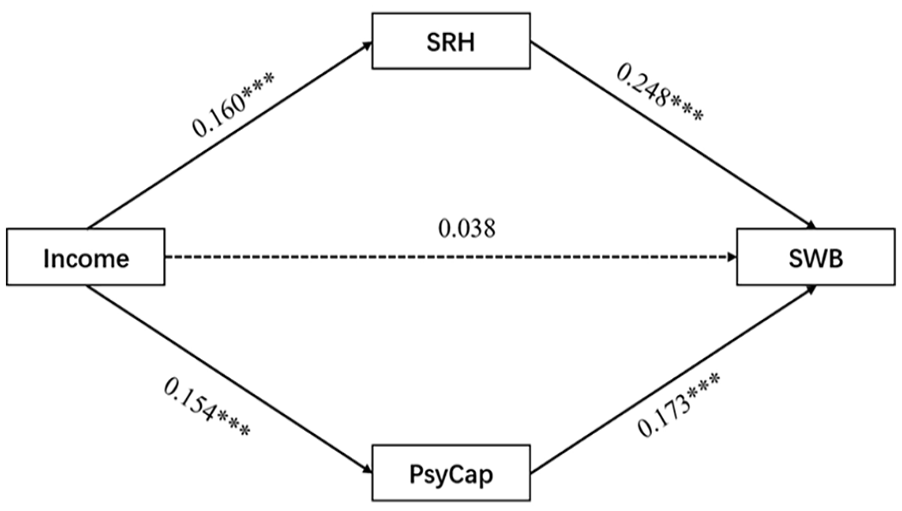
Multiple mediation model of SRH and PsyCap on Income and SWB.
Discussion
The purpose of this study was to discover the differences in income, SRH, PsyCap, and SWB of the elderly under different demographic characteristics and to explore the mediating role of health and psychological capital between income and SWB of the elderly in China. Most of the previous literature was based on the influence of mental health or physical health status on the subjective well-being of the elderly and conducted research on a single aspect. This is the first study to analyze the influence path of income on the subjective well-being of elderly Chinese people by combining self-rated physical health status and PsyCap. Gender, age, current residence, education level, and marital status of the elderly all have different effects on their income, SRH, psychological capital, and SWB. In China, although there is a positive correlation between income and SWB among the elderly, when SRH and PsyCap are included, they play a complete mediating role between income and SWB, thus masking the effect of income on SWB of the aged people.
The results of this study showed that the income level, health status, and PsyCap level of aged men were higher than those of elderly women. Individual income differences are influenced by several factors. Men’s incomes are generally higher than those of women, which may be influenced by women’s childbearing and family roles. Women tend to take on more responsibilities between family responsibilities and work balance, which may take a toll on an individual’s body and energy. 34 In addition, studies have shown that women experience far more gender discrimination at work than men, which has an impact on physical and mental health with associated poverty outcomes. 35 The results of this study show that the influence of age on the subjective well-being of the elderly is U-shaped, which is similar to the results of previous studies. 12 The elderly aged 71 to 80 years have a higher SWB than the elderly in other age groups, which may be due to the elderly in this age group, after years of listening, adapting to retirement life, accumulating rich life experience, “when seventy, he does as he pleases and does not overstep his bounds” (see “The Analects of Confucius - Politics” in Chinese), subjective understanding of happiness is more profound. 36 The income, health, PsyCap, and SWB of the elderly living in urban areas were higher than those living in rural areas. This is similar to the findings of Zhang et al’s study of older Chinese adults. 37 In China, the income sources of the elderly in urban areas mainly include salaries and pensions, whereas the income of the elderly in rural areas mainly comes from land cultivation. 37 With the growth of age and limited physical function, the income brought about by land cultivation is far less stable than the pension for the elderly in urban areas. In addition, at the level of medical insurance, the degree of insurance perfection and reimbursement of urban workers is generally higher than that of rural elderly people, and elderly people from low-income families are often poor or anti-poor due to illness caused by a lack of perfect medical insurance. 38
Using the completion of 9 years of compulsory education as a cut-off point, the income, SRH, PsyCap, and SWB of older adults with an equivalent level of education or higher were significantly higher than those of those with incomplete education. This is consistent with Zhang’s study on elderly people living alone in rural China. 39 Respondents with more education may have more knowledge about physical health, are more willing to use active treatment methods, and are more willing to accept advanced treatment methods. Maintaining an optimistic attitude is conducive to the development of physical and mental health. 40 Older adults with lower educational levels generally have lower levels of social cognition, weaker levels of ideological liberation, fewer available social resources, lower social and economic status, and lower SWB.41,42 In a study of elderly Americans, it was mentioned that some effects are cumulative, and the relationship between income, education, and health accumulates risks that become increasingly significant in old age. 43 The income, SRH, and PsyCap levels of older adults with spouses were higher than those without spouses, whereas SWB approached significance, which is similar to the results of previous studies. 44 Studies have confirmed that older people living alone have less access to healthcare and lower levels of income and family support.39,45 In addition, older people with a spouse relationship can provide emotional social support, take care of each other in life, overcome the difficulties of life together, set goals for the future, and also tend to have higher levels of PsyCap.
We found that income still had a positive relationship with SWB in elderly. This finding is consistent with previous study. 12 Improving the personal income of the elderly may increase their happiness, improve welfare security, and reduce the burden of disease, which means income level is still important measurements for governments at all levels to actively age. The importance of health for a person is self-evident, and many hospitals hold the slogan that health is happiness, which is especially true for older people. There is a saying that health is 1 and everything else is 0. A declining health status not only causes physical pain but is also accompanied by psychological anxiety and insecurity. 46 Elderly people with poor health status are more likely to increase the financial burden on their families, and the relationship between relatives is more likely to be unbalanced, which exacerbates anxiety and depression among elderly people and thus reduces their SWB. 6 PsyCap can also directly affect the health-promotion behavior of the elderly. 47 Under the premise that income and material life are guaranteed, positive psychological factors have an increasingly significant impact on the SWB of older adults. We found that PsyCap can have a positive association with SWB, consistent with previous studies. 48 Previous studies have shown that the mediating effect of PsyCap itself is greater than that of perceived social support itself among Chinese elderly people. 49 This may be due to the influence of traditional Chinese culture, the elderly like to express themselves and communicate with each other, thus enriching the psychological feelings of hope and optimism. Self-expression interventions have been found to be effective in increasing resilience and reducing the impact of negative emotions. 50 Older adults with high levels of resilience are more likely to regain confidence following life setbacks, whereas those with low levels of resilience may remain immersed in frustration for an extended period without being able to recover, subsequently affecting their subjective well-being. 51 PsyCap is the fourth capital, in addition to financial, human, and social capital, and it can be changed and cultivated. 52 According to our research results, the level of PsyCap in the elderly in China is approximately the middle level, and there is potential for future development and improve. At present, there are few studies on psychological capital in the elderly, and future studies should continue to focus on the role of PsyCap in the active aging of the elderly.
In view of the above findings, on the one hand, the rural women, the less educated, and the widowed among the aged people need to get more care and support from the government and society, because these elderly people lack social resources and have low participation in social activities, weak social adjustment and communication skill. Filial piety is a traditional culture in China 53 and filial piety and respect for one’s parents are obligations incumbent on Chinese people. In promoting the culture of filial piety, it is suggested that governments at all levels and social groups focus on bringing into play the psychological resources of the elderly, combining the positive and healthy aspects of traditional culture with positive psychology to promote the psychological health of the elderly more effectively. Furthermore, regularly organizing the elderly to participate in various appropriate social and cultural activities, and constantly improving their emotional communication and psychological resilience, which will be conducive to improve PsyCap and SWB of the elderly. On the other hand, society and families must pay more attention to cultivating positive psychological qualities of the elderly, including the cognition of aging attitudes, social responsibility, organizational belonging, etc. For the rural elderly, we should actively carry out the revitalization of rural education and provide conditions for the elderly to re-study with the village committee as a link, 54 and create an atmosphere for participation in activities. Meanwhile, strengthening the function of community-based elderly services will provide a strong guarantee for the urban elderly to enjoy their twilight years in peace. The inheritance of the cultural value of “filial piety toward the elderly” and the concept of “raising children to support their parents in old age” in China have elevated family pension models to a prominent position among various pension models in our country. Therefore, we should emphasize and utilize the social function of the family in providing health care for the elderly, and continue to maintain and carry forward the fine tradition of family pension. 55
Conclusions
This empirical analysis contributes to understand the factors of influencing SWB among the elderly Chinese. Living in rural areas and not completing 9 years of compulsory education are risk factors affecting SWB in the aged people. This study demonstrates that income, SRH, and PsyCap are significantly correlated with SWB of the elderly, and SRH and PsyCap play an equally important mediating role between income and SWB, which highlight their importance in the context of Chinese traditional social culture.
In view of the influence mechanism of SWB on the elderly, governments at all levels should pay attention to physical and mental health of the elderly, actively carry out screening for chronic diseases, improve the security system for serious diseases, and prevent falling into poverty due to health problems. It is also necessary to actively publicize positive psychological knowledge to help the elderly face suffering and death optimistically, set up life goals, and promote active aging.
Limitations
Compared to other studies published using CGSS2017, this study has the following limitations. First, SWB in the elderly is influenced by many factors. Our study included only the influence of several key variables, such as demographic variables and income, on the SWB of the elderly. Future studies should continue to expand the influence of other important variables on SWB in the elderly population. Second, this study was based on a cross-sectional survey, which cannot be used to directly infer causation and fully explain the factors influencing SWB in the elderly. In future, longitudinal studies should be conducted in combination with historical data.
Footnotes
Acknowledgements
We would like to express our gratitude to the China General Social Survey (CGSS) for providing access to the data used in this analysis.
Author Contributions
H.X. and X.L. contributed to the design and implementation of the research, Z.W. and C.Z. analyzed the results, and wrote the manuscript. C.Z. and L.P. curated the data and revised the manuscript. All authors have reviewed and contributed to the final manuscript.
Data Availability Statement
The data used in this study is available from Chinese National Survey Date Archive (see the website: http://www.cnsda.org/index.php?r=projects/view&id=94525591).
Declaration of Conflicting Interests
The author(s) declared no potential conflicts of interest with respect to the research, authorship, and/or publication of this article.
Funding
The author(s) disclosed receipt of the following financial support for the research, authorship, and/or publication of this article: This study was funded by the Xuzhou social development key R & D plan (Project number: KC21306)
Ethical Approval and Informed Consent Statements
The research was conducted according to the guidelines of the Declaration of Helsinki. Secondary survey data does not require ethical approval and informed consent.
Consent for Publication
Not applicable.
