




Abstract
The coronavirus disease (COVID-19) pandemic and associated infection control measures have introduced significant uncertainty, and the unbearable nature of this uncertainty has heightened the risk of mental health issues among college students. This study aimed to assess the impact of unbearable uncertainty during the COVID-19 pandemic on college students’ depression and investigate the mediating role of coping strategies between unbearable uncertainty and depression. A cross-sectional survey was conducted with 714 Chinese university students using the Intolerance of Uncertainty Scale (IUS-12), Brief Coping Style Questionnaire, and Beck Depression Inventory (BDI-II). SPSS PROCESS was used for the partial correlation analyses and structural equation modeling. (1) Negative coping strategies were significantly positively correlated with intolerable uncertainty and depressive symptoms, while positive coping strategies were negatively correlated with both intolerable uncertainty and depressive symptoms. Intolerable uncertainty was significantly and positively correlated with depressive symptoms. (2) Intolerance to uncertainty significantly predicted depressive symptoms. Both negative and positive coping strategies played parallel mediating roles in the relationship between unbearable uncertainty and depressive symptoms among college students. This study found that coping strategies played a mediating role in the relationship between unbearable uncertainty and depression during the pandemic in 2019. Future research and interventions should focus on enhancing tolerance of uncertainty and promoting positive coping strategies.
The intolerance of uncertainty can affect the mental and psychological health of college students.
Based on the diathesis-stress model, this study explored the relationship between intolerability of uncertainty and depression among college students during the COVID-19 pandemic, coping strategies played a mediating role in this relationship.
The current research results can serve as a decision-making reference for the education department to conduct large-scale mental health screening, and can also serve as a basis for psychological counselors to choose coping strategies.
Introduction
COVID-19 was declared a pandemic by the World Health Organization (WHO) in March 2020. 1 Owing to its high lethality and infectivity, COVID-19 poses an unprecedented threat to people. 2 Studies from around the world have shown that during the first phase of the pandemic, college students experience increased levels of stress and depression, and are unable to fully cope with COVID-19 related stress.3-5 Especially in the second stage of the pandemic, college students have a higher level of perceived health risks and concerns. 6 In China, measures taken to prevent the spread of the pandemic, such as social distancing and the imposition of quarantine periods, have negatively affected people’s psychological adjustment. The pandemic particularly negatively impacted college students. They were compelled to learn online, their social interactions were severely limited, and pressure from academics and jobs had a significant psychological influence on them. One survey revealed that Chinese college students suffered mild, moderate, and severe depression at prevalence rates of 25%, 7%, and 2%, respectively, during the lockdown. 7 College students’ daily lives are highly uncertain because of COVID-19’s unpredictable nature and its control strategies. Although the normal response to the current pandemic is uncertain, those who are poorly equipped to handle it may face serious difficulties. Therefore, it is necessary to investigate the relationship between college students’ psychological adjustment and their intolerance of uncertainty caused by the COVID-19 pandemic.
Intolerance of Uncertainty and Depression
Intolerance of uncertainty (IU) refers to the cognitive bias in perceiving, interpreting, and reacting to uncertain situations or events that affect individuals’ cognitive, emotional, and behavioral responses. 8 Studies have suggested that IU leads to a negative bias in interpretation, attention, and memory9,10 and is negatively connected with psychological adaptive processes, including resilience and self-esteem.11,12 Numerous studies have found that IU is strongly associated with psychopathology.13,14 Individuals who cannot bear a high level of uncertainty have more demands for predictability, 15 and tend to overly perceive the situation as a threat because they are concerned about the negative effect of potential uncertainty, which is linked to anxiety or depression.16,17 LeMoult and Gotlib have demonstrated a connection between negative cognitive bias and the onset and persistence of depressive episodes. 18 IU has also been shown to result in a negative cognitive bias. 10 Therefore, we hypothesize that IU could be a positive predictor of depression (H1).
Coping and Depression
Coping refers to the process of individuals’ efforts to meet the demands of their internal and external environments through cognitive and behavioral efforts. 19 According to the focus and goals of coping actions, Folkman classified the 2 main coping strategies, problem-focused coping and emotion-focused coping, which are also called positive and negative coping strategies. Coping is seen as an internal diathesis; when facing the same stressful event, different coping actions will have various effects on a person’s mental health. Positive coping actions, particularly positive reinterpretation, are crucial defenses against depression and anxiety. 20 The connection between childhood abuse and adult depression is significantly influenced by negative coping behaviors among female Chinese college students. 21 Accordingly, we hypothesize that positive coping would negatively predict depression (H2), and negative coping would positively predict depression (H3).
The Mediating Role of Positive and Negative Coping Between IU and Depression
IU is not only directly related to psychological adaptation but is also mediated by coping strategies. The Diathesis-stress model suggests that psychological disorders are caused by the interaction between underlying vulnerability (diathesis) and external stressors. 22 A person may be predisposed to a certain illness, but the interaction between this vulnerability and adverse life events leads to mental illness. Stressors include life events that disrupt individuals’ psychological balance. During the COVID-19 pandemic, research has shown that the general public has found it more difficult than usual to cope with uncertainty and is exposed to higher levels of stress risk and distress. 23 These uncertainties and life events can profoundly affect individual psychology and are important risk factors for inducing mental health problems. Second, stressors can interact with diathesis, profoundly affecting an individual’s psyche to foment mental illness. The coping style is an inherent quality. When faced with uncertainty caused by pressure, different coping strategies will have different effects on individual mental health.
Research on the 2009 H1N1 pandemic found that IU is associated with emotion-focused coping and greater anxiety about H1N1. 13 According to the mediating model, maladaptive coping partially explains the association between IU and psychological distress. 23 This implies that individuals with high IU may be more prone to psychological maladjustment when employing negative coping strategies in response to stressful events. Previous studies have indicated that coping strategies change with development24,25; emotion-focused coping increases with age, 26 while problem-focused coping is not significantly affected by age. 27 With the background of the pandemic, Rettie and Daniels’ study was based on adults in society and did not explore how IU affected depression through different coping strategies in college students. 23 Therefore, it is crucial to investigate how positive and negative coping strategies regulate IU and depression among college students during the COVID-19 pandemic. This study hypothesized that IU would partially mediate depression through negative and positive coping (H4 and H5, respectively).
Current Study
This study aimed to explore the relationship between intolerance of uncertainty (IU) and depression in college students, focusing on how positive and negative coping strategies mediate this connection during the COVID-19 pandemic. The pandemic and associated preventive measures have introduced significant uncertainty into college students’ daily lives and academic pursuits. Difficulty in coping with this uncertainty can lead to significant psychological distress, impair social and cognitive functioning, and increase the risk of suicide. Depression is prevalent among college students, making it crucial to deepen our understanding of the mechanisms linking IU and depression. This study contributes to the development of a theoretical framework for effective prevention and intervention strategies.
Method
Participants
Participants were recruited from a university in Liaoning Province, China. Data were collected online due to the COVID-19 outbreak. Students volunteered to participate in the survey and were informed that they could quit at any time. In total, 714 college students (M = 20.96, SD = 1.59) participated in the data collection. A cross-sectional study was conducted with a random sample of 714 college students in China between August 2022 and September 2022. The participants were 418 males (58.5%) and 296 females (41.5%). Among them, there are 67 freshmen, 250 sophomores, 281 juniors, and 116 seniors. All participants agreed to refer to this study and provided written informed consent. This study was approved by the Ethics Committee for Psychological Research at the authors’ institution.
The inclusion criteria were as follows: (i) voluntary participation in the study, (ii) currently studying as an undergraduate in a Chinese university, and (iii) at least 18 years old. The exclusion criteria were as follows: first, failing the attention test. Second, the minimum response time for the questionnaire was set at less than 120 s. Using the total number of projects to estimate the sample size before the study, 28 the total number of items in our scale is 53. The estimated sample size is 10 times the total number of projects, and the results indicate that we need at least 530 participants.
Intolerance of Uncertainty Scale-12
IU was measured using the Chinese version of the Intolerance of Uncertainty Short Form (IUS-12). 29 This scale includes 12 items with a 3-factor structure: expected behaviors, inhibitory activity, and prospective emotions. It uses a 5-point Likert scale to calculate the participants’ IU, ranging from 1 = “not at all representative of me” to 5 = “entirely representative of me.” The probable range of this scale is 12 to 60 points. The higher the score, the higher the IU. The questionnaire was administered to college students during the pandemic and showed good reliability and validity. 30 The Cronbach’s alpha for this study was .854.
Simplified Coping Style Questionnaire
Coping was measured using the Simplified Coping Style Questionnaire, which was designed to properly represent a person’s coping actions in Chinese culture. 31 This scale includes 20 items and the score for each item ranges from 0 (never) to 3 (always). Items 1 to 12 represent positive coping, and items 13 to 20 represent negative coping. The higher the score, the more frequently the coping actions were used. The questionnaire was administered to college students during the pandemic, with good reliability and validity. 32 In this study, Cronbach’s alphas for the positive and negative coping dimensions were .810 and .769, respectively.
Beck Depression Inventory-II
Depression was measured using the Chinese version of the Beck Depression Inventory-II (BDI-II) to assess the severity of depressive symptoms over the previous 2 weeks. 33 Degree of depressive symptoms experienced in the last 2 weeks. It includes 21 questions and is graded from 0 to 3, with a possible overall score ranging from 0 to 63. The higher the score, the more severe the individual’s depressive symptoms. Individuals with scores of 0 to 13 are viewed as free of depression, 14 to 19 as “mildly,” 20 to 28 as “moderately,” and 29 to 63 as “severely.” The questionnaire was administered to college students during the pandemic, with good reliability and validity. 34 The Cronbach’s alpha for this study was .959.
Data Analysis
Data analysis and processing were performed using SPSS version 26.0. Due to the influence of sex, grade, and age on coping strategies, the sex, grade, and age of college students were controlled for in the model. First, Harman’s univariate test 35 was used to test for significant common method bias. Second, descriptive statistics and partial correlation analyses were performed on the data. Third, a mediation effect test was conducted using Hayne’s Process 4.0 plugin. Model 4 was selected to study the mediating effect of coping strategies on the relationship between intolerable uncertainty and depressive symptoms and to control for the confounding effects of covariates such as grade, age, and sex. Guidance strategies were used to test the effectiveness of both the direct and indirect effects. Using the bias-corrected percentile bootstrap method, 36 5000 Bootstraps were extracted to estimate the 95% confidence interval for the mediating effect. By determining whether the confidence interval contained 0, the mediating effect of positive and negative coping on the relationship between intolerable uncertainty and depressive symptoms was found to be significant.
Results
Common Method Bias
To examine common method bias, Harman’s single-factor test was implemented. All IU, coping, and depression items were subjected to an unrotated exploratory factor analysis. The findings showed that 9 common factors with eigenvalues greater than 1 were extracted from the factor analysis. The explanation rate for the largest common factor was 20.17%, which was less than the critical value of 40%. It was predicted that the common method bias in this study would have little impact on the association between variables.
Preliminary Analyses
Table 1 shows the preliminary analyses of IU, coping, and depression and their intercorrelations. Partial correlation analysis revealed that all variables were significantly correlated with one another (P < .01) after controlling for grade, sex, and age. There was a strong positive correlation between IU, negative coping, and depression; however, positive coping and other variables were negatively correlated.
Partial Correlations of Variables.
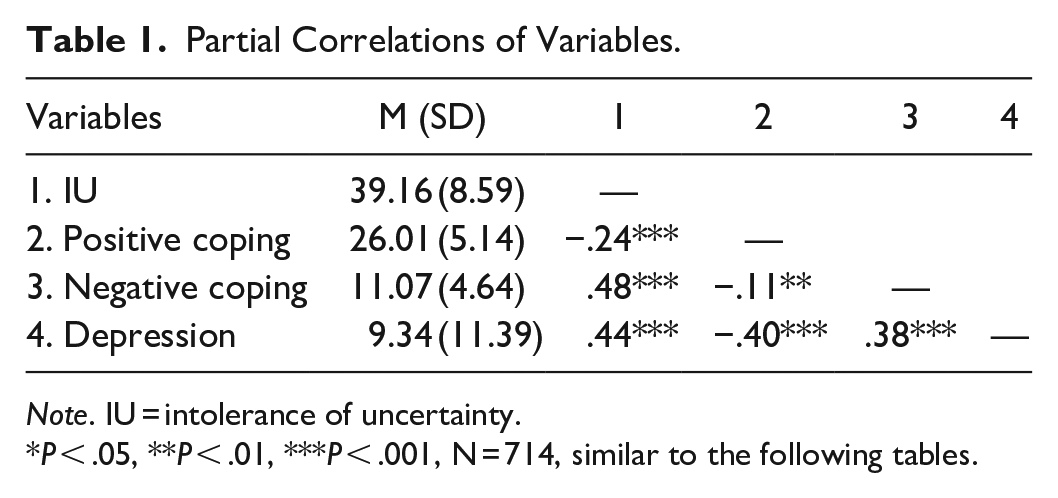
Note. IU = intolerance of uncertainty.
P < .05, **P < .01, ***P < .001, N = 714, similar to the following tables.
Testing for the Multiple Mediation Model
Based on the correlations between the research variables shown in Table 1, a parallel mediation model was constructed to explore the mechanism of coping strategies in the relationship between unbearable uncertainty and depressive symptoms in college students. Based on the regression analysis and according to the PROCESS macro developed by Preacher and Hayes, 36 Model 4 was selected to analyze the mediating effect and conduct a significance test. After controlling for grade, sex, and age, as shown in Figure 1, intolerable uncertainty can negatively predict positive coping (β = −.141), P < .001), positive prediction of negative coping (β = .259), P < .001) and depressive symptoms (β = .343, P < .001).

Mediating effects of positive and negative coping between IU and depression.
Depression symptoms were used as the dependent variable, and intolerable uncertainty and positive and negative coping strategies were included as predictive variables in the regression equation. The 95% confidence interval for the direct effect of unbearable uncertainty on depressive symptoms did not include zero and the direct effect was significant. Moreover, the predictive effect of positive and negative coping strategies on depressive symptoms remained significant, indicating that positive and negative coping strategies partially mediate the relationship between unbearable uncertainty and depressive symptoms. The detailed results of the mediation effect tests are presented in Table 2.
Multiple Mediation Model Analysis.
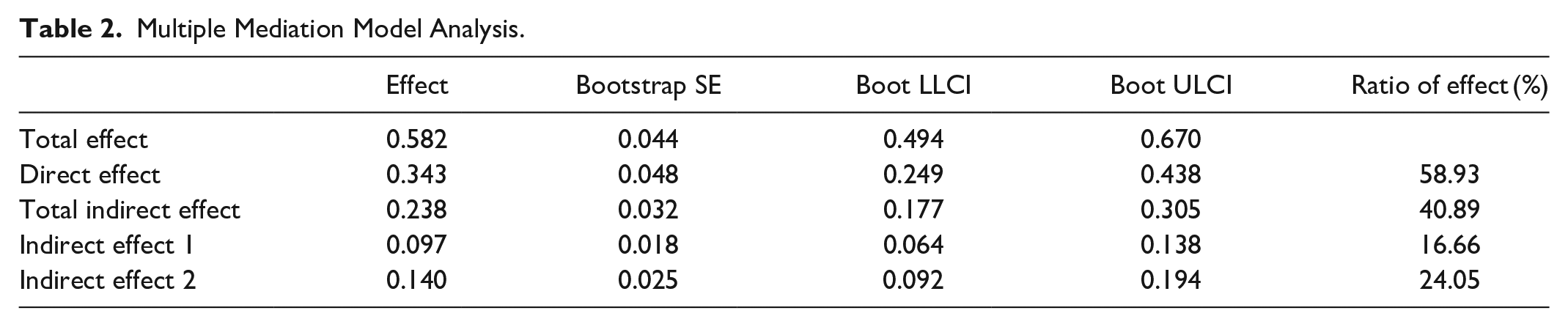
This mediating effect consists of two indirect effects: first, the indirect effect 1 generated by unbearable uncertainty → positive coping → depression, with a confidence interval of no 0 value, indicating that positive coping has a significant indirect effect between unbearable uncertainty and depression (0.097, accounting for 16.66% of the total effect); Second, the confidence interval of the indirect effect 2 generated by the path of unbearable uncertainty → negative coping → depression does not contain a zero value, indicating that the indirect effect generated by this path (0.140, accounting for 24.05% of the total effect) has also reached a significant level.
These results indicate a close relationship between unbearable uncertainty and depression in college students, and that unbearable uncertainty can also affect depression by influencing both negative and positive coping strategies.
Discussion
This study investigated the correlations between uncertainty intolerance (IU), positive coping, negative coping, and depression among Chinese college students during the COVID-19 pandemic. As hypothesized, intolerance to uncertainty is closely related to depression in college students and can affect depression through both negative and positive coping. When using negative coping strategies to manage stress, students with high IU were more likely to have depressive symptoms, whereas students with low IU showed fewer depressive symptoms when using positive coping mechanisms. Under the theoretical framework of the diathesis-stress model, this study connects Chinese college students’ intolerance of uncertainty with depressive symptoms in the context of COVID-19 and explores the different roles of positive and negative coping strategies in the relationship between intolerance of uncertainty and depression.
IU and Depression
Our research showed that intolerance of uncertainty (IU) can be a predictor of depression, which is consistent with previous studies.14,37 This finding suggests that the COVID-19 pandemic has passively impacted mental health by increasing uncertainty and disrupting daily life activities. People who struggle to tolerate uncertainty may perceive such situations as potential threats, 17 leading to a negative cognitive bias9,10 and an increased risk of depression. 18 Additionally, as the COVID-19 pandemic continues to resurface, the escalation of intolerance of uncertainty (IU) can intensify fear and rumination, ultimately deteriorating mental health.38-40 Therefore, it is imperative to implement interventions targeting IU during ongoing pandemics.
Positive and Negative Coping and Depression
According to this study, positive coping had a negative impact on depression, while negative coping had a positive impact. This indicates that college students with high depressive symptoms tended to use negative coping strategies, whereas those with low depressive symptoms tended to use positive coping strategies. A direct test of the diathesis-stress model of depression revealed that the interaction between internal diathesis and external stressful events jointly explains depression. 22 Individuals with poorer diathesis would exhibit more depressive symptoms in the same stressful situation. Conversely, fewer depressive symptoms were observed in individuals with better diathesis. Coping is an important aspect of diathesis. When stressful events occur, individuals experience less depression and anxiety if they adopt positive and problem-focused coping 20 ; individuals experience more depression and anxiety if they adopt negative and emotion-focused coping. 21
The Mediating Effect of Positive and Negative Coping Between IU and Depression
The results indicate that positive coping is an important protective factor that could buffer IU’s effect of IU on depression. That is, individuals with low IU tend to respond more positively to stressful situations and thus should have fewer depressive symptoms. It is important to mention that the study 23 demonstrated that despite the negative correlation between adaptive coping and depression and anxiety during the COVID-19 epidemic, adaptive coping did not mediate the relationship between IU and depression. This may be because the group of participants was an important factor. The diathesis-stress model is one way to explain why some people are more prone to mental illness than others. This also explains why some people may develop mental disorders after experiencing stressful life events while others do not. Previous studies have shown that coping strategies are affected by development.24-26 Future research should compare and explore how individuals at different stages of development cope with the uncertainty of COVID-19.
The diathesis-stress model suggests that mental disorders occur when individuals are vulnerable or susceptible are exposed to stressful life events. 22 Prolonged pandemics lead to increased uncertainty about stressors, which can trigger the onset of mental disorders or worsen existing depressive symptoms. In many cases, the disorder occurs only when stress-related factors trigger the underlying quality. Stress exposure can trigger the onset of mental disorders or worsen the symptoms. In college students, the relationship between IU and depression was found to be partially mediated by negative coping, as demonstrated by the mediating effect, consistent with previous research. 23 Maladaptive coping strategies partially mediated the relationship between IU and psychological distress. Individuals who cannot tolerate uncertainty may have impaired problem-solving abilities.41,42 Therefore, individuals who cannot tolerate uncertainty are prone to using negative coping strategies, which can result in depression. Diathesis-stress models help improve our understanding of mental disorders and lead to the development of more effective intervention training methods.
Meanwhile, when investigating the relationship between IU and adult anxiety during the H1N1 pandemic, the study found that people with high IU not only adopted more emotion-focused coping but also lower problem-focused coping by reducing self-control assessment, which led to more depressive emotions. 13 Therefore, when faced with uncertain situations, it can be inferred that individuals with low IU can eliminate or alleviate the influence of stressful situations to a certain extent through positive coping. Individuals with high IU use negative coping strategies. Negative coping focuses not on negative events but on reducing and managing negative emotional responses caused by negative events. The events themselves did not change; therefore, they are more likely to experience depression.
Strengths and Limitations
This study explored the relationship between IU and depression among college students during the pandemic. The mediating effects of positive and negative coping strategies with IU and depression were also examined. This study has several strengths. First, few studies have explored the relationship between IU, depression, and coping among undergraduates during the COVID-19 pandemic. These findings are valuable in this field. Second, this study found a protective role for positive coping between IU and depression, which was not found in adults in society. Third, the current study has significant theoretical and practical implications, which not only enrich the research on the mechanism of IU’s influence on depression but also play an important role in interventions for college student’s mental health. It is encouraged to decrease college depression by reducing IU using more positive coping strategies and fewer negative coping strategies.
However, there are multiple limitations associated with this study. First, in terms of research design, although there is a theoretical basis for the relevant variables, it is not yet possible to make clear causal inferences based on cross-sectional studies, and a longitudinal design is required to prove causal relationships. In addition, convenience sampling methods and the nature of the survey (based on the internet) limit the generalizability of the survey results by generating a selection bias. Second, as all structures were evaluated through self-reporting, the estimated relationship between uncertainty, coping strategies, and depressive symptoms may be biased due to reporter effects. Future research should involve design and methodological improvements, such as considering longitudinal designs to examine the effects of unbearable uncertainty and coping strategies on individual depressive symptoms during acute and large-scale outbreaks. Finally, males and college students constituted the majority of the sample. During the COVID-19 pandemic, these 2 groups may have faced additional psychological stress, such as professional differences and whether to participate in sports activities. Therefore, the generalizability of these results to the general student population may be limited.
Despite these limitations, our research findings have both theoretical and practical significance. In terms of theoretical significance, the continuously evolving pandemic has led to an increase in sources of uncertainty. Studying the relationship between unbearable uncertainty, coping strategies, and depression among college students can help clarify the mediating mechanism by which uncertainty affects depression. In the practical field, on the one hand, education departments and policymakers should organize mental health screening and online webinars to identify students at risk of mental health problems and refer students with severe psychological problems to counseling service institutions. On the other hand, educators and counselors can provide coping strategies (such as problem-solving, seeking support, stress management, etc.) to alleviate the emotional distress and stress response of college students when facing uncertain situations or events and enhance their psychological coping abilities.
Conclusions
The pandemic has significantly affected mental health among college students. The uncertainties and changes brought about by the pandemic have increased the pressure and likelihood of depression among students. To address ongoing stress and uncertainty, it is important to implement proactive strategies to manage pressure and alleviate the symptoms of depression. Utilizing a combination of coping strategies is essential to maintain college students’ mental wellbeing. Positive coping mechanisms can help reduce the risk of depression and promote overall happiness and wellness.
Footnotes
Acknowledgements
There are no additional acknowledgments to declare.
Author Contributions
Conceptualization, P.W.; methodology, P.W. and C.S.; software, P.W. and C.S.; formal analysis, P.W. and C.S.; investigation, P.W.; resources, J.H.; data curation, P.W.; and Q.L. writing—original draft preparation, P.W.; writing—review and editing, P.W. and J.H.; visualization, P.W.; supervision, J.H.; project administration, J.H.; funding acquisition, J.H. All authors have read and agreed to the published version of the manuscript.
Data Availability
The data will be provided upon request to the corresponding author.
Declaration of Conflicting Interests
The author(s) declared no potential conflicts of interest with respect to the research, authorship, and/or publication of this article.
Funding
The author(s) disclose receipt of the following financial support for the research, authorship, and/or publication of this article: Support for all datasets in the study was provided by the National Education Science Program Fund, Grant Number: BIA200182.
Informed Consent
Written informed consent was obtained from all the participants prior to the enrollment of this study.
Ethics and Informed Consent Statement
The study was conducted in accordance with the Declaration of Helsinki. Studies involving human participants were reviewed and approved by the Ethics Committee of Liaoning Normal University (No. LL2021045) on 15 October, 2021.
