




Abstract
The purpose of this study is to assess the quantity and quality of myopia related articles from 2001 to 2021 using bibliometric methods. The number of published articles and citations, the correlation analysis between gross domestic product (GDP) and annual publication number and citations was investigated. The proportion of myopia articles from East Asia accounted for 55.28% in 2021. The researchers from China published the most articles on myopia during 2001 to 2021, followed by Japan and South Korea. The annual number of articles and citations from China and South Korea showed an exponential increase with strong positive correlation with GDP. All 3 countries in East Asia are mainly researching refractive surgery, prevalence, and glaucoma, and research on children’s myopia is particularly active in China, and in Japan. The researchers from East Asia published more than half of articles on myopia since 2019, in order of China, Japan, and South Korea. The annual number of articles and citations from China and South Korea showed an exponential increase with strong positive correlation with GDP whereas those from Japan did not. All 3 countries are mainly researching refractive surgery, and glaucoma, and research on children’s myopia is particularly active in China, and in Japan.
Uncorrected refractive error, the most general cause of vision impairment is an important global health problem. The prevalence of myopia was particularly high in East Asia (38% in China, 41% in Japan, and 53.7% in South Korea), which was higher than those of Western Europe and United States.
This study uses a bibliometric analysis to examine the quantity and quality of myopia related scientific publications from East Asia and relation with GDP growth. The researchers from East Asia published more than half of articles on myopia in recent years, in order of China, Japan, and South Korea. The annual number of articles and citations from China and South Korea showed an exponential increase during the past 20 years with strong positive correlation with GDP.
All 3 countries, China, Japan, and South Korea, are mainly researching refractive surgery, and glaucoma, and research on children’s myopia is particularly active in China, and in Japan. Myopic research in Japan has particularly subdivided research area compared to China and South Korea.
Introduction
Vision is an essential sense for us to live our daily lives and is the primary of the 5 senses. When the visual system and functions are affected by an eye condition, vision impairment occurs. In 2019, a World Health Organization (WHO) reported that an uncorrected refractive error was the most general cause of vision impairment; though a person wears spectacles or contact lenses to correct their refractive error, he still has a vision impairment. 1 Uncorrected refractive error, which decreases quality of life, and negatively affects socio-economic state, is an important global health problem.2,3 For example, the prevalence of myopia, a common refractive error, has been reported as 25% in Western Europe, 26% in the USA, 38% in China, and 41% in Japan.4-10 In South Korea, the prevalence of myopia was 53.7%, which was higher than those of Western Europe and United States and even those reported in China and Japan. 10 The prevalence rate of those who have refractive error is common in East Asia, a potential obstacle for public health, that research covering refractive error is a universal research topic in East Asia.
Bibliometrics is a field of study that analyzes both scientific and technological literature quantitatively and can provide insight about knowledge development. 11 In spite of the criticism on bibliometric methods that it is limited in assessing scientific outputs on a narrow scale, bibliometric method is widely believed to be tools to derive reasonable and useful assessments on a macroscale. 12 Bibliometric analysis of research output is useful to present the current research status and contribution of countries, organizations, and authors to specific fields. It is also possible to provide insights about future research direction to researchers.13-15
This paper will analyze the contribution of authors from China, Japan, and South Korea, 3 key East Asia to myopia research. These countries were chosen owing to the prevalence of myopia in each country and the difference of socio-economic status they represent. In East Asia region, China, Japan, and South Korea are the countries that have highest GDP, and specifically China and South Korea experienced a rapid and constant increase in GDP over the past 20 years while Japan only fluctuated in a range (Supplemental Figure 1).16,17 The myopia related publications from East Asia in the 21st century was evaluated using bibliometric methods to investigate the myopia related research topics and quantity of them. Furthermore, there are socio-economic factors that affect quantity of their scientific publications such as gross domestic product (GDP), R&D and healthcare expenditure, and the number of researchers.18,19 Therefore, we also investigated the relationship between GDP and research productivity from East Asia.
Methods
Data Collecting
The myopia related articles were collected via the Web of Science Core Collection (WoS, Thomson Reuters). The database was searched on March 6, 2023 using the term “myopia” in terms of “Topic” to browse all articles where the expression “myopia” appeared. Only journal articles and reviews published from 2001 to 2021 were used for the analysis. Based on the author’s affiliation, articles contributed by authors from China, Japan, and South Korea were classified. The information of articles, including titles, keywords, authors, journals, were downloaded from WoS in “Full record and cited references” in text file (.txt) formats. The annual number of citation of publications from each 3 countries were collected at the same day.
Analysis Methods
To investigate whether the socioeconomic factor, GDP, was a determinant for the number of published articles and citations, the correlation analysis between GDP and annual publication number and citations was investigated based on the exponential growth equation using software Graphpad Prism version 8.0. The formula of exponential growth is as following:

The Impact Factor (IF) and rank of the journal in the “Ophthalmology” category of the Journal Citation Reports (JCR, Thomson Reuters) were determined according to the 2020 Journal Citation Reports.
The co-occurrence of all keywords was analyzed in this study. VOSviewer (Leiden University, Leiden, Netherlands) was used to generate the co-occurrence network of keywords.20-23 In co-occurrence networks generated by VOSviewer, each keyword in a network is assigned to a cluster, a set of closely related keywords. Each cluster is distinguished by colors that a keyword has been assigned.
Results
Trends in the Number of Articles
A total of 13 909 myopia articles were published in 2001 to 2021, 4936 (35.49%) of which were from China, Japan, and South Korea. The proportion of myopia articles in East Asia was about 10.46% in 2001, but it achieved 50% in 2020 and accounted for more than half with 55.28% in 2021. In 2001, China accounted for about 2% of all myopia articles, but it grew steadily and accounted for 48% in 2021. South Korea also grew from 2% in 2001 to 4% in 2021. On the other hand, Japan accounted for about 7% in 2001 but decreased to 5% in 2021. As shown in Figure 1a, the annual number of published articles increased 88.4-fold (8-707) in China and 12.8-fold in South Korea (5-64), but that from Japan only increased 3-fold (23-69) during the period studied.

(a) Trends in published myopia articles from China, Japan, and South Korea 2001 to 2021. Influence of GDP on publications from 2001 to 2021. (b) China, (c) Japan, and (d) South Korea.
Publication Activity in Relation to Socioeconomic Factors
As shown in Figure 1, the annual number of articles and citations showed strong, positive correlations in China (R2 = .9549 and .9644) and South Korea (R2 = .8660 and .9060), respectively, with GDP in an exponential growth form. However, in Japan, there was no significant correlation between annual number of articles and citations with GDP discovered (R2 = .07735 and .01367). The growth rate of annual number of articles and citations was largest in South Korea, about 0.19% and 0.31%, followed by China and Japan, about 0.019% and 0.022%, and 0.014% and 0.017% respectively. (Supplemental Table 1)
Journal Analysis
The 4936 included articles came from 561 different journals, which were primarily ophthalmology focused. Table 1 presents the journals publishing the highest number of articles related to myopia. The journal publishing the most articles was the Investigative Ophthalmology & Visual Science (n = 377), followed by BMC Ophthalmology (n = 246) and PLOS ONE (n = 202).
Top 10 Journals Publishing the Most Articles From China, Japan, and South Korea From 2001 to 2021.

All 3 of the top 3 journals were largely contributed by Chinese authors, followed by Japan and South Korea. Authors from Japan published the most papers in the American Journal of Ophthalmology, which has the highest impact factor (IF = 5.258) among the top 10 journals.
Co-Occurrence Analysis and Visualization
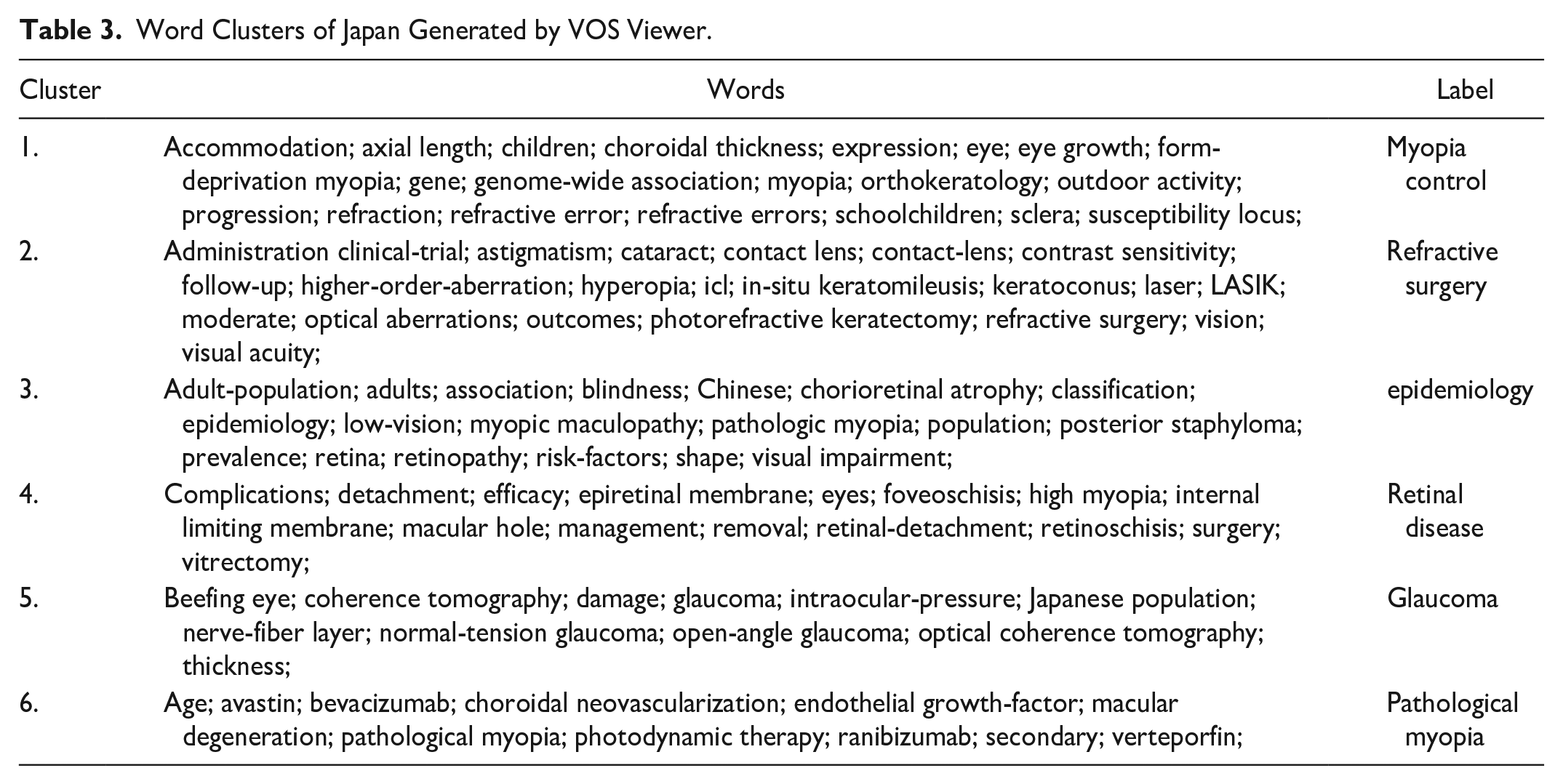
In Figure 2, co-occurrence networks of the 100 most frequent keywords are visualized. In China, clusters for refractive surgery, prevalence, child myopia, and glaucoma were formed (Table 2). The cluster related to child myopia is a characteristic of China. Japan has the greatest number of clusters among the 3 East Asian countries. A total of 6 clusters were formed in Japan: refractive surgery, epidemiology, retinal disease, glaucoma, and pathological myopia (Table 3). A total of 4 clusters were formed in South Korea: refractive surgery, epidemiology, glaucoma and retinal nerve, and glaucoma progression (Table 4). Glaucoma-related clusters were subdivided into 2 types: retinal nerve and progression.

Co-occurrence of the 100 most frequent keywords presented in network visualization: (a) China, (b) Japan, and (c) South Korea.
Word Clusters of China Generated by VOS Viewer.

Word Clusters of Japan Generated by VOS Viewer.
Word Clusters of South Korea Generated by VOS Viewer.

Discussion
The purpose of this study was to assess the contribution of authors from China, Japan, and South Korea to myopia research by analyzing articles published from 2001 to 2021 using bibliometric methods.
The annual number of articles was presented to show the volume of peer-reviewed articles in the field of myopia every year. In order to maintain a certain status of journal or field, not only the quality of research, but the number of articles published every year is important. 18 We found that researchers from China published the most articles on myopia indexed in the WOS during 2001 to 2021, followed by Japan and South Korea. In 2021, about 55% of all myopia-related articles were contributed by authors from East Asia, and 48% were from China. Over the past 20 years, both China and South Korea have shown an increase in the rate of article publication, but that of Japan has declined; though the number of articles from Japan increased, but the overall share decreased because the degree of increase was smaller than that of other countries. Particularly, articles published from China have been largely produced since 2018. This increased article production is believed to be derived from the “Healthy China 2030” owing to one of its core principles, the “scientific development” 24,25. It is expected that Chinese public officers and researchers would have responded to this strategy which leads to the more funding raise and the more research outcomes.
Interestingly, the annual number of articles and citations from China and South Korea showed an exponential increase during the past 20 years with strong positive correlation with GDP, whereas those from Japan did not (Figure 1). In both China and South Korea, GDP has steadily risen, and the number of myopia articles and their citations has increased. South Korea seems to be the most productive country with the largest increase in the number of articles and citations compared to GDP growth. Compared to China, Japan, and South Korea showed no clear trend, which is presumed to be due to Japan’s GDP fluctuating only within a certain range but maintaining the status quo without showing a consistent rise or decline.
Analyzing academic journals can provide information for which academic journals are mainly concentrated, and references for researchers to submit articles and which journals or articles they read. Of the 10 journals contributed by authors from China, Japan, and South Korea, 9 journals belong to the ophthalmology category and only 1 journal—PLOS ONE—belongs to the multidisciplinary category. Since most journals have a grade of Q2 or higher, the quality of articles published in 3 East Asian countries is relatively excellent.
In co-occurrence analysis, it was revealed that all 3 countries in East Asia has clusters related to refractive surgery, prevalence, and glaucoma, and that research on children’s myopia is particularly active in China, and in Japan. The 3 East Asian countries are countries that have a high incidence of glaucoma worldwide.26,27 As many articles have proved, myopia is a risk factor for glaucoma which has a very high prevalence in East Asia.28-30 Therefore, research on association of glaucoma with myopia, which may occur or worsen due to pathological myopia, is also being actively conducted within these regions. In addition, the prevalence of child myopia in China and Japan is also very high, and research on their risk factor, prevalence, and myopia progression has been actively performed. Compared to China and South Korea, Japan has the largest number of clusters, suggesting that Japan’s research on myopia is particularly subdivided and that research is being conducted in various aspects.
This study had some limitations. First, the research output with country was only associated based on author’s affiliation. If the country was not listed in the author’s affiliation in an article, those articles were not included. Second, the qualitative analysis was not performed. The co-occurrence network was based on the number of occurrences of the keywords which cannot represent hot spots itself. Third, the articles written in English was targeted which could be a language restriction. Despite these limitations, we believe that this study provided useful information and insight into research output in myopia from East Asia.
Conclusions
We believe that this study provides useful information and insight about research productivity and trends in the field of myopia from East Asia. The conclusions of this study can be summarized as follows: 1. The researchers from East Asia published more than half of articles on myopia from 2019, in order of China, Japan, and South Korea. 2. The annual number of articles and citations from China and South Korea showed an exponential increase with strong positive correlation with GDP. 3. Of the 10 journals contributed by authors from China, Japan, and South Korea, 9 journals belong to the ophthalmology category. 4. All 3 countries in East Asia are mainly researching refractive surgery, epidemiology, and glaucoma, and research on children’s myopia is particularly active in China, and in Japan.
Since these studies partially reflect the contribution and productivity of specific regions in myopia research, it is expected to provide useful information that can be referred to by national health policymakers, including researchers and health care workers in related fields. This study can be helpful for expanding the researchers’ understanding of myopia and provide insight about future research direction.
Supplemental Material
sj-docx-1-inq-10.1177_00469580231174333 – Supplemental material for A Bibliometric Analysis of Myopia Research in East Asia in the 21st Century: The Socio-Economic Status and Quantitative Analysis
Supplemental material, sj-docx-1-inq-10.1177_00469580231174333 for A Bibliometric Analysis of Myopia Research in East Asia in the 21st Century: The Socio-Economic Status and Quantitative Analysis by Jihye Ahn, Guenhei Kim and Moonsung Choi in INQUIRY: The Journal of Health Care Organization, Provision, and Financing
Footnotes
Declaration of Conflicting Interests
The author(s) declared no potential conflicts of interest with respect to the research, authorship, and/or publication of this article.
Funding
The author(s) disclosed receipt of the following financial support for the research, authorship, and/or publication of this article: This research was supported by Basic Science Research Program through the National Research Foundation of Korea (NRF) funded by the Ministry of Education (2022R1I1A2073387).
Ethical Statement
Our study did not require an ethical board approval because this study does not include animal or human study.

Supplemental Material
Supplemental material for this article is available online.
References
Supplementary Material
Please find the following supplemental material available below.
For Open Access articles published under a Creative Commons License, all supplemental material carries the same license as the article it is associated with.
For non-Open Access articles published, all supplemental material carries a non-exclusive license, and permission requests for re-use of supplemental material or any part of supplemental material shall be sent directly to the copyright owner as specified in the copyright notice associated with the article.
