




Abstract
The construction of weight values for the indicators of community aging-friendly construction is helpful to guide the formulation of strategies for allocating elderly resources in community aging-friendly constructions, and to reflect the shortcomings of community aging-friendly constructions and propose improvement strategies when evaluating the effectiveness of the existing community aging-friendly constructions. The paper uses the Fuzzy Analytic Hierarchy Process (FAHP) to calculate the weighting values of each indicator, consulting the government, industry, and academic experts. The research results show that the weighting-value order is “public environment (W = 0.364),” “health care (W = 0.342),” “humanistic care (W = 0.204)” and “social economy (W = 0.090).” Accordingly, the article proposes specific suggestions to improve the effectiveness of community aging-friendly constructions, including the need to find consensus among all parties involved in the aging industry, the need to focus on improving the public environment of the community, and the need to improve the socio-economic policies as soon as possible.
The weighting values of the indicators in the 4 sub-levels of the community’s aging-friendly construction are “public environment (W = 0.364)> health care (W = 0.342)> humanistic care (W = 0.204).>social economy (W = 0.090).”
The research results show that the public environment is the core element of a community’s aging-friendly construction, and social economy is an effective supplement, and we learned that some differences exist in the government, industry, and academia’s perceptions. Hence, it is necessary to find consensus among all parties to make the aging-friendly construction comprehensive and sustainable.
The results of our study have practical implications for the precise investment of senior care resources, the development of strategies to prioritize older adults’ needs, the objective evaluation of the effectiveness of the community’s aging-friendly construction, and proposing targeted improvement strategies.
Research Background and Objectives
With the development of its economy and the rise of its real estate industry, China’s community’s function is becoming more and more powerful. Therefore, in the 13th 5-year Plan for developing China’s aging cause, it is proposed to build a “home-based, supported by community and institutions” social older-adult care service system as soon as possible. The community home-based older-adult care model has gradually sprung up and developed into China’s most crucial older-adult care model. 1 Statistics show that China’s older-adult care is based mainly on the “9073” model, 90% of the older adults rely on community home-based for older-adult care. 2 Since 2011, led by the Ministry of Civil Affairs and the National Development and Reform Commission, the “Community’s Home-based Older-adult Care Service Plan” has been implemented all over the country, and many community older-adult care service facilities and older-adult activity centers have been established. Social security systems such as pension and medical insurance have gradually improved. The daily care services for the older adults have been significantly improved. 3 As an essential part of the older adults’ pension, the ultimate goal of a community’s home-based older-adult care service is to comprehensively improve the service supply at the levels of community humanistic care, public environment, health care, and social economy, therefore improving the quality of life and older-adult care satisfaction of the older adults. 4 Whether the community older-adult care services and the aging-friendly constructions match the older adults’ needs, and whether the older adults’ diversified care needs are effectively met, are the essential factors affecting the development of the community’s home-based older-adult care industry. 5 Although economic growth and the improvement of community service levels make it possible to meet older-adult care needs, the heterogeneous characteristics of older-adult groups will produce a diversified demand focus, and increase the complexity of demand identification. At the same time, the social background of rapid aging and “getting old before getting rich” also determines that due to the limitation of social pension resources, the pension needs of the older adults can not be fully met. The development of the community’s home-based older-adult care industry depends on the recognition and acceptance of the older-adult care model by the older adults. The current community home-based older-adult care service model generally has structural contradictions, such as a high supply rate versus a low utilization rate, single content versus diversified demand, and insufficient accuracy of demand identification versus repeated investment of resources. 6 Therefore, in order to completely distinguish the index factors for community’s aging-friendly construction, to determine the construction sequence’s priority according to the “importance” of different factors, and to accurately match the limited social pension resources with diversified pension services, whether in practical or academic level, it is necessary to study the index elements of China’s community’s aging-friendly construction and the importance of each index element under the community’s home-based older-adult care model.
The research objectives of this thesis are as follows:
By applying the FAHP method, complete the weighting allocation of each community’s aging index under the home-based older-adult care model. Construct the all-factor indexes that affect community’s aging-friendly construction into a progressive relationship, and evaluate the complex evaluation indexes and research objects. The stratified division clarifies the micro-level structure, which is conducive to guiding the input of community’s aging-friendly construction resources at the macro level and formulating priority strategies at the micro level.
Construct a complete set of evaluation weighting systems covering all elements of community’s aging-friendly construction that effectively assess the current status of community’s aging-friendly construction in existing communities or after renovation. Make qualitative and quantitative judgments on the community’s aging-friendly construction, and reflect on the current situation of aging communities or the shortcomings in their construction, creating effective contrast and promotion.
Research Theory and Literature Review
Research on the Construction of Aging-Friendly Construction Index System
In April 2002, the “Active Aging Index (AAI),” a policy framework to deal with aging in the 21st century, was officially put forward at the United Nations’ second world assembly on Aging. Active aging refers to prolonging the healthy life span and improving the quality of life of the older adults by optimizing the level of health, social participation, and security of the older adults, 7 This new policy theory has attracted attention worldwide and raised extensive discussions. In recent years, scholars in related fields in different regions of the world have started exploring indicators for the level of active aging based on the socioeconomic and cultural background of each area, and suggested many theories, such as the Healthy Aging Index (HAI), Productive Aging Index (PAI) and Successful Aging Index (SAI). Thailand is the first country to release the research and development results of quantitative measurement tools for active aging after the World Health Organization introduced the concept of “active aging.” Thanakwang believes that in addition to physical, cognitive, psychological, social and environmental factors and economic resources, positive aging is also affected by cultural factors, He developed an active aging index evaluation tool adapted to Thailand’s socioeconomic culture based on the World Health Organization (WHO)’s conceptual framework. 8 Bowling and Stafford surveyed the older adults over 65 on active aging and evaluated the influencing factors using an analytic hierarchy process, The results show that “maintaining good health and working”, “leisure and social activities”, “functions and activities”, and “social relations and contacts” are the most critical factors affecting the older adults’ active aging. 9 Lim and Thompson added the spiritual happiness index to the active aging index, and used a multiple regression model to test 120 Singaporeans of Chinese, Malay and Indian origin aged 55 to 64 and over 65, The results show that the AAI evaluation model cannot significantly predict the activity level of the older adults only by controlling age; but the accuracy is significantly improved by implanting spiritual happiness. Significant differences exist in the final evaluation of the AAI index among different ages and races. 10 Based on health, participation, and security, China’s active aging mainly includes development, harmony, and sharing. It can therefore build an all-round policy system including economy, culture, politics, social development, family relations, and social resources. 11 Liu and Yang used Charls and CGSS databases and learned from the EU active aging measurement framework. They used the analytic hierarchy process and DEA method to design China’s active aging index, measured the active aging index of China’s 28 provinces, and studied the development level of active aging at the regional, urban and rural, provincial and gender levels. 12
However, it is important to point out that, with the deepening research on gerontology and aging, the connotation of the concept of “older adults” has become the focus of academic research. Academics usually understand “older adults” in the context of “Aging,” and there are mainly 2 perspectives: “natural aging” and “social aging.” On the one hand, as biological individuals, older adults are “human beings” and have a biological continuum of natural aging 13 ; on the other hand, as a socially interacting entity, older adults will gradually be marginalized by society as their physical functions decline.14,15 “In this study, we follow the scholars mentioned above” opinions and consider people starting to enter the aging state as older adults by combining many factors such as living states, health condition, and living ability in addition to their ages.
Study on Indicators of Community’s Aging-Friendly Construction
Setting the family as the core and relying on the community and professional services as the foundation, the community’s home-based older-adult care makes full use of the community’s resources, which include community health service institutions, various older-adult care institutions, and community public service institutions. It provides social services to help solve older-adult care needs, including life care, medical care, spiritual care, and social pension services of one or more services such as culture, sports, and emergency assistance. 16 The community’s aging-friendly construction is the supportive and instrumental service obtained by the older adults from the community to ensure their care. The International Consensus on Establishing Long-Term Care Policies for the Older Adults issued by the WHO in 2000 pointed out: “based on the community, provide extensive preventive, remedial and developmental services for the older adults, and take independence, participation, care, and self-enrichment as the main objectives of long-term care policies for the older adults.” 17 In addition, the Global Report on Aging and Health proposed: “focusing on the health security, social attributes, economic rights and human rights development of the older adults, and the older adults should receive care, services and protection from the community.” 18 In foreign studies, a community’s aging-friendly construction is generally summarized as “1e3m”: environment, money, medical, and mental, It refers to the public environmental security at the “environment” level, material and economic security at the “money” level, health care security at the “medical” level and psychological care at the “mental” level. 19 Forder summarized the community’s older-adult care needs into 4 aspects: health, economy, residence, and society, and extended to multiple sub-items such as chronic disease management, health maintenance, economic resources, living environment, and psychological comfort. 20 Harrison et al divided the community’s aging-friendly construction in Australia from the general service needs of the community’s older adults, which includes 76 indicators such as housekeeping, care, personal affairs and mental health. 21 The pension system proposed by China’s academics since 1982, which includes “the older adults having a sense of security, medical care, learning, achievement, and happiness,” is the earliest standard used in China’s older-adult care policy and research field. 22 With the progress of the times and the development of society, especially the continuous improvement of the social pension security system and community environment, 4 primary and 9 secondary criteria have been developed based on the original pension system. The 4 primary ones are humanistic care, living environment, health care, and social economy. A community’s aging-friendly construction, with a total of 48 indicators, has become a common and recognized division method in academic circles in line with China’s current conditions. 23 The ultimate goal of the development of community home-based aging services is to improve the service supply in humanistic care, public environment, health care and socio-economic aspects of the community in a comprehensive manner, thus enhancing the quality of life and satisfaction of the older adults.24,25 Therefore, using “humanistic care, public environment, health care and social economy” as the dimensions of community aging construction is consistent with all the elements of community aging-friendly construction under the community home-based aging service model. It can meet the diversified needs of older adults living in communities. 26
Research on Related Theory and Application of FAHP
The Analytic Hierarchy Process (AHP) is a systematic evaluation method for multiple judgment bases and comprehensive decision-making under uncertainty, which was founded by Thomas Saaty, a famous American scholar, in 1971, It mathemationizes the evaluator’s complex thinking process. 27 The AHP requires that the judgment matrix among all levels must conform to the consistency test. To achieve matrix consistency, the matrix value needs to be adjusted and tested several times, affecting decision-making quality. The Fuzzy Analytic Hierarchy Process (FAHP) is an evaluation method developed based on the combination of fuzzy comprehensive evaluation and AHP. It helps to reduce or avoid the impact caused by the evaluator’s subjectivity, fuzziness, and uncertainty. It has been widely used in economic progress prediction, national industrial structure research, national defense and military research, energy policy analysis, scientific and technological achievement evaluation, and development strategy formulation. 28 When making decisions with the FAHP method, the following steps are mainly used:
The first step is to combine the multi-level evaluation model. When using FAHP to solve various evaluation problems, we should first decompose the complex system problems into several levels, and then classify the different influencing factors to build a multi-level evaluation model.
The second step is to construct the paired comparison matrix. After the hierarchical structure is built, the paired comparison between the indicators at each level must be carried out. Numbers 1 to 9 and their reciprocals are used as scales, to assign the relative importance between the indicators and construct the paired comparison matrix, as shown in formula (1).
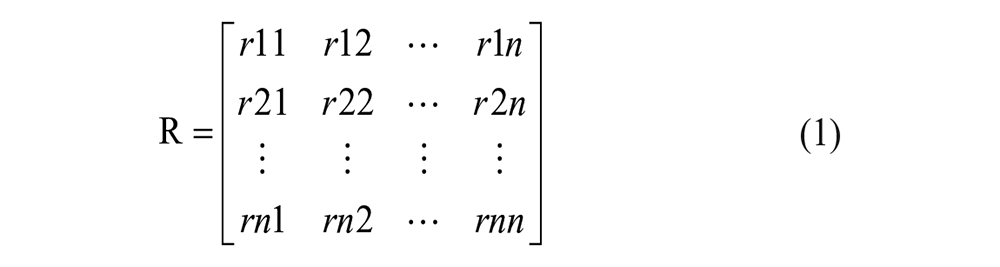
When using the FAHP method for group decision-making, Saaty suggests using “geometric average” to obtain group opinions 29 : if n experts participate in scoring, and their scoring values are x1, x2, x3 . . . xn respectively, the average value is calculated as formula (2):

The third step is to obtain the feature vector and check its consistency. According to the pairwise comparison matrix, the maximum feature vector of each index at the same level can be calculated as ω, which meet
Research Methods and Processes
This study aims to determine the weighting value of various indicators of a community’s aging-friendly construction under the community home-based older-adult care model, thus building a complete evaluation system of the community’s aging-friendly construction indicators. The research is divided into 2 stages. The first stage is the investigation of the FAHP expert questionnaire. Experts from 3 decision-making groups: professional academia, government management and community industry, will then score the relative importance of various indicators. It reflects the cognitive contrasts of different decision-making groups on the importance of a community’s aging-friendly construction indicators. The second stage is calculating the weight of the community’s aging-friendly construction indicators. A super decisions software is used to summarize and calculate the experts’ evaluation, reducing the subjective understanding of evaluators from different decision-making groups, and therefore building a comprehensive and appropriate weighting system for indicators.
The Super Decisions software was developed by Saaty and his research team, Creative Decisions Foundation. It is used to compute models with dependencies and provide decision feedback. It can run the FAHP. 30 The Super Decisions software allows decision-makers to quickly analyze the problem by comparing 2 factors to find the relative weightage of each factor in the overall structure, which saves more computing time and makes the decision-making process more efficient. 31
The First Stage: FAHP Expert Questionnaire Survey
Construction of evaluation system of community’s aging-friendly construction index
This study considers the critical elements of community’s aging-friendly construction from humanistic care, public environment, health care, and social economy. It is divided into 4 criteria levels, 9 sub-criteria levels, and 48 indicator levels, to build a complete CAFCIS. 32 See Table 1:
Index System of Community’s Aging-Friendly Construction.

Fuzzy analytic hierarchy process questionnaire design
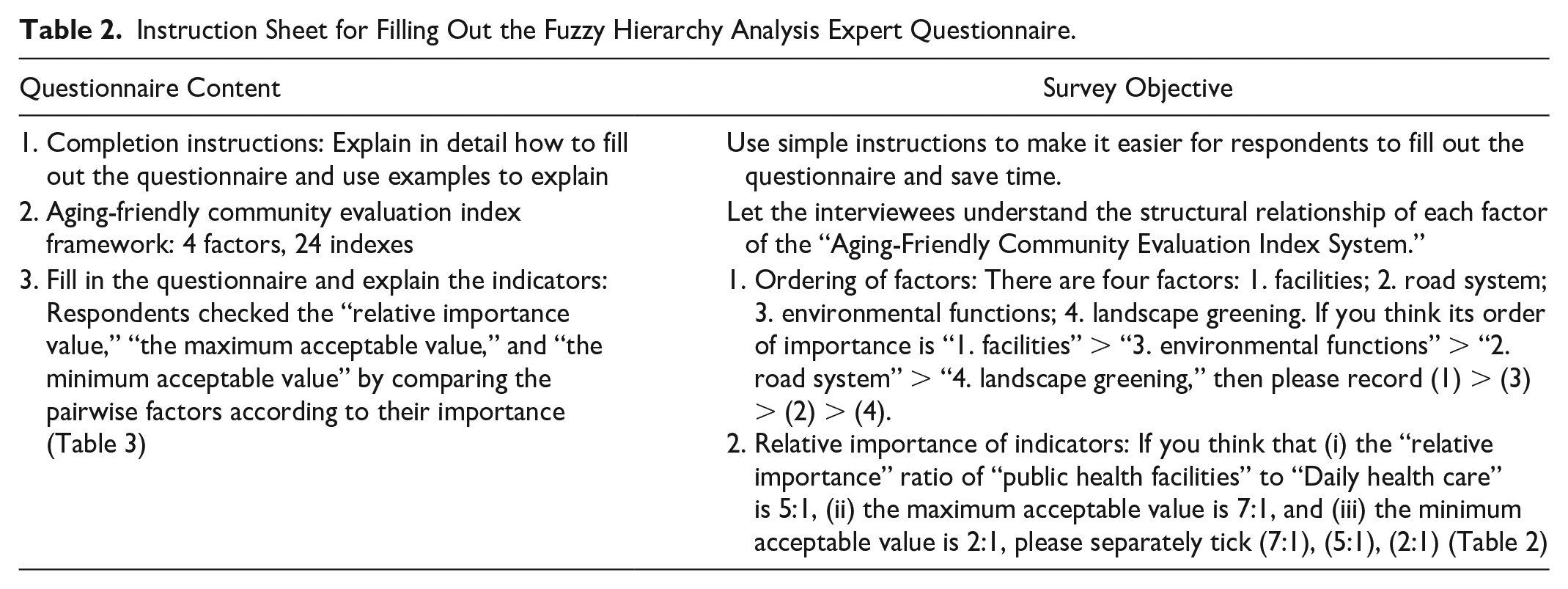
This stage aimed to understand the relationship between the evaluation indicators of the community public environment and aging. The evaluation index weighting of the aging-friendly community was calculated using a fuzzy hierarchy analysis expert questionnaire. With this evaluation method, a relative weight ratio was used, and “relatively important values,” “the maximum acceptable value,” and “the minimum acceptable value” were selected. The collected data were sorted, compared, and checked according to the relative importance of the indicators. The ratio was then subjectively determined based on the experts’ professional and academic experience. The instructions for filling out the fuzzy-level analysis expert questionnaire are listed in Table 2.
Instruction Sheet for Filling Out the Fuzzy Hierarchy Analysis Expert Questionnaire.
Example of Fuzzy Level Expert Analysis Questionnaire.


Selection of expert groups and distribution of questionnaires
In the part of expert group selection, this study believes that the scope of the index evaluation system is broad and complex. If only a particular category of experts was selected, the data obtained might be too biased and less credible. Therefore, this study believes that it is necessary to include the opinions of multiple expert groups. Based on the technical indicators of selecting experts based on “politics” and “analysis,” 33 Relevant experts and scholars from the community pension industry management, community pension research academia, and community planning and construction officials put forward valuable opinions on the expert scoring stage of this study to achieve accuracy. Dalkey believes that when the number of people is at least 10, the group error can be minimized, and the reliability is the highest. 34 Therefore, the research committee invited 16 experts and scholars to participate in the questionnaire group. The number of experts interviewed is 10 males and 6 females. Among them, there are 7 bachelors, 6 masters and 3 PhDs. The interviewees include professional academic research experts above the associate professor level, community industry workers with more than 15 years of employment, and experts from the Civil Affairs and Medical Insurance System departments with more than 20 years of experience. The questionnaire was distributed by e-mail and WeChat files on October 17, 2021. During the survey, online video communication was carried out through Tencent meetings and enterprise WeChat. A total of 16 questionnaires were distributed. The deadline was November 27, 2021. All questionnaires were recovered with a recovery rate of 100%.
The Second Stage: Calculation of the Community’s Aging-Friendly Construction Indicators’ Weighting Value
Expert fuzzy evaluation conversion
In this study, the expert fuzzy interval value conversion rule (Table 4) is used to calculate the geometric average of 16 experts through Microsoft Excel 2019 software. The vague average of each scale is calculated for expert fuzzy evaluation conversion. Then the Super Decision software is used to compare the total target layer, criterion layer, sub-criterion layer, and each index factor. Saaty and its research team jointly develop this Super Decisions software. With the software, decision-makers can quickly analyze problems, leaving more computing time. The decision-maker only needs to construct the relationship diagram of the problem, and does not need to clarify the type of matrix formed by the graph, making it more effective in calculation and selection. After comparing the importance of each factor, the relative weighting value of each factor in the whole structure can be obtained.
Expert Fuzzy Interval Value Conversion Rules.

Construct pairwise comparison matrix
This study calculates the weight value of the target layer, criterion layer, sub-criterion layer, and each index of the CAFCIS under the community home-based older-adult care model. It uses the Super Decisions software to check and solve it. Due to limited space and consistent operation, the following only takes the criterion layer of one of the expert questionnaires as an example to illustrate how to establish the results and paired comparison matrix. Under the general objective level of the CAFCIS, the experts check the “relative importance” of the 4 criteria level of humanistic care, public environment, health care, and social economy, as shown in Table 5 below:
Checklist of Relative Importance of Community’s Aging-Friendly Construction Index Level.

Input the “relative importance value” in Table 3 into super decisions software to get the questionnaire results, as shown in Figure 1:

Results of questionnaires at each criterion level.
The pairwise comparison matrix between the layers of the criteria under the overall objective is shown in Table 6
Pairwise comparison matrix table between benchmark layers.

Calculation of eigenvectors and consistency verification
After completing all the paired comparison matrices of a questionnaire, the verification of the characteristic vector and consistency of each paired comparison matrix in the “CAFCIS under the community home-based older-adult care mode” can be obtained by using super decisions software. The consistency ratio Cr is obtained by dividing the consistency index CI by the random consistency index RI, and its calculation formula is as follows:

As long as the consistency calculation result is less than or equal to 0.1, it is within the allowable error range. Otherwise, it will be regarded as an invalid questionnaire, or experts will adjust it again. With the help of Tencent conference and other network video methods, this study uses super decisions software to verify the data in real-time. When the consistency verification fails, experts will be informed to make corrections and adjustments. Therefore, the consistency ratio of the final 16 points questionnaire (CR ≤ 0.1) is within the acceptable range.
Research Results and Discussion
The CAFCIS constructed by this research emphasizes its construction effect evaluation ability and expresses its guiding value for the accurate construction of community aging. Therefore, based on indicators such as scientific, comprehensiveness, comparability, practicability, feasibility, and the opinions of experts from various fields, we can understand the criteria at all levels of community’s aging-friendly construction indicators and their relative weighting. Officials, industry and academia can thus use them to guide community construction and evaluate its effectiveness.
Research Results
Since the evaluation of the index system of community’s aging-friendly construction involves many disciplines, to ensure that the data obtained are complete, fair, and incorporate multiple expert opinions, the experts are divided into 3 types: professional academic, government management, and community industrial. The weighting values of various criteria and indicators of community’s aging-friendly construction are shown in Table 7:
Statistics of Weight Values of Community’s Aging-Friendly Construction Indicators.

Gp = Group of professional academic; Gg = Group of government management; Gc = Group of community industry; Go = Group of Overall opinion.
Research Discussion
First level (criterion level) evaluation facet analysis
The overall opinion (all samples) analysis results show that the “public environment (W = 0.364)” project is the most important, followed by the “health care (W = 0.342)” project. There is little difference between the weighting values of the 2 criteria. The results of this study verified He and Wei Ling-Hua and other scholars’ conclusions: improving the aging-friendly community environment, creating more and better leisure and interaction spaces, and creating a positive community atmosphere are the core priorities of a community’s aging-friendly construction. 35 In terms of the professional academic group, the “public environment (W = 0.423)” project is the most important, followed by the “health care (W = 0.346)” project. The government management group believes that the “humanistic care (W = 0.412)” project is the most important, followed by the “public environment (W = 0.291)” and “health care (W = 0.200)” projects. Community industry groups also believe that the “public environment (W = 0.374)” project is the most important, followed by “health care (W = 0.291)” and “humanistic care (W = 0.245).” Overall, “public environment” is the most crucial criterion considered by all 3 decision-making groups, and “social economy” is the least important. It shows that the social economy portion under the current community home-based older-adult care mode still needs to be strengthened. 36 The importance of the “humanistic care” project has a considerable cognitive difference among the 3 expert groups. Its importance is particularly affirmed by the government management group, which shows that strengthening the community’s aging-friendly construction can best obtain support from the local government management department. In organizing and guiding the construction of aging-friendly communities, government departments should include more “people-oriented” ideas, avoid utilitarianism, and reflect the warmth of social care. 37
The second level (sub-criterion level) evaluation facet analysis
In the aspect assessment of the second level, the overall opinion indicates that the more critical assessment items are “health management (W = 0.256),” “physical environment (W = 0.196),” and “community care (W = 0.153).” The 3 decision-making groups have a relatively consistent understanding of the importance of each evaluation item at the standard level. Professional and academic groups believe that the “physical environment (W = 0.264)” project is the most important, followed by “health management (W = 0.231)” and “community care (W = 0.117).” The government management group believes that the “community care (W = 0.309)” project is the most important, followed by the “health management (W = 0.160)” and “physical environment (W = 0.129)” projects. The community industry group believes that the “health management (W = 0.219)” project is the most important, followed by the “physical environment (W = 0.202)” and “community care (W = 0.184)” projects. Thus, it is clear that the community environment is the primary place for daily leisure, communication, interaction, and exercise activities of older adults, and that the community’s physical environment is one of the most critical factors influencing older adults’ activities and prosperous aging in place.38,39 Notably, the “daily life” project’s weightage is not high among the 3, indicating that the concept of emphasizing daily older-adult care service in community home-based older-adult care has not been paid attention to. 40 It is urgent to further promote the concept of older-adult daily care service and develop an appropriate supply model. At the same time, it is also worth noting that although the government management group pays more attention to the “social care” project, the weighting value given to the “social care” project by professional academic and industrial community groups is relatively low. It shows that while the government management department vigorously promoted the concept of actively using social resources to improve the community’s aging-friendly construction, it has not been recognized by academic and industrial circles. This also shows that the community’s function as a social resource platform still needs strengthening. 41
The third level (index level) evaluation facet analysis
The 3 expert groups have differences in the importance of each evaluation item in this dimension. The overall opinion shows that “installing emergency assistance systems (W = 0.090),” “renovating the buildings' aging facilities (W = 0.074),” and “providing regular medical checkups (W = 0.063)” are more critical at these levels. Professional and academic groups believe that “renovating the buildings’ aging facilities (W = 0.107)” is the most important, followed by “installing emergency assistance system (w = 0.080)” and “Providing community clinics (W = 0.077).” The government management group believes that “improving community services (W = 0.102)” is the most important, followed by “organizing community activities (W = 0.092)” and “installing emergency assistance systems (W = 0.056).” Community industry groups believe that “installing emergency assistance systems (W = 0.075)” is the most important, followed by “improving community services (W = 0.063)” and “renovating the buildings’ aging facilities (W = 0.059).” To conclude, “installing emergency assistance systems” and “renovating the buildings’ aging facilities” are unanimously recognized by the 3 decision-making groups. It shows that the core concepts of “safety” and “convenience” emphasized in the community’s aging-friendly construction have been jointly recognized by all in the community home-based older-adult care industry. 42 Similarly, when evaluating the importance of “improving community services,” there are significantly different results obtained from the 3 groups. It indicates that government and industry groups hope to prioritize improving the soft needs of community service, which is not recognized by the academic community due to the lack of connotation and evaluation standards. 43 Thus, it can be seen that in order to develop the home-based community older-adult service industry and build aging-friendly medical institutions, the government needs to accelerate the construction of barrier-free facilities to enhance the community environment through policy guidance and support,44,45 while also emphasize responsive, rational and standardized older-adult service provision.46,47
Through the above analysis, we can conclude the following. Government participants in community’s aging-friendly construction pay more attention to policy formulation and plan implementation. Professional and academic circles emphasize the importance of the public environment in a community’s aging-friendly construction, and attend more to the considerations related to their professional background. The industrial community pays more attention to pension needs in their own interests. These differences in cognition and needs can enable all participants in the community’s aging-friendly construction to reflect and think about the places where consensus needs to be sought, and also remind community industry practitioners to strengthen interaction and communication with academia and government management departments based on the common interests of community older-adult care industry.
Research Conclusions and Suggestions
The weightage of the community aging-friendly construction evaluation indexes constructed in this study can screen the importance of different index elements, to accurately match the limited social older-adult resources with diversified older-adult services, thus enhancing the effectiveness of community home-based aging services. The evaluation system of the community home-based aging model covers a broad and complex scope, and this study incorporates multiple expert opinions to improve its objectivity and comprehensiveness through cross-validation of the opinions from government, industry and academia to ensure more thorough and objective research conclusions.
The development of the community home-based older-adult care model and the construction of the true meaning of community’s aging-friendly construction should be a process established by the consensus of multiple groups. In order to improve the construction of aging-friendly communities and expand its coverage, establishing an effective and collaborative innovation mechanism should be encouraged from the levels of government, communities and individuals. The government should actively carry out top-level design, introduce related social resources, and provide policy guidance and financial support for the smooth implementation of community aging-friendly renovation. Communities should be a good platform, actively connecting with social older-adult care resources and providing diversified services. This study suggests that when counseling community aging-friendly constructions, the management departments and practitioners related to community home-based aging services should take the older-adult needs as the guide, and use the evaluation system constructed in this study to assist the government, society, community, and other relevant stakeholders to effectively screen and make decisions using the evaluation tools, to find the most relevant results. Through theoretical and empirical analysis, this study presents the following conclusions and suggestions:
Research Conclusion
The public environment is the core elements of community’s aging-friendly construction
Through the opinion analysis and systematic practical operation of 3 decision-making groups: government directors, professional academics, and community pension industry experts, this study proposes a comprehensive weighting system of community’s aging-friendly construction indicators. The results show that among the 4 criteria levels, the weighting value of “public environment (W = 0.364)” is the highest, followed by “health care (W = 0.342),” “humanistic care (W = 0.204)” and “social economy (W = 0.090).” It shows that the construction of the public environment and the improvement of the health and medical system are still the core content of community’s aging-friendly construction under the development of the community home-based older-adult care model. At the same time, from the weighting value of “humanistic care,” it can be seen that the older adults’ pension needs have gradually changed from “physical” to “spiritual,” and from “survival” to “development,” which has been widely recognized by the society. 48 The social economy’s weighting value is relatively low, limited by the lack of social pension resources and pension funds. Currently, the community’s social and economic pension services, such as housekeeping services, life care, intermediary assistance, and canteen for the older adults, are not free of charge. It leads to low recognition in the social and economic aspects. Therefore, enriching social pension resources and improving social pension security are urgent problems to be solved in the future development of community home-based older-adult care model and the community’s aging-friendly construction. 49
Consensus of all parties must be required to build a comprehensively suitable community’s aging-friendly construction
Through the analysis of 3 decision-making groups on the community’s aging-friendly construction index weighting system, this study also finds similarities and differences in the groups’ opinions. Regarding the first-level evaluation, “public environment” and “health care” are the critical dimensions jointly considered by the 3 groups. Still, there are significant cognitive differences among the 3 groups regarding the importance of “humanistic care.” Regarding the second-level evaluation, the groups tend to be consistent. The importance of “social care” has been affirmed by the government management group. Still, it seems to be relatively ignored by the industrial community group, which shows that the community function advocated by the government, as a platform for older-adult care and social pension resources, still needs to be strengthened at the operation level. Regarding the third-level evaluation, “improving community service” has been valued by government management and community industry groups. Still, the academic community does not seem to agree, indicating that the government wants the community to provide community services and soft-need care for the older adults, which the academic community has not recognized due to the lack of construction standards and effect evaluation. 50 The cognitive differences of these decision-making groups show that there are still many areas to seek consensus in the construction of community aging adaptation.
Improving the social security level for older adults is the key to the construction of aging-friendly communities
The weightage of “social economy” is relatively low. It is caused by the lack of social older-adult resources and the shortage of older-adult funds. Current services provided by the community, such as home care, life care, intermediary help and older-adult canteen, are not free of charge, leading to the low recognition of the social economy component in the community aging-friendly construction. Therefore, enriching older adults’ social resources and improving their social security level is critical in developing the community’s home-based aging model and improving the community’s aging-friendly constructions. 4
Research Recommendations
Review and suggestions on research methods
This study attempts to construct a comprehensive evaluation system of community’s aging-friendly construction indicators. Yet, the research and formulation of any evaluation system will inevitably encounter generality and particularity. This study attempts to consider general and individual needs and hopes to construct a comprehensive evaluation system that can reflect the situation of community’s aging-friendly construction through the FAHP expert questionnaire survey of government, school, industry and other community’s aging-friendly construction participants. However, establishing a community’s aging-friendly construction index evaluation system is a dynamic interactive process that needs to constantly rely on the joint participation of the community’s aging-friendly construction’s decision-makers and the community’s older adults for feedback and correction. Limited by research resources, research methods and the survey sample number, this study is only a preliminary study. More detailed investigation and analysis are needed for feedback correction.
Recommendations for follow-up studies
This study has preliminarily constructed the evaluation weighting system of the community’s aging-friendly construction index. Future research directions are based on this foundation. After that, we will score and quantify the index elements in the index system, construct a community’s aging-friendly construction index evaluation scale, and select specific community examples for confirmatory analysis and quantitative evaluation of community’s aging-friendly construction. On the one hand, it can provide a macro-level construction strategy and a micro-level priority satisfaction strategy for the community’s aging-friendly construction that has not been upgraded. On the other hand, it can evaluate the construction effectiveness of the updated community’s aging-friendly construction, identify the shortcomings of specific indicators’ construction, and propose targeted rectification suggestions to bring in practical significance.
Research Limitations
The main limitations of this study are the following 2. The first is that it uses the FAHP method to construct an assessment system of community aging-friendly construction. It is objective and rational; however, the weightage of each overall assessment index is determined by the consensus among experts, and there are significant differences in the perceptions of the importance of each index by different expert groups. Due to the limitations of the research method and time, the results may be limited in terms of research scope and general inference. Secondly, this paper focuses on exploring and grasping the needs of older adults in general. However, at the individual level, their situation has a great deal of complexity and variability. In particular, there are different levels of intersection between age, disability, and residential status, and the corresponding needs may change. This paper does not analyze the specific needs of older-adult groups.
Footnotes
Author Contributions
“Conceptualization, Wen-Bing Mei, Kun Li. and Yi-zhe Huang.; methodology, Wen-Bing Mei, Kun Li. and Yi-zhe Huang.; software, Kun Li, Wen-Bing Mei.; validation, Wen-Bing Mei, Kun Li. and Yi-zhe Huang.; formal analysis, Wen-Bing Mei, Yi-zhe Huang.; investigation, Kun Li, Wen-Bing Mei.; resources, Kun Li, Wen-Bing Mei.; data curation, Wen-Bing Mei, Kun Li. and Yi-zhe Huang.; writing—original draft preparation, Wen-Bing Mei, Kun Li.; writing—review and editing, Wen-Bing Mei. and Yi-zhe Huang.; funding acquisition, Kun Li, Wen-Bing Mei. All authors have read and agreed to the published version of the manuscript.”
Declaration of Conflicting Interests
The author(s) declared no potential conflicts of interest with respect to the research, authorship, and/or publication of this article.
Funding
The author(s) disclosed receipt of the following financial support for the research, authorship, and/or publication of this article: “This research was funded by 2021 Guangdong Philosophy and Social Science Planning Project, grant number GD21CYS28.”
Ethics and Consent statements
Our study does not require the approval of the ethics committee, because this study mainly focuses on the calculation of the weight of community aging construction indicators under the community home-based care model, and does not involve ethical issues.
Informed Consent Statement
Informed consent was obtained from all subjects involved in the study.
