




Abstract
Do factors impacting life satisfaction remain stable, or do they change, during the life course of workers? This study analyses the relationships between life satisfaction and age. This study is a secondary analysis of data from ENETS a health and working conditions survey. Workers were grouped into 5 age ranges. A scale of life satisfaction was analyzed, investigating aspects such as income, level of debt, physical and mental health, among others. The confirmatory factor analysis (CFA) showed that 4 of the 5 age ranges have a unifactorial structure, but for those under 30 years of age, 2 factors associated with “psychophysical well-being” and “material well-being” were identified. Thus, at different stages of productive life different priorities affect life satisfaction, this should be considered to optimize the human resources management.
One of the changes that constitutes a relevant challenge for companies is the progressive aging of the active population, which implies attending to the needs of people at different stages of their lives.
This study contributes to the field of human resources by highlighting the aging processes of workers as a variable to be considered in the actions that companies generate to promote the wellbeing of their workers.
People management policies should consider general strategies for workers of all ages based on mental and emotional well-being as a cross-sectional variable to promote satisfaction with life. In addition, companies should develop specific strategies for younger workers focused on money and debt management.
Introduction
Companies must overcome multiple challenges on their way to becoming healthy organizations. As Carrión 1 points out, healthy organizations are distinguished by “actively managing the health promotion of their personnel, maintaining their physical, mental and social well-being at the highest level” (p. 1). In the field of health promotion at work, organizations deal with many changes and transformations. The existing diversity within companies and institutions is expressed in a wide range of demands for management, since people with different religions, languages, cultures, sex, functional diversity, etc. work there together.
One of the changes constituting a relevant challenge is the progressive aging of the working population, which entails dealing with the needs of people on different stages of their lives. Thus, the question is, how to build opportunities for healthy aging from the perspective of employment, an area of knowledge that has already developed in Europe for some years but is still incipient in Latin America. The case of Chile offers an attractive study opportunity: with a population of approximately 17 574 003 according to data from the last Census, 2 Chile is in an advanced stage of changes in the structure of its population. 3
The aging of the population, a phenomenon already well established in the developed world, is now observed with greater force in developing countries and in our country. By 2050, 1 out of every 4 people in Chile will be 60 or older.4,5 The scenario in the labor field is especially complex, since this group will probably face a longer working life, due to the extension of the retirement age. 6 In this regard, we can cite data from the Zoom to Work Survey 7 in which, when asked at what age they would like to retire, 52% said they would like to do so at less than 60 years of age. However, in Chile the retirement age for men is 65 years and for women 60 years and people extend their working life several years beyond the legal retirement age.
Age and Sustainable Work
The consequences of getting older and continuing to work into old age are diverse. Aging is characterized by a set of structural and functional changes that arise as age increases, producing, among other things, changes in physical ability and psychological disposition of the subject, with various consequences in the workplace.8-10 Evidence shows that older workers generally have better safety performance, with lower accident rates in some productive sectors, yet these workers are at greater risk of fatal accidents and take longer to recover from serious accidents.11-13
A review of the evidence-based literature supports a productive aging framework for the workforce including the following elements: (1) having a life-course perspective; (2) considering comprehensive and integrated approaches to occupational safety and health; (3) emphasizing positive outcomes for workers and organizations; and 4) encouraging a supportive work culture for multigenerational issues. 14 With respect to the concept of “life course perspective,” the literature in aging and work describes an idea very useful for designing proposals for monitoring or surveillance of both working conditions and employment up to advanced ages: sustainable work. Docherty et al 15 developed a pioneering study contrasting “sustainable work systems” with “labor-intensive systems.” Sustainable work would be work that involves working conditions that, over the course of a lifetime, allow people to extend their activity into old age with relatively preserved health. Intensive work, on the other hand, due to its wear and tear characteristics (use of time, demands, etc.) in the long term will have detrimental effects both on individuals and on the quality of products and services.
Regarding the formulation of public policies in this area, the European Foundation for the Improvement of Living and Working Conditions16-18 develops the idea of sustainable work in various studies and in its proposal for monitoring the aging workforce. From a life course perspective, the concepts of sustainable work and life cycle approach,17,18 should provide an integrated approach to assist policy makers in improving both employment and working conditions for all, considering both the individual changes that may occur with aging and the implications of such changes for safety and health in the workplace. 19
From a Business Perspective, a Key Concept is Age Management
Age management (AM) involves the consideration of “age-related factors in day-to-day management, including the organization of work and the various tasks, so that all people, regardless of age, feel empowered to meet [their] personal and business goals”(p. 2). 20 The 8 objectives of age management proposed by Ilmarinen on aging and work are the following: (i) Increased awareness of aging; (ii) Adopting fair attitudes toward aging; (iii) Consideration of the AM as a fundamental task and obligation of managers and supervisors; (iv) Inclusion of the AM in the human resources policy; (v) Promotion of work capacity and productivity; (vi) Lifelong learning; (vii) Implementation of age-sensitive work schemes; and (viii) Safe and dignified transition to retirement.
Eurofound 16 points out that managing age does not only mean focusing on what happens to older people, but on the whole of working life and on every age groups. At the same time, it stresses that a holistic approach must be taken encompassing all the dimensions contributing to effective age management. The age management policies of organizations fall within the framework of ‘Diversity Management’. Diversity has a number of benefits, including improvements in staff motivation, organizational performance, attracting a wide range of talented staff, stimulation of creative thinking, enhancing corporate reputation, and lowering absenteeism. 21
The Evaluation of Quality of Life in the Working Population in Chile: National Survey of Employment, Working, Health, and Quality of Life Conditions (ENETS)
In Chile, the Ministry of Health led a project to collect information from employed and unemployed workers in the country regarding contractual relations, the conditions in which they work daily, and variables related to their health and well-being. It was carried out between 2009 and 2011. The central axis of analysis was health inequality, trying to visualize how inequalities impact workers health and quality of life. The survey was population-based, with a sample stratified by geographical region and by urban or rural sector. 22
The ENETS Survey included 8 modules, evaluating various aspects of workers’ lives. One of them addressed Quality of Life and Health, with a total of 129 questions. Quality of life was conceptualized in a multidimensional manner, including access to material resources, but also the degree of belonging to society. This multidimensionality included physical well-being, material well-being, social well-being (social support, participation, and inclusion), and emotional well-being.
The main objective of our study was to illustrate how health and public policy research can inform the creation of proposals for healthy organizations. The study relied on a secondary analysis of data on subjective well-being, aging, and work in a population survey in Chile.
Material and Method
Overview
This work consists of a secondary data analysis of the National Survey of Employment, Working, Health and Quality of Life Conditions (ENETS). The survey was carried out between 2009 and 2011. This survey has not been carried out again, so there are no updated versions of the data at the national level.
Sample
Data were taken from the ENETS survey. The survey considered the nation’s population over 15 years of age as employed on the date of the survey, plus the unemployed population that had been working in the last 12 months, residing in urban and rural areas. The sampling design was probabilistic, multistage, stratified both geographically and by population size in urban and rural areas (N = 9503). For the purposes of this study, only workers who were occupied on the date of the survey were selected, corresponding to n = 8354.
We used the Chilean Government’s National Institute of Statistics (INE) definition of occupation. It considers persons aged 15 or over who, during the week of reference to this survey, is in the following condition:
- Worked for 1 h or more as an employee or worker for remuneration (whether salary, wages, commission, payment in kind, etc.) or as an employer or self-employed, for profit or gain, such as: farmers, traders, self-employed, and other professional workers, or as an unpaid family member working 15 h or more normally per week.
- Had a job (or business), but did not work in the reference week, was temporarily absent from work, on vacation, on short term illness, leave or other reason.
The composition of the sample was 64.6% men and 35.4% women, living mostly in urban areas (82.4%). The average age was 43.97 (SD 13.36) for men and 42.02 (SD 12.33) for women. People were grouped into 5 age ranges: under 30, 31 to 40, 41 to 50, 51 to 60 years, and 61 and over. Table 1 shows the percentages of participants by gender and age group.
Descriptive Statistics of the Sample.

Instruments
The ENETS survey includes 8 modules assessing various aspects of workers’ lives. One of the modules deals with Quality of Life and Health, with a total of 129 questions. From this section, the Satisfaction with some aspects of life scale with 11 questions was used.
Satisfaction with some aspects of life scale
This scale is based on various survey questions on the subject, similar but not identical to the instrument designed by the WHOQOL Group,23,24 but there are no specific psychometric studies in our country that can be pointed out as a reference.
Operational definition of the concept of Satisfaction with different aspects of life: this refers to the degree to which the person declares to be satisfied with the overall situation of different aspects of his or her life. It includes privacy, amount of money, level of indebtedness and work; relationship and family life and entertainment; physical and mental condition.22,25 The items are Likert type responses, from 1 to 7 (Very Bad to Very Good). The items of the scale are shown in Table 1.
Procedure
First, the descriptions of the items of the Satisfaction scale with different aspects of life with the total sample were analyzed. As a result of the descriptive analysis, 2 items were discarded because they had too many missing data: D1e (partner = 15.9% missing cases) and D1i (sex life = 14.0% missing cases). The cases corresponding to each of the age ranges were then selected. In each range a sample of 30% (Exploratory Factor Analysis—EFA) and 70% (Confirmatory Factor Analysis—CFA) was extracted. A Pearson correlation analysis was performed for the 11 items of Satisfaction with different aspects of life. Then an exploratory factorial analysis of the scale was carried out to test the psychometric goodness of the items, for the total sample and each one of the age ranges, with a method of Maximum Likelihood and Varimax Rotation extraction. Afterward, a confirmatory factorial analysis was carried out. IBM Statistical Package for the Social Sciences (SPSS) 21.0 software was used for data analysis.
Results
Table 2 presents the descriptive statistics for each item of the satisfaction scale with different aspects of life. The lowest average in the variables studied is for D1b. How do you feel about the amount of money coming into the household? (M = 4.53; SD = 1536) and the highest is for D1g. How do you feel about family life? (M = 5.89; SD = 0.897) and D1j. How do you feel about your life in general? (M = 5.80; SD = 0.892).
Descriptive Scale of Satisfaction With Different Aspects of Life.

Table 3 shows the matrix of correlations between the different items of the Scale and age. The correlation coefficients between the items are all significant (P < .01), with effect sizes ranging from .172 to .696, which could be considered moderate to high. 26 The highest correlation is observed between the items “D1d. How do you feel about your mental or emotional well-being?” and “D1j. How do you feel about your life in general?” (r = .540; P < .01), with the lowest being between “D1k How do you feel about your level of debt” and “D1i How do you feel about your sex life.” (r = .128; P < .01).
Matrix of Correlations of the Satisfaction Scale With Different Aspects of Life and Age.

Note. Statistical significance *P < .05. **P < .01 level.
On the other hand, the correlations with age are almost all significant. Age shows a positive gradient with privacy and an inverse relationship with almost all other variables: physical condition, fun, and sex life show the most important negative gradients.
Exploratory Factor Analysis (EFA)
Exploratory factor analysis, or EFA, is used to try and discover the internal structure of a certain number of variables. The a priori hypothesis is that there may be a series of factors associated with these variables. The loads of the different factors are used to intuit the relationship of these with the different variables. 27
Considering the importance of age for this study, a first EFA was carried out with the whole sample and later an EFA by age ranges, namely: under 30, 31 to 40, 41 to 50, 51 to 60, and over 60 years.
It was possible to confirm very low community values for the variable D1a “How do you feel about the privacy you have where you live” in all ranges, so it was excluded from subsequent analyses. Also, the variable D1k. “How do you feel about your level of indebtedness?” showed very low values of communality for the total sample and all age ranges, except for the under-30s, thus this variable was excluded from the analysis. Also, the variable D1g. “How do you feel about family life?” showed low communality in the under-30 age range, so it was excluded from that specific analysis. The variable D1j “How do you feel about your life in general” was excluded for theoretical reasons, since it is considered redundant.
Considering that the Kaiser-Meyer-Olkin Measure of sampling adequacy in this case yielded an adequate value (KMO = 0.825) and that the Bartlett Sphericity Test is significant, (χ 2 (15) = 3795.221; P < .001), an EFA was performed for the total sample with the Varimax maximum likelihood and rotation extraction method, which revealed the presence of a single factor that explained 39.43% of the total variance. Table 4 shows the factor loads for each item on the Satisfaction Scale factor with some aspects of life having greater weight.
Summary of Factorial Analysis SPSS Satisfaction Scale With Some Aspects of Life, Total Sample (N = 8354).

Note. 1 factors extracted. 4 iterations required.
In the case of the total sample, the items with the greatest weight are mental or emotional well-being and physical condition.
The same procedure was followed for each of the age ranges, which allowed us to observe that both in the total sample and the rest of the ranges except one, there is only one factor that explains in general about 40% of the variance explained. The exception is the case of those under 30 years of age, in which an orthogonal structure of 2 factors is observed, which respond to aspects of physical/emotional well-being, on the one hand, and aspects of material well-being, on the other.
For the total sample the most important factorial loads are mental or emotional well-being, physical condition, and amount of fun in life. In the rest of the age ranges the aspects that are most repeated in the first places are mental and emotional well-being, physical condition, and work.
To check this structure observed in the exploratory factor analysis, a confirmatory factor analysis was performed.
Confirmatory Factor Analysis (CFA)
Confirmatory factor analysis (CFA) tries to determine if the number of factors obtained, and their loads correspond to those that would be expected in light of the theory. The a priori hypothesis is that there are pre-established factors and that each of them is associated with a certain subset of the variables. Confirmatory factor analysis yields a level of confidence to accept or reject this hypothesis. 27
The confirmatory factor analysis that was carried out allowed the comparison of the total sample and the 5 age ranges under study with the same procedure. Since there are some missing data, the IBM SPSS 21.0 software was instructed to estimate the means of the items. Each model was reviewed with the following adjustment indexes: Chi Square (CMIN/DF) with values less than 5; Comparative Fit Index of Bentler (CFI) with values >0.90, and Root Mean Square Error of Approximation (RMSEA) that accepts values between 0.05 and 0.08. 26 A confirmatory factor analysis was developed for the total sample and for each of the age ranges under study.
Total Sample
In the total sample model (see Figure 1), the values of the adjustment indexes were: CMIN/DF = 14.763; CFI = 0.990; and RMSEA = 0.048; the factorial loads are in a range of 0.48 to 0.77. These values are adequate according to the scientific literature. 26 Therefore, the model proposed in Figure 1 is accepted.

Total sample model.
There is an underlying factor that groups the 6 variables together. The greatest weights are represented by mental-emotional well-being and physical condition.
In this case (total sample) they would co-vary:
- Amount of money coming into the household and how it feels about its work: in this case, both variables constitute a certain measure of material well-being that have an evident structural relationship.
- Family life with both fun and work: these variables, put in relation, somehow allude to the concept of “reconciliation of work and family.”
Under 30 Years of Age
In the model of the under 30 range (see Figure 2) it is observed that the values of the adjustment indexes were: CMIN/DF = 2.497; CFI = 0.992, and RMSEA = 0.037; the factorial loads are in a range of 0.53 to 0.72. These values are adequate according to the scientific literature. 26 Therefore, the model proposed in Figure 2 is accepted.

Under-30s range model.
In this range there is not one underlying factor, but 2 separate factors that are highly correlated. In this case (under 30 years old) the factors are: aspects of “psychophysical well-being” (physical condition, mental well-being and fun and aspects of “material well-being” (money, debt, work).
- Regarding the “psychophysical well-being” factor, the mental-emotional aspect and the fun show a very similar weight. The physical condition co-varies with the mental-emotional aspect.
- With respect to the “material well-being” factor, money is the aspect with the greatest weight. In this age range, debt is part of this specific factor.
Range Between 31 and 40 Years Old
In the model of the 31 to 40-year age range (see Figure 3) it is observed that the values of the adjustment indexes were: CMIN/DF = 2.536; CFI = 0.994, and RMSEA = 0.034; the factorial loads are in the range of 0.50 to 0.67. These values are adequate according to the scientific literature. 26 Therefore, the model proposed in Figure 3 is accepted.

Model age range 31 to 40 years old.
There is an underlying factor that groups the 6 variables together. The greatest weight in this case of the so-called “young adults” is given to fun, followed by mental-emotional well-being, with a very similar value. In this case (range of 31-40 years old) they would co-vary:
- Physical condition and mental emotional well-being, as in the range of the youngest.
- Amount of money entering the home with work, aspects that have a natural relationship from the material perspective.
Range of 41 to 50
In the model for the 41 to 50 age range (see Figure 4), the values of the adjustment indexes were: CMIN/DF = 4.724; CFI = 0.990, and RMSEA = 0.048; the factorial loads are in the range of 0.50 to 0.77. These values are adequate according to the scientific literature. 26 Therefore, the model proposed in Figure 4 is accepted

Model age range 41 to 50 years old.
A fitting model can be observed in which there is an underlying factor that groups the 6 variables. The greatest weight for this range is represented by mental-emotional well-being and physical condition. In this case they co-vary:
- Amount of money coming into the household with work: a relationship that is understandable particularly in this phase of life which usually coincides with a key stage in a person’s career development.
- Amount of fun with both family life and money: this stage entails important concrete material demands (children’s education, expenses associated with housing, to mention a few); fun can be both facilitated and restricted by the amount of money entering the household.
Range From 51 to 60 Years Old
In the model of the 51 to 60 age range (see Figure 5), it is observed that the values of the adjustment indexes were: CMIN/DF = 3.972; CFI = 0.989; and RMSEA = 0.050; the factorial loads are in the range of 0.50 to 0.77. These values are adequate according to the scientific literature. 26 Therefore, the model proposed in Figure 5 is accepted.
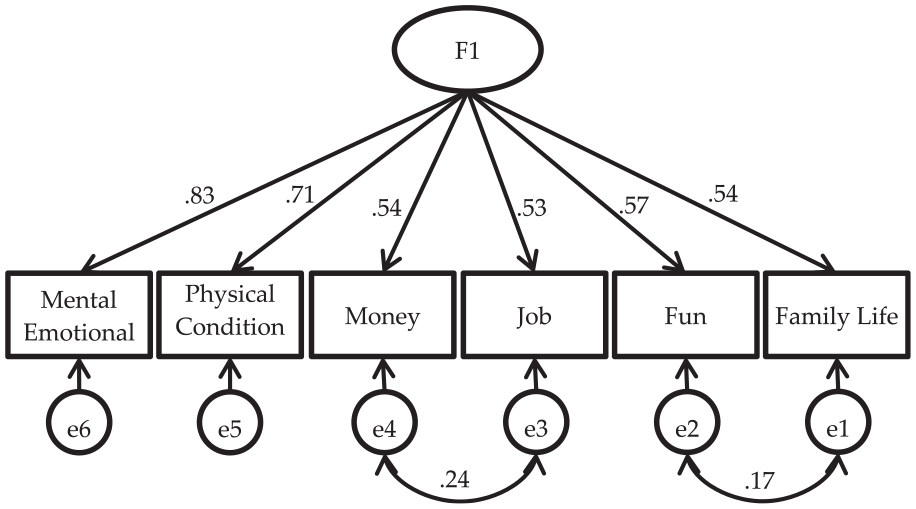
Model age range 51 to 60 years old.
A fitting model can be observed in which there is an underlying factor that groups the 6 variables. The mental-emotional well-being and the physical condition are the aspects of greater weight, with the other aspects having practically similar weight. In this case (range of 51-60 years old) they would co-vary:
- Amount of money coming into the household with Work: as has been documented in previous age ranges, these aspects are naturally very related.
- Amount of fun with family life: this stage, in many cases, is associated with the growth of the family due to the presence of grandchildren, which could be behind this relationship.
Over 61 Years Old
In the model of the age range over 61 years (see Figure 6) it is observed that the values of the adjustment indexes were: CMIN/DF = 1.614; CFI = 0.996; and RMSEA = 0.032; the factorial loads are in a range of 0.44 to 0.74. These values are adequate according to the scientific literature. 26 Therefore, the model proposed in Figure 6 is accepted.

Over 61 model.
As seen, there is an underlying factor that groups the 6 variables together. In this section, physical condition is the most important aspect, followed by mental-emotional well-being. In this case (Over 61 years old) they would co-vary:
- Fun with money: this is a stage in which clearly the material dimension (in the sense of income) can facilitate or restrict the possibilities of access to fun.
- Amount of fun and family life: as in the previous stage, the growth of the family due to the presence of grandchildren could play a role in the observed relationship.
- Working with family life: people in this stage of life are in the final phase of their working lives, this clearly can affect satisfaction with family life.
Discussions
Workers Age as a Relevant Dimension for Healthy Organizations
Age management with a life course perspective in healthy organizations
The specification of co-variances in each age range allows us to posit hypotheses concerning how subjective well-being is experienced according to age, which could be addressed in the future: factors affecting life satisfaction differs in people starting their working life from those finishing it. Therefore, a management of people aligned with a perspective of healthy organizations that incorporates age as a variable should consider different adjustments and emphasis for the diverse age groups within companies. Following authors such as Fabisiak and Prokurat, 28 age management should consider all age ranges and not only older people. In this sense, it is likely that flexible and non-standardized “health and well-being promotion” policies should be built for all workers.
For all age ranges, the most important aspect is mental and emotional well-being, which suggests that it should be considered as a universal variable in the construction of measures that, from the company or organization, aim to promote a better perception of satisfaction with life in their workers. 29
In the case of the youngest people in the companies—those under 30 years of age—policies should aim at both psychophysical and material well-being, the debt level,30,31 being one of the main disruptors of satisfaction with material well-being. A program with an effective age management approach could, perhaps, incorporate workshops directed to this age group on money management and/or debt management.
The 31 to 40 age range has a different situation, since “having fun” aspect plays a very important role in the perceived satisfaction. That is why a formulation of measures for this group should consider this element, promoting “playful experiences” in the company, for instance outdoors activities, sports or entertaining workshops (eg, the offering of cooking courses).
Finally, for those between the ages of 41 and 50 and between 51 and 60, the priority elements in life satisfaction are the same: emotional mental well-being and physical condition. Thus they could be considered as a relatively homogeneous group from the perspective of age management.
Study limitations
This study was developed based on analysis of secondary data from a survey that has been carried out only once in Chile, some years ago. It is unknown the extent to which the data used are still valid nowadays. It is also unknown the impact of COVID 2019 on the perceptions of work-related life satisfaction in Chile.
Although the methodological design of the ENETS survey was probabilistic, multistage, and stratified, we do not have precise data on the power of the sample size, which can be considered a limitation of the study.
The results found in the group of young people could respond to the case of societies in which their university systems are paid (as is the Chilean situation), generating high levels of youth bank indebtedness. Therefore, it would be interesting to carry out comparative research for this group in other countries with both contexts (payment and non-payment).
Conclusions
Are There Differences in the Perception of Satisfaction With Aspects of Life According to Life Stage?
This study has sought to advance knowledge about the subjective well-being of workers in Chile based on the analysis of the ENETS, the only survey on working conditions and health carried out to date by the Ministry of Health.
The confirmatory factor analysis allowed ratifying the existence of different models at the base of the Satisfaction subscale with different aspects of life of the ENETS Quality of Life Module that adjust for the different age ranges. A unifactorial structure could be identified for 4 of the 5 age ranges. However, 2 factors were identified for the under-30 range, one related to “psycho-physical well-being” and the other to “material well-being.” In other words, at different stages of productive life there would be different priorities when evaluating life satisfaction.29,32
The study of diversity, and particularly what refers to age constitutes an emerging field of research, which can feed the theory and management of organizations, contributing to the development of increasingly healthy organizations.
Footnotes
Acknowledgements
We are indebted to Dr. Eugenio Rodríguez for his insightful comments on the previous versions of the manuscript.
Author Note
This study is a secondary analysis of data from the National Employment, Work and Health Survey. According to the internal regulations of the institution where this research was conducted, this type of study is not subject to ethical evaluation and does not require informed consent from the participants. Nora Gray-Gariazzo is also affiliated to Universidad Viña del Mar, Viña del Mar, Chile.
Author Contributions
Conceptualization, NGG, GMZ, and MAB; methodology, NGG, GMZ, and MAB; formal analysis, NGG, GMZ, and MAB; investigation, and data curation, NGG, GMZ, and MAB; writing-original draft, NGG, GMZ, and MAB; writing—review and editing, NGG, GMZ, and MAB; visualization, NGG, GMZ, and MAB. All authors read and approved the final manuscript.
Declaration of Conflicting Interests
The author(s) declared no potential conflicts of interest with respect to the research, authorship, and/or publication of this article.
Funding
The author(s) received no financial support for the research, authorship, and/or publication of this article.
