




Abstract
Current research aims to identify a framework to enhance the performance of employees in government sector healthcare during the COVID-19 pandemic. Perceived organizational support was identified to enhance employees’ performance through the intervention of a psychological process containing 3 states, that is, psychological safety, felt obligation and organization-based self-esteem. Job performance is considered as planned behavior, and psychological links are developed on the basis of the theory of planned behavior. This study is quantitative and used an empirical survey. Respondents of the study were nursing staff of government hospitals in Pakistan. The data were collected during the first wave of COVID-19 in Pakistan through online distributed questionnaires, and the data were analyzed using Smart PLS. Results show that perceived organizational support positively affects job performance during the COVID-19 crisis, and all the psychological states mediate the relationship. The study results are helpful for decision-makers of public sector organizations dealing with the most common problem of performance reduction during COVID-19. Results are also helpful for policymakers to address reduced performance in most government hospitals. Future research should consider antecedents of the perception of organizational support in the context of government and private hospitals.
Employees are in need of organizational support in hard times so that they can be motivated and continue their job performance accordingly.
This study broadens the understanding on how organizational support impacts employees’ work performance by introducing multiple psychological mediating processes in the Pakistani organizational context during peak pandemic time, that is, the first wave of the COVID-19 pandemic.
Concerning practical implications of this study, findings show that the government organizations should exercise a supportive environment for employees as well as decision makers should develop positive psychological states using an appreciation for accomplishments and good work and focus on employees’ well-being.
Introduction
Government organizations are tasked with providing services and goods that are important for organizations and people to accomplish their objectives at every level. 1 Responsibility of government agencies, especially the healthcare system, becomes even more crucial in unusual situations like the COVID-19 pandemic2,3 because the primary function of these organizations is to serve and facilitate by developing and improving strategies and structures for people and organizations for financial and community development in the country. Public sector organizations also develop growth strategies for global competition to boost employee performance and resource utilization in all areas. Government organizations, especially in developing countries have found themselves in financial disorder and hence failed to provide an environment where employees put their best to achieve the organizational goals. 4
It is a general observation validated by Umrani et al. 5 that employees of government sector hospitals in Pakistan are considered unproductive showing lower levels of job performance. Government hospitals face many performance challenges as disease rates are high, for example, hepatitis, tuberculosis, malaria and diarrhea etc., and outpatient departments are overcrowded. 6 Reasons for this could be the lack of leadership, the unprofessional conduct of employees, and the fact that healthcare is not a priority of the governments.7,8 Due to this factor, employees in most public sector organizations need more time to put in efforts to enhance their performance.
Some government organizations are, however, cooperative and provide a supportive environment to the workers. This is the main characteristic of these organizations: employees are motivated to achieve organizational goals by putting in more effort. People with the perception of organizational support may show positive outcomes like positive orientation toward the organization, employee performance and well-being. 9 Through the perception of organizational support, people feel obliged to return to the organization by reciprocity norms, increasing trust and interpersonal relationships. 10 Rhoades and Eisenberger 11 have reviewed the previous work on the perception of organizational support based on organizational support theory and determined that job satisfaction, affective commitment and job performance are an outcome of support perceptions in organizations.
The possibility that organizational support affects employees was initially mentioned by Eisenberger et al.. 12 The organizational support theory affirms that psychological factors have potential positive mediating effects on individual behavior at the workplace as well as in family life or other social contacts. These reactions reach beyond the work environment and may strengthen exchange ideology and reduce strain. 11 However, research has yet to explore the psychological factors through which organizational support transmits its influence on the performance of employees. Moreover, there is a need to do more research in developing countries, such as Pakistan, highlighting the underlying psychological mechanisms of perceived organizational support and employee work performance relationship. Thus, the mediating roles of 3 psychological factors in organizational support and employees’ work performance are tested in this study.
Theory of planned behavior 13 provides a basis for understanding how these psychological states develop and affect work outcomes. Specifically, the current study incorporated psychological safety felt obligation and organization-based self-esteem (OBSE) as the mediating process between perceived organizational support (POS) and employee performance relationship. Relationships are drawn on its rationale to theorize that overall performance can be explained jointly by these psychological factors owing to their respective impacts on employees’ positive attitudinal evaluation of performing a behavior. Ali et al., 14 and Liang et al. 15 studied different psychological states and argued that psychological states are developed based on the theory of planned behavior, which affect job outcomes.
Contributions of the Study
Overall, this study contributes to the extant research in 3 critical directions. First, the study broadens our understanding of how organizational support impacts employees’ work performance by introducing multiple psychological mediating processes. Second, this study examined the proposed relationships in the Pakistani organizational context during peak pandemic time, that is, the first wave of the COVID-19 pandemic. Finally, the sample from government hospitals of Pakistan provides a unique understanding of how organizational support interventions would enhance employees’ positive cognitions that further impact their performance.
Literature Review
An extensive review of recent literature was conducted to develop a sound theoretical model. Based on the review, we proposed a theoretical model that may help increase public sector organizations’ performance.
Perceived Organizational Support (POS) and Job Performance
Organizational support theory provides the basis for employees to consider that the organization value their input and heeds their well-being. This phenomenon becomes the basis for the perception of organizational support. Perceived organizational support is “employee perception regarding organization’s intentions of favorable and unfavorable treatment.” 16 Research discloses that workers with higher perceptions about organizational support are more dedicated and contented with assigned work 11 and produce higher performance levels. 17 Recently, Karatepe and Aga 18 and Sabir et al. 19 also found a positive association between perceived organizational support and job performance. Based on secondary data, Li et al., 20 also found a positive effect of perceived organizational support on job performance. The relationship of POS with job performance and turnover intentions has been assessed in recent years. 21 POS is directly associated with positive work outcomes and negatively associated with adverse work-related outcomes. It is also found that higher levels of POS also contribute to assessing the job security of employees. 22 Based on the literature discussed, organizational support perception is expected to affect job performance significantly.
H 1: Perceived organizational support is directly associated with job performance
Psychological Safety as Mediator in the Relationship of Perceived Organizational Support (POS) and Performance
Psychological safety is the “feeling of the employee being safe from negative consequences of activity.” 23 Tucker 24 argued that variables such as organizational support have a positive relationship with psychological safety. Previous researchers found that the quality of interpersonal relationship among colleagues including esteem support, 25 caring from team members, 26 and mutual trust among members of the team 27 are positively associated with psychological safety. Studies also found that other variables like organizational support 24 and faith in employers 28 are reported to be directly associated with psychological safety. Researchers have found a positive association between psychological safety and job performance. 29
Researchers believe that psychological safety is an essential mediator between organizational environment and job performance. 30 Javed et al. 31 also argued that psychological safety is an essential mediator in work behaviors. Moreover, Akan et al., 32 also considered psychological safety as an essential element in enhancing team effectiveness. Based on the above literature, psychological safety would mediate the relationship between organizational support perceptions and job performance.
H 2: Psychological safety mediates the direct association between perceived organizational support and job performance.
Felt-Obligation as a Mediator in the Relationship Between Perceived Organizational Support (POS) and Performance
Perception of organizational support and felt obligation are causally linked yet conceptually different variables. 33 The felt obligation is “employees' belief that they are personally responsible for serving the best interest of their employers.” 34 Previous research has been conducted to find a direct association of supportive perceptions with various organizational outcomes. Still, little research focused on intervening mechanisms through which organizational support affects job outcomes. 35 Eisenberger et al., 33 suggested that a significant mediator in the relationship of organizational support with various work outcomes could be felt as an obligation. They argued that justification for this relationship is the norm of reciprocity, which creates a feeling of obligation to repay to organization’s good deeds. Employees feel a sense of responsibility to exchange care for care 36 that enhances work outcomes. Perception of support strengthens employees’ belief that their organization acknowledges and rewards positive outcomes. This phenomenon creates favorable and positive outcomes for both employees and employers.
Arshadi 37 analyzed mediation of felt obligation in a support-performance relationship. They argued that felt obligation is one of the outstanding mediators in this relationship. Recently, Johnson 38 also found the significant role of felt obligation in enhancing safety performance. Moreover, Lee et al. 39 argued that felt obligation mediates to enhance the work outcomes of employees. Based on the literature, the current study tries to validate further the mediating role of felt obligation in association with perceived support from an organization with job performance. Hence, felt obligation is a mediator between POS and job performance.
H 3: Felt obligation mediates the direct relationship between perception of support and job performance
Organizational Based Self-Esteem (OBSE) as a Mediator in the Relationship Between Perceived Organizational Support (POS) and Performance
Organization-based self-esteem is “employees’ self-perception of their importance, meaningfulness, effectiveness, competence and worthiness within their organization”. 40 Aryee et al. 41 found mediated role of organization-based self-esteem in association with leader-member exchange relation and contextual performance. From a social identity perspective, Fuller et al. 42 investigated the role of organization-based self-esteem in organizational commitment. This concept is based on social identity theory, defined as “people remain loyal when they feel that their organization value and appreciate them.” 43 This theory plays a significant role in increasing and decreasing job performance through various inputs. 44 Hahn and Mathews 45 also found a positive relationship between organization-based self-esteem and job performance.
Many researchers analyzed the significant role of organization-based self-esteem as a mediator in developing performance-related behaviors. 46 Ghosh 47 opines that organization-based self-esteem is vital in linking perceived organizational support with organizational identification. Based on the above argument, we propose that organization-based self-esteem plays mediating role in POS and performance.
H 4: OBSE mediates the relationship between POS and job performance.
Methodology
Current research is cross-sectional with a quantitative research design. The study population consists of nursing staff of government hospitals in Pakistan. Questionnaires were administered online via email addresses and social media. The unit of analysis is an individual staff member working in government hospitals of Pakistan. Data were collected during the first wave of the COVID-19 Pandemic (ie, June-July 2020).
Sampling
The sample for the current study was collected from 96 district headquarters hospitals in Pakistan, of which 26 were in Punjab, 20 in Sindh, 28 in Balochistan and 22 in Khyber Pakhtunkhwa based on purposive sampling. Since the study was conducted during the peak time of the first wave of COVID-19, it took much work to approach the nursing staff due to social restrictions and their heavy engagements in hospitals. The list and contact information of hospitals was obtained from the official website of the relevant province. A total of 500 questionnaires were distributed to the nursing staff of hospitals. From those, 357 responses were received back and considered for the final analysis. The response rate for this survey was almost 71% which is considered a reasonable response rate.
Measurement of Variables
This study used the 8 items of the “survey of perceived organizational support (SPOS) scale,” encumbered in Eisenberger et al.′s 12 10-factor analysis. It was used by Eisenberger et al., 48 and later researchers showing great consistency. The sample item for this scale is; “The organization values my contributions to its well-being.” To measure psychological safety, 5 items were adopted from the study of May et al.. 49 A sample item for this scale is; “In my work unit, I can express my true feelings regarding my job.”
Seven items “felt-obligation scale” developed by Eisenberger et al. 33 is adapted to measure employee desire to repay their organization by acting for organizational improvement and change. A sample item for this scale is; “I owe it to the organization to do whatever I can to come up with solutions to achieve its goals.” Ten items “Organization based self-esteem scale” developed by Pierce et al. 50 was used to measure the extent to which an individual believes he/she is capable, significant and a worthy organizational member. A sample item for this scale is; “I am valuable around here.” Job performance is measured based on task performance that includes behaviors organized by a formal reward system and is part of the requirements described in the job description. Task performance was measured through 7 items scale for task performance developed by Williams and Anderson. 51 The sample item for this scale is; “I adequately complete assigned duties.”
Demographic Characteristics of Respondents
Respondents’ demographic information related to their job status, organization, and the experience was asked. The purpose of this information was to ensure the veracity of respondents. This information may also be used in analyzing respondents’ characteristics. Table 1 shows the physiognomies of respondents.
Respondents’ Demographics.

Table 1 shows that the final sample consists of 357 respondents, of which 317 (88.79%) males demonstrate the majority of respondents and 40 (11.21%) females representing that working women are in the minority in Pakistan. Most of the employees were between the age group of 29 and 33, and these mid-career employees were 101 (28.29%), 17 (19.89%) were aged 22 years or less, 94 (26.33%) between the age group of 23 and 28, 60 (16.81%) between the age group of 34 and 39, 31 (8.68%) were of the age 40 or above. According to the marital status, most of the respondents (218 making 61.06%) are married, while 139 (38.94%) are single.
Eighty-six (24.08%) respondents have 4 years or less experience, 146 (40.90%) have 5 to 7 years of experience, and 64 (17.93%) respondents are working from 8 to 10 years. Sixty-one (17.09%) respondents have 11 years or more experience.
Measurement Model
The measurement model in PLS-SEM provides external loadings of all factors of the construct. It is also referred to as the outer model which determines the extent to which items of a construct are linked with that construct. In other words, it discusses the soundness of data for further analysis (see Figure 1).

Measurement model of the proposed framework.
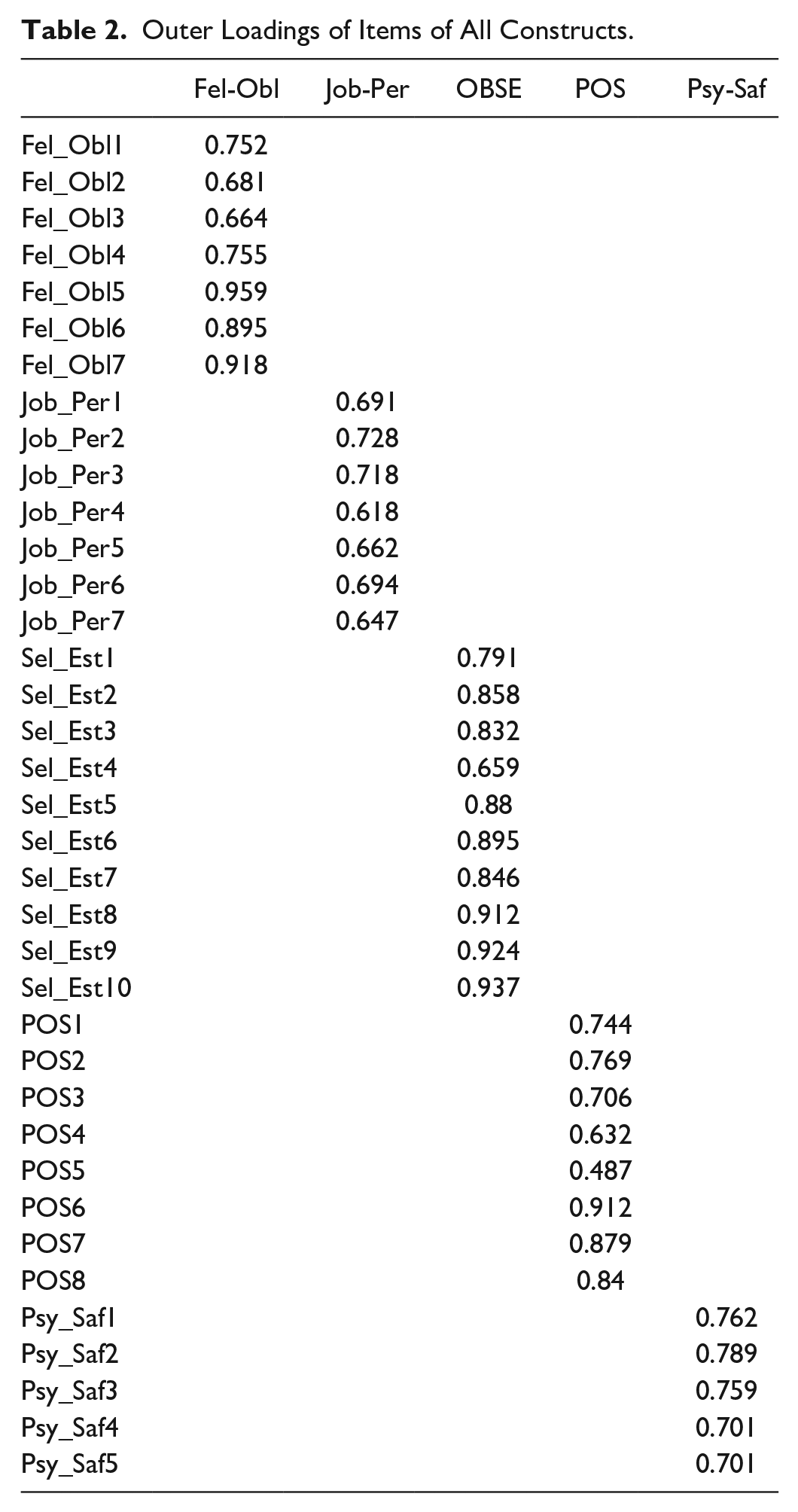
Values of outer loadings for all items are shown with their respective construct. The detail of values and their interpretation is discussed in the table. The value of outer loading should be greater than 0.7, which is considered appropriate for further analysis. However, if the value of loading is less than the threshold value but is more significant than 0.4, it should be analyzed and can be deleted if it increases composite reliability. All such items for the current study were carefully analyzed, and no item was deleted.
Table 2 shows the results of factor loading for the measurement model proposed in the current study. All items of the current study have remained because loadings of all factors were satisfactory to explain related construct.
Outer Loadings of Items of All Constructs.
Reliability and Validity
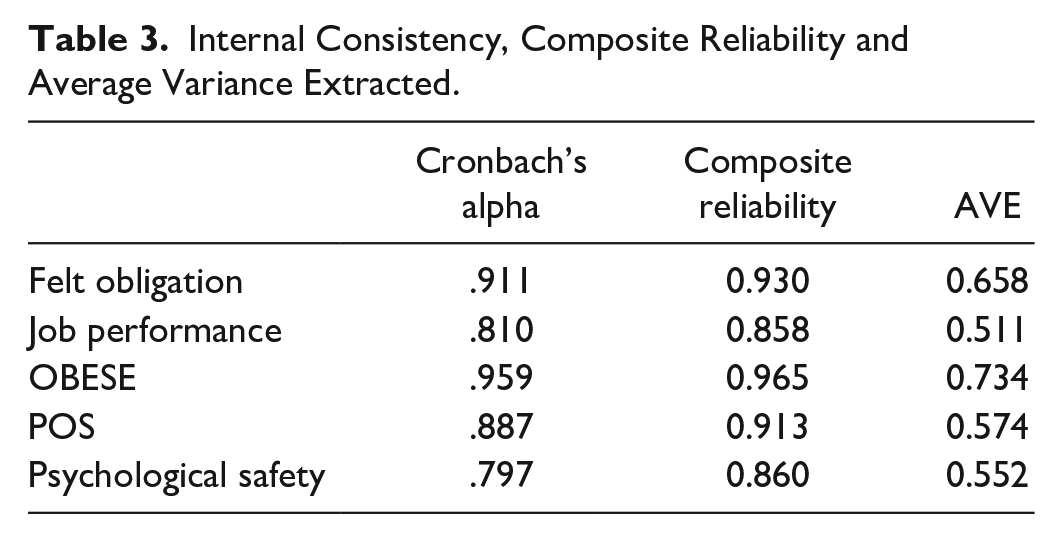
The reliability and validity of data were also assessed for the current study. For this purpose, Cronbach alpha, composite reliability and average variance extracted (AVE) were analyzed for data. Desirable values for Cronbach alpha and composite reliability are more significant than .7, but a value greater than .6 is also considered adequate. The value of AVE should be greater than 0.5, which is considered convergent validity. The table gives discussed values.
In Table 3, the Cronbach alpha value for organization-based self-esteem is .959, the highest, and the value for psychological safety is .797, the lowest of all constructs. All the values of Cronbach’s alpha are within adequate range. Hence, we conclude that the questionnaire has adequate internal consistency. The composite reliability of organization-based self-esteem is .965, which is the highest and the value for job performance is .858, which is the lowest of all constructs. Hence we conclude that data has adequate composite reliability. For the average variance extracted, the value of AVE for organization-based self-esteem is 0.734, which is the highest in all constructs, while the value for job performance is 0.511, which is the lowest. All values are in range, so we can conclude that the data has adequate convergent validity.
Internal Consistency, Composite Reliability and Average Variance Extracted.
Discriminant validity was also assessed for all constructs before going to further analysis. Discriminant validity is assessed by comparing the value of the square root of AVE of each construct with the highest correlation of that construct. A more excellent value of the square root of AVE of any construct than its highest correlation indicates adequate discriminant validity. Values are discussed in the table.
Table 4 shows the values of the square root of AVE (in bold) for a felt obligation is 0.811which is more significant than its highest correlation. We can conclude that felt obligation has an adequate level of discriminant validity. The square root of AVE for job performance is 0.681, which is greater than its highest correlation (.421). So, job performance has an adequate level of discriminant validity. Similarly, the entire construct has an adequate level of discriminant validity. Moreover, all correlations given are significant at 0.05 levels.
Discriminant Validity and Correlation Coefficients.

Correlations are significant at .05 levels.
Structural Model
After analysis of the measurement model, reliability and validity of data, the structural model is analyzed. The structural model, also known as an inner model, analyzes the relationships proposed in a theoretical framework. The results of the structural model are discussed in this portion.
The structural model shows the results of bootstrapping (see Figure 2). Direct and indirect relationships are shown and interpreted in the table below.

Structural model of the proposed framework.
Direct Effects
Direct and indirect relationships of all variables were assessed. The coefficient of variation of all variables, their mean, standard deviation, t-statistics and significance values are discussed in the table below.
Table 5 shows the direct relationship between the variables of the study. All the relationships are positive and significant at .05 levels. The beta value for the relationship of POS with job performance is .283, and the value of the t-test for this relationship is 8.378, which is significant at .05 levels. POS is significantly associated with job performance. Hence, Hypothesis one is accepted.
Direct Relationships of Variables.

Indirect Effects
Indirect effects consist of a mediation path in the proposed model. Mediation of psychological safety felt an obligation, and organization-based self-esteem is considered in the relationship between perceived organizational support and job performance. The coefficient of variation, the sample mean, the standard deviation, t-statistics and significance values are discussed in the table.
Table 6 shows the indirect relationships of variables of the study. All the relationships are based on mediations of psychological safety, felt obligation and organization-based self-esteem. For mediation of psychological safety in the relationship of POS with job performance, a beta value of .149 is significant, with a t-value of 5.094 at 0.05 levels. Hence Hypothesis 2 is supported. For mediation of felt obligation, a beta value of .022 is significant, with a t-value of 2.281 at 0.05 levels. Hence, Hypothesis 3 is supported. For mediation of OBSE, a beta value of .111 is significant, with a t-value of 5.090 at 0.05 levels. Hence Hypothesis 4 is supported.
Indirect Relationships of the Proposed Model.

Discussions
This study highlights the intervention of psychological states in perceived organizational support and performance relationship. In an unstable situation like COVID-19, organizations face the problem of performance reduction. This study investigated the problem in the light of organizational environment and employees’ psychological states. Based on the study’s objectives, the first hypothesis was developed related to the positive association of POS with job performance. The result of the study shows that there is a significant positive effect of POS on job performance. The result is consistent with previous studies. 18
Organizational support theory also confirms that psychological factors positively affect employee outcomes. The nursing staff is essential during a pandemic, and intentional performance became even more critical. Psychological safety plays a vital role in the second hypothesis that was developed related to the mediation of psychological safety in the relationship of POS with job performance.
Results of the current study show that psychological safety mediates the relationship of POS with job performance. Some recent studies also show the same results that allow psychological safety to intervene to increase positive outcomes.30-32 A sense of obligation to repay the organization is developed through positive inputs by an organization to employees. TO incorporate it, a hypothesis was also developed related to the mediation of felt obligation in the relationship of POS with job performance.
The current study shows that felt obligation mediates the relationship of POS with job performance. Employees with high levels of organizational support feel obligated to repay the organization in times of need.37,39 The importance of tasks creates a higher self-esteem for nursing staff in emergencies. The same was incorporated in the study by developing a hypothesis related to the mediation of organization-based self-esteem in the association of POS and job performance. Mediation of OBSE proved significant in the relationship of POS with job performance. Positive outcomes for a feeling of being a significant member of a company are reported by many previous researches.46,47
The results of this study discuss a framework of the psychological process developed based on the perceived organizational support. This study validates previous research studies conducted in the same area. The theory of planned behavior also explains that attitude toward subjective norms and perceived behavioral control are the factors based on which employees decide to contribute to the organization.
Conclusion
This study shows that organizational performance-related behaviors are planned and based on employees’ perceptions. This study was mainly conducted for nursing staff of government hospitals of Pakistan to focus on organizational support for their employees so that their perceptions about support contribute toward achieving potential performance. Results of the study showed that perceived organizational support contributed in developing certain psychological states that ultimately brought in the employee performance-related behavior during the first wave of COVID-19 in Pakistani public sector hospitals. Organizational support comprises the factors like compensation system, overall environment, leadership and employee empowerment. These factors will increase psychological safety, felt obligation, organization-based self-esteem, and job performance. A higher level of organizational support makes the employees put aside personal goals and work for organizational goals. From a practical perspective, people in authority should focus on increasing organizational support that will ultimately enhance the performance of employees, and positive psychological states will also create many other positive personal and organizational outcomes.
Implications of the Study
This study has both theoretical and practical implications. First, mediating mechanisms of employees’ psychological processes are based on organizational support theory and the theory of planned behaviors. Performance-related behavior of employees is based on a psychological process which is developed based on what they perceive about their organization. Such phenomenon is also elaborated by others. 15
Secondly, concerning governmental hospitals, the government may exercise a supportive environment for employees in performing their work-related activities. Decision makers may develop positive psychological states using an appreciation for accomplishments and good work, focus on employees’ well-being and care about work satisfaction. This will build their psychological states to put their best in assigned tasks. Government hospitals have more resources than others. If those resources are combined with employees’ willingness to do their best, they may generate positive effects concerning performance. To the best of our knowledge, there is no related study conducted in the context of Pakistan, so this study will primarily contribute to the healthcare sector of Pakistan and can also generate relevant directions for the other government organizations of Pakistan in specific and other countries in general.
Limitations and Future Research Directions
This study was conducted to suggest a mechanism to increase the performance of government hospitals. Though, specific time and resource constraints are always in the way, which are expected to address by future research in the same area. We developed a process through which perceptions of organizational support make them contribute toward job performance. Another important question related to the antecedents of perception of organizational support still needs to be answered. Future studies can be conducted to find some antecedents of this perception. Moreover, comparing public and private sector organizations will provide more helpful knowledge about policies and strategies to enhance performance. Likewise, future studies can also consider a comparison of different mediators in contributing to the performance.
Footnotes
Declaration of Conflicting Interests
The author(s) declared no potential conflicts of interest with respect to the research, authorship, and/or publication of this article.
Funding
The author(s) received no financial support for the research, authorship, and/or publication of this article.
Ethics and Informed Consent Statement
This study did not require an ethical board approval because no animal or minor/deceased/mentally incapable subjects were involved in the process of data collection or during any other part of this study.
Informed Consent
There was no involvement of any minor/deceased/mentally incapable subjects in this study. During data collection, all the respondents were initially briefed about the study, its objectives and they provided their consent to be part of the data collection process.
