



Abstract
Risk perception and information seeking behaviors are affected by individual psychological and situational factors. In the background of COVID-19 prevailing for a long period, this study examined Chinese people’s information seeking and processing behavior by the RISP model, which focused on the impact of individual risk perception, affective response, perceived information-gathering capacity, and media trust and the impact of the above factors on information seeking. This study designed an online survey with gender and age quotas among the Chinese population, including a total of 675 valid samples. It was found that the Chinese public’s risk perception to pandemic had a positive effect on perceived information-gathering capacity and media trust. Furthermore, both positive emotional responses and negative emotional responses had a positive effect on information seeking behavior. Nurturing positive emotion engendered a holistic perception in pandemic information seeking. In addition, media trust, perceived information-gathering capacity, and subjective norms also positively impact information seeking behavior.
Public awareness of pandemic risk on perceived information-gathering capacity, media trust, and information subjective norms.
Positive and negative emotional response for the COVID-19 on information seeking behavior.
Media trust, information-seeking capability, and subjective norms on information-seeking behavior.
Positive emotion, media dependency in post-pandemic information-seeking behavior RISP model.
Introduction
The World Health Organization declared COVID-19 a global pandemic event since 2020. To date, COVID-19 is still globally prevalent. As a risky public event with close implications, whether for individuals, public health agencies, or government organizations, the coronavirus is widely spread and highly infectious. Some countries have taken rounds of measures such as maintaining personal hygiene, social distancing, strict testing, and lockdowns. However, the pandemic is not under control yet. It is difficult for the new vaccine to fully cope with the highly virulent and infectious mutant strains, and the ensuing epidemic risks are always threatening the social operation order and public life safety.
The high level of uncertainty and the lack of experience has brought negative emotional responses such as fear, 1 anxiety, 2 and irrational public behaviors, 3 leading many people rely on online health information to learn more about preventing themselves and family members from the threat of the coronavirus. 4 Importantly, information seeking facilitated engaging in reasonable behavioral responses 5 and promoting acceptance of prevention promotions, 6 which in turn affects the control of new outbreaks.
The risk remains severe and will persist for a long time. Despite the phased successes in the prevention and control of COVID-19 in China, the challenges of normalizing the epidemic remain daunting. It has become a new issue in health communication and social governance that how the public can respond to the pandemic risks through information seeking. This study focused on the factors influencing the information seeking behaviors of the public in China, and the result explained the significance of health information sharing in the media, both for current and future public health events. Meanwhile, the public’s emotional response, as well as physical health, should also be weighed seriously during the public health events. Finally, this study viewed the people in the long-term, uncertain environment of epidemic risk as the research object, which can provide a reference and perspective for normalized pandemic prevention and social management in China and worldwide in the post-pandemic era.
Literature Review
Factors Influencing Risk Information Seeking Behavior in Public Health Issues
Risk information seeking behavior is concerned with how people seek and use risk information to respond to risky situations and is influenced by several factors. Risk perception is one of the basic factors influencing risk information seeking and has received extensive attention in the fields of health care7-9 and food consumption, 10 which is positively correlated with a willingness to seek information. 11 Influenced by COVID-19, previous studies have focused on vaccination information seeking and found that information channels 12 and perceived risk 13 are key factors influencing vaccination intentions, while risk perception has a significant positive effect on information seeking and supportive attitudes of the COVID-19 vaccination14,15 and affects social media users’ motivation to disseminate health information. 16
Media trust is also noted as a significant factor influencing risk information seeking behavior,17-19 which influenced people’s actions in obeying to health-related information 20 and the willingness to vaccinate, 12 as well as positive attitudes toward future information seeking behavior. 21 With ICTs developments, social media are becoming increasingly important channels for self-care, health information search, and decision-making,22,23 especially for the Generation Z group. 24
RISP Model and Risk Information Seeking Behavior
Systematic and holistic modeling studies have also been developed, among which Griffin et al 5 proposed the risk information seeking and processing model (RISP model) by referring to and integrating the heuristic-systematic model (HSM) and the theory of planned behavior (TPB). RISP model has described the cognitive processing of information due to psychological and social factors, and predict and explained media trust and decision-making behavior, motivation, and capability. It has been widely used in health issues such as cancer control,25,26 environmental issues such as global warming, 27 renewable energy use and ecological safety,28,29 natural disasters such as floods, 30 drinking water contamination caused by chemical substances or microorganisms,25,29,31 as well as food safety information. 32
Most recent studies have focused on applying the RISP model in the context of pandemics and vaccination. News media were found to be the most preferred information source for the public seeking information on disease prevention, treatment, and vaccination, and demographic characteristics such as age and education influenced the public’s choice of media types. 33 It was suggested that scientific communication around the new coronavirus pandemic needs to focus on audience attitudes toward specific information channels and information processing abilities. 34
Meanwhile, some scholars have called attention to the applicability of the RISP model in non-Western cultural contexts. 35 Some studies have also revealed cultural differences in the application of the model, such as a survey of Chinese in the U.S. found no significant role for subjective norms of information, 36 while other studies demonstrated a significant role for subjective norms of information. 37 In addition, the RISP model itself is evolving, such as a study that introduces information overload into the RISP model and finds that information overload is associated with information avoidance behavior, 38 and frequent news and information exposure also leads to amplified risk perception and decreased trust in organizations by the public. 39 Compared to interpersonal communication and traditional mass media, the public avoids information from online platforms more frequently, 38 adding a new topic to the study of RISP models in social networks.
This study investigated the information seeking behavior of the pandemic and aimed as follows. First, though the emotional response weighed significantly in risk perception and information seeking behavior, previous studies lacked a deep exploration of this component in the RISP model. 40 This study explored this specific element and separately examined positive and negative emotional responses. Second, the study explained the applicability of the RISP model in non-Western media contexts, 35 especially in China. Moreover, integrated media systems, including mass media and social media, have a significant impact on public media trust in China. 41 Third, the study explored the relationship between media trust and information seeking behavior among Chinese people innovatively, which facilitates a better handle on global public health events.
Model, Variables, and Hypotheses
The basic structure of the RISP model is shown in Figure 1. The model mainly contains 7 key concepts and variables. The survey questionnaire was design according to the improved model (shown in Supplemental Appendix Table).
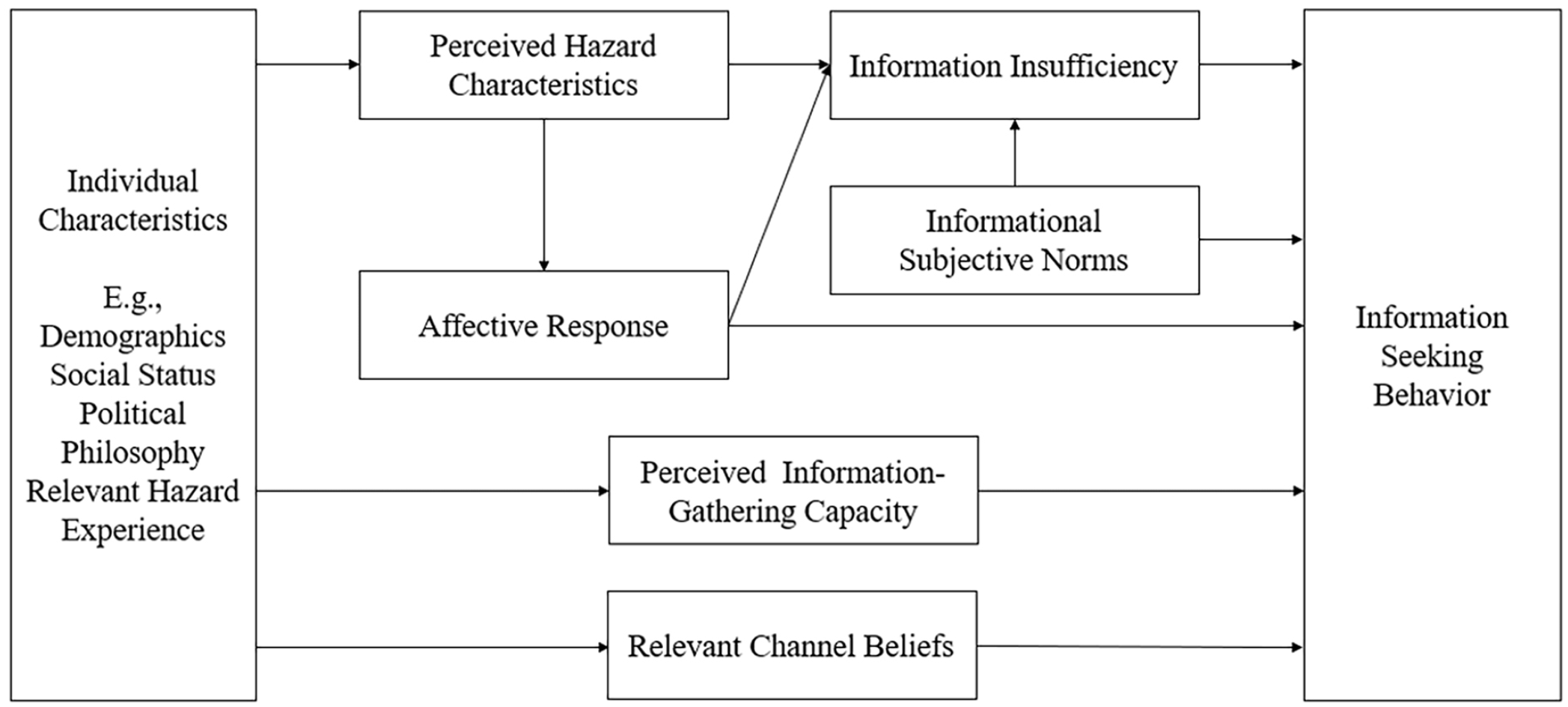
Model of risk information seeking and processing.
Perceived Hazard Characteristics
The process by which individuals measure the relevant events concerning their stakes through information content was decomposed into 2 stages: cognitive and affective. 5 Researchers have classified perceived risk characteristics into risk perception, trust in the relevant risk management organization, risk control assessment, and causal attribution judgments. 40
Combined with the specific context of health risk perception, health risk perception was classified into four dimensions; likelihood, severity, familiarity, and controllability. 42 Institutional trust refers to the degree of willingness to rely on institutional organizations responsible for making and implementing decisions regarding safety management in areas such as public health. 43 Measures of individual control require individuals to assess the ability to overcome relevant difficulties and understand relevant information and are more related to individual self-efficacy. 40 Causal attribution judgments involve the individual’s perception of the subject responsible for the risk event. 30
This study addressed the impact of COVID-19, which is a public health event therefore causal attribution did not consider. In our study, perceived hazard characteristics were characterized as risk perception, divided into three dimensions; risk judgment, organizational trust, and individual control. The study proposed the following hypothesis:
Hypothesis 1: Risk perception is positively related to information insufficiency.
This study also sought to explore whether risk perception has a direct effect on information seeking in the risk context of COVID-19 and therefore put out the following question:
Research Question 1: How does risk perception affect information-seeking behavior?
Emotional Responses
Individuals’ emotional response factors, worry, anger, and uncertainty, 5 triggered by perceived risk characteristics were identified as the main factors influencing information-seeking motivation. Previous studies have found that negative emotions can directly drive information seeking.30,43,44 Notwithstanding it has also been suggested that when people feel threatened or in danger but powerless, they may turn to fear control to avoid further information to reduce negative emotional perceptions.40,45 Due to the uncertainty of risk, positive emotions such as optimism or hopefulness can also occur.46,47 Positive affect reduces an individual’s willingness to seek information by suggesting that the individual is satisfied with the status quo 48 and may also stimulate information seeking 49 and motivate the individual to seek innovative solutions to problems, 50 which drives information avoidance behavior.
This study measured public emotions influenced by COVID-19, dividing them into negative and positive emotions; the former mainly included anxiety, fear, and exasperation, while the latter included satisfaction, optimism, and hope. All 3 negative affective responses stem from the direct impact of COVID-19 on individuals, while the 3 positive affective responses come from the degree of individuals’ judgment of the situation of the epidemic. Previous studies have focused mostly on negative affective responses but rarely on positive emotions, therefore this study did not generalize the impact of emotional responses and posed the following research questions:
Research Question 2: How does risk perception affect an individual’s emotional response?
Research Question 3: What is the effect of emotional response on information insufficiency?
Research Question 4: What is the effect of emotional response on information-seeking behavior?
Information Insufficiency
Information insufficiency refers to the gap between an individual’s existing knowledge of risk events and the adequacy threshold, which is generally measured by perceiving the current knowledge reserve and the adequacy threshold.44,51-53 Previous studies have shown that the cognition of information adequacy is the key motivation of information seeking 40 and the prominent influencing variable, 54 and also the core concept of the RISP model. 44 To meet the goal of information processing, people would spare no effort to obtain more information. It is pointed out that the more people feel that they have insufficient information about the risk situation, the stronger their will to seek risk information.52,55 Therefore, this study proposed the following hypothesis:
Hypothesis 2: Information insufficiency is positively related to information-seeking behavior.
Informational Subjective Norms
Initially, inspired by normative beliefs in the theory of planned behavior, subjective informational norms deal with people’s inclination to act according to social norms. 56 This concept emphasizes that when people believe that others expectations for them to know about a risk issue, they are likely to actively work on it and seek information. 57 People generally desire to form socially acceptable attitudes, 58 and subjective informational norms have key contributions to the predictability of risk information seeking. 54 Previous researchers have tested this indicator in COVID-19, 52 antibiotics, 51 epidemic vaccines, 59 cancer and climate change. 27 In addition, subjective informational norms would affect the perception of information insufficiency. 5 Hence, this study proposed the following hypotheses:
Hypothesis 3: Informational subjective norms are positively related to information insufficiency.
Hypothesis 4: Informational subjective norms are positively related to information-seeking behavior.
Perceived Information-Gathering Capacity
Information-gathering capacity reflects an individual’s perceived ability to perform the information seeking and processing to obtain the desired outcome, especially when it requires more cognitive effort and nonroutine gathering of information, 5 reflecting the perceived controllability and perceived self-efficacy. 27 Based on previous studies, in different events, the impact of perceived information-gathering capacity on information-seeking behavior was divided, including positively correlated,30,43,60,61 noncorrelated 26 or even negatively correlated.40,59,62 Even with the development of an information society, there are fewer obstacles to information gathering, 62 and it may become a marginal role, it was found that perceived information-gathering capacity still had a consistent and strong main effect on risk information search intention. 63 Thus, this study proposed the following hypothesis:
Hypothesis 5: Perceived information-gathering capacity is positively related to information-seeking behavior.
Media Trust
Previous studies have referred to this component of the RISP model as relevant channel beliefs. 40 It focused on whether the specific information channels can meet the individual’s risk information needs and initially investigate views on the credibility, availability, and practicability. However, recent studies have shifted from a single channel to a more comprehensive and universal approach to researching information-seeking behavior.29,59 Some research has divided relevant channels into 4 categories; news media, social media, government, and interpersonal relationships. 63 The study used media trust to describe the credibility of the media channels and the information transmitted, thus proposing the following hypothesis:
Hypothesis 6: Media trust is positively related to information-seeking behavior.
Demographic Characteristics
The general individual characteristics, including socioeconomic and cultural attributes such as risk-related experience, political position, gender, and age, have a certain impact on risk information seeking and processing behavior. 54 Researchers have revealed that females, ethnic minorities, young people, and the ones with risk experience would have a higher degree of insufficient information. 25 Considering that, gender, age, education level, average monthly income, location, and risk experience were investigated in this study.
Methods
This study aimed to investigate the influence mechanism of the information-seeking behavior among Chinese people during the COVID-19 situation. The questionnaire was designed based on the key factors in the RISP model, referring to the measurement questions that have been pre-tested for good validity and reliability, and combined with the actual situation of the current pandemic.
The study adopted an online questionnaire with quotas for gender and age according to the National Bureau of Statistics Census, and commissioned Databnu platform to distribute and collect the questionnaires from May 1 to 15, 2021. After testing and proposing unqualified questionnaires, 675 valid sample were finally obtained, with an effective recovery rate of 98.5%. The survey respondents covered all regions of China. Among them, male accounted for 50.2% (female 49.8%); high school education accounted for 11.6%, 59.3% had bachelor’s degree and 6.8% had master’s degree and above; most were between 25 and 34 (36.3%) and 35 and 44 (26.2%) in age; 17.6% had stayed in high-risk areas during the pandemic, and 9.2% had been diagnosed with new coronary pneumonia around them (including themselves). The characteristics of the respondents were presented in Table 1.
The Characteristics of the Respondents.

Data Results
Data were analyzed using structural equation modeling (SEM) in AMOS 22.0. The results were presented in Figure 2, and the goodness-of-fit test showed ideal indices (RMSEA = 0.064, GFI = 0.889, CFI = 0.903) and presented in Table 2. All of our hypotheses were at least partially supported.
Summary of Fit Indices.

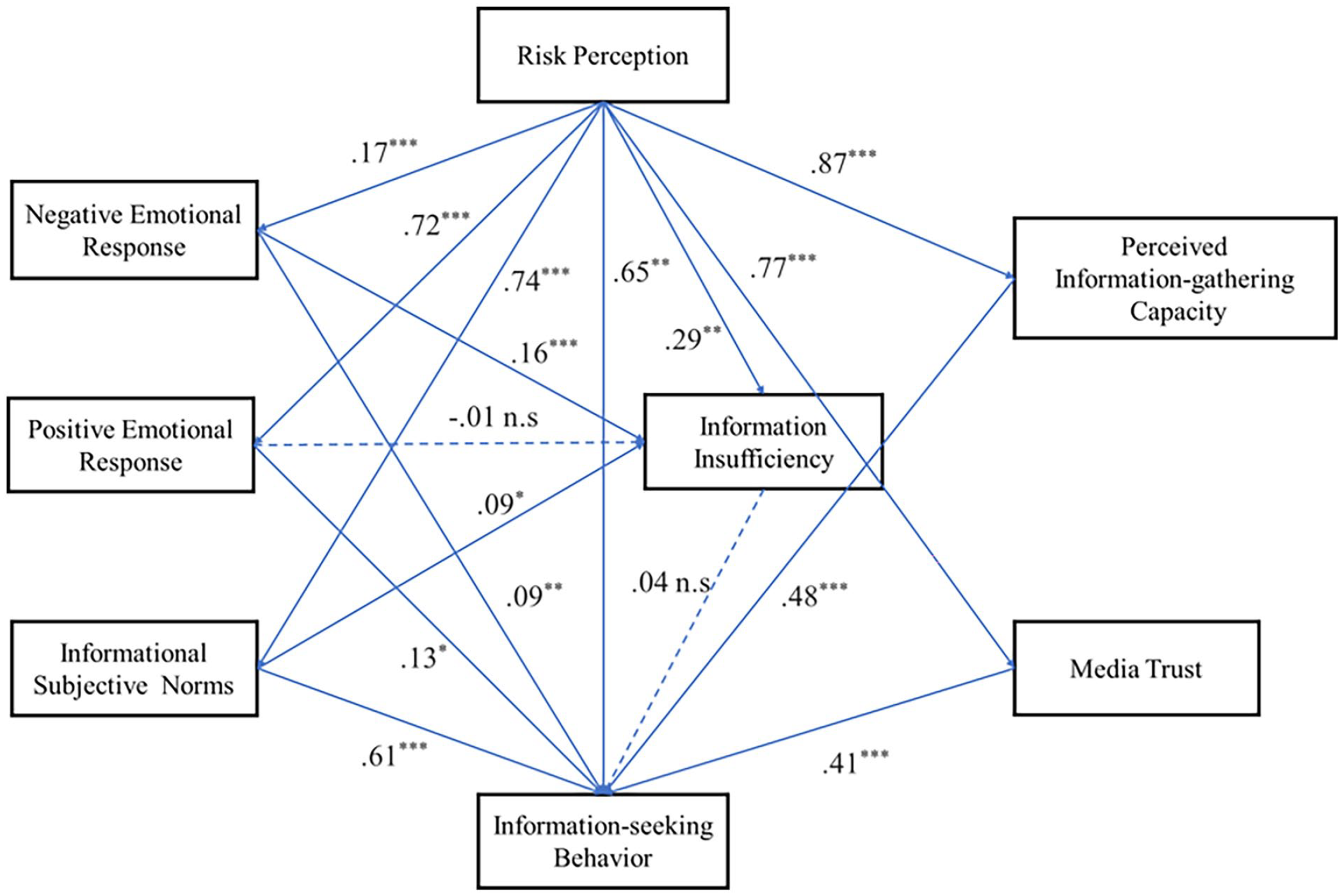
Results for the conceptual model.
First, Chinese people’s Covid-19 pandemic risk perception was positively related to information insufficiency (β =.29, P = .003 < .01, CR = 2.946), positive emotional response (β =.72, P <.001, CR = 11.399 > 0.6), negative emotional response (β = .17, P < .001, CR = 3.575), perceived information-gathering capacity (β = .87, P < .001, CR = 13.682 > 0.6), media trust (β = .77, P < .001, CR = 13.420 > 0.6), and information subjective norms (β = .74, P < .001, CR = 13.929 > 0.6) and had a direct positive impact on information seeking behavior (β = .65, P = .001 < 0.01, CR = 3.273). H1 was supported, and RQ1 and RQ2 were positively significant.
Second, the relationship between information insufficiency and information-seeking behavior was not statistically significant (β = .04, n.s.). However, information subjective norms were positively related to information insufficiency (β = .19, P = .015 < .05, CR = 2.429) and information-seeking behavior (β = .61, P < .001, CR = 7.879 > 0.6). H2 was not supported, H3 and H4 were strongly supported.
Third, perceived information-gathering capacity (β = .48, P < .001, CR = 3.503) and media trust (β = .41, P < .001, CR = 5.192) were positively related to information-seeking behavior. H5 and H6 were supported.
The study further divided the emotional response into positive and negative versions. Negative emotional response was positively related to information insufficiency (β = .16, P < .001, CR = 4.452) and information-seeking behavior (β = .09, P = .006 < .01, CR = 2.721). Meanwhile, the positive emotional response were also positively related to information-seeking behavior (β = .13, P = .04 < .05, CR = 2.053), indicating that in addition to negative emotions, people’s information-seeking behavior was also affected by positive emotions.
Finally, the study explored the association of respondents’ characteristics with their responses in SPSS 25.0. The results showed that respondents’ age was significantly correlated with information insufficiency (P = .000) and media trust (P = .036). The elder the participants, the more insufficient they perceived the pandemic information and the more they trusted the media. The education background was significantly correlated with information insufficiency (P = .004), perceived information-gathering capacity (P = .003), subjective norms (P = .038), and negative emotional response (P = .000). The average income was significantly associated with individual control (P = .016), media trust (P = .001), information-seeking behavior (P = .000), perceived information-gathering capacity (P = .000), and positive emotional response (P = .006). The region was significantly related to the likelihood of perceived risk characteristics (P = .000) and information insufficiency (P = .002). The participants’ epidemic-related experiences were significantly correlated with the likelihood of perceived risk characteristics (P = .000), the severity of perceived risk characteristics (P = .000), and negative emotional response (P = .000), who with epidemic-related experiences judged both the likelihood and severity of the coronavirus to be significantly higher, while generating more significant negative emotions about the pandemic.
Conclusion and Discussion
At present, facing the far-from-over and sporadic outbreak of the coronavirus, Chinese epidemic prevention is still under great pressure. In the public risk events caused by the pandemic, the dissemination of epidemic information according to the psychological and behavioral characteristics can more effectively alleviate the public’s uncertainty about the risk, and help the public better cope with this invisible risk struggle. Therefore, this study chose the timing when the risk of COVID-19 remains and the calls for the vaccination has begun, to analyze the current situation and the influence mechanism of the public’s risk information seeking behaviors.
First, the study revealed that the Chinese public’s risk perception positively affected emotional response, information gathering capability, media trust, and subjective informational norms, thus directly influencing risk information-seeking behavior. This is consistent with the findings of related studies. 25 The nature of risk is uncertainty, while the nature of information is uncertainty reduction. This study showed that the more apprehensive the Chinese public was about the risk of COVID-19, the more likely they were to have negative emotions such as panic and anxiety, and the more eager they were to obtain information. Therefore, the government and the media should promptly release information and details about the pandemic outbreak to help the public obtain adequate information, and increase the public’s sense of control over the risk, thus reducing their internal anxiety and stress.
Second, the Chinese public’s subjective information norms positively affect information insufficiency and information-seeking behavior. This is consistent with the results of many previous studies. 64 However, information insufficiency did not pose a significant effect on information-seeking behavior. The reason for the above situation due to, on the one hand, Chinese culture has a strong connection to family, relatives, and friends. When people feel that their surrounding family members and friends want them to know more about the pandemic, they will feel that they have insufficient information and are obliged to seek more information.
On the other hand, along with the flourishing of social media, information is rapidly updated and overloaded, where people are immersed in redundant information and always online, clinging to the information channels and contents that are familiar and well-rated, gradually forming an individual “information cocoon,” 65 thus impeding them from accurately judge their information insufficiency and adding difficulties for their direct information-seeking behavior. Though this situation is beyond the hypotheses of this study, it provides a new topic for future research in the areas of online media audience analysis in risk communication.
Third, this research on media trust was innovative compared to the previous studies. It was found that the more the public perceived their capability to collect Covid-19-related information, the more they trusted the information released by the media, and the more they were willing to seek related information. Although some scholars have argued that perceived information-gathering ability may play a marginal role, 66 our findings showed that it remained an important variable influencing the public’s information-seeking behavior, which is consistent with the findings of recent studies, 32 and closely related to self-efficacy as well. In the COVID-19, the massive amount of information has further increased the difficulty in obtaining effective information, thus shoving individuals’ self-efficacy to a greater test.
Moreover, it examined individuals’ interpretation of their own media useability; therefore, it is also important to improve the Chinese public’s media literacy and develop their capability to identify health rumors. Studies have also shown that media trust has a significant positive effect on information-seeking behavior. During the COVID-19 pandemic, rumors such as “Shuang Huang Lian (Coptis Chinensis) is effective to prevent COVID-19” seriously undermined media credibility. It was found that the credibility of authorized media during the pandemics was significantly higher than that of self-media and online media. 67 Combined with the results of this study, official news media should publish more comprehensive and professional information with higher credibility during epidemic prevention and control.
What was more innovative about this study was that emotional responses were examined separately into positive and negative emotions. The results indicated that the Chinese public’s both positive and negative emotional responses had a significant positive effect on information-seeking behavior, while negative emotional responses had a significant effect on information insufficiency. As confirmed by most studies, the stronger the public’s negative emotions were, the more they perceived information as insufficient, and tended to seek new information to eliminate panic and uncertainty.
Positive emotions positively affect risk information-seeking behavior, but the specific purposes remain a question for further research. It can motivate individuals to seek more information to increase their self-confidence in the positive trend of risky events.49,50 In the context of the current situation, the increase in the cure rate and the new treatments enhance the public’s confidence, which evokes positive emotions and may cause people to seek more information to solidify this belief. Future research can conduct an in-depth analysis of the purposes and types of positive emotions to test the above hypothetical explanations.
Nonetheless, the present study has some limitations. First, the study verified the effects of relevant variables merely on information-seeking behavior in the RISP model without examining the subsequent information processing and health coping behavior. Second, the validity of the measurement could be improved by increasing the number of questions on the relevant variables in the future. At the same time, compared with the previous research on the pandemic, this study specifically focused on the role of positive/negative emotional responses and media trust in the model and chose to survey during the new coronavirus vaccination period, which can compensate for the gap of previous studies on related variables, and also form a comparison to explore the information-seeking behavior of the Chinese public before and after the risk information intervention of vaccination.
With the normalization of epidemic prevention and control in China and worldwide, the risk environment, media content, and social governance strategies are constantly changing. Our study on the public’s information-seeking behavior and its influencing mechanism can provide a reference for the prevention of the potential abrupt pandemic, and put forward new perspectives on media and society research in the post-pandemic era.
Supplemental Material
sj-docx-1-inq-10.1177_00469580231159747 – Supplemental material for Positive Emotion and Media Dependence: Measuring Risk Information Seeking and Perception in the COVID-19 Pandemic Prevention
Supplemental material, sj-docx-1-inq-10.1177_00469580231159747 for Positive Emotion and Media Dependence: Measuring Risk Information Seeking and Perception in the COVID-19 Pandemic Prevention by Jinye Huang, Wujiong Ren, Shiwen Wang, Yifan Zhou and Ya Yang in INQUIRY: The Journal of Health Care Organization, Provision, and Financing
Footnotes
Authors’ Note
Ya Yang is also affiliated to Tsinghua University, Beijing, China.
Declaration of Conflicting Interests
The author(s) declared no potential conflicts of interest with respect to the research, authorship, and/or publication of this article.
Funding
The author(s) received no financial support for the research, authorship, and/or publication of this article.

Presence of Declarations and Ethics and Consent Statements
Our study has received an approval of ethical board at the School of Journalism and Communication, Beijing Normal University, CN.
Supplemental Material
Supplemental material for this article is available online.
References
Supplementary Material
Please find the following supplemental material available below.
For Open Access articles published under a Creative Commons License, all supplemental material carries the same license as the article it is associated with.
For non-Open Access articles published, all supplemental material carries a non-exclusive license, and permission requests for re-use of supplemental material or any part of supplemental material shall be sent directly to the copyright owner as specified in the copyright notice associated with the article.
