




Abstract
Coronavirus disease 2019 (COVID-19), a disease caused by a novel severe acute respiratory syndrome coronavirus 2 (SARS-CoV-2), emerged initially as an isolated illness in December 2019 and later progressed to a global pandemic. Hard-hit areas were lockdown, massively disrupting medical education activities. Tele-education, previously used as a means of long-distance education emerged as a solution in the field of medical education. Tele-rotations for medical students, journal clubs and lectures via Microsoft teams, medical conferences via zoom, residency, and fellowship interviews online, all emerged during this pandemic. Some medical students and trainees found it enjoyable, cost-effective, time saving, feasible, unbiased, and preferred mode of education. Challenges related to supervision, availability, affordability, diminished communication, disturbance of streaming, or distractions due to environment. Tele-education has had a boom in the era of COVID-19. Research is needed further on effective mentoring and supervision of trainees via tele educational teaching models.
Introduction
Coronavirus disease 2019 (COVID-19), a disease caused by a novel severe acute respiratory syndrome coronavirus 2 (SARS-CoV-2), emerged in December 2019 and soon became a global pandemic. It was first reported in Wuhan, China1,2 and then invaded almost every country of the world including the United States. By June 16, 2022, there have been over 542 677 962 confirmed cases, while 6 337 092 deaths occurred worldwide and 517 994 570 recoveries worldwide so far. 3 In the United States, there are over 87 759 180 total confirmed cases of COVID-19, 262 134 cases per 1 000 000 people, and over 83 505 111 deaths reported so far. 4
Lock downs were imposed, and in-person interaction was discouraged to curtail spread of infection. This measure severely affected educational activities in all medical training program globally. Some of the activities that need mentioning are Journal clubs, case presentations, resident and fellow interviews, clinical rotations, tumor boards, grand rounds, certification and board examinations and teaching modules and conferences.
Tele-education: previously used as a means of long-distance education was proposed as an alternative to in-person education. Tele-education has been defined as learning via internet and web-based learning portals. It is of 2 types, synchronous and asynchronous modes. 5 In synchronous mode interaction can take place between the instructor and learner at the same point in time and same location for example, video conferences and zoom sessions. In asynchronous mode no direct communication happens between the teacher and the learner and course material is prepared in advance by the instructor and uploaded for students. 6 Transformation to tele-education was considered indispensable during the time of COVID-19. Keeping the above rationale in mind we aimed to write a commentary about the recent literature on tele educational modalities that emerged during COVID pandemic. The purpose of creating a commentary is to report a concise review of the current literature highlighting the recent tele-education modalities. A brief methodology has been provided for readership.
Methods
Relevant key words were used which are as follows “tele education,” “tele medicine, ‘medical education’, COVID-19,” COVID-19 pandemic. Databases searched included PubMed and Google Scholar. Any relevant articles that reported the use of tele education or any of its modalities during COVID-19 were included in the review irrespective of the study design.
Results: Literature Review of Tele-Medicine in COVID-19 Pandemic; A Global Picture
Tele-Rotation Clerkships and Virtual Reality Cases for Medical Students
During the COVID-19 pandemic, all in-person student rotations were suspended due to a risk of infection to students. The Association of American Medical College (AAMC) discontinued all in-person medical student clerkships on 17 March 2020.7,8 This uncertain situation posed a unique challenge for the medical students across the globe and a need for an alternative route was felt. 9 Many institutions in the United States provided tele-rotations for the students; including the Yale University School of Medicine New Haven. 10 Virtual reality which was previously used solely for entertainment purpose was introduced as a mode of tele-education for medical students in the University of Insubria, Italy. Through using Body Interact TM a virtual reality platform, 21 simulated scenario cases were created. This platform allowed the students to perform a history and physical examination by giving commands. A total of 122 medical students completed this online training with overall positive results. 11 South Asian universities were also quick to react to the changing needs of the medical students by introducing virtual lectures via Microsoft Teams, in Pakistan 12 and other similarly online apps, and smartphone in India. 13
Journal Club for Resident Trainees Via Microsoft Teams
Journal Club are a means of keeping up to date with the current literature for the medical trainees. Before the COVID-19 pandemic, the online journal club was existent, albeit used seldomly. 14 COVID-19 pandemic led to a shift to virtual journal clubs. In December of 2019, the first virtual Journal Club of the gynecologic-oncology department was held in Colombia, South America, with 20 participants. The participants included fellows, gynecologic oncologists, and international guests. The overall response to the journal club was positive since the participants found convenience in scheduling and attending the meetings from home, very useful. 14 Microsoft teams emerged as a commonly used modality for conducting the journal club in Bradford Trust hospitals in the United Kingdom 15
Tumor Board Reviews Through Videoconferencing
Tumor boards comprise of multidisciplinary board members that manage complicated cancer patients from various clinical dimensions. It is mostly conducted in-person: however, due to the COVID-19 pandemic, it was arranged virtually via videoconferencing in different hospitals. The University of Pittsburgh Medical Center passaged to virtual multidisciplinary tumor boards during the COVID-19 pandemic for the first time. 16 The virtual multidisciplinary conferencing MDC was found feasible in the setting of a large hospital network setting. There were minor setbacks due to electronic documentation and data tracking which needed further exploration. 16
Virtual Grand Rounds Via Zoom
Grand rounds, a means of learning from interesting cases and imparting clinical wisdom were disrupted. “Traditional” grand rounds were replaced with test run of virtual grand rounds at Cambridge University Hospitals NHS Foundation Trust. The virtual Zoom platform was selected to present to an online audience and discuss topics with the theme of COVID-19. When perceptions of trainees were explored about the online grand rounds majority were positive with 88% of respondents stating that they would be very likely to attend a future virtual grand round. 17
Continuing Medical Education (CME) Via Video Conferencing
CME is a system of structured learning for physicians, which allows them to keep up with medical advances and maintain their medical license. During COVID-19 pandemic, virtual channels used for CME included video conferences, educational videos, and different e-learning modules. 18 Mayo clinic developed several online CME courses for physicians learning about COVID-19. 19 An online survey was conducted by in November 2020, by 326 physicians and specialists of multiple countries. Results showed that 58% of attendees reported attending a higher number of virtual webinars during COVID-19 pandemic, on average 3 per month. Majority (60%) were satisfied with the content of online CME courses and conferences. The most common challenge faced by them was lack of regulations regarding online meetings. 20 Furthermore, online portals were used for education and treatment of COVID-19. These were of benefit to the physicians as well as general public. 21
Medical Conferences Via Zoom
Several national and international in-person conferences were canceled due to the COVID-19 pandemic. However, to cope with the pandemic, the conferences were later held virtual. In 2020, the University of Massachusetts Memorial Children’s Medical Center hosted a conference on their Zoom platform. 99% of attendees found the online platform to be effective in delivering the conference content. 22
Research Training Via Microsoft Teams
Research has always been an integral part of medical education. It keeps its importance in both pre-and post-graduation levels. COVID-19 pandemic affected research training initially. 23 However, virtual methods were used in the provision of research activities. 24 The Aga Khan University in Pakistan also used Microsoft Teams as the main source of training for its graduate trainees. 12
Virtual Interviews for Trainees Via Zoom or Skype
During the COVID-19 pandemic, many countries-imposed travel restrictions and candidates could not travel for in-person interviews. The Accreditation Council for Graduate Medical Education (ACGME) hospitals started virtual interviews for the recruitment of residency and fellowship applicants during COVID-19. 25 Experience from gastroenterology fellowship interviews in 2020 showed that 94% of the candidates were strongly satisfied with virtual interviews, with a high majority (89%) agreeing about the cost-effectiveness of virtual interviews and further continuation in future (76%). With 100% faculty supporting the online interviews hence highly recommending the virtual platform for future interviews. 25 A similar study done on 349 surgical applicants found online interviews “valuable” but preferred smaller breakout rooms, and clearer instructions on the interview day. Shorter interview day (<3 h) was associated with less familiarity of interviewer with the program and a 2 to 7 h interview increased familiarity. 26
Mentoring Trainees During the COVID-19 Pandemic
Mentorship inside a clinical specialty like surgery has shown to be beneficial in advancing career of the mentee. Mentors validate the knowledge of the learner and can contribute to the professional growth for the clinical or surgical student. In a specialty like surgery mentorship is particularly important for the trainee/student. A review on the role of distance mentoring during COIVID-19 pandemic was conducted which showed promise in the use of tele-education as a means of enhancing surgical skill (93%) or clinical knowledge (1.5%). 27 This will further need exploration especially in specialties where direct supervision is necessary for learning advanced skills.
Impact of COVID-19 on Residency Training
COVID-19 impacted the education of many trainees both directly and indirectly. A study was conducted among US plastic surgery residents where 58% of the residents reported a negative impact of COVID-19 on their education with a possible loss of supervised learning. Some anticipated a negative impact on future job prospects. 28
Discussion
In this discussion we focus on the pros in the first paragraph, followed by the challenges of virtual teaching and learning modalities used during COVID-19. They have been summarized in Table 1.There is an huge geographic advantage for students that use tele education as it is available anywhere in the world, without visiting the classrooms, wards, and other teaching sites. 29 Virtual learning via tele education is also cost effective especially for trainees from low resource countries. 29 Virtual online education can save time for the participating students and educators as well through achieving the desired course objectives in less time.30,31 This is of advantage to both the student and the institutes that invest resources in students. Virtual lectures have the added advantage of being recorded, paused, forwarded and downloaded, hence they can be watched more than once and shared with other students . 29 Virtual education can solve issues related to accessibility of teachers. 29 These virtual teaching can save travel charges, hostel charges, and other travel-related problems and hence can provide ease to participants.29,31 Virtual COVID-19 courses helped many physicians and trainees that were fighting at the forefront by treating COVID-19 patients. 19 Virtual interviews emerged as a means of recruiting quality trainees at various levels of medical training (27). Some learners found virtual learning enjoyable. 29 Mentoring opportunity for students seeking guidance or validation in clinical or surgical careers was an added plus. 27 Mental health and psychiatry training was continued uninterrupted using tele education. 32
Summary of Different Tele-Education Modalities Used in Miscellaneous Medical Activities.
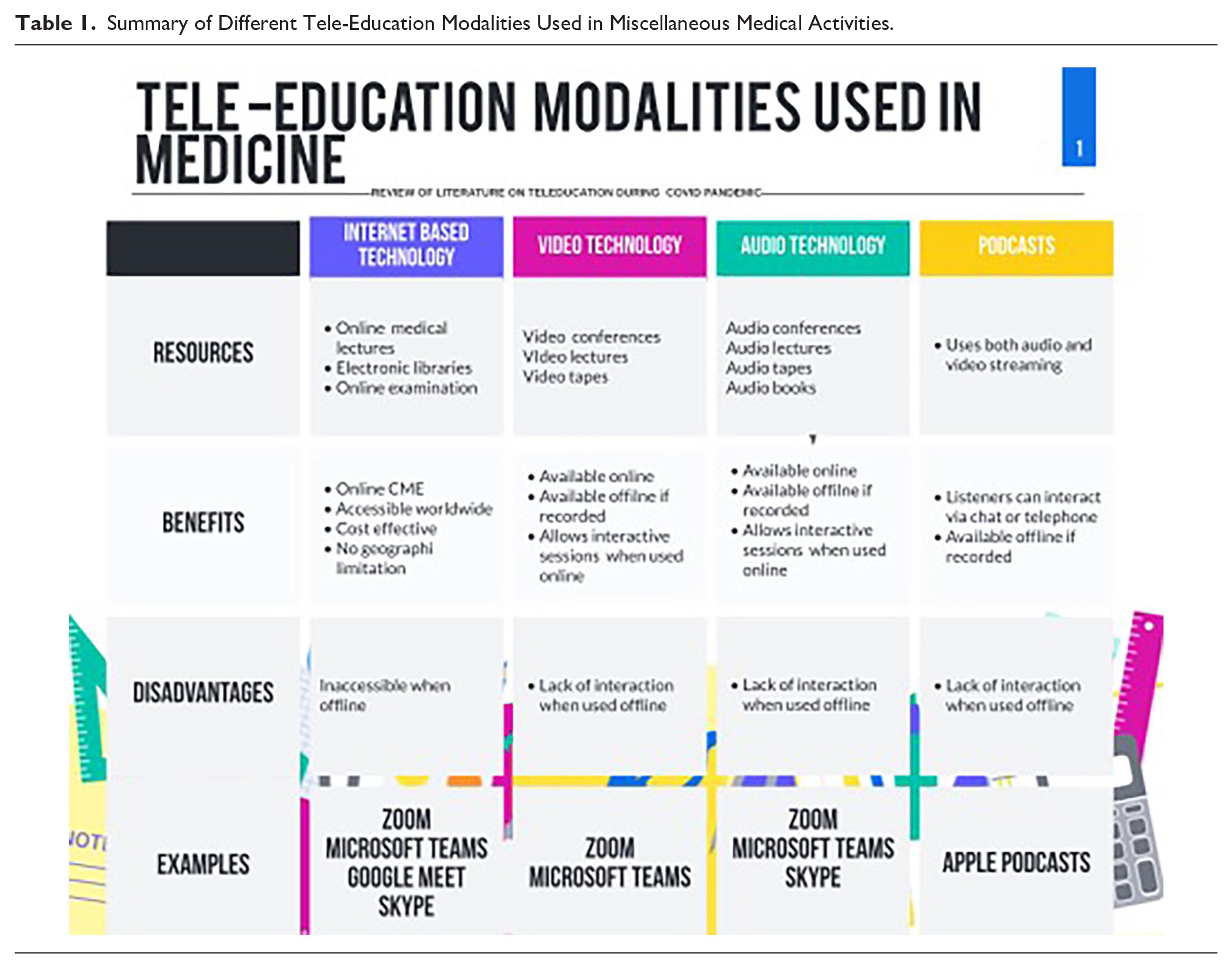
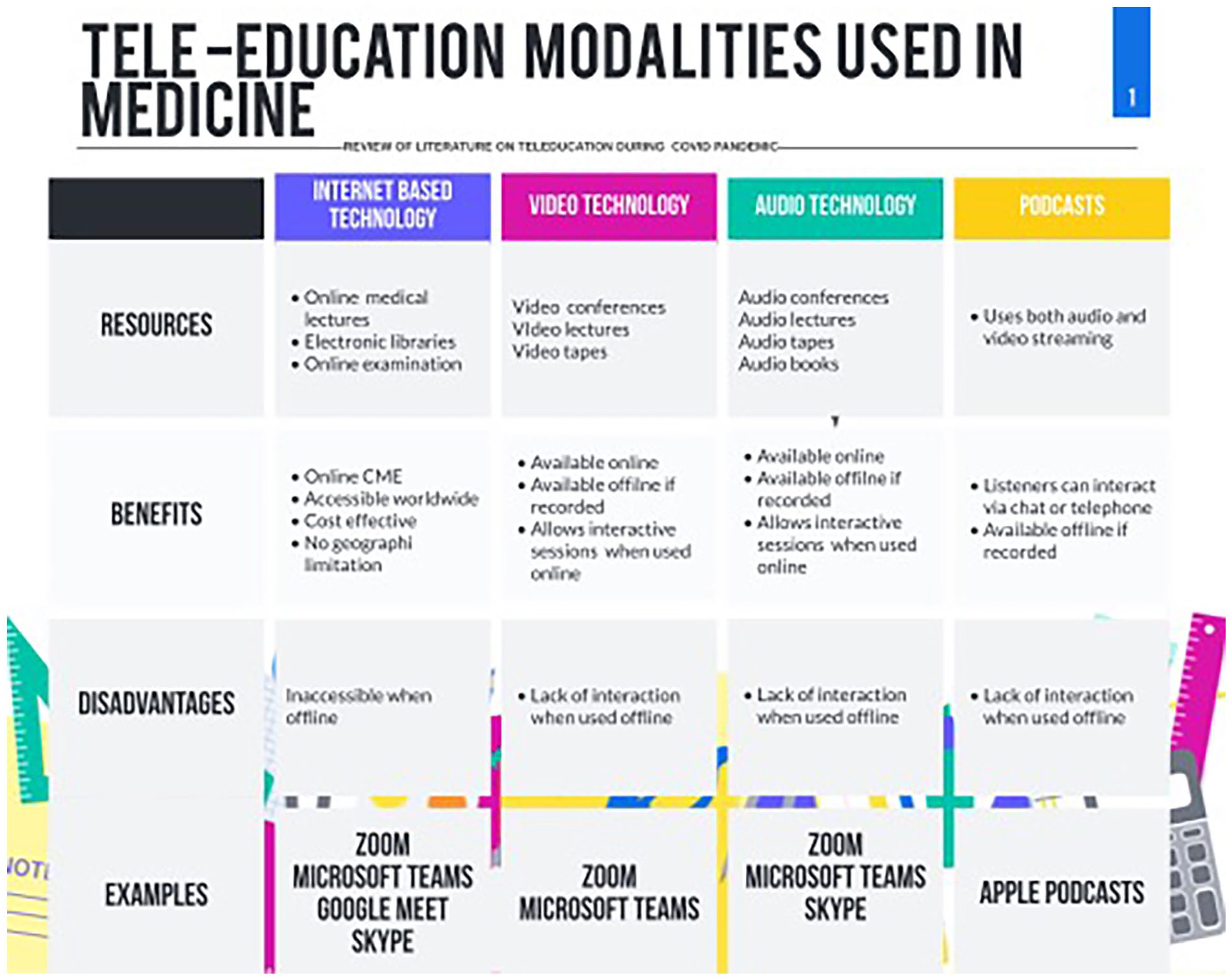
Affordability of the devices used in the tele-education are among the most common challenges faced by students engaged in tele-education. 8 This issue is important in the context of low-income countries 33 where students have limited budget. Availability of high speed internet is another challenge for rural dwellers and the developing world students. 34 Affordability of the data packages still remains a challenge faced by some students.14,30 Visual disturbances, due to excessive exposure to electronic devices can lead to problems in young students who may not know how to operate these devices effectively.16,35,36 Communication between the learner and the instructor, especially for evaluation of the students examination was a challenge faced in some regions. 37 Student-to-student interaction and student to teacher interaction, an environment like class may not be ensured at the same level as in-person attendance.30,38 Interruption of the streaming may result in inconvenience and a poor quality experience.38,39 Progress and monitoring of the students may be effected and may not be as accurate in some cases. 29 Unethical activities were experienced in some settings of students which could not be monitored directly. 29 Distractions in the household for example, babysitting of children or pets can affect the progress of some students. 35
Conclusion
Tele-education has emerged as a solution for medical education needs across the globe, during the COVD- 19 pandemic. Since candidates could not travel, interviewing was done online during the COVID-19 pandemic. The tele-education helped overcome the challenge of recruitment and training. It is convenient, equitable, cost-effective, and sustainable. Those using online interviews are recommended to take 3 to 7 h for interviewing to better acquaint candidates with the program. Use of tele education for mentoring has been explored with positive reviews. Surgical specialties where direct supervision could be important for surgical skill development need further research in tele educational training of residents. Future job placement of COVID-19 era trainees is an area that needs explored further.
Footnotes
Acknowledgements
We thank the “Johns Hopkins-Afghanistan Pakistan International Collaborative Trauma and Injury Research Training program,” [grant number D43- TW007292] from the Fogarty International Center of the United States National Institutes of Health, for supporting the PhD of student SM. The content is solely the responsibility of the authors and does not represent the views of Fogarty or NIH.
Author Contributions
SM contributed to design and final editing of manuscript. TK, JK, JK, FUH conducted literature search and review. RK was involved in conception and review of the manuscript. All authors have reviewed and approved the final draft.
Author Disclaimers
Views that are reposted in this article are authors own views and do not reflect views of their official institutions.
Declaration of Conflicting Interests
The author(s) declared no potential conflicts of interest with respect to the research, authorship, and/or publication of this article.
Funding
The author(s) received no financial support for the research, authorship, and/or publication of this article.
