




Abstract
To investigate the levels of witnessing risky behaviors in workplaces, such as sexual violence, and identify the factors associated with sexual violence awareness among employees. An online survey was conducted on 336 workers (aged 20-65 years), registered in an online survey company in Korea. The survey was conducted from September 15, 2021, to September 17, 2021. The participants were divided into equal quotas sampled on the basis of sex and age (participants’ average age was 44 years, among whom 171 were women [50.9%] and 165 were men [49.1%]). The questionnaire contained items pertaining to demographic characteristics, gender consciousness, sexual violence awareness, witness experience, situational empathy distress, self-efficacy, and self-esteem. The collected data were analyzed using descriptive statistics, Pearson’s correlation analysis, and multiple regression. Sexual violence awareness was lower among male workers than among female workers (P < .001), and sexual harassment and violence accounted for 54.8% of cases witnessed. The predictors of sexual violence awareness were age, gender consciousness, situational empathy, and self-esteem, with these factors explaining 53.9% of the variance. The findings highlight the need for strategies to improve sexual violence awareness and bystander intervention that are tailored to demographic predictors, such as sex, age, total length of employment, and position. These results could provide foundational data for developing sexual violence prevention education programs and practical bystander intervention programs focused on coworkers as well as promote relevant policymaking.
Previous studies have focused on the victims of sexual violence to identify factors that can affect the prevention of such incidents and post-event coping strategies.
Demographic predictors can be used for formulating strategies for sexual assault awareness education and co-worker intervention.
Education and policy development are needed to facilitate the involvement of co-workers in workplace sexual violence prevention education rather than taking a victim-centered approach to adequately address and prevent sexual violence in the workplace.
Introduction
In October 2017, the #MeToo movement began worldwide, with the New York Times reporting an allegation of sex crimes in Hollywood. 1 After the eruption of the #MeToo movement in the Korean cultural and entertainment industry in 2017, followed by a series of incidents pertaining to workplace sexual violence, including death of a sexually harassed, non-commissioned officer, the topic attracted great interest. However, only approximately 1.7% of sexual violence cases have been reported to the police, 2 and up to 62.6% of sexual violence victims believe that reporting these cases is pointless.2,3 “Sexual violence” refers to all behaviors that inflict physical and mental damage on others through unwanted sexual activity; it is an overarching construct that encompasses all sex-related crimes, including sexual harassment, sexual assault, and rape. 4 All violence pertains to gender stereotypes and experiences of abuse or damage from family violence, and sexual violence is a major public health and safety issue worldwide. 5 As victims continue to be partly blamed, and the atmosphere that forces them to remain quiet and move on is still rampant in workplaces; risky behaviors, such as deliberate contact, unwelcome sexual advances, verbal conduct in workplaces, and rape, persist. Despite sex offenders being punished in all countries, as well as education on and prevention of sexual violence in workplaces being promoted, sex-related crime incidents have not been substantially reduced.
To prevent sexual crimes, South Korea mandated sex violence prevention education in 2010, allowing daycare centers, kindergarteners, elementary, middle, high school students, college students, and office workers to receive more than 1 h of such education each year. Most of the education consists of teacher-centered lectures. However, there is a risk of instilling a false perception that sexual violence may occur because of the victims, primarily in the case of biological content and victim-centered content. 3
Sexual violence victims suffer from post-traumatic stress for prolonged periods following the incident,3,6 and sexual violence problems cannot be resolved solely on the basis of the victims’ statements. Thus, prevention strategies with the assistance of the individuals associated with the victims are essential.7-9
For responding appropriately to and for preventing workplace sexual violence, collective action of coworkers, that is, people who share the workplace environments and situations, is more important than taking a victim-focused approach. In particular, in South Korea, acting against the will of a boss or senior leads to inconvenience, and there is a vertical workplace culture, in which obedience to instructions is both a moral and an invisible discipline. For this reason, if the perpetrator has a position of authority with power over decisions pertaining to the workers’ progress, promotions, and selections,10,11 workplace sexual violence cannot be resolved without the collective efforts of the coworkers who spend a substantial amount of time together, both directly and indirectly, and this affects both the victim as well as the other coworkers. Consequently, it can have an adverse impact on the organizational climate and productivity.
Once a sexual violence incident occurs at a workplace, coworkers become bystanders. Their gender consciousness and sexual violence awareness may influence their roles in such a situation.9,12 Awareness of gender equality refers to a fair attitude, free of discrimination, regarding the roles, status, and relationships between men and women, and awareness of sexual violence refers to the “degree of recognition that an act constitutes sexual violence.” If coworkers become active bystanders, rather than simple witnesses, they can function as unofficial social regulators for any harassment that occurs in the environment and thus lower the rates of incidents pertaining to sexual violence.13,14 For coworkers to become active bystanders and undertake these roles, they must be aware of the harassment situations. Hence, as members of an organization, they require gender consciousness, awareness of sexual violence, self-efficacy, and self-esteem. In this context, this study aims to investigate the level of gender awareness in the workplace, the degree of recognition that a co-worker’s behavior is sexual violence, and the feelings when witnessing sexual violence. It also aims to explore the frequency of being a witness or being given an opportunity to intervene in risky situations in which sexual violence toward co-workers can occur, as well as any dangerous situations that may arise as a result of sexual violence. Moreover, we hope to contribute to future research aiming at developing education programs and relevant policies to promote bystander intervention and the undertaking of upstander roles, focused on coworkers, to enhance gender sensitivity and prevent sexual violence in workplaces.
Methods
Study Design
This descriptive survey aimed to investigate Korean workers’ history of witnessing or intervening in risky behaviors, including sexual violence, in workplaces and to examine workers’ gender consciousness, sexual violence awareness, situational empathy and distress, self-efficacy for intervening in situations, and self-esteem for preventing risky behaviors at workplaces.
Participants
Data were collected from employed individuals aged 20 to 65 years registered with Macromill Embrain Co., an online survey company, from September 15, 2021, to September 17, 2021. The participants were quota-sampled by sex and age. The sample size was determined using G* Power 3.1.9.7 (Universität Düsseldorf, Düsseldorf, Germany). The 14 predictor-variables were analyzed using multiple regression with a 5% significance level, .15 effect-size f2, and 95% power, and the minimum sample size was 194. A request for study participation was sent to approximately 2722 randomly selected email addresses of adult men and women aged 20 to 65 years who voluntarily registered with a Korean online survey company, and 336 participants completed the survey. We used a system in which markedly short response times or omission of responses prevented advancement to subsequent questions. Those who did not provide consent for participating in the study and those who withdrew their participation were excluded from the analysis.
Tools and Methods
Participants’ demographic characteristics
Demographic characteristics included sex, age, total length of employment, marital status, education level, monthly income, economic status, and prior sexual harassment education in the workplace.
Gender consciousness
The Korean Gender Egalitarianism Scale (Short Form) developed by the Korea Women’s Policy Institute was used. 15 This instrument was validated in 2016 and 2018; in 2018, its convergence validity was r = .905 (P = .01), and its Cronbach’s α was .875. 15 Each of the 12 items was rated on a 4-point scale, with responses ranging from 1 (strongly disagree) to 4 (strongly agree), with a higher score indicating lower awareness of gender equality. The Cronbach’s α was .874 in this study.
Sexual violence awareness
Sexual violence awareness refers to the degree to which an individual recognizes sexual violence; it was assessed with the sexual violence scale used in the triennial Sexual Violence Survey conducted on Korean men and women aged 19 years or older. 3 Five items for dating violence and cyber sexual violence were included in the 10-item questionnaire that was used in 2016. Each item was rated on a 4-point scale, with a higher score indicating poor sexual violence awareness. The Cronbach’s alpha values were .823 in the first study in 20193 and .820 in this study.
Witnessing sexual violence
We used the instrument adopted in the study on interventions to reduce risky sexual violence-related behaviors in the US army. 16 The author of this tool identifies suicide and alcohol use as dangerous behaviors that are closely related to sexual violence, and this 9-item instrument assesses witnessing of risky behaviors and intervening after witnessing such incidents; it comprises 3 types of situations: those related to alcohol, sexual violence, and suicide. To determine how often an intervention opportunity presented itself and how often individuals would actually intervene, each of the 3 situations was rated based on 1 of 3 responses: 1 “yes, and I have intervened in any way possible,” 2 “yes, but I have not intervened in any way,” and 3 “no, I have not witnessed such a situation.”
Situational Empathy-Distress Scale (SEDS)
We used the 16-item Situational Empathy-Distress Scale (SEDS) developed by Lee. 17 This scale measures an individual’s situational empathy and level of distress upon seeing a person in a risky situation; situational empathy and situational distress were surveyed using 8 items each. The level of emotion described in each item is rated on a 5-point scale, with a higher score indicating stronger feeling of empathy or distress in the situation. The Cronbach’s alpha values were .85 for situational empathy and .87 for situational distress at the time of development 17 ; they were .887 and .92, respectively, in this study.
Self-efficacy
In this study, self-efficacy refers to the social self-efficacy to assist with or intervene in a situation that calls for an individuals’ involvement; it was measured using the scale for rescue behaviors developed and validated by Kang and Kim. 18 The 8 items in this scale are rated on a 6-point Likert scale, with a higher score indicating greater social self-efficacy. The Cronbach’s alpha values were .84 at the time of development 18 and .88 in this study.
Self-esteem
Self-esteem was assessed using the Rosenberg Self-Esteem Scale. 19 The 10 items of this scale were rated on a 4-point Likert scale, with a higher score indicating greater self-esteem. The Cronbach’s alpha values were .92 at the time of development 19 and .825 in this study.
Data Analysis
Data were analyzed using the Statistical Package for the Social Sciences (SPSS) 23.0/PC software (IBM Corp., Armonk, NY, USA). First, participants’ general characteristics and differences among them with respect to the study parameters, were analyzed using descriptive statistics. Second, the relationships among the related variables were analyzed using the Pearson correlation analysis. Third, differences in characteristics according to witnessing experience were analyzed using logistic regression, and the predictors of sexual violence awareness were identified using stepwise multiple linear regression.
Results
Demographic Characteristics
For this study 336 participants were enrolled, which included 165 men (49.1%) and 171 women (50.9%). The mean age was 44.22 (±12.61) years, and the predominant marital status was married/other (n = 203, 60.4%). The mean length of employment was 15.02 (±10.37) years. The mean length of employment and monthly income were significantly higher among men than among women. Of the participants, 222 (66.1%) had prior workplace sexual harassment education, and there was no gender difference. Gender consciousness, sexual violence awareness, situational empathy, and social self-efficacy significantly differed between genders (Table 1).
Gender Differences in General Characteristics and Main Variables (N = 336).
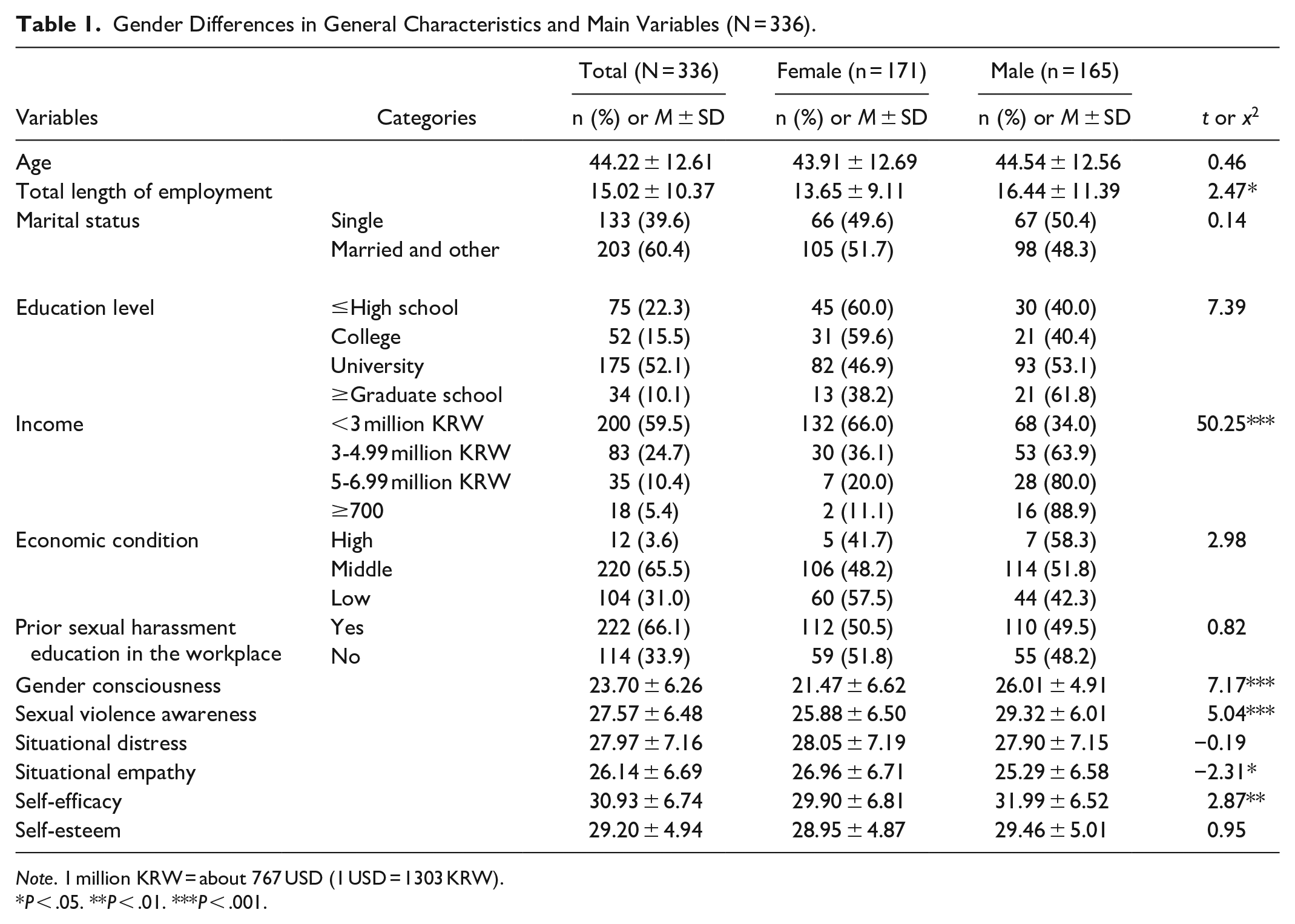
Note. 1 million KRW = about 767 USD (1 USD = 1303 KRW).
P < .05. **P < .01. ***P < .001.
Witnessing Sexual Violence
Out of all the study participants, 72.3% had witnessed at least 1 out of 9 risky behavior scenarios in their workplaces, including “a coworker/friend seemed to be planning to kill themselves” (9.2%) and “a friend’s or coworker’s drinking problem regularly disturbing their work or personal life” (41.7%). The most common category of risky behavior witnessed was alcohol misuse or abuse (61.0%), followed by sexual harassment and violence (54.8%) and suicide-related behaviors (28.6%) (Table 2). We compared the characteristics of witnessing risky behavior using the logistic regression for intervening upon witnessing and those for not intervening upon witnessing. The results showed that situational empathy was significantly higher when at least one sexual violence (OR = 1.076, P = .009) and suicide-related behavior (OR = 1.042, P = .047) was observed.
Participants Who Reported Witnessing Risky Behaviors Related to Suicide-Related Behaviors, Alcohol Misuse, Sexual Harassment, and Assault (N = 336).

Correlations Among Related Variables
Table 3 illustrates the correlations among the related variables, namely the total length of employment, gender consciousness, sexual violence awareness, situational distress, situational empathy, social self-efficacy, and self-esteem.
Correlation Among Variables.

P < .05. **P < .01. ***P < .001.
Predictors of Sexual Violence Awareness
Age, sex, total length of employment, monthly income, and related variables that were significantly different from those related to sexual violence awareness in previous studies were included in the multiple regression analysis in this study. The results revealed that age (β = .129, P = .043), gender consciousness (β = .619, P < .001), situational empathy (β = −.13, P < .001), and self-esteem (β = −.107, P = .014) were significant independent variables that predicted sexual violence awareness, and this model explained 53.9% of the variance (F = 31.13, P < .001) (Table 4).
Factors Influencing Perception of Sexual Violence.

Note. R2 = .557, Adjusted R2 = .539, F = 31.13, P < .001.
Discussion
This study aimed to investigate the frequency at which workers witness risky behaviors that involve coworkers in workplaces, to identify the predictors of sexual violence awareness among workers and to subsequently provide foundational data for preventing risky behaviors—such as sexual violence at workplaces. The mean sexual violence awareness score of the participants was 27.57 (±6.48).
In our study, men demonstrated significantly lower sexual violence awareness than women (P < .001). This is consistent with the Ministry of Gender Equality and Family’s Sexual Violence Survey of adult men and women and supports previous findings that gender influences sexual violence awareness3,20 and that men generally have a more lenient view regarding sexual violence than women.21,22
Further, this study showed a correlation between the total length of employment and the degree of sexual violence awareness, and as age increases with increasing length of employment, this is relevant to our result that age is a predictor of sexual violence awareness. This result supports Lee et al’s 21 finding that older individuals have a more lenient view of sexual violence compared to their younger counterparts. Thus, demographic characteristics, such as sex, age, and total length of employment, should be considered when designing programs to enhance sexual violence awareness and counseling services for workers.
In this study, men demonstrated significantly poorer gender equality awareness than women (P < .001), which is consistent with the findings of existing studies in Korea and abroad.10,15,20 Globally, older men are predominantly in positions of authority at workplaces, and considering that women generally assume lower positions, have shorter lengths of employment, and are generally younger in Korea, gender consciousness that does not align with the period and culture may easily provoke conflict across genders, generations, and job positions. Thus, gender sensitivity must be ameliorated continuously and universally to resolve workplace conflicts, such as unintended sexual harassment, and subsequently potential risky sexual violence-related behaviors can be prevented.
In a study by Elliman et al 16 consumption of alcohol (30.2%) was the most common risky behavior category witnessed in workplaces, followed by suicide (24.3%) and sexual harassment and violence (23.2%). In contrast, the most common risky behavior category in our study was alcohol (61.0%), followed by sexual harassment and violence (54.8%) and then suicide (28.6%), and the rate of sexual harassment and violence was more than 2 times higher than that in the aforementioned study. This suggests that sexual harassment and violence are very common in workplaces in Korea.
A negative correlation was observed between situational empathy and self-efficacy in our study; this may be attributed to the practical difficulties in witnessing risky situations (eg, sexual violence) in workplaces. In Korea, the spatial environment at work often indirectly indicates corporate hierarchy. 8 That is, senior management personnel often have private office spaces at work, which makes it difficult for other employees to witness any sexual violence that may occur in these private spaces. To promote coworkers’ bystander intervention in risky situations, such as those related to sexual violence, conditions that enable recognition of such a situation are important. Thus, educating employees and introducing them to possible cases in which they witness risky behaviors is important to help them better recognize and monitor risky situations and bystander intervention opportunities. Further, redesigning spatial environments in workplaces, such as implementing open-space offices, should be discussed to foster environments that enable natural surveillance.
In addition to age and gender consciousness, situational empathy was significantly associated with sexual violence awareness. Considering that both perpetrators and victims are coworkers, and victims of workplace harassment such as sexual violence are mostly younger or in lower positions, participants may have empathized with the victim more substantially in the SEDS. However, additional studies are required to further examine the use of the SEDS with different samples, as the SEDS 17 was developed considering undergraduate students, whereas our participants were working adult men and women aged 20 to 65 years and thus may have different social values (eg, views of making a living) and emotional states. Self-esteem was also identified as a predictor of sexual violence awareness. As this construct refers to a belief in one’s competence to accomplish certain tasks, it might have had a significant influence on working individuals who value performance and outcomes.
Actively attempting to resolve a problem, such as if a coworker has fallen victim to sexual violence and needs help, is a good thing for witnesses. Even if the problem cannot be resolved, simply showing interest and attempting to learn about it would be a significant step toward preventing sexual violence in workplaces. Such endeavors influence the organizational cultures and further enhance individuals’ self-esteem, thereby contributing to boosting organizational performance and cultivating an advanced workplace culture.
However, the study data were obtained from a subset of the working population in Korea; therefore, the findings have limited generalizability to the entire population. This study was conducted only on consenting participants recruited through a random e-mail sent to Korean workers who were registered with online survey companies; therefore, it does not represent the majority of Korean employees who are not registered with online survey companies. Moreover, witnessing and intervening in risky behaviors, such as sexual violence, can be influenced by the size of the workplace, the number of employees, and the industry-specific atmosphere. Therefore, additional research should be conducted on a wider range of people, including those not registered on an online survey, and according to the size of the workplace and the type of industry.
Additionally, this study was conducted during the COVID-19 pandemic, and hence factors pertaining to mental health may have affected the outcome of psychosocial measures, including experiences of the witnesses. In particular, as COVID-19 is related to various mental health factors, including depression, sleep deprivation, stress, and fear, 23 it is necessary to consider the relationship between the psychological health of the study participants and the organizational culture of the workplace. Hence, we recommend that future studies can be undertaken, after the COVID-19 pandemic is over, to investigate sexual violence awareness in more detail according to the characteristics and scope of workplaces.
Conclusion
For Korean workers, men, older individuals, and those with longer working years had a lower perception level of sexual violence, indicating a low level of awareness; sexual harassment and violence accounted for more than half of the cases witnessed. The predictors of sexual violence awareness were age, gender consciousness, situational empathy, and self-esteem, with these factors explaining 53.9% of the variance. This study’s findings highlight the need for strategies to improve sexual violence awareness and bystander interventions that are tailored to demographic predictors, such as sex, age, total length of employment, and position. These results may serve as foundational data to develop practical education programs and promote interventions by witnesses and the undertaking of upstander roles focused on coworkers.
Footnotes
Acknowledgements
The authors would like to acknowledge the participants for sparing their valuable time to participate in the survey.
Data Availability Statement
Data sharing is not applicable to this article as no datasets were generated or analyzed during the current study.
Declaration of Conflicting Interests
The author(s) declared no potential conflicts of interest with respect to the research, authorship, and/or publication of this article.
Funding
The author(s) disclosed receipt of the following financial support for the research, authorship, and/or publication of this article: This work was supported by the Basic Science Research Program through the National Research Foundation of Korea (NRF), funded by the Ministry of Education (No. NRF-2020R1I1A3065986).
Consent to Participate
All study participants provided written consent for their participation.
Ethics Approval
This study was approved by the Institutional Review Board of Jeju National University (Approval No. JJNU-IRB-2021-063) after reviewing for purpose, method, information sheet, consent form, and confidentiality. We further certify that the study was performed in accordance with the ethical standards as outlined in the 1964 Declaration of Helsinki and its later amendments or comparable ethical standards.
Participants
Data were collected from employed individuals aged 20 to 65 years registered with Macromill Embrain Co., an online survey company, from September 15, 2021 to September 17, 2021.
