



Abstract
The avalanche of Corona Virus 2019 (COVID-19) cases has placed an unprecedented load on Afghanistan’s government and public health authorities, putting the country in jeopardy. The primary goal of this research was to shed light on the country’s capital, Kabul, and to examine the existing preparedness and perceptions of its population in the midst of COVID-19’s third wave, which could result in decentralization and fragmentation of the already overburdened health-care system. An online, cross-sectional survey was conducted by the lecturers of the Kabul University of Medical Sciences between April 15, 2021 and April 25, 2021, to evaluate the preparedness of the Kabul citizens amidst the third wave of COVID-19. About 1736 citizens from Kabul participated in the survey. Data was analyzed using Statistical Package for Social Sciences (SPSS) version 25. All categorical variables were reported using frequencies and percentages. The findings revealed that the most common source of COVID-19-related information was social media (74.8%). In addition, 34.4% of subjects had previously been infected with COVID-19. It was reassuring to see that 78.4% of residents said they knew more about COVID-19 than they did about prior COVID-19 waves. A majority (81.5%) expressed willingness to resist the third wave, but 89.4% said that the country’s government would be unable to develop an effective COVID-19 vaccine within the next 6 months. The findings of this present study indicates that citizens of Kabul are active in obtaining accurate information and disseminating it in the community. The citizens also reported sufficient COVID-19 related knowledge; however, they were more motivated to fight against the third wave of COVID-19. In regards to vaccination, they believed that the government could not vaccinate the public anytime soon. Hence, the enactment of non-pharmaceutical measures is important in the fight against the pandemic.
The COVID-19 pandemic has taken various trends in Afghanistan. The country has entered the third wave of the pandemic. The third wave has escalated the health issues for government and public health authorities. Hence, majority of the population are infected with the virus. However, due to a lack of strong surveillance system, the true figure of the pandemic is not clear.
The present study aims to evaluate the preparedness of the general population in third wave of the COVID-19 to provide an estimate of the COVID-19 trend in the country. Moreover, the study is expected to fill the paucity of data and literature on the COVID-19 pandemic in Afghanistan.
This research article assesses the preventive practices among the general population during the third wave of the pandemic. The results of this study can help health policymakers devise strategic plans for the management of the COVID-19 pandemic.
Introduction
Background
The Corona Virus 2019 first emerged as a cluster of unusual pneumonia-like illnesses in the city of Wuhan, China in late December 2019. 1 Owning to the rapid transmissibility of the Severe Acute Respiratory Syndrome Coronavirus-2 (SARS-CoV-2), the disease spread across international borders affecting nearly 219 countries and territories so far.2,3 The pandemic has enormously affected the health-care systems to a state of exhaustion. Vulnerable communities and low-income countries have been disproportionately impacted during this health crisis which are already suffering from numerous challenges. These challenges include, poor health infrastructure with limited diagnostic and treatment settings, under-funded and neglected public health sector, weak health-care systems, and lack of public health education. 4
Afghanistan, a low-income country with an estimated population of 31.6 million, has been hit hardly by the COVID-19. The country has been suffering from devastating wars, conflicts, and poverty from the early days resulting in a weak public health system. The onset of COVID-19 pandemic has intensified the existing critical situation in Afghanistan. 5 The country is currently going through the third wave of the COVID-19 as the cases continue to surge. As of January 11, 158 452 cases of COVID-19 and 7374 deaths have been confirmed by healthcare authorities. 6
Kabul, the capital city of Afghanistan, is considered one of the fast-developing and densely populated cities in the world.7,8 The city has a cold, semi-arid climate with a total population of 4.4 million. 9 The highest infection rate has been reported from Kabul province during the pandemic. A study classified the country’s 34 provinces into 9 zones. Kabul was considered a single zone, with the Coronavirus affecting 53% of the total population. 10 Moreover, the current political climate which has started after the withdrawal of US and international allies plighted the capital, Kabul, and all the country, has overshadowed the country’s response to COVID-19. 11 Therefore, a truer and clearer picture of the pandemic cannot be estimated. Recently, the country is suffering from ventilation supply and bed capacities. These problems taken together have overburdened the healthcare system. 12
The highly contagious nature, and mortality of the COVID-19 is said to have a positive correlation with population density. 13 Due to the insufficient quantity and uncertain role of vaccines in curbing the infection, the best principle to fight against the COVID-19 is by following infection prevention protocols such as hygiene practices, and social distancing. 14 Unfortunately, the Kabul residents appeared to have been massively infected due to non-compliance to the infection prevention advices as recommended. 15 The knowledge gap concerning the COVID-19 pandemic remains a great challenge given that a huge portion of the country’s population are illiterate. However, in a study conducted in Mbale Uganda, knowledge of the community toward COVID-19 was moderate and good which had a positive impact on the pandemic response. 16 Similarly, in a study conducted in Zimbabwe, the spread of myth and untrusted information related to COVID-19 had an undesirable impact on the people. 17
Meanwhile in Afghanistan, the overwhelming cases have put a huge burden on the Kabul’s public health sector due to limited medical facilities including COVID-19 testing kits, primers, and equipment, in addition to the misuse of the resources available. 18 The existence burden of the pandemic is overwhelming the country’s healthcare system amidst the prolonged uncertainty in the country.
Objectives
This study aimed to assess the preparedness and perceptions of the Kabul residents during the third wave in order to shed light on the current situation and provide some useful insights to be used in designing appropriate programs to reduce the infection rates and negative consequences. In addition, the study would also provide additional insights for health policymakers to report the current situation of the COVID-19 trend to the global community and relevant stakeholders.
Material and Methods
Study Design and Sampling
A cross-sectional study was performed from April 15 to April 25, 2021 among the general public using online questionnaire in Kabul, Afghanistan. The participants were selected using non-probability convenience sampling in this online survey. The sample size required for the study was calculated using Morgan’s Table. Considering the total Kabul citizens to be 4 400 000, 7 at 99% confidence interval with 3% margin of error, the calculated sample size was estimated to be 1067. Due to wider outreach of the survey, a total of 1736 responses were received.
Survey Instrument and Tool Administration
A self-reporting questionnaire was developed based on the published similar studies19-22 in English language, and then translated into Persian language to be used for data collection. Three subject matter experts reviewed the questionnaire to make sure the content was valid and appropriate for the study. The questionnaire was modified based on their feedback and suggestions. Furthermore, a pilot study was also pretested among 20 potential participants that yielded the questionnaire to be comprehensive, easily accessible, understandable. It took 2 to 5 min to complete the survey.
The survey questionnaire was distributed online via social media platforms such as Facebook and WhatsApp. Citizens who volunteered to participate in the study were allowed to answer the questions only once, and were given the option to terminate the survey any time they felt uncomfortable within the study period without any consequences.
The questionnaire consisted of an introductory paragraph which briefly explained the aim of the study, a description on voluntary participation, a declaration of anonymity and confidentiality, and a mandatory informed consent obtained from all participants. Participants who were less than 18 years old, and those who refused to provide informed consent were excluded from the study. It was also mentioned that the findings of the study shall be published anonymously through an academic paper.
Four items of the questionnaire accessed the demographic information including gender that is, male or female; age (<20, 20-40, 41-60, and >60 years); educational level (post-graduate, bachelor’s degree, university student, school graduated, school student, and no formal education); and location of residency (Kabul city, and Kabul districts) of the participant. The remaining items assessed the source of COVID-19 information, previous history of COVID-19 infection, confidence in controlling the COVID-19 pandemic, confidence in winning the COVID-19 war in Afghanistan, and finally, the possibility of a COVID-19 vaccination in Kabul, Afghanistan, within the next 6 months.
Data Analysis
All incomplete questionnaires were removed from the final analysis. The statistical analysis was conducted using Statistical Package for Social Sciences (SPSS) version 25. All categorical variables were reported using frequencies and percentages.
Ethical Approval
This study was approved by the Research Ethics Committee of Microbiology Department of Kabul University of Medical Sciences (KUMS). Approval code: KUMS/ RECMD—89.
Results
Demographic Characteristics
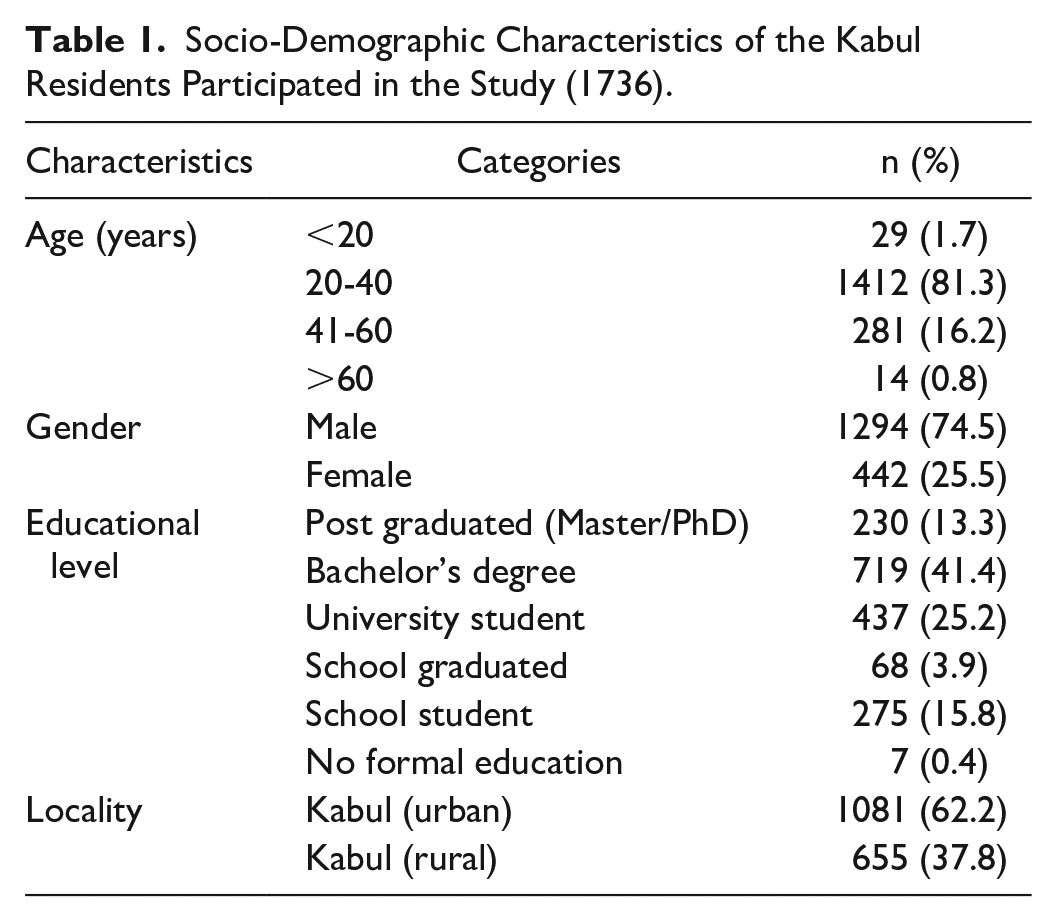
A total of 1736 Kabul residents participated in the online survey. Nearly two-thirds (62.2%) of them lived in Kabul in the Kabul city. Almost three-quarter (74.5%) of the respondents were males, and around 40% of them had a bachelor degree. Majority (81.3%) of the participants were in the 20 to 40-year-old category (Table 1).
Socio-Demographic Characteristics of the Kabul Residents Participated in the Study (1736).
Sources of Information
Social media was the most common source of information of the study participants (54.8%), followed by Television (31.7%) and community (9.6%). Remaining participants reported that they got the information through print media (magazines, newspapers), and other sources (Figure 1).
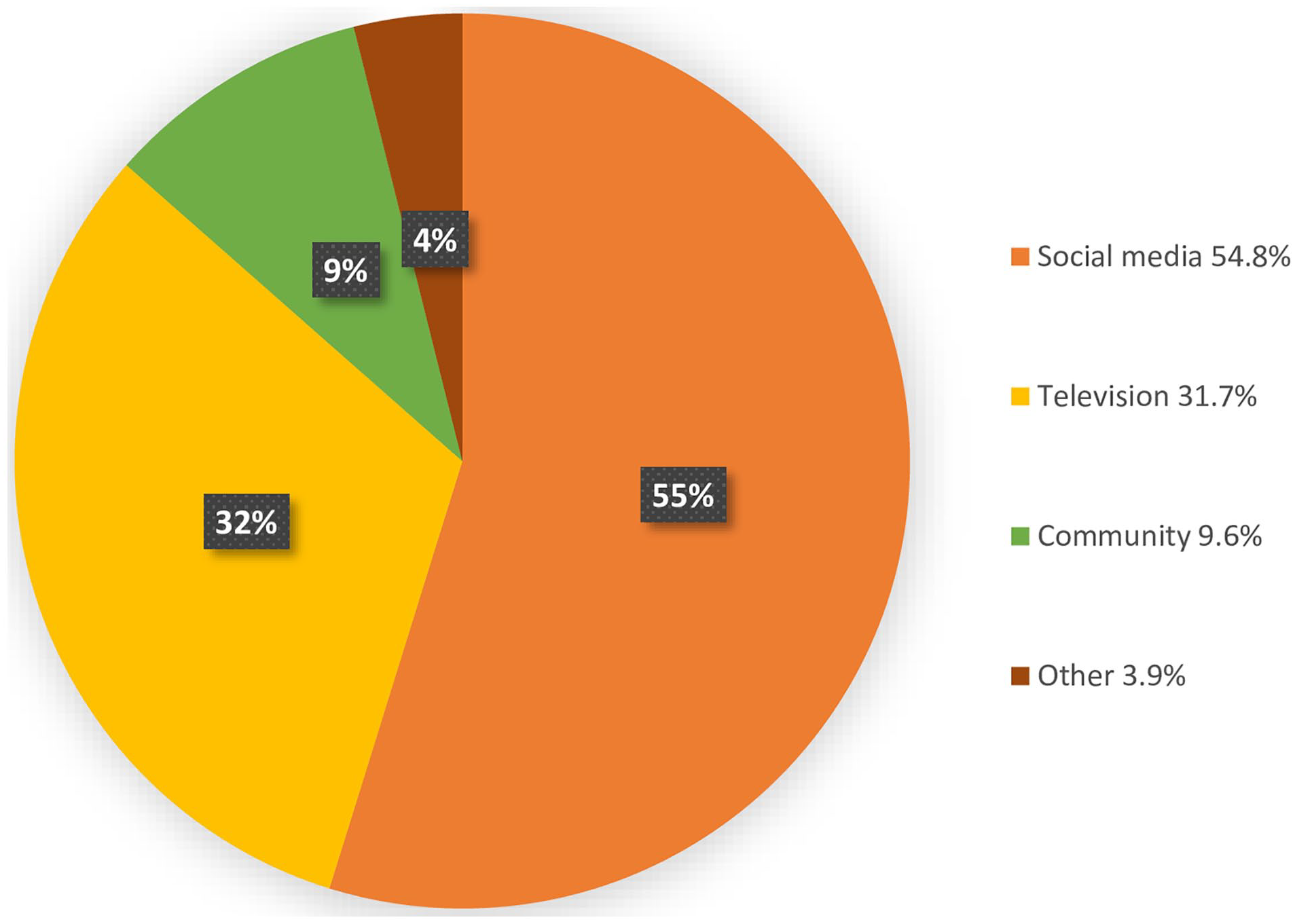
Sources of information.
Perception and Exposure in Regards to COVID-19
More than one-third of the participants reported that they were infected by the COVID-19 previously, while almost half of them reported the opposite and only 16% were not sure. Majority of the respondents (78%) thought that the COVID-19 will be successfully controlled.
Majority of respondents (76%) believed that Afghanistan can win the battle against COVID-19. Most of the participants (81.5%) showed their willingness to fight against the third wave of the COVID-19. Almost 9 out of 10 respondents did not think that the government would be able to vaccinate the Kabul residents in the next 6 months (Table 2).
Items to Explore Participants General Perception and Preparedness Among the Study Respondents (1736).

Discussion
Kabul, Afghanistan’s largest city and capital, is located in the country’s eastern region and faces a number of challenges that jeopardize an efficient and robust response to the ongoing COVID-19 pandemic. The data revealed that Kabul residents rely heavily on social media, highlighting the need for the government and health professionals to focus more on improving the reliability and authenticity of these media sources, as information conveyed through media channels has a significant impact on user behavior. False information was posted more than evidence-based information, according to an analysis of 2 days’ worth of tweets on Twitter. 23 False information has been regarded as a major public health hazard to governments around the world since the outbreak of the epidemic because it is easily distributed. 24
The World Health Organization (WHO) has also highlighted this issue, stating that the world is fighting a “infodemic” rather than an epidemic. 25 Furthermore, media information should be presented to the public by qualified professionals working in the field of public health. This may place a greater focus on correct information being covered by the media. 26 In doing such, the general public can easily receive accurate information and this will create an impetus in them for sharing genuine information.
To our knowledge, this is the first study which aims to evaluate the Kabul’s citizens perception and preparedness to fight against the third wave of the COVID-19. A majority of the participants indicated their willingness and preparedness to fight the pandemic, and also respondents’ level of knowledge and attitude were convincing, despite the spread of false information.
In this present study, we acquired the participant’s notion in the fight against COVID-19. Due to a lack of vaccine in the first wave of COVID-19, almost 3000 healthcare workers across the country have been infected by the virus and 65 healthcare workers have been died so far. 27 This can adversely affect the healthcare sector in a country where healthcare workers are already in fewer numbers. 5 However, with the media coverage of the information available, we found that, 81.5% of our respondents believed that they can fight against the COVID-19 pandemic using preventive health measures. This is very similar to a study conducted in Bangladesh where participants believed in the severity, and complications of COVID-19 disease. 28 In the study, 62.3% of participants had positive attitudes toward COVID-19, while 55.1% observed frequent practices regarding COVID-19 prevention. Only a minority of our respondents were not willing to fight against COVID-19 and neglected preventive health measures. This can presumably correlate to reasons such as poverty, and illiteracy. 25
Almost one-third of the participants reported to be previously infected by the COVID-19, which might be lower than the actual rate of the infection. Underreporting of the cases and low testing capacity have been identified as possible reasons for the lower reports. 29 In the context of Afghanistan, the high rate of illiteracy and poverty is one of the most alarming factors behind the rapid spread of the virus. 30 However, in our study majority (76%) of the participants showed a high confidence in winning the fight against COVID-19 since they belonged to an educated background, and followed all preventive measures necessary to eradicate the virus. Similarly, another study conducted among university students in the United Arab Emirates, indicated a significant level of confidence in eradicating COVID-19, 31 background education has proved to be a positive indicator in the fight against COVID-19. 32 On the other hand, myths and misinformation regarding COVID-19 can put unfavorable impacts on people. This was seen particularly in Bangladesh, where male respondents had incorrect knowledge regarding COVID-19. 33
The survey also found that almost 90% of the participants did not think that the government would be able to vaccinate the citizens of Kabul. Although the deployment of the vaccine from India enabled the vaccination program to begin in Afghanistan, 34 but due to the large population and limited number of doses provided it seems almost impossible to vaccinate a big proportion of the population required for achieving herd immunity.
Limitations
The chances of recall bias in each on-line survey could not be ignored. Participants were asked specific questions that might not cover all issues related to public perception and preparedness to fight such a critical infection. Furthermore, owing to the new culture of participation in online surveys, we tried to facilitate the participation of a large audience by designing a simple questionnaire, but in other side this simplicity became one of the limitations of this research.
Conclusion
The current pandemic does not appear to be going away as quickly as we might anticipate. To address such a large-scale catastrophe, the government and the general population should work together. In this situation, public awareness and empowerment remain the most effective technique. The most promising medium for sharing knowledge has proven to be social media. The present study also indicates citizen’s willingness to fight the COVID-19 pandemic. Vaccination campaign against COVID-19 may appear to be a relief, given the few doses available and the large number of people waiting for their vaccine shots, non-pharmaceutical measures will continue to be critical in combating COVID-19 in the country.
Supplemental Material
sj-docx-1-inq-10.1177_00469580221117743 – Supplemental material for Public Perception and Preparedness to Fight Against the Third Wave of COVID-19 in Kabul, Afghanistan
Supplemental material, sj-docx-1-inq-10.1177_00469580221117743 for Public Perception and Preparedness to Fight Against the Third Wave of COVID-19 in Kabul, Afghanistan by Arash Nemat, Farah Yasmin, Mohammad Yasir Essar, Nahid Raufi, Shoaib Ahmad, Abdullah Asady and Qingchun Zeng in INQUIRY: The Journal of Health Care Organization, Provision, and Financing
Footnotes
Acknowledgements
We sincerely thank all participants for taking part in answering the questionnaire.
Author Contributions
All authors made a significant contribution to the work reported, whether that is in the conception, study design, execution, acquisition of data, analysis and interpretation, or in all these areas; took part in drafting, revising or critically reviewing the article; have agreed on the journal to which the article has been submitted; and agree to be accountable for all aspects of the work. All authors attest they meet the ICMJE criteria for authorship.
Data Availability
Data cannot be shared publicly because of ethical restriction and respect for anonymity. Data are available upon request from Dr. Arash Nemat, Academic member of Microbiology Department, Kabul University of Medical Sciences via (
Declaration of Conflicting Interests
The author(s) declared no potential conflicts of interest with respect to the research, authorship, and/or publication of this article.
Funding
The author(s) received no financial support for the research, authorship, and/or publication of this article.
Ethical Approval and Consent
The study was conducted in accordance with the Declaration of Helsinki. All participants agreed to participate before filling the questionnaire. This study was approved by the Research Ethics Committee of Microbiology Department of Kabul University of Medical Sciences (KUMS). Approval code: KUMS/ RECMD—89.

Supplemental Material
Supplemental material for this article is available online.
References
Supplementary Material
Please find the following supplemental material available below.
For Open Access articles published under a Creative Commons License, all supplemental material carries the same license as the article it is associated with.
For non-Open Access articles published, all supplemental material carries a non-exclusive license, and permission requests for re-use of supplemental material or any part of supplemental material shall be sent directly to the copyright owner as specified in the copyright notice associated with the article.
