



Abstract
Keywords
• OTC products have gained popularity during the COVID-19 pandemic. Besides, healthcare providers received unprecedented numbers of consultations related to the safety and efficacy of OTC products to combat COVID-19. • Highlight the degree of healthcare providers’ acceptance of the use of OTC to combat COVID-19 pandemic. Furthermore, the present study shed the light on the healthcare provider’s familiarity with different aspects related to the safety and efficacy of the integration of OTC supplementation during the COVID-19 outbreak. • The present research can serve to establish a framework to influence future regulatory interventions related to OTC products’ use to promote patient safety, especially during pandemic diseases. Moreover, the present study highlighted the importance of organizing educational campaigns to sharpen healthcare provider’s skills in dispensing such products.
Introduction
Coronavirus disease-19 (COVID-19) is a global health crisis challenging healthcare systems worldwide. 1 COVID-19 is caused by a novel human coronavirus, severe acute respiratory syndrome coronavirus (SARS-COV-2). 2 The hallmark in severe COVID-19 is the aggravated flow of inflammatory mediators along with respiratory failure. 3 Risk factors for such potentially life-threatening manifestations include advanced age and the coexistence of chronic diseases. 3
Around the COVID-19 pandemic declaration’s anniversary, unprecedented variants were detected in different countries (CDC). 4 Given the lack of definitive treatment and alarmingly high recorded death rate, people still explore shielding therapies besides standard preventative measures, such as social distancing and hand hygiene.5,6 Self-medication with several over the counter (OTC) products claimed to improve immune function has spread. 7 The rationale of using such preventive supplements lies in their immune fortifying properties. 7 Ease of access and assumed efficacy are major causes of increased popularity. Vitamin C, vitamin D, and zinc were among the most OTC advertised products as immunity-boosting aids.8-12 However, there is a lack of consolidated scientific evidence to refute or accept such assumed roles in the COVID-19 pandemic. 13
People always turn to healthcare providers (HCPs) as trustworthy consultants to solve their general health uncertainties. HCPs from different disciplines are frontliners in battling the COVID-19 pandemic.14-16 In a recently published guide, WHO highlighted the importance of building competence by the health workforce in response to the COVID-19 pandemic. 17 Although the deployment of several vaccines later in 2020 flowered some hope to curb the spread of the pandemic, vaccination hesitancy poses a counteracting health threat.18-20 It is expected that OTC supplementation’s popularity continues to peak until sufficient trust is built to convince reluctant people to get the vaccine to tackle the COVID-19 pandemic.
As such and responding to the increased demands and inquiries related to such products, it is crucial to assess HCP perceptions toward popular OTC products. Thus, the present study aimed to evaluate HCP perceptions toward popular OTC dietary supplements and the level of familiarity with safety concerns related to the increased consumption of such products.
Methods
A cross-sectional study was conducted over six months (October 2020 to March 2021). An online questionnaire was posted through different social media portals, including Facebook and WhatsApp, to recruit a convenient sample of HCPs in Jordan. At first, consent information was provided to potential respondents; per their agreement, they were directed to research instrument on Google forms.
In regards to sample size calculation, the estimated population size in Jordan is 10 million, and the facts reported by Nazer et al. 21 about workforce in Jordan indicated that it consists mainly of physicians, pharmacists, dentists, and nurses with nurses representing (44%), followed by physicians (25%), pharmacists (16%), and dentists (15%). Accordingly, the estimated total number of healthcare force in Jordan is around 101,600 (including physicians, dentists, pharmacists, and nurses). Based on the Raosoft online calculator, it was anticipated that a sample of 383 respondents would enable us to achieve the study objectives. 22
Our research instrument consisted of four main sections: (1) Demographic characteristics and general attitudes toward popular OTC products (e.g., age, gender, marital status, place of residence, educational level, profession, practice sector, income, and self or relative status of infection with COVID-19. (2) HCP levels of agreement with the use of popular OTC supplements, which comprised 18 items (9 items focused on vitamins and minerals, eight items on herbal and natural products, and the last item asking about the overall agreement in general) were assessed using a five-point Likert-type scale of agreement. (3) Respondents concerns about the safety of OTC products in users which comprised eight items with a three-point Likert-type scale. (4) Respondents’ confidence about recommending dose regimens and educating patients about side effects of these products, comprising 16 items with a five-point Likert-type scale. Finally, few items on their main sources of information and their beliefs about other health-related behaviors (e.g., vaccination, smoking cessation, stress management, and sleeping and eating well) were included.
The survey instrument was constructed after a thorough review of the literature.14,15 Close-ended structured items were developed and modified (in English) by researchers. Several academic experts from healthcare professions assessed the research tool to ensure its content and face validity. Obtained feedbacks and comments were reviewed and applied to refine the questionnaire accordingly. The Institutional Review Board approved the protocol of this study at Jordan University of Science and Technology (no. 20210025).
In order to quantify the perception of HCPs toward OTC supplementary use, the confidence to concerns ratio (CCR) was calculated. Since the confidence scale contained 16 items while the concerns scale contained eight items, the confidence to concern ratio was adjusted. A correction factor, K, was computed by dividing the number of concern items (8) over the number of confidence items (16). Hence, the confidence to concerns ratio was calculated using the equation below

CCR can be interpreted with respondents scoring 1.0 and higher to have positive perceptions of OTC supplements' benefits. On the other hand, respondents scoring less than 1.0 generally perceive these products with more concerns than benefits.
Following data collection, data was extracted into Excel and then imported for coding, cleaning, and analyses into the Statistical Package for Social Sciences (SPSS) version 25 (SPSS Inc., Chicago, IL, USA). Descriptive statistics were used to summarize data for the total sample using numbers and percentages and means (±SD) as appropriate. Further, the reliability of scales was assessed and reported using Cronbach alpha as applicable.
Total scores were calculated, and comparisons of perceptions between different groups were conducted by non-parametric tests (Wilcoxon–Mann–Whitney and Kruskal Wallis tests). Associations between categorical variables were assessed using the chi-square test, while the Spearman correlation test was used to test the association between continuous variables. The multivariate logistic regression model was performed to assess the impact of different factors on obtained perception scores. A 5% level of significance was considered statistically significant.
Results
Demographic Characteristics and General Attitudes Toward Dietary Supplements Among Study Respondents (N = 600).
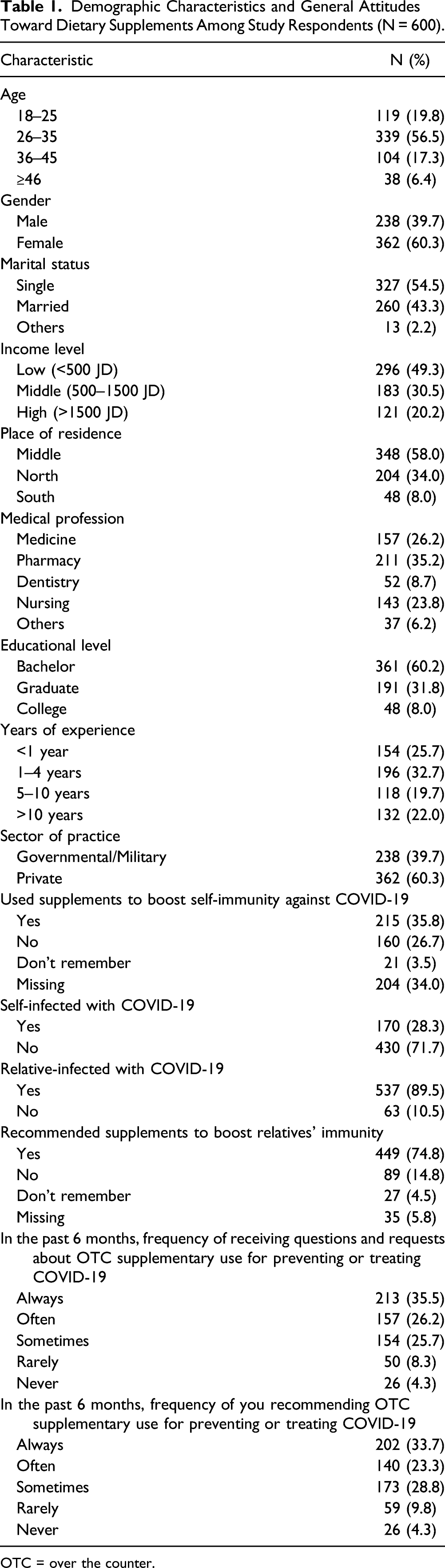
OTC = over the counter.
Recommended Use of Dietary Supplements During the Past 6 Months.
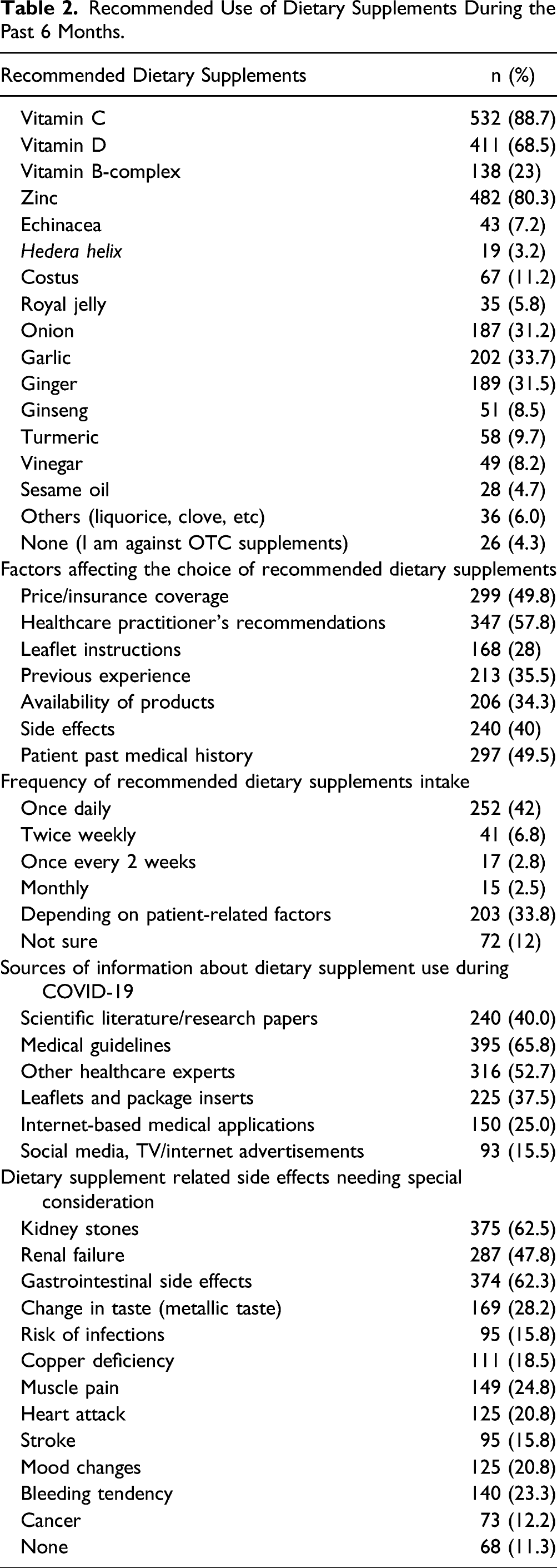

Percentage of recommended over the counter supplements.
Worth mentioning, the majority of respondents emphasized the protective role of health-related behaviors such as a healthy diet (93.7%), getting enough rest/sleep at night (93%), stress management (92.3%), and smoking cessation (84.7%) against COVID-19. However, 59% of them were against the role of vaccination against COVID-19, 24.2% were not sure about it, and only 16.8% of them supported its protective role.
Reported Scores of All Measurement Scales.

In assessing healthcare professionals’ concerns about the overall use of dietary supplements during the COVID-19 outbreak, Cronbach’s alpha indicated good internal consistency (.83). In addition, a high average score of 18.1 was indicated as related to the scoring range of 8-24 (Table 3). Regardless, while assessing their confidence in recommending different dietary supplements during the outbreak, Cronbach’s alpha indicated excellent internal consistency (.96). Furthermore, a mean score of 58.4 was relatively high when referring to the scale-midpoint of 40. Last, according to quantified perception score represented by corrected confidence-concern ratio, most of study respondents indicated positive perceptions toward the benefits of dietary supplements. On the other hand, only 7% of them perceived these supplements with more concerns than benefits.
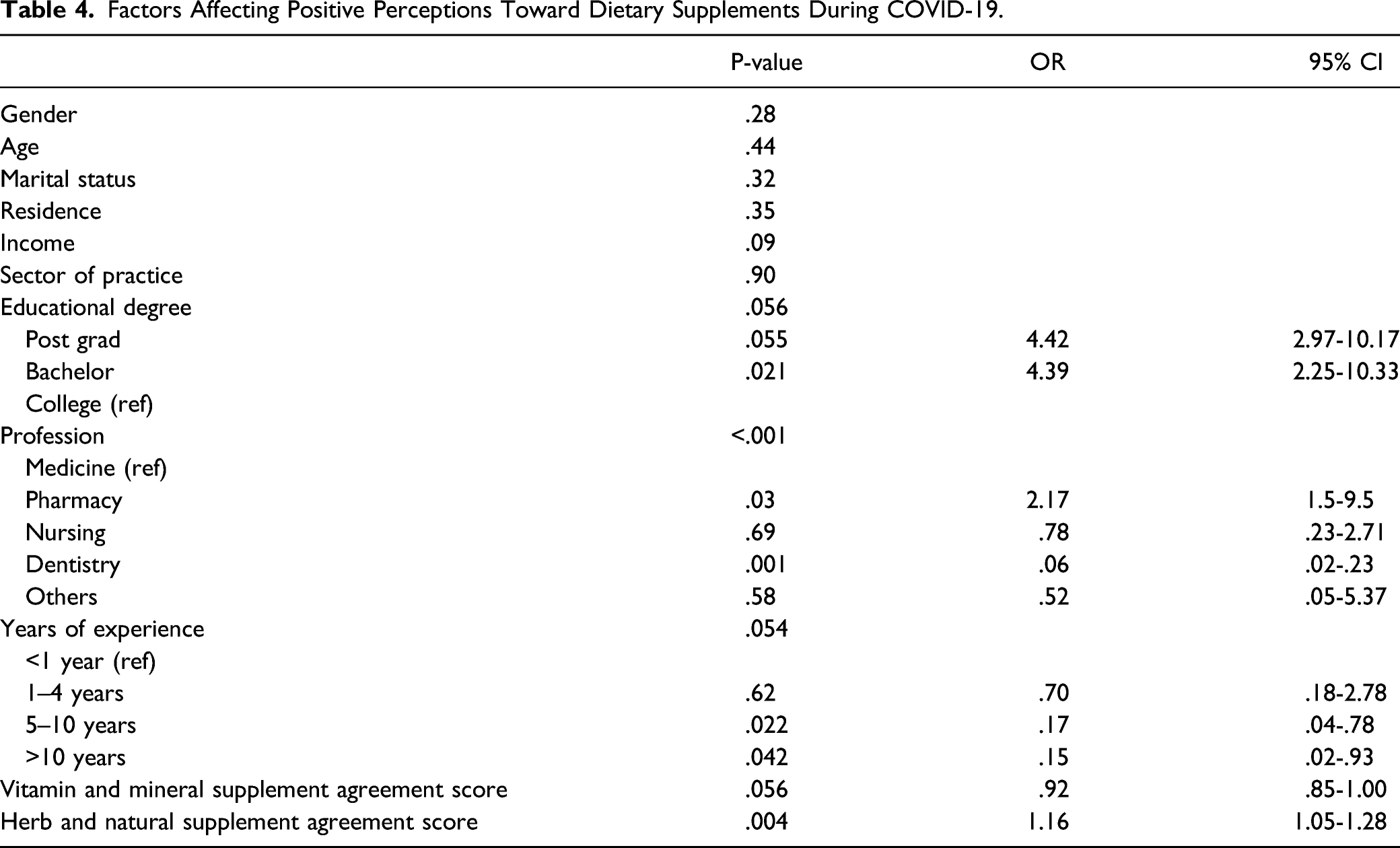
Factors Affecting Positive Perceptions Toward Dietary Supplements During COVID-19.
Discussion
COVID-19 is a pandemic disease with a considerable threat to public health. Despite the availability of vaccines, the COVID-19 situation is still complex considering the significance of public awareness and adherence to the preventive and treatment measures. Noteworthy, healthcare providers can play major role in reducing infection rates and controlling the transmission of COVID-19. One study from Jordan reported that the majority of pharmacists believed that they have sufficient education and a significant role to play during the COVID-19 pandemic disease. 15 Another Jordanian study reported that the public positively endorsed the significant educational role and services the pharmacist can provide during the COVID-19 pandemic. 23 However, this study focused on evaluating the HCP’s perceptions about the OTC dietary supplements and the level of familiarity with safety concerns related to the increased consumption of such products.
In this study, two-thirds of respondents recommended using OTC dietary supplements for their relatives, among which the vast majority were infected with COVID-19. Also, about one-third of the respondents used OTC dietary supplements to boost self-immunity against COVID-19. This was consistent with the results of other studies.12,24 Another recent study that evaluated the use of dietary supplements and herbal medicines by dieticians reported that almost all (i.e., 94.5%) of dieticians used dietary supplements to avoid COVID-19; however, the result is expected as it includes only dieticians. 25 However, and up to the author’s knowledge, this is the first Jordanian study that focused on the perceptions of HCP about the potential safe and effective use of OTC dietary supplements to boost self-immunity against COVID-19.
The dietary supplements mostly recommended in this study by HCP were vitamin C, zinc, and vitamin D, followed by garlic, ginger, and onions. Around half of the HCP recommended the use of dietary supplements daily. The HCP were using guidelines, healthcare experts, and scientific research were reported as the primary sources of information about dietary supplement use during COVID-19, with price and patients’ medical history being the major factors that influenced their choices. It is mandatory to highlight that the use of OTC dietary supplements to mitigate COVID-19 infection has not been supported by well-established scientific evidence to sufficiently recommend effective agents, dosage, and duration. 26 To clarify this more, a potential immunomodulatory effect of zinc and vitamin C in reducing infection signs and symptoms and length of hospital stay has been proposed in many studies.27-32 Particularly with COVID-19 patients, findings from a case series of four patients reported that high doses of zinc were linked with improved oxygenation and recovery of shortness of breath after one day of treatment. 33 However, more robust evidence from a prospective study of 242 patients failed to report a considerable correlation between zinc supplementation and reduced COVID-19 associated mortality. 34
Regarding Vitamin C, a case series study of 17 patients showed a reduction of anti-inflammatory markers such as ferritin and d-dimers after using 1 g of I.V vitamin C. 35 However, this effect was not determined to be a result of vitamin C alone as patients were receiving other medications. 35 In addition, findings from a recent randomized clinical trial of 214 patients infected with COVID-19 showed that treatment with high-dose zinc, ascorbic acid, in solo or combined, did not significantly decrease the duration of symptoms compared to standard of care. 36 Although vitamin C and zinc are safe and available at a low cost, 27 the clinical evidence about the effect of vitamin C and zinc in COVID-19 patients has not been yet established and requires further research.
In the present study, more than half of the respondents expressed opposing views on the protective role of COVID-19 vaccination. This finding contradicts the results reported by several other studies where healthcare professionals were primarily envisioned to resolve vaccine hesitancy among the general population.37,38 Pharmacists, for example, are easily accessible to the community. Thus, Ciliberti et al. study 39 highlighted the potential implementation of the healthcare professional’s role of community pharmacists in building scientifically grounded trust toward COVID-19 vaccines to promote acceptance by the general population.
Switching gears to the safety domain of the OTC dietary supplement use and the related side effects that need special considerations, kidney stones and gastrointestinal adverse effects were reported by more than half of the respondents. However, only a small number of respondents (11%) considered the dietary supplements to be free from any side effects. Evidence about the safety of using OTC dietary supplement for COVID-19 patients is still lacking. 40 For example, the safety of vitamin C and zinc may be a concern at higher doses.40,41 Therefore, the awareness of both public and healthcare professionals about the potential safety of using OTC dietary supplement is significant.
A higher educational degree was associated with better perceptions toward OTC supplementary use during COVID-19. Holders of higher degrees are expected to understand information about contemporary immune system enhancing claims to accept or refute such assumptions. This finding goes in line with what has been reported by Cho and Lee 42 in a study conducted among the general public population, where more educated respondents had higher odds of using OTC products for nutritional purposes. However, respondents with longer professional experience tend to have negative perceptions toward dietary supplement use as compared to junior healthcare professionals. The reasons behind the negative perceptions of experienced HCP were not explored; this could be a limitation to this study.
In summary, there was an overall higher interest and potential to recommendation of vitamin C, zinc, and vitamin D. Those three elements paly integral part in proper immune response rendering deficient people prone to different infections including COVID-19. In regards to safety of such products, they are considered generally safe if administered under medical supervision. Administration of very high doses of vitamin C, zinc, and vitamin D can lead to decreased effectiveness of some medications, gastrointestinal disturbances, and renal failure induced by nephrolithiasis, respectively. 13 Up to the authors’ knowledge, this is the first Jordanian study that reported HCP perceptions about the use and safety of dietary supplements for COVID-19. In addition, the balanced number of males and females with different age bands, medical professions, and from different areas in Jordan was included, which adds to the generalizability of the findings that can be drawn from this study. However, and given the limited number of studies addressing factors affecting OTC dietary supplement use during the COVID-19 pandemic, the comparison of our results to those of close ones was difficult. Also, data were collected online based on authors’ networks and through self-reporting, which could be another limitation to this study.
Finding from this study described the perceptions of HCPs toward the potential benefit and safety issues of using OTC dietary supplements for COVID-19 patients. Thus, this study provides a scheme to examine the perception of the HCPs toward the safe and effective use of OTC dietary supplements in pandemic diseases. Also, results from this study would help policymakers in Jordan, as well as comparable global countries, gain more insight into the perceptions of HCP toward the potential benefit and safety issues of using OTC dietary supplements for COVID-19 patients. This in turn allows policymakers to react by developing and updating the policies regarding the potential use of OTC dietary supplements in pandemic diseases.
Conclusion
The interest and the use of OTC dietary supplements that boost the immune response, such as vitamins C and D, zinc, garlic, and ginger, increased dramatically during the COVID-19 pandemic. However, there is a lack of studies that evaluate or support OTC dietary supplements safe and effective use in the treatment and prevention of COVID-19. Findings from this study indicate that the HCP positively endorsed the potential benefits of OTC dietary supplements, considering the added risks of increasingly taking these supplements in treatments and prevention of COVID-19 patients. Also, this research should establish a framework to influence future regulatory interventions related to OTC products’ use to promote patient safety, especially during pandemic diseases. Future research is required to extensively and qualitatively assess the reasons that influence the HCP’s decisions of recommending OTC dietary supplements for COVID-19 patients.
Footnotes
Acknowledgments
The research team acknowledges funding and support from the Deanship of Research at Jordan University of Science and Technology
Declaration of Conflicting Interests
The author(s) declared no potential conflicts of interest with respect to the research, authorship, and/or publication of this article.
Funding
The author(s) disclosed receipt of the following financial support for the research, authorship, and/or publication of this article: This study is supported by Jordan University of Science and Technology (20210025).
