



Abstract
This narrative review aimed to clarify the characteristics of international government support for sepsis research, trends in published literature on sepsis, and potential contributions of government-source grants to progress in sepsis research between fiscal years 2010 and 2019. The data in this study were collected from the National Institutes of Health (NIH, https://projectreporter.nih.gov/reporter.cfm/) of the United States of America (USA), National Natural Science Foundation of China (NSFC, https://isisn.nsfc.gov.cn/egrantweb/), and Japan Society for the Promotion of Science (JSPS, https://kaken.nii.ac.jp/). All sepsis-related projects approved by the NIH, NSFC, and JSPS were retrieved by searching the project titles, abstracts, and key words for “sepsis,” “septic shock,” or “sepsis inflammatory response syndrome” between 2010 and 2019. Representative sepsis-related studies published between Jan 2010 and Aug 2020 by the first/corresponding authors from these countries were obtained by searching the PubMed database using Medical Subject Heading terms for “sepsis” in representative journals, including Nature, Cell, Science, The Lancet, New England Journal of medicine (New Engl J Med), The Journal of American Medical Association (JAMA), Critical Care Medicine (CCM), Intensive Care Medicine (ICM), Chest, Annals of Emergency Medicine (Ann Emerg Med), and American Thoracic Society journals (ATS). The total/annual institutional budgets, major funding mechanisms and schemes, superior institutions and individual principal investigators, and published original research articles in the field of sepsis in the USA, China, and Japan during the past decade were investigated. The national supporting schemes of the NIH, NSFC, and JSPS were similar. Support from these institutions is quite important for the development of the field of “sepsis” which was acknowledged in 57–64% of original research articles published in CCM. For the future development of precision medicine in sepsis, more government funding support is necessary.
Keywords
Sepsis has become a severe public health problem.
The international government support is essential for the development of sepsis research.
For the future development of precision medicine in sepsis, more government funding support is necessary.Highlights
Introduction
Sepsis is a life-threatening organ dysfunction caused by a dysregulated host response to infection and is the primary cause of death in intensive care units (ICUs). 1 In mainland China, mortality in the ICU is approximately 30–50%,2,3 which is significantly higher than in developed countries. Recently, Rudd et al. provided more detailed and evidence-based information on the global epidemiology of sepsis with striking global estimates of 48.9 million cases and 11.0 million sepsis-related deaths, representing 19.7% of all global deaths in 2017. 4 Sepsis is an inherently severe public health problem that results in a huge medical burden. In the United States of America (USA), the cost of sepsis increased from US$24 billion in 2013 to US$38 billion in 2017, making it the most expensive hospitalized condition (approximately twice that of the second most expensive disease, osteoarthritis).5,6
Sepsis is heterogeneous, with varying etiologies, pathogeneses, and clinical manifestations that make fundamental research, clinical translation, and precision medicine in sepsis more challenging. Government funding is the main source of scientific support, which focuses not only on the promotion of original innovation capability but also on international public health needs. Reasonable and forward-looking funding frameworks will accelerate medical research progress in sepsis and greatly promote human health.
Here, we investigated the characteristics of international government support for sepsis-related research between fiscal years 2010 and 2019. We also analyzed the varying trends in published studies of sepsis and potential roles of government-source grants in promoting the progress of sepsis research. We hope that our review will provide valuable information for guiding future government funding in the field of sepsis.
Fund and Study Selection
The present narrative review is designed to discuss the supportive role of international government funds on the progress of sepsis research from a point of bibliometric view.
Retrieval of International Government Funded Projects
The National Institutes of Health (NIH, https://projectreporter.nih.gov/reporter.cfm/) of the USA, Japan Society for the Promotion of Science (JSPS, https://kaken.nii.ac.jp/), and National Natural Science Foundation of China (NSFC, https://isisn.nsfc.gov.cn/egrantweb/) were taken as representative international government funding institutions. Analyses and comparisons of total/annual budgets, major funding mechanisms and schemes, and distribution of superior institutions and individual principal investigators (PIs) among these institutions were performed. Sepsis-related scientific projects between fiscal years 2010 and 2019 were retrieved from their official open databases with modifications based on Coopersmith et al.’s method. 7 To acquire the projects definitely related to critical care sepsis, we performed two rounds of screening. The preliminary screening was performed by searching project titles, abstracts, and key words with “sepsis,” “septic shock,” or “sepsis inflammatory response syndrome.” As Coopersmith et al. recommended, although 62 variations on “sepsis” were found, “sepsis” and “sepsis inflammatory response syndrome” were selected as representative key words, which will include more than 95% of the critical care sepsis projects. After the first round of screening (LF), potential sepsis-related projects were independently and manually reviewed by two different emergency/critical care specialists (LYX and GCJ). When there was discordance between the two reviewers, a third reviewer independently analyzed the grants using the same criteria. Definite sepsis-related projects alone were finally included, numbering around 1435, 581, and 429 from the NIH, NSFC, and JSPS, respectively (Figure S1).
Retrieval of Representative Achievements in Sepsis
To evaluate the research status and progress in the field of sepsis, we selected representative journals, including top comprehensive journals and professional journals. All sepsis-related studies published in English between Jan 2010 and Aug 2020 by at least one of the first and corresponding authors from the USA, China, and Japan were obtained by searching the PubMed database using Medical Subject Heading (MeSH) terms for “sepsis” in Nature, Cell, Science, The Lancet, New England Journal of medicine (New Engl J Med), The Journal of American Medical Association (JAMA), Critical Care Medicine (CCM), Intensive Care Medicine (ICM), Chest, Annals of Emergency Medicine (Ann Emerg Med), and American Thoracic Society journals (ATS journals).
To survey the current situation of precision medicine (PM) in the field of sepsis, all original sepsis-related studies published between Jan 2016 and Aug 2020 in English were selected. The key words used to screen the potential PM studies included “marker, precision medicine, personal medicine, integrative medicine, or omics.”
For bibliometric analyses, all papers were manually checked to ensure compliance with topic suitability after the first screening.
Comparisons of Government Funding Investment in the Field of Sepsis in USA, China, and Japan
During the past decade, the NIH has invested the most in the field of sepsis (Figure 1A), with a total of 1435 projects and US$476.9 million funding. The NSFC of China was in second place, with US$47.7 million awarded to 581 projects. The total allocation for sepsis research by the National Grants-in-Aid for Scientific Research (JSPS KAKENHI) Program in Japan was the lowest, with 429 projects and a funding of US$23.8 million. Differences in the institutional overall budgets for health-related fields were also considered to evaluate the relative intensity of investment in sepsis within each institution (Figure S2). The 10-year total relative investments in sepsis to total institutional budgets for health-related fields were 1.5%, 5.9%, and 2.7% in the NIH, NSFC, and JSPS, respectively. In terms of the dynamic changes between 2010 and 2019, the trends of both absolute and relative investment in sepsis in the NIH, NSFC, and JSPS were the same Figure 1B-C. The national government support approved by the NIH and NSFC tended to increase gradually, while those approved by the JSPS were stable except for 2013. By further comparing the changes in the average budget over a 5-year period Figure 1D, we found that among these national government institutions, “sepsis” gained the most attention in the NSFC. The average relative and absolute budgets increased by 63.7% and 98.9%, respectively, from 2010–2014 to 2015–2019. The corresponding data for the NIH were 54.4% and 77.2%, respectively, while those for the JSPS were 16.5% and 1.4%, respectively. Comparisons of national government funding support in the field of sepsis among the NSFC, NIH, and KAKENHI (2010–2019). (A) Comparisons of total support in sepsis from 2010 to 2019. (B) Dynamic changes of institutional relative budget in sepsis. (C) Dynamic changes in absolute budget in sepsis. (D) Average relative/absolute budget increase in sepsis from 2010–2014 to 2015–2019. The Chinese Yuan and Japanese Yen to USA Dollar exchange rates used in this study were 6.5 Yuan/Dollar and 109 Yen/Dollar, respectively.
Comparisons of the National Government Funding Schemes in the Field of Sepsis Among USA, China, and Japan
According to the NIH grants and funding information system (https://grants.nih.gov/grants/funding/funding_program.htm), the NIH uses activity codes to represent the main types of grant funding it provides, which include research grants (R series), career development awards (K series), research training and fellowship grants (T & F series), and program project/center grants (P series). The main project types of the NSFC (http://www.nsfc.gov.cn/publish/portal0/jgsz/08/) and JSPS (https://www.jsps.go.jp/j-grantsinaid/01_seido/01_shumoku/index.html) are similar to those of the NIH, most of which are ordinary scientific research funds and young scientists’ funds. The T & F and K series grants of the NIH constitute a complete cultivation system for young scientists, 8 including both training and fellowship allowances and research funds to accommodate their transition to independent investigators. Similarly, there are also different mechanisms for young scientists in the JSPS. Aside from the young scientists’ research fund, the JSPS also sets a Grant-in-Aid for Research Activity Start-up for specific young investigators (those who have just been hired or just came back from maternity leave) to accomplish this transition. However, in China, there is no such pluralistic mechanism for young scientists’ training. The only type of funding resource for young investigator supported by NSFC is a kind of research fund. Instead, a considerable budget is allocated to less-developed regions. From 2010 to 2019, the Department of Health Science in the NSFC allocated 8.5% of all approved projects and 6.8% of the total budget to these less-developed regions.
By analyzing the retrieved “sepsis” related projects, we found that the funding schemes in sepsis from 2010 to 2019 were consistent with the whole institutional mechanisms. Most of the NIH-, NSFC-, and JSPS- approved “sepsis” projects were ordinary scientific research funds and young scientists’ funds, wherein the sum of these two parts in percentage were comparable among the NIH, NSFC, and JSPS Figure 2A. As shown in Figure 2B, the numbers of R series projects (including R01 and other R series grants), K series projects, and T&F series projects were 70%, 15%, and 4% of all funded grants in the NIH, respectively, amounting to a total of 89%. In the NSFC, the corresponding number ratios (general research fund, young scientists fund, and total sum) were 48%, 41%, and 89%, respectively. Similarly, the scientific research, young scientists’ fund (identical to early career scientist funds from 2018), and Research Activity Start-up funds comprised 49%, 38%, and 2% of the total grants in the JSPS, respectively, amounting to 89% of the total. As for the budget, the total amount of ordinary scientific research funds and young scientists’ funds accounted for 87%, 81%, and 94% of the total budget of the NIH, NSFC, and JSPS, respectively Figure 2A. Comparisons of the 10-year funding schemes in the field of sepsis among the NIH, NSFC, and JSPS. (A) Number and amount percentages of the two main types of grants. (B) Details in the number and amount composition of all funded projects in sepsis.
Notably, although the NIH of the USA has a relatively complete and reasonable funding mechanism for young scientists, institutional support (including K and T&F series) was relatively less compared with the NSFC and JSPS. The proportion of number of projects and budget for sepsis-related grants allocated to young scientists was markedly lower Figure 2A.
Institutions and PIs Funded by the NIH, NSFC, and JSPS
Our investigation on the institutions and PIs funded by the NIH, NSFC, and JSPS in the field of sepsis research revealed a number of stable superior institutions and PIs in their respective countries. In general, 10–20% of the supported institutions were awarded more than 50% of the sepsis-related projects. In Japan, during the past decade, 429 KAKENHI projects approved by the JSPS were distributed across 96 scientific research institutions and 343 PIs. Among these, 18.8% of the 96 institutions received 50% of the projects. In the USA, 186 institutions with 403 PIs received funding from the NIH, 10.8% of which (20/186) were awarded 51% of the projects. In China, 581 projects were allocated to 94 institutions and 472 PIs, among which 11.7% were awarded 51% of the projects. The most highly awarded institutions are shown in Figure 3A. Superior research institutions and principal investigators (PIs) in the field of sepsis in the USA, China, and Japan from 2010 to 2019. (A) Top 10 research institutions in the field of sepsis research supported by the NIH of USA, NSFC of China, and JSPS of Japan, respectively. (B) Composition of the supported PIs in numbers of grants from the NIH, NSFC, and JSPS, respectively.
Regarding superior investigators Figure 3B, approximately 70% (282/403) of the NIH-supported PIs were awarded more than one grant during the past 10 years, with the most superior applicant receiving 29 projects in total. Nevertheless, the research priorities of PIs in Japan and China were not very concentrated compared with those in the USA. In Japan, 12% of the KAKENHI-funded PIs acquired more than one grant, with single PIs acquiring up to only five grants. Similarly in China, the corresponding numbers were 17% and 5%, respectively.
Comparative Analysis of Papers Published in Representative Journals
The total number of relative publications (Jan 2010–Aug 2020) and five year varying trends (from Jan 2010–Dec 2015 to Jan 2016–Aug 2020) were compared among countries. With MeSH terms searched, we did not find any relative publications in New Engl J Med and ATS journals with main authors from the USA, China, or Japan.
As shown in Figure 4A, the USA had the largest number of publications on sepsis in selected journals in the past decade, followed by China and Japan. In terms of overall publication level of articles, those from the USA were relatively high. Among the 289 publications with main authors from the USA, 31.1% were published in top comprehensive journals, such as Cell, Nature, Science, The Lancet, and JAMA, as compared with China and Japan with top comprehensive journal publication rates of 5.6% and 13.8%, respectively. Comparisons of studies related to sepsis published by scholars from the USA, China, and Japan. (A) Comparisons of the numbers of published studies between 2010 and 2020 in representative journals. (B) Comparisons on five year varying trends from Jan 2010–Dec 2015 to Jan 2016–Aug 2020 in the USA, China, and Japan. (C) Comparisons of publication preferences in the USA, China, and Japan.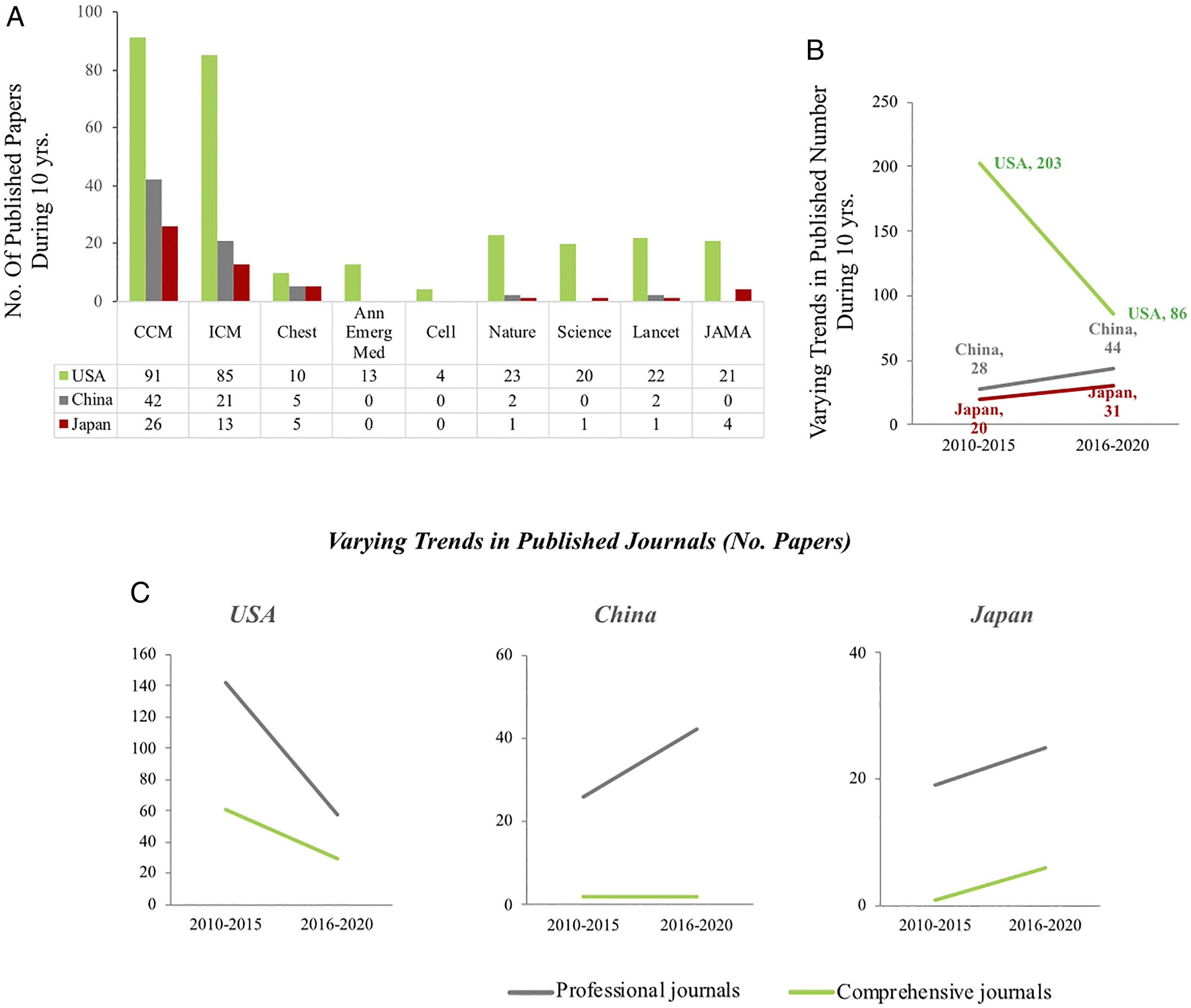
Applying a 5-year period as a counting unit, we found that the varying trends in the total number of papers published in our selected representative journals were quite different among these three countries Figure 4B. Publications by the USA during Jan 2016–Aug 2020 decreased 57.7% when compared to Jan 2010–Dec 2015, while the publications by Chinese and Japanese authors increased by 57.1% and 55.0%, respectively. The apparent increase by Japanese scholars was comparably attributed to both professional and comprehensive journals. However, the increase by Chinese scholars was mainly attributable to professional journals such as CCM, ICM, and Chest, with publications in high-level comprehensive journals stable and at a low level Figure 4C.
Relationship Between Government Support and Academic Publications
To further clarify the supporting role of government funding in the progress of sepsis research, we selected CCM as a representative journal and surveyed scientific funding acknowledgments for original research articles published by the first and/or corresponding authors in the USA, China, and Japan. In the past decade, a total of 67, 21, and 14 original articles were published by main authors from the USA, China, and Japan, respectively. As we can see, the development of sepsis research was inseparable from the support of national government funding Figure 5. Fund labeling on original papers published in Critical Care Medicine by authors from the USA, China, and Japan from Jan 2010 to Aug 2020.
Among USA-published papers
65.7% (44/67) reported having received funding from different levels of official institutions, including the NIH and state governments. As expected, NIH was the main funding source, supporting approximately 64.2% (43/67) of the publications. In addition, pharmaceutical enterprises and social donations played important roles in the progress of sepsis research in the USA, supporting 23.9% of the publications.
Among China-published papers
85.7% (18/21) reported having received funding from different levels of official institutions, including the NSFC, Ministry of Health, and Provincial and/or Municipal Science and Technology Departments. Similar to the NIH in the USA, the NSFC was the main government funding source in China, supporting 61.9% (13/21) of the publications. However, unlike USA-published papers, no enterprises or social donations were acknowledged, indicating that diverse funding should be further advocated in China.
Among Japan-published papers
During the past decade, among the 14 original articles identified based on MeSH terms 78.6% (11/14) reported having received funding from the KAKENHI of the JSPS, the Ministry of Health, Labor and Welfare, among others. Of these papers, more than half of the publications in the CCM were supported by the JSPS (57.1%, 8/14). Similar to the USA, progress in the field of sepsis research was also supported by enterprises and social academic organizations, accounting for 28.1% of the publications (4/14).
Analysis of the Evolution of the Research Paradigm in the Field of Sepsis
We also examined the changes in the research paradigm in the field of sepsis by analyzing the research direction and paradigm of literature published in the CCM. We found that among USA-authored research articles, those matching the MeSH terms were published between 2010 and 2015, and most were multicenter clinical observations or randomized controlled studies. From 2016 to 2020, scientists in the USA no longer preferred to publish research-oriented works in the CCM, and only four corresponding author articles were guidelines and consensus (three guidelines and one review). In China, accompanied by an increase in the number of papers (from seven papers between 2010 and 2015 to 14 papers between 2016 and 2020), the research paradigm has also changed significantly, gradually shifting from simple mechanism studies or clinical observations to the verification of clinical markers based on the results of the mechanism studies. This change indicates that scholars in China have begun to focus on precision medicine in sepsis, although there is still a long way to go for clinical translation. In Japan, no obvious changes in the paradigm have been observed over the past 10 years, with most of the studies being clinical observations.
Prospects of Precision Medicine in Sepsis
Precision medicine (PM), whose predecessor was personalized medicine,9-11 has made great progress in many fields; “omics” technologies act as essential drivers for individualized medicine. According to the example of integrated personal omics profiling technologies, 12 high-throughput sequencing (such as whole-genome sequencing and transcriptome, proteome, metabolome, and microbiome research in different parts of the body) combined with in-depth biological information can reveal detailed differences between individual health and disease statuses, avoid misunderstandings regarding the personalized treatment of critically ill patients, and highlight the characteristics of disease genotypes from multiple angles and levels. As expected, approximately 200 studies containing more than two omics in sepsis-related research were published in the Medline database from 2011 to 2015 by the USA, European Union 28 member states, and China. 13 Notably, more than half of these studies were published by authors from the USA, with more than half of these studies having a university or government/state funding source. Despite these advantages, PM in critical illnesses remains challenging.14-16
Here, we investigated the development of PM, personalized medicine, and integrated medicine in “sepsis” within the last 5 years (between Jan 2016 and Aug 2020). Relevant publications by at least one of the first/corresponding authors from the USA, Japan, and China in the PubMed database were obtained. Although we included many key words such as “marker, precision medicine, personal medicine, integrative medicine, or omics,” among others, to search for potential PM studies in the field of sepsis, only 60, 43, and 88 studies were published by the USA, Japan, and China, respectively. Surprisingly, most of these studies focused on the clinical verification of a single index; only two articles (one in the USA and one in China) were in accordance with the precision medicine concept by multi-omics analysis. Therefore, the progress of PM research in sepsis is lagged. To address this, there is an urgent need for government departments to increase funding support to promote the development of PM in the field of critical illness.
Conclusions
1. The national government supporting schemes of the NIH, NSFC, and JSPS in sepsis are similar. For the NIH of the USA, NSFC of China, and JSPS KAKENHI of Japan, most of the grants (>80% in quantity and amount) were allocated to ordinary scientific research funds and young scientists’ funds; 2. Support from international government funds is important for the progress of sepsis research. The achievements in sepsis were associated with national government support. In general, among the countries surveyed, more funds invested, more researches published. Take CCM as an example, half of the sepsis-related publications acknowledged the government funds support; 3. More government funding support is necessary. For the future development of precision medicine in sepsis, the international governments should pay more.
Limitations
Even though this study provides an overall depiction on the supportive role of international government funds on sepsis research, there are still some limitations we need to address. First, the scope of this survey was limited. We took the NIH of USA, NSFC of China, and JSPS KAKENHI of Japan as representative government funding institutions. Future studies can be expanded to more countries and more institutions. Second, when discussing the development in precision medicine in sepsis, we only considered the typical research paradigm, such as omic/marker/personal medicine/integrative medicine studies without considering the “intelligent decision-making studies” based on electronic medical record system or machine learning. Third, we evaluated the effect of government supporting from a point of bibliometric view without considering other types of achievements.
Supplemental Material
sj-pdf-1-inq-10.1177_00469580221078513 – Supplemental Material for The Supportive Role of International Government Funds on the Progress of Sepsis Research During the Past Decade (2010–2019): A Narrative Review
Supplemental Material, sj-pdf-1-inq-10.1177_00469580221078513 for The Supportive Role of International Government Funds on the Progress of Sepsis Research During the Past Decade (2010–2019): A Narrative Review by Yuxin Leng, Chengjin Gao, Fang Li, Enzhong Li and Fengzhu Zhang in INQUIRY: The Journal of Health Care Organization, Provision, and Financing
Footnotes
Authors' contributions
ZFZ conceived and supervised the review. LYX collected and interpreted the projects and published literature with help from GCJ and LF. LEZ supported the integration of national government funding support with the progress in sepsis. LYX drafted the manuscripts with help from GCJ and LF.
Declaration of Conflicting Interests
The author(s) declared no potential conflicts of interest with respect to the research, authorship, and/or publication of this article.
Funding
The author(s) received no financial support for the research, authorship, and/or publication of this article.
Author’s Note
Yuxin Leng, Chengjin Gao and Fang Li contributed equally.

Supplemental Material
Supplemental material for this article is available online.
Nomenclature
References
Supplementary Material
Please find the following supplemental material available below.
For Open Access articles published under a Creative Commons License, all supplemental material carries the same license as the article it is associated with.
For non-Open Access articles published, all supplemental material carries a non-exclusive license, and permission requests for re-use of supplemental material or any part of supplemental material shall be sent directly to the copyright owner as specified in the copyright notice associated with the article.
