



Abstract
School workers constitute the bulk of public workers in Saudi Arabia. Most of these workers seek public health care services through the Ministry of Health, which is characterised by an overloaded service. Consequently, the government is planning to introduce employment-based health insurance. However, government employees’ willingness to pay (WTP) for health insurance was not investigated. This study explores the feasibility and acceptability of employment-based health insurance by examining public school workers’ WTP. Methods: six hundred and twenty-second number participants from Riyadh city were interviewed from September to October 2020 using an online structured questionnaire. The contingent valuation method with a payment card was used to assess WTP among the participants. This study also determined the association between the willingness to participate and WTP for health insurance respondents’ demographic and socio-economic characteristics. Chi-square and multiple linear regression analyses were used to analyse the data. The majority (76%) with an average monthly mean of 77.9 Saudi Riyal (SAR) ($20.7) per capita. Male, had higher educated, and those diagnosed with chronic disease were more likely to report a willingness to participate and/or pay for health insurance (P > .005). This study demonstrates that WTP for employment-based health insurance depends on workers’ characteristics. The results of this study may be of use to policymakers to help with a set insurance premium, priority setting and fund allocation.
Highlights
What do we already know about this topic? • A limited number of studies has investigated willingness to pay for health insurance in Saudi Arabia
How does your research contribute to the field? • This study assess the willingness of the public school workers to participate and pay in employment-based health insurance in Saudi Arabia
What are your research’s implications towards theory, practice or policy? • The data can be used by Saudi policymakers to estimate an acceptable premium for planned employment-based health insurance
Background
The Kingdom of Saudi Arabia (KSA) is a high-income country with the largest population in the Middle East. In 2018, the estimated population was 33,413,660, with a growth rate of 1.86, which is considered the 64th highest population in the world. According to the latest statistical report, life expectancy in KSA increased for both genders to 75 years. 1 Since the discovery of oil in the late 1930s, it has become the backbone of the Saudi economy, currently accounting for 87% of governmental revenues. However, the country has identified the reliance on oil to finance governmental services, including health, as a challenge due to its sharp instabilities in the last few years. 2 The major health care provider in the KSA is the Ministry of Health (MOH) and other governmental agencies. The private health sector operates approximately 30% of health care facilities. 1 Following the ‘Health for All’ strategy, all Saudi citizens have the right to free health care services provided by the MOH and other governmental agencies. 3
Following the economic and demographic situations cited above, Saudi policymakers realised the unsuitability of the existing free health care delivery model, and the government adopted health insurance in 2006. This started with compulsory employment-based health insurance, which covered all workers in the private sector, subsequently including all workers in the governmental sectors, and finally a universal coverage to other population groups. However, only the first stage has been fully implemented, with the government systematically implementing the remaining two stages. 4
A limited number of studies has investigated willingness to pay (WTP) for health insurance in KSA.5–8 Furthermore, none of these studies assessed employment-based health insurance. Therefore, this is the first study on the feasibility and acceptability of health care financing reform in the KSA, specifically the willingness of the public school workers to participate in employment-based health insurance and to investigate the WTP of those who were willing to participate. The analysis focused on this occupational group for two reasons. First, public school workers constitute a large category of KSA government employees and, consequently, their importance regarding service utilisation in the Saudi health care system. 9 Second, another deciding factor was the nature of teachers’ work, which has been determined by international studies, and its impact on occupational health.10–12
Methods
Study Design
A cross-sectional study was conducted among public school workers in Riyadh, the capital city of Saudi Arabia. Given the social distancing circumstances due to COVID-19, the data were collected through an online interview with participants using a structured questionnaire. The study was conducted from 20 September to October 8, 2020. The target sample size calculated was based on a total number of school workers in Riyadh city (631.764) using 95% CI (Z = 1.96) and 5% margin of error; the assumption sample size was 384. However, by employing the convenience sampling method, the researcher invited all Saudi workers to participate in the study, of which 622 responded.
Measures
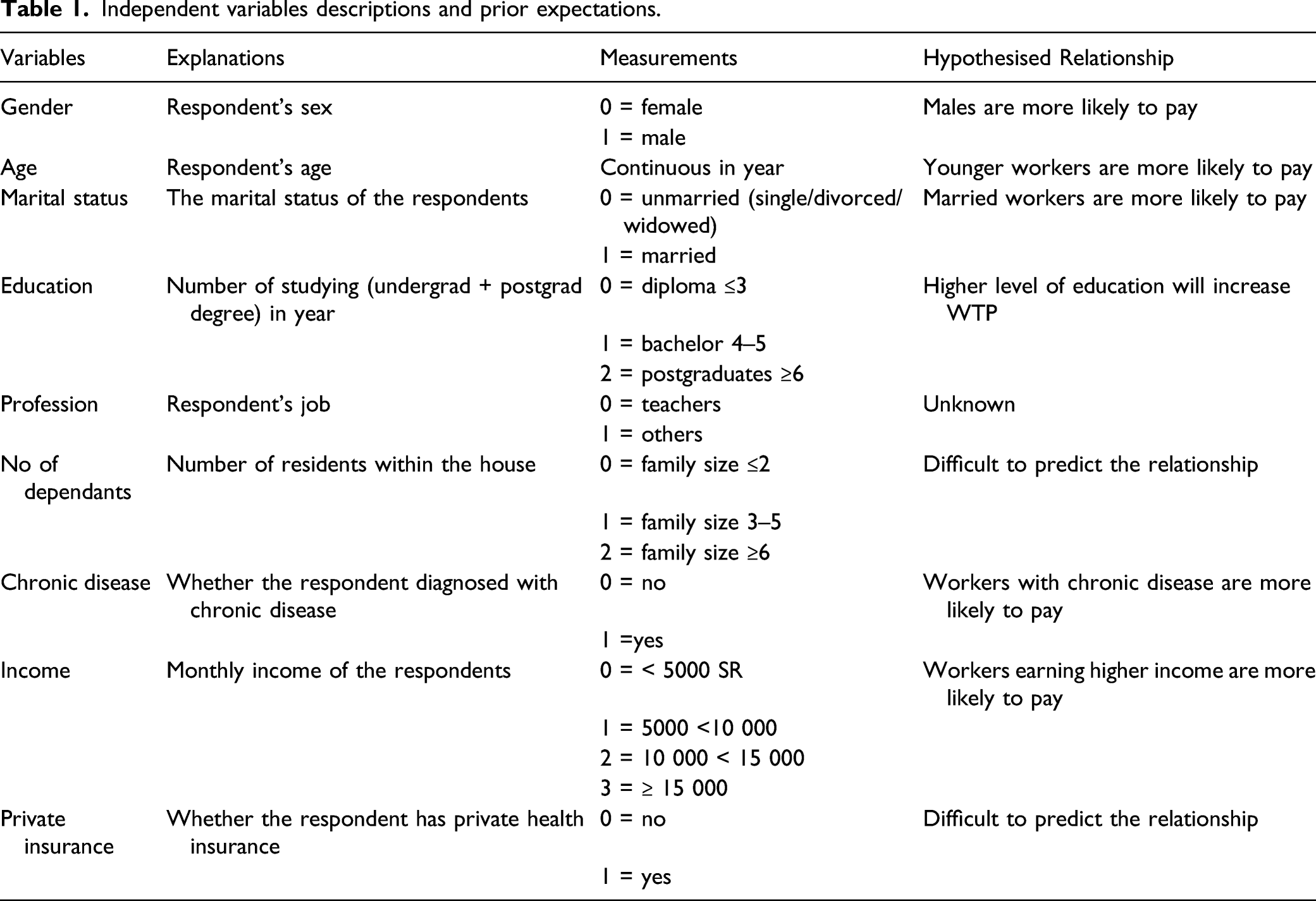
Demographic and work characteristics
Independent variables descriptions and prior expectations.
Eliciting WTP
An economic valuation was employed using a contingent valuation technique to estimate the WTP.14,15 In this study, a payment card was used, 16 introduced as follows: ‘Imagine that the government has decided to set up an employment-based health insurance for the public school workers, in to which you are required to make regular contributions, how much would you maximally be willing to pay per month for health insurance, if it provides the same health care services that are currently available to you?’. The payment cards consisted of two questions: ‘How much would you surely be maximally willing to pay per month?’; ‘How much would you be minimally defiantly not willing to pay per month?’. For each question, the payment for care offered different amounts of money as answer possibilities (SAR 50, SAR 100, SAR 150, SAR 200, SAR 250, SAR 300 and more than SAR 300).
Data Analysis
The statistical analysis procedures included the calculation of frequencies and percentages for the participants’ demographic characteristics and questionnaire items. The impact of demographic factors on participants’ willingness to participate was explored using the chi-square test and binary logistic regression. WTP mean, median and quartiles were also estimated. Considering that the WTP value consists of ordinal data, ordinal regression analysis was adopted to estimate the coefficients, which explain how WTP varies with respondents’ demographic characteristics. For all analyses, a P-value of ≤.05 was used. Stata 16.0 was used to enter and analyse the data (Stata Corp, College Station, Texas).
Results
Demographic and Socio-Economic Characteristics
Socio-demographic characteristics of workers in public schools (N = 622).

Mean, median and quartiles according to income level.
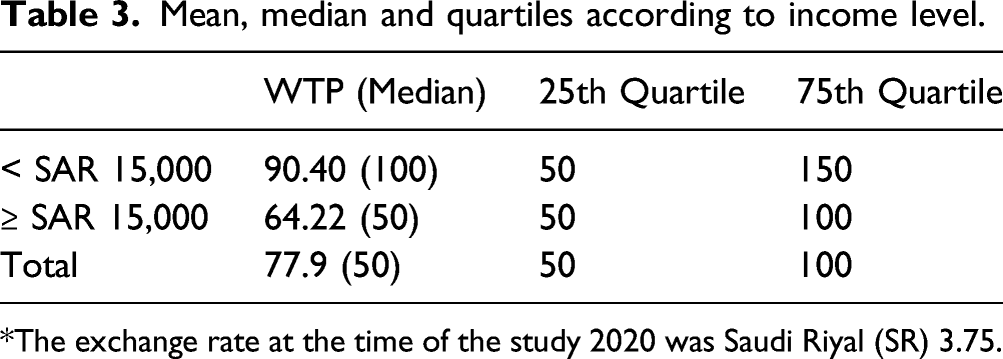
*The exchange rate at the time of the study 2020 was Saudi Riyal (SR) 3.75.
Willingness to Participate and Pay
Chi-square analysis of willingness to participate.

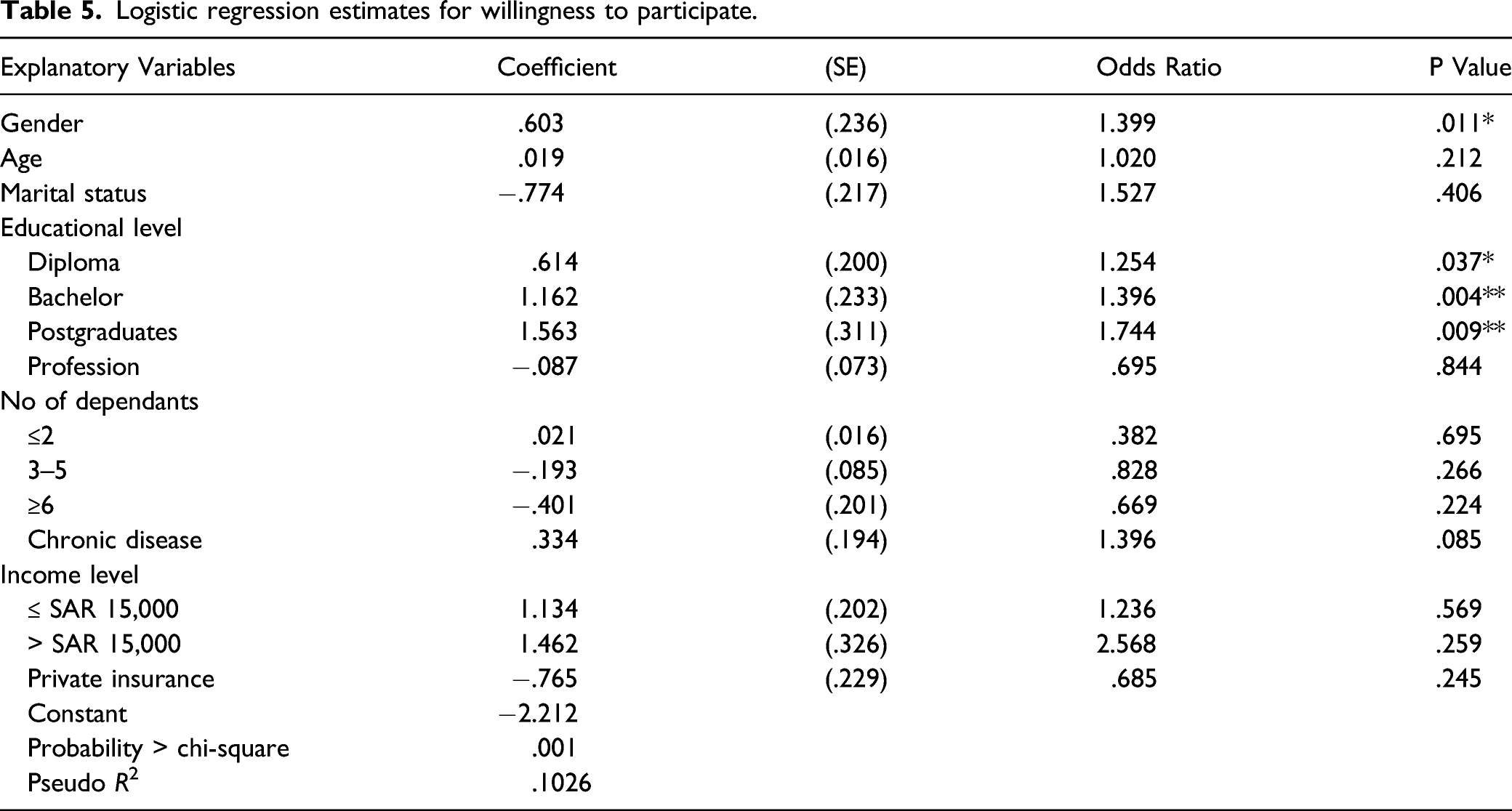
Logistic regression estimates for willingness to participate.
Ordinal regression analysis on factors influencing WTP for health insurance.

Discussion
This study aimed to explore the determinants of willingness to participate and pay for health insurance among public school workers. The main findings were as follows: first, the mean monthly WTP amounted to SAR 77.9. Second, many socio-economic factors, such as gender, educational level, health status and income, significantly influenced willingness to participate and/or pay. Third, neither marital status, number of dependants, profession and ownership of private insurance were associated with willingness to participate or pay for health insurance.
This study revealed that approximately 76% of the participants were willing to join the proposed health insurance system. This finding is in line with another study conducted among the general population in Saudi Arabia to estimate the enrolment rate for the national health insurance programme (70%). The number of persons willing to participate was also higher than that of other studies conducted on other worker groups in Bangladesh and schoolteachers in Ethiopia.5,17,18 This highlights that Saudi studies differed from the existing in particular by setting in a high-income country. The mean WTP in this study was 55.8% higher than the estimated mean WTP among the Saudi population (SAR 77.9 vs SAR 50). However, this difference might be due to the differences in the economic status of the participants, and the period when this study was conducted which was during the COVID-19 pandemic. In the latter instance, people were more concerned about health insurance. 5
Among all the socio-economic variables used in the regression model, income was statistically significant. Therefore, it is the main determinant of WTP in this study. This suggests that school workers were more willing to pay for health insurance as their income increases. These results align with previous studies that reported a positive relationship between income and WTP for health insurance.5,17–22
Previous internal studies established gender differences in the willingness to participate in health insurance, with a larger number of males being willing to do so.20,23,24 In the context of Saudi school workers, men were significantly more willing to join a health insurance scheme. Likewise, in this study, participants with relatively high education were more willing to participate in health insurance. Many other studies identified a positive relationship between education and willingness to participate or pay for health insurance in keeping with the findings from this study.5,13,22,24 This might be related to the fact that higher-educated people can better understand the value of health insurance. 25
Approximately half of the study participants were diagnosed with at least one chronic disease. Health status was significantly associated with willingness to participate in health insurance. However, one study in the KSA identified no relationship between the presence of chronic disease and WTP. 5 This may be because people who are diagnosed with chronic disease are more likely to utilise health services and are concerned about medical expenses; therefore, they are more interested in health insurance to avoid these costs. 20
To the best of the researcher’s knowledge, and based on an extensive literature review, this is the first study to assess the WTP of employee-based health insurance in Saudi Arabia. Although there is only one region in Saudi Arabia, the sample used could be representative of the wider population. Thus, the characteristics of the sample, particularly gender and age distribution, agree with the overall distribution of public school teachers in Saudi Arabia. However, this study has several limitations. First, as the topic studied was a proposed health insurance scheme, and not one in operation, this was a stated preference survey, not an observed one. Second, a convenience sample was used which could have created a bias in selection which might affect the general applicability of the findings. Third, since all the results presented in this study are based on the contingent valuation method, and the researcher did not conduct a pilot study, therefore the chosen categories in the payment card might have influenced participants’ answers and limited their accuracy. Therefore, these limitations should be considered, and future research should consider a beginning game process to increase accuracy.
Conclusion
Most school workers were willing to participate in health insurance. Factors such as gender, level of education, monthly salary and health status were significantly associated with willingness to participate and/or pay for health insurance. From a policy viewpoint, the data can be used to estimate an acceptable premium for planned employment-based health insurance. Furthermore, identifying and understanding the key influencing factors associated with WTP would help in moving towards implementing an employment-based health insurance system in the KSA.
Footnotes
Acknowledgments
The authors extend their appreciation to the Research Centre, College of Business Administration, and the Deanship of Scientific Research at King Saud University, for funding this study.
Declaration of Conflicting Interests
The author(s) declared no potential conflicts of interest with respect to the research, authorship, and/or publication of this article.
Funding
The author(s) received no financial support for the research, authorship, and/or publication of this article.
Ethical Approval
The study protocol and informed consent form were in accordance with the standards of the scientific committee at King Saud University and received approval (KSU-HE-20-379).
Informed Consent
Informed consent was obtained from all participants.
