



Abstract
The purpose of this study is to investigate the effects of an infertility counseling education program on education satisfaction and counseling competency of nurses. The study used a one-group pretest–posttest design. Participants were 135 nurses in Korea. Data on demographic characteristics on education satisfaction, and counseling competency were collected. After participating in the infertility counseling education program, the level of counseling competency increased significantly over that before participating in the infertility counseling education program. The infertility counseling education program improved the counseling competency of the participating nurses. Use of such an infertility counseling education program is recommended when nurses counsel patients facing infertility. It is necessary to repeat this study in the future to clarify the effects of these counseling education programs.
What do we already know about this topic
Infertility in women is on the rise worldwide, and various interventions have been reported to be effective in counseling.
How does your research contribute to the field?
Nurse-led counseling composed of infertility counseling education program that has been shown to be effective in counseling infertility woman.
What are your research’s implications toward theory, practice, or policy?
Evidence for counseling education program the most effective program for infertility woman intervention was presented, making a practical contribution to improving the health indicators of women with infertility.
Introduction
Background
With a total fertility rate of .92, South Korea is the only OECD country whose fertility rate is below 1. The natural increase in the population calculated by subtracting the number of deaths from the number of births was 8,000, the lowest since statistics started to be calculated in 1970. 1 As of 2018, 220,000 patients were diagnosed with infertility, one of the causes of the low fertility rate in South Korea. 2 Since such an increase in the infertile population is also closely related to population issues, infertility is recognized as an important issue from a national perspective, and various efforts have been made to overcome the low fertility rate, such as the introduction of the “National Supporting Program for Infertility Couples” in 2006. 3 In 2015, a pilot operation of infertility counseling commenced through the Korea Population, Health and Welfare Association 4 ; in 2017, health insurance coverage was expanded to provide support for infertility treatment and related costs to support the infertility treatment process 5 ; and, in 2018, the Central Fertility and Depression Center and regional centers in Daegu, Incheon, and Jeonnam were installed and began operations. 6 Infertility is not only a crisis but can also constitute an identity crisis for couples planning to conceive because it involves social problems related to reproduction and rearing of the population. 5 At present, when the accountability of the nation is being emphasized according to the input of public resources, the supporting program for patients facing infertility is predicted to help improve the fertility rate 7 ; the national and local governments should put forth various efforts to contribute to the improvement of the quality of life of patients facing infertility. Diagnosis and treatment of infertility take a lot of time accompanied by physical and psychological problems as well as economic burdens on the patients. 8 Patients facing infertility need psychological intervention as they experience mental pain, isolation, and depression during this process and complain of various emotional pains such as guilt and thoughts of suicide. 3 The European Society of Human Reproduction and Embryology (ESHRE) presents behavioral, relationship and social, emotional, and cognitive needs as psychosocial problems that patients facing infertility may experience before, during, and after infertility treatment procedures. The ESHRE provides guidelines for medical staff to provide psychosocial services tailored to the needs of patients at specific stages of treatment and proposes an integrated approach to psychological counseling for patients during infertility treatment, recognizing infertility as a physiological, psychological, and social. 9
Fertility counseling aims to provide counseling and assistance to patients with reproductive health issues, including infertility, and is a specialized field that includes psychology and reproductive medicine. 10 Stopping treatment due to emotional pain and negative psychological conditions experienced during infertility treatment accounted for 22% of cases, 8 and a study even revealed that 95% of domestic infertile women require psychological counseling programs. 11 Therefore, the need for infertility counseling for the psychological well-being of patients facing infertility is inevitably emphasized. 12 An infertility counselor should be a competent professional who not only provides medical information related to infertility to infertility targets but also identifies the characteristics of patients facing infertility to encourage them to properly express their needs and feelings. 6 In the process of counseling for infertility treatment and examination, it is necessary to understand patients’ reproductive history, ovulation cycle, and sex life. 9 Nurses who care for patients facing infertility are health care managers who assess the risks associated with overall infertility and provide counseling and patient care related to the risks associated with infertility based on their expertise. 13 Since patient information learned during infertility treatment is personal information, infertility nurses must respond sensitively to ethical, legal, and social issues that may arise related to infertility information while having rich knowledge related to infertility. The quality and attitude of infertility counselors determine the success or failure of infertility counseling. 14 During infertility counseling, medical staff should be able to provide customized counseling services that reflect the needs of patients facing infertility while identifying their needs and encouraging them to resolve their problems independently. 15 Accordingly, professional training for providing infertility counseling is implemented by allocating public resources in various countries such as the United Kingdom, Germany, Australia, the United States, and Japan. 12 Considering this aspect, there is a need to develop an infertility counseling education program and nurture nursing professionals in infertility counseling so that infertility counseling can be established and provided as an evidence-based practice for infertility nursing.
Therefore, this study was conducted to develop an infertility counseling education program that aims to strengthen the counseling competency of nurses in charge of patients facing infertility and to evaluate the effect of this program on nurses’ satisfaction with education and their counseling competency. This study aims to provide practical evidence for the effectiveness of the program for building counseling competency in nurses and to contribute to improving the quality of infertility counseling and nursing in the long run.
The Study
Aims
This study aims to develop an infertility counseling education program to improve the counseling competency of nurses in charge of patients facing infertility and to evaluate the effect of this program on nurses’ satisfaction with education and their counseling competency.
Design
This was an experimental study using a one-group pretest–posttest design developing an infertility counseling education program to improve the counseling capability of nurses in charge of patients facing infertility. It then investigated the effect on nurses’ satisfaction with education and their counseling competency.
Development of the Education Program
Infertility Counseling Education Program Study Procedure
Since there were not enough previous studies on the infertility counseling education program to suggest a number and time of operation for the program, the program was developed as an 8-h education program with 4 participants per day, 2 h per subject, with reference to the German Society for Fertility Counseling 16 running a 7-h fertility counseling training course per day. The validity of the contents of the developed program was evaluated by 1 professor in counseling psychology, 1 infertility specialist nursing team leader, and 1 female health nursing professor. The expert content validity index (CVI) was .8 or higher.
Measurement
Satisfaction With Education
To determine participants’ satisfaction with the education, this study developed a 5-point Likert scale to evaluate the adequacy of the content of the counseling program, the practical utility, the benefit of the educational content, the appropriateness of the education time, and the appropriateness of the education method. The higher the score, from 1 point for “not at all” to 5 points for “very much,” the higher the satisfaction with education. In this study, Cronbach’s α was .94.
Counseling Competency
To evaluate the counseling competency of the nurses, a public work, the Counselor Competencies Scale-Revised (CCS-R) developed by Lambie and Swank 17 was used after notifying the original author of the use of the tool. The CCS-R consists of 22 questions rated on a 5-point Likert scale with responses ranging from 1 point for “not at all” to 5 points for “very much.” Based on the total score calculated for each area, the higher the score, the higher the level of satisfaction with counseling competency. In this study, Cronbach’s α was .90.
Participants
This study used a convenience sample of nurses working in 10 infertility hospitals located in Seoul and Gyeonggi-do as an accessible population. The specific criteria for selecting participants included having more than 12 months of nursing experience with patients facing infertility not having received a counseling education program and understanding the purpose of the study and agreeing in writing to participate. G*Power 3.1.5 was used to calculate the number of samples to achieve the research objective. With the significance level set to .05, effect size to .25,
18
and power to .8, the number of samples required for the paired t-test was 95 people. In this study, a total of 105 participants were recruited considering a 10% dropout rate, and data from 103 participants were used for the analysis, excluding 2 participants who did not participate in the posttest (Figure 1). Flow diagram of the process through the phase of trial.
Data Collection
The data were collected in July 2019. Prior to collecting data, the purpose and method of the study were explained to the nursing departments of the infertility hospitals in Seoul and Gyeonggi-do. After obtaining permission, the recruitment announcement was posted to recruit the participants. The preliminary survey was conducted in an independent space using a structured self-report questionnaire to collect the data on general characteristics, job-related characteristics, and counseling competency. The post-hoc survey collected data on satisfaction with education and counseling competency immediately after completion of the infertility counseling education program.
Implementation
Process of Infertility Counseling Education Program.

Ethical Considerations
This study was conducted after obtaining the approval of the institutional review board (IRB) of the researcher’s university (IRB NO. 2018-**). Prior to completing the questionnaire, the participants were informed of the purpose of the study, research method, and data anonymization. It was announced that the data would not be used for purposes other than research, would be numerically coded for management, and would be destroyed after being stored for 3 years in a lockable storage box. In addition, the participants were informed that they could stop participating in the study at any time, and all data collected would be discarded. The data were collected for those who voluntarily agreed to participate after hearing the explanation. The completed questionnaires were collected by 2 researchers. After completing the survey, rewards worth 10,000 won were provided to the participants in return for taking their time to participate in this study.
Data Analysis
The data of this study were analyzed using SPSS/WIN 26.0. The general and job-related characteristics of the participants were analyzed using actual numbers and percentages, and satisfaction with education and counseling competency were analyzed using means and standard deviations. Prior to applying the program, the Kolmogorov–Smirnov test was used to confirm the normality of the counseling competency. The difference in counseling competencies before and after intervention with the infertility counseling education program was analyzed using a paired t-test.
Results
General Characteristics of the Participants
General Characteristics (N = 103).

Effectiveness of the Infertility Counseling Education Program
Satisfaction With Education
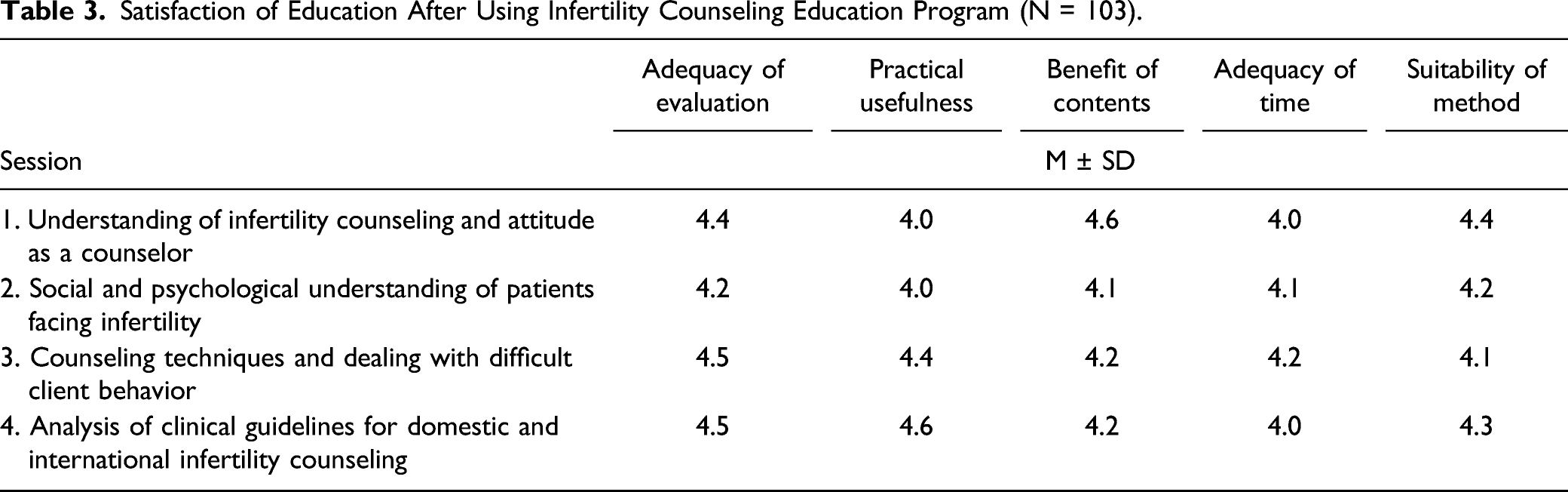
Satisfaction of Education After Using Infertility Counseling Education Program (N = 103).
Counseling Competency
Counseling Competency Before and After Using Infertility Counseling Education Program (N = 103).

Discussion
This study was conducted to develop an infertility counseling education program to improve the counseling competency of nurses in charge of patients facing infertility and to evaluate the effect of this program on nurses’ satisfaction with education and their counseling competency. The results are discussed as follows.
First, as a result of the survey for satisfaction with education, the satisfaction with the infertility counseling education program received a relatively high score with 4.0 to 4.6 points for each item out of 5 points, corresponding to the answer “yes.” Since there was no comparative education related to counseling education, satisfaction with education in this study was only measured afterward. As all of the participants in this study had no prior education related to counseling, the results can be deemed as the data obtained after receiving systematic counseling education. Regarding the “counseling techniques and dealing with difficult client behavior” part of the education program, the participants answered that they were highly immersed in the situation by practicing infertility counseling themselves while switching the roles and that it was a great opportunity to learn how to cope with situations that they had not yet been prepared to face in clinical practice, indicating their satisfaction with the infertility education program. In the study on the development and application of an education program for nurses in charge of HIV/AIDS counseling, 19 the satisfaction with the education program was rated 4 points or more out of 5 points, resulting in improved practical ability through face-to-face counseling training, which was in line with the results of this study.
Second, the counseling competency of nurses was improved through the infertility counseling education program. For the cases of unexplained infertility, which account for the majority of the patients in the supporting program for couples facing infertility, in addition to simple interventions of procedures and treatments, accurate diagnosis and characterization of the patients must be preceded by understanding the factors of the physical or mental problems of the patients causing infertility. 3 Among the patients facing infertility, the pregnancy success rate was increased through psychosocial intervention, 20 and the success rate was not high with only fertility treatment performed without psychosocial intervention. 21 According to the results of previous studies, it is believed that women facing infertility have a lot of motivation for counseling when experiencing failures or problems during the procedure. 22 Such stress from infertility can lower the pregnancy rate and increase the discontinuation of infertility treatment, 3 which is highly likely to cause health problems for infertile women. In addition, counseling for childbirth in the future can have an important effect on infertile couples 23 ; it can be said that counseling for infertile women has contributed to improving their psychological and mental health, thereby improving the pregnancy success rate. 24 Such study results support that the contents of the education program in this study such as “understanding of infertility counseling and attitude as a counselor,” “social and psychological understanding of patients facing infertility,” “counseling techniques and dealing with difficult client behavior,” and “analysis of clinical guidelines for domestic and international infertility counseling” may improve the pregnancy success rate of patients. While infertility counseling is established and managed as a major axis of infertility treatment and treatment in major developed countries overseas, 25 the infertility support system in South Korea has not yielded clear results since the pilot project in 2018. Therefore, it is necessary to clarify the elements of psychosocial support required to aid the patients facing infertility by reinforcing infertility counseling competency of nurses through fertility counseling education in South Korea.
Limitations
This study is meaningful in that it is the first attempt to develop an infertility counseling education program based on the guideline on routine psychosocial care in infertility and medically assisted reproduction for nurses in charge of patients facing infertility. It has enhanced counseling competency of nurses showing high satisfaction with education.
However, although the participants in this study were all nurses in charge of patients facing infertility, there was a limitation in that a control group could not be established. In the future, long-term research is required to develop indicators to determine the effectiveness of education programs. Nevertheless, this study applied a systematic education program for infertility counseling through various cases of counseling infertile women, discussions in small groups, and analyses of the latest clinical views, such as “understanding of infertility counseling and attitude as a counselor,” “social and psychological understanding of patients facing infertility,” “counseling techniques and dealing with difficult client behavior,” and “analysis of clinical guidelines for domestic and international infertility counseling,” to strengthen the counseling competency of infertility counseling nurses. It will be necessary to improve the nurses’ ability to conduct counseling and analyze the effectiveness of the program through expanded research in the future.
Conclusion
The results of this study can be used to develop an intervention program to provide sufficient counseling by infertility nurses in a cooperative relationship with patients facing infertility based on the understanding of the counseling experience of nurses at infertility centers. Currently, in South Korea, central and regional infertility counseling centers have been established and operated since 2018 based on a developed country-type infertility counseling model, but the system has not yet been stabilized with many remaining problems that need to be improved. The results of this study are expected to help infertility counseling nurses settle into the system and be used as a basis for presenting a counseling model for patients facing infertility.
Footnotes
Author Contributions
JP include contribution to study conception, design, acquisition, analysis, and interpretation of the data. NS include contribution to study drafting and revision of the manuscript for important intellectual content.
Declaration of Conflicting Interests
The authors declared no potential conflicts of interest with respect to the research, authorship, and/or publication of this article.
Funding
The authors disclosed receipt of the following financial support for the research, authorship, and/or publication of this article: This work was supported by the Namseoul University grant numbers 2021.
Research ethics
IRB number and institute: Namseoul University.
