




Abstract
Medical tourism has emerged as an industry due to the constantly improved information technology and decreasing cost for transportation. Evidence on how medical tourists develop their medical travel and their experience keeps growing. This article aims to provide an integrative review to understand medical tourism from the patients’ perspective. PRISMA procedures were followed. All the literature was published from January 1, 2009, to May 4, 2019, in peer-reviewed journals in CINAHL and MEDLINE/PubMed. Johns Hopkins Nursing evidence level and quality guide were used to evaluate evidence level. Twenty-one studies including 8 quantitative, 10 qualitative, and 3 mix-method studies were reviewed. Low cost, short waiting list, quality, and procedures available were the motivators to treatment abroad. The Internet, former tourists’ testimonial, and physician and facilitators’ advice were the predominant resources consulted. Perceived value of medical quality directly affected patients’ overall satisfaction. Our integrative review has led to the identification of many factors related to medical tourist’s experience. We suggest further empirical researches on (1) the patients’ decision-making process of motivators and barriers, (2) the factors related to patients’ experience on the health care quality, and (3) the strategies to ensure the continuity of care.
Medical tourism has emerged as an industry due to improved health technology, decreased cost for transportation, and innovative information technology. It is estimated that the number of medical tourists in the world was 14 to 16 million in 2017. The ongoing increase in medical travel flow brings both opportunities and challenges for the health care industry.
In this review, we intend to develop a comprehensive understanding of the existing knowledge about medical tourism from the patients’ perspective.
We suggest promoting the implementation of standards and guidelines of linguistic and cultural competency. Additional cultural competency training such as cross-cultural knowledge and skills and sensitivity toward the diversity norms of other cultures should be offered in schools and hospitals. Moreover, strategies for promoting continuity of care should be implemented to ensure that millions of medical tourists can receive optimal health care.
Medical tourism has emerged as an industry due to improved health technology, decreased cost for transportation, and innovative information technology. Individuals travel thousands of miles to seek treatment abroad. 1 The US cross-border exports of medical services have more than doubled in the past 10 years with a continuous growth at 7.7% compound annual growth (CAGR). In addition, imports of medical services to the United States have increased up to 24% CAGR. 2 It is estimated that the number of medical tourists in the world was 14 to 16 million in 2017. 3 The ongoing increase in medical travel flow brings both opportunities and challenges for the health care industry.
Medical tourism has been popular for centuries since the ancient Greeks and Egyptians swarmed to baths and hot springs to current surgery abroad. Although a growing number of valuable and relevant studies have addressed the new trend of medical tourism, majority of them focused on the opportunities and challenges it created for the global market and each national health care service 4 ; a few studies started to shed light on how the new trend of the medical tourism affected patients’ health care–seeking behavior such as the motivators and challenges. 5 A common misperception among scholars and the general public is that wealthy classes are the mainstream population with access to care abroad. Moreover, most people hold a similar opinion that medical tourists who come from developing countries tend to seek treatment in developed nations. Accordingly, in this review, we intend to develop a comprehensive understanding of the existing knowledge about medical tourism from the patients’ perspective.
The advance in information technology drives the rapid development of medical tourism. The Internet becomes the most common source that tourists use to acquire an initial understanding of a potential destination hospital. 6 Clicking “treatment abroad” on Google generated more than 33 000 000 results on May 4, 2019. However, no tool could be used to assess the accuracy and reliability of information sources. In addition, online information may lead to unrealistic expectations and uninformed decisions. 7 Subsequently, certain patients turn to facilitators or brokers when choosing a destination hospital. 8 Others may adopt the family physician’s advice. The fragmented evidence of medical tourism information continues to grow. However, none of the literature reviews has focused on how the tourists consult information and how to decide a destination.
Patient satisfaction with the medical tourism is also a critical indicator of health care quality and predict patients’ intention of revisiting. Medical tourists seek quality in their interaction with health care providers in the destination hospital. Employee’s responsibility and attitude, tourists’ perceived value, and other factors such as environment, food, and communication shape their own understanding of health care quality and thereby influence their experience. In addition, medical tourists divided health care quality into medical and service qualities. 9 Moreover, a growing number of studies have investigated medical tourists’ perception on this aspect of health care. However, literature review has scarcely established a comprehensive review concerning medical tourists’ experience in health care quality when they seek treatment abroad.
Accordingly, the present study aims to explore a full understanding of the medical tourism that forms the patient’s perspective. In addition, it attempts to answer the following research questions:
Methods
The integrative review followed PRISMA. 10 Our team investigated 181 peer-reviewed studies related to medical tourists’ experience in medical tourism.
Data Sources and Search Strategies
This research performed an electronic search for articles related to our topic in MEDLINE/PubMed and CINAHL Complete from January 1, 2009, to May 4, 2019. Such combing sets no limitation on the country. Medical Subject Headings (MeSHs) were used to search for articles. Four main concepts were found, namely, Medical Tourism, Global Health, Patient’s Satisfaction, and Perception. The Boolean phrases used included the following: (1) (“medical tourism” [MeSH] OR “global health” [MeSH] AND “patient’s satisfaction” [MeSH] AND [“Patients”] [MeSH]) and (2) (“medical tourism” [MeSH] OR “global health” [MeSH] AND [“patient”] [MeSH] AND “perception” [MeSH]). The search in CINAHL database was conducted using the following keywords: Medical Travel, Medical Tourism, Patient Satisfaction, Patient Experience, and Patient Perception. Boolean phrases were (1) Medical Travel OR Medical Tourism AND Patient Satisfaction and (2) Medical Travel OR Medical Tourism AND experience. Hand searching supplemented the search strategy, and these strategies identified 99 and 79 articles in PubMed and CINAHL Complete, respectively. Four articles were found through hand searching.
Study Selection and Data Collection Process
In the first stage, all abstracts were reviewed on the basis of the evaluation of inclusion/exclusion criteria to determine potentially relevant articles (n = 78). Inclusion criteria were studies on tourists who were (1) 18 years of age or older and (2) seeking treatment abroad or immigrants who access care to the homeland. Articles that do not focus on medical tourists’ perspective were excluded (n = 32). In the second stage, 46 articles remained for a full-text review. Inclusion criteria were primary studies regarding medical tourism and reports of studies related to patients’ perspective regarding their perception or experience of medical tourism. No limitations were placed on destination country and type of treatment. All studies on (1) tourists seeking treatment due to political issues such as refugees, (2) literature reviews, (3) case study, or (4) editorials or reports were excluded (n = 24). A total of 22 articles remained. During the peer-review process, 1 article was eliminated because such participants who accessed care abroad were residents in the US-Mexico border region. Thus, a total of 21 articles were included in the current integrative review. The literature selection process is depicted in a PRISMA diagram 10 (Figure 1).
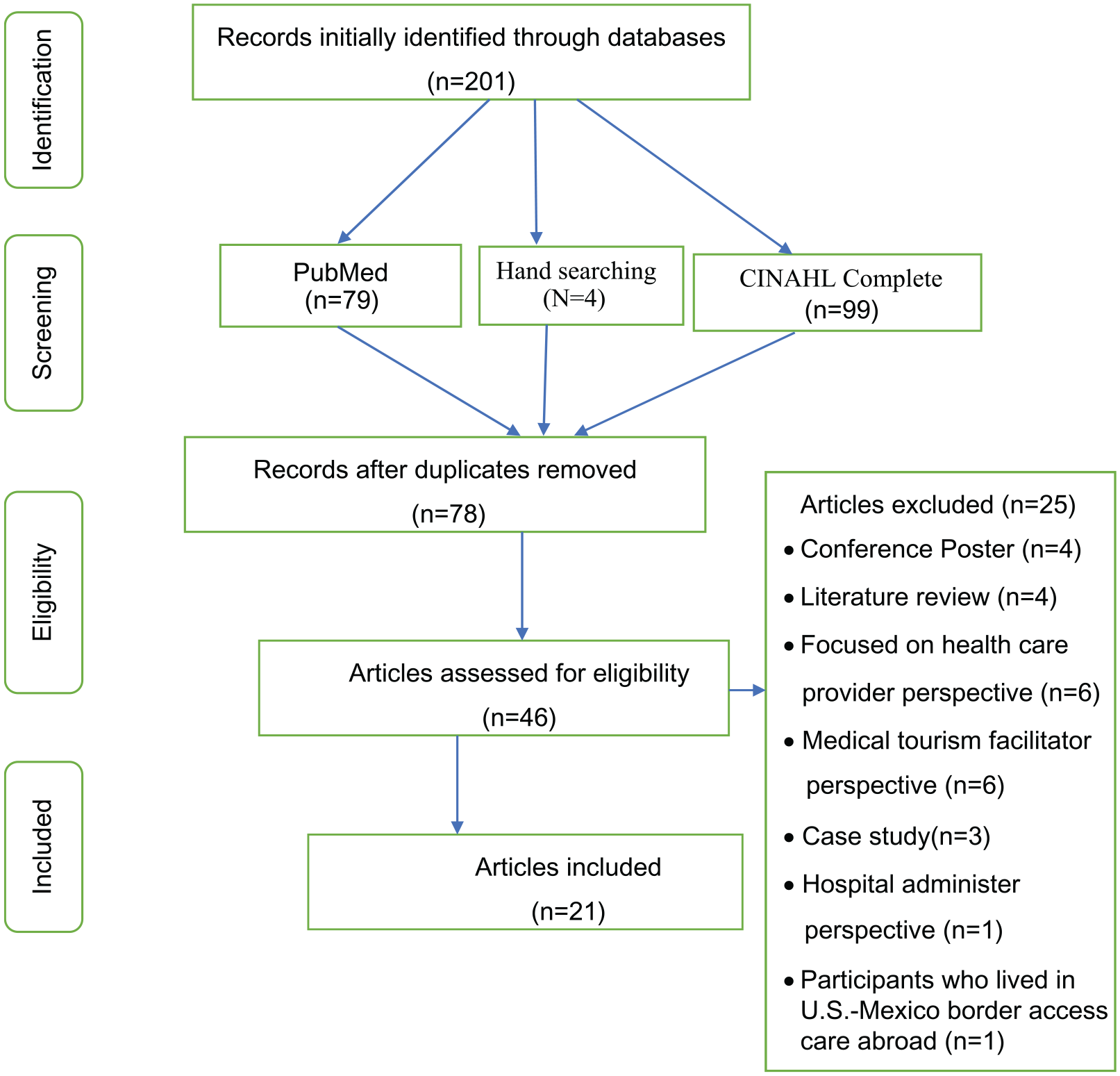
PRISMA diagram.
Data Analysis
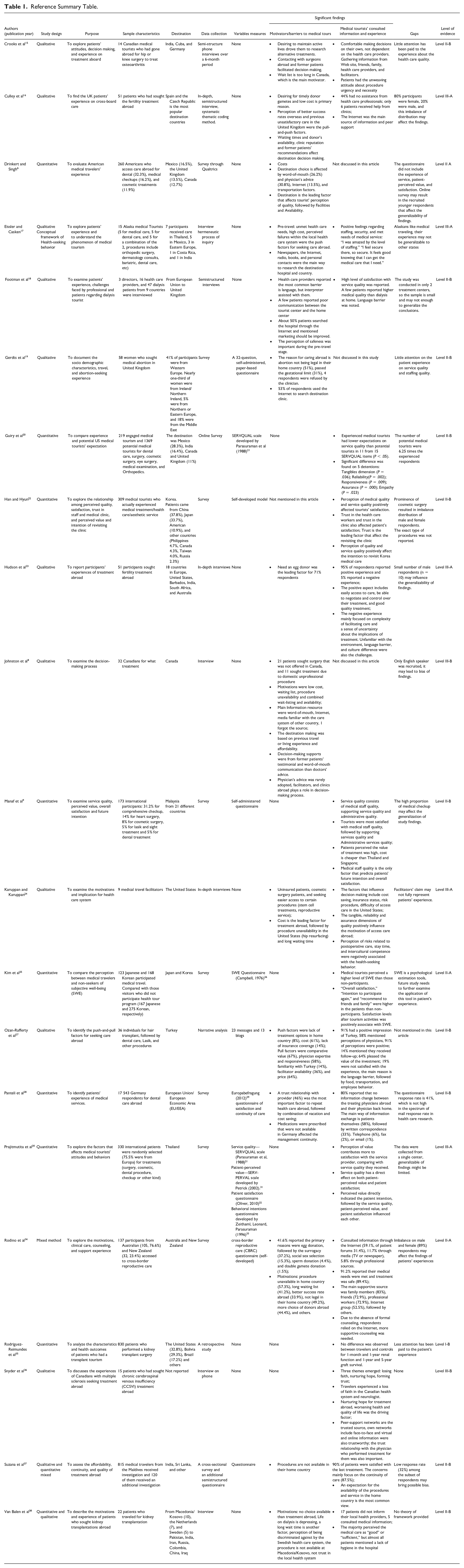
The data analysis process followed the updated integrative review method by Whittemore and Knafl 11 including the steps of data extraction, display, comparison, and drawing conclusions. Data extraction was independently completed by 2 reviewers (T.X. and W.W.). The data extraction form was designed on the basis of the research questions. Data items include the author (publishing year), purpose, research design, destination country, participants, research method, themes, and significant findings of studies (Table 1). A descriptive synthesis approach 12 was employed to present the results due to the inclusion of studies incorporating many types of research methods. The motivators and barriers, patients’ consult information, and experience were highlighted in the significant findings section. The common themes were emerged from the data analysis process. The relevant risk of bias and methodological quality of included studies were evaluated on the basis of the Cochrane Collaboration tool. 13 Johns Hopkins Nursing evidence level and quality guide 14 were used to evaluate the level of evidence which rate the strength of research evidence from level I to level V and the quality of evidence as grades A, B, and C.
Reference Summary Table.
Results
Overview of the Studies
A total of 21 studies remained in this review, and all the included records were published from 2011 to 2018. In addition, all included studies were assessed as of fair or good quality based on the Johns Hopkins evidence level and quality guide. 14 Eight were quantitative studies, 10 were qualitative, and the other 3 used a mix of quantitative and qualitative methods. Most quantitative studies used survey method, and qualitative research used in-depth interview to collect data. The mixed methods were conducted via surveys and interviews. The most frequently purchased destination countries were Mexico, India, the United States, and the United Kingdom. The frequently used procedures were dental care, cosmetic surgery, and reproductive treatment, apart from comprehensive checkup. By reviewing all included articles independently using notes, keywords, and phrases, 2 reviewers (T.X. and W.W.) identified 3 common emerging themes among these 21 articles that remain relevant to medical tourists’ experiences, namely, (1) motivators (n = 13) and barriers (n = 3), (2) consulted information sources and decision-making support (n = 14), and (3) perceived quality of health care (n = 6). Three themes interacted with each other and collectively contributed to answering the interaction review questions.
Motivators and Barriers for Medical Tourism
Thirteen studies reported the predominant motivators for treatment abroad, including low cost, short waiting list, quality, insurance status, distance, and domestically unavailable procedures. Four studies in the United States6,16,24 and Canada 39 indicated that the leading motivator for medical tourism is the low cost in the destination countries followed by the short waiting list. Five studies indicated that patients from the Maldives and other developing countries such as Macedonia/Kosovo seek care abroad because the procedures were either unavailable or illegal in their local origins.19,27,34,37,38 For instance, medical abortion is illegal in selected areas in Western Europe. For certain specific procedure such as fertility treatment, donor’s availability in destination country was the leading motivator for planning medical travel.16,23 Four studies identified the perception of better quality abroad and dissatisfaction with local health care as the primary reasons for medical tourism.8,16,17,36
Language barrier was identified as the most common barrier.18,23,27 It has led to miscommunication and anxiety between patients and health care professionals. Research with 66 respondents (n = 47 patients and n = 19 health professionals) indicated that physicians and nurses were expected to speak more than 1 language due to limited interpreter availability. 18 Other barriers affecting the patient’s experience included unfamiliarity to the environment, culture difference, food, transportation, and employee behavior. 23
Information Sources and Decision Making for Medical Tourism
Consulting information is a vital step prior to traveling for a medical procedure. Owing to limited information, patients typically take a longer time making the ultimate decision to access care abroad than treatment in their home country. 6 The Internet was the primary source tourists use to initially learn a potential destination country followed by word-of-mouth and peer-support networks.6,8,9,15,16,18,19,34,35
Many factors drove the decision making about the destination. Drinkert and Singh 6 reported that 30.8% of medical tourists adopted physician’s advice followed by word-of-mouth (26.2%) and the Internet (13.5%) to decide on the destination hospital. However, in a study of 32 Canadians who sought treatments abroad, former patients’ testimonial and word-of-mouth communication have more influence on patient’s intention than doctors’ advice. 8 Moreover, certain medical tourists solely depended on facilitators or brokers when selecting a destination hospital abroad.6,8,37,38 These medical tourists rarely adopted their physician’s advice and did not inform their physicians of overseas treatment. Drinkert and Singh 6 and Han and Hyun 22 showed that familiarity and cultural similarity were other important factors for tourists planning a medical trip.
Experience in Quality of Health Care
Six studies reported the quality of health care as perceived by medical tourists. In these studies, quality of health care consists of many factors, including service, medical staff, and quality, and patient-perceived value.9,18,22-24,30 Patients perceived a high level of service and medical quality in destination hospitals including the following: easy access to care, 23 the ability to communicate the treatment with health care providers, 23 trust relationship with physicians,22,36 and obtained good health outcomes. 23 Manaf et al 9 conducted a survey of 173 international patients from 21 countries in Malaysian hospitals. Tourists were most satisfied with the staff quality followed by supporting and administrative service quality. Rodino et al 34 interviewed 137 patients who sought reproductive care in Australia and New Zealand. In addition, they found that more than 90% of respondents reported that their medical needs were met, and treatment was safe.
The perception of high quality positively affects patients’ intention to revisit the hospitals.9,24,25,30 The perception of value contributes more to overall satisfaction than the service quality, and it directly influences the intention to revisit. 30 Service quality has an opposite effect on patient satisfaction and perceived value. Trust in the provider and the clinic contributes to patient satisfaction and is an effective indicator for the future intention to revisit. 22 Guiry et al 20 surveyed 219 engaged medical tourists and 1369 potential medical tourists and showed that their perception of the quality of health care was significant associated with the expectations. 20 The potential medical tourists had expectations over 6 times higher than those of experienced individuals. Hence, the expected service quality is higher, and such perception may influence their evaluation of the quality they received in the destination hospitals.
Panteli et al 28 and Suzana et al 37 indicated the concern for the continuity of care. After returning to their home country and when a complication occurs, the local clinic is unwilling to provide care. In addition, certain prescribed medication may be unavailable in local clinics. Hence, patients are compelled to travel back to the clinic abroad for treatment. Another concern is the continuity of information. In a German study 2 of 17 543 medical tourists with access to care in European Union/European Economic Area countries, only 1 in 3 received follow-up care. More than 80% of respondents reported no information exchange between the international hospital and the family physician.
Discussion
Many scholars, including some in the health care system, mistakenly believe that medical travelers from wealthy classes of developing countries seek treatment in the developed nations. However, our literature review showed an increasing number of medical travelers who access care from developed countries to certain less-developed nations. For example, Americans traveled to Mexico for dental care 6 and Canadians went to India and Cuba for hip or knee surgery. 9 Moreover, medical tourists are becoming increasingly interested in destination hospitals that can provide competitive quality and more affordable prices than other institutions worldwide such as those in India, Korea, and Iran.
Motivators and Barriers for Medical Tourism
Medical travel was driven by diverse motivators and may vary depending on which treatment was used. Patients from developing countries predictably continue to travel to developed health systems for high-quality treatment. However, for selected developed countries such as America 6 and Canada,8,9 patients’ leading motivators to access care abroad were the low cost and short waiting list in destination countries rather than the quality of health care. Even with the same expenditure, Canadian and American people would prefer to access care abroad to avoid the long waiting list in their respective countries.6,8,9,24,33 Lunt et al 40 supported the finding that deteriorating conditions such as high cost and a long waiting list in developed countries push an increasing number of patients to seek treatment abroad. Alternately, pull factors in the developing countries, including the innovation, high efficiency, and competent service quality, appear to keep attracting patients worldwide. This finding is supported by an investigation of 800 participants from 40 countries. The decision to treat is remarkably increased if the participants were told that Asia is known for high-quality care, low cost, and short waiting times. 41 Interpreters were provided in many big medical centers. However, our patients continued anticipating health care providers to speak 1 more language. Moreover, culture difference was found to impede effective communication between patients and health care providers. This finding explained why patients opted to choose a familiar or similar language and culture as their destinations.22,25
Information Sources and Decision Making
Having access to information is a vital step in decision making for medical tourism. Notably, most of the patients use mixed information such as online information and former patients’ testimonies in formulating their decision. We found that the accessibility and reliability of online information remain to be the greatest barriers for tourists to make an informed decision. Excessive information includes advertisements and social media sites that pop up on the screen and consequently confuses the patients. Word-of-mouth plays an important role in medical tourists’ decision-making process. The former patients become “ambassadors” in spreading information about the destination hospitals to interested others, and the former in turn affects the decision making of the latter. 42 Certain patients solely rely on the facilitator company to decide the destination hospital. Health care professionals and patients should be provided with precise information about transportation, booking service, and detailed information about procedures. 18 Few of the facilitator companies were operated by professional groups. Inaccurate resources emerged because of outdated statistics and missing important information. Such limitation may lead to unrealistic expectations and uninformed decision making. These findings are aligned with Rodino et al 32 that additional supportive counseling is needed for patients. The perception of safety and risks during information consulting may also affect medical tourists’ decision making. 24
Experience in the Quality of Health Care
Patients likely evaluate the staff and service quality rather than the medical procedure itself. Compared with the perception of service quality, perceived value (if the quality had a reasonable price) directly predicted the future intention of revisiting, and it would lead to a recommendation to other potential medical tourists. In addition, a trusting relationship with the clinic abroad and providers can facilitate the process of decision making on treatment abroad. The local doctor’s advice was one of the main supportive sources for medical tourists. However, certain patients avoided discussing their plan with family physicians. This kind of fractured trust in the physician-patient relationship would affect the follow-up care for the tourists returning to their respective homelands.
Implications
Language and culturally competent care are the most common barriers to health care delivery. The US government has developed standards and guidelines of linguistic and cultural competency that aims to promote health equity at the national and state levels. Promoting the implementation of these standards is essential in providing culturally appropriate care. Additional cultural competency training such as cross-cultural knowledge and skills and sensitivity toward the diversity norms of other cultures should be offered in schools and hospitals. Moreover, strategies for promoting continuity of care should be implemented to ensure that millions of medical tourists can receive optimal health care. Such strategies include increasing the information exchange between family physicians and overseas clinics and providing follow-up care for medical tourists after they return to their respective homelands. Destination hospitals’ official websites should provide additional valuable information for potential medical tourists including transportation, booking service, and procedural information due to the limited availability of information. Peer-support forums are highly recommended.
Limitations
Limitations of this review are the relatively low level of evidence in majority of the studies, which were survey studies and qualitative semi-structure interview. Although the methods are appropriate answering the integrative review questions, limitations of the self-reporting studies may affect the results. In addition, the language restriction of only English-language sources was included and reviewed brought systematic bias and affects the conclusions.
Conclusions
This integrative review provides an overview of current knowledge on medical tourism from the patients’ perspective. Our findings led to the identification of factors related to medical tourists’ experience including the following: the motivators and barriers, information sources, and decision making, apart from the experience of the quality of care. Despite many published articles addressing medical tourism, additional theoretical and empirical research can facilitate our complete understanding of patients’ experience in the medical journey. Thus, we suggest the following additional empirical studies: (1) the patients’ decision-making process of motivators and barriers, (2) the factors related to patients’ experience in the health care quality, and (3) the strategies to ensure the continuity of care.
Footnotes
Acknowledgements
We thank Dr. Mikyoung A. Lee, Associate Director of PhD Program and Associate Professor, for supporting the manuscript development in the Exploring Scientific Literature Review course at Texas Woman’s University College of Nursing.
Declaration of Conflicting Interests
The author(s) declared no potential conflicts of interest with respect to the research, authorship, and/or publication of this article.
Funding
The author(s) received no financial support for the research, authorship, and/or publication of this article.
