




Abstract
Studies of satisfaction among patients are a popular and frequently obligatory tool used in improving the quality of medical services worldwide. Becoming familiar with the opinion of the patients enables to adjust the venue to their expectations, thus contributing to the increase in its competitiveness. We aimed to study patients’ satisfaction understood as a tool used in increasing the quality of medical services; in addition, we assessed factors that affect a worse review patients gave about the functioning of this Polish hospital before and after its transformation into a commercial company. The study of satisfaction among patients was conducted using an anonymous questionnaire among 2702 respondents before and 2795 respondents after the hospital’s transformation. Multivariate logistic regression analysis was applied to statistically analyze the collected empirical material, where the dependent variable was a worse evaluation of respondents concerning the functioning of the hospital. It was demonstrated that both before and after the hospital’s transformation into a commercial company, it was education and conditions of housing of patients that determined their opinion about the functioning of the admission center and hospital wards. A higher level of education increases the risk of a worse evaluation of the admission center and hospital wards, whereas higher self-evaluation of housing conditions lowered the discussed risk. Factors that influence the opinion of patients concerning the functioning of the hospital are education, age, marital status, housing conditions of the respondents and also the number of stays at a given hospital, and a conscious choice of the facility in which a patient wished to be treated.
Introduction
The market of medical services in Poland is currently undergoing a rapid transformation from the system where the state was the only owner and manager, to the system in which many suppliers with the legitimate co-financing of services exist.
The main assumption of the changes taking place at the turn of years in the Polish system of health protection was to improve the level of benefits, increase their accessibility, and improvement of the system’s financial liquidity. New regulations opened new possibilities of transforming hospitals’ ownerships and medical centers were presented with the possibility to be transformed into commercial companies. The process of transformation is based on liquidation of the Independent Health Care Centre and appointing a subject such as a partnership in its place. Thanks to the completed organizational and legal transformation, there appears a possibility to eliminate some duties that make managing the facility difficult, and it becomes possible to increase access to financial instruments. 1
Quality management is of particular importance here as it becomes a more and more frequently implemented method of the health managing process both worldwide and in Poland. 1 High quality of health care allows Independent Health Care Centre to supply patients with aid that remains in accordance with their health needs.2,3 High quality of the provided health services and patients’ satisfaction becomes the main factor deciding about the “brand” of a medical health center. It is usually assumed that the relationship between a patient, and the subjective evaluation of the level of the service provided and expectations is of key importance. 3 Health care managers realize that to improve health care centers and thus the whole health care system, it is necessary to consider opinion of patients. 4
The influence of satisfaction of patients on the improvement of medical services quality is proven and broadly discussed in literature.5-7 The multifaceted evaluation of a medical facility performed by patients is an effective tool that ensures better health care and strengthens taking strategic decisions, lowering the costs, thus fulfilling patients’ expectations, and preparing strategy of effective management and supervising progress.8-10
A hospital in Tomaszów underwent a transition from a health care center into an Independent Public Health Care Centre Ltd., one of the first Polish hospitals doing so, between August 8, 2008, and June 30, 2009, following the Health Care Institutions Act; as a result, it became a team of identified individuals and assets. Familiarizing with the opinion of patients enables adjusting the center to their expectations and—consequently—contributes to the increase in competition. We aimed to study patients’ satisfaction as a tool used in increasing the quality of medical services,5-7 In addition, we assessed factors that affect a worse review patients gave about the functioning of this Polish hospital before and after its transformation into a commercial company.
Methods
The survey was carried out among the respondents hospitalized at the Polish hospital in Tomaszów (all patients who volunteered between August 8, 2008, and June 30, 2009). The survey included 5497 patients: 2702 before and 2795 after the hospital’s transition. It took 2 years to collect all questionnaires—1 year before and 1 year after the transition. Ballot boxes were placed around the hospital, where patients could place their filled questionnaires that had previously been included in the pilot study. 11
Description of Research Tools
A complete description of research tools and characteristic of the tested groups of respondents before and after the transformation has been published elsewhere. 12
Methods of Statistical Analysis
Multivariate logistic analysis was used in statistical analysis of the collected empirical material, where the dependent variable was the worse opinion of the respondents concerning functioning of the hospital. The analysis was performed using Statistica 8.0 software. In all performed tests, the null hypothesis was rejected at P< .05 level.
Results
In the first stage, dependent variables were defined. For every respondent, an arithmetic mean was calculated out of 10 questions assessing the functioning of the admission center and out of 24 questions assessing the functioning of the hospital wards. Dichotomization of variables describing the averaged opinion of respondents concerning the functioning of the admission center and the hospital wards was performed before and after the transition. The median of the assessment of patients of the functioning of the admission center before the transition was 3, whereas after the transition it was 4.5. In case of hospital wards, the median of assessment before the transition equaled 3, whereas after the transition, it reached 4.17. The averaged opinion of respondents concerning the functioning of the admission center and the hospital wards that was lower than the median was defined as “worse.” Both before and after the transition, the averaged assessment of the functioning of the admission center and the hospital wards that were greater than or equaled the median was defined as “better.” In the next stage, elements of characteristic of the studied population both before (see Table 1) and after (see Table 2) the transition were juxtaposed, depending on the better or worse review of the functioning of the admission center and the hospital wards. A similar juxtaposition was performed for the analysis of logistic regression that enabled us to define the independent risk factors in the inferior opinion of respondents about the functioning of the hospital before and after the transition.
Evaluation of the Functioning of the Admission Center and the Hospital Wards Before and After the Transformation, Depending on the Parameters Characterizing a Studied Group of Respondents.

Note.Better evaluation: evaluation ≥ median for the group. Worse evaluation: evaluation < median for the group. The median for the group both at the admission center and the hospital wards was 3.
Evaluation of the Functioning of the Admission Center and the Hospital Wards After the Transformation, Depending on the Parameters Characterizing a Given Group of Respondents.

Note.Better evaluation: evaluation ≥ median for the group. Worse evaluation: evaluation < median for the group. The median for the group evaluating the admission center was 4.5 whereas for the hospital wards it was 4.17.
Risk Factors for the Inferior Opinion of the Admission Center Functioning
It was demonstrated that both before and after the transition of the hospital into a commercial company, patients’ education and living conditions determined their opinion about functioning of the admission center. A higher level of education increased the risk of a worse evaluation of the admission center, whereas higher self-evaluation of living conditions lowers the discussed risk. In addition, factors for the contradictory direction of impact on the opinion of respondents before and after the hospital’s transformation were identified. An independent risk factor that was inferior in the opinion of the functioning of the admission center before the transition was the older age of respondents. It appeared that such variables as marital status (widow/widower vs a single person) and the number of stays at the hospital (the first stay vs the following ones) lowered the risk of a more inferior evaluation of the admission center before the transition. In the analyzed period after the transition of the hospital into a commercial company, the risk of an inferior evaluation of the admission center was increased by the following variables: marital status (married vs single) and the number of stay at hospital (the first stay vs another one). A conscious choice of hospital (a person wanted to be treated at this hospital vs a person had no other option) and older age of respondents (a clearly visible gradient of chance ratios) lowered the risk of an inferior evaluation of the functioning of the admission center after the transition (see Table 3).
Analysis of the Risk Factors for a More Inferior Evaluation of the Admission Center Before and After the Transformation.

Note.The evaluation was determined as mean < median for the group; the median for the group evaluating the admission center before the transformation was 3 and after the transformation was 4.5. The table presents models of multivariate logistic regression analysis. OR = odds ratio; CI = confidence interval; LL = lower limit; UL = upper limit;Ref = reference category.
Dependent variable: patients’ more inferior evaluation concerning the functioning of the hospital wards (average out of 10 questions < median) before the transformation.
Dependent variable: patients’ more inferior evaluation concerning the functioning of the hospital wards (average out of 10 questions < median) after the transformation.
Risk Factors for the Inferior Evaluation of the Functioning of Hospital Wards
It was determined that both before and after the hospital’s transition, education and living conditions determined patients’ opinion concerning the functioning of the hospital wards. A higher level of education (high school education vs primary school education) lowered the risk of an inferior evaluation of the hospital wards. In addition, factors for the contradictory impact on the opinion of respondents before and after the hospitals transformation were identified. An independent factor lowering the risk of a more inferior evaluation of functioning of the hospital wards before the transition was the number of stays at the hospital (second, third, or subsequent stay at the hospital vs the first one). After the transformation, the risk of a more inferior evaluation of the hospital wards was increased by the following variables: marital status (married, divorces, widow/widower vs single person) and the number of stays at hospital (second, third, or subsequent stay at the hospital). It appeared that a conscious choice of hospital (a person wanted to be treated there vs a person had no other option) and older age of respondents (a clearly visible gradient of chance ratios) lowered the risk of a more inferior evaluation of the functioning of the hospital wards after the transformation (see Table 4).
Analysis of the Risk Factors for a More Inferior Evaluation of the Hospital Wards Before and After the Transformation.
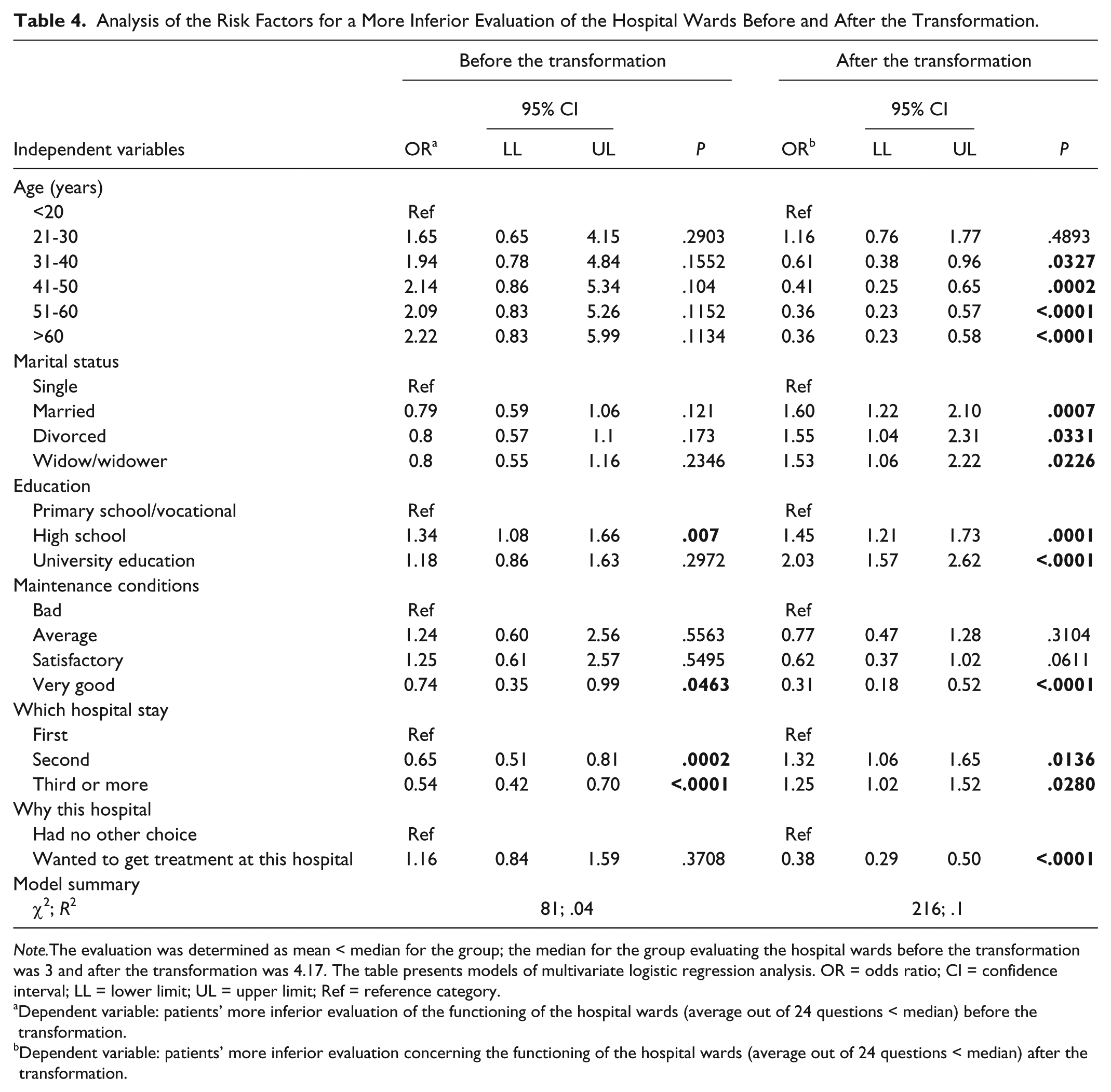
Note.The evaluation was determined as mean < median for the group; the median for the group evaluating the hospital wards before the transformation was 3 and after the transformation was 4.17. The table presents models of multivariate logistic regression analysis. OR = odds ratio; CI = confidence interval; LL = lower limit; UL = upper limit; Ref = reference category.
Dependent variable: patients’ more inferior evaluation of the functioning of the hospital wards (average out of 24 questions < median) before the transformation.
Dependent variable: patients’ more inferior evaluation concerning the functioning of the hospital wards (average out of 24 questions < median) after the transformation.
All of the above-presented risk factors were of rather independent character. Ratios of chances were estimated on the basis of logistic regression analysis results in multifactor models. Variables presented in Tables 3 and 4 in bold present the final models. The influence of the type of a hospital ward was included in the evaluation of hospital wards.
Discussion
Analysis of the collected empirical material allowed to identify a number of risk factors contributing to the inferior opinion of respondents concerning the functioning of the hospital before and after its transformation into a commercial company. Education, age, marital status, living conditions of the respondents and the number of hospital stays, and conscious choice of the facility in which a patient wished to be treated were included among the most important factors determining the opinion of patients. In the study of satisfaction among patients carried out by other authors, similar variables that influenced the opinion of patients about a facility were identified. Among some of the most frequently mentioned variables, the following were included: age, level of education, and economic status of the studied.13-18 As the analysis presented in this work showed, patients’ sex had no impact on their opinion about hospital’s functioning. A similar lack of dependency was found in the publications of other authors.13,17,18 Determining the risk factors allowed to point the way forward in the quality management at this hospital so as to improve the opinion of patients concerning the hospital’s functioning. Young patients who are also better educated and living in worse conditions should be of particular importance here. In light of the obtained results, it seems necessary to attempt defining the expectations of the listed groups of patients concerning the hospital. It may be assumed that more frequent hospitalizations are connected with a more severe illness, which may influence a patient’s worse psychological state and thus a more inferior opinion concerning the facility this patient is treated at. It is also probable that the worsening evaluation of the hospital during subsequent stays results from the lack of further modernization and improvement that would meet the patients’ expectations that they hold.
A tendency to issue a worse assessment in the time prior to the hospital’s transformation was presented mostly by a group of elderly people, that is, those between the ages of 51 and 60 years and above. After the hospital’s transition into a commercial company, a reverse situation was observed. With the increased age, the risk of a more inferior assessment lowered both for the admission center and the hospital wards. It may be assumed that the changes connected with the process of the hospital’s transformation met mostly the needs of the elderly people.
The risk of a more inferior evaluation of the hospital was significantly lower among people who have consciously chosen this hospital as the place in which they wanted to be treated. This positive tendency proves that the hospital did meet the expectations of people who consciously entrusted the employees of this facility with their health.
While conducting the analyses of risk that would influence the more inferior evaluation of medical facilities in Poland, the changes and events taking place in this country cannot be overlooked as they influence the patients and thus their opinion about the system and the health care facilities. Patients frequently have problems with an objective evaluation of quality and the level of difficulty of the performed treatments as well as the risk involved with the medical procedures. It is the duty of the hospital personnel to provide the hospitalized person with such information, whereas the State should convince patients that the main value of the health care system is the protection of health and life of its citizens. However, the transformation into a commercial company (regardless of the type of ownership) can have a negative effect on hospital profitability. Younis, for example, showed that small rural hospitals that converted to critical access status enjoyed improvement in financial status; however, hospitals that converted to for-profit status did not improve in financial status, and showed a lower earning after the conversion. 19 Also, as showed by Younis and Forgione, some other actions, such as introducing the Balanced Budget Act and Balanced Budget Refinement Act, leading to financial cuts for hospitals had a negative effect on the ability of hospitals to continue offering safety-net services and negatively affected the length of stay in a hospital. 20
It is also very important to consider the expectations and suggestions of patients while introducing the changes. This applies to both macro-changes (health care system) and micro-changes (hospital). Patients need to be educated systematically that the introduced changes are beneficial for them and are determined by their actual needs.
Conclusions
Factors influencing the evaluation of patients concerning the functioning of the hospital are the following: education, age, marital status, living conditions of the respondents and the number of stays at a given hospital, and their conscious choice of the facility in which they wanted to be treated.
To improve the hospital’s further evaluation by patients, a particular importance should be placed on the needs of young people who are better educated and live in worse living conditions.
There is a need for further, systematic studies of satisfaction of patients to answer the following questions: Will higher satisfaction scores make the health care organization more efficient, competitive, and profitable? Will higher scores improve quality, and not just the patients’ perception of quality? Will higher scores increase patients’ access? Will higher scores help lower the costs, or improve financial performance?
Footnotes
Declaration of Conflicting Interests
The author(s) declared no potential conflicts of interest with respect to the research, authorship, and/or publication of this article.
Funding
The author(s) disclosed receipt of the following financial support for the research, authorship, and/or publication of this article: The work was financed from the funds of statutory funds of the Social Medicine Institute of the Medical University of Łódź (503/6-029-01/503-01).