




Abstract
It has been documented that about 20% of children and adolescents suffer from a diagnosable mental or addictive disorder in the United States. The high prevalence of children’s emotional and behavioral problems (EBP) might have a negative effect on their mothers’ labor market outcomes because children with EBP require additional time for treatment. However, these children may require additional financial resources, which might promote mothers’ labor supply. Previous studies have only considered chronic conditions in analyzing the impact of children’s health on parental work activities. Moreover, most of these studies have not accounted for endogeneity in children’s health. This article estimates the effects of children’s EBP on their mothers’ labor supply by family structure while accounting for endogeneity in children’s health. We used the 1997 and 2002 Child Development Supplements (CDS) to the Panel Study of Income Dynamics (PSID). We used probit and bivariate probit models to estimate mothers’ probability of employment, and tobit and instrumental variable tobit models to estimate the effects of children’s EBP on their mothers’ work hours. Findings show negative effects of children’s EBP on their married mothers’ employment and on their single mothers’ work hours.
Introduction
Concerns over the social and economic consequences of highly prevalent childhood emotional and behavioral problems (EBP) have become increasingly important. In fact, it has been documented that about 20% of children and adolescents in the United States suffer from a diagnosable mental or addictive disorder. 1 In addition to their enduring effects across the life span and generations, childhood psychiatric disorders place an enormous burden on society, communities and families. 2 Parents, particularly mothers, face serious difficulty in balancing daily activities such as employment, child care, and parent-child relationships because they must invest a considerable amount of time and economic resources in these children. The high prevalence of children’s EBP might have a negative effect on their mothers’ labor market outcomes because children with EBP require additional time for treatment. However, these children may require additional financial resources, which would promote their mothers’ work activities.
There is a long-standing literature in the economics field on the impact of children’s disabilities or other chronic conditions on their parents’ work activities, particularly, the effects of children’s health on their single mothers’ employment.3-19 This literature is not conclusive for single mothers and shows a wide range of reductions from 5% to 30%.3,4,6,10,13-19 Findings are more consistent across the small number of studies that have examined the impact of children’s chronic illnesses on married mothers’ employment.3-5,10-12 More recent studies which have used richer data sets and larger sample sizes and have accounted for endogeneity in children’s health including omitted variables bias are more consistent in their findings. They have consistently found negative effects of children’s health on mothers’ work activities ranging from 10% to 16%.13,14,20-25 However, only a few studies have either considered mental health symptoms in addition to general chronic health conditions in analyzing children’s health on parental work activities7,8 or have examined the effect of having any household family member with mental illness, including children, on single and married mothers’ work hours.14,17,18
Focusing on the most recent literature which seeks to understand the impact of children’s health on parental work activities, there are four articles that are relevant to this study.26-29 Two of these articles used different measures of child health such as birth weight, physical disabilities, and mental, emotional, sensory, and cognitive disabilities to examine the relationship between child health and mother’s labor supply.26,28 Both studies found that having a child in poor physical health reduces single mothers’ probability of working from 2 to 8 percentage points and from 1 hour to 3 hours per week for employed mothers. Similar but smaller effects were found for married women. However, the effects of child health on mothers’ work activities were less strong for those mothers with a child who suffered from a disabling mental, emotional, sensory, or cognitive condition.26,28
Other studies have examined the long-term effects of children’s health on parental labor supply. For instance, Kvist et al. examined the relationship between children’s attention deficit hyperactivity disorder (ADHD) and parents’ labor supply using data from the Danish Psychiatric Central Register. 29 The authors found that parents of children diagnosed with ADHD have a 7% to 13% lower probability of labor supply 10 years after the child’s birth, compared with their counterparts with non-ADHD children. 29
The study most closely related to our study was the one conducted by Coley et al. 27 The authors used a sample of low-income mothers and early adolescent children (aged 10-14) from the Three-City Study (Boston, Chicago, and San Antonio) to examine the relationship between adolescent behavioral and psychological functioning and maternal labor supply such as employment status and duration of employment. They used a shortened version of the Brief Symptom Inventory to measure adolescents’ symptoms of depression, somatization, and anxiety. They also used items derived from the National Longitudinal Study of Youth and the Youth Deviance Scale to describe adolescents’ behavioral problems. Employment status indicated whether or not mothers were employed at the time of the survey. Weeks and months of employment were assessed by using the number of weeks or months during the previous 6 months when mothers were employed in their primary jobs. The study found that greater psychological distress among adolescents predicted a lower likelihood of employment for mothers (fewer hours worked, fewer months worked, and lower earnings), and a greater likelihood of having lost hours in the previous week. They also found that adolescent delinquency and disabilities were less consistent predictors of mothers’ lower employment effort. 27
While these studies provided some insights regarding the impact of children’s health on their mothers’ work activities, the current study contributes to the literature in several ways. First, it focuses on the impact of having a child between the ages of 4 and 18 who is suffering from EBP on their mothers’ labor supply (employment and work hours). As the literature review above shows, there are no previous studies focusing on this area. It is important to examine the effects of children’s EBP on parental work activities for children of different ages because children require different amounts of time and resources from their parents for the production of their well-being at different ages. Second, this study uses rich and nationally representative data sets. Third, it accounts for issues of endogeneity such as omitted variables biases and reverse causality between children’s EBP and their mothers’ labor supply. More specifically, this article estimates the effects of children’s EBP on (1) their mothers’ employment status and (2) work hours for single and married mothers.
We hypothesize that mothers with children who suffer from EBP are more likely to reduce their labor supply compared with mothers whose children are free from EBP. We further hypothesize that these effects are larger on married mothers’ labor supply compared with single mothers because of the flexibility provided by the presence of fathers in two-parent families. It is important that policy makers, clinicians, and researchers understand these effects because of the role that parents’ labor income plays in shaping children’s health, educational, and economic trajectories. 9
Materials and Methods
Conceptual Framework
The study focuses on the extent to which U.S. households with children affected by EBP withdraw time from market activities to reallocate it to the production of their child’s mental well-being. Based on insights from Becker’s intra-family allocation framework and from Grossman, we hypothesized that a child’s mental well-being is a commodity produced in the house with some combination of time and medical care and services based on parental preferences, time, income, and budget.30,31 The key implication of this framework is that maternal employment depends on changes in children’s mental health endowment as well as the marginal productivity of the inputs used to produce mental well-being in the child. For instance, an increase in the child’s EBP would increase the use of medical goods and child care services, which might increase the mother’s labor supply to compensate for additional income needs. However, this situation would impose a greater demand on the mother’s time. Mothers may reduce their labor supply because they are able to provide more effective and efficient services to their child with EBP than alternative child care providers. We hypothesized that the net effects are a reduction in the mother’s labor supply.
Data Sources
We pooled two waves of data from the Child Development Supplements (CDS) of the Panel Study of Income Dynamics (PSID) collected in 1997 and 2002 and combined these CDS files with the family and individual files from the PSID. The PSID is an ongoing nationally representative panel survey that has been collecting detailed socio-economic and socio-demographic data such as employment, income, and marital status from individuals and households in the United States since 1968. The PSID added the CDS to its core data in 1997 and 2002 to understand the socio-demographic, psychological, and economic aspects of childrens’ lives. Both waves of the CDS randomly sampled up to two children per PSID family. CDS-I collected information from the primary care givers (PCGs) on 3,563 children ranging in age from 0 to 12. CDS-II collected information on households that remained in the sample through 2001, including 2,907 children ranging in age from 5 to 18. For both waves of the CDS, the PCGs provided information on their children’s health, behavior, cognitive ability, socio-emotional development, home environment, and child care arrangements. The response rates for the PCGs were 88% in 1997 and 89% in 2002, and the response rates for children were approximately 81% for both waves. Evidence from a number of methodological studies to assess the quality of the PSID has indicated that issues such as attrition in the CDS-PSID may not make the survey less representative.32,33 For instance, Duncan and Hill found that the key survey measures from the PSID are generally unbiased and contain small amounts of measurement-error variances when compared with validated data such as the CDS. 32 Although the CDS data were collected after the studies by Duncan and Hill, there is no reason to believe that the CDS would be biased because of measurement errors. Furthermore, we combined data from the CDS with the core sample in which Duncan and Hill found small measurement errors. 32
The Analytic Sample
Mothers are the unit of analysis in this study. CDS-I contains information on 2,233 PCGs and CDS-II contains information on 2,006 PCGs. For CDS-II, 1,905 PCGs had positive weights. We restricted the sample to households with children aged 3 years or older because the CDS only collected mental health information for these children. This resulted in 3,485 pooled observations for CDS-I and CDS-II. We used the PSID Family Information and Mapping System (FIMS) to identify the siblings of CDS-I and CDS-II eligible children, as well as their EBP status. All eligible children and their siblings were interviewed in about 80% of the households (81.4% for married mothers and 78.8% for single mothers). The majority of the households had either one or two children. In addition, we included information on the EBP status of siblings in the remaining 20% of family units with two or more children. We excluded PCGs who were fathers or other relatives to restrict the sample to biological mothers, adoptive mothers, and stepmothers. Because we are interested in labor market activities, we restricted the sample to mothers aged 24 to 55 years old for a total sample size of 2,916.
We used two dummy variables to define family structure. By default, the PSID designates the male as the head of any two-parent household, which means that a female is only designated as head of household when she is not currently married. Thus, married/cohabitating mothers were comprised of biological mothers, adoptive mothers, and stepmothers as long as both parents lived in the same household. All other mothers formed the category of single mothers. This produced an analytic sample of 2,007 married mothers and 909 single mothers.
Labor Market Measures
Employment status (P) and work hours (H) are our labor market outcomes of interest in this study. The variable P is binary and equals 1 if mothers reported an employment status of “working now, temporarily laid off, or on maternity leave.” The variable H is continuous and represents the total hours that mothers worked for the past 12 months. Given the skewness in the distribution of work hours, this variable was log-transformed.
Measures of the Child’s EBP
The CDS used 30 items selected from the Achenbach Child Behavior Checklist (CBCL) to collect children’s EBP data for 1997 and 2002 from the PCGs.34,35 The CBCL, initially tested on a large number of children with EBP, is a gold standard and widely used tool completed by parents to assess their children’s EBP over the preceding 6 months. This instrument has been validated in a variety of languages and socio-economic groups.34-36
The CDS computed total scores for two subscales of syndromes: externalizing or aggressive behavior (13 items), and internalizing, withdrawn, or sad behavior (16 items). The subscales have very good psychometric properties (Cronbach’s αs = .86 and .81 respectively). We should note that although the CBCL is a parent-reported measure of children’s mental health status, it is not one of the instruments that Glied et al. found to lead to biased estimates of the effects of income on health services use by children. 37 Furthermore, a review conducted by Biederman et al. found that there is good agreement between CBCL scores and diagnostic categories from the Diagnostic and Statistical Manual of Mental Disorders–Third Edition, Revised (DSM-III-R).38,39 In the current study, we considered any children in the household as having EBP if the total score was above the 90th percentile. This cutoff point for dichotomizing EBP is based on the American normative sample version of the Dutch scoring distribution where cases are allocated according to a clinical range if the score is above the 90th percentile. 40
Child’s General Health and Household Socio-demographics
Children’s general health status was measured by asking the caregiver, “In general, would you say the (child’s) health is excellent, very good, good, fair, or poor?” We created the following three dummy variables: excellent/very good, good, and fair/poor health. Excellent/very good health was used as the reference group. Children’s functional impairment was coded as 1 if the caregiver reported that any child in the household had any physical limitations. A set of children’s, mother’s, father’s, and family characteristics were controlled for in the model. Characteristics of children included age, gender, and health status. We also controlled for parents’ age, race, education, and health status. Other variables included in the analysis were the presence of any children younger than 6 years old and regional variables. The annual non-wage income was scaled in $10,000 units. Experience was squared to capture the non-linearity of this variable.
Estimation Strategy
We used the standard reduced form model below to estimate the effects of any children in the household with EBP on their mothers’ employment status:

Pi measures mother i’s employment status. Mi is a dummy variable that takes the value of 1 if any children in the household have EBP, and 0 otherwise.

Hi measures mother i’s work hours for the past 12 months. Mi is a dummy variable that takes the value of 1 if any children in the household have EBP, and 0 otherwise.
If the variable measuring the mental health status of any children in the household is endogenous in Equations 1 and 2, univariate probit models typically used to estimate the probability of employment and standard tobit model typically used to estimate censored work hours would lead to biased estimators. Indeed, evidence suggests that children’s EBP are not randomly distributed in the population of all children and are strongly associated with their mothers’ employment. 41 For instance, a literature review by Ruhm concluded that maternal employment may have a positive effect on the well-being of children during their early years and a negative effect on the development of 3 and 4 year olds. 42 In the case of a positive effect, children of employed mothers may have greater access to mental health services through more disposable income and/or employer-provided insurance coverage. 43 Conversely, reduced maternal time and stress associated with employment may also lead to increased EBP in children during their early formative years.44,45
Endogeneity may also arise from measurement errors in children’s EBP. Measurement error is a potentially important problem in any study relying on self-reported measures of children’s mental health disorders.37,46,47 Glied et al. discussed how the use of different children’s mental health measures, particularly those reported by parents, might introduce estimation bias. 37 Furthermore, the lack of measures such as the mental health status of mothers in the PSID is a likely source of omitted variable bias and hence endogeneity.
Endogeneity of Children’s EBP: Instrumental Variable (IV) Approach
We implemented the following IV approach to address any potential endogeneity:

Mi measures child i’s mental health status in the household.
The main difficulty with the IV approach is to find suitable instruments. The following three instruments were used to predict children’s EBP and remove the unobserved factors that affect both children’s EBP and maternal labor supply: (1) whether any children were ever spanked by the mother by the time they turned 3 years old, (2) the mother’s frequency of religious activity with any of the children in the household (and/or the father in the case of married mothers), and (3) whether these children have any biological siblings younger than 18 years old who do not live in the same household. Spanking reflects parental attitudes toward discipline to control children’s behaviors. Several studies have documented the positive effects of spanking on children and adolescents’ emotional and behavioral well-being.49-51 Using the constructs of the problem behavior theory, we hypothesized that children’s spankings are protective factors against behavioral problems because they capture the different means used by mothers to control their children’s behavior.52,53
In addition, several studies have shown that family environments and the quality of relationships among family members play an important role in shaping children’s well-being.54-56 Research in sociology has shown an important transmission of attitudes and behaviors during family interactions. 54 The frequency of religious activities and the absence of biological siblings who are less than 18 years old in the household are important dimensions of family environments involving the interaction and the quality of relationships among family members. Mothers’ frequency of religious activities and siblings’ interactions play an important role in shaping these family dynamics that would in turn influence children’s EBP. More specifically, the frequency of religious activities reflects parental inputs into the child’s emotional and behavioral development. Studies have shown that children and adolescents whose parents frequently attend religious services are less likely to suffer from emotional problems because these children are more involved with their families, have better support networks from friends, and feel more able to deal with health-related problems.57,58 A similar instrument was used in a prior study to estimate the effects of depression on employment in a low-income population in Miami-Dade County, Florida. 59 However, we hypothesized that children whose biological siblings live outside of the family unit are more likely to suffer from emotional problems. The absence of other biological siblings in the same household reflects a lack of cohesion and environmental circumstances within the family that may impact the child’s well-being. Indeed, sibling relationships have been found to have important effects on each other’s internalizing and externalizing behaviors.60,61 In sum, all three instruments are related to children’s EBP but are not correlated to mothers’ labor supply.
Results
We first presented the weighted means of the study sample, followed by the multivariate estimates of the employment status and work hours’ equations. For ease of interpretation, the estimates from the models were converted to “marginal effects.” For binary explanatory variables, these marginal effects represent the estimated effect of a change in the value of an indicator from 0 to 1 on the percentage of employed mothers. For continuous explanatory variables such as age, years of education, and non-wage income, the marginal effects represent the estimated effects of a one-unit increase in value on the expected percentage of employed mothers. In the log work hours regression models, the marginal effects on a continuous variable such as age or years of education represent the proportional change in work hours. Variances were estimated using complex sampling design commands as available in STATA10 to account for heteroskedascity. 62 As suggested by the CDS-PSID, we used the PCG/mother weights provided by the CDS because mothers are the unit of analysis in this study. 63
Descriptive Statistics
Table 3 summarizes the weighted means of the dependent and independent variables used in the study by family structure. The rates of employment and work hours for single mothers are significantly higher compared to those for married mothers. Single mothers in this sample are more likely to be black (44% vs. 7%), in fair/poor health (15% vs. 8%), have functional impairment (11% vs. 9%), and live in the South (38% vs. 29%) compared with married mothers (p < .001). They also have lower socio-economic status compared with two-parent families. For instance, the average total family income, expressed in 1996 dollars, is about $30,000 for single mothers compared with about $80,000 for married mothers (p < .0001). Likewise, single mothers have lower education levels, averaging 12 years of education compared to 13 years of education for married mothers (p < .0001).
Variables, PSID 1997-2002.
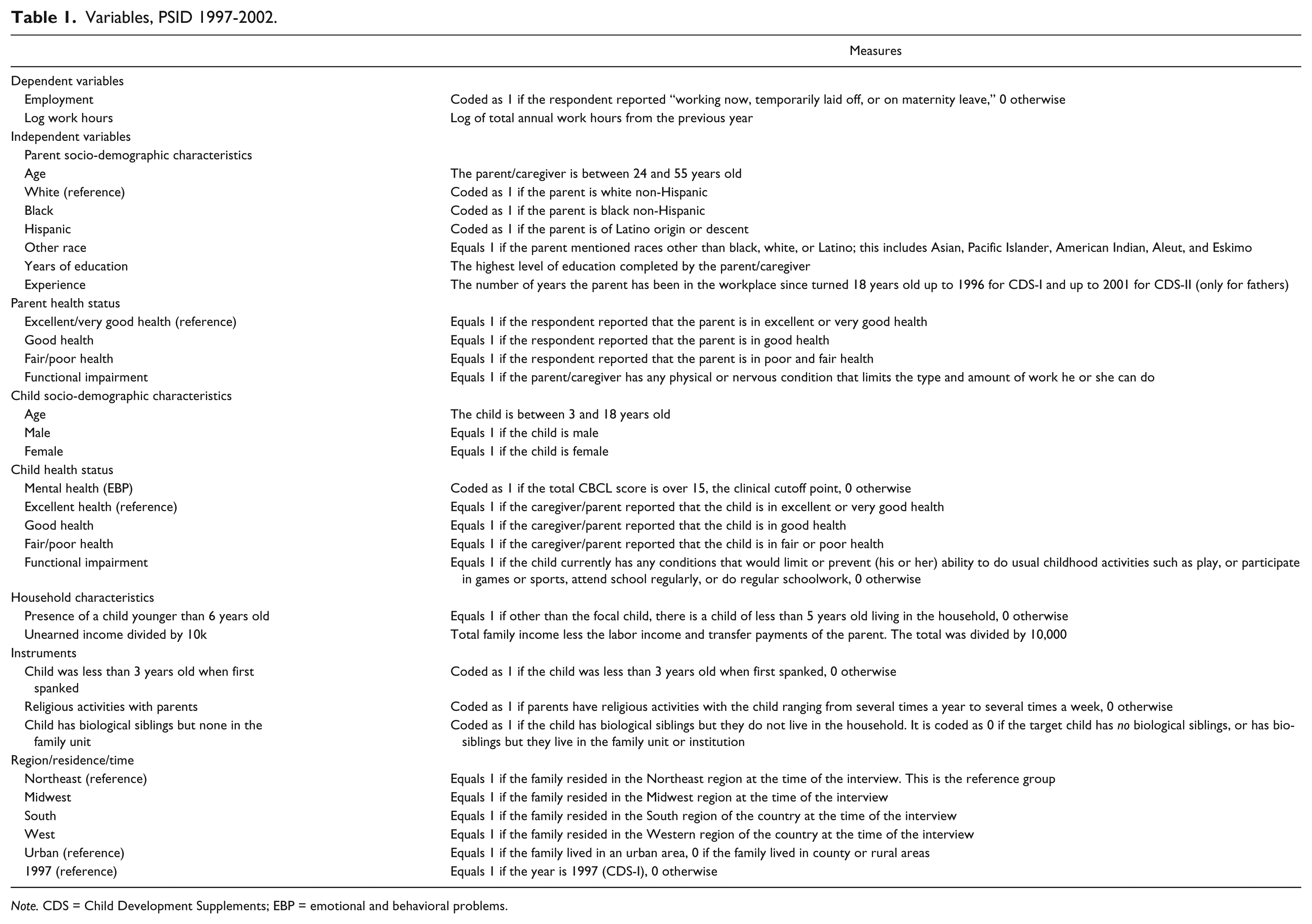
Note. CDS = Child Development Supplements; EBP = emotional and behavioral problems.
Sample Selection,PSID 1997-2002.
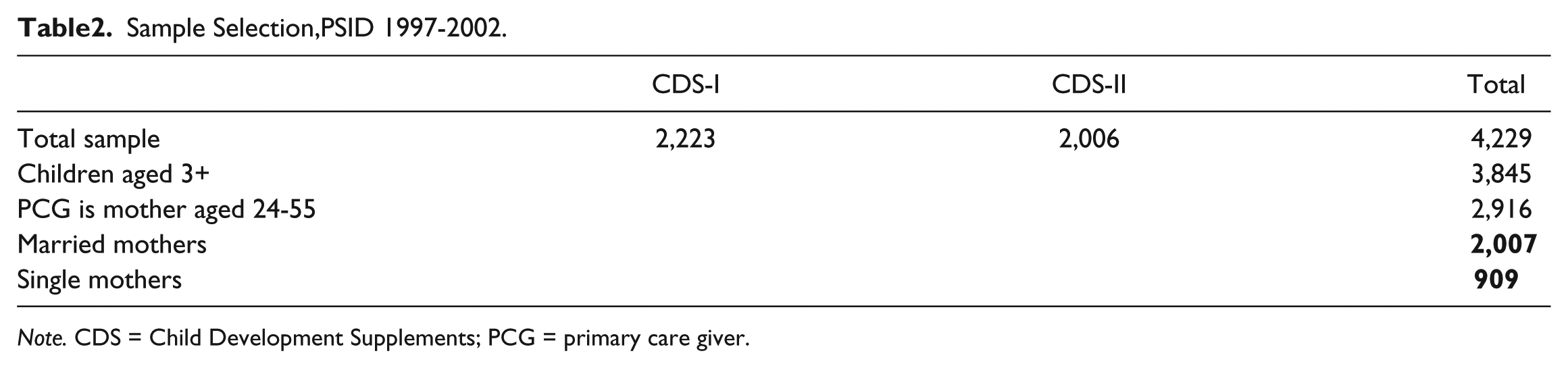
Note. CDS = Child Development Supplements; PCG = primary care giver.
Weighted Means (Pooled CDS-I and CDS-II), PSID 1997-2002.
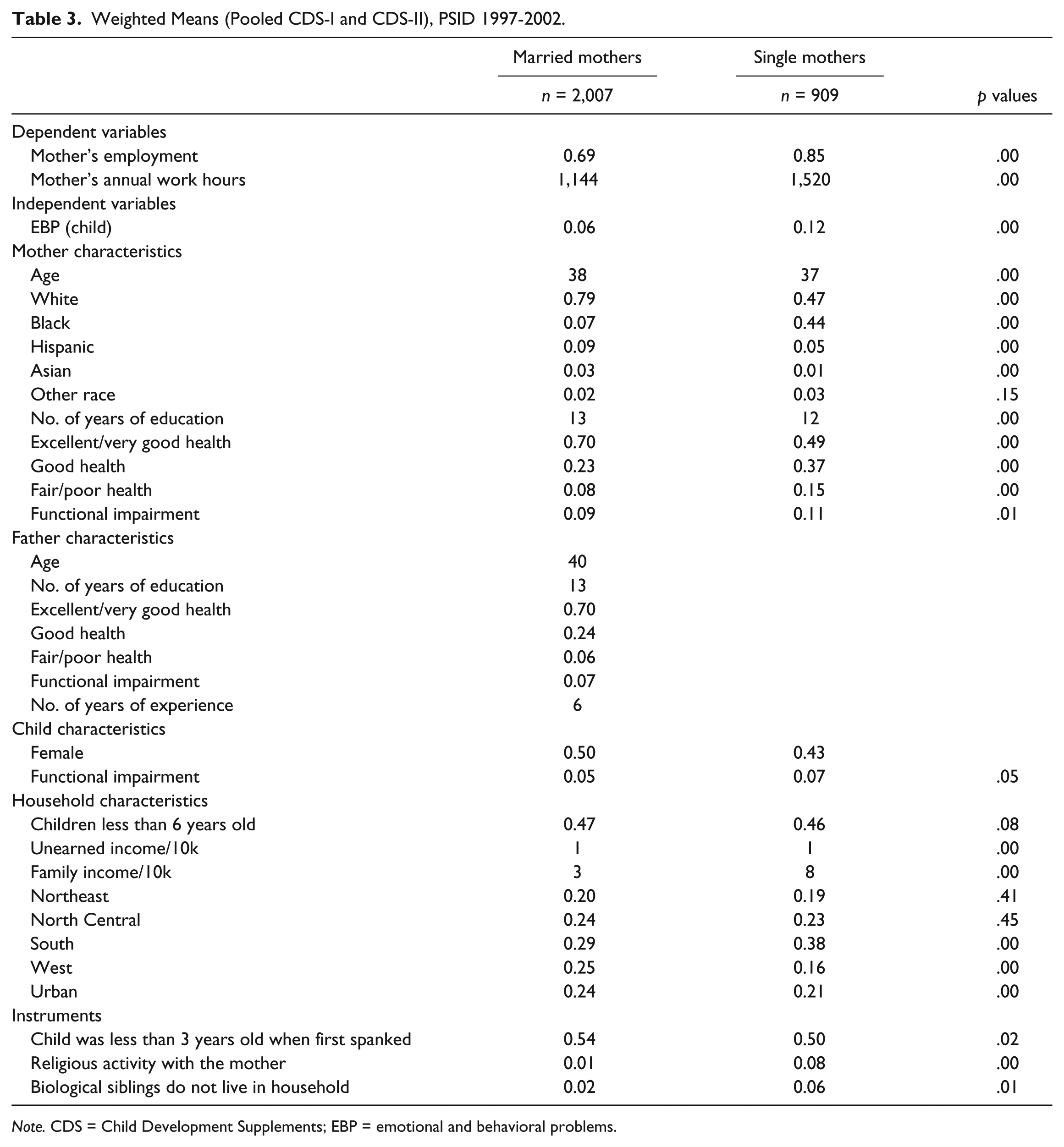
Note. CDS = Child Development Supplements; EBP = emotional and behavioral problems.
Employment of Married and Single Mothers
As reported in Table 4, two different models were used to estimate the effects of children’s EBP on the employment probability of married mothers. In the case of married mothers, ρ, the coefficient of correlation that measures exogeneity between children’s EBP and mothers’ employment in the IV bivariate probit model, is positive and significantly different from zero (ρ = .705**). Therefore, we can reject the null hypothesis that children’s EBP are exogenous in the married mothers’ employment equation. In this context, the bivariate probit model with IV is preferred to the univariate probit model and the marginal effects indicate that children’s EBP significantly reduce their married mothers’ probability of employment by about 1% (p < .001). As a result, we decided to assess the strength and validity of the instruments used to correct for endogeneity in the bivariate probit model with IV for married mothers because weak instruments yield inconsistent estimates. 64 Table 4 summarizes the results from the joint significance test and shows that the set of instruments perform well using the Staiger and Stock rule of thumb of an F statistic of 10 or more (F = 107.09***). 65 Moreover, we used the equivalent of a Hausman test developed by Smith and Blundell 66 for non-linear models to test the exogeneity of the instruments and a Lagrange multiplier test to assess their validity. For these tests, the chi-square statistics and the adjusted Wald test results were not significant; therefore, we concluded that the instruments were not correlated with married mothers’ employment in the bivariate probit model with IV. In the case of single mothers, the univariate probit model is preferred to the bivariate probit model with IV because the correlation term measuring exogeneity between children’s EBP and their single mothers’ employment is not significant. In other words, the results from the bivariate probit model with IV show that children’s EBP and single mothers’ employment are exogenous. Thus, marginal effects from the univariate probit model show that children’s EBP have no effect on their single mothers’ employment probability.
Marginal Effects of Independent Variables on Maternal Employment (SE).

Note. IV = instrumental variable; EBP = emotional and behavioral problems. *p<0.1, **p<0.05, ***p<0.01
Work Hours of Married and Single Mothers
As indicated in Table 5, two models were used to estimate the marginal effects of children’s EBP on their mothers’ work hours. Alpha, which represents the degree of correlation between children’s EBP and their mothers’ hours of work, is not statistically different from zero in the IV tobit models for both married and single mothers as indicated at the bottom of Table 5. In other words, the results show that children’s EBP are exogenous with their married and single mothers’ work hours; therefore, the tobit models are preferred in both cases. Marginal effects from the tobit model for married mothers show that children’s EBP have no effect on their married mothers’ work hours. However, as shown in Table 4, marginal effects indicate that children’s EBP significantly reduce their single mothers’ work activities by 0.920 log work hours.
Marginal Effects of Independent Variables on Maternal Log Work Hours (SE).

Note. IV = instrumental variable; EBP = emotional and behavioral problems. *p<0.1, **p<0.05, ***p<0.01
Discussion
The primary goal of this study was to estimate the effects of children’s EBP on their mothers’ labor supply including employment and work hours. We found reductions in married mothers’ probability of employment and single mothers’ work hours resulting from children’s EBP. Marginal effect estimates are negative and significant for married mothers’ employment that account for endogeneity in children’s mental health. These findings are consistent and similar to those of the study conducted by Coley et al. 27 A possible explanation for these findings is that the presence of a father in two-parent households may provide more financial flexibility for married mothers to stay at home with a child with EBP. However, given a child with EBP, single mothers may not be able to leave work completely but can only afford to reduce their work hours to deal with demand on their time to seek treatment for their children.
It is worth noting that the study has some limitations. Mother’s marital status might be another mechanism through which maternal work activities impact children’s EBP. Children living in single-parent families are known to be more likely to have EBP compared with those raised by two parents. 42 Compared with their peers in two-parent families, these children are more likely to use more mental health services because of less time and emotional support from their parent. 45 Conversely, children’s EBP might be a contributing factor to changes in the family structure such as marital dissolution. A child with EBP might bring additional financial and marital stress into the family, which could result in single-parent households. 67 For instance, a recent article by Kvist et al. found that the existence of a child with ADHD in the household can contribute to marital separation. 29 As such, one would contend that the effect of children’s EBP on mothers’ employment could be confounded with parental separation. However, this would not be the case in our study because we conducted separate analyses for married and single mothers.
Although most households in the study have one sampled child, the CDS randomly sampled two or three eligible children in 18% of the households in the sample. If EBP are correlated across siblings in families where the CDS interviewed two or more children, then the effects of children’s EBP on their mothers’ labor supply will be overestimated. Although the IV approach may account for some of this omitted variable bias, it would be better to include information about as many siblings as possible. However, this was not possible as the CDS only collected a series of information about siblings’ relationships in 2002, but not in 1997.
Conclusions
This study shows that children’s EBP negatively influence married mothers’ probability of employment and single mothers’ work hours. To increase maternal employment, policies may consider targeting both children’s mental health symptoms and their families’ financial resources. Attempts could also be made to provide families with access to services that may reduce children’s EBP such as screening for children’s EBP in primary care and adequate treatment.
Although the effects of children’s EBP on maternal employment and work hours appear to be fairly small, researchers may consider whether children with more severe mental health problems have larger effects on their mothers’ employment and work hours as more appropriate data sets become available. Implications for future research could be longitudinal assessments of the impact of children’s EBP on their mothers’ labor supply as these children age. The analytic sample was restricted to biological mothers, adoptive mothers, and stepmothers. But future research should consider a sub-group analysis of biological mothers to examine the impact of EBP on this population.
Footnotes
Declaration of Conflicting Interests
The author(s) declared no potential conflicts of interest with respect to the research, authorship, and/or publication of this article.
Funding
The author(s) received no financial support for the research, authorship, and/or publication of this article.