



Abstract
School belonging is an important concept that positively affects adolescents’ development as well as their feelings connected to school. The aim of this study is to examine the mediating role of loneliness problems in the relationship between internalization problems and school belonging among adolescents within a model framework. A total of 305 adolescents participated in the study, including 187 girls (61.3%) and 118 boys (38.7%). The findings revealed that internalization is a significant negative predictor of school belongingness and that loneliness mediates this relationship. The current research findings suggest that internalized problems (e.g., anxiety, depression) may be more prevalent among adolescents who experience difficulties with school belongingness. This situation necessitates the early detection of low belonging levels and the development of preventive or remedial interventions.
Internalizing Problems
Internalizing problems include mental health symptoms that cause distress, such as anxiety, depression, sadness, feelings of worthlessness, social withdrawal, and hypersensitivity (Forns et al., 2018; Gresham & Kern, 2004; J. Wang et al., 2025). Internalized behaviors in adolescents have many causes, including family-related factors, parental attitudes, individual reasons, social environment and school environment, life events, and environmental stress factors. Research indicates that children raised in non-democratic parenting styles, in supportive, critical, or authoritarian family environments, internalize these feelings by perceiving themselves as worthless and insecure (Gresham & Kern, 2004). On the other hand, individuals with low self-regulation skills and difficulties in recognizing and expressing their emotions struggle to cope with negative life events and are at risk of developing internalized behaviors (Eisenberg et al., 2010). Children with high levels of negative affect—for example, those who frequently feel sadness, anger, or guilt—may turn inward and isolate themselves from their social environment when they are unable to cope with these emotions (Larsen et al., 2022). The social environment and school setting are also important external factors in adolescents’ internalizing behavior. In particular, exclusion, bullying, or unsupportive attitudes from teachers at school can lead students to develop negative attitudes toward school and their peer group. This situation causes young people to feel lonely, misunderstood, and worthless, which may lead to an increase in internalizing behaviors (Arslan, 2022). A meta-analysis conducted by Ttofi et al. (2011) found that individuals who have been bullied at school are more likely to exhibit internalizing behaviors such as depression than those who have not been involved in such aggression. According to Eastman et al. (2018), there is evidence that individuals are more likely to exhibit internalizing behaviors when they frequently encounter victimization.
Lau et al. (2019) noted that depression and anxiety are two subscales of internalizing symptoms. Internalizing symptoms can lead to clinical impairment in anxiety disorders and mood disorders such as depression (Gresham & Kern, 2004; Keyes & Platt, 2024). Indeed, research on internalization issues has determined that high levels of anxiety can impair the efficiency of prefrontal areas and cause increased distractibility in cognitive processing (Derakshan et al., 2009). Furthermore, longitudinal studies have shown that such behaviors can lead to problems such as unemployment, low quality of life, low academic achievement, suicidal behaviors or thoughts in adolescence, and suicide attempts or completed suicide in adulthood (Plunkett et al., 2007). One of the most prominent consequences of internalized behaviors is impaired academic and social functioning. Adolescents may struggle to adapt to school, experience a decline in academic performance, and withdraw from social relationships (Murray-Harvey & Slee, 2010), which also affects their sense of belonging to the school (Arslan, 2022).
School Belonging
School belonging (K. A. Allen et al., 2022), which refers to students feeling emotionally attached to the school community and perceiving that they are accepted and valued at school, is an important factor that strengthens students’ psychological well-being. Students’ perception of being valued at school contributes to a reduction in internalized problem behaviors (Arslan, 2022). Adolescence is the developmental stage in which an individual’s identity formation, social acceptance, and belonging needs are most intense (Kansok-Dusche et al., 2023). In this context, adolescents’ development of a sense of belonging to school plays a critical role not only in terms of their academic achievement but also in terms of their psychosocial adjustment and identity development (Neel & Fuligni, 2013). According to self-determination theory (Ryan & Deci, 2017), belonging is seen as one of the individual’s basic psychological needs; the support of social bonds and autonomous relationships plays a critical role in the development of a sense of belonging. Belonging, especially school climate, teacher-student relationships, and peer interactions, are among the determining factors in the formation of students’ sense of belonging (Neel & Fuligni, 2013; M. T. Wang & Eccles, 2012). In short, school belonging during adolescence is a critical factor shaped by school climate and social relationships that supports identity development, psychosocial adjustment, and academic achievement by serving to meet the individual’s basic psychological needs.
Various studies have shown that students with a developed sense of school belonging have lower levels of depression and anxiety, higher academic achievement and motivation, better mental health, reduced school absenteeism, and more harmonious social relationships (K. Allen et al., 2018; Arslan, 2021; Slaten et al., 2016). On the other hand, feeling excluded or worthless at school increases the risk of loneliness, low self-esteem, and academic failure in students (K. Allen et al., 2018; Pittman & Richmond, 2007). Newman et al. (2007) found in their study with adolescents that as school belonging increased, adolescents’ internalized and externalized behavior problems decreased. However, it was determined that the sense of belonging does not form in the same way in every student group and that supportive school policies are important in reducing these differences (Steinmayr et al., 2019). In summary, school belonging is a multidimensional concept that involves students feeling accepted, valued, and important at school. Developing this feeling contributes significantly to students achieving positive results in both academic and psychosocial aspects of their educational lives. Therefore, it is of great importance for educators and school administrators to develop strategies to strengthen the sense of belonging.
Loneliness
Loneliness is defined as a subjective feeling of deprivation and isolation experienced by an individual because of not achieving the desired level of closeness in their social relationships (Perlman & Peplau, 1981). This concept is related more to the perceived quality of an individual’s social relationships than to the quantity of those relationships (Cacioppo & Cacioppo, 2018). Loneliness can manifest itself in different ways throughout developmental processes and can lead to various psychological and physiological consequences in childhood, adolescence, adulthood, and old age.
Current research shows that loneliness is strongly associated with psychological problems such as depression, anxiety, low self-esteem, increased stress levels, and social anxiety in individuals (Loades et al., 2020). According to recent global statistics, around 12% of adolescents experience loneliness (Smith et al., 2024). It is emphasized that the experience of loneliness increases during adolescence and young adulthood, a period when identity formation and the need for social acceptance become more sensitive (Qualter et al., 2010). Studies conducted after the COVID-19 pandemic have shown that loneliness has become even more pronounced at the individual and societal levels. Particularly concerning findings have been obtained regarding the psychological effects of social isolation among young people and adolescents (Loades et al., 2020). Furthermore, loneliness can lead not only to individual health problems but also to broader societal consequences such as substance use, truancy, criminal behavior, social maladjustment, and reduced labor force productivity (Heinrich & Gullone, 2006; Holt-Lunstad, 2022). In short, loneliness, especially during adolescence and young adulthood, can have multidimensional negative effects on individuals’ psychological health and social maladjustment, labor force loss, and truancy, as well as on their social functioning.
Current Study
Adolescence is a critical transition period in an individual’s psychological, social, and cognitive development, and internalized behavioral problems such as depression, anxiety, low self-esteem, and social withdrawal experienced during this period emerge as risk factors (Gresham & Kern, 2004). Such internalized behaviors often co-occur with loneliness and are exacerbated by a lack of social support and insufficient feelings of belonging (Cacioppo & Hawkley, 2009; J. Wang et al., 2025). Loneliness is a persistent emotional state that develops when an adolescent’s psychological needs (relationship, autonomy, competence) are not adequately met, and it is one of the primary determinants of internalized problems (Cacioppo & Cacioppo, 2018; Deci & Ryan, 2000). In this context, loneliness is directly and indirectly linked to psychological problems such as depression and anxiety (Loades et al., 2020; Qualter et al., 2010).
One of the important protective factors that can reduce the negative effects of loneliness is school belonging. Feeling accepted, valued, and able to form relationships in the school environment is a fundamental need for students in terms of both their psychological well-being and academic motivation (K. Allen et al., 2018; K. A. Allen et al., 2022). Therefore, strengthening school belonging can be said to play a critical role in preventing internalized behaviors by increasing adolescents’ capacity to cope with loneliness (Arslan & Duru, 2017; Slaten et al., 2016). In this context, loneliness emerges as an important psychosocial variable that partially or completely mediates the relationship between internalization and school belonging. Recent studies indicate that this mediating role is particularly pronounced in adolescents. By examining these variables at different times, the current study may yield important insights into how reducing feelings of loneliness through internalizing behaviors can strengthen students’ sense of school belonging. The findings may help identify the role of loneliness in enhancing students’ school belonging and lead to important outcomes in terms of addressing loneliness. Additionally, this study, which investigates the effect of internalizing behaviors on students’ sense of belonging to school, can help identify individuals who are struggling with school belonging and guide the development of early intervention strategies. In conclusion, this research may offer a more effective perspective on how individuals can overcome the factors that affect their sense of belonging to school and may contribute to the development of school-based intervention programs that focus on both internalizing support practices and strategies for coping with loneliness. In this context, the objective of this study is to examine the mediating role of loneliness on the relationship between internalizing behavior and school belongingness. Corresponding to this primary objective, the research inquiries are as follows.
Method
Participants and Procedure
The research was conducted at two points. Time 1 in January 2025 and time 2 in April 2025, with a 3-month interval between the two data collection periods. At time 1, there were 315 participants, and at time 2, there were 310 participants. After the matching, 305 participants remained. The matching process was based on the participants’ pseudonyms, the last three letters of their mother’s and father’s first names, and the last five digits of their mobile phone numbers, ensuring a complete match for all. Informed consent was obtained from all participants, their parents and the data was collected face-to-face. In this context, all adolescents and their parents who participated in the study provided written and signed consent forms stating that they voluntarily participated in the study and gave permission for the research. No compensation was provided for completing the surveys. Regarding participant demographics, 187 girls (61.3%), and 118 were boys (38.7%). The average age was 16.11 years (SD = 0.99).
Measures
School Belongingness Scale
Developed by School Belongingness Scale (Arslan & Duru, 2017) consists 10 items divided into two sub-dimensions, each of which is measured by five items: Social Exclusion Scale (SES) and Social Inclusion Scale (SIS). The scale is a self-report rating scale consisting of 10 items developed to determine Turkish students’ school belonging. (e.g., “I do not have close/intimate ties with other people in the school.,” “I do not feel that I belong to this school”). The scale uses a four-point Likert scale (1 = almost never, 4 = to almost always), with higher scores reflecting a higher perception of school belongingness. The maximum value that can be obtained from the scale is 40. Structural validity testing has shown that the model fits the data (χ2 = 83.54, df = 34, p < .001, CFI = 0.94, RMESA [90% CI] = 0.069 [0.050, 0.088) appropriately. As seen in this study, the scales were found to have strong internal reliability coefficients (see Table 1).
Descriptive Statistics and Reliabilities for the Study Variables.
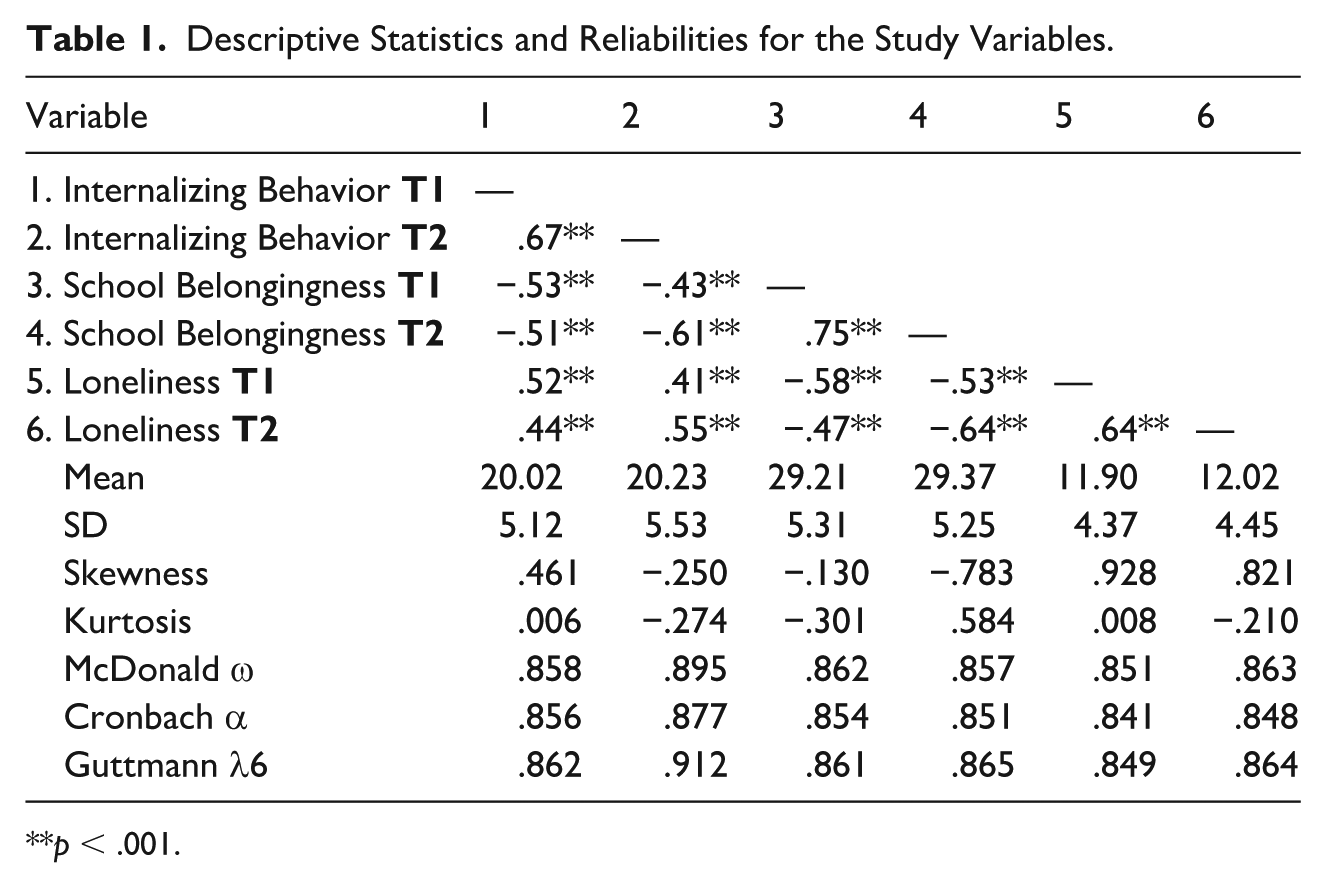
p < .001.
UCLA Loneliness Scale
UCLA Loneliness Scale was developed by Hays and DiMatteo (1987). The scale, which was adapted into Turkish by Yıldız and Duy (2014), consists of seven items and a single dimension. The scale was developed as a four-point Likert scale and the response format was organized from 1 = Never to 4 = Always. The maximum value that can be obtained from the scale is 28. (e.g., “I have no one to turn to.,” “I feel pushed out of the group.”). In the Exploratory Factor Analysis (EFA) and Confirmatory Factor Analysis (CFA) analyses conducted to verify the original unidimensional structure of the scale in Turkish culture, it was seen that the scale items were gathered under a single dimension as a result of EFA. CFA results also revealed that the scale showed good fit to Turkish culture (χ2 = 27.12, SD = 14, χ2/DF = 1.94, RMSEA = 0.06, RMR = 0.03, SRMR = 0.04, GFI = 0.97, AGFI = 0.95, CFI = 0.98, NFI = 0.96, NNFI = 0.97). As seen in this study, the scales were found to have strong internal reliability coefficients (see Table 1).
Internalizing Behaviors
To measure the internalizing behaviors of young people, the Youth Internalizing Behavior Scale (YIBS) developed by Arslan et al. (2020) was used. The scale consists of two subscales, depression and anxiety, each with five items. The scale consists of 10 items and is a self-report (e.g., “I see myself as a useless person,” “I feel sad and pessimistic”). The items in the 4-point Likert-type scale are scored from 1 = almost never to 4 = almost always. The maximum point that can be obtained from the scale is 40. As seen in this study, the scales were found to have strong internal reliability coefficients (see Table 1).
Data Analysis
Based on the survey results filled out by the participants, an initial analysis of the data was conducted. The normality analyses, means, and standard deviations of the concepts of internalizing problems, loneliness, and school belongingness were analyzed using the SPSS program, followed by reliability analyses conducted with the JASP program. Subsequently, the correlations among the concepts of internalizing problems, loneliness, and school belongingness were analyzed using the SPSS program. Given the constraints of cross-sectional data (Maxwell et al., 2011), an autoregressive analysis of the cross-lagged panel model was employed to examine the mediating role of loneliness on the relationship between internalizing problems and school belongingness (Cole & Maxwell, 2003; Preacher, 2015). The cross-lagged panel model enables the examination of the proposed research model and the identification of temporal variations in the variables (Selig et al., 2012). The fit indices for the current study were compared to the ranges specified by Kline (2016). Kline (2016) asserts that a model is deemed adequate when the CFI, IFI, NFI, and GFI values are 0.90 or above, and an SRMR threshold of 0.08 or below signifies good model fit.
Results
A presentation of the descriptive statistics, reliability coefficients, and bivariate correlations for the variables of internalizing behaviors, loneliness, and school belongingness can be found in Table 1. Based on the values of skewness (−0.25 and 0.92) and kurtosis (−0.301 and 0.584), it can be concluded that the distribution of the concepts of internalizing behavior, loneliness, and school belongingness is normal. The table demonstrates that there are significant relationships between the concepts of self-compassion, psychological maltreatment, and psychological resilience at both time points.
The findings of the cross-lagged panel model for internalizing behavior, school belongingness, and loneliness are presented in Figure 1. Loneliness is hypothesized to act as a mediator in the relationship between internalizing behavior and school belongingness, according to this model. In terms of fit, the model was found to be satisfactory, as evidenced by the following: χ2(3, N = 305) = 64.279, p < .001; SRMR = 0.0642; CFI = 0.915, GFI = 0.921, NFI = 0.911, and IFI = 0.915. The findings further demonstrated that the internalizing behavior that occurred at Time 1 had a significant impact on the level of loneliness that was present at Time 2 (β = .15, SE = 0.11, p < .05). Furthermore, it was discovered that loneliness at Time 1 had a significant impact on school belongingness at Time 2 (β = −.10, SE = 0.014, p < .05). Also, it was discovered that internalizing behavior at Time 1 had a significant impact on school belongingness at Time 2 (β = −.13, SE = 0.091, p < .05). As a result, the findings of the cross-lagged panel model indicate that loneliness acts as a mediator in the relationship that exists between internalizing behavior and school belongingness over time.
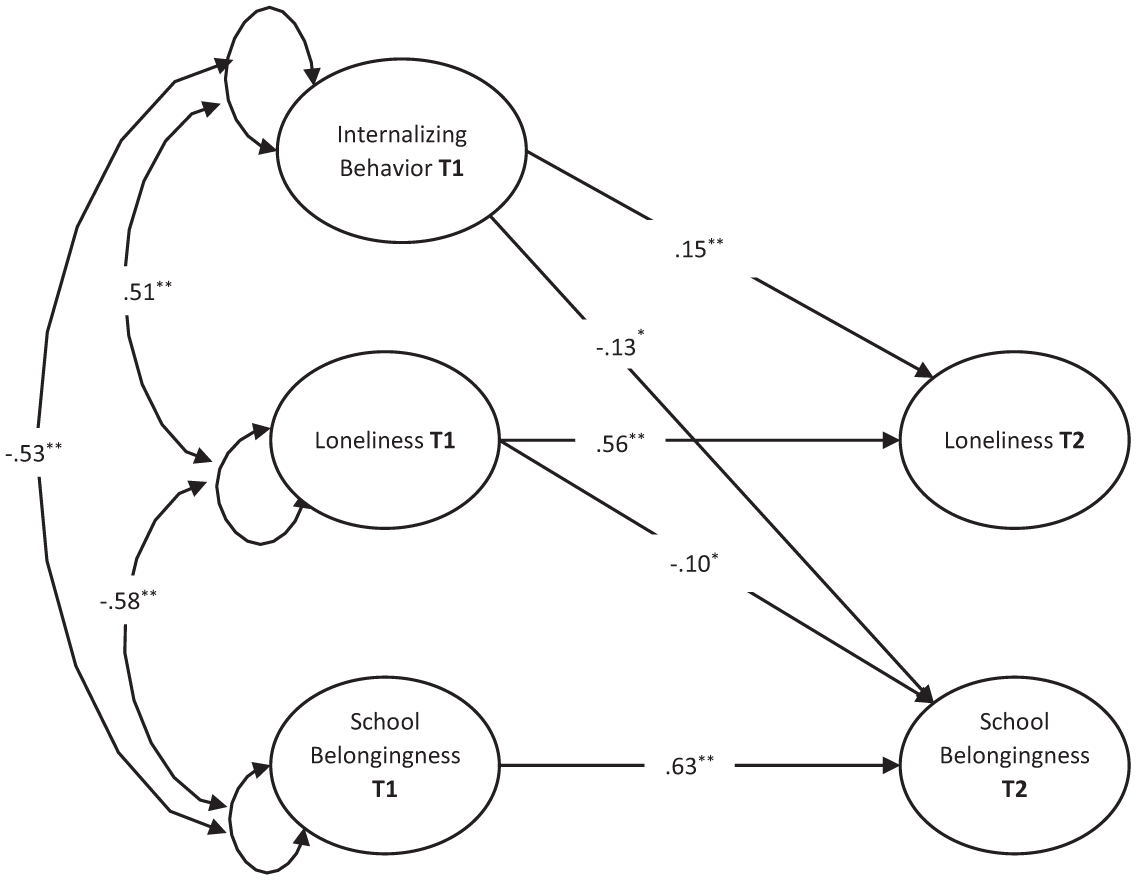
Cross-lagged panel model for a half-longitudinal design for testing the indirect association between internalizing behavior and school belongingness via loneliness.
Discussion
Research shows that when school belonging is low, adolescents experience increased levels of loneliness, which in turn leads to internalized problems (e.g., depressive symptoms, anxiety disorders; Arslan, 2021). A sense of school belonging emerges as a fundamental developmental need that influences both adolescents’ academic achievement and psychological well-being (K. Allen et al., 2018). The current study investigated the role of loneliness in the relationship between internalizing problems and school belongingness among adolescents. The findings showed that internalization is a significant negative predictor of school belonging and that loneliness mediates this relationship. The present study with adolescents is one of the few studies showing the relationship between loneliness-related problems and the relationship between school belonging and internalization. The current research findings suggest that internalized problems (e.g., anxiety, depression) may be more prevalent among adolescents who experience difficulties with school belonging. This situation necessitates the early detection of low levels of belonging and the development of preventive or remedial interventions. Therefore, in addition to practices aimed at strengthening adolescents’ school belonging, the creation of effective and inclusive educational policies in this area is of great importance in terms of increasing students’ psychological well-being and school retention rates. Accordingly, it can be said that adolescents with internalized behaviors have lower levels of school belonging. Internalized behaviors that develop during adolescence, particularly anxiety, depression, and loneliness—significantly affect both adolescents’ psychological well-being and their connection to the school environment (Arslan, 2022; Gresham & Kern, 2004). In particular, adolescents who perceive insufficient social support in the school environment and feel excluded experience a decrease in their sense of belonging to school, while their depressive symptoms and social anxiety levels increase significantly (K. Allen et al., 2018; Arslan, 2021). In this context, it is argued that school belonging acts as a protective factor in preventing and reducing internalized problems in adolescents (Pittman & Richmond, 2007). School belonging is when students feel like they’re an important, meaningful, and valuable part of their school (Arslan & Duru, 2017). There’s a bunch of research on the link between internalizing behaviors and school belonging. Research shows that school belonging is inversely related to loneliness and depressive symptoms, and that high levels of belonging increase students’ psychological adjustment and desire to stay in school (K. Allen et al., 2018; Arslan & Duru, 2017; Qualter et al., 2010). Therefore, social-emotional learning programs, counseling efforts, and teacher support systems that strengthen adolescents’ school belonging should be considered as comprehensive interventions for both mental health and academic development (Slaten et al., 2016). Thus, all previous research and the findings of the current study indicate that adolescents with internalizing behavior problems may have a high level of negative attitude toward school and low school belonging. Based on this, it is important to develop and implement educational policies that increase adolescents’ school belonging, in addition to preventive interventions targeting the conditions that cause internalizing behaviors in adolescents.
The second finding of the current study shows that internalization problems are a positive predictor of lonelines. Accordingly, it can be said that adolescents’ internalized problems (depression and anxiety, etc.) increase their feelings of loneliness by distancing them from social relationships. Different studies have found that loneliness is associated with internalized symptoms such as depression and anxiety in adolescents (Koenig & Abrams, 1999; Sündermann et al., 2014). Therefore, the fact that internalization issues predict loneliness levels in a positive direction is a developmentally expected situation. This is because adolescents experiencing emotional problems may have difficulty establishing social interactions, feel excluded, or isolate themselves from relationships (Danneel et al., 2019; Qualter et al., 2010). On the other hand, a longitudinal study also observed a significant relationship between loneliness and emotional instability and internalization symptom dimensions. In particular, the dimensions of loneliness directly predict depression, anxiety, and stress levels (Velotti et al., 2021). Indeed, Qualter et al. (2010) state that feeling lonely constantly leads to psychological and physiological stress, and that this stress makes people prone to emotional disorders. When the findings of the current study are examined alongside the results of other researchers, they provide important clues that loneliness affects adolescents in different ways. Accordingly, loneliness can be considered not only as a result of experiences during adolescence but also as a mechanism that feeds new psychological problems (Laursen & Hartl, 2013). In summary, the internalized problems experienced by adolescents can lead to a weakening of the individual’s social relationships and an increase in feelings of loneliness. Loneliness, on the other hand, can be both a result of these problems and a factor that causes and deepens them. Therefore, identifying and addressing internalized problems at an early stage plays a critical role in preventing social risks such as loneliness.
The third finding of the study shows that loneliness is a negative predictor of school belonging. There are many studies in the literature that support the research results (Ayğar & Kaya, 2017; Cicognani et al., 2014). Zhou et al. (2023) found in their study on school belonging among adolescents that hopelessness and loneliness have a negative relationship with school belonging. Asher and Paquette (2003), in their study, found that prolonged feelings of loneliness are associated with dropping out of school, depression, alcohol dependence, and various health problems. The formation of a sense of belonging to school, which is of critical importance for high school students (Neel & Fuligni, 2013), leads to feelings of happiness, pride, and satisfaction, while the absence of a sense of belonging causes feelings of depression, sadness, and loneliness (Osterman, 2000). Cemalcilar (2010) also noted in their study that students with higher levels of school attachment had lower rates of anxiety, loneliness, and school absenteeism, while autonomy, positive social behavior, internal motivation, and academic achievement were higher. This may be due to the protective role of the sense of belonging against loneliness (Altınsoy & Karakaya-Özyer, 2018). As a result, feelings of loneliness experienced during adolescence can negatively affect the individual’s school experience, which in turn can weaken their sense of belonging to school. The loneliness experienced by the individual may cause them to disconnect from the social environment and feel excluded in the school environment. This situation can negatively affect psychological well-being and harm academic development. On the other hand, when students have a strong sense of belonging to school, they feel safe and valued, develop positive emotions, and participate more actively in the school environment. Therefore, providing social and emotional support to help adolescents cope with loneliness can be considered an important requirement in terms of strengthening their sense of belonging to school.
The most important and fourth finding of the study shows that loneliness plays a long-term mediating role between internalized problems and school belonging in adolescents. This finding suggests that adolescents experiencing loneliness may experience higher levels of internalized problems, feel more anxiety, be more shy, exhibit depressive behaviors, and have lower levels of school belonging. Danneel et al.’s (2019) research reveals that loneliness, social anxiety, and depression are internalized problems that develop in parallel and reciprocally throughout adolescence. Adolescents who exhibit internalized behavioral problems are at increased risk of loneliness later in life (Danneel et al., 2019). A longitudinal study shows that internalizing problems are a positive predictor of low academic achievement and that low academic achievement may be a risk factor for school belonging and externalizing problems (Masten et al., 2005). Many studies have reported that a lack of school belonging in adolescents is associated with a higher likelihood of mental health disorders, depressive symptoms, low self-esteem, and loneliness, as well as social withdrawal, loss of motivation, and academic failure, and that they exhibit fewer prosocial behaviors and positive peer relationships (K. A. Allen et al., 2021; Arslan et al., 2022; Arslan & Renshaw, 2019; Parr et al., 2020; Pittman & Richmond, 2007; M. T. Wang & Eccles, 2012). On the other hand, as adolescents’ sense of belonging to school increases, it has been shown that enjoyment of learning, educational goals, academic competence, academic satisfaction, prosocial behaviors, and academic achievement also increase. When the studies are summarized, it is shown that adolescents who are lonely may have more internalization problems such as anxiety, worry, depression, and withdrawal, which may negatively affect their sense of belonging to school. Therefore, studies should be conducted to identify and eliminate the factors causing these behavioral problems in adolescents, and their sense of belonging to school should be ensured.
Practical Implications
The findings of the study indicate that there is a long-term negative relationship between internalized problems and school belonging among adolescents, and that loneliness mediates this relationship. According to the findings, adolescents with internalized problems are likely to have negative feelings and thoughts about school and may experience a decrease in their sense of belonging to school. According to the research findings, it is thought that adolescents’ internalized problems prevent them from participating socially, causing them to become more lonely. In addition, it can be said that adolescents who experience loneliness will exhibit internalization behavior, lose their sense of belonging to school, and exhibit behavior that distances them from school. Based on these results, it can be said that organizing educational activities that identify, prevent, and remedy the situations that cause internalization and loneliness in adolescents, and applying appropriate psychological intervention methods when necessary, will have a positive effect on their sense of belonging to school.
Limitations
Within the scope of the research, data was collected from the same sample group at two different time intervals with a 3-month interval. Although this is a strong study in this respect, it has some limitations. First, self-assessment questionnaires related to the subject were given to adolescents in the study, and the data used in the study is based on their responses. The responses may be based more on societal preconceptions than on the adolescents’ own thoughts. Since the questionnaires were Likert-type, the responses exhibit standard characteristics. This may have limited the participants’ higher and lower thoughts. Although participants were not required to complete the questionnaire, factors related to the environment, or the participants themselves may have prevented them from providing voluntary and sincere answers. The study group consisted of adolescents from middle and lower socioeconomic backgrounds attending public high schools. A more comprehensive study could be conducted to include a larger number of adolescents from different socioeconomic backgrounds.
Conclusion
The findings of the current study highlight the impact of loneliness on the relationship between internalizing problems and school engagement in adolescents. First, the study found a negative relationship between internalizing problems and school engagement and draws attention to the fact that adolescents with internalizing problems have lower levels of school engagement. On the other hand, adolescents with internalizing problems become lonely and their level of school belonging decreases. This situation is important in terms of showing that internalizing problems isolate adolescents and that isolated adolescents have lower levels of school engagement and positive attitudes toward school. Future research should explore interventions aimed at reducing loneliness to further confirm these findings and improve our understanding of adolescents’ strategies for developing school belonging in the context of internalizing problems.
Footnotes

Ethical Considerations
The researcher declares that he carried out the study by adhering to the ethical rules that must be followed in human experiments as stated in the Helsinki Declaration of 2024. Furthermore, this study was conducted in accordance with the approval of the Necmettin Erbakan University Social and Human Sciences Scientific Research Ethics Committee, numbered 2025/388.
Consent to Participate
Informed consent was obtained from all the individual participants that were included in the study. In addition, permission was obtained from their parents.
Author Contribution
The author carried out all stages of the study himself.
Funding
The author received no financial support for the research, authorship, and/or publication of this article.
Declaration of Conflicting Interests
The author declared no potential conflicts of interest with respect to the research, authorship, and/or publication of this article.
Data Availability Statement
The data used in the study can be requested from the corresponded author upon reasonable request.