



Abstract
This study examined the association between postdivorce coparenting patterns and adolescent internalizing and externalizing behavior. Children after parental divorce increasingly grow up in shared residence arrangements, making postdivorce coparenting much more pertinent. The Coparenting Behavior Questionnaire was used to investigate the perceptions of 251 Dutch adolescents regarding postdivorce coparenting behaviors. Latent class analysis was used to identify coparenting patterns, and associations with adolescent outcomes were examined. Four distinct postdivorce coparenting patterns were identified: cooperative, negatively engaged, negatively disengaged, and average. Adolescents of parents with a cooperative pattern reported the least amount of internalizing and externalizing problems, whereas adolescents with negatively engaged parents reported the most internalizing problems. In line with family systems theory, interactions in the coparental subsystem are associated with adolescent adjustment and can therefore be viewed as both a risk and protective factor.
Annually, a considerable number of children in the Western world face the divorce or separation of their parents. Empirical studies have consistently shown that this is a risk factor for their short- and long-term adjustment (e.g., Lansford, 2009). On average, children after divorce experience more emotional, behavioral, social, and academic problems compared to their peers from intact families (Amato, 2010; Kelly & Emery, 2003). The seriousness of these consequences varies enormously, and not the divorce itself, but factors accompanying it, are responsible for most of its negative effects (e.g., Amato, 2010). In order to understand children’s postdivorce adjustment, it is essential to understand the larger family system they grow up in and therefore to consider the mutual influences among family subsystems (Family Systems Theory, Cox & Paley, 1997; 2003; Minuchin, 1985). Two important dyadic factors in this respect are the child’s relationship with both parents, and the quality of the interparental relationship (Fabricius & Luecken, 2007; Lamb, 2018; Weaver & Schofield, 2015). Both factors relate to, and shape, an important aspect of family functioning: coparenting.
Previous studies have shown that coparenting affects child wellbeing above and beyond parenting (Buehler, 2020; Murphy et al., 2017; Teubert & Pinquart, 2010). Coparenting can be defined as the collaboration in childrearing of two parental figures who share the responsibilities for at least one child (Feinberg, 2003). Ideally, parents not only “share parenthood,” but also actively try to support each other’s parenting while maintaining healthy but flexible boundaries (Adamsons & Pasley, 2006). Not all parents are able to show effective coparenting, however, and ineffective coparenting might have negative consequences for adolescent wellbeing. Especially when parents are divorced and share their parenting responsibilities in different households, coparenting is important to provide the child with consistency and a certain amount of mutual consent, but might be challenging for parents as they might have different interests. Nowadays, an increasing number of children and adolescents have regular contact with both parents after divorce (Poortman & Van Gaalen, 2017; Steinbach, Augustijn, & Corkadi, 2020), making it more pertinent how parents shape their joint parenthood. Particularly during adolescence, when the parent–child relationship is reorganizing and parents need to balance supportive parenting with autonomy granting, effective coparenting might be crucial for adolescents’ development. This study focuses on coparenting after divorce and relations with adolescent adjustment.
Postdivorce Coparenting Dimensions
Four key postdivorce coparenting dimensions commonly distinguished in the literature are coparental communication, respect and cooperation, conflict, and triangulation (e.g., Macie & Stolberg, 2003; McConnell & Kerig, 2002; Mullett & Stolberg, 1999). The communication dimension refers to the exchange of information between parents about childrearing issues and the interaction patterns that emerge as one parent supports or undermines the parenting attempts of the other parent (Schrodt & Shimkowski, 2013). Coparental cooperation and respect requires parents to put their own differences aside in the interests of their child and to promote a positive relationship between the child and the other parent (Feinberg, 2003). Putting their child first helps divorced parents relate to each other and to focus their conversations on their children (Markham et al., 2017). Both coparental communication and respect are associated with adolescent self-esteem and internalizing and externalizing problems (Beckmeyer, Coleman, & Ganong, 2014; Gasper et al., 2008).
A third dimension entails coparental conflict. Conflicts between parents about childrearing can cause a disturbance in their parenting skills and compromise positive parenting behaviors (Elam et al., 2019). Moreover, negativity between parents can lead to negativity within the entire family system, a so-called spillover effect (Erel & Burman, 1995). High levels of interparental conflict are associated with negative outcomes for children and adolescents, such as internalizing and externalizing behavior (Van Dijk et al., 2020). The fourth dimension, triangulation, refers to the involvement of children in parental conflicts. When parents try to form alliances with a child against the other parent, or when the boundaries between the parental and parent–child subsystems become unclear, children are likely to serve as “allies” or “pawns” in their parents’ conflicts (Buchanan, Maccoby, & Dornbusch, 1991; Minuchin, 1985). Triangulation, or feeling caught between parents, has been studied to a lesser extent than the other coparenting dimensions, but has been linked to higher levels of negative affect (Schwarz, 2009; Shimkowski & Schrodt, 2012).
Although individual coparenting dimensions have been linked to child and adolescent wellbeing, it is clear that parents’ behaviors do not stand on their own. Positive dimensions such as communication and cooperation are interrelated, just like negative dimensions such as conflict and triangulation, but do not necessarily have to occur together. Parents after divorce can show different combinations of these four dimensions of coparenting. Moreover, it is the interplay between different dimensions rather than a single dimension of coparenting that determines post-divorce family functioning. In line with this notion, researchers have started to use person-oriented instead of variable-centered approaches. Rather than focusing on the association between a specific variable and an outcome, a person-centered approach allows to empirically identify distinct patterns among multiple variables and to test associations of those patterns with outcome variables. Taking this approach provides a more holistic picture of postdivorce coparenting since it focuses on the combined way in which parents use several aspects of coparenting and its relations with adolescent adjustment.
Postdivorce Coparenting Patterns and Adolescent Adjustment
Despite the use of different conceptualizations of coparenting, different samples from different countries, different research methods, and different types of analyses, previous studies have identified similar postdivorce coparenting patterns or typologies. Two commonly distinguished patterns are the cooperative and the high-conflict pattern (Ahrons, 1994; Amato, Kane & James, 2011; Beckmeyer et al., 2014; Beckmeyer, Markham, & Troilo, 2019; Lamela, Figueiredo, Bastos, & Feinberg, 2016; Maccoby, Depner, & Mnookin, 1990). The cooperative pattern is characterized by high levels of coparental communication, interaction, cooperation, and little conflict. Parents showing this coparenting style are able to isolate potential interpersonal conflicts from their role as parents, facilitating communication and coordination between the two households. By contrast, the high-conflict coparenting pattern involves high levels of conflict, in combination with infrequent communication. Parents in this group continue their conflicts after divorce, allowing the negativity to spill over into the parenting domain. Some studies have also identified a pattern in which parents have stopped communicating, have little or no conflicts, make few attempts to coordinate parenting, and thus act as single parents; a disengaged pattern, which refers to a more parallel way of parenting (Amato et al., 2011; Maccoby et al., 1990). Last, some mixed coparenting patterns were found, in which parents communicate and coordinate frequently, but at the same time maintain high degrees of conflict (Beckmeyer et al., 2014, 2019; Maccoby et al., 1990).
The fact that several studies have found similar postdivorce coparenting patterns based on data collected between 1984 and 2016 among divorced and separated mothers and fathers with children between 3 and 19 years old speaks for the reliability and generalizability of its findings. Nevertheless, researchers have noted that children may perceive coparenting relationships differently than parents (e.g., Beckmeyer et al., 2019). Co-parents may not agree on how they assess their coparental relationship, and parents may overestimate their own coparenting skills. Therefore, the current study examined whether these coparenting patterns can be replicated using adolescents’ perspectives.
Furthermore, empirical findings on the association between postdivorce coparenting patterns and child and adolescent adjustment are inconsistent. Theoretically, constructive coparenting patterns can serve as a protective factor for adolescent adjustment. Yet, one study found that children’s internalizing and externalizing behaviors did not differ significantly by type of postdivorce coparenting relationship (Beckmeyer et al., 2014). Another showed that children in the cooperative coparenting group had the smallest number of behavior problems, but did not score significantly better than other children on 10 additional outcomes (Amato et al., 2011), and yet another study found that cooperative coparents reported lower internalizing and externalizing problems in their children than parents with other coparenting styles (Lamela et al., 2016). Taken together, there is inconsistent empirical support for positive, cooperative postdivorce coparenting as a protective factor for youth adjustment, and no direct support for negative, high-conflict postdivorce coparenting as a risk factor. However, since there are indications that higher levels of shared parenting are associated with poorer child adjustment in cases of high conflict following divorce (Mahrer, O’Hara, Sandler, & Wolchick, 2018), the possibility of negative coparenting as perceived by adolescents as a risk factor for adolescent adjustment cannot be ruled out completely.
The Current Study
The aim of the current study was twofold. First, we aimed to replicate the findings of previous studies on postdivorce coparenting patterns, using adolescent instead of parent reports. To our knowledge, this was the first study that focused on the perceptions of adolescents in this context. Our second aim was to explore the associations between adolescent-reported postdivorce coparenting patterns and self-reported internalizing and externalizing problem behavior, in order to advance our understanding of coparenting after divorce.
Method
Procedure
Data used in this study were collected within the cross-sequential research project “Students & Families” [Scholieren & Gezinnen]. Since 2006, this research has been conducted every 2 years among different cohorts of Dutch students. As coparenting variables were measured only in Wave 2016, in adolescents from divorced families, data from the cohort assessed in this wave were used for the present study. Using self-report questionnaires, quantitative data were collected at various Dutch schools throughout The Netherlands. The questionnaires were introduced and administered during school hours by students from Utrecht University. The participants completed the questionnaires individually, anonymously, and voluntarily after informed consent from the school, parents, and participants themselves.
Sample
A total of 1227 adolescents from intact, divorced, and widowed families from 18 different schools completed the questionnaire. After selecting adolescents from divorced families, the final study sample consisted of 251 adolescents, of which 124 boys (49.4%) and 127 girls (506%) aged 11 to 17, with an average age of 13.4 years (SD = 1.09). 8.5% of the participants were in primary school, and the rest were in high school, with the level of education varying from low (49.6%), to medium (18.3%). to high (23.6%). Of these adolescents, 163 came from formally divorced families and 88 from formerly cohabiting, now separated families. Respondents’ age at time of their parents’ divorce ranged from 0 to 16, with an average age of 6.3 years (SD = 3.79). Respondents’ were asked to indicate how much time they typically spent with their father and mother, ranging from 1 (no days/nights a week) to 8 (7 days/nights a week). Based on these scores, 24% of the adolescents reported living solely with their mothers, 41% living mostly with their mothers, 26% living with both parents an equal amount of time, and 9% living mostly or solely with their fathers.
Measures
Coparenting
Postdivorce coparenting was measured with the Dutch translation of the Coparenting Behavior Questionnaire (CBQ; Schum & Stolberg, 2007). This questionnaire measures adolescents’ perceptions of divorced parents’ coparenting interactions and parenting behavior, independent of residence arrangements. The four subscales measure parental respect, parental communication, parental conflict, and triangulation. Participants assessed the frequency of certain interactions on a Likert scale ranging from 1 (almost never) to 5 (almost always).
The Coparental Respect/Cooperation scale consists of eight items on parents’ mutual respect, for example: “My mom wants me to be close to dad” and “My dad says good things about my mom.” The Coparental Communication scale consists of six items on the content and frequency of parents’ communication, such as “My parents talk to each other about important choices in my life” and “My parents talk to each other about how I feel about their divorce.” The Coparental Conflict scale consists of 10 items on the amount of overt hostility between parents, among which are “My parents argue with each other” and “My parents get along well.” Lastly, the Triangulation scale consists of 12 items assessing adolescents’ feelings of being caught in-between their parents, such as “My dad asks questions about my mom” and “It’s okay to talk about mom in front of dad.” Internal consistencies of the scales ranged from α = .80 to α = .91. For each dimension, the mean score on the combined items was used, with higher scores reflecting a higher level of each dimension.
Internalizing behavior
Internalizing problem behavior was measured by a combined score of depression and anxiety. Depression was measured with a shortened version of the Children’s Depression Inventory (CDI; Craighead, Smucker, Craighead, & Ilardi, 1998). Participants evaluated 10 statements on a Likert scale ranging from 1 (not at all true) to 5 (very true). Exemplary items are “I often feel sad” and “I blame myself often.” The reliability of this scale was considered good (α = .90).
Anxiety was measured with the subscale “generalized anxiety” of the Screen of Child Anxiety-Related Emotional Disorders (SCARED-NL; Muris & Steerneman, 2001). Participants evaluated nine statements on a Likert scale ranging from 1 (never) and 5 (always). Exemplary items are “I worry about the future” and “Others say I worry too much.” The reliability of this scale was considered good (α = .89). For both the depression and the anxiety scale, scores on the items were averaged. Scores on depression and anxiety were highly correlated (r = .78). The scores on the two subscales were therefore combined in an average score of internalizing behavior.
Externalizing behavior
Externalizing problem behavior was measured by a combined score of aggression and delinquency. Aggression was measured with a shortened version of the Direct and Indirect Aggression Scales (DIAS; Björkvist, Lagerspretz, & Osterman, 1992). Participants evaluated 11 statements on a Likert scale ranging from 1 (never) to 5 (very often). Exemplary items are “I make fun of others” and “I hit and kick others.” The reliability of this scale was considered good (α = .84).
Delinquency was measured with the shortened version of the Delinquency Self-Report Questionnaire, [Delinquentie Zelfrapportagelijst] (Baerveldt, Rossem, & Vermande, 2003). On a scale ranging from 1 (never) to 4 (4 times or more), participants indicated how often they committed 15 delinquent acts in the past 12 months, like “I stole a bike” or “I started a fire.” The reliability of this scale was considered good (α = .86). For both the aggression and the delinquency scale, scores on the items were averaged. Scores on aggression and delinquency were moderately correlated (r = .52). The scores on the two subscales were therefore combined in an average score of externalizing behavior.
Strategy of Analyses
To examine whether different postdivorce coparenting patterns could be identified in our sample, we used Latent Class Analysis in Mplus 8.2 (Muthén & Muthén, 1998-2017). Main variables in this dataset contained limited missing data (1 or 2 cases per variable), and Little’s missing completely at random test showed that these data were missing at random, χ2 (13) = 16.65, p = .216. In the Latent Class Analysis, missing data were handled in Mplus with full information maximum likelihood (FIML; Muthén & Muthén, 1998-2017).To explore the number of classes that would best fit the data, two-, three-, four-, and five-class models were investigated using the following criteria (Nylund, Asparouhov, & Muthén, 2007). First, when adding an additional class, the Bayesian Information Criterion (BIC) should indicate improved model fit, by decreasing at least 10 points (Kass & Raftery, 1995). Second, entropy (E) was assessed, a standardized measure of classification of individuals into trajectory classes based upon the posterior probabilities of classification. Entropy values range from .00 to 1.00, and values of .70 or higher indicate good classification accuracy (Reinecke, 2006). Third, the bootstrapped likelihood ratio test (BLRT; McLachlan, 1987) was utilized to assess an increase of fit. Fourth, all classes had to cover at least 5% of the sample to be able to make meaningful comparisons. Fifth, we evaluated the theoretical interpretation of the classes in the several models. If an additional class in a solution with k classes was found to be a slight variation of a class already found in a solution with k – 1 classes, we chose the most parsimonious solution. Next, we conducted a power analysis on the model, based on the RMSEA (MacCallum, Browne, & Sugawara, 1996), using a webpage by Preacher and Coffman (2006). This method provides power estimates that indicate the sensitivity of the model to detect model misspecification, based on the complexity of the model (df) and the sample size. Next, several background characteristics were examined as predictors of the classes: Adolescent sex, age, age at time of divorce, contact frequency with mother and father, and presence of a stepmother and/or father. We used the 3-step method (R3STEP) in Mplus, meaning that these variables were specified as predictors to the model (step 3), after the latent classes were estimated (step 1) and most likely class membership was determined (step 2) (Asparouhov & Muthén, 2014a). This resulted in unstandardized (b) and standardized estimates (odds ratios) for every pairwise class comparison, with significant results suggesting that a variable significantly predicts the likelihood of belonging to class A versus class B. Several background characteristics had missing values: Age at time of divorce (14.3%), contact frequency with mother (8.0%) and father (9.2%), and presence of a stepfather (6.0%) or stepmother (11.2%). Little’s missing completely at random test showed that data were missing at random, χ2 (20) = 24.37, p = .227. As Mplus applies listwise deletion to auxiliary variables, incomplete data were imputed using multiple imputation before conducting the analysis.
To examine whether postdivorce coparenting patterns were associated with adolescent adjustment outcomes, we used the Mplus automatic BCH 1 approach (Asparouhov & Muthén, 2014b). This approach has been recommended as the most preferable way to examine the associations between latent classes and outcome variables, as it takes into account classification uncertainty rather than assigning individuals to their most likely class. Finally, we performed a sensitivity analysis to find out whether the results would remain the same when including previously listed background characteristics, as well as maternal and paternal warmth as predictors of adolescent internalizing and externalizing behavior.
Results
Correlations
Postdivorce Coparenting Variables and Adolescent Outcomes: Correlations and Descriptive Statistics (N = 251).
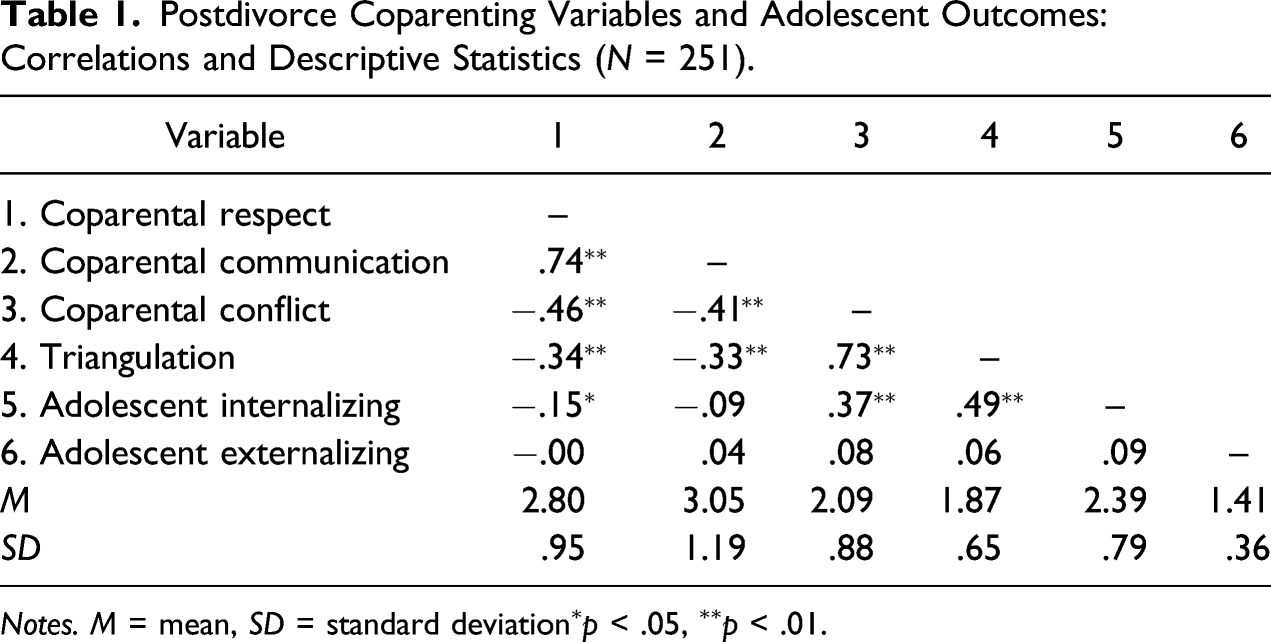
Notes. M = mean, SD = standard deviation∗p < .05, ∗∗p < .01.
Regarding adolescent outcomes, in line with expectations, parental conflicts (r = .37, p < .01) and triangulation (r = .49, p < .01) were significantly positively associated with internalizing behavior. Furthermore, a small but significant negative correlation was found between parental respect and internalizing problems (r = −.15, p < .05), but not between parental communication and internalizing problems. In contrast to expectations, no significant associations were found between coparenting dimensions and externalizing behavior.
Postdivorce Coparenting Patterns: Latent Class Analysis
Results of Latent Class Analyses (N = 251).
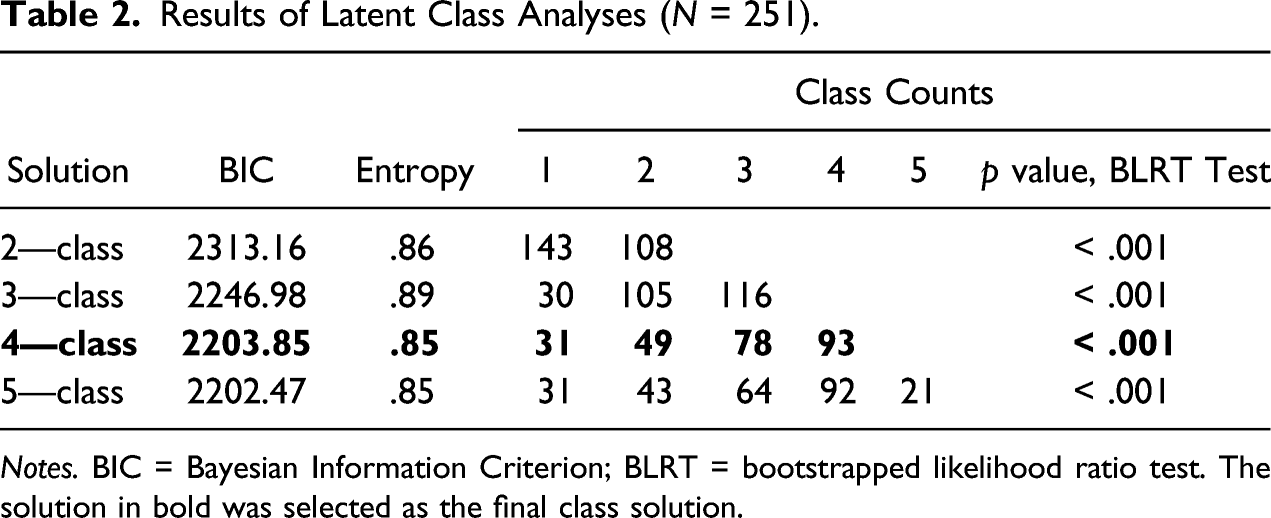
Notes. BIC = Bayesian Information Criterion; BLRT = bootstrapped likelihood ratio test. The solution in bold was selected as the final class solution.
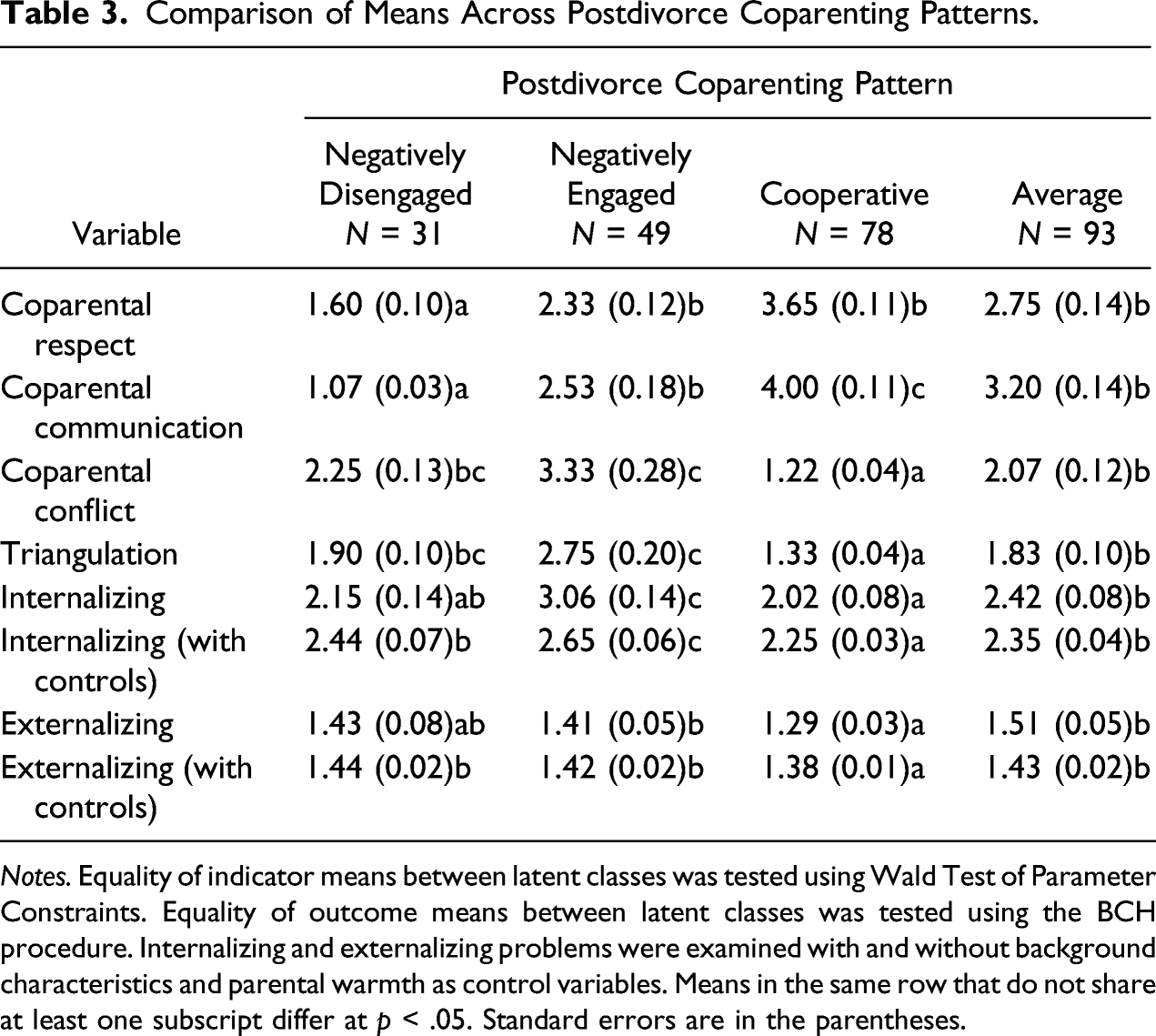
Figure 1 presents the four-class solution. The y-axis represents z scores. Mean scores and pairwise mean comparisons are presented in Table 3. The following labels were assigned to the four classes: A cooperative (31%), negatively engaged (20%), negatively disengaged (12%), and an average postdivorce coparenting pattern (37%). The cooperative pattern is characterized by relatively high levels of parental respect and communication, combined with the lowest levels of conflict and triangulation. By contrast, the negatively engaged pattern is characterized by the highest levels of conflict and triangulation, combined with average to high levels of respect and communication. Within the negatively disengaged pattern, levels of parental respect and communication were lowest, combined with average to high amounts of conflict and triangulation. Finally, within the average pattern, levels of parental respect and communication were comparable with those in the cooperative and negatively engaged pattern, combined with average amounts of conflict and triangulation (i.e., lower than the negatively engaged pattern, higher than the cooperative pattern). Postdivorce Coparenting Patterns. Note. Z scores for coparental respect, communication, conflict, and triangulation. Comparison of Means Across Postdivorce Coparenting Patterns. Notes. Equality of indicator means between latent classes was tested using Wald Test of Parameter Constraints. Equality of outcome means between latent classes was tested using the BCH procedure. Internalizing and externalizing problems were examined with and without background characteristics and parental warmth as control variables. Means in the same row that do not share at least one subscript differ at p < .05. Standard errors are in the parentheses.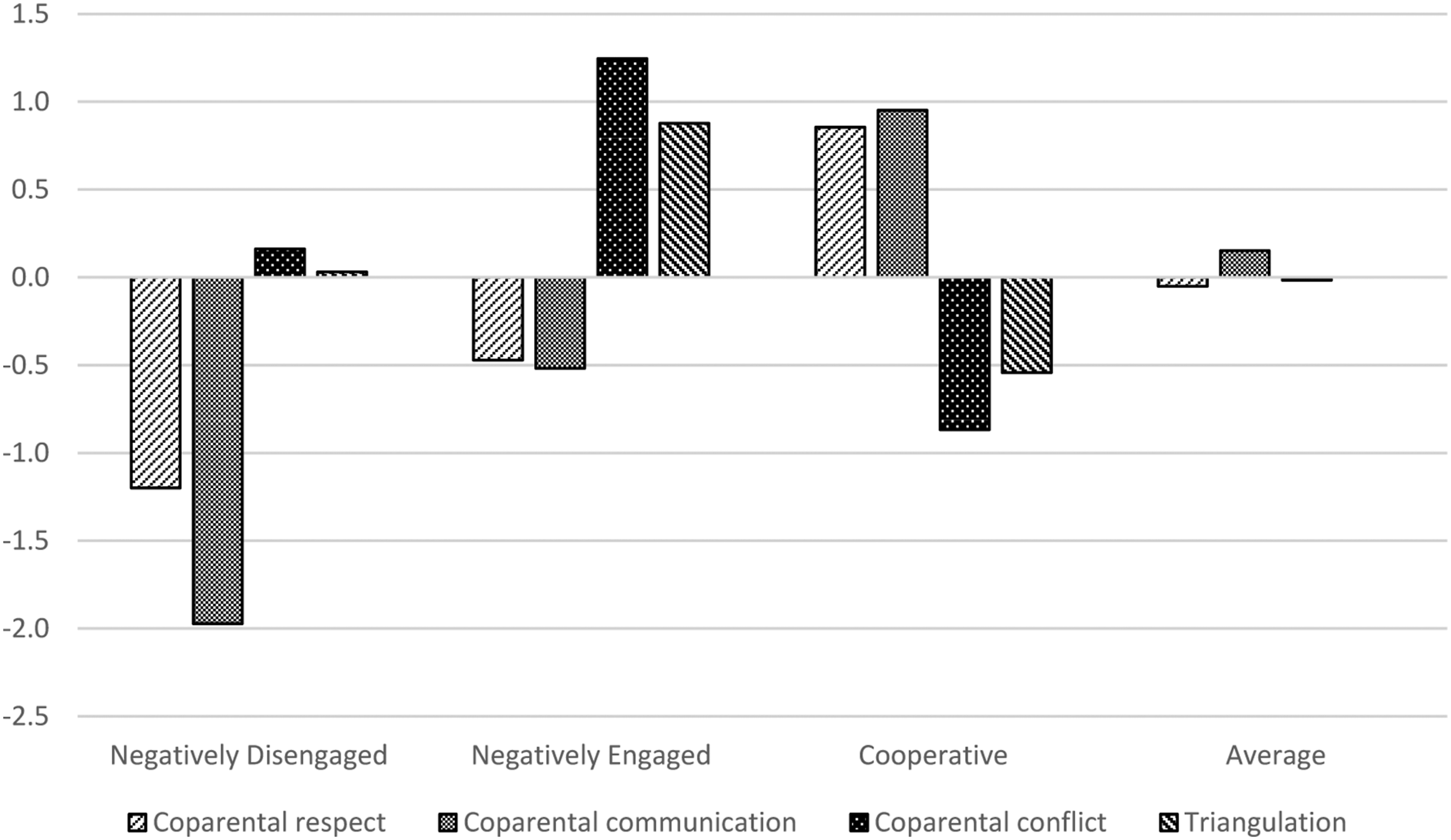
Next, we examined potential predictors of the latent coparenting patterns: adolescent sex, age, age at time of divorce, contact frequency with mother and father, and presence of a stepmother and/or father. No significant results were found with regard to adolescent age, contact frequency with parents, and presence of a stepparent. This means that overall, these variables do not appear to be substantial predictors of the four latent postdivorce coparenting patterns. We did find several significant results for adolescent sex and age at time of the divorce. Girls were more likely than boys to “belong to” the negatively engaged pattern compared to the other patterns: the average pattern (b = 1.13, p =.018, OR = 3.09), negatively disengaged pattern (b = 1.37, p = .031, OR = 3.92), or cooperative pattern (b = .98, p = .031, OR = 2.66). Furthermore, adolescents that were younger at time of the divorce were more likely to belong to the negatively disengaged pattern than to the other patterns, that is, the average pattern (b = .23, p =.003, OR = 1.26), the cooperative pattern (b = .22, p = .006, OR = 1.25), or the negatively engaged pattern (b = .41, p = < .001, OR = 1.51). Additionally, adolescents that were older at time of the divorce were more likely to belong to the negatively engaged pattern than to the average pattern (b = −.18, p = .045, OR = .84) and the cooperative pattern (b = −.19, p = .029, OR = .83).
Postdivorce Coparenting Patterns and Adolescent Adjustment
To examine whether the postdivorce coparenting patterns were associated with different psychosocial outcomes for adolescents, we estimated and compared mean levels of internalizing and externalizing problems across the different classes. Table 3 presents the comparison of means, both with and without controlling for adolescent sex, age, age at time of divorce, contact frequency with parents, presence of a stepparent, and adolescents’ perceptions of paternal and maternal warmth. Initial results showed that mean levels of internalizing behavior were significantly higher for adolescents in the negatively engaged pattern compared to the other patterns. Additionally, adolescents in the average pattern reported significantly higher levels of internalizing behavior than adolescents in the cooperative pattern. Furthermore, adolescents in the average and negatively engaged pattern reported significantly higher levels of externalizing behavior than adolescents in the cooperative pattern. No other significant differences in externalizing and internalizing behavior between postdivorce coparenting patterns were found. After controlling for adolescents’ reported parental warmth and several background characteristics, the differences reported above remained significant. In addition, we found significant differences in externalizing behavior between adolescents in the negatively disengaged pattern and the cooperative pattern, with those in the negatively disengaged pattern showing higher levels of problem behavior. Taken together, we found that adolescents belonging to the cooperative pattern reported the lowest amount of both internalizing and externalizing problem behavior. Whereas adolescents in the negatively engaged pattern showed significantly more internalizing behavior than those in the other three patterns, they did not differ in externalizing problem behavior from those in the average and negatively disengaged patterns.
Discussion
Each year, a considerable number of children are faced with the divorce or separation of their parents, which is associated with an increased risk of problems that may persist well into adolescence and adulthood (Amato, 2010). Understanding families as systems that are composed of interrelated subsystems is crucial for understanding adolescents’ psychosocial adjustment after divorce (Cox & Paley, 2003). This study focused on how parents interact with each other in relation to their adolescent child. Rather than examining coparenting dimensions (coparental communication, respect, conflict, and triangulation) individually, we adopted a person-centered approach and identified distinct patterns of postdivorce coparenting. The current study validated and built on previous studies on postdivorce coparenting patterns (e.g., Amato et al., 2011; Beckmeyer et al., 2014) by involving the perspectives of adolescents themselves. Moreover, we investigated the role of adolescent-reported postdivorce coparenting patterns in self-reported internalizing and externalizing problem behavior, as this association has been studied to a limited extent. Our findings are in line with family systems theory and suggest that interactions in the coparental subsystem are associated with adolescent adjustment and can therefore be viewed as both a risk and protective factor.
Latent class analysis was used to identify postdivorce coparenting patterns based on adolescents’ reports on the psychometrically validated Coparenting Behavior Questionnaire (Schum & Stolberg, 2007). Four distinct patterns were identified in our sample: cooperative, negatively engaged, negatively disengaged, and average patterns of coparenting after divorce. As expected, these patterns are comparable to those identified in previous studies using parental reports. Especially the cooperative pattern, characterized by high levels of communication and respect and low levels of conflict and triangulation, has consistently been found for about one-third of parents after divorce in previous studies. The negatively engaged pattern found in our study resembles prior mixed (Maccoby et al., 1990) or high conflicted patterns (Lamela et al., 2016). Parents in this group have a relatively large number of conflicts, yet they do not score lowest on respect and communication. The parents in the negatively disengaged pattern combine lowest levels of respect and communication with levels of coparental conflict and triangulation that are equal to parents in the negatively engaged pattern. Hence, this pattern resembles the parallel (Amato et al., 2011), infrequent but conflictual (Beckmeyer et al., 2014) or conflicted patterns (Maccoby et al., 1990) identified in earlier studies. It has been suggested that both the prevalence and severity of coparental conflicts strongly vary across samples, and that variations in these conflict-characterized patterns are therefore not unusual (Amato et al., 2011). In our sample, the largest class, that is, the average class, consisted of parents that scored average on all coparenting dimensions, and thus neither scored lowest or highest on positive nor negative coparenting behaviors.
Analysis of the role of background characteristics in adolescents’ class membership revealed that age, contact frequency with mothers and fathers, and presence of a stepparent were not of significant importance. However, girls were overrepresented in the negatively engaged pattern compared to boys. One possible explanation is that girls tend to experience elevated levels of communion toward parents, increasing their vulnerability to coparental conflict (Davies & Lindsay, 2004), and consequently, their reports of coparental conflict. In addition, results showed that adolescents that were younger during the divorce were more likely to belong to the negatively disengaged pattern compared to the other patterns. It has been hypothesized that coparenting relations become more parallel the more time has passed since the divorce (Maccoby et al., 1993). Although this could apply to our sample, it is remarkable that the amount of conflict in this group is still relatively high, as rates of high conflict typically decrease in the years following divorce (Fischer, de Graaf & Kalmijn, 2005).
The second aim of this study was to explore whether adolescents’ self-reported adjustment differed based on the identified coparenting patterns after divorce. Our findings showed significant associations between postdivorce coparenting and adolescent internalizing and externalizing problem behavior, both with and without controlling for several background characteristics and reports on paternal and maternal warmth. In line with findings from Amato et al. (2011) and Lamela et al. (2016), adolescents in the cooperative pattern reported the least amount of internalizing and externalizing behavior. In addition, we found that adolescents in the negatively engaged pattern reported the most internalizing behavior. Although previous studies found no support for negative, conflicted, coparenting as a risk factor, our findings are in line with family systems theory. It appears that the relatively high levels of conflict and triangulation combined with average levels of coparental engagement (in terms of communication and respect) increases adolescents exposure to negative coparental interactions, which may threaten their internalizing adjustment. However, this is not reflected in the level of externalizing problems in this group. One explanation could be that SDs and mean levels of externalizing problems were smaller/lower than those of internalizing problems. This was the case in our sample, but has also been noted in previous studies, and typically makes differences in externalizing behavior small and insignificant (Amato, 2010). On the other hand, factors other than postdivorce coparenting quality may play a more important role in adolescents’ externalizing adjustment.
It should be noted that the associations between coparenting and adolescent adjustment found in this study could partially be explained by adolescents’ perceived coparenting behaviors. Furthermore, other family processes, such as parenting, are likely to have an equal or potentially even stronger effect on adjustment outcomes. From a family systems perspective, the family as a whole is greater than the sum of its parts (Cox & Paley, 2003). As such, the quality of coparenting, parenting, and individual parent–child relationships are all interrelated and therefore, all crucial to take into account in order to understand adolescents’ postdivorce adjustment. Finally, it is important to note that the relations between postdivorce coparenting patterns and adolescent adjustment are likely to be bidirectional, and our study does not provide any evidence for direction of effects. Healthy adolescent adjustment can also invoke positive interactions between parents, and adolescent maladjustment can be a stressor to the coparents’ relationship after divorce, as well as a risk for perceiving coparenting more negatively.
Limitations and Directions for Future Research
Even though this study is strengthened by its use of adolescent reports, validated postdivorce coparenting measures, and advanced statistical techniques, it also has its limitations. One major limitation is that results are based on cross-sectional data, making it impossible to draw any conclusions on the causal effects of postdivorce coparenting patterns on adolescent adjustment. Equally plausible is that adolescent problems may place a strain on an already fragile coparenting relationship. To establish causality, research is required in which adolescents would be followed over a longer period of time, preferably even before the divorce. This would also provide an opportunity to learn more about the stability of coparenting patterns after divorce. Furthermore, however important it is to include adolescents’ perceptions on concepts that are typically reported on by parents, the fact remains that our study is based on the perceptions of single informants. We believe that future research would benefit from parent as well as adolescent reports on postdivorce coparenting and adolescent adjustment so that possible differences in views between adolescents and parents can be investigated. Finally, although our study examined effects of coparenting on adolescent adjustment with and without taking into account parental warmth, future research that includes the quality of parenting and parent–adolescent relationships is necessary for a better understanding of adolescent adjustment after divorce. Nevertheless, our study has contributed to knowledge on present-day coparenting and its relations with adolescent adjustment.
Implications for Practice
In line with family systems theory, our findings support the hypothesis that cooperative coparenting is the most desirable with regards to adolescents’ internalizing and externalizing behavior after divorce. Ideally, coparents would strive to develop or maintain a relationship characterized by mutual respect, collaboration, effective communication, and harmony after divorce. Adolescence is a critical life period to accomplish key developmental tasks, and parents continue to serve as important sources of support during this period (Gavazzi, 2011). Cooperative coparenting ensures that parents have mutual expectations about their child’s needs. However, our findings show that not all parents are able to achieve a cooperative relationship after divorce. This cannot simply be blamed on a lack of skill, knowledge, or willingness of parents, but also has to do with negotiating and organizing new family boundaries, roles, and routines following divorce (Russell, Beckmeyer, Coleman, & Ganong, 2016). Fathers, for example, have been found to perceive legal and financial issues as barriers to coparenting, whereas mothers experience negative perceptions of the coparents’ parental fitness as a barrier (Russell et al., 2016). Additionally, parental conflicts, geographical distance, and non–family-friendly working hours may stand in the way of forming a cooperative coparental relationship after divorce (Steinbach, 2019). Yet, in the Western world, both practice and divorce legislation focus on promoting equal parenting and joint physical custody, and therefore cooperative coparenting. As an alternative for cooperative coparenting, parents after divorce should strive to minimize their children’s exposure to conflict. If legal and mental health professionals continue to mediate conflicted coparents into becoming cooperative, they might keep the level of engagement as well as the level of conflict high (Sullivan, 2008). Disengaging feuding coparents and teaching them skills to be effective parents when they are alone with their children, rather than being dependent on the coparent, may provide a good solution in those cases (Cottyn, 2009). After all, a positive home environment should be the aim of all parents after divorce.
Footnotes
Declaration of Conflicting Interests
The author(s) declared no potential conflicts of interest with respect to the research, authorship, and/or publication of this article.
Funding
The author(s) received no financial support for the research, authorship, and/or publication of this article.
