



Abstract
This study examined the stability/change trajectories of future expectations during high school, analyzing whether adolescents’ sex, attachment to parents and peers, multiple risk, and pandemic-related stress explained these trajectories. The sample included 467 Portuguese adolescents, assessed three times across 18 months. Results revealed that adolescents’ future expectations increased significantly over time. We observed significant inter-participant variance at initial levels and growth rates. Emotional bonds with parents was associated with higher initial levels of optimistic future expectations, whereas alienation to peers was associated with lower initial levels of optimism. Adolescents’ exposure to multiple psychosocial risks was associated with lower growth of optimism. In turn, alienation to peers was associated with a higher growth rate of optimism. Pandemic-related stress was negatively associated with optimism at T2 and T3, and these associations were different over time. Our findings emphasize the associations between individual, relational, broader social contexts, and development of adolescents’ future expectations.
Keywords
Future expectations (FE) refer to individuals’ beliefs, perspectives, and predictions regarding their future, which may reveal a sense of optimism and hope that desired outcomes will be achieved in the future or, conversely, a sense of hopelessness (Ginevra et al., 2016; Hitlin & Johnson, 2015). These expectations are considered key predictors of individuals’ short- and long-term choices, as they guide behavior and shape decisions throughout life (Eccles & Wigfield, 2020; Rand, 2018). Several studies have revealed that optimistic and hopeful FE are associated with greater motivation and academic performance, increased resilience, psychological well-being, and decision-making ability (e.g., Prince et al., 2019; Stoddard & Pierce, 2015; Zou et al., 2022). Conversely, pessimistic FE have been linked to anxiety and depression over time, engagement in risky behaviors, poor academic performance, and school dropout (e.g., Cerqueira et al., 2022). Taken together, these findings underscore the current and long-term importance of FE in individuals’ lives.
However, the significance of FE during adolescence goes beyond immediate outcomes. Studies have highlighted their critical role in shaping long-term aspects of well-being, including educational attainment, career trajectories, and mental health (Berry et al., 2024; Thom et al., 2021). Positive FE during adolescence have been shown to correlate with improved later-life health outcomes (e.g., Kim & Kim, 2020), illustrating their broader implications for individual development. Therefore, understanding the development and fluctuations of FE in adolescence is crucial not only for immediate academic and behavioral outcomes but also for fostering long-term success and well-being. By engaging more deeply with the existing literature on adolescent FE, this study seeks to provide a more comprehensive view of how FE evolve and associate with both short- and long-term outcomes.
According to the situated expectancy-value theory (Eccles & Wigfield, 2020), FE reveal fluctuations over time based on individual, relational, and contextual processes. Late adolescence has been suggested as a period where substantial changes in adolescents’ FE occur (Eccles & Wigfield, 2020; Nurmi, 1991). However, the literature on the fluctuations of FE during this particular period is scarce. Based on the assumptions of the situated expectancy-value theory, we aim to address two knowledge gaps. First, we analyze fluctuations in FE during late adolescence, more specifically during high school. Second, we consider individual, relational, and contextual factors such as adolescents’ sex, attachment to parents and peers, psychosocial multiple risk, and pandemic-related stress in relation to these trajectories.
Fluctuations of FE Across Late Adolescence
FE are not stable or immutable, they also change as a function of age and maturation, in response to new developments, experiences, and life circumstances (Bandura, 2000; Eccles & Wigfield, 2020). During adolescence, youth face numerous developmental challenges that may contribute to fluctuations in their FE (Fleming, 2004). For instance, during this period of life, adolescents develop a personal identity, where they explore different possibilities for a clearer vision of themselves (Branje et al., 2021). Consequently, as they experiment new ways of being, they will experience different perspectives and beliefs about their future. In addition to identity formation, adolescence is a period marked by the development of increasingly complex cognitive and social-emotional abilities. Beyond the growth in abstract thinking (Dumontheil, 2014), adolescents also develop advanced perspective-taking and critical thinking skills, both of which are reinforced by the development of moral reasoning, values, and ethical beliefs (Marcia, 1966). These capacities, in conjunction with their emotional experiences, play an important role in shaping how adolescents project themselves into the future. Adolescents’ moral and affective development allows them to critically reflect on societal norms and personal goals, which further informs their FE.
Moreover, during this phase, adolescents must balance relational family demands with the need for autonomy and independence from their parents. This reorganization occurs as adolescents seek greater autonomy from their parents while also forming new social relationships, particularly with peers (Allen et al., 2007; Allen & Miga, 2010; Branje, 2018). In this intricate relational reorganization, adolescents may face different kind of experiences that can shape how they perceive their future.
Furthermore, high school students may face a series of important decisions regarding their academic and professional careers. These decisions are embedded within socio-cultural norms and expectations, and country-specific transition regimes (Schoon & Bynner, 2019). In Portugal, with 14 to 15 years-old, during the transition to high school, students are required to choose academic paths that may determine their access to higher education or vocational training, both of which significantly impact their future opportunities (Saraiva & Matos, 2016). In addition, economic fluctuations and labor market instability in Portugal impose significant constraints on adolescents’ decision-making processes (Torres & Mouraz, 2019). As such, studying the fluctuations in young adolescents’ FE during late adolescence, particularly within the Portuguese socio-economic context, is especially relevant today.
Close Relationships: Attachment to Parents and Peers
According to the situated expectancy-value theory (Eccles & Wigfield, 2020), individuals’ FE are shaped by the social contexts in which they are embedded, such as family and peers. Within the family context, we highlight the role of the quality of relationships between parents and adolescents based on the assumptions of attachment theory (Ainsworth, 1969; Bowlby, 1988). According to this theory, the availability and responsiveness conveyed by attachment figures allow for the construction of internal working models about the self, others, and the world, which can lead to more positive or negative behavior and emotion regulation patterns.
The quality of emotional bonds with parents establishes an important lever for adolescents to explore the world around them confidently and shapes believes regarding their abilities and the availability of others to help them in times of need (Bowlby, 1988). Conversely, relationships characterized by insecurity tend to impair individuals’ exploration processes (Matos & Costa, 2006). The link between exploration and FE can be better understood through the concept of internal working models (Bowlby, 1988).
Adolescents with positive internal working models see themselves as capable and worthy of support, and see the world as a place of opportunity, which can lead to more optimistic and hopeful perspectives of their future. On the other hand, adolescents with negative internal working models see themselves as less competent and the world as unpredictable or threatening, which can lead to more pessimistic views of their future. Based on these assumptions, we hypothesize that the quality of emotional bonds with parents plays an important role in adolescents’ FE. For instance, in some situations, adolescents do not have direct control over the conditions that affect their lives. In these circumstances, they need to rely on their parents’ availability to believe they can achieve the desired outcomes. Although scarce, there is evidence supporting this perspective (e.g., Alfiasari, 2023; Machado et al., 2015). For instance, in a cross-sectional study with 256 adolescents, Alfiasari (2023) found that attachment to mother and father was associated with optimism about future. Another study, developed with 262 Portuguese emerging adults found that attachment to parents are positive related with hope about future (Machado et al., 2015). Despite these initial findings, the role of attachment to parents in the development of FE during late adolescence still need to be further explored.
While parents continue to serve as secure bases for encouraging adolescents’ autonomy and differentiation, adolescents turn to their peers and rehearse new developmental competencies (e.g., Holmes, 2001). The connections established with peers are distinct from relationships with parental figures, as they are characterized by greater reciprocity and power symmetry (Cassidy et al., 1996). In affective relationships with peers, adolescents encounter similar challenges, anxieties, and aspirations to other peers and feel more capable of constructing their “true self” (Eccles et al., 2003). Secure relationships with peers provide a safe haven for validating the self and the world. Therefore, we suggest that the quality of relationships with peers may be reflected in how adolescents perspective their future. For instance, adolescents who feel understood and valued by their peers may feel more optimistic and hopeful about their future. Conversely, adolescents who feel disconnected or alienated from their peers may experience feelings of hopelessness about the future (Cassidy et al., 1996).
This perspective is supported by previous evidence showing that trustful relationships with peers are associated with optimism about the future (Alfiasari, 2023). However, the link between attachment to peers and development of FE during late adolescence remains relatively unexplored in the literature. More evidence needs to be gathered to understand better the role of peer relationships in fluctuations of adolescents’ FE.
Sex, Multiple Psychosocial Risk, and Pandemic-Related Stress
The literature has underscored the role of multiple individual and contextual shapes in shaping adolescents’ FE and the broader, ever-changing social context (Eccles & Wigfield, 2020). Regarding individual factors, various studies have shown that boys exhibit more optimistic and hopeful FE than girls, while girls tend to display more pessimistic expectations (Bjuggren & Elert, 2019). These differences may be attributed to several factors, including the focus of these assessments on domains (e.g., financial risk) typically valued differently by boys and girls. Another explanatory factor may lie in the tendency for boys and girls to exhibit distinct development patterns (Martin & Ruble, 2010), which may be reflected in their FE. For instance, studies indicate that girls, on average, tend to mature emotionally and cognitively earlier than boys, which may shape how they project their future (Steinberg, 2017). They also tend to demonstrate greater social and emotional competence, including a higher capacity for empathy and self-regulation (Zahn-Waxler et al., 2008). In contrast, boys, although they may exhibit slower development in terms of emotional maturity, are often encouraged to engage in more independent and risk-taking behaviors, which can differently shape their FE (Blakemore & Mills, 2014). These developmental pattern differences may shape how boys and girls approaches challenges, opportunities, and uncertainties regarding the future. Another factor that can contribute to sex differences is societal gender roles and expectations, which can shape the way boys and girls perceive their futures (Cislaghi & Heise, 2020). Unraveling possible sex differences in FE’ fluctuations will allow us better understand how late adolescents develop their perspectives about future.
Regarding contextual factors, it is also important to consider the concept of multiple psychosocial risks, which involves the intersection of various risk factors (e.g., low family income) and can create significant barriers to the development of positive FE (Brannen & O’Connell, 2022; Harris, 2022). Not all adolescents have the same opportunity to develop optimistic and hopeful FE (Prince et al., 2019). For example, adolescents growing up in economically disadvantaged communities may face additional obstacles in achieving their goals due to a lack of resources and opportunities, lack of social support and/or lack of secure emotional bonds with significative others. Therefore, when studying fluctuations in adolescents’ FE, it is essential to consider the sociocultural context in which they live, including their experience of multiple risks. This allows us to understand better how risks shape the fluctuations of adolescent’s FE throughout high school and contribute to developing policies to promote equity and opportunities for all adolescents’ lives.
At the broader social level, we consider it important to consider the challenges associated with the COVID-19 pandemic, which significantly affected adolescents (Santomauro et al., 2021). Evidence highlight the significant impacts of COVID-19 on adolescents’ educational, employment, and training opportunities (Daumiller et al., 2023; Green et al., 2022). There is evidence suggesting that the COVID-19 has undermined adolescents’ FE (Schoon & Henseke, 2021). Thus, in this study, we consider and analyze the effect of pandemic-related stress on trajectories of FE.
Current Study
The current study has three main research questions. First, we analyze the stability and change in FE across late adolescence, specifically during high school. Second, we analyze the association of adolescents’ sex, attachment to parents and peers, and the multiple psychosocial risks at baseline, over time with these trajectories. Third, we investigate whether variations in stress related to pandemic are associated with the trajectory of adolescents’ FE. The current study explored all possible trajectories of FE during high school (increase, maintenance, or decrease). This approach was taken because some adolescents may face additional difficulties in managing developmental tasks during adolescence. In other words, adolescents can vary significantly in developing their characteristics, which may shape their perspectives towards the future.
Method
Participants
This longitudinal study comprises three assessment points across 18 months, including 467 adolescents (40.7% male, 59.3% girls, and Mage = 15.58 years, SD = 0.80) in the baseline. We conducted the baseline assessment (T1) between September and December 2019. After 12 months (T2, Mage = 16.52, SD = 0.76) and again 18 months (T3, Mage = 16.93, SD = 0.87) adolescents were assessed again. Almost 80% of participants lived with both parents. Only a few of them lived with their mother (18.4%) or with their father (3.0%; 0.6% of missing). Fifty-three percent of adolescents attended the 10th grade, while 47% attended the 11th. These educational levels correspond to the third level of the International Standard Classification of Education (ISCED). More than half of adolescents (56%) live in non-metropolitan areas, while 36% live in metropolitan areas (8% missing). Approximately 13% of adolescents report that their family income is below the national minimum wage (NMW), 17.8% report that the family income is between 1 and 2 NMW, 28.7% report that the family income is between 2 and 3 NMW, 15% report that the family income is between 3 and 4 NMW, and 12.4% report that the family income is between 4 and 5 NMW (13.1% missing). Regarding the marital status of the adolescents’ parents, 1.9% were single, 80.3% were married/living in a civil union, 15.6% were separated/divorced, and 1.9% were widowed (0.2% missing).
Approximately 18% of adolescents had missing data at T2, and 25% had missing data at T3. The attrition rate was 12% and 13% at T2 and T3, respectively (Supplemental Table S1). The attrition observed in T2 was mainly due to the error of including a class at baseline, which was later transferred to another school. Attrition in T3 was mainly due to the research team’s incorrect identification of two classes. It was impossible to match the observation of these students at T2 with their reports at T3. Furthermore, we verified that the observed patterns of missing data were not completely at random (MCAR; χ2(108) = 143.84, p = .012). We conducted several general regression models to assess associations between adolescents’ sex, family income, residence, parent’s marital status, and adolescents’ participation status in T2 and T3. We found that boys were more prone to drop out of the study than girls (χ2(1, 466) = 14.12, p = .001). As missing data were related to measured variables and characteristics of participants, we assumed that they were Missing at Random (MAR) and use full information maximum likelihood (Little & Rubin, 2002).
Measures
Sociodemographic Measure
Participants answered a questionnaire on their age, sex, school year, household, and parent’s marital status.
Future Expectations
In all assessment points, adolescents completed the Visions About Future scale (VAF; Ginevra et al., 2016; Portuguese version by Nunes et al., 2018). VAF comprises 19 items distributed across three dimensions: Optimism, Pessimism, and Hope. Optimism entails the overarching belief that taking action will yield favorable outcomes (six items, e.g., Even if I encounter difficulties in the future, I will continue being optimistic). The pessimism comprises six items and assesses the generalized beliefs about negative outcomes or a disregard toward 1’s ability to face adversities (six items, In the future, I will have to settle for what I’ll be able to do). Hope comprises seven items, refers to the individual’s motivation regarding goal achievement, and comprises an affective component (seven items, In the future, I will be able to do what I can’t do today). The items are completed using a five-point Likert scale: (1) “This does not describe me at all” to (5) “This totally describes me.” We found good internal consistency in three dimensions across three assessment points: Optimism = 0.88 / 0.91 / 0.92, Pessimism = 0.73 / 0.79 / 0.83, and Hope = 0.91 / 0.92 / 0.92. Item 13 was eliminated as it did not contribute significantly to the pessimism dimension.
Attachment to Parents
Adolescents completed separately on father and mother the Quality of the Emotional Bond (QEB) and Inhibition of Exploration and Individuality (IEI) subscales of Father and Mother Attachment Questionnaire - short form (FMAQ; Nunes, Mota et al., 2020). QEB comprise five items and evaluates the individual’s importance on parents as attachment figures (I rely on my parents’ support in difficult moments of my life). IEI comprise five items and assess the individuals’ perception that their parents are actively discouraging their individuality and exploratory behavior (At home, it is a problem when my interests differ from my parents). The items are completed using a six-point Likert scale: (1) “totally disagree” to (6) “totally agree.” We found acceptable internal consistency in the father and mother versions: QEB = 0.86 / 0.86, IEI = 0.66 / 0.65.
Attachment to Peers
Adolescents completed the alienation and trust subscales of Inventory of Parents and Peers Attachment (IPPA; Armsden & Greenberg, 1987; Portuguese version by Ferreira & Costa, 1998). The alienation comprises seven items and evaluates the extent to which adolescents feel they are not accepted and understood by their peers (I feel alone or apart when I’m with my friends). The trust comprises 10 items and assesses the extent to which young people believe that peers are available to provide them with care, security and protection (My friends respect my feelings). The items are rated on a six-point Likert scale: (1) “strongly disagree” to (6) “strongly agree.” Both dimensions reveal good internal consistency: trust = 0.86, alienation = 0.77.
Multiple Psychosocial Risk
Participants completed a Multi-Risk Questionnaire addressing their exposure to a range of psychosocial risks situation (Gutman et al., 2002; Johnson & Hitlin, 2017), including:
Not living with both parents: Scores: 0 – No Risk, 1 – Risk.
Low parental education: 0 – Parents with education higher the sixth grade level; 1– One parent with education at or below the sixth grade level; 2– Both parent with education at or below the sixth grade level.
Unskilled parental occupations: 0 - Parents engaged in skilled work; 1– At least one parent unemployed, retired, or engaged in unskilled work; 2– Both parents unemployed, retired, or engaged in unskilled work.
Low family income: 0 – Families with incomes higher the minimum wage, 1– Families with incomes equal or below the minimum wage.
Change of residence or school in last 5 years: 0– No Risk; 1– Risk.
Accident or severe illness in last 5 years: Scores: 0 – No Risk, 1 – Risk.
Experience of two or more negative life events (e.g., death of a close relative, parents’ divorce) in the last 5 years. Scores: 0 – No Risk, 1– Risk.
The last three situations were only considered a risk if adolescents reported that the experience had a negative impact on their lives. We used the following Likert scale ranging from 0 (“did not affect me negatively”) to 4 (“affected me a lot”). Scores of two, three, and four indicated that these situations had a significant negative impact on the adolescents’ lives. We calculated a composite risk index (CRI) by summing the scores obtained for each of the seven risk factors (Conger et al., 2010; Gutman et al., 2002). The CRI ranges from zero to eight, with higher scores indicating higher risk accumulation. Approximately 48.3% of adolescents experienced four or more multiple risks. The most prevalent risk factor among participants was both parents having unskilled occupations (64.7%; see Table 1).
Incidence of Risk Factors in Our Sample.

Note. CRI - Composite Risk Index; 0 - no risk experiences; 1 - one risk experience; 2 - two risk experiences; 3 - three risk experiences; 4 - four risk experiences; 5 - five risk experiences; 6 - six risk experiences; 7 - seven risk experiences; 8 - eight risk experiences.
Pandemic-Related Stress
We adapted the Perceived Distress (PD) dimension of Perceived Stress Scale (PSS-10; Cohen et al., 1983; Portuguese version by Amaral et al., 2010) to Covid-19 pandemic situation (Nunes, Matos, & Mota, 2020). This dimension is composed by six items (e.g., “During the covid-19 pandemic, I felt more nervous or stressed”) answered through a five point Likert scale: from (0) “never” to (4) “very frequent.” PD presented adequate consistency (α = .75 / 0.80) at T2 and T3, respectively.
Procedures
Data were collected as part of a broader research project to understand the impact of individual, relational, family, and school factors on the development of adolescents’ sense of agency. Authorizations were obtained from the Ethics Committee, the data protection officer at the author’s institutions, and the Portuguese Ministry of Education to administer the questionnaires within schools. Initially, all public schools (N = 71) in the Porto district of Portugal were contacted via phone and email, which were asked to schedule a meeting with research team. Approximately 30% of the schools expressed willingness to host the research team, leading to meetings with the school heads of 21 schools. We opted for this close approach to facilitate trust in the project and encourage greater compliance. Of the total meetings held, one institution decided not to participate, one did not respond to the request, and two withdrew their participation following the outbreak of the Covid-19 pandemic. Our project was implemented in 18 high schools, in which were randomly selected four high school classes to participate (necessary number to carry out multilevel analyses). Despite the 21 schools that participated in the project, only 8 agreed to take part in the longitudinal study, which included three assessment periods. The study initially planned for three assessments 6 months apart. However, the assessment schedule was revised due to the pandemic outbreak and subsequent school closures. The second assessment (T2) was conducted 12 months after the first (T1), and the third assessment (T3) took place 6 months after T2. Data collection for T2 and T3 occurred in classrooms during regular school hours, with the research team providing online support due to Covid-19 restrictions. Parents and adolescents provided written informed consent. Adolescents who agreed to participate completed a questionnaire on FE at T1, T2, and T3. They also reported multiple psychosocial risk and attachment to parents and peers at T1, and pandemic-related stress at T2 and T3. No rewards were provided for participation.
Data Analysis
We analyze Z scores and Mahalanobis distance to identified univariate and multivariate potential outliers (Kline, 2015). We identified six participants as outliers and decided not to consider them in subsequent analyses. We calculated means, standard deviation, and correlations among variables. We also inspected measures properties through reliability and factorial confirmatory analysis (CFA). We interpret the CFA results based on the following cut-offs points: CFI and TLI ≥ 0.80, RMSEA and SRMR < 0.10 to indicate an acceptable fit (Kline, 2015). Also, we tested the longitudinal measurement invariance (LMI) of FE and pandemic stress. The following cut-offs guided the invariance results interpretation: nonsignificant Δχ2, ΔCFI ≤ 0.010, and ΔRMSEA < 0.015. According to Cheung and Lau (2012), even though Δχ2 is significant if ΔCFI and ΔRMSEA are within these cut-off points, this means that differences between the models are tiny, and that invariance of the more restricted model can be assumed. The results of intraclass correlations (ICCs) indicated that a low proportion of variance in adolescents’ FE dimensions was related to the class (ICC range from 0.05 to 0.14) and school levels (ICC range from 0.00 to 0.16) in all assessment points. A design-based estimation approach corrected standard errors for potential nonindependence of observations (Muthen & Satorra, 1995). Next, we texted an unconditional latent growth curve (LGC) with latent variables and using the saturated correlated approach, that is, adolescents’ sex as introduced in the model as an auxiliary variable (Newson, 2015). Finally, several conditional LGC models examined the effects of adolescents’ sex, attachment to parents and peers, and the multiple psychosocial risks on stability and change of FE. Further, we controlled the effect of pandemic related stress over time (T2 and T3). A robust maximum likelihood estimation corrected the nonnormality and nonindependence of data. Also, under the assumption of MAR, full information maximum likelihood estimation was used to avoid deleting participants with missing data (Enders & Bandalos, 2001). All analyses were conducted in R (R Core Team, 2020), using the lavaan (Rosseel, 2012) and the semTools packages (Jorgensen, 2019).
Results
Preliminary Analyses: Internal Consistency, CFA, and MI
The Visions About Future scale showed an acceptable fit at T1, T2, and T3. Also, the attachment to mother, father and peers demonstrated a good fit at T1. The perceived distress related to COVID-19 revealed an acceptable fit at T2 and T3 (Table 2). The measurement invariance results revealed that the FE are invariant over time at the residual level (Δχ2(4) = 5.57, p = .234). We also found partial scalar longitudinal invariance of pandemic-related stress across T2 and T3 (Δχ2(4) = 9.06, p = .060). Further, we found metric invariance among parents’ sex on attachment to parents (Δχ2(50) = 87.05, p = .001, ΔCFI = −0.005; ΔRMSEA = 0.001).
Confirmatory Factor Analyses.

Note. VAF – Visions About Future; FMAQ Father – Attachment to father; FMAQ Mother – Attachment to mother; IPPA – PEERS – Attachment to peers; PSS - Perceived Stress Scale; NA – Not applicable.
Covariances
Optimism and hope positively correlated with the quality of the emotional bond with father and mother and trustful relationships with peers. In turn, optimism and hope were negatively correlated with inhibition of exploration and individuality by father and mother and alienated relationships with peers. The opposite pattern was found between pessimism and dimensions of attachment to parents and peers (see Table 3).
Covariances Over Time.

Note. **p < .01; *p < .05. OPT_T1 – Optimism at T1; HOP_T1 – Hope at T1; PESS_T1 - Pessimism at T1; QEB_M – Quality of emotional Bound of Mother; IEI_F – Inhibition of Exploration and Individuality of Mother; QEB_F – Quality of emotional Bound of Father; IEI_F – Inhibition of Exploration and Individuality of Father; TRU – Trust to peers; ALI – Alienation to peers; RISK – Cumulative Psychosocial Risk; OPT_T2 – Optimism at T2; HOP_T2 – Hope at T2; PESS_T2 - Pessimism at T2; PSS_T2 – Pandemic-related stress at T2; OPT_T3 – Optimism at T3; HOP_T3 – Hope at T3; PESS_T3 - Pessimism at T3; PSS_T3 – Pandemic-related stress at T3.
Latent Growth Curve (LGC): Unconditional and Conditional Model
An unconditional LGC model examined the change trajectories of adolescents’ FE. FE at T1, T2, and T3 was modeled as a latent variable informed by three indicators (optimism, hope, and pessimism). Based on the preliminary results, we imposed longitudinal residual invariance. The intercept’s loadings were fixed to 1 and slope’s loadings were fixed to 0, 1, and 1.5 to account for the time gap between three assessment points. The saturated correlated approach considered the adolescents’ sex in the auxiliary variable; that is, adolescents’ sex was correlated as all exogenous manifest variables of the LGC model. The model (see Figure 1) estimated a mean latent intercept and slope for adolescents’ FE. The results revealed a good fit to the data (χ2(18) = 27.70, p = .117, CFI = 0.99, TLI = 0.99, RMSEA = 0.03, SRMR = 0.03). Adolescents reported a mean score of 1.78 (p = .001) on the FE at T1, followed by a positive linear slope (b = 0.07, p = .001). Results also revealed significant between-participant variance at initial levels (b = 0.02, p = .001) and at rate growth (b = 0.02, p = .001).
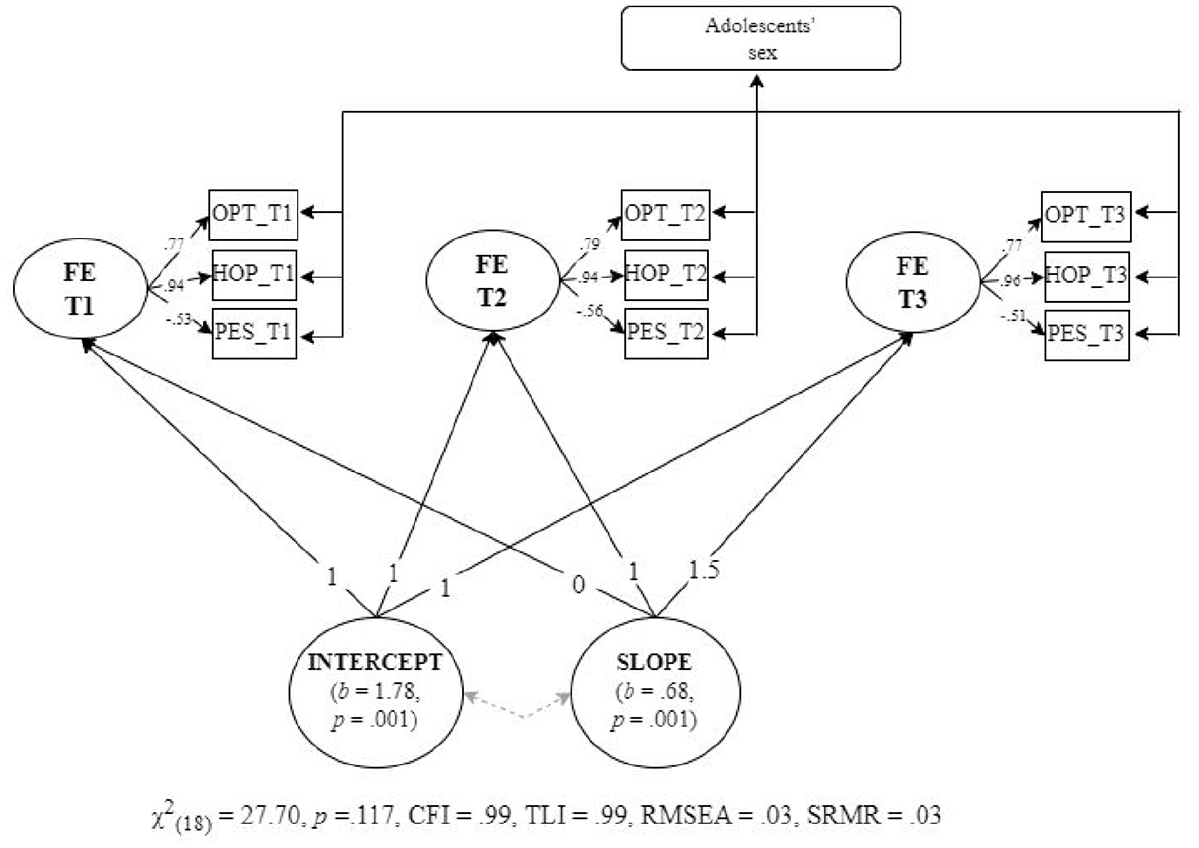
Unconditional latent growth curve (LGC) on future expectations across late adolescence.
Following, two manifest variables measuring pandemic-related stress were added to the previous LGC. These variables evaluated whether variations in pandemic-related stress are associated to the FE at T2, and T3. First, a full unconstrained model was tested. Next, the links of pandemic-related stress on FE were constrained to be equal in T2 and T3. Models’ comparison indicated models show significantly different adjustment to the data (Δχ2(1) = 5.77, p = .016). This finding suggests a differential association of pandemic-related stress to adolescents’ FE over time, with a higher contribution in T3 than in T2. Next, eight manifest variables (adolescent’s sex, multiple risks, attachment to mother, father, and peers) were added to the unconstrained conditional model LGC as covariates of the intercept and slope of FE. The model fit acceptably to the data (χ2(102) = 211.35, p = .001, CFI = 0.95, TLI = 0.93, RMSEA = 0.06, SRMR = 0.06; Figure 2). The results showed that adolescents with a higher quality of emotional attachment to their father (B = 0.117, p = .001) and mother (B = 0.14, p = .001) had higher initial levels of optimism and hope about future. In turn, adolescents with alienated relationships with peers (B = −0.32, p = .001) present lower initial levels of optimism and hope. Adolescents who experienced higher multiple risks in T1 revealed lower growth rate of optimistic and hope (B = −0.25, p = .001). Further, adolescents who reported higher levels of alienation to peers in T1 revealed higher growth of optimism and hope (B = 0.34, p = .001).
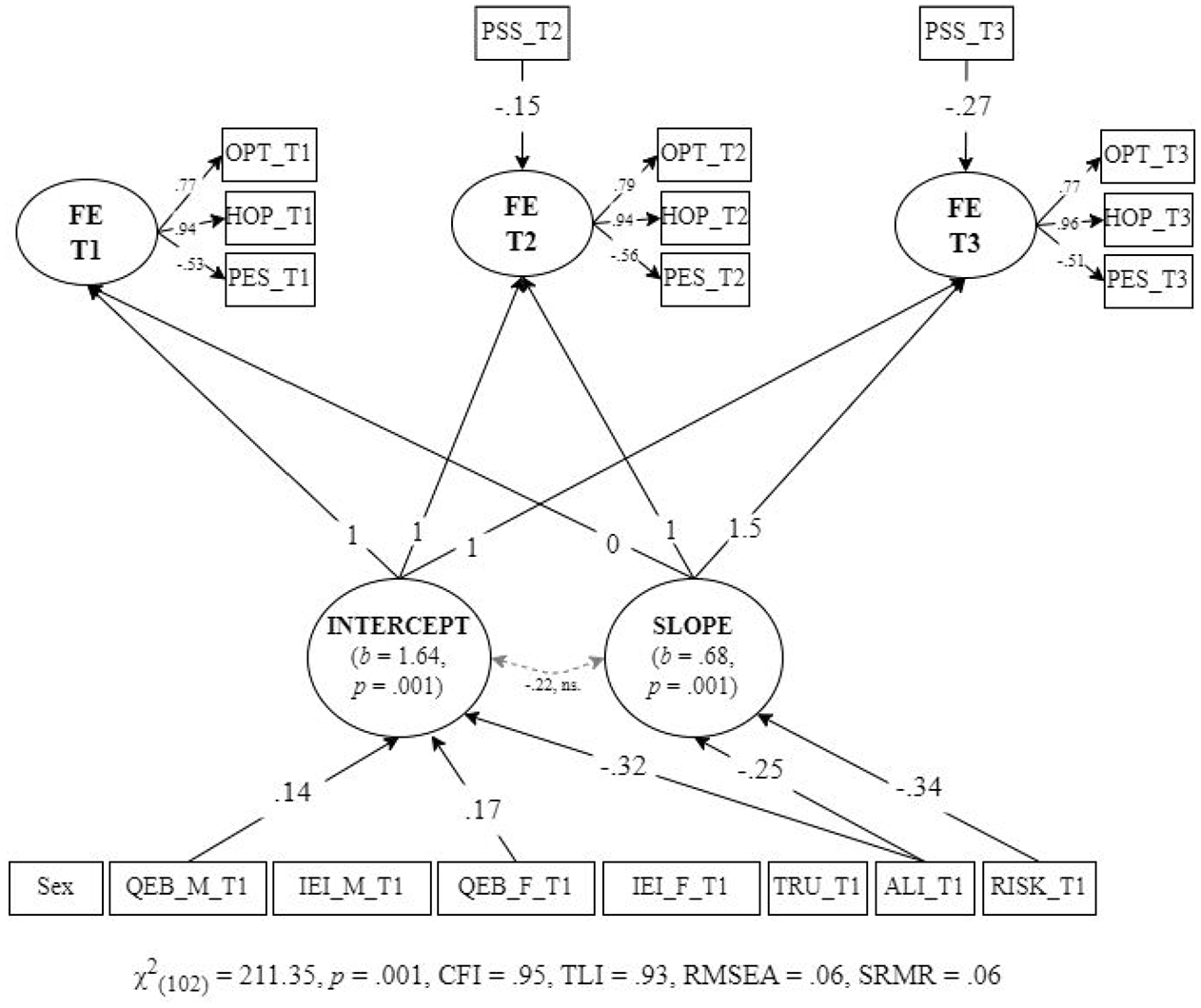
Conditional LGC on future expectations: Effects of pandemic-related stress, attachment to parents and peers, adolescent’s sex, and cumulative psychosocial risk.
Discussion
In the current study, we examined the stability and change in adolescents’ FE during high school and the association of sex, attachment to parents and peers, multiple psychosocial risks at baseline, and pandemic-related stress over time (T2 and T3). The results of the unconditional latent growth curve analysis revealed that optimism and hope increased linearly over time. These findings suggest that adolescents’ FE became more optimistic and hopeful, and less pessimistic, as they progressed through high school. These results align with the situated expectancy-value theory, which posits that FE are dynamic and exhibit fluctuations over time (Eccles & Wigfield, 2020). The fluctuation observed in the current study may be attributed to developmental challenges typically encountered during this period, such as identity formation and the acquisition of more advanced cognitive and social-emotional abilities, which enable adolescents to consider a wider range of future possibilities (Branje et al., 2021; Dumontheil, 2014). The increased decision-making power regarding their future, particularly their academic and career paths, may also explain this result (e.g., Saraiva & Matos, 2016; Torres & Mouraz, 2019).
Our results also indicated that not all adolescents reported the same baseline levels of optimistic, hopeful, and pessimistic FE, and not all exhibited the same rate of change over time. This variation underscores the heterogeneity in how adolescents’ FE fluctuate during high school. Regarding interindividual variation in initial values, we found that adolescents with high-quality emotional bonds with their father and mother reported more optimistic and hopeful and less pessimistic FE. This association was equal for both parents. These results suggest that quality emotional bonds with both parents by promoting emotional security and self-esteem, can enable adolescents to anticipate positive outcomes. These findings align with attachment theory, which posits that secure relationships with significant figures, particularly parents, provide a secure base that enable adolescents to trust themselves and others, being more optimistic. Quality relationships with caregivers, especially parents, foster a belief in one’s abilities and the availability of others in times of need (Bowlby, 1988), potentially associating to a more positive FE. Furthermore, our results corroborate previous evidence (Alfiasari, 2023; Machado et al., 2015). In addition, our findings add important knowledge to the literature. First, they clarify that attachment to both father and mother associates equally to adolescents’ FE. Second, they clarify that both parents are not only associated with adolescents’ FE, but also are associate with fluctuations in these expectations during late adolescence.
Moreover, our results show that relationships with peers characterized by alienation were associated with lower initial levels of FE, that is, more alienated adolescents exhibited more pessimistic and less optimistic and hopeful perspectives. These results highlight the negative association of feeling disconnected from peers on adolescents’ FE. It is well-known that peer relationships during adolescence are important, as they provide a context for social learning, emotional support, and identity development (Schoeps et al., 2020). When adolescents feel alienated from their peers, they experience feelings of loneliness, rejection, disconnection, and lack of social support. These feelings can undermine their self-esteem and confidence, potentially fostering a more pessimistic FE future, which corroborates previous preliminary evidence (Alfiasari, 2023).
Additionally, our results show that multiple psychosocial risks at baseline are negatively associated with the growth rate in FE. Adolescents facing multiple risks may struggle to maintain a positive outlook due to limited resources and support, impairing their ability to anticipate and believe in a positive future.
We also found that adolescents who reported higher peer alienation at baseline (T1) exhibited a greater growth rate in optimism and hope over time. These results are unexpected, and it is important to emphasize that initial values and growth rates are negatively correlated, that is, the adolescents who initially displayed less optimism and hope and more pessimism experienced the most significant increase over time. When we reflect on this unexpected result, several hypotheses come to mind. First, adolescents who start with lower FE might develop coping mechanisms and resilience over time that enable them to overcome their initial disadvantage. For example, their challenges could catalyze their personal growth, leading to a more positive outlook as they perceive themselves as more capable of shaping their life paths (Nunes et al., 2023). Second, adolescents experience a reorganization of their attachment network, where new figures become more prominent (e.g., peer friends and romantic peers). Adolescents who experienced relational difficulties with their peers at baseline can have found other relationships, such as new friendships or romantic relationships, that let them overcome their initial disadvantage and gradually develop more optimistic and hopeful FE. Moreover, other significant figures may play a crucial role during this phase, notably parents, who can provide a refuge when adolescents face peer-related difficulties, thereby fostering their personal growth. For instance, parental support might buffer the negative association of peer alienation, promoting more positive FE. It is also possible that other key figures, such as teachers, could make a difference in shaping adolescents’ FE, even though this aspect was not directly tested in our study. Third, the mean level of peer alienation reported by adolescents was 2.33 on a scale from 1 to 6, indicating that these feelings of alienation were relatively moderate. This suggests that the relational difficulties faced by adolescents may not necessarily be problematic or chronic, but rather part of a typical developmental process during adolescence. Peer alienation in this context may reflect temporary challenges that adolescents face as they navigate complex social dynamics, rather than indicating persistent social isolation or dysfunction. For instance, the shift from ninth to 10th grade can disrupt existing social networks, contributing to temporary feelings of alienation. The loss of familiar peers due to school transitions or changing class structures may increase these feelings. However, this phase also offers opportunities to form new social connections, potentially leading to personal development and the broadening of FE. Despite our initial hypotheses to explain these results, further studies are needed to understand better the role of peer relationships in developing future perspectives throughout late adolescence.
Our results also showed that pandemic-related stress not are only negatively associated with adolescents’ FE but also that this negative association tended to strengthen over time. This finding suggests that the prolonged and evolving nature of the COVID-19 pandemic exacerbated stress and uncertainty, thereby undermining the change in FE (Schoon & Henseke, 2021). These results carry important implications for understanding how external crises, such as pandemics, can have long-lasting psychological effects on adolescents. The persistence of stress and uncertainty seems undermine adolescents capacity to perceived positive future results. This highlights the need for intervention strategies that not only address immediate stressors but also provide ongoing support to help adolescents build resilience over time. The differential association of pandemic-related stress to FE highlights the importance of considering temporal changes and external stress factors when examining adolescents’ trajectories of change.
Limitations, and Future Research
The current study highlights the dynamic nature of adolescents’ FE and the significant roles of close relationships, multiple psychosocial risks, and pandemic-related stress in the fluctuations of these perspectives throughout high school. Despite its implications, the current study has limitations that should be acknowledged. First, the sample was collected from a specific region in Northern Portugal, which may limit the generalizability of the results to other regions with different opportunities for youth. Second, we used only self-report instruments that were reported solely by adolescents. Other variables not considered in this study may also be important for the fluctuations in FE during adolescence, such as school belonging, and significant other (e.g., romantic partners, teachers). Moreover, the data was collected during the height of the COVID-19 pandemic, a period in which parents may have played a more prominent role in providing support. Therefore, the study should be replicated in a period without a global pandemic to assess whether these dynamics persist. Future research should address these limitations by including more diverse and representative samples, incorporating multi-informant data, and employing mixed-method approaches to capture the complexities of adolescents’ experiences. Longer longitudinal studies and including a wider range of individual, relational, and contextual factors would also allow for a deeper understanding of the fluctuations in FE during high school.
Conclusion/Implications
The findings of this study underscore the dynamic nature of adolescents’ FE and highlight the critical importance of attachment to parents and peers, psychosocial risks, and pandemic-related stress on these expectations during high school. To support adolescents in becoming more optimistic and hopeful about the future, it is crucial to develop programs that raise awareness among parents about the importance of supporting adolescents’ autonomy efforts. Fulfill these autonomy needs in a supportive and safe environment is essential for healthy emotional development and fostering a positive FE. Thus, investing in strategies that enhance these social connections is an effective approach to nurturing hope and resilience among adolescents. Additionally, recognizing the long-term impact of pandemic stress emphasizes the need for ongoing support systems that promote resilience.
Supplemental Material
sj-docx-1-yas-10.1177_0044118X251320402 – Supplemental material for Adolescents’ Future Expectations During High School: Examining the Role of Close Relationships, Psychosocial Risk and Sex in Stability and Change
Supplemental material, sj-docx-1-yas-10.1177_0044118X251320402 for Adolescents’ Future Expectations During High School: Examining the Role of Close Relationships, Psychosocial Risk and Sex in Stability and Change by Filipa Nunes, Catarina Pinheiro Mota, Tiago Ferreira, Ingrid Schoon and Paula Mena Matos in Youth & Society
Footnotes
Data Availability Statement
This research was not pre-registered. The data used in the research cannot be publicly shared but are available upon request. All materials used in the research cannot be publicly shared but are available upon request to corresponding author.
Declaration of Conflicting Interests
The author(s) declared no potential conflicts of interest with respect to the research, authorship, and/or publication of this article.
Funding
The author(s) disclosed receipt of the following financial support for the research, authorship, and/or publication of this article: This work was funded by the Portuguese Science Foundation (UIDB/00050/2020) and a PhD scholarship (SFRH/BD/133032/2017; COVID/BD/151973/2022). Ingrid Schoon received funding from the UK Social Economic Research Council (ESRC), grant nr. ES/T001526/1, and ES/V01577X/1.
Ethics Approval Statement
Authorizations were obtained from the Ethics Committee of the Faculty of Psychology and Education Science at the University of Porto (REFª2017/12-11).
Permission to Reproduce Material From Other Sources
The authors do not reproduce material from other sources. They have obtained the necessary approvals to use the self-report measures used in the current study.

Supplemental Material
Supplemental material for this article is available online.
Author Biographies
References
Supplementary Material
Please find the following supplemental material available below.
For Open Access articles published under a Creative Commons License, all supplemental material carries the same license as the article it is associated with.
For non-Open Access articles published, all supplemental material carries a non-exclusive license, and permission requests for re-use of supplemental material or any part of supplemental material shall be sent directly to the copyright owner as specified in the copyright notice associated with the article.
