



Abstract
Inequalities in news use and political participation exist among young people from (dis-)advantaged backgrounds which challenge the idea of informed citizens that can participate in democratic processes. Relating to self-actualizing (AC) and dutiful (DC) citizen identity paradigms and performative citizenship, this study investigates information and engagement practices of low-educated young people. The results from ten focus groups N = 46 with young Germans (14- to 22-year-olds) conducted in 2023 show four analytical networks that are mostly related to AC qualities. Contact and potential engagement with political information result from incidental news exposure on social media platforms. Participants’ engagement practices are characterized by exchange on political topics in interpersonal contexts as well as little participation experience and limited self-efficacy. Participants’ critical perception of media coverage comprises a limited representation of relevant topics and perspectives as well as a discouraging presentation of news. Group differences and explanations for participants’ limited engagement are analyzed.
Introduction
Among young audiences, there is an increasingly large group that is less interested in current events and more likely to actively avoid news (Newman, 2024). This group is usually referred to as “news avoiders” (Edgerly et al., 2018), “minimalists” (Geers, 2020), “non-news seekers” (Peters et al., 2021), or “slightly information-oriented” (Wunderlich & Hölig, 2022). Especially young and lower-educated people belong to this group (Karlsen et al., 2020). However, young people are not necessarily uninterested and disengaged with all kinds of news (Clark & Marchi, 2017; Tamboer et al., 2022). They have a different understanding of citizenship (Shehata et al., 2016; Smith et al., 2005) and politics (Fleischer, 2018). Scholars argue that young people correspond to a new paradigm of citizenship including distinct patterns of news use and new forms of participation (Bennett et al., 2009; Shehata et al., 2016). Yet, qualitative studies show that especially for young people with low cultural capital, the availability of high-quality information and access to the public debate do not automatically go hand in hand with engagement and participation (Lindell & Sartoretto, 2018; Perkins et al., 2007). In fact, class inequalities exist in political participation and broader political engagement among young people (Council of Europe, 2019; Grasso & Giugni, 2022). These can exacerbate inequalities between young people who engage with news and politics and those who do not (Geers & Vliegenthart, 2021; Shehata et al., 2016), challenging the idea of an informed public that can participate in democratic processes. Relying on the work related to Bennett et al.’s (2009) citizen identity paradigms Actualizing Citizen (AC) and Dutiful Citizen (DC) and Isin’s (2017) concept of performative citizenship, this study investigates if and how low-educated young people encounter political information (RQ1) and engage with it (RQ2). Studies indicate that motivations (Lee & Chyi, 2014) and “class-distinctive” attitudes (Lindell & Sartoretto, 2018, p. 16) toward news influence consumption behavior. Thus, this study investigates young users’ attitudes toward news media and politics (RQ 3). Findings from ten focus groups that were conducted with young people aged between 14 and 22 years (N = 46) in four major German cities in 2023 show four analytical networks relating to political information and participation behavior.
Young Peoples’ (Non-)engagement With News
Young peoples’ engagement with news is usually characterized by patterns of incidental consumption (Kümpel, 2020) and limited news use or even avoidance (Edgerly et al., 2018; Shehata et al., 2016). Online media and social media platforms are the most important source of news for the majority of 18 to 24-year-olds in Germany (Behre et al., 2023). Those who often encounter news while using social media for other activities are more likely to develop a “news-finds-me” mindset (Strauß et al., 2021). While, in general, it seems that all young people consume significantly less news and are less interested in news than older people, there are significant differences within the younger age group. Prior repertoire studies show that there is a sub-group of young people who use little to no news or actively avoids it (Edgerly et al., 2018). Young people (16 to 21 years) who hardly ever use news across platforms and are considered as “minimalists” (Geers, 2020) pay little attention to any type of news content. In addition, an interview study with Danish youth (18–24 years) found that those who are labeled “non-news Information Seeker” consume little news and have a “distinctive” preference for non-journalistic media (Peters et al., 2021). Moreover, users’ social position, mainly their level of education and socio-economic status, plays a role when it comes to low news consumption. In general, higher-educated people are more likely to use online media for news consumption than lower-educated people (van Deursen & van Dijk, 2014). More recent news repertoire studies show no significant differences regarding the educational level of young people with different news repertoires (Geers, 2020). However, social position influences young peoples’ practices related to news in the way that it determines the extent to which they internalize normative assumptions about news as being valuable. Especially for young people from the working-class, “widely available quality information and access to public debate does not mean an automatic engagement and participation [. . .]” (Lindell & Sartoretto, 2018, p. 17).
Young Peoples’ Civic Engagement
Analytically, this study adopts Bennett et al. (2009) paradigms of citizenship and Isin’s (2017) performative perspective on citizenship to produce insights into the ways in which mainly low-educated young people engage with political news and the extent to which attitudes toward news media and politics shape their behavior. Bennett et al. (2009) argue that “ongoing processes of social change have produced two paradigms of citizenship” (p. 106), dutiful citizenship (DC) and actualizing citizenship (AC). People who match the DC type feel a sense of duty to stay informed, to partake in society and fulfill conventional duties such as voting (Bennett et al., 2010). By contrast, people who correspond to the conception of AC have a weak sense of civic obligation and see civic engagement more as a form of personal expression (Bennett et al., 2010; Toff & Nielsen, 2022). This type is characterized by mistrust of the media and politics. Consequently, people who correspond to this conception are less inclined to actively follow politics in the media (Bennett et al., 2009).
In general, younger citizens are more likely to demonstrate the AC type (Bennett et al., 2009; Shehata et al., 2016) since they hold an individualistic perspective on news consumption in general (Galan et al., 2019) and do not recognize a civic duty to keep informed in the same way older generations do (Cannon & Mackay, 2017). However, qualitative research has shown that young people can demonstrate both types of citizenship in the way that they were socialized into a dutiful pattern by education, but their information behavior resembled the actualizing citizen type (Sveningsson, 2015). Besides, young people have different ways of performing citizenship as they are more likely to engage in non-conventional activities such as taking part in online debates, participating in demonstrations or initiating political discussions on social media (Andersen et al., 2020). For them, different forms of popular culture can be one way to engage in the politics of identity and everyday life (Street, Inthorn & Scott, 2013).
Moreover, education and socio-economic status influence young people’s self-efficacy as well as their level of participation. Grasso and Giugni (2022) examined differences within young people from different class backgrounds cross-nationally and show that major class inequalities exist in political participation and broader political engagement among young people across Europe. Adding on this, a European wide study on the active political participation of national minority youth identified a lack of awareness of rights and opportunities and a lack of capacities as main obstacles to engage in political processes (Council of Europe, 2019). Nevertheless, Sime and Behrens (2022, p. 1502) in their study with UK young people originally from Central and Eastern Europe show that they “were interested and wanted to be involved in politics, yet they did not feel they could shape political decisions, unlike other forms of participation, such as volunteering and social activism.” Besides, children of families with a higher educational level show higher self-efficacy whereas adolescents with a relatives’ history of working and other nationalities show a lower rate of academic, social, and emotional self-efficacy (Taheri et al., 2023).
Consequently, when looking at engagement practices of youth from disadvantaged backgrounds, the AC-DC paradigm potentially misses mixed types and non-conventional practices of citizenship. Isin’s (2017) contemporary conceptualization of “performative citizenship” emphasizes how people perform their citizenship rights and responsibilities. Thus, in the context of this study, Isin’s concept allows both AC and DC forms to be recognized and potentially helps to identify possible explanations for disinterest in politics and limited self-efficacy among disadvantaged youth. Young people with lower levels of education have been found to be prone to lower news consumption and lower political engagement (Edgerly et al., 2018) which can mutually reinforce each other (Geers & Vliegenthart, 2021). Consequently, I want to address the following research questions:
RQ1: (How) do young low-educated people encounter political issues and information?
RQ2: (How) do they engage with political issues?
RQ3: What attitudes toward the media and politics shape their information and participation behavior?
Study Design and Methodology
I specifically focused on less educated young people with migration background since they still are an under researched group on the issues of political news use and participation (Sime & Behrens, 2022). Focus groups were selected as data collection method to find out which practices and attitudes are specific and common to this particular group (Short, 2006). As news consumption is linked to normative expectations that young people feel (Lehaff, 2022), the risk of social desirability increases. Focus groups with peers can counteract this possible distortion, as the participants have a similar social background and the feeling that they can speak freely within the group. The choice of four major cities on the north-south and west-east axis in Germany is intended to create diversity in the sample. A total of ten focus groups (N = 46) were held, each with between three and six young people. In terms of age, these can be divided into six groups of adolescents aged between 14 and 17 and four with young adults aged between 18 and 22. Focus groups were made up entirely of participants from migration backgrounds, or many of them (n = 28), there were two groups in Dresden with youth from non-migrant backgrounds. There was one all-female as well as one all-male focus group. Otherwise, genders were evenly distributed. Group participants are all or mostly noted as “low” education (n = 36). The Bottrop groups consist of one person with lower education and three participants who are seeking to attain a higher level of formal education. Even though focus groups were intended to include youth with low education levels, the Bottrop groups were kept in the sample for contrast.
Participants were recruited locally by contacting youth facilities and city district schools. Here, close contact to employees of the respective facilities was very helpful in reaching the target group and it was possible to obtain consent forms from the teenagers’ legal guardians in advance. Regarding education, the reference is their own (aspired) educational qualification. Immigration background refers to the definition of the German Federal Statistical Office (2023). The focus groups were conducted between 15 May and 15 July 2023 in Nuremberg (one with teenagers and two with young adults), Hamburg (one with teenagers and one with young adults), Dresden (two with teenagers and one with young adults), and Bottrop (two groups with teenagers). On average, a discussion round lasted 60 min (min. = 50 min/max. = 75 min). Participants received a cash payment of 30 euros. A guideline was used for each of the discussions, which included the following key areas: information needs, consumption habits, engagement practices, and attitudes toward media and politics. An initial question (“What do you think: Is a like on a social media post or a cross on a voting paper worth more?”) was asked first for each area with various follow-up options to stimulate the conversation. The discussions were recorded using audio equipment and then transcribed by a professional transcription service for further analysis.
The focus groups’ data was analyzed in several steps. Firstly, a brief profile was created for each group based on short memos, which were written down immediately after the respective discussion round. Secondly, to analyse focus group data, an inductive approach of thematic analysis was applied (Attride-Sterling, 2001). The goal was to understand how participants make sense of their information behavior as well as their perspectives regarding news media and political engagement. Thus, an open approach was applied, and the coding was performed inductively with MAXQDA 2024 software. The first thematic coding exercise concerned all parts of the discussions about interests, political content, media use, and engagement within the groups or by individuals. Here, ten codes with 52 discussed topics relevant to the research questions were identified and then reduced to 32 themes. Following the analytical steps described by Attride-Sterling (2001), the 32 themes were arranged into 12 broad formations, based on related conceptual content. Then, the thematic networks were constructed. In this process, four global themes unifying the organizing themes were deduced; these summarized the main propositions of the 11 organizing and the basic themes. In the final step, the groups were systematically compared with each other regarding the manifestation of the organizing themes.
Results
Across groups, I identified four main themes relevant to the research questions (see Figure 1). There are differences in the understanding and elaboration of the four main themes between groups.
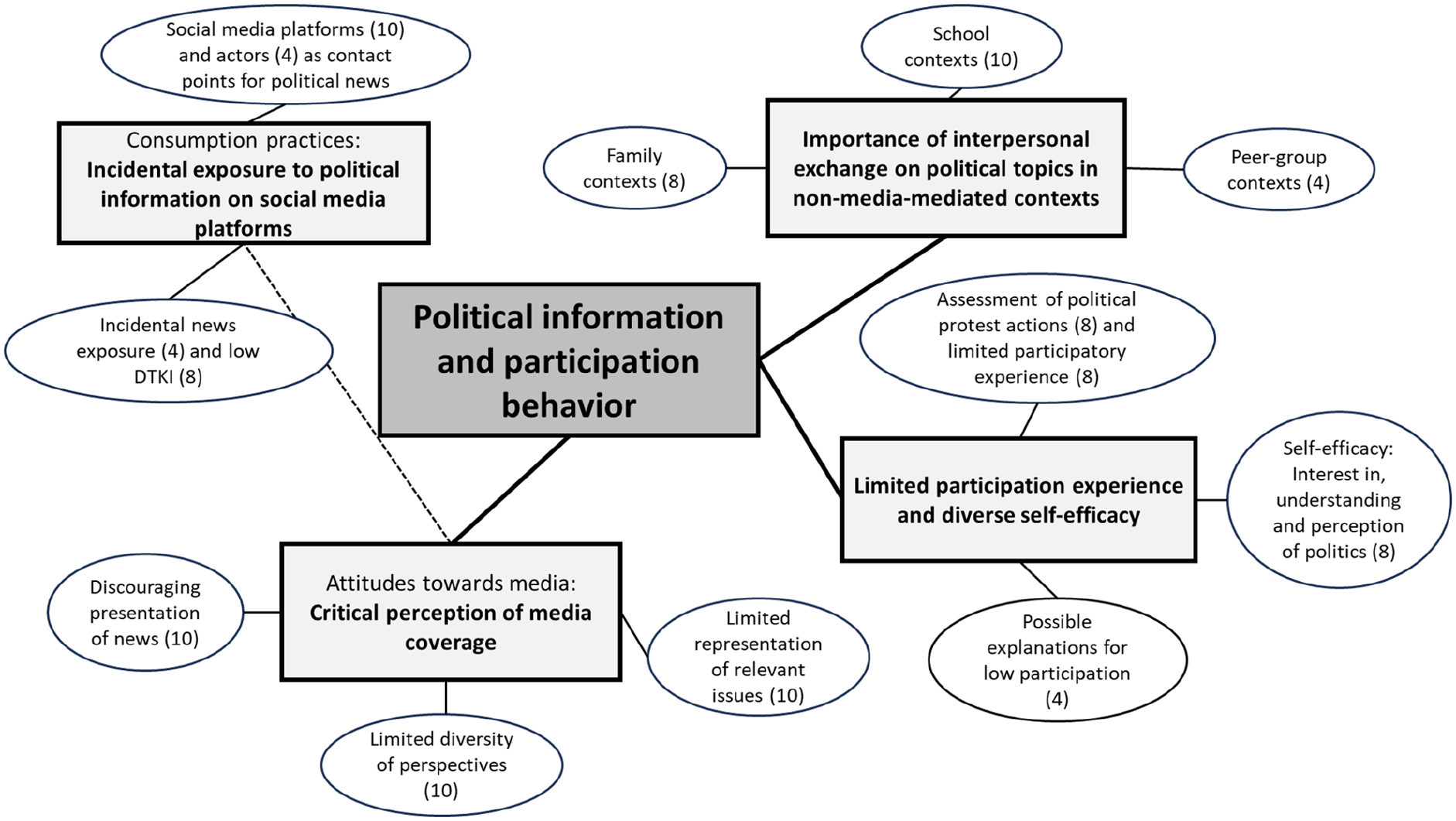
Conceptual map of political information and participation practices (number of groups coded with each basic theme).
Incidental Exposure to Political Information on Social Media Platforms
The first network represents an exploration of participants’ information practices (see Table A1 in Appendix). Across-group, participants get exposed to news information on social media platforms (SMP), mainly TikTok, Instagram, and YouTube. Young adults in the Hamburg, Nuremberg, and Dresden groups said that they “get informed” on these platforms “by chance.” Some even stated: “I watch each year less and less news, because if it is important, it will reach me already somehow” (H_P3_m19y). In contrast, teenagers from the Bottrop groups reported to follow news and politics additionally in local newspapers and news apps. In four focus groups, influencer “Mr. Lawyer,” a German lawyer who has been active on social media since 2016, was mentioned as someone who “gives a lot of information on TikTok.” In one group, participants reported that he replaces established news providers as a trustworthy source of information: “He’s a lawyer. But for me he’s like a news reporter” (H_P4_m15y). Participants appreciate how he provides “really good content” and explains things “really well,” referring to characteristics of social media influencers who serve as digital opinion leaders for young people (Harff & Schmuck, 2024). Participants did not follow his account actively but reported to only saw his content on their For-You-Page (FYP). In two focus groups, participants critically reflected on the role of influencers in connection with political information: “I also always find it difficult to let YouTubers enlighten me about any political topics [. . .]” (D_P3_f18y).
A perceived obligation to inform oneself about political matters is not very pronounced among the respondents from all groups except the two Bottrop groups as a representative statement shows: “I think it’s important to be up to date” (B2_P1_f18y). Participants stated that it is somewhat important to be aware of what is happening. During the conversation, however, it became clear that particularly the young adults (Hamburg, Dresden, and Nuremberg) believe they can indirectly stay informed despite not actively following the news: “I think you’re bound to notice the really big issues, even if you don’t go looking for them” (D_P1_f20y). In these groups, low interest in being informed is also accompanied by a perceived low level of knowledge. Young adults discussed being only superficially informed “about a maximum of 20 percent of what’s happening” (N1_P5_m19y).
Interpersonal Information Sharing and Discussions
The second network (see Table A2 in Appendix) represents an exploration of participants’ configuration of participation practices (RQ 2). It becomes clear that interpersonal discussions in school, peer group, and family contexts are one way in which participants engage with political topics (Klopfenstein Frei et al., 2024). Reading and summarizing news texts is perceived as a burdensome duty by teenagers from three focus groups even though it activates them to actively search for information. For all participants, discussions of political topics in class offer context to express their opinion (Ekström, 2016), as depicted exemplarily in the following:
[. . .] Sometimes it’s about politics, what we talk about in class.
Can you give an example?
Yes, arms deliveries to Ukraine, whether that’s really necessary. [. . .]
So, it [migration] is also often mentioned, and many also express their opinions in class.
(Dresden, FG1, 14–17 years)
In both Nuremberg groups with young adults as well as in the two Bottrop groups, participants appreciated being integrated in peer groups where they can discuss different political topics: “Fortunately, in my circle of friends, there is a lot of discussion about things that are happening, that have an impact” (B2_P2_m18y). In all other groups, participants stated that political issues are not really discussed. Most of them are integrated into social groups and structures in which it is hardly relevant to know about current affairs, as depicted in this extract:
Well, in my circle of friends, we don’t talk about news or anything like that. Like ‘Have you watched the news or anything like that today?’ [. . .]
You don’t actually talk about it, so hardly ever about the websites from which you know it, but rather about the topics. [. . .] Everyone has a completely different opinion about the topics that certain sites tell you about, so to speak.
[. . .]
Yes, that’s not bad either. No. I think it’s good too.
(Hamburg, 18–22 years)
Participants also deal with political or current affairs in different ways in family contexts. The aspect of role attribution should be emphasized here. In eight out of ten focus groups, the interviewees mentioned their father as the main reference person when it comes to political issues or questions, while their mother plays no role in this. For example, a young girl said, “We talk about politics with my father” (B1_P4_f14y) or another participant stated, “I always ask my father’s opinion first” (N1_P2_m19y). Participants trust their father to tell them about the news:
My mum isn’t a fan of the news at all. She thinks it’s all rubbish. She’s also someone who believes in bullshit. So, I wouldn’t trust my mum now, in terms of sources. But I would trust my father because I think he tends to look at reputable websites.
Well, I also realize that my mother is very emotionally attractive. [. . .]
For me, it’s particularly about money. I’m sceptical, always about money.
Yes. And then when I hear something from Dad, I tend to trust him more.
(Bottrop, FG1, 14–17 years)
Limited Participation Experience and Diverse Self-Efficacy
While teenagers from both Bottrop groups expressed an explicit interest in political topics and believe that they understand political processes, participants from six other groups explicitly reported not being interested in politics and do not engage with it themselves. For example, one teenage girl stated that “I feel like I’ve lost touch a bit because I’ve never been so actively involved with it [politics]” (D_P2_f17y) and her discussion partner replied “I’m not familiar with politics in Germany either. And I don’t intend to deal with it either” (D_P4_m18y). Participants in the teenage groups in Hamburg and Nuremberg did not express explicit disinterest but rather disappointment in politics or individual politicians because of the unequal treatment of refugees from different countries: “With Olaf Scholz [German Chancellor] I thought of solidarity. But is solidarity good if it only applies to one country?” (H_P3_17y) and another teenager said: “I just want politicians to be fair” (H_P2_m17y).
Regarding participation experience, discussion about getting involved in politics first evolved around the protest campaigns of climate activists in Germany which was reported in the media during the time of the interviews. It became clear that all participants have little or no experience of participation themselves, only the young adults from the Nuremberg groups participated in a demonstration with the IG Metal [German trade union] recently. In two teenage groups, some referred to non-conventional forms of digital engagement practices (Ohme et al., 2022) such as giving out likes or using emojis on social media to show support for a specific party during the 2023 presidential election in Turkey. The idea of becoming active including the assessment of the importance to perform citizenship rights (Isin, 2017) in general was discussed differently. Teenagers from the Bottrop groups emphasize the benefits for society “it’s always a good thing to get involved, whether it’s for the climate, for politics, for anything” (P2_m18y), while teenagers in the Dresden groups mention personal benefit as a condition for participating themselves “as long as it has a long-term effect that is good for you, then yes” (P2_m16y) and called the effectiveness of political participation into question:
Why wouldn’t you vote?
Somehow, I have the feeling that it wouldn’t really make a difference. Yes.
[. . .]
Well, I agree with your opinion, because I actually think that going to vote doesn’t make much of a difference. If there was something important, well, if someone said something important that would interest me, something like that, then I would go and vote, but otherwise, no, I wouldn’t really.
Or why should older people vote for a party that wants to do something for schools?
(Dresden, FG1, 14–17 years)
There are different reasons to (not) perform citizenships rights such as voting. In the two Dresden groups, a lack of political knowledge and familiarity with the system became apparent when one teenager stated: “I don’t know who to vote for, so I don’t even know if I’ll vote myself or not. I have no idea about politics” (P5_m15y) and in another group a teenager asked, “what is a voting paper?” (P1_f16y). While the participants in the Bottrop groups (2) are aware of how they could potentially become active, “you could demonstrate, you could put up posters” (N_P3_m16y), especially young adults from the Dresden group lack the motivation to perform citizenship rights: “If you just, I don’t know, want to demonstrate, like [P2] says, just to somehow get the politicians’ attention, that’s great. But I just think to myself, no, that’s not something for me” (D_P4_m18y). The participants’ impression of their low ability to influence change through action could also be related to negative experiences or examples of how political engagement did not have an impact:
In my opinion, if the politicians have the attitude ‘I won’t listen to them’, then they won’t listen to me. [. . .]
And in Germany, even if you demonstrate in favor of Afghanistan, for example, it doesn’t achieve much. So, they can say as much as you want, but if not, everyone is actively involved, it won’t work.
Have you or a friend ever taken part in a demonstration for Afghanistan?
Yes, definitely. I have a close friend who is also here at the school. She also took part in it. But what has changed? Nothing.
(Dresden, FG2, 14–17 years)
Another struggle is that teenage participants from three groups tend to have the feeling that they are not heard by politicians. Even one Bottrop-teenager said, “If the government was more interested in listening to young people like that, then we wouldn’t have such a big issue [climate activists] now” (B1_P1_f17y).
Critical Perception of Media Coverage
The discussion about the perception of media coverage evolved in all ten focus groups and is structured by three organizing themes (see Table A3 in Appendix). The first theme reflects how participants feel that traditional media report too much on certain political topics while other more important topics are ignored or even concealed. This was discussed in all 10 groups. Depending on the group, certain aspects were emphasized. In the two Bottrop groups (2), teenagers criticized that the media does not report enough on the voices of and topics for young people, including “love and relationships,” “cyberbullying,” and “problems of young people such as depression.” In the Hamburg, Nuremberg, and Dresden teenage-groups (3), participants stated to miss topics that concern their own origin-related identity, as the following excerpt from a focus group with female teenagers originally from Syria shows:
Yes, for example, [about] Ukraine there is a lot of rumour and so on. For example, in Afghanistan, in Syria. It’s not talked about like that; people don’t talk about it.
It’s not really taken seriously or recognized.
Yes, it’s not taken seriously.
Or made a topic of discussion in the media. [. . .]
(Dresden, FG2, 14–17 years)
In the groups with young adults (3), participants emphasized the aspect that contextual or background information is often missing.
The perception of limited representation of relevant topics often go hand in hand with the sense that one perspective is taken on certain topics in the media and disseminated in a dominant way. This was also discussed cross-group with group distinctions. In all four groups with young adults, participants discussed their perception that “mainstream” perspectives on certain topics are dominant and reported across the media. For example, many participants explained that regarding issues such as presidential election in Turkey or war in Ukraine in the media, “you usually only get one opinion” (D2_P3_f18y) and “only one side is reported” and “explained” (N2_P5_m19y). In the Bottrop groups and the groups with young adults in Hamburg and Nuremberg, discussions evolved around a negative influence on opinion formation processes. Participants talked about the feeling of having the dominant opinion “imposed” (B1_P3_f14y) on them without other points of view being allowed. As a result, these teenagers and young adults turned to alternative sources, primarily on TikTok: “There, you can listen to both sides [. . .] the news only ever explains one side and the other side is always portrayed badly” (N1_P2_m19y). In focus groups with teenagers from migrant backgrounds (3) the perception of limited or unfair representation grouped around crime coverage and the negative portrayal of religion (Islam) in the media. Along these lines, one teenager commented: “For example, if a German attacks someone, you don’t say anything. [. . .] But as soon as it’s a foreigner, it’s something else” (H1_P1_16y).
In all focus groups (10), participants expressed their perception of a discouraging presentation of political news in the media, especially in terms of style and language. The perception that all news is negative, as already identified in existing studies (Tamboer et al., 2022), is also evident among teenage participants in Hamburg and Dresden. In all focus groups except Hamburg, young people criticized the media for exaggeration and sensationalism, only “to get as many clicks as possible” (D_P1_female20y). Moreover, it became clear that “technical terms” in news texts is perceived as too demanding for the young participants. This feeling was especially common among teenagers whose mother tongue is not German. As a result, these difficulties in understanding in some cases lead to information and opinion-forming processes being disrupted, as a teenager explains: “Especially in important news. If you knew what this and that word meant, you could deduce it and form your own opinion” (B1_P3_f14y). Only a smaller number of participants from the Dresden, Hamburg, and Nuremberg groups with young adults expressed distrust toward the media due to suspected dependency from politics. One participant suggested that there are “rules” (D_P3_m18y) as to what can be reported and another one said media are under the “influence of the government” (N1_P2_m19y).
Discussion
This study was set out to investigate how low-educated young people encounter political information (RQ1) and engage with it (RQ2) as well as how their attitudes toward news media and politics shape their behavior (RQ 3). Based on Bennett et al. (2009) paradigms of citizenship, results indicate that participants show characteristics of both types depending on educational background and previous journalistic experience. Relating to Isin’s (2017) conceptualization of “performative citizenship,” possible explanations for participants’ limited self-efficacy were identified.
Judging based on information practices, participants predominantly show characteristics of the AC type that is in line with previous research (Bennett et al., 2009; Shehata et al., 2016). First, most participants encounter political information on social media platforms without intentionally looking for news or wanting to keep up to date. Second, non-journalistic sources are more important for news than established media outlets. For some teenagers (Hamburg, Nuremberg), social media influencers replace journalistic intermediaries and can be a starting point for further engagement, while other participants (Bottrop, Dresden) do not easily trust these network actors for political content. These differences seem to be related to educational background and personal preferences. Accordingly, follow-up studies should consider the relevance that young people ascribe to these actors, especially when it comes to political topics and problematic phenomena such as extremist propaganda or disinformation.
Relating to participation practices, the results indicate differences between the groups with participants showing characteristics of both the DC and AC type. Across groups, young participants’ engagement with political topics takes place at school (Suppers, 2024) while interpersonal information sharing and discussions do not play a role for all participants, but only for those who are embedded in the appropriate social environment (Ekström, 2016). Whether or not participants talk about politics with friends or family has less to do with their educational or migration background, but rather whether they are integrated into an active and interested group of friends. While almost all participants had little or no participation experience, their assessment of the importance and effectiveness to perform citizenship rights in general varied by group with personal benefit being prioritized (Dresden groups) over social benefit (Bottrop groups) what indicates AC qualities. However, teenagers from the two Bottrop groups show characteristics of the DC type in the way that they additionally seek information in established media, showed a clear commitment to keeping up with political events, and rate participation as important for society. These differences could be attributed to the fact that the groups have a higher proportion of participants who are noted as “high” education. Another explanation might be their joint involvement in the youth editorial office of a journalistic research network. Even if the network members are mainly young people from socially disadvantaged backgrounds, they generally have a basic interest in current affairs and a basic motivation to become active. Thus, journalistic educational work can make a big difference, and individual initiatives have the potential to reach and activate young people who could be labeled as less interested and participatory simply due to socio-demographic characteristics.
The identified themes regarding shared attitudes toward media reflect the low relevance of established media outlets and mistrust or reservations about media in general (Woodstock, 2014), which indicate AC qualities. In all groups with young adults, criticism of reporting mainly relates to sensationalism, as well as mistrust and bias regarding certain topics, which leads to a turning away from traditional media. By contrast, the criticism of teenagers is more about the choice and presentation of topics, which goes hand in hand with a lack of representativeness of their own age- and identity-related concerns in both the media and in politics. These attitudes toward media (coverage) overlap strongly with findings of existing research examining the perspectives of disadvantaged groups (Arguedas et al., 2023; Lindell & Sartoretto, 2018; Palmer & Toff, 2020). Moreover, findings reveal that specific attitudes toward media and politics (e.g., lack of representativeness and negative portrayal of religion) are linked to migrant identity; limited self-efficacy on the other hand, is linked to educational backgrounds with those groups who are labeled “low” education being less active. Other research with minoritized youth has identified obstacles to active participation at the individual and institutional level (Council of Europe, 2019; Perkins et al., 2007). Regarding the limited self-efficacy as it was expressed in most groups of this study, possible explanations have been found to be a lack of political knowledge and familiarity with the system, a lack of motivation to get active, and negative experiences or examples of non-effectiveness of political actions.
While mostly young adults expressed an explicit lack of interest in party politics, particularly the reporting on individual politicians, elections, and which laws are being voted on, especially teenagers from migration backgrounds are not disinterested per se, but rather express dissatisfaction with certain political actions and decisions. As shown in previous research on youth political engagement (Street Inthorn & Scott, 2013, p. 118), my findings emphasizes as well that these participants want politicians to care and properly address broader political issues that are of concern to young people. For example, political issues like racism, mental health, and social justice can inspire these teenagers. Here, the decisive factor is personal involvement; these issues have an age- or identity-related relevance for the young people or their peer-group (Schrøder, 2019). Against this background, I would argue that the voices and perspectives of young people from diverse but especially disadvantaged backgrounds need to be reflected more—in theory and practice.
The findings must be viewed critically considering the study’s limitations including the non- generalizability of qualitative data. Care was taken to recruit specific groups of participants according to predefined criteria, which were as homogeneous as possible regarding the characteristics of these criteria (Scholl, 2014). However, the level of formal education is difficult to record, particularly among teenagers, and the information on the parents’ level of education is based on self-reporting and was not provided in some cases.
Nonetheless, the study progresses existing knowledge on attitudes and political engagement practices of youth from minoritized backgrounds, in the context of current debates on young peoples’ political news consumption and participation. Moreover, it provides a starting point for deriving important implications for journalistic and educational initiatives that aim to promote news and democracy literacy.
Footnotes
Appendix
Overview of Thematic Network of Evaluations and Assessments of Media Reporting.

| Global theme | Organizing themes | Basic themes |
|---|---|---|
| Critical perception of media coverage | Limited representation of relevant issues | Issues that are reported too less |
| Issues that are reported too much | ||
| Limited diversity of perspectives | Dominance of certain (“mainstream”) perspectives | |
| Negative portrayal of Islam/religion in the media | ||
| Negative influence on opinion formation processes | ||
| Discouraging presentation of news | Style: Negativity and exaggeration in the news | |
| Language: Difficulties in understanding news texts | ||
| Distrust due to dependence from government |
Acknowledgements
I would like to thank the academic editors and reviewers for helping me develop the article through a combination of challenging criticisms and productive suggestions.
Data Availability Statement
Data sharing not applicable to this article as no datasets were generated or analyzed during the current study.
Declaration of Conflicting Interests
The author(s) declared no potential conflicts of interest with respect to the research, authorship, and/or publication of this article.
Funding
The author(s) disclosed receipt of the following financial support for the research, authorship, and/or publication of this article: This research was supported by the German Press Agency (DPA). An open access publication is partly financed by the Leibniz Institute for Media Research.
