




Abstract
Approaches to youth engagement typically focus on withdrawal from conventional politics and participatory transformation. In this paper, we argue that such approaches fall short in grasping how groups with blended styles of relationship with politics assess their political ownership. This became apparent when, in the context of European elections, the rise of extreme right wing in Europe and intensification of austerity in Portugal, we discussed the circumstances framing youth’s relationship with politics with 40 youngsters outside regular school. Quantitative data from regular-school students on the same topic were used to trigger focus groups and later used by participants to interview their peers. Participants displayed ‘ordinary’ approaches to engagement, attributing an unexpected relevance to vote. Socioeducational disadvantages and self-blaming perspectives were actively contested, and the gap between youth and politics is to be filled by a normative equipment, with the school indicated as a fundamental, structured and unbiased locus of political education.
Introduction
Youth participation is a complex story to tell. However, there is currently a wide agreement that the forms, repertoires and targets of youth political engagement are changing and expanding (Amnå & Ekman, 2014; Barrett & Zani, 2015; Dalton, 2008; Hustinx et al., 2012; Ribeiro et al., 2017). Indeed, creative and non-traditional forms of engagement are on the rise, pointing towards a participatory transformation (Barrett & Zani, 2015; Norris, 2004). However, when compared to older generations, today’s youth are less interested in conventional politics (Pattie et al., 2003), registering historically low levels of voter turnout and engagement in party politics across Europe (International IDEA, 2008). Yet, it can be argued that analysing political engagement requires overcoming both the reductionism of the birth cohort concept and the dichotomous understanding of participation (Harris et al., 2010; Mannheim, [1927]1952). In other words, the vision of youth based on adult standards, modelled on the type of relationship with politics forged by previous youth cohorts, fails to acknowledge young people as full citizens. In its turn, the participatory transformation thesis, while intending to recognize youth’s political agency, may lead to an overemphasis on positive features of new, exuberant participatory styles that risks disregarding the importance of involvement with institutional politics and fails to grasp middle-terms and ordinary approaches to politics.
These problems pose themselves acutely in the changing socio-economic landscape arising from one of the worst economic crises in Europe. Indeed, economic shocks impact democratic support (Armingeon & Guthmann, 2014), making economic and ontological insecurity integral to the ways in which young people act as political subjects. This is particularly clear in countries which, like Portugal, have been most affected by the ‘sovereign debt crisis’. The result is a high-risk cocktail of democratic disaffection and socioeducational inequalities (OECD, 2016; Sousa et al., 2014). The numbers of NEET—40 million across the OECD countries in 2016 (OECD, 2016)—as well as of those enrolled in vocational routes—which have been increasing in Portugal (European Commission/EACEA/Eurydice, 2017)—are part of this context. Importantly, there is evidence that the opportunities for political learning tend to be poorly provided in vocational education, which in Europe is typically undertaken by disadvantaged students (Hoskins et al., 2016), and that youngsters from vocational schools are less likely to engage in politics (van de Werfhorst, 2017). Considering that Portugal is one of the European countries with higher rates of early school leaving (European Commission, 2017), and has had the highest increase in the number of vocational education graduates among OECD countries between 2005 and 2014 (OECD, 2016), bringing the voices and experiences of these socioeducationally disadvantaged youths to the debates on youth and politics is fundamental: not only are they often out of the research radar, but they may also display surprising, blended, profiles of political engagement.
This article explores the perspectives of young people outside the regular school system (school dropouts and vocational education students) on the relationship between youth and politics. This was done through focus group discussions (FGD) based on survey data about civic and political participation of their counterparts from regular schools. The participants in the FGD not only commented on those data, but also used them to interview some of their peers about the same topics—thus assuming a role as co-researchers in this study. The findings will allow us to discuss how youngsters articulate individual resources and structural opportunities regarding their political engagement, their visions about the State and the future of democracy, and how the gap between youth and politics can be addressed. As will be fleshed out, while it would be expectable that socioeducational disadvantage would correspond to positions closer to one of the ends of the participation continuum—characterized by apathy, disaffection and/or radicalization (Williamson, 2014)—the data unveiled instead these young people’s ‘ordinariness’ (Harris et al., 2010) and ‘middleness’ (Sveningsson, 2015), with a surprising emphasis on voting turnout and on the role of structured modes and contexts for political learning.
Youth and Politics: Still a Complex Story to Tell
Research has been pointing to the erosion of political participation and to transformations in youth engagement patterns, reporting shifts towards ‘little p’ politics (Kahne et al., 2013), engaged citizenship (Dalton, 2008) and ‘cause-oriented repertoires’ (Norris, 2004). Likewise, ways of relating to politics and being a citizen are being reconfigured, including ‘standby’ political positions (Amnå & Ekman, 2014). Such research enables discrediting simplistic deficit approaches by recognizing that contemporary youth understand, define and live politics in new and diverse ways. Yet, one must ask whether there are risks in assuming that even those who do not take action ‘stay alert, keep themselves informed about politics and are willing and able to participate if needed’ (Amnå & Ekman, 2014, p. 262). Ultimately, do we risk engaging in a discourse that suggests that it is fine that young people do not vote since they are doing (and being) many other political things? Moreover, by focusing on new, alternative ways of engagement, are we failing to include more nuanced, less exuberant forms of relationship with politics? Indeed, research often provides a picture that focuses on the bright, striking features of new participatory styles, ending up highlighting cosmopolitan, activist and post-materialistic profiles (Sloam & Henn, 2019). As a consequence, those youngsters who are ‘neither apathetic, nor activists’ (Harris et al., 2010), neither ‘troublemakers’ nor ‘achievers’ (Nairn et al., 2006), fail to be properly represented in the debate. By considering ‘the ordinary ways that young people are both disengaged and engaged with politics’ (Harris et al., 2010, p. 28), and having young people talk about this, more continuities than discontinuities may emerge, even if in less spectacular forms (Sveningsson, 2015). Thus, it is necessary to explore the ‘ordinary’ and ‘middle’ grounds of the relationship with politics and democracy undertaken by many young people who, despite being ‘disenchanted with traditional politics … remain interested … and continue to seek recognition from the political system’ (Harris et al., 2010, p. 10). Because these youngsters operate outside both traditional and emerging contexts of political engagement, they are either misleadingly depicted as apathetic (Sveningsson, 2015) or end up by evaporating from the scientific and political radar altogether. Nairn and colleagues (2006) highlight precisely the polarization underlying the political processes that often target either the problematic groups—in need of intervention—or the promising ones—a new generation of leaders. Consequently, those who do not fit the opposite ends of the participation continuum end up by never being included in political initiatives—those are the ‘excluded middle’ (Nairn et al., 2006). Since ‘ordinary’ and ‘middle’ forms of engagement are likely to encompass many groups of young people, there is a vast territory open to exploration (e.g., do their social and educational backgrounds match such political middleness? do they value mostly informal or everyday activities?).
Concerning the opposition between conventional and non-conventional participation, Hustinx and colleagues (2012) put forward the concept of ‘civic omnivore’ to account for the existence of a repertoire characterized by ‘a blended civic taste pattern that blurs traditional distinctions between old/institutionalized and new/individualized forms of participation’ (p. 99). In his turn, Andersson (2017), drawing on the criticisms to the developmental approach to youth political socialization (e.g., Biesta, 2011), and arguing for the recognition of youngsters’ political agency, proposes the contingent approach. This emphasizes that political development often unfolds in nonlinear, unstable and contingent ways and that ‘young people already participate in society as situated agents … implicated in social, economic, cultural and political domains’ (p. 1348). Additionally, even though it is difficult to make clear-cut generational comparisons, the sociopolitical and historical context needs to be accounted for. Mannheim ([1927]1952), a ubiquitous scholarly reference on generation, endowed us with a vision of generation as a historical and multidimensional construct, implying a tripartite definition: generation as location, actuality and unit(s). According to Mannheim, the interpretation of historical conditions and events is always mediated through structures of meanings grounded on space–time locations. Thus, the same historical context does not result in a more or less homogeneous generation; rather, the location in a structural historical commonality (and the socialization conditions associated with it), together with the sharing of a common culture and worldview, may translate into a generation containing diverse (even antagonistic) units. Generation units ‘are characterized by the fact that they do not merely involve a loose participation by a number of individuals in a pattern of events shared by all alike though interpreted … differently, [but] a certain affinity in the way in which all move with and are formed by their common experiences’ (Mannheim [1927] 1952, p. 306). In this perspective, historical discontinuities are important triggers for forming generations.
Both the individual and the structural dimensions need to be summoned when accounting for the resources and opportunities that contingently shape the ways in which young people become political subjects. The importance of political information and knowledge (Dalton, 2008; Pattie et al., 2003), the influence of socio-economic status (e.g., Verba & Nie, 1972) and the emphasis on political learning as a contextual and interactive process (Campbell, 2008; Ferreira et al., 2012) contribute to explaining youth political involvement. These contributions help to account for the multiple contextual elements at stake in political engagement. In this line of thought, the analysis must be broadened to consider the effects of political socialization agents. Despite variations, the family, peers, media, voluntary associations and schools are pointed out as unavoidable elements of political socialization (Quintelier, 2015).
Additionally, a qualitative body of research has been questioning not only whether youngsters are learning about politics, but also how this is happening—without imposing a conception of what politics means (Lister et al., 2003; O’Toole et al., 2003). It has been argued that ‘young people are given very little language with which to conceive of their everyday issues as belonging to the same arena as politics’ (Harris et al., 2010, p. 21). Employing qualitative-based methodologies often enables including the ‘excluded middle’ (Nairn et al., 2006), those ‘ordinary’ young people (Harris et al., 2010) that are not outstandingly engaged nor disengaged and usually talk about themselves mixing typologies of participation (Sveningsson, 2015). Also, considering that opportunities to engage with politics vary across different sociodemographic groups, favouring the highly educated ones, the inclusion of the least-heard voices (Hoskins et al., 2017) may complexify the analysis of the gap between youth and politics.
Sociopolitical Context of the Study
The data collection took place between May and September 2014, before and after the European elections. Although not directly addressed in the study, the European elections and related subjects were brought to the table by the young participants. This was the largest election of the European Parliament that had ever taken place until then (citizens from 28 Member States were called upon to vote, with more than 12,000 candidates from almost 450 parties and lists competing for 751 seats). Also, there were a record number of candidates from Eurosceptic parties featuring high on the polls. Together with the Eurosceptic drift that ensued, the rise of right-wing parties also stood out—with Portugal witnessing the surprising success of MPT, led by Marinho e Pinto, an unorthodox conservative lawyer who campaigned against corruption and conventional political parties. The abstention rate increased compared to the 2009 elections. Only 19% of the Portuguese youngsters aged 18–24 voted in these elections, the lowest figure among all countries; the corresponding European average was 28% (Eurobarometer, 2014).
Moreover, the data were collected during a period in which Portugal was governed by a right-wing coalition with the assistance and supervision of a Troika composed of the International Monetary Fund, the European Central Bank and the European Commission. During this period of intense austerity, which came to an end in October 2015, Portuguese people experienced severe hardship and a general decline in the quality of life, which motivated the organization of public demonstrations of unprecedented dimensions since the 1974 democratic revolution. In this context, we sought to investigate how young people collectively talk about and make sense of political issues and also what needs to be changed (if anything) in relationship between youth and politics.
Methodology
As outlined above, our main research question was: how do educationally disadvantaged youngsters position themselves with regard to the well-known gap between youth and politics in a context of social and political polarization? The literature tells us that vocational-school students and school dropouts tend to be less engaged in politics (van de Werfhorst, 2017) and are, in contexts of contestation, more prone to political radicalization (Williamson, 2014). Therefore, we anticipated that our exploration of how they frame politics and democracy in a context of unprecedented political upheaval would point in the direction of either disengagement or attraction to strong anti-austerity, anti-establishment protests. As will be detailed below, the findings were rather unforeseen. Furthermore, the fact that data relative to regular-school students were presented to the school dropouts and vocational-school students during the FGDs was instrumental to further the analysis, namely by assessing the extent to which the conditions for the youngsters’ development as political subjects are interpreted differently by youngsters living in different ‘locations’, although under the same ‘historical conditions’—to use the Mannheim’s terminology.
FGDs were conducted with youngsters outside the regular school system. This method promotes the discussion of concepts in youngsters’ own terms (e.g., O’Toole et al., 2003), enabling an insight on their understandings of politics, and on how perspectives are negotiated, and framed, by peer dynamics. Simultaneously, this study sought to promote the youngsters’ involvement in the research process itself, both by having them provide feedback on previous research findings and by inviting them to collaborate in collecting data from their peers. To conduct the FGD, a script was drafted to address the youngsters’ perceptions and experiences about civic and political participation, including how politics is part of their daily lives, the main factors hindering and fostering participation, and the social and personal impacts of participation. During the FGD, leaflets with findings from a survey with youngsters from regular schools were distributed to the participants so they could comment on them. These leaflets highlighted results from a survey developed in a previous research phase. In it, 1,107 young students (8th grade, 11th grade, 2nd year of university) from public and private schools, located in urban and rural settings, participated in a study that aimed to unveil levels of and trends in civic and political participation. As detailed below, contrasting results were intentionally portrayed regarding each topic/section in the leaflet (e.g., ‘Democracy’), instigating FGD participants to take a stance by asking them ‘What do you think?’ or ‘What is your opinion about this issue?’. In addition, some participants volunteered to informally interview their friends, asking for feedback on the findings in the leaflets. About two weeks after each FGD, the researcher met again with the group to collect the leaflets some youngsters had taken with them and filled in with their friends’ comments. The content of the leaflets, and the subsequent discussion they triggered, will be presented in the results’ section.
Focus Group Participants
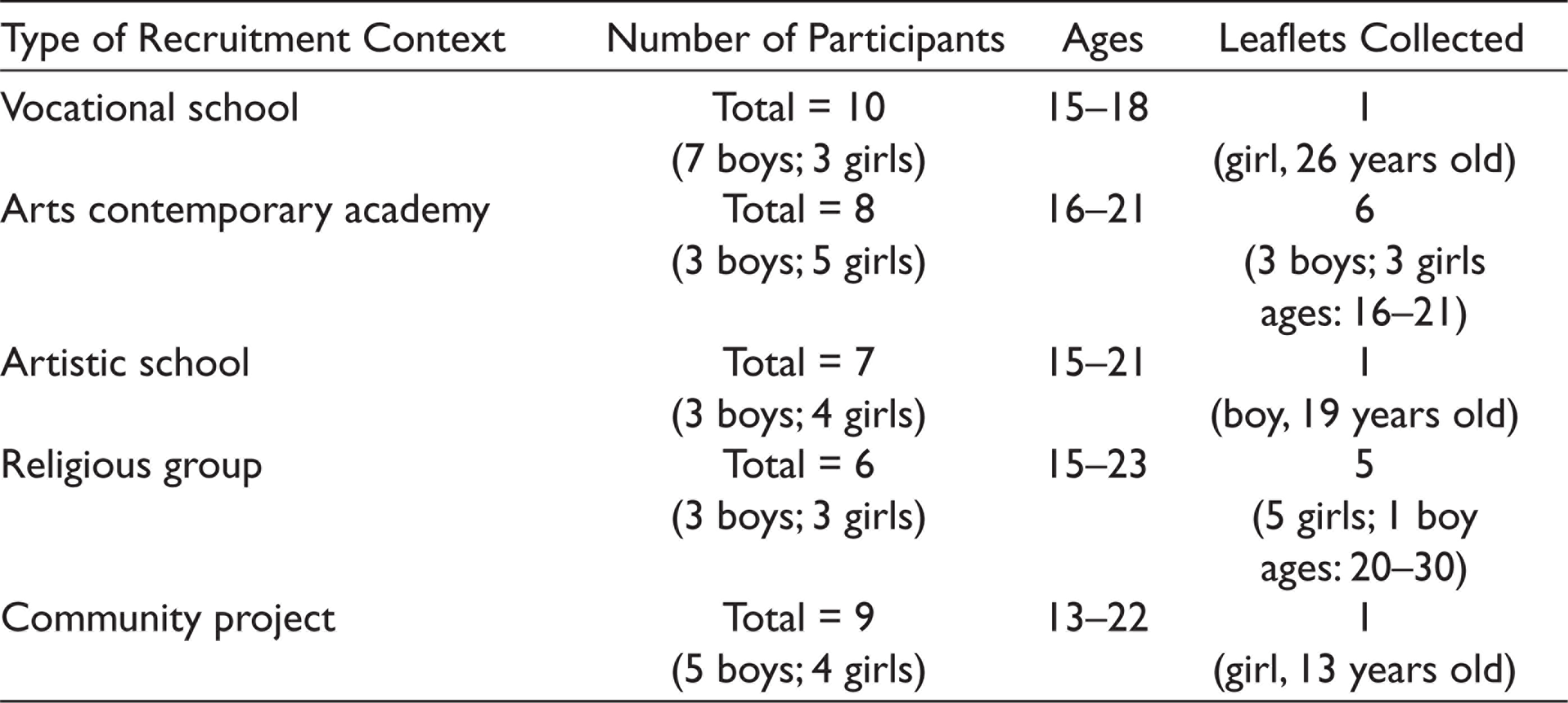
A total of 40 youngsters (60% female), aged between 15 and 23, participated in five FGDs. We engaged with young people from vocational schools, religious groups and community projects from the metropolitan area of Porto, from the urban centre, peripheries and rural areas. Participants were recruited based on their withdrawal from the regular school system: all either were in alternative educational pathways or had dropped out from school (temporarily or for good). Table 1 presents the sample composition.
Sample Composition of FGD (Context, Gender and Age) and Leaflets Collected
Analytical Procedures
All FGDs were recorded, transcribed and then analysed with NVivo 11. Some previously defined content categories were used in this process, while others were transformed and new ones emerged. This article focuses on:
The participants’ perspectives about the kinds of resources and conditions for participation; Their views on the political system, democracy and the relationship between youth and politics.
The youngsters’ participation in this research was voluntary and all information about the research procedure was presented beforehand, so they could decide about their participation. Informed consents were signed by both participants and, when necessary, their parents/legal tutors. In order to protect the anonymity of participants, all names are fictional.
Findings
The Crossroad of Factors at Stake in Political Engagement
One section of the leaflet was dedicated to ‘Youth participation experiences’. It showed a bar chart with results on ‘The forms and levels of civic and political participation of young people’. This came from a set of items used in the questionnaire—corresponding to an adaptation of the Political Action Scale (Lyons, 2008)—in which respondents were asked the following: ‘Have you done any of the following in the past 12 months?’ The items were rated in a 5-point Likert-type scale, from 1 (never) to 5 (very often): ‘to attend a public meeting or demonstration dealing with social or political issues’ (M = 1.55); ‘do volunteer work’ (M = 2.55); ‘wear a bracelet, sign or other symbol to show support to a political or social cause’ (M = 2.18); ‘boycott or buy certain products for political, ethical, or environmental reasons’ (M = 2.32); ‘to participate in political actions that might be considered illegal’ (M = 1.30); ‘to link news, music or videos with a social or political content to my contacts’ (M = 1.70); ‘Sign a petition’ (M = 1.90); ‘vote in elections’ (M= 1.81). The participants in the FGD immediately related with these results of their regular-school counterparts, namely their low levels of civic and political participation and the apparent drift towards non-conventional forms of participation. In this regard, João, from the arts school, highlights that young people get involved when issues are close to them, suggesting that political partisanship is too distant to deal with issues that have immediate relevance:
I think that youngsters today want another way of doing politics, not the politics related to political parties; I think that each person acts according to what affects him/her directly. For example, we organised a demonstration at the beginning of the year because we had been without subsidies for three or four months … You see, we did it because it was really affecting us.
Jaime, also from the arts school, considers he and his friends are more interested in political matters than the majority of youngsters because, unlike what happens in other schools, they often struggle with difficulties in their daily school life, and this triggers their engagement and provides them with more tools as well. He says that:
Public school students don’t have so much interest as we have, because we are related to the arts. By being directly related to the arts, we have more ways to express ourselves and we are much more affected… because public schools have all the necessary means, and here we sometimes lack material because there is no money.
This opinion echoed an FGD in a vocational school, when Manuel and Rodrigo discussed the link between participation (namely taking part in protests) and socio-economic status:
Manuel—Only those who feel problems go to protests. Poor people. Rodrigo—But there are people who have money, who live well, but do understand what others feel and support them in their cause. Manuel—Well, they understand but I’m not sure if they support them. Rodrigo—I know people who support. They have a lot of money and there they are always active, with their friends. And although [a certain cause] doesn’t mean anything to them directly, since they don’t face difficulties, they feel for what others are going through.
According to Manuel’s experiences in different schools, having money or not entails a given ‘mentality’, and he differentiates those who feel they do not have to make any effort and those who know they have to keep trying to bring about change. For him, participation is all about changing the status quo, which does not fit with a ‘rich person’s mentality’.
Despite having unanimously diagnosed a generalized withdrawal from formal political participation, the participants regard the information available and the way it shapes political literacy crucial to understand and foster youth political participation. Henrique, recently turned 18, repeatedly stressed his interest in political issues. Although he was not 18 at the time of the European elections, he considers voting and being attentive to politics quite important, however challenging it might be.
Henrique—I think today it is very important that we have a choice. But in the midst of so many parties and so much politics and so many possibilities… I think it is necessary to know what to choose. I’m not so much into those things…I don’t have to vote yet, but I will soon…
Researcher—And you think it is important…?
Henrique—I think it is really important! Of course, I read some things. because I’m interested in politics. I think that being interested in politics is to be interested in my country, in my community, in my society.
However, sometimes it is not a matter of interest, but rather a matter of lack of appropriate information. They pointed out some obstacles to youngsters’ active engagement, namely the lack of accessible, well-explained and less-sensationalist information. From their viewpoint, these are factors that turn youngsters away from conventional politics.
Rafaela—I never liked politics. But I’m forced to pay attention; I mean, but I need to know so I can vote. Only the best-known political parties appear on TV. When I saw that parties’ list [referring to the European elections].… I had never heard about many of them!
Ricardo—And there are some expressions they [politicians and political journalists] use that we don’t know what they are talking about. …
João—I think that disinterest is growing because we turn on the TV and we start watch-ing a debate with four gentlemen from four different parties, and I see it for 10 minutes and realise that I don’t understand what they are saying, what kind of issues they are addressing. …
The young participants are quite critical of the tone and the content of the political issues covered. Misinformation (and inadequate information) contributes to the lack of interest and motivation to pay attention to political information. Neither the media nor the politicians are portrayed in a good light, as according to participants they do not seem to be concerned with reaching people. This has consequences for youngsters like Beatriz, from a vocational school, who, while stating that watching the news is boring, feels that she should be more interested. However, she believes that political concerns will eventually flourish later in life—a vision of political engagement that sparked criticism from other participants.
Beatriz—I watch television during dinner, at my grandparents’, and sometimes I get tired of it because it is politics all the time. Someday in the future I will be concerned about it.
Manuel—Beatriz, you are already 18 years old!
Because—But when I’m older…
Manuel—When you start getting interested you’ll be very old, then.
Carlos—I think that all of this has to do with each person’s interests. I mean, it all comes from each person’s aspirations and plans for the future ….
The age talk also emerged in other FGDs. Age is presented as a kind of boundary that justifies being more or less interested in politics (the corollary of having a job and being independent), exception made to those youngsters who, while still young, have ‘aspirations and plans about the future’. The references to the developmental nature of political engagement that accompanies the adult-centric idea that youngsters are uninterested in politics are internalized, but mainly disputed by these youngsters.
Cátia—In general, youngsters are quite undervalued about what they think. For instance, at home, what I think doesn’t matter. And this ends up constraining every time we want to express our opinions… it is like ‘young people talking… what do they know? They know nothing about life‟. And even if I do not know anything about life, that may also influence the way I think and, perhaps, in a good way. Maybe because of that I have more innovative ideas. Who knows? I think that this is the age to discover things and start constructing our own positions, and we should not be undervalued.
Fabiana, from the community project group, also said that youngsters are not heard, sometimes neither at school, by their teachers, nor at home, by their parents.
Still in the leaflet’s section on ‘Youth participation experiences’, the following statement was presented: ‘The lack of time and interest, but also the lack of opportunities, are the major obstacles influencing the youth experiences of participation’. This was illustrated by a pie graph displaying the percentage of young respondents identifying the obstacles they consider most relevant in their experiences. In the survey, this question (‘Which factors influence your involvement the most?’) was based on the dimensions identified in the literature regarding the resources and opportunities to participate (Pattie et al., 2003; Verba & Nie, 1972), including the following options: ‘lack of time’ (75.8%), ‘lack of money’ (16.2%), ‘lack of interest’ (29.8%), ‘insufficient educational level’ (4.3%), ‘lack of knowledge about institutions and organisations’ (29.1%), ‘difficulties created by friends and relatives’ (6.7%), ‘lack of opportunities in the place where you live’ (31.3%).
The participants in the FGD found it odd that lack of time was the most indicated reason. This understanding was shared by the friends they interviewed, who considered lack of time ‘a bit of a lame excuse’ (male, 18 years old, arts group), probably masking other reasons. As highlighted by a 20-year-old girl, interviewed by a participant recruited from a religious group, ‘increasingly fewer young people play an active role in political and civic realms, and although claiming lack of time, I think that demotivation, carelessness and lack of responsibility are the main reasons behind that’. Along with a recognition that the lack of opportunities may trigger youngsters’ motivation to participate, there is the discourse of irresponsibility as a sort of inherent feature of youth. Still, participants from the religious group unanimously agreed that the lack of opportunities in the place where they live (rural village) and the lack of knowledge are the most important obstacles to participation:
Casimiro—I would say lack of opportunities at the place I live in and lack of knowledge of institutions and organisations. Because sometimes one doesn’t participate because one doesn’t know…I mean, he/she may even know it exists but doesn’t know what is it.
Views on Democracy and Requests for Political Education
The leaflet’s section on ‘Democracy’ included two statements: ‘Some youngsters question the democratic system in which we live, pointing out some flaws and fragilities’, ‘However, most of them consider that, compared with any other system, democracy is still the best Government system for Portugal’. The first statement was followed by four excerpts from the open-ended question of the questionnaire, in which respondents commented two images portraying the recent anti-austerity demonstrations: ‘What strikes me most is that sometimes people don’t even have free speech, which makes me wonder ‘what kind of democracy is this?’ (8th-grade student)’; ‘Democracy means that power belongs to the people, but if power is knowledge, then we don’t have power (university student)’; ‘The future will entail the people’s political education, so that people are not fooled by empty words and pretty faces, only this way people will be able to vote, enlightened (11th-grade student)’. The second statement was based on the results of the questionnaire’s scale ‘trust in the form of government’ (α = 0.81), concerning the respondents’ levels of democratic support.
Regarding this section, participants discussed democracy in relation to the European framework and the national corruption problem:
Osvaldo—At this moment, the democratic system in Portugal is corrupted. We do not have a democracy working as it should be. In fact, it is not only in Portugal, it is at the European level as well… For example, the European Community is not democratic. What we see is … [that] Portugal has to be a servant of the others that have the money…. We fight and they [politicians] do whatever they want to do… they use public money for private business and this is quite revolting. … we don’t believe in politics and we don’t believe in the political system because it is vitiated. I admire the political system of the Nordic countries because they are a kind of people that is aware that a society is made of and supported by everyone.
Regarding the interviews that the participants conducted with their peers, oddly enough, this was the leaflet’s section in which more interviewees either refrained from commenting or provided answers like: ‘I do not have abilities and/or knowledge to give any sort of opinion about this matter’ (18-year-old boy, interview from the arts group). Yet, others provided interesting views on the topic. For instance, a 19-year-old girl interviewed in a rural village displayed a critical view of democracy, while underlining the need for including youngsters in the country’s governance:
Portuguese democracy needs to be renewed. Democracy needs young players, with new ideas and principles to govern the country. But these young people need to be motivated for it, which does not currently happen. Besides, it would be necessary that politicians really count people’s opinions in.
Another interviewee pointed out the limits of a representative model:
I believe that democracy exists, but the concept is a bit ambiguous. We choose a party that will ‘lead us’ and then we wait. In my opinion, that is not very democratic. In other words, conditions should be created for the population to intervene more.
Participants in the FGD also showed concern with the results of the European elections, namely with the rise of the extreme right wing in Europe:
Maria—This is scary… Henrique—History is repeating itself. In Greece, in classical antiquity, there was democracy and then came imperialism… it seems like big falls have to precede big advances… but I don’t know what will be the result. Even here, with Marinho e Pinto… extreme positions are definitely gaining ground.
Filipe said that the ‘Government cares about numbers, not people’, adding that politicians ‘are turning democracy into a liberal dictatorship’. Participants tend to consider that politicians do not take people, particularly young people, into account. Young people indicate willingness to get closer to politicians in order to improve the relationship between youngsters and politics. In the vocational school, they stress the need to bring politicians to schools:
Clemente—Politicians do not take the initiative of… for instance, ‘let’s go to that school and hear these students in a session/lecture‟. If politicians cared about us, if we really mattered to them, they would take what we think into more consideration. If these kinds of sessions took place on a regular basis … everybody would win. Rafael—Yes, to organise lectures with politicians, them and us, talking, explaining things. Politicians should go to schools, face up, talk, explain things to us. Maria—They also have to listen to us. Rafael—To listen to what we have to say. Ask us ‘what you all think is wrong?’, and listen. Even if it took the whole day.
Similarly, Rodrigo and Manuel argued that, in some cases, youngsters are interested in participating in politics but there is no trigger to actually accomplish that, particularly a space in which they could discuss political issues.
Rodrigo—There are youngsters to whom these themes matter but there is no one to take them to the next level…
Manuel—What lacks is what is happening now.
Researcher—What is happening now?
Manuel—This. What we are doing now.
Rodrigo—This kind of debates.
An intentional educational arena to promote political education is a transversal request these youngsters make. They identify the school as the most appropriate context both to convey information about political issues and to practice political skills.
João—I think that in school we could debate each one’s ideas among ourselves. That would be a good way to know what everyone thinks and start understanding basic political issues.
Lara—When some youngster hears political talk, at home for instance, he/she will want to run away because it seems like a very specific thing for a restricted number of people…
Ricardo—Even in the newspapers, when I read the political news, they give us very specific information. I often feel that news are meant to be read by someone who already understands them, who is familiarized with an entire political and partisan conceptual framework…
Maria—And then young people see politics as a negative thing… well, most of them.
Osvaldo, from a rural village, repeatedly pointed to the 11th-grade boy’s quote in the leaflet (‘the future will rely on political education’), stressing its importance, along with the need to simplify politics:
If a politician talks, perhaps most people here will only understand half of it, because the words are too complicated, and only those who go to University will have the knowledge to get it.
As suggested, the political world is not youth-friendly, because both the ballot paper presents a number of political parties about which there is not enough information, and the political information at the youngsters’ disposal is too confusing. In this vein, João is not alone in considering that the leaflet’s item that should have scored higher on the obstacles to participation was the educational level, judged in terms of political education.
João—There should be someone who could explain these sorts of things to us.
Cátia—Lack of information, that is the main problem.
João—The ballot paper had thirty-five parties in it and we should know what is claimed by each one, so we can start defining what we want.
Cátia—First of all, I think people should be taught at school about politics.
Henrique—That is right! That is the first issue.
Cátia—Much more about politics. For example, I would like that someone taught me at school, impartially… because it is impossible to talk about this with my parents… They are always saying that some John Doe is lazy and some other John Doe is a fascist, and so on. So, I would like to have someone impartial who could explain to us, like ‘look, you have this and that party… this emerged in the French Revolution, etc. etc.’
Henrique—And I really would like to have some education about political parties. Even if I research on the internet, it is not easy, the websites are all like ‘vote, vote, vote’, ‘we will do this and that’, but nothing is clear. Plus, I would say that we should foster and motivate the critical spirit, like ‘why is this?’, ‘why we do keep on like this?’.
The lack of proper information and of opportunities to learn politics is confirmed by all participants, alongside statements about the biased role of the family as a political socialization agent. For instance, Carlos said that the family can actually be a bad influence regarding vote, as the parents’ political preferences often lead youngsters to vote ‘just following the family’s political colour’. Therefore, the school emerges as an educational institution supposedly able to teach about politics.
João—There should be a subject about politics at school. For example, my sister just turned 18 and she can’t even tell the difference between the left and the right. I think it is essential to start instilling all this in schools… teach what is the left and what is the right, what is the political centre, what this and that political party do…
Henrique—I totally agree!
Discussion
Having young people talk about the relationship between youth and politics, based on previous empirical results, has led to a two-fold contribution to this field. First, the study’s methodological design provided young people with a relevant opportunity to realize how research in this area looks like (e.g., how it can be undertaken, what kind of findings can be drawn from it). Indeed, young people, as research participants, are frequently clueless about what is being said about them in the scientific world—a situation that tends to be acuter regarding groups not involved in regular educational trajectories and, thus, presumably further apart from scientific circuits. Second, analysing how participants collectively made sense of quantitative data drawn from a sample with another educational profile contributed to an ampler, more complex, analysis of the relationship between youth and politics, both by expanding the understanding of it and by making room for opposing standpoints.
The results show the diversity of positions concerning the relationship between youth and politics, enabling a better understanding of the dimensions at stake when discussing the conditions of politicization and engagement of young people. The first dimension relates to the combination of a (routinely) pragmatic and a (transversal) parliamentary approach to participation. If a given issue makes sense and concerns them directly, youngsters will engage—either participating in a school-related protest or voting in the European elections. This is reported in other studies (e.g., Eliasoph, 1998; Henn et al., 2002) but, in this case, the reasons for not participating do not seem to rest on a consideration of politics as something that does not affect their lives (Henn et al., 2002). Instead, political disengagement seems to be related with the opacity of the mechanics of parliamentary and party politics, as well as of the channels linking local, daily forms of engagement with the broader policy sphere. It becomes clear that a great deal of attention and importance is paid to political issues and forms of participation as diverse as protesting and voting, with the latter recurrently brought to the fore—even when talking about the role of socializing agents. This is something worth highlighting, namely because these youngsters are either dropouts or vocational-school students. Thus, we could expect either a disengaged approach to politics or an attraction to radicalized, anti-institutional approaches; certainly not an emphasis on voting and parliamentary politics. Such appraisal is based on the literature in this field, but also on the particular sociopolitical context of the data collection: the wide anti-austerity, youth-led, protests in Portugal and the rise of right-wing movements across Europe. The young participants show themselves quite engaged, but in different ways: mobilizing (locally) if something is close to them, and valuing opportunities for decision-making and monitoring of parliamentary and institutional politics (nation and European-wide). Indeed, they ‘are not oriented towards spectacular antistate activism …, but take the form of informal and everyday activities’ (Harris et al., 2010, p. 10). Consequently, our findings, related to a non-so-ordinary group of young people, push our analysis to the exploration of the ‘ordinariness’ in political engagement introduced by Harris and colleagues (2010). Like in Harris’s study, these young participants also represent the ‘shift away from formal politics … expressing a desire to be recognised by and meaningfully participate in more conventional sites where formal political change is effected’ (p. 10). Yet, additional nuances ensue. While the youngsters believe that their routine participatory efforts should be directed towards local and immediately relevant issues—discarding, for instance, involvement in political parties—they display an unusual political interest (considering themselves more interested in politics than the majority of youngsters) and actively contest the adult-centric idea of political engagement, strongly criticizing their peers’ internalization of such narrative. It seems that these youngsters do not quite fit in neither pole of political engagement (the traditional nor the new alternative), but rather exhibit mixed repertoires (Hustinx et al., 2012; Sveningsson, 2015), granting an unanticipated relevance to institutional politics.
The conditions for be(com)ing political subjects, then, encompass individual and structural dimensions. However, unlike the tendency displayed by their regular-school counterparts, the participants in the FGD consider that the main shortcoming in terms of individual resources relates to political information, which they believe to be rooted in a crossroad of contextual factors. According to them, the desired proximity with institutional politics implies more information, clearly conveyed, in a language and style they can understand, and a parallel increase in the information about contexts and modes of participation in order to democratize access to politics. The fact that they feel they are not politically equipped to participate in institutional politics excludes them from effective participation in the democratic process. This takes us to the second dimension, related to the resources and contexts identified as important in the politicization process.
We agree that it is fundamental to problematize normative perspectives of citizenship and ‘to contest a vision of “informed,” “active” and “responsible” citizens—through which legislators probably imply that ‘you can be active citizens, as long as you do it the right way”’ (Menezes, 2017, p. 19). At the same time, our results show the emphasis youngsters attribute to knowledge and information as conditions to play the political game, and to recognize themselves as political beings. This very fact indicates a predominance of a conception of citizenship and politics that ultimately ‘disempowers those whose knowledge and competencies are not recognized as good enough’ (Menezes, 2017, p. 19). Still, our results suggest that while the game does not change, the young spectators demand equipment to level them up with the main players. In other words, the relevance of information and knowledge, coupled with awareness, emphasized by some models of youth dis/engagement (Pattie et al., 2003) and the related ability to make sense of abstract concepts and ideas of politics, continue to be relevant dimensions for how young people assess the conditions to be politically effective subjects. In their turn, the role of socio-economic resources is at odds with the classic literature on the link between economic and political inequalities (e.g., Verba & Nie, 1972). Considering that the profile of the participants in this study—either enrolled in vocational education or having dropped out from school—tends to correspond to social disadvantage (OECD, 2016), political disengagement (Hoskins et al., 2017) and democratic disaffection (Armingeon & Guthmann, 2014), it is interesting to realize that this is not felt as drawback.
Great hopes are put in the school as a potentially ‘neutral’ ground in which young people might learn politics, away from diversion manoeuvres (associated with the mass media) and political stances that sound mostly like ‘partisan tribalism’ (related to the family). These results go in line with the study of Kudrnáč and Lyons (2018), particularly on the impact of having opportunities for political discussions on internal political efficacy. However, unlike this and other studies (Kudrnáč & Lyons, 2018; Quintelier, 2015), our results indicate that the family is not perceived as a context of political learning, both because the youngsters feel they have no legitimacy to participate in political discussions within the family and because they regard their parents’ political discussions as not having what it takes to promote political learning: openness to plural political standpoints. Research has been providing evidence about the importance of contextual condiments that lead to individuals’ political development, including an environment in which confrontation with different points of view is not only supported but stimulated (Ferreira et al., 2012). It is interesting that participants’ idea of politicization is so strongly anchored on the inevitably relational nature of politics—for example, when they assess political discussions in family moments—and, therefore, the realm of plurality (Mouffe, 1996). The two relevant sources of influence (family and media) are actually not performing in a pedagogical fashion. Consequently, the message youngsters are getting is that the political world is an adult world, with an adult language and clouded by an adult bias. The school’s role is called on, not only as context for providing needed political equipment (which is not limited to political knowledge), but also for creating conditions for political discussion (including being a platform for direct links with policy-makers, who ‘should go to schools, face up, talk, explain things’, according to one of the youngsters).
By exploring the perspectives of educationally disadvantaged youngsters, we found them close to the ‘ordinary’ (Harris et al., 2010) and ‘excluded middle’ (Sveningsson, 2015) approaches to politics; that is, youngsters who are ‘neither apathetic, nor activists’ (Harris et al., 2010, p. 27), displaying a great deal of interest and attention to politics, attributing an unexpected relevance to institutional politics, namely voting, and an unforeseen emphasis on school, even if not enrolled in the regular school system. These findings came across as somewhat surprising, highlighting the need for contextual analyses that reject sociological and psychological determinisms, and polarizing, simplistic representations of young people. Contesting self-blaming and internalized adult-centric perspectives, the young participants demand instead for structural conditions for participation, displaying empowered stances about their somewhat deprived situation, particularly when compared with their regular-school counterparts (be it lack of money or less resources in their school); actually, such disadvantage is mentioned as a powerful drive for political mobilization. These findings seem to suggest that lack of structure, in terms both of individual context (outside regular school pathways) and of macro context (socio-economic and political uncertainty), may lead the youngsters towards (the longing for) a more structured approach to politics in terms of practices and learning. This needs to be framed in the historical context at the time of the research. The proximity of electoral periods may assist in explaining this (with Portugal’s relationship with Europe being played in the institutional arena), as well as the austerity Portugal was going through, with many demonstrations taking the streets (in the aftermath of the global financial crisis). Mannheim’s ([1927]1952) debate on generation, and the complex relationship between worldviews and historical locations, can help us make sense of our findings. In particular, his consideration of the ‘generational units’ sheds light on how, under specific conditions of living, certain generation-units display different political reactions to the same historical events. The fact that the young participants in this study elaborate differently the same generational location—when compared either with their regular-school counterparts or the young anti-austerity activists on the streets—calls attention to how generational location is shaped by political-economic change and educational pathways, giving rise to different visions and meanings assigned to time and space by a ‘unit’ sharing common experiences and challenges (Mannheim’s ([1927]1952). Based on this, the youngsters express the kinds of political subjects they aspire to, and reimagine school, family, politics, democracy, putting forward concrete suggestions in order to close the gap between youth and politics.
All in all, this study adds to the literature on youth politicization and engagement by bringing to the fore young people’s own assessment of the individual, social and economic conditions underlying it, and the voices of groups who manage to challenge ill-advised labels of political disengagement and disempowerment. The young participants in this research certainly are not ‘young cosmopolitans’—highly educated and middle-class youngsters, characterized by a leftward postmaterialist drift. However, they do not represent their direct opposition either—disadvantaged and disengaged youth attracted to nationalist movements (Sloam & Henn, 2019). In a sense, as aforementioned, the participants in this research correspond to young people ‘“in the middle” of debates about youth participation’ (Harris et al., 2010, p. 27). Yet, the many facets shaping the relationship between youth and politics highlight the risk that may be irreparably sharpened due to the mismatch between anachronistic traditional politics and the youth’s changing political imaginary.
Footnotes
Declaration of Conflicting Interests
The authors declared no potential conflicts of interest with respect to the research, authorship and/or publication of this article.
Funding
This research was supported by the Portuguese Foundation of Science and Technology (FCT) (through the first author's PhD grant with the following reference: SFRH/BD/92113/2012).