




Abstract
To effectively prevent and address self-harm behavior (SHB), it is crucial to understand the relational and social contexts of young people (YP) who engage in SHB, as well as the meanings they ascribe to their behavior. The aim of study is to gain a deeper understanding of the processes SHB among YP in disadvantaged neighborhoods in Turkey. The research examines the factors that contribute to SHB and how YP interpret this behavior. In-depth interviews were conducted with 20 YP, aged 14 to 24, who demonstrated moderate SHB that did not lead to mutilation. Through the application of Embodied Grounded Theory, findings were organized into 11 sub-categories and 4 main categories and presents a model proposal for understanding the SHB journeys of these YP. The findings highlight the significance of the meanings attached to SHB in its onset and persistence, besides the influence of social and relational contexts on these meanings.
Introduction
Self-harm behavior (SHB) is a major public health concern that typically begins during adolescence and tends to escalate over time (Haregu et al., 2023; Muehlenkamp et al., 2012; Voss et al., 2020). As these behaviors recur among young people (YP), their severity may increase (Andrews et al., 2013; Hawton et al., 2012). In Turkey, the prevalence of SHB has been reported to range from 31.3% to 57% (Lüleci, 2007; Oktan, 2014; Somer et al., 2015). This wide variation is likely influenced by factors such as the fear of stigma and a lack of consensus on the definition of SHB (Hicks & Hinck, 2008; Ögel & Aksoy, 2006; Suyemoto, 1998).
Although SHB is prevalent among YP, the underlying reasons for engaging in this behavior, its personal significance, and its persistence are still not fully understood. The causes of SHB are complex and influenced by various factors, including time, space, and social context (Edmondson et al., 2016; Wadman et al., 2017). While research has sought to address this complexity by focusing on the risk factors and functions of SHB, the literature highlights that the exact causes remain elusive (Fox et al., 2019; Hooley & St. Germain, 2014).
Most empirical studies have primarily focused on childhood experiences, including dysfunctional family backgrounds (Michelson & Bhugra, 2012), abuse (Hoyos et al., 2019), childhood trauma (van Schie et al., 2024), domestic violence, and insecure attachment (Liu et al., 2018). Additionally, peer-related factors such as bullying (Monto et al., 2018) and social exclusion (Gandhi et al., 2016) have been identified as significant risk factors. Less frequently studied, but still relevant, are factors like living in low socioeconomic or rural areas (Ayton et al., 2003; Li et al., 2019) and having divorced parents, which have also been associated with an elevated risk of SHB (Shek & Yu, 2012).
Since the early work on SHB various theories have been put forward to explain its functions (Nock & Prinstein, 2004; Suyemoto, 1998). Research suggests that SHB serves a range of purposes, including managing distress, influencing interpersonal dynamics, self-punishment, and even suicide prevention (Edmondson et al., 2016). These functions are typically divided into two categories: intrapersonal and interpersonal, though these categories often overlap (Taylor et al., 2019).
The variation in the prevalence, risk factors, and functions of SHB across cultures highlights the importance of conducting more inclusive research that examines YP’s experiences in their specific contexts (Gholamrezaei et al., 2015; Stänicke et al., 2018). In the literature, SHB risk factors and functions are often studied separately. For example, a study with YP aged 16 to 25 who engage in SHB used reflexive thematic analysis to explore both SHB functions and the necessary care services. The themes identified included “managing emotional states,” “self-punishment,” “coping with mental illness and trauma,” and “positive thoughts and protection.” The study emphasized the need for self-help oriented and personalized support for these individuals (Mughal et al., 2023). This suggests that analyzing risks and functions together, in a context-sensitive way, can provide a deeper understanding of SHB and lead to more individualized care. Additionally, the lack of research on SHB in non-Western societies hinders intercultural understanding and complicates effective prevention strategies (Tuna & Gençöz, 2024).
The aim of this study is to gain an in-depth understanding of the processes associated with SHB among YP living in disadvantaged neighborhoods in Turkey. Specifically, the study examines the factors that facilitate SHB and how YP make sense of this behavior. This research views SHB as a behavior emerging from social and relational contexts, rather than simply as a symptom of mental illness, aligning with Hicks and Hinck’s (2008) definition. In this view, SHB is the intentional infliction of harm aimed at converting emotional pain into physical pain, excluding culturally accepted practices such as tattooing or cosmetic surgery. In line with this definition, in-depth interviews were conducted with YP aged 14 to 24 who engaged in moderate SHB that did not result in severe physical harm, providing a deeper exploration of how they navigate and interpret their experiences.
Method
In this study, the experiences of self-harm among Turkish YP were explored, with a focus on a phenomenon that is largely expressed through the body. Given the embodied nature of self-harm, Rennie’s (2000) Embodied Grounded Theory framework was chosen as the most appropriate approach. This approach combines hermeneutics (the interpretation of meaning) and pragmatism (clarifying ideas and determining the meaning of concepts), enabling researchers to interpret participants’ lived experiences within their specific contexts while accounting for both psychological and contextual dimensions.
Rennie’s (2000) framework, building on Corbin and Strauss’ (1990) Systematic Grounded Theory, provides a more reflexive and iterative process. It incorporates interpretative engagement with the data and continuous re-examination, allowing the nuanced lived and embodied experiences of participants to surface. This framework enabled researchers to embody the voices of participants, ensuring their lived experiences were authentically captured, especially given the physical manifestations of self-harm (Pekasıl & Erşahin, 2019). Unlike traditional grounded theory, Rennie’s approach moves beyond present coding frameworks, encouraging researchers to interpret data in context, enhancing the depth and richness of the analysis. By capturing the depth of participants’ narratives and acknowledging their physical expressions of distress, the researchers developed a preliminary theory that offers practical applicability, while also deeply reflective of the lived and embodied experiences of the individuals involved in the study.
Participants
Snowball sampling, a type of purposive sampling, was employed to select participants, allowing for an in-depth exploration of their experiences (Neuman, 2014; Yıldırım & Şimşek, 2016). A boxing instructor and a cafe manager were key facilitators in building trust between the researcher and participants, playing a vital role in reaching YP who engaged in deliberate SHB without suicidal intent in disadvantaged neighborhoods in Turkey. A preliminary interview was conducted with the individuals identified by these facilitators to determine whether they had engaged in self-harm with suicidal intent; those who had would have been excluded from the study. A clinical psychologist was available for signposting purposes, though none of the YP interviewed reported self-harm with suicidal intent.
The study group size was determined by theoretical factors, such as data saturation, and aimed to include participants between the ages of 12 and 24, with diversity in both age and self-harm methods. This age range aligns with the United Nations’ definition of youth in Turkey (HUGAUM, 2023; TUİK, 2020). Ultimately, the study included 20 participants aged 14 to 22, with participant details provided in Table 1, and anonymity was ensured through the use of pseudonyms.
Descriptive Information of the Study Group.

Procedure and Ethics
The researchers developed a semi-structured interview protocol that focused on participants’ social contexts, including family, friends, and SHB by reviewing the literature. A social worker and a psychologist with experience working with YP who engage in SHB reviewed the protocol for appropriateness. After conducting a pilot study with two participants, some questions were removed, and others were rephrased for clarity. Consent was obtained from all participants, with parental consent required for those under 18. Most participants (17) met once for an interview, two participants met twice, and one participant met three times, due to their scheduling constraints. The average interview lasted 50 min. Interviews were audio-recorded with participants’ consent, and non-verbal expressions were noted as memos. A distress protocol was implemented during the interviews, with a clinical psychologist on standby for support. The study received ethical approval from the Ethics Committee of Ankara Yıldırım Beyazıt University (15.03.2019/69).
Data Analysis
The researchers manually transcribed the audio-recorded interviews and created detailed transcripts for analysis. The data were analyzed using Rennie’s embodied grounded theory framework alongside the stages developed by Corbin and Strauss (1990). Data were coded line by line in the initial open coding phase, and key phenomena were labeled. During axial coding, these codes were connected to form categories, and relationships between the categories were identified. In the final stage of selective coding, core categories were developed and linked to other categories, identifying four main core categories. Participants’ statements were directly quoted, and pseudonyms along with participants’ ages were included in parentheses to maintain confidentiality and provide context.
Rennie’s (2000) approach was applied to enhance the depth and reflexivity of the analysis. This method emphasizes a continuous, iterative process, allowing researchers to revisit the data multiple times, ensuring that emerging insights were refined and grounded in participants’ lived and embodied experiences. Reflexivity played a key role, with researchers reflecting on their own assumptions and how these may influence the interpretation of the data. The analysis was conducted in an ongoing dialogue with the data, allowing for deeper, more nuanced understanding as patterns emerged.
Results
The findings were organized into 11 sub-categories and 4 main categories. Figure 1 presents a proposed model for understanding the SHB journeys of YP from disadvantaged neighborhoods in Turkey.
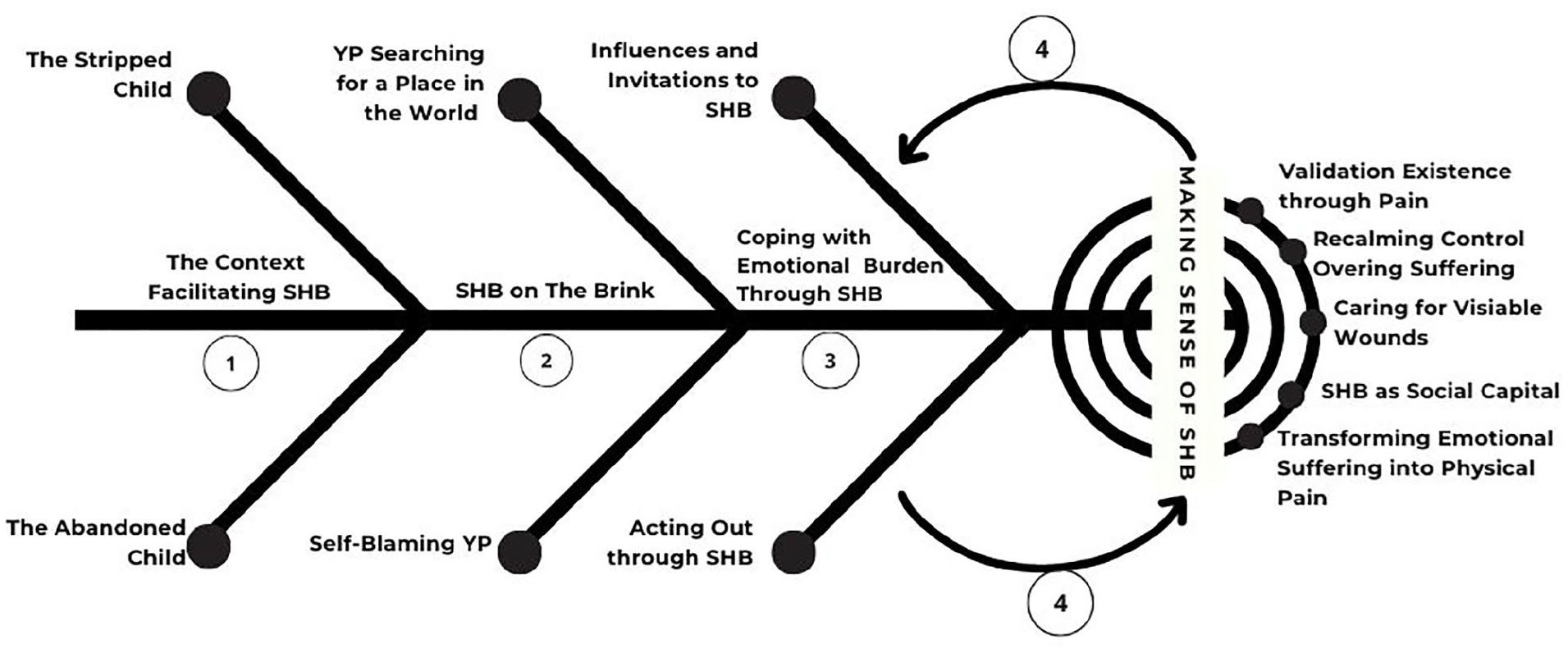
The proposed model for understanding the SHB journeys of YP from disadvantaged neighborhoods in Turkey.
The Context Facilitating SHB
Participants strive to find meaning in their lives by balancing the influences of their past with the realities of the present. However, contexts characterized by social and relational risks deprive them of protective and supportive resources. This deprivation heightens their vulnerability to SHB, facilitates the emergence of such behavior, and contributes to its perpetuation.
The Stripped Child
Social risks, such as poverty and hazardous environments, adversely impact participants’ childhood and present, stripping them of protective resources. This situation renders participants’ bio psychosocially vulnerable, hindering their ability to experience a typical childhood and forcing them to assume excessive responsibilities at an early age. Child labor, harsh working conditions, and begging were frequently emphasized as consequences of poverty. For instance, P14(22) stated, “My mother raised us begging. We suffered a lot of poverty. I was studying and working at the same time, doing jobs heavier than myself.”
Additionally, participants reported that their living areas were dangerous due to issues such as theft, drug use, and assaults. P12(15) summarized this situation by saying, “Give everything and save yourself.” P18(21) and P10(16) shared concerns about the dangers posed by acquaintances who use drugs. P14 (22) described his neighborhood, saying, “We were born and raised in the centre of Çinçin, amidst every filth.”
The Abandoned Child
Participants who are vulnerable due to social risks often face relational risks that leave them feeling abandoned. Their inability to connect with parents and relatives creates a profound sense of abandonment. Participants frequently mentioned experiences of neglect, emotional and physical abuse, unreachable fathers, domestic violence, and negative relationships with relatives.
Emphasizing that their relational needs remain unmet, participants seek validation of their emotional experiences, safety, consistency, reliability, gratitude, and unconditional love. For example, P5(20) expressed, “No matter what happened, no one gave me the feeling that we are with you.” P20(19) stated, “My reactions were ignored” while P16(16) noted, “I want my family to be happy with me for a minute.”
Participants also shared their experiences of emotional and physical abuse. P20(19) described her parents’ violence by saying, “My father is not a normal father.” P5(20) highlighted her father’s emotional abuse, stating, “He calls me a slut, inglorious, and immoral every day.”
Participants frequently expressed their negative relationships with their fathers, describing them as “oppressive” and “disconnected.” In these descriptions, fathers were characterized as “unreachable” figures. The term “oppressive father” refers to those who are constantly angry, impose strict rules, humiliate their children, and fail to share their emotions. For example, P6(16) stated, “My father was constantly oppressive. All the problems were with my father.” In contrast, the “disconnected father” is indifferent; P18(21) highlighted the disconnection in her relationship by saying, “My father does not recognize me.”
Participants also reported witnessing domestic violence. P9(17) stated, “My father used to beat my mother,” while P20(19) described a more traumatic experience: “My father used to hit my mum. Our house was on the stove, and sometimes he would heat iron bar in the stove and step on my mother. My mum’s eyes were always bruise. I was afraid that I would lose her if this violence continued (crying).”
Additionally, the lack of relatives in their social support networks and conflicts between relatives and parents further harmed the participants. P14(22) expressed her relatives’ indifference after her father was imprisoned, saying, “They did not open my door; they did not ask about my needs.” P2(17) emphasized the negative impact of his uncle on the family, stating, “If it weren’t for my uncle, everyone would be happy . . . He stabbed my father once.”
SHB on The Brink
Vulnerable and lonely participants question their position and self-perception as they assess social and relational risks at the brink of SHB. YP who feel abandoned during the facilitation of SHB tend to abandon themselves as well. During this process, they report experiencing issues related to trust, belonging, inner anger, and feelings of worthlessness.
YP Searching for a Place in the World
Participants struggled to establish a sense of belonging due to their inability to build trusting relationships with their families. They expressed feeling more at peace in their social environments than at home. P6(16) articulated the problem of trust, stating, “I do not trust anyone. As long as you stay hidden, you are strong. That’s why I don’t reveal anything to my family, friends, etc.” P5(20) emphasized his lack of belonging by saying, “I come home as late as possible and leave the house as soon as I can. The streets are mine, and I am happy there.” P1(16) remarked, “My father behaves as if I am not his child” while P16(16) told his mother, “I can no longer accept you as a mother; a mother does not treat her child like that.”
Self-Blaming YP
Participants who faced various risks in their social environments while navigating SHB perceived themselves as responsible for their negative experiences. They shared emotional experiences shaped by feelings of worthlessness and inadequacy. For instance, P20(19) expressed that “I feel like an insignificant and unloved person,” while P5(20) emphasized that “I do not see myself as a normal person.” P3(15) similarly stated that “I struggle to accept myself.” P19(22) articulated, “I feel like a wimp, helpless, or unlovable; I feel like I am a person who is not very important.”
Participants experienced a decline in their sense of self-worth due to feeling unloved and misunderstood, often blaming themselves for negative experiences. P5(20) shared that his father fought with his mother because of him, while P9(17) felt guilty for not being able to stop his father from using violence against his mother. P20(19) felt guilty about his parents’ fights, while P16(16) reflected, “Maybe there is something wrong with me; I always talk to myself like this,” indicating self-blame.
Coping With Emotional Burden Through SHB
Participants who are traumatized by social and relational risks and blame themselves struggle to bear their emotional burdens. Participants unable to find a healthy emotional outlet have turned to SHB.
Influences and Invitations to SHB
Participants explore the invitation to SHB before engaging in it. Those unable to cope with emotional burdens tend to try these behaviors that they see in their environment, and social media with their groups of friends reinforces this tendency. For example, P6(16) and P8(14) stated that they tried SHB after seeing it from their friends, while P2(17) expressed that She tried it after being influenced by what his friends told him. P1(16) stated that he learned SHB from his environment by saying, “People around me were cutting themselves to ease their pain, I saw them and I tried it myself.” P15(17) expressed the effect of social media on SHB by saying, “When I put on a song and watch the guy cutting his hand, I get swept into it and I’m doing it with the song.”
Acting Out Through SHB
Participants express SHB in response to social pressures, family problems, and emotional stress. In their narratives, they mention using cutting tools such as razors, utility knives, broken glass, or pencil sharpeners. For example, P16 (16) shared, “I started 2 years ago. My family was very hard on me. One day, my father swore at me in front of my friends, and that’s when I cut my arm the razor.” Similarly, P14 (22) said, “I had an argument with my family, got very angry, and hit the window with my hand.” P7 (14) mentioned engaging in SHB at school with a pencil sharpener during a period when his relationship with his mother was bad.
Making Sense of SHB
Participants attribute different meanings to SHB, viewing it as a response to pain, stress, or unresolved issues. These meanings serve various social, relational, or personal functions for the participants.
Validation Existence Through Pain
Some participants interpreted SHB as a way to affirm their existence, alleviating feelings of emptiness, unreality, and numbness. P5(20) expressed, “It bleeds at that moment. You forget troubles and feel alive.” P3(15) referred to it as “a reaction to life.” P16(16) noted that even painful memories help her feel alive: “Sometimes, I put salt on the wound to make it hurt more and I say it like this: let this pain and memory stay in my mind. I mean, let me never forget it.”
Transforming Emotional Suffering into Physical Pain
Some participants interpreted SHB as a way to convert emotional suffering into physical pain. Contrary to expectations, most reported not feeling physical pain or being disturbed by it. Statements like “I don’t feel pain; I relieve my pain” highlight a conceptual distinction. “Emotional suffering” was described as abstract, uncontrollable, and enveloping, while “physical pain” was seen as visible, controllable, and localized. Thus, participants viewed physical pain as a paradoxical way to combat emotional suffering. P5(20) noted that cutting hurt but was tolerable because she would heal, unlike her unpredictable emotional issues. P6(16) emphasized the cut’s pain was insignificant compared to emotional pain. P20 felt no pain during SHB, only relief. P18(21) expressed that “If I get furious, I think of hurting myself if I get really, how can I put it, hurt.”
Caring for Visible Wounds
Some participants interpreted SHB as a sense of self-care. Participants who are unable to make contact with themselves in an environment shaped by contextual and relation risks find the opportunity to care for their wounds and the emotional suffering that they embody with wounds through SHB. P7(14) said “I carefully clean and bandage my wound after SHB.” Similarly, P16(16) said “I calmly cleaned the blood flowing after each cut.”
Reclaiming Control Overing Suffering
Participants interpreted SHB as a means to regulate intense emotions. P16(16) noted that SHB helped her relax by alleviating uncomfortable thoughts, with its duration varying based on her emotional intensity: “I mean, I do such things for a week, and then I feel comfortable as if I talked to someone and told my problems.” P2(17) described cutting as a way to feel that problems would pass: “It’s as if those problems will pass more if you do it more.” P9(17) hoped that SHB would relieve his anger: “I mean, I feel like my behaviour will take away that anger.” P18(21) admitted to engaging in SHB when she couldn’t calm down: “If I can get angry, I punch somewhere. I hurt myself a lot.” P4(18) expressed using SHB to avoid hurting others: “I take it out on myself instead of breaking someone else’s heart.”
SHB as Social Capital
Some participants interpreted SHB as a way to influence others and gain status among peers. P5(20) shared, “. . . my other friends immediately said it hurts too much; I wish I had not done it. At that moment, I realized that I was stronger than usual.” P6(16) mentioned gaining status at school through SHB: “We were traveling around like the lord of the city.” She explained her deeper cuts as a means to assert superiority: “I was trying to say I was strong; I thought that no one could interfere with me.” P19(22) engaged in SHB to prove her point to her mother, hoping she would regret her actions. Similarly, P1(16) exhibited SHB to make his father feel remorse: “I say that he will apologize, he will realize his mistake, he will regret it. I go back inside, and it is the same man again.”
Discussion
This study’s unique methodology allowed for the integration of both internal and external experiences, as expressed by the participants. The findings highlight the significance of the meanings that YP attribute to SHB in its onset and persistence, as well as the impact of social and relational contexts on these meanings. Given the recurring patterns of SHB among YP (Baetens et al., 2011; Çamuroğlu, 2014; Morey et al., 2008), it is crucial to recognize the role of social and relational context risks in making youth vulnerable, fostering a sense of abandonment, and sustaining SHB. These contexts also shape the meaning that YP assign to the behavior. Developing functional and inclusive interventions will require a deep understanding of the meanings YP attribute to SHB, as these are shaped by their social environment. Defining the process and addressing their needs is essential. Without this understanding, services offered to these YP may result in negative attitudes and ineffective support (Bresin et al., 2013).
Therefore, establishing more secure, empathic, and consistent bonds with the family, education, and socialization environments of YP will protect them against social risks and enable the development of their subjective meanings (Gysbers et al., 2000; Rogers, 1951). Hence, the current study’s relationship between context and meaning given to SHB for YP who engage in SHB is grounded in three dimensions.
The study highlights how the social environments of YP contribute to their vulnerability to SHB. Many participants reside in disadvantaged areas characterized by poverty, neglect, and abuse. This context creates a cycle of negative outcomes, such as child labor, emotional difficulties, and ongoing poverty, which are further intensified by parental attitudes and peer dynamics. Research has long emphasized the significant impact of poverty on lifelong development (Bolger et al., 1995; Duncan & Brooks-Gunn, 2000; Kağıtçıbaşı, 2017; Yeung et al., 2002). Additionally, adverse social environments, such as poverty and unsafe conditions, increase relational risks, leading to psychosocial challenges for both YP and their families. Relational factors contributing to SHB risk include childhood abuse, neglect, trauma, and specific family characteristics. SHB rates are particularly high among those who have experienced abuse, with sexual abuse being closely linked to depression, self-harm ideation, and suicidal behavior (Kara et al., 2004; Maloney et al., 2010; Yargıç et al., 2012; Yates et al., 2008).
Individuals who suffered childhood abuse may seek control over their trauma by engaging in SHB (Van der Kolk et al., 1991). It appears that the psychosocial needs of participants, such as acceptance, safety, consistency, self-acceptance, and love, remain unmet, leaving them feeling stripped and abandoned. In this context, SHB may act as a situational response to these unmet needs, serving as a substitute for the secure parental bond typically required during the developmental phase of independence (Suyemoto, 1998). Additionally the participants’ relationship with their fathers, characterized by an “unreachable father,” also points to this situation. Numerous studies have unequivocally established that the quality of YP’s relationships with their fathers acts as a protective factor against behavioral problems, psychological issues, criminal activities, substance use, and risky behaviors (Ellis et al., 2012; Yogman & Garfield, 2016). Furthermore, when domestic violence is introduced into this context, it may become inevitable that developmental tasks could be interapted, and behavioral problems may manifest in these YP (Kara et al., 2004; Parkinson et al., 2001).
The second point concerns the determining power of YP’s social and relational contexts on their coping strategies in SHB. YP who encounter various risk factors in relational and social contexts may resort to such behaviors as coping strategies. Indeed, studies suggest this behavior is a coping strategy due to the relief after SHB (Haines & Williams, 1997). As expressed in the study, YP may resort to SHB as a coping strategy in challenging social and relational contexts, with functions that essentially protect and soothe themselves.
Participants’ relational and social contexts influence the meaning attributed to SHB. These meanings include “validation existence through pain,” “transforming emotional suffering into physical pain,” “caring for visible wounds,” “reclaiming control overing suffering,” and “SHB as Social Capital.” These categories of meaning are consistent with the functions emphasized in existing research. For example, Shearer (1994) identified functions such as emotional release, self-punishment, suicide prevention, control, feeling alive, and alleviating emptiness. Polk and Liss (2009) listed functions including reducing dissociation, self-control, self-punishment, suicide prevention, protecting others, and distraction. Another study highlighted relaxation and self-punishment as functions of SHB (Wadman et al., 2017).
Bryant et al. (2020) categorized the functions of SHB as managing mental processes, expressing distress, diverting attention from suicidal thoughts, and eliciting positive emotions. Existing literature emphasizes SHB’s personal functions, like avoiding negative emotions and self-punishment, rather than interpersonal functions, such as influencing others (Yates et al., 2008). Klonsky (2011) highlights emotion alleviation as the primary function of SHB, while establishing interpersonal connections is as common as coping with distress (Edmondson et al., 2016). The lack of consensus on SHB function underscores the importance of considering contextual factors, as the quality and frequency of functions vary depending on the studied group. Without contextual assessment, understanding the causes, methods, and frequency of SHB functions remains challenging.
At this point, it would be helpful to go into great depth about the SHB meanings that the study supports. The validation existence through pain serves as the primary purpose. It is possible that some YP with SHB are testing the boundaries of their existential beliefs by engaging in such behaviors and that they view their wounds as proof of life, given that they have a relationship with blood and feel alive. This notion allows for interpreting SHB as an effort to cling to life shaped by challenging contexts rather than an act performed with the desire to die.
Another meaning is the transforming emotional suffering into physical pain. Some YP reported feeling no physical pain during SHB (Bohus et al., 2000), while others found physical pain insignificant compared to their emotional anguish. This suggests that they perceive the physical pain from self-harm as a means to combat emotional suffering stemming from their circumstances. This supports the idea that physical pain is used to alleviate emotional pain (Polk & Liss, 2009; Suyemoto, 1998) and serves a paradoxical self-protection function (Herman, 2017). By creating a controlled wound, individuals aim to mitigate pain in other areas, manifesting emotional suffering visibly and facilitating a sense of control, as suggested by Favazza and Rosenthal (1993) concept of the “skin/self-boundary.” This aligns with Van der Kolk et al.’s (1991) idea that individuals protect themselves from harm through SHB.
Another meaning is the caring for visible wounds. YP who cannot get in touch with themselves due to the adverse effects of the context can engage in SHB as a form of self-care. They can find the opportunity to tend to their wounds and the emotional suffering they materialize through these wounds. This can be interpreted as YP creating a wound on their body and diverting all their attention to healing the wound instead of addressing the emotional distress they cannot cope with (Klonsky, 2007). Alternatively, it can be seen as an attempt to compensate for impaired self-care in victims of childhood abuse (Herman, 2017).
Another function attributed to SHB is its use as a form of social capital, where participants manipulate and influence others through SHB a concept recognized in literature for decades (Klonsky, 2007). Some YP engage in SHB as a way to assert their perceived righteousness, aiming to be noticed and taken seriously (Allen, 1995), reflecting a need for recognition and validation from their loved ones. Additionally, SHB can be used as a means to gain or maintain social status among peers, with the depth and frequency of self-harm serving to reinforce their standing, as noted by Simpson (as cited in Suyemoto, 1998).
The reclaiming control overing suffering is another key function of SHB, highlighted as a powerful motivator for its occurrence (Claes et al., 2010; Muehlenkamp et al., 2012). For many, SHB serves as a means of regulating intense emotions in the absence of emotional support and effective self-soothing strategies, with approximately 90% of individuals engaging in SHB for this purpose (Klonsky, 2007). Some individuals continue engaging in SHB until a sense of calmness and relaxation is achieved, indicating a paradoxical self-soothing and protective function.
Conclusion
This grounded theory study, centered on gaining a deep understanding, identified four interconnected stages in the SHB processes among Turkish YP. Through this approach, the data generated under specific conditions were synthesized, offering insights into SHB-related experiences. To fully grasp these processes, it is crucial to examine both the social and relational contexts in conjunction with the functions of SHB, while also drawing from the accumulated life experiences of YP. This proposed model emphasizes that the experience of SHB is an ongoing, interactive process that is continuously reconstructed.
YP turn to SHB as a coping mechanism to find solace and protection from relational and social risks. Despite its short-term relief, relying on SHB as a coping strategy leads to a paradoxical struggle in the long term. This reliance on SHB brings two critical outcomes: First, YP experience shame and regret, often concealing their wounds. Despite foreseeing the harm, they feel helpless to stop due to ingrained coping mechanisms. Second, they underestimate the seriousness of SHB, believing they can manage without help. Professionals working with these individuals must address underlying relational and social triggers while promoting alternative coping skills, effective communication, stress management, and robust social support networks. Interdisciplinary community-based prevention programs should be tailored to address individual contexts and meanings attached to SHB, ensuring routine access to services and informing policy decisions.
Limitations and Future Research
The sensitive nature of SHB, coupled with the stigma surrounding it, made it challenging to recruit YP for this study. However, this difficulty was mitigated by the selection of accessible venues (such as sports centers and cafes) and the involvement of key facilitators. It is recommended that researchers working with similar groups engage key individuals who can help establish trust with YP. Additionally, since this study focused on the social and relational risks of SHB, the developmental risks associated with YP were not addressed. Future research should address these developmental risks and evaluate the process of SHB using longitudinal research designs.
Footnotes
Author Note
This research was carried out under the second author’s supervision using the first author’s MSc dissertation.
Data Availability Statement
Data sharing not applicable to this article as no datasets were generated or analyzed during the current study.
Declaration of Conflicting Interests
The author(s) declared no potential conflicts of interest with respect to the research, authorship, and/or publication of this article.
Funding
The author(s) received no financial support for the research, authorship, and/or publication of this article.
