




Abstract
This study examines how Black and Latinx youth organizers navigate intersectionality and positionality as they campaigned for community and educational justice. Studies have shown the value of youth organizing for Black and Latinx populations but there is limited knowledge of how members navigate their differences to deepen solidarity efforts. The research questions are (1) how do youth organizers negotiate their positionality in terms of privileges and vulnerabilities? and (2) how do youth organizers show up for each other when addressing issues that do not affect everyone the same? We draw on a longitudinal, mixed-methods study that follows multiple cohorts of youth organizers, which revealed that young people in youth organizing spaces had a sophisticated understanding of their own identities and positionality in relation to their campaigns and other youth who did not share the same identity.
Keywords
From the Greensboro lunch counter sit-ins and East LA walkouts of the 1960s to the recent nationwide Black Lives Matter (BLM) protests against police brutality and Immigrations and Customs Enforcement, Black and Latinx youth have played a key role in leading the charge for social transformation. Throughout Trump’s presidency and the increased visibility of shootings of unarmed Black people, youth campaigned to fight injustice. During the pandemic summer of 2020, social tensions boiled over as the video of George Floyd’s murder by a white police officer, sparked outrage and protests across the country. The senseless murders of unarmed Black people reminded youth not only of widely known cases but the police brutality witnessed in their own communities and even in their schools.
While recent events forced some adults to contend with racial injustice, youth organizers across the country deeply engaged in understanding the context of these issues and pushed for change. Despite (or in spite of) deficit notions of Black and Latinx youth (Howard, 2013; Singh, 2020), Black and Latinx student organizers regularly and intelligently unpack the implications of structural inequities as they proactively address the consistent criminalization of the people in their communities. Youth organizing (YO) groups have challenged zero-tolerance discipline policies, shifted funding from school policing to counseling and mental health supports, and held systems accountable for racially biased school policing (Washington, 2022).
Our purpose is to debunk the ideology that Black and Latinx organizers are a homogenous group. In the literature surrounding YO, Black and Latinx youth are often paired together (Ginwright & Cammarota, 2007; Kirshner & Ginwright, 2012). Research shows that among YO groups, being in community, exchanging, and making meaning of shared experiences with inequity and learning about local policies can help young people develop and heal from societal trauma they experience (Ginwright, 2015). Yet, interracial and intraracial differences present between and among the groups are largely unaddressed.
We seek to understand how Black and Latinx youth navigate their identities and positionalities to maintain solidarity with each other. What has helped them invest in each other’s causes despite differences such as gender, sexuality, income, documentation status, ability, etc.? This paper examines intersectionality and positionality of YO groups as they campaign around community and educational justice as there is limited knowledge of how, in Black, Indigenous, People of Color (BIPOC) spaces, people without white privilege but who have other privileges (able-bodied, man, cishetero, etc.) show up for one another. Our research questions are (1) how do youth organizers negotiate their positionality in terms of privileges and vulnerabilities? and (2) how do youth organizers show up for each other when addressing issues that do not affect everyone the same?
Literature Review
Youth Organizing
We use the term youth organizer (YO) to describe a person, typically high school aged, paid or unpaid, in a leadership position or a general member, who works to address relevant social issues. Extensive literature documents youth organizing and its positive benefits for youth development (Ginwright & Cammarota, 2007; Ginwright & James, 2002; Kirshner & Ginwright, 2012). Youth organizing helps young people develop critical consciousness, which stems from Freire’s (1970) concept of conscientizaçao that “refers to learning to perceive social, political, and economic contradictions, and to take action against the oppressive elements of reality.” Therefore, one gains awareness to deconstruct power relations around them and transform their realities. YO fosters leadership skills that facilitate positive community change (Ginwright & Cammarota, 2007).
Ginwright and Cammarota (2002) first introduced the Social Justice Youth Development (SJYD) model to provide a lens to view youth as agents of change. SJYD “acknowledges social contexts and highlights the capacity for youth to respond to community problems and heal from the psycho/social wounds of hostile urban environments.” (p. 87). The model describes stages in which young people analyze power in social relationships, make identity central, promote systemic social change, encourage collective action, and embrace youth culture. Further, SJYD exemplifies how youth activism is healing since it develops self awareness through an analysis of power, privilege, and oppression.
Ginwright and Cammarota (2007) explore the critical civic praxis and development of critical consciousness of youth organizers in Oakland from two separate groups, one that is predominantly Black and the other that is predominantly Latinx. They found that young people came up with their own solutions, built community through dialogic exchange and mobilized over a common cause. Yet, conclusions are drawn without differentiating the Black and Latinx youth organizers. Further, YO literature (Kirshner, 2009; Rogers et al., 2007) explored YO as context for exploring civic identity and educational justice. Yet, racial identity of participants and other identifying factors are absent from the study. Activism among Black and Latinx youth, was lumped together as a homogeneous group of “urban youth,” a term often used in the field to avoid delineating race and racism, which whether inadvertently or deliberately, erases the identities of youth and instead centers whiteness (Paris, 2019).
Intersectionality and Positionality
Since YO literature does not often explore differences, we find it necessary to address the terms positionality and intersectionality. We take up positionality from Black Feminist Standpoint Theory, where the perspective of Black women interrupts the white male gaze that dominated the master narrative of a single reality. Awareness of one’s positionality, which is the “multiple, unique experiences that situate each of us” (Takacs, 2003) becomes a critical lens that is generative of multiple realities. Further, “reflection on positionality promotes better understandings of power dynamics in myriad contexts” (Hausermann & Adomako, 2022).
Intersectionality was coined by legal scholar Kimberlé Crenshaw who began conceptualizing the term with a focus on race and gender. Crenshaw (1991) noted that identity politics “frequently conflates or ignores intragroup differences” (p. 1242). Crenshaw’s (1991) scholarship explicates how race and class shape violence against women, and that sometimes “ignoring difference within groups contributes to tension among groups, another problem of identity politics that bears on efforts to politicize violence against women” (p. 1242). Women of color are marginalized within both conversations of racism and feminism and therefore intersectionality was necessary. Before the term was coined in the early 1990s, Black Feminists such as the Combahee River Collective outlined in their 1977 statement that, “we are actively committed to struggling against racial, sexual, heterosexual, and class oppression [. . .] based upon the fact that the major systems of oppression are interlocking” (Taylor, 2017, p. 15). Further, LatCrit theory looks beyond the Black-White binary to acknowledge the intersectionality for Latinx communities by considering language, immigration, ethnicity, culture, identity, and sexuality (Solórzano & Bernal, 2001). In Terriquez et al. (2018) study, intersectionality was viewed as a “master frame” highlighting queer college aged students advocating for undocumented students within the Latinx community. Other scholarship emphasized the significance of an intersectional lens from the field of health pedagogy and sports to suicidality prevention (Dagkas, 2016; Standley & Foster-Fishman, 2021). Given the seriousness of not erasing the intersectional identities of youth, we set out to learn from youth organizers about how they grappled with differences within and between racial groups. Under the framework of intersectionality, we explore what worked among youth organizers in order to foster strong communities that advanced equity for everyone.
Toward Thick Solidarity
As we explore intersectionality and positionality within Black and Latinx youth organizing groups, we are drawn to the concept of thick solidarity. Liu and Shange (2018) theorized empathy in social justice with the understanding that, “Thick solidarity is based on a radical belief in the inherent value of each other’s lives despite never being able to fully understand or fully share in the experience of those lives” (p. 190). The fundamental difference between understandings of “solidarity” and “thick solidarity” as explained by Liu and Shange (2018), is that they think of a solidarity “that mobilizes empathy in ways that do not gloss over difference, but rather pushes into the specificity, irreducibility, and incommensurability of racialized experiences” (emphasis ours, p. 190). To help shape this concept, Liu and Shange (2018) focused on Black and Asian relationships in social justice movements. The authors emphasized historical differences instead of making anti-Asian sentiments and anti-Blackness the same. This was demonstrated through Asian Americans writing letters for Black lives to show support for the BLM movement, which helped them combat their own feelings of anti-Blackness that were ingrained in them through childhood and media. Thick solidarity is further illustrated in Abad’s (2021) study on Asian American youth organizers. The organizers chose to align their fight with the Black community who were vulnerable from state sanctioned violence and recognized the importance of countering anti-Black rhetoric in the midst of anti-Asian attacks.
Additionally, Terriquez and Milkman (2021) discussed non identifying Black immigrant and refugee youth organizing in solidarity with the movement for Black lives. Although participants began organizing at young ages, in the context of the murders of Breonna Taylor and George Floyd a youth relayed, “The Southeast Asian community is still struggling to survive every day in this country. For us to lead full lives, we all must actively dismantle patriarchy and white supremacy” (Terriquez & Milkman, 2021, p. 581). Youth acknowledged the pain of their own communities while fostering alliances across a wide spectrum of identities. Such intersectional frameworks helped young organizers highlight gender, class, and other inequalities while fighting for racial justice and immigrant rights, allowing them to lean into thick solidarity with communities other than their own.
Studies acknowledge the powerful benefits of YO for young people and their larger communities. What we seek to understand is how they come to understand intersectionality, privilege, and solidarity. What is happening in these youth organizing spaces that allows rooms for everyone’s identity while working together for the collective? How do racial groups who are perceived as racially monolithic grapple with their differences (i.e., immigration status, religion, gender, sexuality, and ability)? We interrogate how young people conceptualize their individuality in relation to their collectiveness toward greater social change.
Methods
Author Positionality
Given the nature of this paper we present our own positionality that has likely influenced our study. Hui-Ling is an Assistant Professor at a public university in California exploring education, race and equity. She identifies as a biracial Black and Asian woman who grew up in organizing spaces, where she navigated multiracial spaces, beginning with her own family, that shed light on anti-Blackness and intersectionality. Sara and Wendy are senior research associates at NYU Metro Center. Sara is white identified and has been involved in educational and racial equity work for two decades. Wendy is the bilingual daughter of Ecuadorian immigrants and her multiple identities and experiences as a Latina scholar inform her intersectional lens in education issues.
Data Collection and Analysis
This paper draws on a longitudinal, mixed-methods study that sought to understand how participation in YO groups supports historically marginalized youth in developing socio-emotional skills and critical consciousness, and whether those skills inform their school and postsecondary engagement. We conducted the study in close partnership with six established YO groups leading campaigns related to youth justice. Our partner YO groups are described in Table 1. All groups organize primarily BIPOC youth, with significant representation of undocumented youth and LGBTQIA+ youth, in large cities and mobilize around education and other systems directly impacting adolescents.
Youth Organizing Groups.
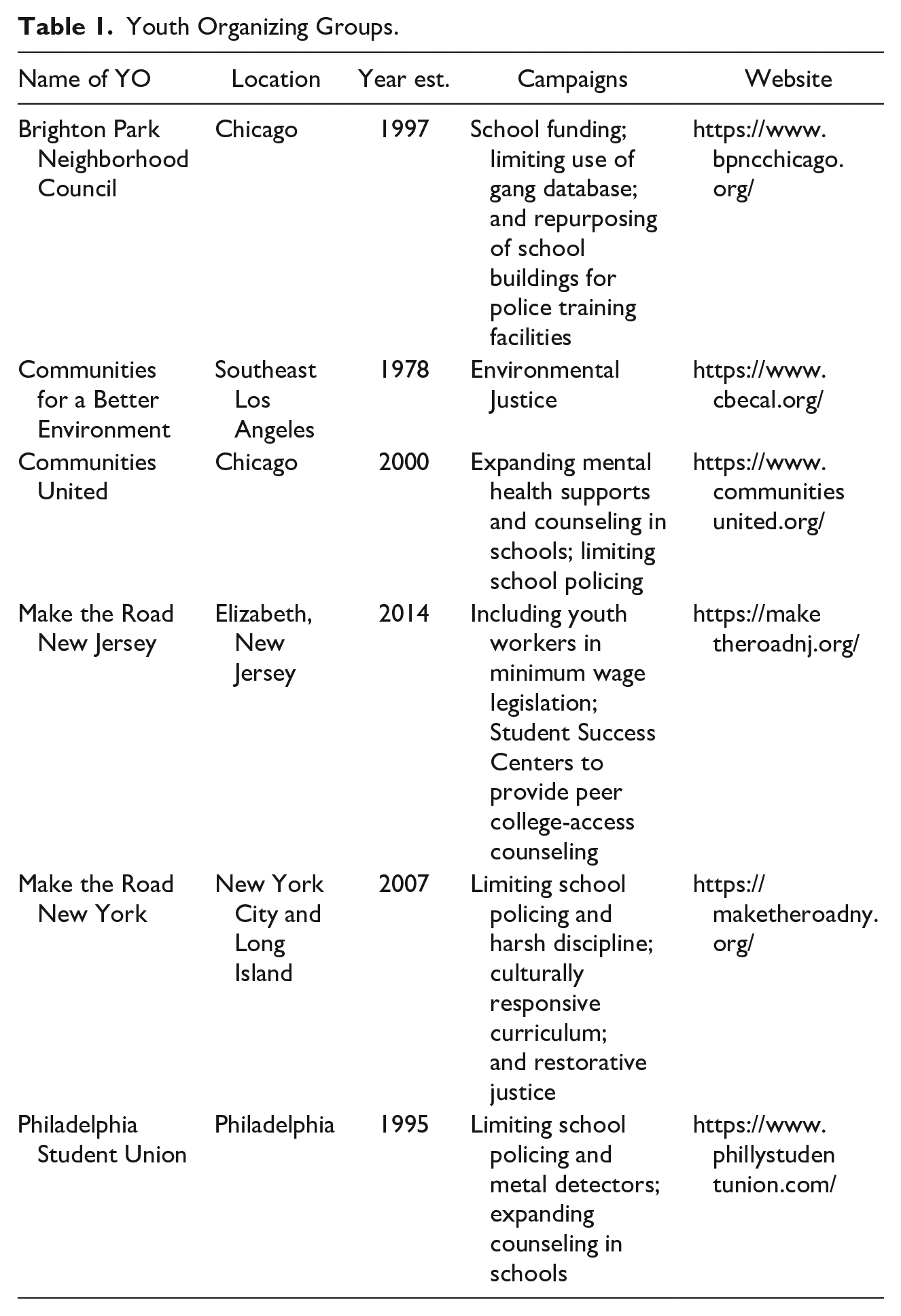
During the course of the study, our partner organizations engaged in campaigns to minimize police presence in schools, change discipline practices, increase funding for counselors and mental health supports, expand college access supports, include teen workers in minimum wage increases, and block the expansion of a freeway in their predominantly BIPOC community struggling with air pollution. With the exception of the Philadelphia Student Union (PSU), which is predominantly Black, our partner organizations have a majority or plurality of Latinx members, but all are intentionally multi-racial and include Asian, mixed race, and White youth. Participants in the larger study were 49% Latinx, 18% Black, 9% Asian/Pacific Islander, 5% multi-racial, and 5% White, with 14% not specifying a race or ethnicity. The median age upon joining our study was 17.
Between 2018 and 2021, we conducted individual and group interviews with participants at each site, interviewing new and experienced members and conducted follow-up interviews with the same young people over time, where possible. (Due to the pandemic, we were unable to conduct as many follow-up interviews as planned. A total of 51 youth participated in one interview; 26 in two interviews, and 4 in three interviews. We had more success in collecting longitudinal survey data, which is not reflected in this article.) One aim of the interviews was to understand young people’s critical analysis of their campaigns, such as its root causes and the development of their analysis. Between 2018 and early 2020, we observed organizing meetings, political education workshops, and summer training sessions at each organization. We observed public actions led by two organizations. When the Covid pandemic began, we suspended our observations.
We used the comparative case study approach to analyze the YO groups spatially and relationally. Comparative case studies are attentive to cultural nuances, take a critical theoretical stance by incorporating the perspectives of social actors, and consider the “historical and contemporary processes that have produced a sense of shared place, purpose or identity” (Bartlett & Vavrus, 2016, p. 39). We analyzed more than 60 interview and focus group transcripts and 25 observations to elucidate how BIPOC youth across organizational contexts negotiate positionality, allyship, and solidarity. Through an iterative process of coding and recoding we reached conclusions grounded in our data and existing theory from the literature.
Findings
We found that youth organizers engaged in advocacy and activism that brought an increased awareness of their own positionality and privilege while aligning themselves in solidarity with peers that did not share their same identities. In this section we discuss how youth navigated intersections of race, gender, educational access, income, and documentation status as they advocated for justice for the most vulnerable groups. As YO campaigned to address social issues and participated in ongoing political education within their organizations, the young members revealed a sophisticated understanding of their own identities and positionality in relation to their campaigns and other youth in and outside the group who did not share the same identity.
We organize our findings by first highlighting the political education that took place within the groups and, second, address two common campaigns that took place among the youth organizing groups: (1) Educational justice and (2) Advocacy for undocumented students.
Through the examples of political education and their campaigns, we explain what we learned about the young people’s sense of identity, positionality, and solidarity with their fellow peers while working toward social transformation.
Political Education
Youth developed an understanding of their identities and positionality through political education that established a culture of inclusive and safe spaces for multiple identities and found common ground across differences. One common theme we found across the groups is that members were a close group who trusted each other. Before engaging in difficult conversation on power and privilege, each organization intentionally fostered an inclusive environment that honored individual voices by facilitating meetings that encouraged everyone to speak. For example, a PSU member, Carlos described that in their meetings they sit in a circle, state their names, pronouns, and then participate in an icebreaker. As he described the start of a meeting he stated,
We’ll do a random question, like, ‘what’s your favorite song at the moment?’ just to get people talking. And then we just go over our topics [. . .] and we’re in the circle and we just look at the poster board and then we talk about it [. . .] Everyone’s heard and listened to, and then if there’s an issue we can figure out rules on how we want to take action.
There was a culture of warmth, comfort, and trust established before members dove into the hard work of analyzing their own positionality and relationships to each other. This allowed for deeper conversations and exploration of power, privilege, and oppression. In all organizations, political education was intentional. Typically they led summer trainings before the academic year began. The summer sessions laid the groundwork for fundamental understandings of power. Afterward, political education was ongoing and recurring as they researched for and rallied around campaigns.
Communities for a Better Environment (CBE) explored varying identities and intersectionality during their summer program. Similar to the other groups, adult organizers and youth organizers co-led these sessions. During one session, they explored the meaning of power. They posed the question, “Who has power? White people? Men?” They then examined the definition of privilege and oppression. During this period, participants acquired the language to articulate their experiences with racism, especially in terms of white supremacy. Once that understanding is established, conversations on power and privilege become more nuanced. For instance, CBE used a power chart to examine their identities in relation to power which included racism, sexism, classism, and immigration status. A youth facilitator spoke about where he is in the power group (his privileges) and where he is in the target group (his vulnerabilities). He talked about how his stepdad tells him to take charge, and while his sister is told to do the dishes, he does nothing. Recognizing the lopsided expectations between him and his sister from his stepdad, he offers to do the dishes to own responsibility. This highlighted an intersectional approach toward the group that strengthened their work together as allies working on various campaigns.
At Make the Road New York (MRNY), Tawheedah, a Black lead youth organizer, described their weekly political education workshops as a space where,
We share with them any and all information and research in regards to dismantling systems that have been a part of their oppression. We talk about things from gentrification to the abolishment of ICE. We’ve talked about certain political organizations who’ve paved the way in the past. We allow you to really soak up all that information because these are things they’re not talking about in school.
Tawheedah is clear that the organization offers an education that is not offered in mainstream schooling. During political education workshops, students dig deep into concepts of power and relation to self. At PSU, Nirvana recalled that learning about Claudette Colvin, a young Black woman who refused to give up her seat before Rosa Parks did, gave PSU members insight into anti-Blackness, sexism, colorism, and classism. Learning her story propelled them into not only learning more about positionality but helped fuel their organizing tactics. Overall, organizations created inclusive spaces that fostered political education to prepare youth organizers to cultivate their identities and voices.
Recognition of Anti-Blackness
Given that most YO groups were made up of a majority of Latinx youth, and that this article concerns Black and Latinx solidarity, it’s important to note the ongoing conversations around anti-Blackness toward Black and Latinx solidarity that occurred throughout the YO groups.
When asked about an example of an issue that affects a group outside your own, Vi, a Latinx YO from BPNC spoke extensively about police brutality. She recognized that although overpolicing is a problem in both Black and Latinx communities, it is more present in Black communities. She discussed that being exposed to different issues at BPNC caused her to reflect on her internalized anti-Blackness. She stated,
For example, with No Cop Academy [a campaign to block the transfer of a closed school building to use as a police training facility], I was an ally but I was also a leader. I would bring in the perspective of police brutality in Latinx communities, but not over-voicing the violence that is in Black communities caused by police and other oppressive systems.
BPNC helped Vi realize that her and her community’s relationship to police brutality was not the same as the Black community and was inspired to be an advocate on this issue. In Communities United (CU), we asked how members in this predominantly Latinx organization grasped the issue of police brutality. They relayed that it is typically Black members who share stories around personal connections to police brutality. Yet, the entire group made space to listen to Black youth about their negative encounters with police officers. A Black YO, Courtney, discussed that CU planned to make policing a larger conversation and that they planned to have members distribute and collect surveys around policing in their neighborhoods because “that’s what we always do.” This response dispelled the idea of homogeneity within Black and Latinx organizing spaces and instead acknowledged differences that fueled solidarity efforts.
Although not full fledged campaigns in all groups, YO directly addressed the issue of policing, recognizing the disproportionate impact on their Black peers. Rather than ignoring the issue because it did not personally resonate with the majority group, YO opened the space for Black voices to be heard and viewed this issue as important to better society for everyone.
Educational Justice Campaign
School equity was a top concern among YO regardless of whether they attended a relatively well-resourced or under-resourced school. Participants were located in large urban school districts with both across-the-board disinvestment and significant within-district disparities in school resources. Each district had several selective high schools that used academic screens to admit high-achieving students across the district. These magnet schools often have fewer economically disadvantaged Black and Latinx students and attract experienced teachers and extra resources. The YO groups we studied drew leaders from a mix of selective and non-selective neighborhood schools. As a collective, youth organizers viewed this issue as impacting everyone and demanded educational equity for all.
For example, PSU addressed a new policy to mandate metal detectors in high schools citywide. The policy would only immediately impact three small, relatively well-resourced magnet schools, as all other high schools already had metal detectors. YO members actively acknowledged their privileges and positionality as PSU campaigned for school equity. When Khalif, a Black high school senior who attended a selective high school, was asked, “Has being a part of PSU changed the way you think or feel about school?” he responded,
I’ve noticed the disparities that exist, that before, [. . .] I hadn’t thought about, or hadn’t thought about in a critical way. It’s really opened my eyes to the disparities and deficiencies that other students deal with and mitigate on their own as individuals without the resources they are supposed to be given and that they frankly deserve. I’m personally in a pretty privileged position, I have a school that has like three or four counselors, and most schools are struggling with one, maybe two if they’re fortunate. But just understanding that privilege and understanding how that disparity exists has been a result of my participation in PSU.
Although Khalif attended a well resourced school, his involvement with PSU dispelled myths of meritocracy as educational disparities were rampant in their city. With PSU, he and other YO spoke about their privilege despite being Black students. This does not dismiss the racism they may have experienced as young Black teenagers, but they could address conversations of equity with nuance and recognize opportunities afforded to them that were not afforded to all.
PSU leaders pushed back against metal detectors and school policing city-wide, and cited research on the ineffectiveness of metal detectors and policing. They testified at school board meetings against the policy and organized alongside citywide teacher and student groups. They marshaled data on the under-investment in school counselors, psychologists, and nurses across the district. PSU members from other selective schools, which had metal detectors but minimal police presence, were also active leaders in the campaign, advocating for more investments in non-punitive school safety interventions and a reduced reliance on policing across the district. In this way, youth organizers like Khalif recognized their privilege and yet demanded educational justice for their greater community.
In addition, YO leading Brighton Park Neighborhood Council’s (BPNC) educational justice campaign included students who attended schools with more resources, who acknowledged their privilege and yet maintained invested in the fight for school equity. Students we spoke to who attended relatively new schools, in contrast to traditional neighborhood schools in Black and Latinx neighborhoods that faced chronic disinvestment, had access to new materials and resources. Eliana, a Latinx organizer who attended a selective magnet school on the north side, stated that she was aware of her educational privilege and felt that it was necessary to take action toward educational equity. Eliana remarked,
It wasn’t until I started organizing with BPNC and I heard about everyone else’s experience with police in their schools and how they felt about having police in their schools, and it opened my mind. It was like, ‘Maybe I’m not going through it but I know everyone else in this group is going through it, because they go to a neighborhood school.’ [. . .] they’re always the ones being targeted whenever it comes to budget cuts, cutting resources, cutting staff, they’re always the ones being affected. I have to be an advocate for others. And I feel like BPNC helped me realize that I need to use my voice and my power to speak up for others.
Eliana’s interactions with fellow BPNC organizers opened her eyes to the educational landscape of Chicago and its glaring disproportionalities. Yet, despite that Eliana admitted that she did not share the same issues as others, she was committed to the campaign toward educational justice.
A BPNC group interview with Latina high school seniors, Bunny and Yellow, addressed school inequity and disparities with school funding. They attend college prep schools that are newer and smaller and have more investment than the larger neighborhood schools that were closing, but aren’t nearly as resourced as schools downtown and on Chicago’s North side, where magnet schools predominately serve white and wealthy students. In this interview, they addressed the issues of privilege and positionality similar to Eliana, despite that their schools are less resourced than Eliana’s.
Bunny explained school budget disparities and how those who are in privileged schools may not be aware of their advantage. She also explained the problematic nature of enrollment and TIF funding [capital investment through a controversial program sometimes blamed for accelerating gentrification]. This comment was followed up by Yellow stating,
It’s not just supporting people, but learning to recognize your privilege and use that to be a support system. So yes, these problems do impact everyone and it’s different; we all have different levels of privilege. And we all need to recognize that privilege to see where we stand with different topics and with each other and how we can help each other.
The commentary from Bunny, Yellow, and Eliana is remarkable given that they are coming from different schools that have different resources. Both groups acknowledged their advantages and disadvantages and yet were all invested in creating equitable outcomes. During school closures in Englewood, several youth organizers showed up to protest regardless if they attended the shuttered schools. When asked why, Bunny said that they were there “to be allies” and that “this is still in a community that we care about and these students don’t deserve to be pushed out of their schools.”
The YO of BPNC highlight their awareness of educational privilege, which increased their awareness of inequities. Due to their involvement in a political organization, understanding their positionality was necessary to how they showed up for the most vulnerable students. These examples from PSU and BPNC demonstrate young people’s understanding of their privilege and that this increased a desire to invest in educational justice campaigns to improve schooling for all.
Advocacy and Solidarity for Undocumented Students
Further, youth organizers demonstrated an understanding of their positionality intracially within the Latinx community among the issue of educational access for undocumented students. In some of the organizing groups, participants were undocumented. Within the groups, documented students actively supported undocumented students and also acknowledged the privilege of their documented status.
A Latinx youth staff member from Make the Road New Jersey (MRNJ), Nina, discussed how they approach discussions of privilege in their political education and the type of space needed to discuss these issues. She shared that documented students often addressed their privilege yet:
Acknowledging the privilege that you have and then being in the same space as somebody that doesn’t have that same privilege. And then it being like, but we are the same. We go to school together. We’re in the same grade. Then it’s like, that’s not fair and what am I going to do to support you? This might be relevant to my aunt or my uncle, and what am I going to do to help them?
As Nina noted, one of the reasons documented youth grasped an understanding of their positionality of issues dealing with undocumented students is that some of their own family members were immigrants. Naomi, a college sophomore alumni of MRNJ said,
Part of what also made me really interested in immigration is my mom being an immigrant, she’s from Colombia. I guess I care a lot about these issues because every time there’s something with ICE and about people being undocumented I’m like, ‘Oh my God, I couldn’t imagine if my mom didn’t gain her citizenship.’ I would’ve been so worried about her and what would have happened to her situation. And so I feel like it definitely just made me care a lot more about the issue.
Although her mom is documented, there is still a fear and a sentiment of racism for the larger Latinx community. Whether undocumented or not, in a politically polarized society, some Latina/os could feel their Americanness stripped away (Anzaldua, 1999).
MRNJ supported various campaigns, including a statewide campaign to make DACA recipients eligible for in-state tuition. In an interview with Jane and Amanda, a sophomore and senior in high school respectively, Jane recollected a discussion around access to driver’s licenses and testimonies of her peers around advocacy for undocumented youth. Amanda responded, “I think Make the Road also creates more empathy within people. Like, even if you’re not someone who’s undocumented, you can still understand and feel for someone who is in that position.” Toward the end of this dialogue the two decided that unification of all people was necessary due to “more power in numbers” that helped a greater cause.
Jane and Amanda articulated that MRNJ created empathy among the group, between the undocumented and the documented that sparked empathy and solidarity with the most vulnerable. Angelica, a Latina BPNC leader, reflected that conversations about immigration during YO meetings prompted her to think about how she could draw on the privileges of citizenship to support immigrant members of her community:
It’s gotten me to think about the ways that I can help my community, the ways that I actually can make a difference being a citizen. Even though I’m not an immigrant, I can still do something about it, even if it’s not affecting me directly. I could still hold some power to change some stuff. . . .For people that say, to talk to elected officials or to higher authority, probably immigrants don’t want to talk about it because they know they have consequences. But with citizens, they’re a little bit more comfortable; they don’t really have much to lose.
Angelica’s comment demonstrates that even within intraracial groups, there are privileges among group members and that youth organizers learn to reflect on their privilege that strengthens social action toward equity. This is just one example, as indicated in our interviews, that documented youth in YO groups felt more compelled to use their privilege to stand up for those who are more vulnerable.
Overall, in order to create a tight community, young people in the organizations were not oblivious to their own identities, positionality, and privileges when uniting for a cause. This nuanced understanding of their identity led toward a macro understanding of the world and a need to be in solidarity with their Black and Latinx peers from other walks of life. Many people perceive YO as one entity under the same socio-political circumstances. But upon a closer look, one might notice that Black and Latinx youth organizers can recognize their privileges stemming from educational privilege and documentation status. There is also nuance in recognizing anti-Blackness and that policing and criminalization affects the Black community in unique ways. This is not to say that these Black and Latinx youth who identify their privileges do not experience hardships—they all experience white supremacy, but instead of ignoring their differences that may inadvertently further the oppression of others, they decide to vouch for the side that experiences the least privilege for the collective uplift of their comrades. Our findings give us a look at how young people think about their positionality and privilege to maintain solidarity with their fellow organizers and larger community to attain greater social change.
Limitations
As with other studies of YO settings, our research does not account for selection bias. That is, youth who are recruited into YO groups may be more interested in social justice issues than their peers, and may bring some understanding of their positionality and an intersectional lens with them. At the same time, youth in our study were able to clearly articulate shifts in their thinking that they attributed to their involvement in organizing. While our article focuses on the role of intersectionality and positionality in building thick solidarity, it is important to acknowledge other factors that influence solidarity within organizing. Warren et al. (2021) discussed several factors that contribute to solidarity, including creating healing spaces that encourage empathy and understanding, and political education that examines root causes of oppression. These factors were consistently present in our participants, and likely contributed to the development of solidarity.
Because data collection occurred mostly through interviews and observations of internal organizing meetings and trainings, our descriptions of thick solidarity are largely limited to young people’s reports of shifts in their analyses and commitments to solidarity, and in some cases their own accounts of how they act in solidarity. We have less direct evidence of solidarity in action. Future research might follow young people engaged in organizing over longer time periods, to observe whether building an analysis of intersectionality and positionality through organizing prompts youth to seek sustained opportunities to enact thick solidarity as young adults.
Conclusion
“I feel a lot of times when we think about social justice issues, we think of them as separate instead of being different pillars of white supremacy being propped up by each other. So like colonialism, and anti-Black sentiment and anti-immigrant sentiment. It’s all connected. And if we just band together and work collectively, things can get done.”
Neon captures a sentiment of solidarity toward a more just society that holds coloniality and white supremacy accountable. They state that anti-Blackness and anti-immigrant sentiments are connected. What we found in our study is aligned with other literature on YO that demonstrated how youth activism heightened awareness about society, increased relationships with adults and each other, and was beneficial in improving mental health and academic success (Christens & Dolan, 2011; Martínez et al., 2017; Ortega-Williams et al., 2020). What is significant about Neon’s quote is that we found that youth not only demonstrated an acute awareness of an oppressive white power structure, but also how one navigated their own positionality and privilege. We found that the YO in our study from across the country held a sophisticated knowledge of the social complex realities that impacted their daily lives. They could articulate the different identity markers between themselves that reflected honestly on privilege and positionality, which helped to bring everyone closer together toward racial solidarity and justice. More than just a superficial desire for solidarity, they did the deep and hard work of self reflection to advocate for those who are most vulnerable.
A gap our study fills is narrowing in on Latinx and Black youth organizers in a way that does not position these groups as homogenous but picks apart privilege and identity within the groups. We noticed that there are intraracial differences, considering ethnicity, documentation status, educational access, and anti-Blackness that lives within these spaces. We found that organizing across and within racial groups was more than just uniting around a campaign. Before the external actions and throughout the campaign, each YO group provided a political education that critically examined social issues and the identities and positionalities of its members. Youth organizers oriented toward a “thick solidarity” by first understanding their own relationship to the issue, such as their privileges, in order to be in deeper solidarity with their campaigns and each other. This awareness of their positionality and identity led to a greater understanding about the issue and care for each other. It allowed students to step up and hold space for each other, and take action to resist oppression, defend one another, and work together toward collective healing and liberation.
Footnotes
Declaration of Conflicting Interests
The author declared no potential conflicts of interest with respect to the research, authorship, and/or publication of this article.
Funding
The author(s) disclosed receipt of the following financial support for the research, authorship, and/or publication of this article: The research study was funded by the William T. Grant Foundation.
